


Henry Fuseli

Encyclopedia

United Kingdom
The United Kingdom of Great Britain and Northern IrelandIn the United Kingdom and Dependencies, other languages have been officially recognised as legitimate autochthonous languages under the European Charter for Regional or Minority Languages...
painter
Painting
Painting is the practice of applying paint, pigment, color or other medium to a surface . The application of the medium is commonly applied to the base with a brush but other objects can be used. In art, the term painting describes both the act and the result of the action. However, painting is...
, draughtsman
Drawing
Drawing is a form of visual art that makes use of any number of drawing instruments to mark a two-dimensional medium. Common instruments include graphite pencils, pen and ink, inked brushes, wax color pencils, crayons, charcoal, chalk, pastels, markers, styluses, and various metals .An artist who...
, and writer on art, of Swiss origin.
Biography
Fuseli was born in ZürichZürich
Zurich is the largest city in Switzerland and the capital of the canton of Zurich. It is located in central Switzerland at the northwestern tip of Lake Zurich...
, Switzerland
Switzerland
Switzerland name of one of the Swiss cantons. ; ; ; or ), in its full name the Swiss Confederation , is a federal republic consisting of 26 cantons, with Bern as the seat of the federal authorities. The country is situated in Western Europe,Or Central Europe depending on the definition....
, the second of eighteen children. His father was Johann Caspar Füssli
Johann Caspar Füssli
Johann Caspar Füssli was a Swiss portrait painter.He was born in Zurich to Hans Rudolf Füssli, who was also a painter, and Elisabeth Schärer....
, a painter of portraits and landscapes, and author of Lives of the Helvetic
Helvetia
Helvetia is the female national personification of Switzerland, officially Confœderatio Helvetica, the "Helvetic Confederation".The allegory is typically pictured in a flowing gown, with a spear and a shield emblazoned with the Swiss flag, and commonly with braided hair, commonly with a wreath as...
Painters. He intended Henry for the church, and sent him to the Caroline college of Zurich, where he received an excellent classical education. One of his schoolmates there was Johann Kaspar Lavater
Johann Kaspar Lavater
Johann Kaspar Lavater was a Swiss poet and physiognomist.-Early life:Lavater was born at Zürich, and educated at the Gymnasium there, where J. J. Bodmer and J. J...
, with whom he became close friends.

Germany
Germany , officially the Federal Republic of Germany , is a federal parliamentary republic in Europe. The country consists of 16 states while the capital and largest city is Berlin. Germany covers an area of 357,021 km2 and has a largely temperate seasonal climate...
, and then, in 1765, visited England, where he supported himself for some time by miscellaneous writing. Eventually, he became acquainted with Sir Joshua Reynolds, to whom he showed his drawings. Following Sir Joshua's advice he devoted himself wholly to art. In 1770 he made an art
Art
Art is the product or process of deliberately arranging items in a way that influences and affects one or more of the senses, emotions, and intellect....
-pilgrimage
Pilgrimage
A pilgrimage is a journey or search of great moral or spiritual significance. Typically, it is a journey to a shrine or other location of importance to a person's beliefs and faith...
to Italy
Italy
Italy , officially the Italian Republic languages]] under the European Charter for Regional or Minority Languages. In each of these, Italy's official name is as follows:;;;;;;;;), is a unitary parliamentary republic in South-Central Europe. To the north it borders France, Switzerland, Austria and...
, where he remained till 1778, changing his name from Füssli to Fuseli, because it was more Italian-sounding.
Early in 1779 he returned to Britain, taking in Zürich on his way. He found a commission awaiting him from Alderman Boydell, who was then organizing his famous Shakespeare Gallery
Boydell Shakespeare Gallery
The Boydell Shakespeare Gallery in London, England, was the first stage of a three-part project initiated in November 1786 by engraver and publisher John Boydell in an effort to foster a school of British history painting...
. Fuseli painted a number of pieces for Boydell, and published an English edition of Lavater's work on physiognomy
Physiognomy
Physiognomy is the assessment of a person's character or personality from their outer appearance, especially the face...
. He likewise gave William Cowper
William Cowper
William Cowper was an English poet and hymnodist. One of the most popular poets of his time, Cowper changed the direction of 18th century nature poetry by writing of everyday life and scenes of the English countryside. In many ways, he was one of the forerunners of Romantic poetry...
some valuable assistance in preparing a translation of Homer
Homer
In the Western classical tradition Homer , is the author of the Iliad and the Odyssey, and is revered as the greatest ancient Greek epic poet. These epics lie at the beginning of the Western canon of literature, and have had an enormous influence on the history of literature.When he lived is...
. In 1788 Fuseli married Sophia Rawlins (originally one of his models), and he soon after became an associate of the Royal Academy
Royal Academy
The Royal Academy of Arts is an art institution based in Burlington House on Piccadilly, London. The Royal Academy of Arts has a unique position in being an independent, privately funded institution led by eminent artists and architects whose purpose is to promote the creation, enjoyment and...
. The early feminist Mary Wollstonecraft
Mary Wollstonecraft
Mary Wollstonecraft was an eighteenth-century British writer, philosopher, and advocate of women's rights. During her brief career, she wrote novels, treatises, a travel narrative, a history of the French Revolution, a conduct book, and a children's book...
, whose portrait he had painted, planned a trip with him to Paris, but after Sophia's intervention the Fuselis door was closed to her forever. Two years later he was promoted to Academician
Academician
The title Academician denotes a Full Member of an art, literary, or scientific academy.In many countries, it is an honorary title. There also exists a lower-rank title, variously translated Corresponding Member or Associate Member, .-Eastern Europe and China:"Academician" may also be a functional...
.
In 1799 Fuseli exhibited a series of paintings from subjects furnished by the works of John Milton
John Milton
John Milton was an English poet, polemicist, a scholarly man of letters, and a civil servant for the Commonwealth of England under Oliver Cromwell...
, with a view to forming a Milton gallery corresponding to Boydell's Shakespeare gallery. There were 47 Milton paintings, many of them very large; they were completed at intervals in the space of nine years. The exhibition, which closed in 1800, proved a commercial failure. In 1799 Fuseli was also appointed professor of painting to the Academy. Four years afterwards he was chosen as Keeper, and resigned his professorship; but he resumed it in 1810, and continued to hold both offices until his death. In 1805 he brought out an edition of Pilkington's Lives of the Painters, which did little for his reputation. As Keeper, he was succeeded by Henry Thomson
Henry Thomson (painter)
Henry Thomson RA was an English artist and Royal Academician who became Keeper of the Royal Academy.As a painter, he specialized in historical, mythological and literary subjects. He was also a translator.-Life:...
.
Antonio Canova
Antonio Canova
Antonio Canova was an Italian sculptor from the Republic of Venice who became famous for his marble sculptures that delicately rendered nude flesh...
, when on his visit to England, was much taken with Fuseli's works, and on returning to Rome in 1817 caused him to be elected a member of the first class in the Academy of St Luke. Fuseli, after a life of uninterrupted good health, died at Putney Hill, at the advanced age of eighty-four, and was buried in the crypt of St Paul's Cathedral
St Paul's Cathedral
St Paul's Cathedral, London, is a Church of England cathedral and seat of the Bishop of London. Its dedication to Paul the Apostle dates back to the original church on this site, founded in AD 604. St Paul's sits at the top of Ludgate Hill, the highest point in the City of London, and is the mother...
. He was comparatively rich at his death.
Works
As a painter, Fuseli favoured the supernatural. He pitched everything on an ideal scale, believing a certain amount of exaggeration necessary in the higher branches of historical painting. In this theory he was confirmed by the study of MichelangeloMichelangelo
Michelangelo di Lodovico Buonarroti Simoni , commonly known as Michelangelo, was an Italian Renaissance painter, sculptor, architect, poet, and engineer who exerted an unparalleled influence on the development of Western art...
's works and the marble statues of the Monte Cavallo
Monte Cavallo
Monte Cavallo is a comune in the Province of Macerata in the Italian region Marche, located about 80 km southwest of Ancona and about 45 km southwest of Macerata....
, which, when at Rome
Rome
Rome is the capital of Italy and the country's largest and most populated city and comune, with over 2.7 million residents in . The city is located in the central-western portion of the Italian Peninsula, on the Tiber River within the Lazio region of Italy.Rome's history spans two and a half...
, he liked to contemplate in the evening, relieved against a murky sky or illuminated by lightning. The violent and intemperate action which he often displays, in the conventional wisdom, destroys the grand effect of many of his pieces. A striking illustration of this occurs in his famous picture of "Hamlet breaking from his Attendants to follow the Ghost": Hamlet, it has been said, looks as though he would burst his clothes with convulsive cramps in all his muscles.
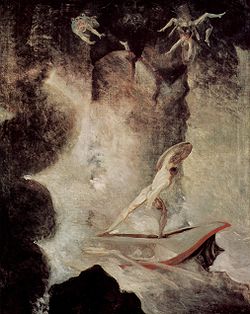
As a colourist Fuseli has but small claims to distinction. He scorned to set a palette as most artists do; he merely dashed his tints recklessly over it. Not infrequently he used his paints in the form of a dry powder, which he hastily combined on the end of his brush with oil, or turpentine
Turpentine
Turpentine is a fluid obtained by the distillation of resin obtained from trees, mainly pine trees. It is composed of terpenes, mainly the monoterpenes alpha-pinene and beta-pinene...
, or gold size, regardless of the quantity, and depending on accident for the general effect. This recklessness may perhaps be explained by the fact that he did not paint in oil until he was twenty-five years of age. Despite these drawbacks he possessed the elements of a great painter.
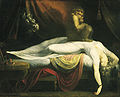
The Nightmare
The Nightmare is a 1781 oil painting by Anglo-Swiss artist Henry Fuseli . Since its creation, it has remained Fuseli's best-known work. With its first exhibition in 1782 at the Royal Academy of London, the image became famous; an engraved version was widely distributed and the painting was parodied...
, exhibited in 1782. He painted two versions, shown in the Nightmare
The Nightmare
The Nightmare is a 1781 oil painting by Anglo-Swiss artist Henry Fuseli . Since its creation, it has remained Fuseli's best-known work. With its first exhibition in 1782 at the Royal Academy of London, the image became famous; an engraved version was widely distributed and the painting was parodied...
article. Themes seen in "The Nightmare" were repeated in his 1796 painting, "Night-Hag visiting the Lapland Witches."
His sketches or designs numbered about 800; they have admirable qualities of invention and design, and are frequently superior to his paintings. In his drawings, as in his paintings, his method included deliberately exaggerating the due proportions of the parts and throwing his figures into contorted attitudes. One technique involved setting down arbitrary points on a sheet, which then became the extreme points of the various limbs—rather like creating a constellation from the unintentional relations of stars. Notable examples of these drawings were made in concert with George Richmond when the two artists were together in Rome.
He rarely drew the figure from life, basing his art on study of the antique and Michelangelo. He produced no landscapes
Landscape art
Landscape art is a term that covers the depiction of natural scenery such as mountains, valleys, trees, rivers, and forests, and especially art where the main subject is a wide view, with its elements arranged into a coherent composition. In other works landscape backgrounds for figures can still...
—"Damn Nature! she always puts me out," was his characteristic exclamation—and painted only two portraits.
His general powers of mind were large. He was a thorough master of French
French language
French is a Romance language spoken as a first language in France, the Romandy region in Switzerland, Wallonia and Brussels in Belgium, Monaco, the regions of Quebec and Acadia in Canada, and by various communities elsewhere. Second-language speakers of French are distributed throughout many parts...
, Italian
Italian language
Italian is a Romance language spoken mainly in Europe: Italy, Switzerland, San Marino, Vatican City, by minorities in Malta, Monaco, Croatia, Slovenia, France, Libya, Eritrea, and Somalia, and by immigrant communities in the Americas and Australia...
, English
English language
English is a West Germanic language that arose in the Anglo-Saxon kingdoms of England and spread into what was to become south-east Scotland under the influence of the Anglian medieval kingdom of Northumbria...
and German
German language
German is a West Germanic language, related to and classified alongside English and Dutch. With an estimated 90 – 98 million native speakers, German is one of the world's major languages and is the most widely-spoken first language in the European Union....
, and could write in all these tongues with equal facility and vigour, though he preferred German as the vehicle of his thoughts. His writings contain passages of the best art-criticism that English literature can show. The principal work is his series of Lectures in the Royal Academy, twelve in number, commenced in 1801.
Many interesting anecdotes of Fuseli, and his relations to contemporary artists, are given in his Life by John Knowles
John Knowles (author)
John Knowles was the English biographer of Henry Fuseli, and author of works on Naval architecture.-Life:Knowles, born in 1781, early in life became a clerk in the surveyor's department of the navy office. He attained the chief clerkship there about 1806, and held this post until 1832...
(1831). He influenced the art of Fortunato Duranti
Fortunato Duranti
Fortunato Duranti was an Italian painter and collector.Durant was born at Montefortino, in what are now the Marche, then part of the Papal States. His father was a shoemaker of limited means. In Rome he befriended Nicola Consoni and Tommaso Minardi. He was influenced by the neoclassic painter...
.
Time in England
In 1788 Fuseli started to write essays and reviews for the Analytical ReviewAnalytical Review
The Analytical Review was a periodical established in London in 1788 by the publisher Joseph Johnson and the writer Thomas Christie. Part of the Republic of Letters, it was a gadfly publication, which offered readers summaries and analyses of the many new publications issued at the end of the...
. With Thomas Paine
Thomas Paine
Thomas "Tom" Paine was an English author, pamphleteer, radical, inventor, intellectual, revolutionary, and one of the Founding Fathers of the United States...
, William Godwin
William Godwin
William Godwin was an English journalist, political philosopher and novelist. He is considered one of the first exponents of utilitarianism, and the first modern proponent of anarchism...
, Joseph Priestley
Joseph Priestley
Joseph Priestley, FRS was an 18th-century English theologian, Dissenting clergyman, natural philosopher, chemist, educator, and political theorist who published over 150 works...
, Erasmus Darwin
Erasmus Darwin
Erasmus Darwin was an English physician who turned down George III's invitation to be a physician to the King. One of the key thinkers of the Midlands Enlightenment, he was also a natural philosopher, physiologist, slave trade abolitionist,inventor and poet...
, Mary Wollstonecraft
Mary Wollstonecraft
Mary Wollstonecraft was an eighteenth-century British writer, philosopher, and advocate of women's rights. During her brief career, she wrote novels, treatises, a travel narrative, a history of the French Revolution, a conduct book, and a children's book...
, and other men and women interested in art, literature and politics, Fuseli frequented the home of Joseph Johnson
Joseph Johnson (publisher)
Joseph Johnson was an influential 18th-century London bookseller and publisher. His publications covered a wide variety of genres and a broad spectrum of opinions on important issues...
, a publisher and prominent figure in radical British political and intellectual life. He also visited Allerton Hall in Liverpool, the home of William Roscoe
William Roscoe
William Roscoe , was an English historian and miscellaneous writer.-Life:He was born in Liverpool, where his father, a market gardener, kept a public house called the Bowling Green at Mount Pleasant. Roscoe left school at the age of twelve, having learned all that his schoolmaster could teach...
.
When Louis XVI was executed in France in 1793, he condemned the revolution as despotic and anarchic, although he had first welcomed it as a sign of "an age pregnant with the most gigantic efforts of character." In 1799 he was appointed professor of painting at the Royal Academy, and keeper of the Academy in 1804. Among his pupils were John Constable
John Constable
John Constable was an English Romantic painter. Born in Suffolk, he is known principally for his landscape paintings of Dedham Vale, the area surrounding his home—now known as "Constable Country"—which he invested with an intensity of affection...
(1776-1837), the major English landscape painter of his time, Benjamin Robert Haydon (1786-1846), William Etty
William Etty
William Etty was an English painter, best known for his paintings of nudes.-Beginnings:In accordance with the wishes of his father, Etty served seven years of apprenticeship to a printer in Hull...
(1787-1849), and Edwin Landseer (1802-73), who first exhibited at the age of twelve. William Blake
William Blake
William Blake was an English poet, painter, and printmaker. Largely unrecognised during his lifetime, Blake is now considered a seminal figure in the history of both the poetry and visual arts of the Romantic Age...
, who was sixteen years his junior, recognized a debt to him, and for a time many English artists copied his mannerisms.
See also
- Füssli, Johann CasparJohann Caspar FüssliJohann Caspar Füssli was a Swiss portrait painter.He was born in Zurich to Hans Rudolf Füssli, who was also a painter, and Elisabeth Schärer....
(1706-1782), Swiss portrait painter (Father of Henry Fuseli) - Füssli, Johann KasparJohann Kaspar FüssliJohann Kaspar Füssli, also written Johann Caspar Fuesslins, was a Swiss painter, entomologist and publisher....
(1743-1786), Swiss entomologist (Brother of Henry Fuseli)