
Home      Discussion      Topics      Dictionary      Almanac
Signup       Login
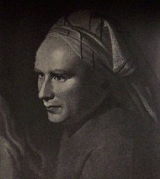
William Cowper

William Cowper

Overview
William Cowper
Discussion
Ask a question about 'William Cowper'
Start a new discussion about 'William Cowper'
Answer questions from other users
Full Discussion Forum
 
Unanswered Questions
Quotations

Absence from whom we love is worse than death, And frustrate hope severer than despair.

"Hope, like the short-lived ray that gleams awhile", line 35

But oars alone can ne'er prevail To reach the distant coast; The breath of Heaven must swell the sail, Or all the toil is lost.

"Human Frailty", line 21 (1779)

Reasoning at every step he treads, Man yet mistakes his way, While meaner things, whom instinct leads, Are rarely known to stray.

"The Doves", line 1. (1780)

Fate steals along with silent tread, Found oftenest in what least we dread, Frowns in the storm with angry brow, But in the sunshine strikes the blow.

"A Fable" (or "The Raven"), line 36

True Charity, a plant divinely nurs'd.

"Charity", line 573. (1781)

"Regions Caesar never knew Thy posterity shall sway; Where his eagles never flew, None invincible as they." Such the bard's prophetic words, Pregnant with celestial fire, Bending as he swept the chords Of his sweet but awful lyre.

"Boadicea" (1782)

Sweet stream that winds through yonder glade, Apt emblem of a virtuous maid Silent and chaste she steals along, Far from the world's gay busy throng: With gentle yet prevailing force, Intent upon her destined course; Graceful and useful all she does, Blessing and blest where'er she goes; Pure-bosom'd as that watery glass, And Heaven reflected in her face.

"To a Young Lady" (1782)

Candid, and generous, and just,Boys care but little whom they trust,An error soon corrected— For who but learns in riper yearsThat man, when smoothest he appearsIs most to be suspected?

"Friendship", line 19 (1782)

Thus neither the praise nor the blame is our own.

"From a Letter to the Rev. Mr. Newton", line 21. (1782)

I believe no man was ever scolded out of his sins.

Letter to John Newton|John Newton, June 17, 1783.
Encyclopedia
William Cowper
was an English poet
Poet
A poet is a person who writes poetry. A poet's work can be literal, meaning that his work is derived from a specific event, or metaphorical, meaning that his work can take on many meanings and forms. Poets have existed since antiquity, in nearly all languages, and have produced works that vary...

 and hymnodist. One of the most popular poets of his time, Cowper changed the direction of 18th century nature poetry by writing of everyday life and scenes of the English countryside. In many ways, he was one of the forerunners of Romantic poetry
Romantic poetry
Romanticism, a philosophical, literary, artistic and cultural era which began in the mid/late-1700s as a reaction against the prevailing Enlightenment ideals of the day , also influenced poetry...

. Samuel Taylor Coleridge
Samuel Taylor Coleridge
Samuel Taylor Coleridge was an English poet, Romantic, literary critic and philosopher who, with his friend William Wordsworth, was a founder of the Romantic Movement in England and a member of the Lake Poets. He is probably best known for his poems The Rime of the Ancient Mariner and Kubla...

 called him "the best modern poet", whilst William Wordsworth
William Wordsworth
William Wordsworth was a major English Romantic poet who, with Samuel Taylor Coleridge, helped to launch the Romantic Age in English literature with the 1798 joint publication Lyrical Ballads....

 particularly admired his poem Yardley-Oak. He was a nephew of the poet Judith Madan
Judith Madan
Judith Madan was an English poet. She was the grand daughter of Lady Sarah Cowper , the diarist....

.

While Cowper found refuge in a fervent evangelical
Evangelicalism
Evangelicalism is a Protestant Christian movement which began in Great Britain in the 1730s and gained popularity in the United States during the series of Great Awakenings of the 18th and 19th century.Its key commitments are:...

 Christianity
Christianity
Christianity is a monotheistic religion based on the life and teachings of Jesus as presented in canonical gospels and other New Testament writings...

, the inspiration behind his much-loved hymns, he often experienced doubt
Doubt
Doubt, a status between belief and disbelief, involves uncertainty or distrust or lack of sureness of an alleged fact, an action, a motive, or a decision. Doubt brings into question some notion of a perceived "reality", and may involve delaying or rejecting relevant action out of concerns for...

 and feared that he was doomed to eternal damnation. His religious sentiment and association with John Newton
John Newton
John Henry Newton was a British sailor and Anglican clergyman. Starting his career on the sea at a young age, he became involved with the slave trade for a few years. After experiencing a religious conversion, he became a minister, hymn-writer, and later a prominent supporter of the abolition of...

 (who wrote the hymn "Amazing Grace
Amazing Grace
"Amazing Grace" is a Christian hymn with words written by the English poet and clergyman John Newton , published in 1779. With a message that forgiveness and redemption are possible regardless of the sins people commit and that the soul can be delivered from despair through the mercy of God,...

") led to much of the poetry for which he is best remembered. His poem "Light Shining out of Darkness" gave the English language the idiom
Idiom
Idiom is an expression, word, or phrase that has a figurative meaning that is comprehended in regard to a common use of that expression that is separate from the literal meaning or definition of the words of which it is made...

 "God moves in a mysterious way, His wonders to perform."

Life of Cowper


He was born in Berkhamsted
Berkhamsted
-Climate:Berkhamsted experiences an oceanic climate similar to almost all of the United Kingdom.-Castle:...

, Hertfordshire
Hertfordshire
Hertfordshire is a ceremonial and non-metropolitan county in the East region of England. The county town is Hertford.The county is one of the Home Counties and lies inland, bordered by Greater London , Buckinghamshire , Bedfordshire , Cambridgeshire and...

, England
England
England is a country that is part of the United Kingdom. It shares land borders with Scotland to the north and Wales to the west; the Irish Sea is to the north west, the Celtic Sea to the south west, with the North Sea to the east and the English Channel to the south separating it from continental...

 where his father John Cowper was rector of the Church of St Peter
Church of St Peter, Great Berkhamsted
The Parish Church of St Peter, Great Berkhamsted is a Church of England, Grade II* listed church in the town of Berkhamsted, Hertfordshire, in the United Kingdom...

. After education at Westminster School
Westminster School
The Royal College of St. Peter in Westminster, almost always known as Westminster School, is one of Britain's leading independent schools, with the highest Oxford and Cambridge acceptance rate of any secondary school or college in Britain...

, he was articled to Mr. Chapman, solicitor
Solicitor
Solicitors are lawyers who traditionally deal with any legal matter including conducting proceedings in courts. In the United Kingdom, a few Australian states and the Republic of Ireland, the legal profession is split between solicitors and barristers , and a lawyer will usually only hold one title...

, of Ely Place
Ely Place
Ely Place is a gated road at the southern tip of the London Borough of Camden in London, England. It is the location of the Old Mitre Tavern and is adjacent to Hatton Garden.-Origins:...

, Holborn
Holborn
Holborn is an area of Central London. Holborn is also the name of the area's principal east-west street, running as High Holborn from St Giles's High Street to Gray's Inn Road and then on to Holborn Viaduct...

, in order to be trained for a career in law. During this time, he spent his leisure at the home of his uncle Ashley Cowper, and there fell in love with his cousin Theodora, whom he wished to marry. But as James Croft, who in 1825 first published the poems Cowper addressed to Theodora, wrote, "her father, from an idea that the union of persons so nearly related was improper, refused to accede to the wishes of his daughter and nephew." This refusal left Cowper distraught.

In 1763 he was offered a Clerkship of Journals in the House of Lords
House of Lords
The House of Lords is the upper house of the Parliament of the United Kingdom. Like the House of Commons, it meets in the Palace of Westminster....

, but broke under the strain of the approaching examination and experienced a period of insanity
Insanity
Insanity, craziness or madness is a spectrum of behaviors characterized by certain abnormal mental or behavioral patterns. Insanity may manifest as violations of societal norms, including becoming a danger to themselves and others, though not all such acts are considered insanity...

. At this time he tried three times to commit suicide
Suicide
Suicide is the act of intentionally causing one's own death. Suicide is often committed out of despair or attributed to some underlying mental disorder, such as depression, bipolar disorder, schizophrenia, alcoholism, or drug abuse...

 and was sent to Nathaniel Cotton
Nathaniel Cotton
Nathaniel Cotton was an English physician and poet.Cotton is thought to have studied at Leiden University, possibly under Herman Boerhaave. Cotton specialised in the care of patients with mental health issues, maintaining an asylum known as the Collegium Insanorum, at St Albans...

's asylum at St. Albans for recovery. His poem beginning "Hatred and vengeance, my eternal portions" (sometimes referred to as "Sapphics") was written in the aftermath of his suicide attempt.

After recovering, he settled at Huntingdon
Huntingdon
Huntingdon is a market town in Cambridgeshire, England. The town was chartered by King John in 1205. It is the traditional county town of Huntingdonshire, and is currently the seat of the Huntingdonshire district council. It is known as the birthplace in 1599 of Oliver Cromwell.-History:Huntingdon...

 with a retired clergyman named Morley Unwin and his wife Mary
Mary Unwin
Mary Unwin , the friend of Cowper, the daughter of William Cawthorne, a draper, of Ely, was born in that city in 1724. Hayley remembered her when comparatively young, a person of lively talents with a sweet serene countenance, and remarkably fond of reading...

. Cowper grew to be on such good terms with the Unwin family that he went to live in their house, and moved with them to Olney, where John Newton
John Newton
John Henry Newton was a British sailor and Anglican clergyman. Starting his career on the sea at a young age, he became involved with the slave trade for a few years. After experiencing a religious conversion, he became a minister, hymn-writer, and later a prominent supporter of the abolition of...

, a former slave trader who had repented and devoted his life to the gospel, was curate
Curate
A curate is a person who is invested with the care or cure of souls of a parish. In this sense "curate" correctly means a parish priest but in English-speaking countries a curate is an assistant to the parish priest...

. Not long afterwards, Morley Unwin was killed in a fall from his horse, but Cowper continued to live in the Unwin home and became extremely attached to Mary Unwin
Mary Unwin
Mary Unwin , the friend of Cowper, the daughter of William Cawthorne, a draper, of Ely, was born in that city in 1724. Hayley remembered her when comparatively young, a person of lively talents with a sweet serene countenance, and remarkably fond of reading...

.

At Olney, Newton invited Cowper to contribute to a hymnbook that Newton was compiling. The resulting volume known as Olney Hymns was not published until 1779 but includes hymns such as "Praise for the Fountain Opened" (beginning "There is a fountain fill'd with blood") and "Light Shining out of Darkness" (beginning "God moves in a mysterious way") which remain some of Cowper's most familiar verses. Several of Cowper's hymns, as well as others originally published in the "Olney Hymns," are today preserved in the Sacred Harp
Sacred Harp
Sacred Harp singing is a tradition of sacred choral music that took root in the Southern region of the United States. It is part of the larger tradition of shape note music.- The music and its notation :...

.

In 1773, Cowper, experienced an attack of insanity, imagining not only that he was condemned to hell eternally, but that God was commanding him to make a sacrifice of his own life. Mary Unwin took care of him with great devotion and after a year he began again to recover. In 1779, after Newton had left Olney to go to London
London
London is the capital city of :England and the :United Kingdom, the largest metropolitan area in the United Kingdom, and the largest urban zone in the European Union by most measures. Located on the River Thames, London has been a major settlement for two millennia, its history going back to its...

, Cowper started to write further poetry. Mary Unwin, wanting to keep Cowper's mind occupied, suggested that he write on the subject of The Progress of Error, and after writing his satire
Satire
Satire is primarily a literary genre or form, although in practice it can also be found in the graphic and performing arts. In satire, vices, follies, abuses, and shortcomings are held up to ridicule, ideally with the intent of shaming individuals, and society itself, into improvement...

 of this name he wrote seven others. All of them were published in 1782 under the title Poems by William Cowper, of the Inner Temple, Esq..

The year before this publication, Cowper met a sophisticated and charming widow named Lady Austen who served as a new impetus to his poetry. Cowper himself tells of the genesis of what some have considered his most substantial work, The Task
The Task (poem)
The Task: A Poem, in Six Books is a poem in 6000 lines of blank verse by William Cowper, usually seen as his supreme achievement. Its six books are called "The Sofa", "The Timepiece", "The Garden", "The Winter Evening", "The Winter Morning Walk" and "The Winter Walk at Noon"...

,
in his "Advertisement" to the original edition of 1785:


"...a lady, fond of blank verse
Blank verse
Blank verse is poetry written in unrhymed iambic pentameter. It has been described as "probably the most common and influential form that English poetry has taken since the sixteenth century" and Paul Fussell has claimed that "about three-quarters of all English poetry is in blank verse."The first...

, demanded a poem of that kind from the author, and gave him the SOFA for a subject. He obeyed; and, having much leisure, connected another subject with it; and, pursuing the train of thought to which his situation and turn of mind led him, brought forth at length, instead of the trifle which he at first intended, a serious affair—a Volume!"


In the same volume Cowper also printed "The Diverting History of John Gilpin
The Diverting History of John Gilpin
The Diverting History of John Gilpin is a comic ballad by William Cowper, written in 1782. The ballad concerns a draper called John Gilpin who rides a runaway horse...

", a notable piece of comic verse. John Gilpin was later looked back on as almost saving Cowper from turning insane.

Cowper and Mary Unwin moved to Weston in 1786 and shortly before this became close with his cousin Harriet (Theodora's sister), now Lady Hesketh. During this period he started his translations of Homer
Homer
In the Western classical tradition Homer , is the author of the Iliad and the Odyssey, and is revered as the greatest ancient Greek epic poet. These epics lie at the beginning of the Western canon of literature, and have had an enormous influence on the history of literature.When he lived is...

's Iliad
Iliad
The Iliad is an epic poem in dactylic hexameters, traditionally attributed to Homer. Set during the Trojan War, the ten-year siege of the city of Troy by a coalition of Greek states, it tells of the battles and events during the weeks of a quarrel between King Agamemnon and the warrior Achilles...

and Odyssey
Odyssey
The Odyssey is one of two major ancient Greek epic poems attributed to Homer. It is, in part, a sequel to the Iliad, the other work ascribed to Homer. The poem is fundamental to the modern Western canon, and is the second—the Iliad being the first—extant work of Western literature...

into blank verse
Blank verse
Blank verse is poetry written in unrhymed iambic pentameter. It has been described as "probably the most common and influential form that English poetry has taken since the sixteenth century" and Paul Fussell has claimed that "about three-quarters of all English poetry is in blank verse."The first...

, and his versions (published in 1791) were the most significant English renderings of these epic poems
Epic poetry
An epic is a lengthy narrative poem, ordinarily concerning a serious subject containing details of heroic deeds and events significant to a culture or nation. Oral poetry may qualify as an epic, and Albert Lord and Milman Parry have argued that classical epics were fundamentally an oral poetic form...

 since those of Alexander Pope
Alexander Pope
Alexander Pope was an 18th-century English poet, best known for his satirical verse and for his translation of Homer. He is the third-most frequently quoted writer in The Oxford Dictionary of Quotations, after Shakespeare and Tennyson...

 earlier in the century, although later critics have faulted Cowper's Homer for being too much in the mold of John Milton
John Milton
John Milton was an English poet, polemicist, a scholarly man of letters, and a civil servant for the Commonwealth of England under Oliver Cromwell...

.

In 1795 Cowper moved with Mary to Norfolk
Norfolk
Norfolk is a low-lying county in the East of England. It has borders with Lincolnshire to the west, Cambridgeshire to the west and southwest and Suffolk to the south. Its northern and eastern boundaries are the North Sea coast and to the north-west the county is bordered by The Wash. The county...

. They originally stayed at North Tuddenham
North Tuddenham
North Tuddenham is a civil parish in the English county of Norfolk, it has a parish church, that is named St Mary's.It covers an area of and had a population of 305 in 121 households as of the 2001 census. For the purposes of local government, it falls within the district of Breckland.North...

, then at Dunham Lodge near Swaffham
Swaffham
Swaffham is a market town and civil parish in the English county of Norfolk. The town is situated east of King's Lynn and west of Norwich.The civil parish has an area of and in the 2001 census had a population of 6,935 in 3,130 households...

 and then Mundesley
Mundesley
Mundesley is a coastal village and a civil parish in the English county of Norfolk. The village is 20.3 miles north-north east of Norwich, 7.3 miles south east of Cromer and 136 miles north east of London. The village lies 5.6 miles north-north east of the town of North Walsham. The nearest...

 before finally settling in East Dereham.

Mary Unwin died in 1796, plunging Cowper into a gloom from which he never fully recovered. He did, however, continue revising his Homer for a second edition of his translation, and, aside from writing the powerful and bleak poem "The Castaway", penned some English translations of Greek verse and turned some of the Fables of John Gay
John Gay
John Gay was an English poet and dramatist and member of the Scriblerus Club. He is best remembered for The Beggar's Opera , set to music by Johann Christoph Pepusch...

 into Latin.

Cowper was seized with dropsy in the spring of 1800 and died. He is buried in the chapel of St. Thomas of Canterbury, St. Nicholas Church, East Dereham. A window in Westminster Abbey
Westminster Abbey
The Collegiate Church of St Peter at Westminster, popularly known as Westminster Abbey, is a large, mainly Gothic church, in the City of Westminster, London, United Kingdom, located just to the west of the Palace of Westminster. It is the traditional place of coronation and burial site for English,...

 honours him.

Major works

  • Olney Hymns
    Olney Hymns
    The Olney Hymns were first published in February 1779, and are the combined work of curate John Newton and his poet friend, William Cowper . The hymns were written for use in Newton's rural parish which was made up of relatively poor and uneducated followers...

    , 1779, in collaboration with John Newton
    John Newton
    John Henry Newton was a British sailor and Anglican clergyman. Starting his career on the sea at a young age, he became involved with the slave trade for a few years. After experiencing a religious conversion, he became a minister, hymn-writer, and later a prominent supporter of the abolition of...

  • John Gilpin
    The Diverting History of John Gilpin
    The Diverting History of John Gilpin is a comic ballad by William Cowper, written in 1782. The ballad concerns a draper called John Gilpin who rides a runaway horse...

    , 1782
  • The Task
    The Task (poem)
    The Task: A Poem, in Six Books is a poem in 6000 lines of blank verse by William Cowper, usually seen as his supreme achievement. Its six books are called "The Sofa", "The Timepiece", "The Garden", "The Winter Evening", "The Winter Morning Walk" and "The Winter Walk at Noon"...

    , 1785
  • Homer
    Homer
    In the Western classical tradition Homer , is the author of the Iliad and the Odyssey, and is revered as the greatest ancient Greek epic poet. These epics lie at the beginning of the Western canon of literature, and have had an enormous influence on the history of literature.When he lived is...

    's Iliad
    Iliad
    The Iliad is an epic poem in dactylic hexameters, traditionally attributed to Homer. Set during the Trojan War, the ten-year siege of the city of Troy by a coalition of Greek states, it tells of the battles and events during the weeks of a quarrel between King Agamemnon and the warrior Achilles...

    and Odyssey
    Odyssey
    The Odyssey is one of two major ancient Greek epic poems attributed to Homer. It is, in part, a sequel to the Iliad, the other work ascribed to Homer. The poem is fundamental to the modern Western canon, and is the second—the Iliad being the first—extant work of Western literature...

    , 1791 (translation
    Translation
    Translation is the communication of the meaning of a source-language text by means of an equivalent target-language text. Whereas interpreting undoubtedly antedates writing, translation began only after the appearance of written literature; there exist partial translations of the Sumerian Epic of...

    s from the Greek
    Greek language
    Greek is an independent branch of the Indo-European family of languages. Native to the southern Balkans, it has the longest documented history of any Indo-European language, spanning 34 centuries of written records. Its writing system has been the Greek alphabet for the majority of its history;...

    ).


Hymns by Cowper


Cowper is represented with fifteen hymns in The Church Hymn book 1872:
  • 127 Jesus! where'er thy people meet
  • 357 The Spirit breathes upon the word
  • 450 There is a fountain, filled with blood
  • 790 Hark! my soul! it is the Lord
  • 856 To Jesus, the Crown of my hope
  • 871 Far from the world, O Lord! I flee
  • 885 My Lord! how full of sweet content (1782 translation)
  • 932 What various hindrances we meet
  • 945 Oh! for a closer walk with God
  • 965 When darkness long has veiled my mind
  • 1002 T is my happiness below
  • 1009 O Lord! in sorrow I resign (1782 translation)
  • 1029 O Lord! my best desire fulfill
  • 1043 There is a safe and secret place
  • 1060 God of my life! to thee I call

Familiar quotations from Cowper


GOD moves in a mysterious way,

His wonders to perform;

He plants his footsteps in the sea,

And rides upon the storm.
Olney Hymns (1779)--'Light Shining out of Darkness'


There is a fountain fill'd with blood

Drawn from EMMANUEL's veins;

And sinners, plung'd beneath that flood,

Lose all their guilty stains.
Olney Hymns (1779)--'Praise for the Fountain Opened'


Oh! for a closer walk with GOD,

A calm and heav'nly frame;

A light to shine upon the road

That leads me to the Lamb!
Olney Hymns (1779)--'Walking with God'


God made the country, and man made the town.
The Task (1785)--'The Sofa' (Book I, line 749)


There is a pleasure in poetic pains

Which only poets know.
The Task (1785)--'The Timepiece' (Book II, lines 285-6)


Variety's the very spice of life,

That gives it all its flavour.
The Task (1785)--'The Timepiece' (Book II, lines 606-7)


I am monarch of all I survey,

My right there is none to dispute;

From the centre all round to the sea,

I am lord of the fowl and the brute.
'Verses Supposed to be Written by Alexander Selkirk
Alexander Selkirk
Alexander Selkirk was a Scottish sailor who spent four years as a castaway when he was marooned on an uninhabited island. It is probable that his travels provided the inspiration for Daniel Defoe's novel Robinson Crusoe....

' (1782), lines 1-4


No voice divine the storm allay'd,

No light propitious shone;

When, snatch'd from all effectual aid,

We perish'd, each alone;

But I beneath a rougher sea,

And whelmed in deeper gulphs than he.
"The Castaway" (1799), lines 61-66


'Tis pleasant, through the loopholes of retreat,

To peep at such a world; to see the stir

Of the great Babel, and not feel the crowd;

To hear the roar she sends through all her gates

At a safe distance, where the dying sound

Falls a soft murmur on the uninjur'd ear.
The Task (1785)--'The Winter Evening' (Book IV, lines 88-93)

Works by Cowper

(plain text and HTML)

Works about Cowper


Other links


External links