


Uros

Encyclopedia
.jpg)
Inca civilization
The Andean civilizations made up a loose patchwork of different cultures that developed from the highlands of Colombia to the Atacama Desert. The Andean civilizations are mainly based on the cultures of Ancient Peru and some others such as Tiahuanaco. The Inca Empire was the last sovereign...
n people who live on forty-two self-fashioned floating island
Floating island
A floating island is a mass of floating aquatic plants, mud, and peat ranging in thickness from a few inches to several feet. Floating islands are a common natural phenomenon that are found in many parts of the world. They exist less commonly as a man-made phenomenon...
s in Lake Titicaca
Lake Titicaca
Lake Titicaca is a lake located on the border of Peru and Bolivia. It sits 3,811 m above sea level, making it the highest commercially navigable lake in the world...
Puno
Puno
Puno is a city in southeastern Peru, located on the shore of Lake Titicaca. It is the capital city of the Puno Region and the Puno Province with a population of approximately 100,000. The city was established in 1668 by viceroy Pedro Antonio Fernández de Castro as capital of the province of...
, Peru
Peru
Peru , officially the Republic of Peru , is a country in western South America. It is bordered on the north by Ecuador and Colombia, on the east by Brazil, on the southeast by Bolivia, on the south by Chile, and on the west by the Pacific Ocean....
and Bolivia
Bolivia
Bolivia officially known as Plurinational State of Bolivia , is a landlocked country in central South America. It is the poorest country in South America...
. They form three main groups: Uru-Chipayas, Uru-Muratos
Uru-Muratos
The Uru-Muratos are descendents of an old indigenous community in Bolivia, the Urus or Uros. Because of their place of living, surroundings of Lake Poopó, they were commonly known as the "men of the lake". In 1930 their lands and lake were invaded by the Aymara people...
and the Uru-Iruitos. The latter are still located on the Bolivian side of Lake Titicaca and Desaguadero River.
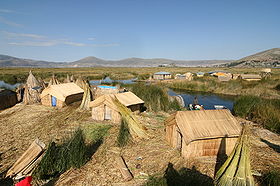
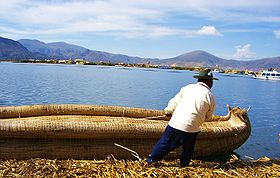
The Uros use bundles of dried totora reeds
Totora (plant)
Totora is a subspecies of the giant bulrush sedge. It is found in South America - notably on Lake Titicaca, the middle coast of Perú and on Easter Island in the Pacific Ocean...
to make reed boat
Reed boat
Reed boats and rafts, along with dugout canoes and other rafts, are among the oldest known types of boats. Often used as traditional fishing boats, they are still used in a few places around the world, though they have generally been replaced with planked boats. Reed boats can be distinguished from...
s (balsas mats), and to make the islands themselves.
The Uros islands at 3810 meters above sea level are just five kilometers west from Puno port. Around 2,000 descendants of the Uros were counted in the 1997 census, although only a few hundred still live on and maintain the islands; most have moved to the mainland. The Uros also bury their dead on the mainland in special cemeteries.
Television
Television is a telecommunication medium for transmitting and receiving moving images that can be monochrome or colored, with accompanying sound...
s, and the main island is home to an Uros-run FM
Frequency modulation
In telecommunications and signal processing, frequency modulation conveys information over a carrier wave by varying its instantaneous frequency. This contrasts with amplitude modulation, in which the amplitude of the carrier is varied while its frequency remains constant...
radio station, which plays music for several hours a day.
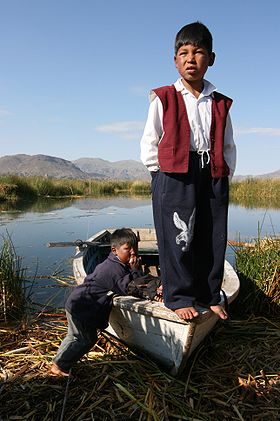
Early schooling is done on several islands, including a traditional school and a school run by a Christian
Christianity
Christianity is a monotheistic religion based on the life and teachings of Jesus as presented in canonical gospels and other New Testament writings...
church. Older children and university students attend school on the mainland, often in nearby Puno.
History
The Uros descend from a millennial town that according to legends are "pukinas" who speak Uro or Pukina and that believe they are the owners of the lake and water. Uros used to say that they have black bloodBlood
Blood is a specialized bodily fluid in animals that delivers necessary substances such as nutrients and oxygen to the cells and transports metabolic waste products away from those same cells....
because they did not feel the cold. Also they call themselves "Lupihaques" (Sons of The Sun). Nowadays, Uros do not speak the Uro language, nor practice their old beliefs but keep some old customs.
The purpose of the island settlements was originally defensive, and if a threat arose they could be moved. The largest island retains a watchtower almost entirely constructed of reeds.
The Uros traded with the Aymara tribe on the mainland, intermarrying with them and eventually abandoning the Uro language for that of the Aymara. About 500 years ago they lost their original language. When conquered by the Inca empire
Inca Empire
The Inca Empire, or Inka Empire , was the largest empire in pre-Columbian America. The administrative, political and military center of the empire was located in Cusco in modern-day Peru. The Inca civilization arose from the highlands of Peru sometime in the early 13th century...
, they had to pay taxes to them, and often were made slave
Slavery
Slavery is a system under which people are treated as property to be bought and sold, and are forced to work. Slaves can be held against their will from the time of their capture, purchase or birth, and deprived of the right to leave, to refuse to work, or to demand compensation...
s.
Traditional lifestyle
The larger islands house about ten families, while smaller ones, only about thirty meters wide, house only two or three.The islets are made of totora
Totora (plant)
Totora is a subspecies of the giant bulrush sedge. It is found in South America - notably on Lake Titicaca, the middle coast of Perú and on Easter Island in the Pacific Ocean...
reeds, which grow in the lake. The dense roots that the plants develop and interweave form a natural layer called Khili (about one to two meters thick) that support the islands. They are anchored with ropes attached to sticks driven into the bottom of the lake. The reeds at the bottoms of the islands rot away fairly quickly, so new reeds are added to the top constantly, about every three months; this is what it makes exciting for tourist
Tourism
Tourism is travel for recreational, leisure or business purposes. The World Tourism Organization defines tourists as people "traveling to and staying in places outside their usual environment for not more than one consecutive year for leisure, business and other purposes".Tourism has become a...
s when walking on the island. This is especially important in the rainy season when the reeds rot much faster. The islands last about thirty years.
Each step on an island sinks about 2-4" depending on the density of the ground underfoot. As the reeds dry, they break up more and more as they are walked upon. As the reed breaks up and moisture gets to it, it rots, and a new layer has to be added to it. It is a lot of work to maintain the islands. Because the people living there are so infiltrated with tourists now, they have less time to maintain everything, so they have to work even harder in order to keep up with the tourists and with the maintenance of their island. Tourism provides financial opportunities for the natives, while simultaneously challenging their traditional lifestyle.
Much of the Uros' diet and medicine also revolve around these totora
Totora (plant)
Totora is a subspecies of the giant bulrush sedge. It is found in South America - notably on Lake Titicaca, the middle coast of Perú and on Easter Island in the Pacific Ocean...
reeds. When a reed is pulled, the white bottom is often eaten for iodine
Iodine
Iodine is a chemical element with the symbol I and atomic number 53. The name is pronounced , , or . The name is from the , meaning violet or purple, due to the color of elemental iodine vapor....
. This prevents goiter
Goitre
A goitre or goiter , is a swelling in the thyroid gland, which can lead to a swelling of the neck or larynx...
. This white part of the reed is called the chullo (Aymara tʃʼuʎo). Like the Andean people of Peru rely on the Coca
Coca
Coca, Erythroxylum coca, is a plant in the family Erythroxylaceae, native to western South America. The plant plays a significant role in many traditional Andean cultures...
Leaf for relief from a harsh climate and hunger, the Uros rely on the Totora reeds in the same way. When in pain, the reed is wrapped around the place in pain to absorb it. Also if it is hot outside, they roll the white part of the reed in their hands and split it open, placing the reed on their forehead. In this stage, it is very cool to the touch. The white part of the reed is also used to help ease alcohol-related hangovers. It is a primary source of food. They also make a reed flower tea
Tea
Tea is an aromatic beverage prepared by adding cured leaves of the Camellia sinensis plant to hot water. The term also refers to the plant itself. After water, tea is the most widely consumed beverage in the world...
.
Local residents fish ispi
Pupfish
Pupfish are a group of small killifish belonging to ten genera of the family Cyprinodontidae of ray-finned fish. All pupfish are especially noted for being found in extreme and isolated situations, in various parts of North America, South America, and the Caribbean region...
, carachi and catfish
Catfish
Catfishes are a diverse group of ray-finned fish. Named for their prominent barbels, which resemble a cat's whiskers, catfish range in size and behavior from the heaviest and longest, the Mekong giant catfish from Southeast Asia and the second longest, the wels catfish of Eurasia, to detritivores...
. Trout
Trout
Trout is the name for a number of species of freshwater and saltwater fish belonging to the Salmoninae subfamily of the family Salmonidae. Salmon belong to the same family as trout. Most salmon species spend almost all their lives in salt water...
was introduced to the lake from Canada
Canada
Canada is a North American country consisting of ten provinces and three territories. Located in the northern part of the continent, it extends from the Atlantic Ocean in the east to the Pacific Ocean in the west, and northward into the Arctic Ocean...
in 1940, and kingfish
Kingfish
-Fish:* King mackerel Scomberomorus cavalla* Kingcroaker Menticirrhus spp.* Narrow-barred Spanish mackerel Scomberomorus commerson * White croaker Genyonemus lineatus * Cobia Rachycentron canadum...
was introduced from Argentina
Argentina
Argentina , officially the Argentine Republic , is the second largest country in South America by land area, after Brazil. It is constituted as a federation of 23 provinces and an autonomous city, Buenos Aires...
. Uros also hunt birds such as seagull
Gull
Gulls are birds in the family Laridae. They are most closely related to the terns and only distantly related to auks, skimmers, and more distantly to the waders...
s, duck
Duck
Duck is the common name for a large number of species in the Anatidae family of birds, which also includes swans and geese. The ducks are divided among several subfamilies in the Anatidae family; they do not represent a monophyletic group but a form taxon, since swans and geese are not considered...
s and flamingo
Flamingo
Flamingos or flamingoes are gregarious wading birds in the genus Phoenicopterus , the only genus in the family Phoenicopteridae...
s, and graze their cattle
Cattle
Cattle are the most common type of large domesticated ungulates. They are a prominent modern member of the subfamily Bovinae, are the most widespread species of the genus Bos, and are most commonly classified collectively as Bos primigenius...
on the islets. They also run crafts stalls aimed at the numerous tourists who land on ten of the islands each year. They barter totora reeds on the mainland in Puno
Puno
Puno is a city in southeastern Peru, located on the shore of Lake Titicaca. It is the capital city of the Puno Region and the Puno Province with a population of approximately 100,000. The city was established in 1668 by viceroy Pedro Antonio Fernández de Castro as capital of the province of...
to get products they need, such as quinoa
Quinoa
Quinoa , a species of goosefoot , is a grain-like crop grown primarily for its edible seeds. It is a pseudocereal rather than a true cereal, or grain, as it is not a member of the grass family...
and other foods.
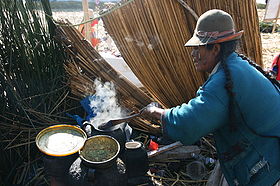
Food is cooked with fires placed on piles of stones. To relieve themselves, tiny 'outhouse' islands are near the main islands. The ground root absorbs the waste.