
All Topics  
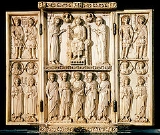
Triptych

 
Triptych

   Email Print
   Bookmark   Link


Triptych


A triptych (pronounced "trip-tick" (or US
American English

PhonologyIn many ways, compared to English language in England, North American English is conservative in its phonology. Some distinctive accents can be found on the East Coast of the United States , partly because these areas were in contact with England, and imitated prestigious varieties of English English at a time when those varieties we...
: [ 't???p.d?k ]) from the Greek
Greek language

Greek is an Indo-European languages native to the southern Balkan peninsula, the language of the Greek people. It forms an independent branch within Indo-European....
 t??pt??? [ tri'ptu.xo ] tri- "three" + ptyche "fold") is a work of art
Art

Art is the process or product of deliberately arranging elements in a way that appeals to the senses or emotions. It encompasses a diverse range of human activities, creations, and modes of expression, including music and literature....
 (usually a panel painting
Panel painting

A panel painting is a painting on a panel made of wood, either a single piece, or a number of pieces joined together. Until canvas became the more popular support medium in the 16th century, it was the normal form of support for a painting not on a wall or on vellum, which was used for miniature in illuminated manuscripts and also for pa...
) which is divided into three sections, or three carved
Wood carving

Wood carving is a form of Woodworking by means of a cutting tool held in the hand , resulting in a wooden figure or figurine or in the sculpture ornamentation of a wooden object....
 panels which are hinged together and folded.


Discussion
Ask a question about 'Triptych'
Start a new discussion about 'Triptych'
Answer questions from other users
Full Discussion Forum


Encyclopedia


Harbaville
A triptych (pronounced "trip-tick" (or US
American English

PhonologyIn many ways, compared to English language in England, North American English is conservative in its phonology. Some distinctive accents can be found on the East Coast of the United States , partly because these areas were in contact with England, and imitated prestigious varieties of English English at a time when those varieties we...
: [ 't???p.d?k ]) from the Greek
Greek language

Greek is an Indo-European languages native to the southern Balkan peninsula, the language of the Greek people. It forms an independent branch within Indo-European....
 t??pt??? [ tri'ptu.xo ] tri- "three" + ptyche "fold") is a work of art
Art

Art is the process or product of deliberately arranging elements in a way that appeals to the senses or emotions. It encompasses a diverse range of human activities, creations, and modes of expression, including music and literature....
 (usually a panel painting
Panel painting

A panel painting is a painting on a panel made of wood, either a single piece, or a number of pieces joined together. Until canvas became the more popular support medium in the 16th century, it was the normal form of support for a painting not on a wall or on vellum, which was used for miniature in illuminated manuscripts and also for pa...
) which is divided into three sections, or three carved
Wood carving

Wood carving is a form of Woodworking by means of a cutting tool held in the hand , resulting in a wooden figure or figurine or in the sculpture ornamentation of a wooden object....
 panels which are hinged together and folded. It is therefore a type of polyptych
Polyptych

A polyptych generally refers to a painting which is divided into four or more sections, or panels. Polyptych may also be used to refer collectively to all multi-panel paintings....
, the term for all multi-panel works; the diptych
Diptych

A diptych is any object with two flat plates attached at a hinge. Devices of this form were quite popular in the ancient world, types existing for recording notes and for measuring time and direction....
 has two panels. The middle panel is the larger one and is flanked by two smaller, but related, works.

While the root of the word is the ancient Greek "triptychos", the word arose into the medieval period from the name for an Ancient Roman
Ancient Rome

Ancient Rome was a civilization that grew out of a small agricultural community founded on the Italian Peninsula as early as the 10th century BC....
 writing tablet, which had two hinged panels flanking a central one. The form can also be used for pendant
Pendant

A pendant is a hanging object, generally attached to a necklace or an earring. In modern French language this is a the gerund form of ?hanging? ....
 jewelry.

In art


The triptych form arises from early Christian art, and was a popular standard format for altar paintings from the Middle Ages
Middle Ages

File:Karl 1 mit papst gelasius gregor1 sacramentar v karl d kahlen.jpgThe Middle Ages of European history are a period in history which lasted for roughly a millennium, commonly dated from the fall of the Roman Empire in the 5th century to the beginning of the Early Modern Period in the 16th century, marked by the division of Western Christi...
 onwards. Its geographical range was from the eastern Byzantine
Byzantine

The word Byzantine may refer to:Topics directly related to the Byzantine Empire* A citizen of Byzantine Empire, or native Greeks during the Middle Ages ....
 churches to the English Celtic churches in the west. Renaissance
Renaissance

The Renaissance was a cultural movement that spanned roughly the 14th to the 17th century, beginning in Italy in the late Middle Ages and later spreading to the rest of Europe....
 painter
Painting

Painting is the practice of applying paint, pigment, color or other medium to a surface . In art, the term describes both the act and the result, which is called a painting....
s and sculptors
Sculpture

Sculpture is Three-dimensional space artwork created by shaping or combining hard and or plastic material, sound, and or text and or light, commonly Stone sculpture , metal, glass, or wood....
 such as Hans Memling
Hans Memling

Hans Memling was an Early Netherlandish painting, born in Seligenstadt/Germany, who was the last major fifteenth century artist in the Low Countries, the successor to Jan van Eyck and Rogier van der Weyden, whose tradition he continued with little innovation....
 and Hieronymus Bosch
Hieronymus Bosch

Hieronymus Bosch was an Early Netherlandish painting Painting of the fifteenth and sixteenth centuries. The artist's work is well-known for the use of fantastic imagery to illustrate moral and religious concepts and narratives....
 used the form.

From the Gothic
Gothic architecture

Gothic architecture is a style of architecture which flourished during the high and late Middle Ages. It evolved from Romanesque architecture and was succeeded by Renaissance architecture....
 period onward, both in Europe and elsewhere, altarpiece
Altarpiece

An altarpiece is a picture or relief representing a religious subject and suspended in a frame behind the altar of a church. The altarpiece is often made up of two or more separate panels created using a technique known as panel painting....
s in churches and cathedral
Cathedral

A cathedral is a Christian church that contains the seat of a bishop. It is a Religion building for worship, specifically of a denomination with an episcopal hierarchy, such as the Roman Catholic Church, Anglicanism, Orthodox Christian and some Lutheranism churches, which serves as a bishop's seat, and thus as the central church of a dioc...
s were often in triptych form. One such cathedral with an altarpiece triptych is Llandaff Cathedral
Llandaff Cathedral

Llandaff Cathedral is the seat of the Church in Wales Bishop of Llandaff, situated in the suburb of Llandaff in the city of Cardiff, the capital of Wales....
. The Cathedral of Our Lady in Antwerp, Belgium, contains two examples by Rubens
Peter Paul Rubens

Peter Paul Rubens was a prolific seventeenth-century Flemish Baroque painter, and a proponent of an exuberant Baroque style that emphasized movement, color, and sensuality....
, and Notre Dame de Paris
Notre Dame de Paris

Notre Dame de Paris is a Gothic architecture cathedral on the eastern half of the ?le de la Cit? in the 4th arrondissement of Paris of Paris, France, with its main entrance to the west....
 is another example of the use of triptych in architecture. One can also see the form echoed by the structure of many ecclesiastical stained glass window
Stained Glass Window

Stained Glass Window is the third and final studio album released by American country music artist Mila Mason. It was her first album after a five-year hiatus from the music industry....
s. Although most famous as a altarpiece form, tryptiches outside that context have been created, most prominently by Hieronymus Bosch, Max Beckmann, and Francis Bacon. Famous examples include:
  • The Annunciation (Simone Martini
    Simone Martini

    Simone Martini was an Italy painter born in Siena.He was a major figure in the development of early Italian painting and greatly influenced the development of the International Gothic style....
    )
  • The Merode Altarpiece (Robert Campin
    Robert Campin

    Robert Campin , now usually identified with the artist known as the Master of Fl?malle, is usually considered the first great master of Early Netherlandish painting....
    )
  • The Garden of Earthly Delights
    The Garden of Earthly Delights

    The Garden of Earthly Delights is a triptych painted by the Early Netherlandish painting master Hieronymus Bosch , housed in the Museo del Prado in Madrid since 1939....
     and The Haywain Triptych
    The Haywain Triptych

    Haywain is a triptych panel painting by Hieronymus Bosch, begun in 1485 and completed in 1490. The centre panel measures 140 by 100 centimetre, and the wings measure 147 by 66 cm....
     (Hieronymus Bosch
    Hieronymus Bosch

    Hieronymus Bosch was an Early Netherlandish painting Painting of the fifteenth and sixteenth centuries. The artist's work is well-known for the use of fantastic imagery to illustrate moral and religious concepts and narratives....
    )
  • The Portinari Altarpiece (Hugo Van Der Goes
    Hugo van der Goes

    Hugo van der Goes was a Flemish painter. He was, along with Jan van Eyck, Rogier van der Weyden, Hans Memling and Gerard David, one of the most important of the Early Netherlandish Painting....
    )
  • The Raising of the Cross
    The Elevation of the Cross (Rubens)

    The Elevation of the Cross is a triptych painting by Peter Paul Rubens.Rubens painted The Elevation of the Cross after returning to Flanders from Italy....
     (Peter Paul Rubens
    Peter Paul Rubens

    Peter Paul Rubens was a prolific seventeenth-century Flemish Baroque painter, and a proponent of an exuberant Baroque style that emphasized movement, color, and sensuality....
    )
  • Departure (Max Beckmann
    Max Beckmann

    Max Beckmann was a Germany Painting, drawing, printmaker, sculpture, and writer. Although he is usually classified as an Expressionist artist, he rejected both the term and the movement....
    )
  • Three Studies for Figures at the Base of a Crucifixion
    Three Studies for Figures at the Base of a Crucifixion

    Three Studies for Figures at the Base of a Crucifixion is a 1944 triptych painted by the Irish-born artist Francis Bacon . The work is based on the Erinyes—or Furies—of Aeschylus' The Oresteia, and depicts three writhing anthropomorphic creatures set against a flat Orange #Burnt orange background....
     (Francis Bacon)


An ancient means of writing


A tryptich is also a hinged, three-leaved wood or wax tablet
Wax tablet

A wax tablet is a tablet made of wood and covered with a layer of wax. It was used as a reusable and portable writing surface in classical antiquity and throughout the Middle Ages....
 which in ancient times was written on with a stylus
Stylus

A stylus is a writing utensil. The word is also used for a computer accessory . It usually refers to a narrow elongated staff, similar to a modern ballpoint pen....
.

See also

  • Napoléon, a silent film
    Silent film

    A silent film is a film with no synchronized recorded sound, especially spoken dialogue. The idea of combining motion pictures with recorded sound is nearly as old as film itself, but because of the technical challenges involved, synchronized dialogue was only made possible in the late 1920s with the introduction of the Vitaphone system....
     which included a portion projected in Polyvision
    Polyvision

    Polyvision was the name given to a specialized widescreen film format devised exclusively for the filming and movie projector of Abel Gance's 1927 film Napoleon ....
    , a triptych format


External links