


Guild of Saint Luke

Encyclopedia

Guild
A guild is an association of craftsmen in a particular trade. The earliest types of guild were formed as confraternities of workers. They were organized in a manner something between a trade union, a cartel, and a secret society...
for painters and other artists in early modern Europe
Early modern Europe
Early modern Europe is the term used by historians to refer to a period in the history of Europe which spanned the centuries between the end of the Middle Ages and the beginning of the Industrial Revolution, roughly the late 15th century to the late 18th century...
, especially in the Low Countries
Low Countries
The Low Countries are the historical lands around the low-lying delta of the Rhine, Scheldt, and Meuse rivers, including the modern countries of Belgium, the Netherlands, Luxembourg and parts of northern France and western Germany....
. They were named in honor of the Evangelist
Four Evangelists
In Christian tradition the Four Evangelists are Matthew, Mark, Luke, and John, the authors attributed with the creation of the four Gospel accounts in the New Testament that bear the following titles:*Gospel according to Matthew*Gospel according to Mark...
Luke, the patron saint
Patron saint
A patron saint is a saint who is regarded as the intercessor and advocate in heaven of a nation, place, craft, activity, class, clan, family, or person...
of artists, who was identified by John of Damascus
John of Damascus
Saint John of Damascus was a Syrian monk and priest...
as having painted the Virgin's
Mary (mother of Jesus)
Mary , commonly referred to as "Saint Mary", "Mother Mary", the "Virgin Mary", the "Blessed Virgin Mary", or "Mary, Mother of God", was a Jewish woman of Nazareth in Galilee...
portrait.
One of the most famous such organizations was founded in Antwerp. It continued to function until 1795, although by then it had lost its monopoly
Legal monopoly
A legal monopoly, statutory monopoly, or de jure monopoly is a monopoly that is protected by law from competition. A statutory monopoly may take the form of a government monopoly where the state owns the particular means of production or government-granted monopoly where a private interest is...
and therefore most of its power. In most cities, including Antwerp, the local government had given the Guild the power to regulate defined types of trade within the city. Guild membership, as a master, was therefore required for an artist to take on apprentices or to sell paintings to the public. Similar rules existed in Delft
Delft
Delft is a city and municipality in the province of South Holland , the Netherlands. It is located between Rotterdam and The Hague....
, where only members could sell paintings in the city or have a shop. The early guilds in Antwerp and Bruges
Bruges
Bruges is the capital and largest city of the province of West Flanders in the Flemish Region of Belgium. It is located in the northwest of the country....
, setting a model that would be followed in other cities, even had their own showroom or market stall from which members could sell their paintings directly to the public. The guild of Saint Luke not only represented painters, sculptors, and other visual artists, but also—especially in the seventeenth century—dealers, amateurs, and even art lovers (the so-called liefhebbers). In the medieval period most members in most places were probably manuscript illuminators
Illuminated manuscript
An illuminated manuscript is a manuscript in which the text is supplemented by the addition of decoration, such as decorated initials, borders and miniature illustrations...
, where these were in the same guild as painters on wood and cloth - in many cities they were joined with the scribes or "scriveners". In traditional guild structures, house-painters and decorators were often in the same guild. However, as artists formed under their own specific guild of St. Luke, particularly in the Netherlands, distinctions were increasingly made. In general, guilds also made judgments on disputes between artists and other artists or their clients. In such ways, it controlled the economic career of an artist working in a specific city, while in different cities they were wholly independent and often competitive against each other.
Antwerp and Bruges
Although it did not become a major artistic center until the sixteenth century, Antwerp was one of, if not the first, city to found a guild of Saint Luke. It is first mentioned in 1382, and was given special privileges by the city in 1442. The registers from the guild exist, cataloging when artists became masters, who the dean for each year was, what their specialities were, and the names of any students. In Bruges, however, which was the dominant city for artistic production in the Low Countries in the fifteenth century, the earliest known list of guild members dates to 1453, although the guild was certainly older than this. There all artists had to belong to the guild in order to practice in their own names or to sell their works, and the guild was very strict about which artistic activities could be practiced–distinctly forbidding an artisan to work in an area where another guild's members, such as tapestry weaving, were represented. The Bruges guild, in a typically idiosyncratic medieval arrangement, also included the saddlemakers, probably because most members were painting illuminated manuscriptIlluminated manuscript
An illuminated manuscript is a manuscript in which the text is supplemented by the addition of decoration, such as decorated initials, borders and miniature illustrations...
s on vellum
Vellum
Vellum is mammal skin prepared for writing or printing on, to produce single pages, scrolls, codices or books. It is generally smooth and durable, although there are great variations depending on preparation, the quality of the skin and the type of animal used...
, and were therefore grouped as a sort of leatherworker. Perhaps because of this link, for a period they had a rule that all miniatures needed a tiny mark to identify the artist, which was registered with the Guild. Only under special privileges, such as court artist, could an artist effectively practice their craft without holding membership in the guild. Peter Paul Rubens had a similar situation in the seventeenth century, when he obtained special permission from the Archdukes Albert
Albert VII, Archduke of Austria
Archduke Albert VII of Austria was, jointly with his wife, the Infanta Isabella Clara Eugenia, sovereign of the Habsburg Netherlands between 1598 and 1621, ruling the Habsburg territories in the southern Low Countries and the north of modern France...
and Isabella
Infanta Isabella Clara Eugenia of Spain
Isabella Clara Eugenia of Austria was sovereign of the Spanish Netherlands in the Low Countries and the north of modern France, together with her husband Albert. In some sources, she is referred to as Clara Isabella Eugenia...
to be both court artist in Brussels
Brussels
Brussels , officially the Brussels Region or Brussels-Capital Region , is the capital of Belgium and the de facto capital of the European Union...
and an active member of the Guild of Saint Luke in Antwerp. Membership also allowed members to sell works at the guild-owned showroom. Antwerp, for example, opened a market stall for selling paintings in front of the cathedral
Cathedral of Our Lady, Antwerp
The Cathedral of Our Lady is a Roman Catholic cathedral in Antwerp, Belgium. Today's see of the Diocese of Antwerp was started in 1352 and, although the first stage of construction was ended in 1521, has never been 'completed'. In Gothic style, its architects were Jan and Pieter Appelmans...
in 1460, and Bruges followed in 1482.
Dutch Republic
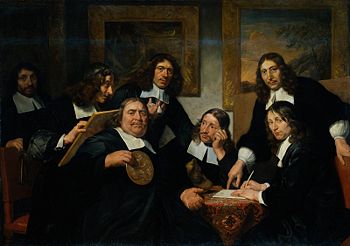
Dutch Republic
The Dutch Republic — officially known as the Republic of the Seven United Netherlands , the Republic of the United Netherlands, or the Republic of the Seven United Provinces — was a republic in Europe existing from 1581 to 1795, preceding the Batavian Republic and ultimately...
began to reinvent themselves as cities there changed over to Protestant rule, and there were dramatic movements in population. Many St. Luke guilds reissued charters to protect the interests of local painters from the influx of southern talent from places like Antwerp and Bruges. Many cities in the young republic became more important artistic centres in the late sixteenth and early seventeenth centuries. Amsterdam
Amsterdam
Amsterdam is the largest city and the capital of the Netherlands. The current position of Amsterdam as capital city of the Kingdom of the Netherlands is governed by the constitution of August 24, 1815 and its successors. Amsterdam has a population of 783,364 within city limits, an urban population...
was the first city to reissue a St. Luke's charter after the reformation in 1579, and it included painters, sculptors, engravers, and other trades dealing specifically in the visual arts. When trade between the Spanish Netherlands and the Dutch Republic
Dutch Republic
The Dutch Republic — officially known as the Republic of the Seven United Netherlands , the Republic of the United Netherlands, or the Republic of the Seven United Provinces — was a republic in Europe existing from 1581 to 1795, preceding the Batavian Republic and ultimately...
resumed with the Twelve Years' Truce
Twelve Years' Truce
The Twelve Years' Truce was the name given to the cessation of hostilities between the Habsburg rulers of Spain and the Southern Netherlands and the Dutch Republic as agreed in Antwerp on 9 April 1609. It was a watershed in the Eighty Years' War, marking the point from which the independence of the...
in 1609, immigration increased and many Dutch cities reissued guild charters as a form of protection against the great number of paintings that began to cross the border. For example, Gouda
Gouda
Gouda is a city and municipality in the western Netherlands, in the province of South Holland. Gouda, which was granted city rights in 1272, is famous for its Gouda cheese, smoking pipes, and 15th-century city hall....
, Rotterdam
Rotterdam
Rotterdam is the second-largest city in the Netherlands and one of the largest ports in the world. Starting as a dam on the Rotte river, Rotterdam has grown into a major international commercial centre...
, and Delft
Delft
Delft is a city and municipality in the province of South Holland , the Netherlands. It is located between Rotterdam and The Hague....
, all founded guilds between 1609 and 1611. In each of those cases, panel painters removed themselves from their traditional guild structure that included other painters, such as those who worked in fresco and on houses, in favor of a specific "Guild of St. Luke". On the other hand, these distinctions did not take effect at that time in Amsterdam or Haarlem. In the Haarlem Guild of St. Luke
Haarlem Guild of St. Luke
The Haarlem Guild of Saint Luke was first a Christian, and later a city Guild for a large number of trades falling under the patron saints Luke the Evangelist and Saint Eligius.-History:...
, however, a strict hierarchy was attempted in 1631 with panel painters at the top, though this hierarchy was eventually rejected. In the Utrecht
Utrecht (city)
Utrecht city and municipality is the capital and most populous city of the Dutch province of Utrecht. It is located in the eastern corner of the Randstad conurbation, and is the fourth largest city of the Netherlands with a population of 312,634 on 1 Jan 2011.Utrecht's ancient city centre features...
guild, also founded in 1611, the break was with the saddlemakers, but in 1644 a further split created a new painters' guild, leaving the guild of Saint Luke with only the sculptors and woodcarvers. A similar move in The Hague
The Hague
The Hague is the capital city of the province of South Holland in the Netherlands. With a population of 500,000 inhabitants , it is the third largest city of the Netherlands, after Amsterdam and Rotterdam...
in 1656 led to the painters leaving the Guild of Saint Luke to establish a new Confrerie Pictura
Confrerie Pictura
The Confrerie Pictura was a more or less academic club of artists founded in 1656 in The Hague, by local art painters, who were unsatisfied by the Guild of Saint Luke there.-History:The guild of St...
with all other kinds of visual artists, leaving the guild to the house-painters.
Artists in other cities were not successful in setting up their own guilds of St. Luke, and remained part of the existing guild structure (or lack thereof). For example, an attempt was made in Leiden to set up a guild in 1610 specifically for painters to protect themselves against the sale of art from foreigners, especially those from areas of Brabant
Duchy of Brabant
The Duchy of Brabant was a historical region in the Low Countries. Its territory consisted essentially of the three modern-day Belgian provinces of Flemish Brabant, Walloon Brabant and Antwerp, the Brussels-Capital Region and most of the present-day Dutch province of North Brabant.The Flag of...
and the area around Antwerp. However, the town, which traditionally resisted guilds in general, only offered to help them from illegal imports. Not until 1648 was a loosely-organized "quasi-guild" permitted in that city. The Guilds of the small but wealthy seat of government The Hague and its near neighbour, Delft, were constantly battling to stop the other's artists encroaching into their city, often without success. By the later part of the century a kind of balance was achieved, with The Hague's portraitists supplying both cities, whilst Delft's genre painters did the same.
Italy
In RenaissanceRenaissance
The Renaissance was a cultural movement that spanned roughly the 14th to the 17th century, beginning in Italy in the Late Middle Ages and later spreading to the rest of Europe. The term is also used more loosely to refer to the historical era, but since the changes of the Renaissance were not...
Florence
Florence
Florence is the capital city of the Italian region of Tuscany and of the province of Florence. It is the most populous city in Tuscany, with approximately 370,000 inhabitants, expanding to over 1.5 million in the metropolitan area....
the Guild of St. Luke, per se, did not exist. Painters belonged to the guild of the Doctors and Apothecaries ("Arte dei Medici e Speziali") as they bought their pigments from the apothecaries, while sculptors were members of the Masters of Stone and Wood ("Maestri di Pietri e Legname). They were also frequently members in the confraternity of St. Luke (Compagnia di San Luca)—which had been founded as early as 1349—although it was a separate entity from the guild system. There were similar confraternal organizations in other parts of Italy, such as Rome. By the 16th century a guild had even been established in Candia
Candia
-Places:* The old Venetian name for Heraklion, Crete* Kingdom of Candia, colony of the Republic of Venice * Candia Canavese, Italy* Candia Lomellina, Italy...
in Crete
Crete
Crete is the largest and most populous of the Greek islands, the fifth largest island in the Mediterranean Sea, and one of the thirteen administrative regions of Greece. It forms a significant part of the economy and cultural heritage of Greece while retaining its own local cultural traits...
, then a Venetian possession, by the very successful Greek artists of the Cretan School
Cretan School
The term Cretan School describes an important school of icon painting, also known as Post-Byzantine art, which flourished while Crete was under Venetian rule during the late Middle Ages, reaching its climax after the Fall of Constantinople, becoming the central force in Greek painting during the...
. In the sixteenth century, the Compagnia di San Luca began to meet at SS. Annunziata
Basilica della Santissima Annunziata di Firenze
The Basilica della Santissima Annunziata is a Roman Catholic minor basilica in Florence, Italy, the mother church of the Servite order. It is located at the northeastern side of the Piazza Santissima Annunziata....
, and sculptors, who had previously been members of a confraternity dedicated to St. Paul (Compagnia di San Paolo), also joined. This form of the compagnia developed into the Florentine Accademia del Disegno
Accademia di Belle Arti Firenze
The Accademia di Belle Arti is an art academy in Florence, Italy and it is now the operative branch of the still existing Accademia delle Arti del Disegno that was the first academy of drawing in Europe.-History:The Accademia delle Arti del Disegno The Accademia di Belle Arti ("Academy of Fine...
in 1563, which was then formally incorporated into the city's guild system in 1572. The Florence example, in fact, eventually acted more like a traditional guild structure than the Accademia di San Luca
Accademia di San Luca
The Accademia di San Luca, was founded in 1577 as an association of artists in Rome, under the directorship of Federico Zuccari, with the purpose of elevating the work of "artists", which included painters, sculptors and architects, above that of mere craftsmen. Other founders included Girolamo...
in Rome
Rome
Rome is the capital of Italy and the country's largest and most populated city and comune, with over 2.7 million residents in . The city is located in the central-western portion of the Italian Peninsula, on the Tiber River within the Lazio region of Italy.Rome's history spans two and a half...
. Founded by Federico Zuccari
Federico Zuccari
Federico Zuccari, also known as Federigo Zuccaro , was an Italian Mannerist painter and architect, active both in Italy and abroad.-Biography:Zuccari was born at Sant'Angelo in Vado, near Urbino ....
in 1593, Rome's Accademia reflects more clearly the "modern" notions of an artistic academy rather than perpetuating what has often been seen as the medieval nature of the guild system. Gradually other cities were to follow the example of Rome and the Carracci
Accademia degli Incamminati
The Accademia degli Incamminati was one of the first art academies in Italy. It was originally created around 1580 in Bologna as the Accademia dei Desiderosi and was sometimes known as the Accademia dei Carracci after its founders the Carracci cousins , with Annibale heading the institution thanks...
in Bologna
Bologna
Bologna is the capital city of Emilia-Romagna, in the Po Valley of Northern Italy. The city lies between the Po River and the Apennine Mountains, more specifically, between the Reno River and the Savena River. Bologna is a lively and cosmopolitan Italian college city, with spectacular history,...
, with leading painters founding an "Academy", not always initially in direct competition with the local Guilds, but tending to eclipse and supplant it in time. This shift in artistic representation is generally associated with the modern conception of the visual arts as a liberal rather than mechanical art, and occurred in cities across Europe. In Antwerp David Teniers the Younger
David Teniers the Younger
David Teniers the Younger was a Flemish artist born in Antwerp, the son of David Teniers the Elder. His son David Teniers III and his grandson David Teniers IV were also painters...
was both a dean of the Guild and founded the Academy, while in Venice Pittoni and Tiepolo
Giovanni Battista Tiepolo
Giovanni Battista Tiepolo , also known as Gianbattista or Giambattista Tiepolo, was an Italian painter and printmaker from the Republic of Venice...
led a breakaway Accademia
Accademia
The Accademia is a museum gallery of pre-19th century art in Venice, northern Italy. Situated on the south bank of the Grand Canal, within the sestiere of Dorsoduro, it gives its name to one of the three bridges across the canal, the Ponte dell'Accademia, and to the boat landing station for the...
from the old Fraglia dei Pittori as the local guild was known. The new academies began to offer training in drawing and the early stages of painting to students, and artistic theory, including the hierarchy of genres
Hierarchy of genres
A hierarchy of genres is any formalization which ranks different genres in an art form in terms of their prestige and cultural value....
, increased in importance.
Guilds and intellectual pursuits
The late sixteenth-century elevation of artist's status that occurred in Italy was echoed in the Low Countries by increased participation by artists in literary and humanistic societies. The Antwerp Guild of St. Luke, in particular, was closely associated with one of the city's eminent chambers of rhetoricChamber of rhetoric
Chambers of rhetoric were dramatic societies in the Low Countries. Their members are called Rederijkers , from the french word 'rhétoricien', and during the 15th and 16th centuries were mainly interested in dramas and lyrics...
, the Violieren
Violieren
The Violieren was a chamber of rhetoric that dates back to the 15th century in Antwerp, when it was the social drama society of the Guild of St. Luke. In 1660 it merged with its former rival "Olijftak", and in 1762 the society was dissolved altogether.-History:Much of what is known today about...
, and, in fact, the two were often discussed as being the same. By the mid-sixteenth century, when Pieter Bruegel the Elder was active in the city, most of the members of the Violieren, including Frans Floris
Frans Floris
Frans Floris, or more correctly Frans de Vriendt, called Floris was a Flemish painter. He was a member of a large family trained to the study of art in Flanders.-Biography:...
, Cornelis Floris, and Hieronymus Cock
Hieronymus Cock
Jérôme or Hieronymus Cock, or Wellens de Cock was a Flemish painter and etcher of the Northern Renaissance, as well as a publisher and distributor of prints.-Biography:...
, were artists. The relationship between the two organizations, one for professionals practicing a trade and the other a literary and dramatist group, continued into the seventeenth century until the two groups formally merged in 1663 when the Antwerp Academy was founded a century after its Roman counterpart. Similar relationships between the Guild of St. Luke and chambers of rhetoric appear to have existed in Dutch cities in the seventeenth century. Haarlem's
Haarlem
Haarlem is a municipality and a city in the Netherlands. It is the capital of the province of North Holland, the northern half of Holland, which at one time was the most powerful of the seven provinces of the Dutch Republic...
"Liefde boven al" ("Love above all") is a prime example, to which Frans Hals
Frans Hals
Frans Hals was a Dutch Golden Age painter. He is notable for his loose painterly brushwork, and helped introduce this lively style of painting into Dutch art. Hals was also instrumental in the evolution of 17th century group portraiture.-Biography:Hals was born in 1580 or 1581, in Antwerp...
, Esaias van de Velde
Esaias van de Velde
Esaias van de Velde was a Dutch landscape painter.-Biography:Born in Amsterdam, where his Flemish father Hans had fled as a Protestant in 1585, he probably studied under his father and Gillis van Coninxloo, a landscape painter from Antwerp and a follower of Pieter Brueghel the Elder...
, and Adriaen Brouwer
Adriaen Brouwer
Adriaen Brouwer was a Flemish genre painter active in Flanders and the Dutch Republic in the seventeenth century.-Biography:...
all belonged. These activities also manifested themselves in groups that developed outside of the guild like Antwerp's Romanists
Guild of Romanists
The Guild of Romanists was a 16th and 17th century society in Antwerp for humanist and artists; it was a condition of membership that the member had visited Rome. Deans were appointed annually. It was "where 'art-pilgrims' met to keep themselves up to date on news from Rome, whether it be new...
, for whom travel to Italy and appreciation of classical and humanist culture were essential.
Guild rules
Guild rules varied greatly. In common with the Guilds for other trades, there would be an initial apprenticeship of at least three, more often five years. Typically, the apprentice would then qualify as a "journeymanJourneyman
A journeyman is someone who completed an apprenticeship and was fully educated in a trade or craft, but not yet a master. To become a master, a journeyman had to submit a master work piece to a guild for evaluation and be admitted to the guild as a master....
", free to work for any Guild member. Some artists began to sign and date paintings a year or two before they reached the next stage, which often involved a payment to the Guild, and was to become a "free Master
Master craftsman
A master craftsman or master tradesman was a member of a guild. In the European guild system, only masters were allowed to be members of the guild....
". After this the artist could sell his own works, set up his own workshop with apprentices of his own, and also sell the work of other artists. Anthony van Dyck
Anthony van Dyck
Sir Anthony van Dyck was a Flemish Baroque artist who became the leading court painter in England. He is most famous for his portraits of Charles I of England and his family and court, painted with a relaxed elegance that was to be the dominant influence on English portrait-painting for the next...
achieved this at eighteen, but in the twenties would be more typical. In some places the maximum number of apprentices was specified (as for example two), especially in the earlier periods, and alternatively a minimum of one might be specified. In Nuremberg
Nuremberg
Nuremberg[p] is a city in the German state of Bavaria, in the administrative region of Middle Franconia. Situated on the Pegnitz river and the Rhine–Main–Danube Canal, it is located about north of Munich and is Franconia's largest city. The population is 505,664...
painting, unlike say goldsmithing, was a "free trade" without a Guild and regulated directly by the city council; this was intended to encourage growth in a city where much art was becoming linked with book publishing
Publishing
Publishing is the process of production and dissemination of literature or information—the activity of making information available to the general public...
, for which Nuremberg was the largest German centre. Nonetheless there were rules and for example only married men could operate a workshop. In most cities the women who were important members of workshops making illuminated manuscript
Illuminated manuscript
An illuminated manuscript is a manuscript in which the text is supplemented by the addition of decoration, such as decorated initials, borders and miniature illustrations...
s were excluded from the Guild or from being masters; however not in Antwerp, where Caterina van Hemessen and others were members. As the Christian title of the Guild suggested, Jews were excluded, at least from becoming masters, in most cities.
When printmaking
Printmaking
Printmaking is the process of making artworks by printing, normally on paper. Printmaking normally covers only the process of creating prints with an element of originality, rather than just being a photographic reproduction of a painting. Except in the case of monotyping, the process is capable...
arrived, many engravers were from a goldsmith
Goldsmith
A goldsmith is a metalworker who specializes in working with gold and other precious metals. Since ancient times the techniques of a goldsmith have evolved very little in order to produce items of jewelry of quality standards. In modern times actual goldsmiths are rare...
ing background and stayed in that guild. As that link weakened with the development of pintmaking, some painter' guilds accepted engravers or etchers who did not paint as Members, and others did not. In London painters on glass had their own separate guild with the glaziers; elsewhere they would be accepted by the painters.
The rules of the Delft guild have been much puzzled over by art historians seeking to illuminate the undocumented training of Vermeer. When he joined the Guild there in 1653, he must have received six years training, according to the local rules. In addition, he had to pay a six guilders admission fee, despite the fact that his father was a Guild member (as an art dealer), which would normally have meant only a three guilder fee. This appears to mean that his training had not been received in Delft itself. Pieter de Hooch
Pieter de Hooch
Pieter de Hooch was a genre painter during the Dutch Golden Age. He was a contemporary of Dutch Master Jan Vermeer, with whom his work shared themes and style.-Biography:...
on the other hand, as an immigrant to Delft, had to pay twelve guilders in 1655, which he could not afford to pay all at once.
Another aspect of the Guild rules is illustrated by the dispute between Frans Hals
Frans Hals
Frans Hals was a Dutch Golden Age painter. He is notable for his loose painterly brushwork, and helped introduce this lively style of painting into Dutch art. Hals was also instrumental in the evolution of 17th century group portraiture.-Biography:Hals was born in 1580 or 1581, in Antwerp...
and Judith Leyster
Judith Leyster
Judith Jans Leyster was a Dutch Golden Age painter. She was one of three significant women artists in Dutch Golden Age painting; the other two, Rachel Ruysch and Maria van Oosterwijk, were specialized painters of flower still-lifes, while Leyster painted genre works, a few portraits, and a...
in Haarlem. Leyster was the first woman in Haarlem to join the Guild, and may have trained with Hals - she was a witness at the baptism
Baptism
In Christianity, baptism is for the majority the rite of admission , almost invariably with the use of water, into the Christian Church generally and also membership of a particular church tradition...
of his daughter. Some years later, in 1635, she brought a dispute to the Guild complaining that one of her three apprentices had left her workshop after only a few days, and had been accepted into Hals' shop, in breach of Guild rules. The Guild had the power to fine members, and after discovering that the apprentice had not been registered with them, fined both artists, and made a ruling on the apprentice's position.
Decline of the guilds
All guild local monopolies came under general economic disapproval from the 17th century onwards; in the particular case of painters there was in many places a tension between the Guilds and artists imported as court painter by a ruler. When Anthony van DyckAnthony van Dyck
Sir Anthony van Dyck was a Flemish Baroque artist who became the leading court painter in England. He is most famous for his portraits of Charles I of England and his family and court, painted with a relaxed elegance that was to be the dominant influence on English portrait-painting for the next...
was finally enticed to come to England by King Charles I, he was provided with a house at Blackfriars, then just outside the boundary of the City of London
City of London
The City of London is a small area within Greater London, England. It is the historic core of London around which the modern conurbation grew and has held city status since time immemorial. The City’s boundaries have remained almost unchanged since the Middle Ages, and it is now only a tiny part of...
to avoid the monopoly of the London guild. The Hague
The Hague
The Hague is the capital city of the province of South Holland in the Netherlands. With a population of 500,000 inhabitants , it is the third largest city of the Netherlands, after Amsterdam and Rotterdam...
with its Catholic court, split itself in two in 1656 with the Confrerie Pictura
Confrerie Pictura
The Confrerie Pictura was a more or less academic club of artists founded in 1656 in The Hague, by local art painters, who were unsatisfied by the Guild of Saint Luke there.-History:The guild of St...
. By that time it was clear to all involved that the one-stop-shop concept of a guild was past its prime, and to ensure high quality and high prices, the education of artists needed to be separated from sales venues. Many towns set up academy style schools for education, while sales could be generated from arranged viewings at local inns, estate sales, or open markets. In Antwerp the Habsburg Governors eventually removed the Guild's monopoly, and by the end of the 18th century hardly any guild monopolies survived, even before Napoleon disbanded all guilds in territories he controlled. Guilds survived as societies or charitable organisations, or merged with the newer "Academies" - as happened in Antwerp, but not in London or Paris. Guild monopoly had a brief 20th century revival in Eastern Europe under Communism
Communism
Communism is a social, political and economic ideology that aims at the establishment of a classless, moneyless, revolutionary and stateless socialist society structured upon common ownership of the means of production...
, where non-members of the official artist's union or guild found it very hard to work as painters - for example the Czech Josef Váchal
Josef Váchal
Josef Váchal was a Czech writer, painter, graphic designer and book-printer.Váchal was the illegitimate son of Josef Aleš-Lyžec and Anna Váchalová - his parents never married...
.
Paintings for the guilds
In many cities the Guild of Saint Luke financed a chapel that was decorated with an altarpiece of their patron saint. Rogier van der Weyden's St. Luke Drawing the Virgin (Museum of Fine Arts, BostonMuseum of Fine Arts, Boston
The Museum of Fine Arts in Boston, Massachusetts, is one of the largest museums in the United States, attracting over one million visitors a year. It contains over 450,000 works of art, making it one of the most comprehensive collections in the Americas...
), one of the earliest-known paintings, set up a tradition that was followed by many subsequent artists. Jan Gossaert's work in the Kunsthistorisches Museum, Vienna (illustrated, top right) revisits Van der Weyden's composition while presenting the scene as a visionary experience instead of a directly-witnessed portrait sitting. Later, Frans Floris
Frans Floris
Frans Floris, or more correctly Frans de Vriendt, called Floris was a Flemish painter. He was a member of a large family trained to the study of art in Flanders.-Biography:...
(1556), Marten de Vos
Marten de Vos
Marten de Vos , also Maarten, was a leading Antwerp painter and draughtsman in the late sixteenth century.-Biography:Like Frans Floris, he travelled to Italy and adopted the mannerist style popular at the time. De Vos was also highly influenced by the colors of Venetian painting, and might have...
(1602) and Otto van Veen
Otto van Veen
Otto van Veen, also known by his Latinized name Otto Venius or Octavius Vaenius, was a painter, draughtsman, and humanist active primarily in Antwerp and Brussels in the late sixteenth and early seventeenth century...
all represented the subject for the guild in Antwerp, and Abraham Janssens
Abraham Janssens
Abraham Janssens van Nuyssen was a Flemish Baroque painter.He was born at Antwerp, in a year variously reported between 1567 and 1576. He studied under Jan Snellinck, was a master in 1602, and in 1607 was dean of the master-painters...
painted an altarpiece for the guild in Mechelen
Mechelen
Mechelen Footnote: Mechelen became known in English as 'Mechlin' from which the adjective 'Mechlinian' is derived...
in 1605. These paintings are frequently self-portraits with the artist as Luke, and often provide insight into artistic practices from the time when they were made since the subject is of an artist at work.
See also
- Saint Luke painting the VirginSaint Luke painting the VirginSaint Luke painting the Virgin, , is a devotional subject in art showing Saint Luke painting the Virgin Mary with the Baby Jesus. Such paintings were often painted for chapels of Saint Luke in European churches during the Renaissance, and often include the pose of the Salus Populi Romani, based on...
- Worshipful Company of Painter-StainersWorshipful Company of Painter-StainersThe Worshipful Company of Painter-Stainers is one of the Livery Companies of the City of London. An organisation of stainers, or painters of metals and wood, is known to have existed as early as 1268. A similar organisation of painters, who generally worked on cloth, existed as early as 1283...
London - Worshipful Company of Glaziers and Painters of GlassWorshipful Company of Glaziers and Painters of GlassThe Worshipful Company of Glaziers and Painters of Glass is one of the Livery Companies of the City of London. The Guild of Glaziers, or makers of Glass, the Company's forerunner, existed as early as 1328. It received a Royal Charter of incorporation in 1638...
London - Guild of RomanistsGuild of RomanistsThe Guild of Romanists was a 16th and 17th century society in Antwerp for humanist and artists; it was a condition of membership that the member had visited Rome. Deans were appointed annually. It was "where 'art-pilgrims' met to keep themselves up to date on news from Rome, whether it be new...
Club in 17th century Antwerp - Royal Academy of Fine Arts AntwerpRoyal Academy of Fine Arts AntwerpThe Royal Academy of Fine Arts Antwerp is an art academy located in Antwerp, Belgium. It is one of the oldest of its kind in Europe. It was founded in 1663 by David Teniers the Younger, painter to the Archduke Leopold Wilhelm and Don Juan of Austria...
Founded in 1663
External links
Further reading
- Stabel,Peter, "Organisation corporative et production d'oeuvres d'art à Bruges à la fin du moyen âge et au début des temps modernes", in: Le Moyen Âge. Revue d'histoire et de philologie, 113, 1, 2007, pp. 91–134.