


Growth medium

Encyclopedia
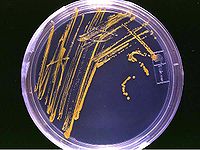
Microorganism
A microorganism or microbe is a microscopic organism that comprises either a single cell , cell clusters, or no cell at all...
s or cell
Cell (biology)
The cell is the basic structural and functional unit of all known living organisms. It is the smallest unit of life that is classified as a living thing, and is often called the building block of life. The Alberts text discusses how the "cellular building blocks" move to shape developing embryos....
s, or small plant
Plant
Plants are living organisms belonging to the kingdom Plantae. Precise definitions of the kingdom vary, but as the term is used here, plants include familiar organisms such as trees, flowers, herbs, bushes, grasses, vines, ferns, mosses, and green algae. The group is also called green plants or...
s like the moss
Moss
Mosses are small, soft plants that are typically 1–10 cm tall, though some species are much larger. They commonly grow close together in clumps or mats in damp or shady locations. They do not have flowers or seeds, and their simple leaves cover the thin wiry stems...
Physcomitrella patens
Physcomitrella patens
Physcomitrella patens is a moss used as a model organism for studies on plant evolution, development and physiology.-Model organism:...
.
There are different types of media for growing different types of cells.
There are two major types of growth media: those used for cell culture
Cell culture
Cell culture is the complex process by which cells are grown under controlled conditions. In practice, the term "cell culture" has come to refer to the culturing of cells derived from singlecellular eukaryotes, especially animal cells. However, there are also cultures of plants, fungi and microbes,...
, which use specific cell types derived from plants or animals, and microbiological culture
Microbiological culture
A microbiological culture, or microbial culture, is a method of multiplying microbial organisms by letting them reproduce in predetermined culture media under controlled laboratory conditions. Microbial cultures are used to determine the type of organism, its abundance in the sample being tested,...
, which are used for growing microorganisms, such as bacteria
Bacteria
Bacteria are a large domain of prokaryotic microorganisms. Typically a few micrometres in length, bacteria have a wide range of shapes, ranging from spheres to rods and spirals...
or yeast
Yeast
Yeasts are eukaryotic micro-organisms classified in the kingdom Fungi, with 1,500 species currently described estimated to be only 1% of all fungal species. Most reproduce asexually by mitosis, and many do so by an asymmetric division process called budding...
. The most common growth media for microorganisms are nutrient broths and agar plate
Agar plate
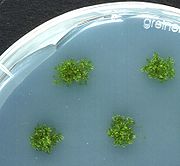
An agar plate is a Petri dish that contains a growth medium used to culture microorganisms or small plants like the moss Physcomitrella patens.Selective growth compounds may also be added to the media, such as antibiotics....
s; specialized media are sometimes required for microorganism and cell culture growth. Some organisms, termed fastidious organisms, require specialized environments due to complex nutritional requirements. Virus
Virus
A virus is a small infectious agent that can replicate only inside the living cells of organisms. Viruses infect all types of organisms, from animals and plants to bacteria and archaea...
es, for example, are obligate intracellular parasites and require a growth medium containing living cells.
Types of growth media
The most common growth media for microorganisms are nutrient broths (liquid nutrient medium) or LB medium (Lysogeny BrothLysogeny broth
Lysogeny broth , a nutritionally rich medium, is primarily used for the growth of bacteria. The acronym has been incorrectly interpreted as Luria broth, Lennox broth, or Luria-Bertani medium; according to its creator Giuseppe Bertani, the abbreviation LB was actually intended to stand for lysogeny...
). Liquid media are often mixed with agar
Agar
Agar or agar-agar is a gelatinous substance derived from a polysaccharide that accumulates in the cell walls of agarophyte red algae. Throughout history into modern times, agar has been chiefly used as an ingredient in desserts throughout Asia and also as a solid substrate to contain culture medium...
and poured into Petri dish
Petri dish
A Petri dish is a shallow glass or plastic cylindrical lidded dish that biologists use to culture cells or small moss plants. It was named after German bacteriologist Julius Richard Petri, who invented it when working as an assistant to Robert Koch...
es to solidify. These agar plate
Agar plate
An agar plate is a Petri dish that contains a growth medium used to culture microorganisms or small plants like the moss Physcomitrella patens.Selective growth compounds may also be added to the media, such as antibiotics....
s provide a solid medium on which microbes may be cultured. They remain solid, as very few bacteria are able to decompose agar. Bacteria grown in liquid cultures often form colloid
Colloid
A colloid is a substance microscopically dispersed evenly throughout another substance.A colloidal system consists of two separate phases: a dispersed phase and a continuous phase . A colloidal system may be solid, liquid, or gaseous.Many familiar substances are colloids, as shown in the chart below...
al suspension
Suspension (chemistry)
In chemistry, a suspension is a heterogeneous fluid containing solid particles that are sufficiently large for sedimentation. Usually they must be larger than 1 micrometer. The internal phase is dispersed throughout the external phase through mechanical agitation, with the use of certain...
s.
The difference between growth media used for cell culture and those used for microbiological culture is that cells derived from whole organisms and grown in culture often cannot grow without the addition of, for instance, hormones or growth factors which usually occur in vivo
In vivo
In vivo is experimentation using a whole, living organism as opposed to a partial or dead organism, or an in vitro controlled environment. Animal testing and clinical trials are two forms of in vivo research...
. In the case of animal cells, this difficulty is often addressed by the addition of blood serum
Blood serum
In blood, the serum is the component that is neither a blood cell nor a clotting factor; it is the blood plasma with the fibrinogens removed...
or a synthetic serum replacement to the medium. In the case of microorganisms, there are no such limitations, as they are often unicellular organism
Unicellular organism
A unicellular organism, also known as a single-celled organism is an organism that consists of only one cell, in contrast to a multicellular organism that consists of multiple cells. Historically simple single celled organisms have sometimes been referred to as monads Prokaryotes, most protists,...
s. One other major difference is that animal cells in culture are often grown on a flat surface to which they attach, and the medium is provided in a liquid form, which covers the cells. In contrast, bacteria such as Escherichia coli
Escherichia coli
Escherichia coli is a Gram-negative, rod-shaped bacterium that is commonly found in the lower intestine of warm-blooded organisms . Most E. coli strains are harmless, but some serotypes can cause serious food poisoning in humans, and are occasionally responsible for product recalls...
may be grown on solid media or in liquid media.
An important distinction between growth media types is that of defined versus undefined media. A defined medium will have known quantities of all ingredients. For microorganisms, they consist of providing trace elements and vitamins required by the microbe and especially a defined carbon source
Carbon
Carbon is the chemical element with symbol C and atomic number 6. As a member of group 14 on the periodic table, it is nonmetallic and tetravalent—making four electrons available to form covalent chemical bonds...
and nitrogen source
Nitrogen
Nitrogen is a chemical element that has the symbol N, atomic number of 7 and atomic mass 14.00674 u. Elemental nitrogen is a colorless, odorless, tasteless, and mostly inert diatomic gas at standard conditions, constituting 78.08% by volume of Earth's atmosphere...
. Glucose
Glucose
Glucose is a simple sugar and an important carbohydrate in biology. Cells use it as the primary source of energy and a metabolic intermediate...
or glycerol
Glycerol
Glycerol is a simple polyol compound. It is a colorless, odorless, viscous liquid that is widely used in pharmaceutical formulations. Glycerol has three hydroxyl groups that are responsible for its solubility in water and its hygroscopic nature. The glycerol backbone is central to all lipids...
are often used as carbon sources, and ammonium
Ammonium
The ammonium cation is a positively charged polyatomic cation with the chemical formula NH. It is formed by the protonation of ammonia...
salt
Salt
In chemistry, salts are ionic compounds that result from the neutralization reaction of an acid and a base. They are composed of cations and anions so that the product is electrically neutral...
s or nitrate
Nitrate
The nitrate ion is a polyatomic ion with the molecular formula NO and a molecular mass of 62.0049 g/mol. It is the conjugate base of nitric acid, consisting of one central nitrogen atom surrounded by three identically-bonded oxygen atoms in a trigonal planar arrangement. The nitrate ion carries a...
s as inorganic nitrogen sources. An undefined medium has some complex ingredients, such as yeast extract
Yeast extract
Yeast extract is the common name for various forms of processed yeast products made by extracting the cell contents ; they are used as food additives or flavourings, or as nutrients for bacterial culture media. They are often used to create savory flavors and umami taste sensations. Monosodium...
or casein hydrolysate, which consist of a mixture of many, many chemical species in unknown proportions. Undefined media are sometimes chosen based on price and sometimes by necessity - some microorganisms have never been cultured on defined media.
A good example of a growth medium is the wort
Wort (brewing)
Wort, , is the liquid extracted from the mashing process during the brewing of beer or whisky. Wort contains the sugars that will be fermented by the brewing yeast to produce alcohol.- Production :...
used to make beer
Beer
Beer is the world's most widely consumed andprobably oldest alcoholic beverage; it is the third most popular drink overall, after water and tea. It is produced by the brewing and fermentation of sugars, mainly derived from malted cereal grains, most commonly malted barley and malted wheat...
. The wort contains all the nutrients required for yeast growth, and under anaerobic conditions, alcohol is produced. When the fermentation
Fermentation (food)
Fermentation in food processing typically is the conversion of carbohydrates to alcohols and carbon dioxide or organic acids using yeasts, bacteria, or a combination thereof, under anaerobic conditions. Fermentation in simple terms is the chemical conversion of sugars into ethanol...
process is complete, the combination of medium and dormant microbes, now beer, is ready for consumption.
Nutrient media
- a source of amino acids and nitrogen (e.g., beef, yeast extract)
This is an undefined medium because the amino acid source contains a variety of compounds with the exact composition being unknown. Nutrient media contain all the elements that most bacteria need for growth and are non-selective, so they are used for the general cultivation and maintenance of bacteria kept in laboratory culture collections.
- a carbon source such as glucoseGlucoseGlucose is a simple sugar and an important carbohydrate in biology. Cells use it as the primary source of energy and a metabolic intermediate...
for bacterial growth - water
- various salts needed for bacterial growth
A defined medium (also known as chemically defined medium
Chemically defined medium
A chemically defined medium is a growth medium suitable for the in vitro cell culture of human or animal cells in which all of the chemical components are known...
or synthetic medium) is a medium in which
- all the chemicals used are known
- no yeast, animal or plant tissue is present
A differential medium is a medium that includes
- some sort of added indicator that allows for the differentiation of particular chemical reactions occurring during growth
Minimal media
Minimal media are those that contain the minimum nutrients possible for colony growth, generally without the presence of amino acids, and are often used by microbiologists and geneticists to grow "wild type" microorganisms. Minimal media can also be used to select for or against recombinantRecombinant DNA
Recombinant DNA molecules are DNA sequences that result from the use of laboratory methods to bring together genetic material from multiple sources, creating sequences that would not otherwise be found in biological organisms...
s or exconjugants.
Minimal medium typically contains:
- a carbon source for bacterial growth, which may be a sugar such as glucoseGlucoseGlucose is a simple sugar and an important carbohydrate in biology. Cells use it as the primary source of energy and a metabolic intermediate...
, or a less energy-rich source like succinate - various salts, which may vary among bacteria species and growing conditions; these generally provide essential elements such as magnesiumMagnesiumMagnesium is a chemical element with the symbol Mg, atomic number 12, and common oxidation number +2. It is an alkaline earth metal and the eighth most abundant element in the Earth's crust and ninth in the known universe as a whole...
, nitrogenNitrogenNitrogen is a chemical element that has the symbol N, atomic number of 7 and atomic mass 14.00674 u. Elemental nitrogen is a colorless, odorless, tasteless, and mostly inert diatomic gas at standard conditions, constituting 78.08% by volume of Earth's atmosphere...
, phosphorusPhosphorusPhosphorus is the chemical element that has the symbol P and atomic number 15. A multivalent nonmetal of the nitrogen group, phosphorus as a mineral is almost always present in its maximally oxidized state, as inorganic phosphate rocks...
, and sulfurSulfurSulfur or sulphur is the chemical element with atomic number 16. In the periodic table it is represented by the symbol S. It is an abundant, multivalent non-metal. Under normal conditions, sulfur atoms form cyclic octatomic molecules with chemical formula S8. Elemental sulfur is a bright yellow...
to allow the bacteria to synthesize proteinProteinProteins are biochemical compounds consisting of one or more polypeptides typically folded into a globular or fibrous form, facilitating a biological function. A polypeptide is a single linear polymer chain of amino acids bonded together by peptide bonds between the carboxyl and amino groups of...
and nucleic acidNucleic acidNucleic acids are biological molecules essential for life, and include DNA and RNA . Together with proteins, nucleic acids make up the most important macromolecules; each is found in abundance in all living things, where they function in encoding, transmitting and expressing genetic information... - water
Supplementary minimal media are a type of minimal media that also contains a single selected agent, usually an amino acid
Amino acid
Amino acids are molecules containing an amine group, a carboxylic acid group and a side-chain that varies between different amino acids. The key elements of an amino acid are carbon, hydrogen, oxygen, and nitrogen...
or a sugar
Sugar
Sugar is a class of edible crystalline carbohydrates, mainly sucrose, lactose, and fructose, characterized by a sweet flavor.Sucrose in its refined form primarily comes from sugar cane and sugar beet...
. This supplementation allows for the culturing of specific lines of auxotrophic recombinants.
Selective media

Antibiotic
An antibacterial is a compound or substance that kills or slows down the growth of bacteria.The term is often used synonymously with the term antibiotic; today, however, with increased knowledge of the causative agents of various infectious diseases, antibiotic has come to denote a broader range of...
, such as ampicillin
Ampicillin
Ampicillin is a beta-lactam antibiotic that has been used extensively to treat bacterial infections since 1961. Until the introduction of ampicillin by the British company Beecham, penicillin therapies had only been effective against Gram-positive organisms such as staphylococci and streptococci...
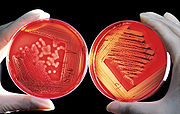
or tetracycline, then that antibiotic can be added to the medium in order to prevent other cells, which do not possess the resistance, from growing. Media lacking an amino acid
Amino acid
Amino acids are molecules containing an amine group, a carboxylic acid group and a side-chain that varies between different amino acids. The key elements of an amino acid are carbon, hydrogen, oxygen, and nitrogen...
such as proline
Proline
Proline is an α-amino acid, one of the twenty DNA-encoded amino acids. Its codons are CCU, CCC, CCA, and CCG. It is not an essential amino acid, which means that the human body can synthesize it. It is unique among the 20 protein-forming amino acids in that the α-amino group is secondary...
in conjunction with E. coli
Escherichia coli
Escherichia coli is a Gram-negative, rod-shaped bacterium that is commonly found in the lower intestine of warm-blooded organisms . Most E. coli strains are harmless, but some serotypes can cause serious food poisoning in humans, and are occasionally responsible for product recalls...
unable to synthesize it were commonly used by geneticists before the emergence of genomics
Genomics
Genomics is a discipline in genetics concerning the study of the genomes of organisms. The field includes intensive efforts to determine the entire DNA sequence of organisms and fine-scale genetic mapping efforts. The field also includes studies of intragenomic phenomena such as heterosis,...
to map bacterial chromosomes.
Selective growth media are also used in cell culture
Cell culture
Cell culture is the complex process by which cells are grown under controlled conditions. In practice, the term "cell culture" has come to refer to the culturing of cells derived from singlecellular eukaryotes, especially animal cells. However, there are also cultures of plants, fungi and microbes,...
to ensure the survival or proliferation of cells with certain properties, such as antibiotic resistance
Antibiotic resistance
Antibiotic resistance is a type of drug resistance where a microorganism is able to survive exposure to an antibiotic. While a spontaneous or induced genetic mutation in bacteria may confer resistance to antimicrobial drugs, genes that confer resistance can be transferred between bacteria in a...
or the ability to synthesize a certain metabolite
Metabolite
Metabolites are the intermediates and products of metabolism. The term metabolite is usually restricted to small molecules. A primary metabolite is directly involved in normal growth, development, and reproduction. Alcohol is an example of a primary metabolite produced in large-scale by industrial...
. Normally, the presence of a specific gene
Gene
A gene is a molecular unit of heredity of a living organism. It is a name given to some stretches of DNA and RNA that code for a type of protein or for an RNA chain that has a function in the organism. Living beings depend on genes, as they specify all proteins and functional RNA chains...
or an allele
Allele
An allele is one of two or more forms of a gene or a genetic locus . "Allel" is an abbreviation of allelomorph. Sometimes, different alleles can result in different observable phenotypic traits, such as different pigmentation...
of a gene confers upon the cell the ability to grow in the selective medium. In such cases, the gene is termed a marker
Genetic marker
A genetic marker is a gene or DNA sequence with a known location on a chromosome that can be used to identify cells, individuals or species. It can be described as a variation that can be observed...
.
Selective growth media for eukaryotic cells commonly contain neomycin
Neomycin
Neomycin is an aminoglycoside antibiotic that is found in many topical medications such as creams, ointments, and eyedrops. The discovery of Neomycin dates back to 1949. It was discovered in the lab of Selman Waksman, who was later awarded the Nobel Prize in Physiology and medicine in 1951...
to select cells that have been successfully transfected
Transfection
Transfection is the process of deliberately introducing nucleic acids into cells. The term is used notably for non-viral methods in eukaryotic cells...
with a plasmid carrying the neomycin resistance gene as a marker. Gancyclovir is an exception to the rule as it is used to specifically kill cells that carry its respective marker, the Herpes simplex virus
Herpes simplex virus
Herpes simplex virus 1 and 2 , also known as Human herpes virus 1 and 2 , are two members of the herpes virus family, Herpesviridae, that infect humans. Both HSV-1 and HSV-2 are ubiquitous and contagious...
thymidine kinase (HSV TK).
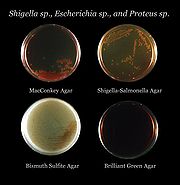
- eosin methylene blueEosin methylene blueEosin methylene blue is a slightly selective stain for Gram-negative bacteria. It is a blend of two stains, eosin and methylene blue in the ratio of 6:1...
(EMB) that contains methylene blueMethylene blueMethylene blue is a heterocyclic aromatic chemical compound with the molecular formula C16H18N3SCl. It has many uses in a range of different fields, such as biology and chemistry. At room temperature it appears as a solid, odorless, dark green powder, that yields a blue solution when dissolved in...
– toxic to Gram-positiveGram-positiveGram-positive bacteria are those that are stained dark blue or violet by Gram staining. This is in contrast to Gram-negative bacteria, which cannot retain the crystal violet stain, instead taking up the counterstain and appearing red or pink...
bacteria, allowing only the growth of Gram negative bacteria - YMYM (selective medium)YM Agar and Broth, is a selective growth medium with low pH useful for cultivating yeasts, molds, or other acid-tolerant or acidophilic organisms, while deterring growth of most bacteria and other acid intolerant organisms...
(yeastYeastYeasts are eukaryotic micro-organisms classified in the kingdom Fungi, with 1,500 species currently described estimated to be only 1% of all fungal species. Most reproduce asexually by mitosis, and many do so by an asymmetric division process called budding...
and moldMoldMolds are fungi that grow in the form of multicellular filaments called hyphae. Molds are not considered to be microbes but microscopic fungi that grow as single cells called yeasts...
) which has a low pHPHIn chemistry, pH is a measure of the acidity or basicity of an aqueous solution. Pure water is said to be neutral, with a pH close to 7.0 at . Solutions with a pH less than 7 are said to be acidic and solutions with a pH greater than 7 are basic or alkaline...
, deterring bacterial growth - MacConkey agarMacConkey agarMacConkey agar is a culture medium designed to grow Gram-negative bacteria and stain them for lactose fermentation.-Contents:It contains bile salts MacConkey agar is a culture medium designed to grow Gram-negative bacteria and stain them for lactose fermentation.-Contents:It contains bile salts...
for Gram-negativeGram-negativeGram-negative bacteria are bacteria that do not retain crystal violet dye in the Gram staining protocol. In a Gram stain test, a counterstain is added after the crystal violet, coloring all Gram-negative bacteria with a red or pink color...
bacteria - Hektoen enteric agarHektoen enteric agarHektoen enteric agar is a selective and differential agar primarily used to recover Salmonella and Shigella from patient specimens. HE contains indicators of lactose fermentation and H2S production; as well as inhibitors to prevent the growth of gram positive bacteria...
(HE) which is selective for Gram-negative bacteria - mannitol salt agarMannitol Salt AgarMannitol salt agar or MSA is a commonly used growth medium in microbiology. It encourages the growth of a group of certain bacteria while inhibiting the growth of others. This medium is important in medical laboratories by distinguishing pathogenic microbes in a short period of time...
(MSA) which is selective for Gram-positive bacteria and differential for mannitol - Terrific Broth (TB) is used with glycerol in cultivating recombinant strains of Escherichia coli.
- xylose lysine desoxyscholateXLD agarXylose lysine deoxycholate agar is a selective growth medium used in the isolation of Salmonella and Shigella species from clinical samples and from food. It has a pH of approximately 7.4, leaving it with a bright pink or red appearance due to the indicator phenol red. Sugar fermentation lowers...
(XLD), which is selective for Gram-negative bacteria - buffered charcoal yeast extract agarBuffered charcoal yeast extract agarBuffered charcoal yeast extract agar is a selective growth medium used to culture or grow certain bacteria, particularly the Gram-negative species Legionella pneumophila.It has also been used for the recovery of Acanthamoeba keratitis....
, which is selective for certain gram-negative bacteria, especially Legionella pneumophilaLegionella pneumophilaLegionella pneumophila is a thin, ærobic, pleomorphic, flagellated, non-spore forming, Gram-negative bacterium of the genus Legionella. L. pneumophila is the primary human pathogenic bacterium in this group and is the causative agent of legionellosis or Legionnaires' disease.-Characterization:L...
Differential media
Differential media or indicator media distinguish one microorganism type from another growing on the same media. This type of media uses the biochemical characteristics of a microorganism growing in the presence of specific nutrients or indicators (such as neutral redNeutral red
Neutral Red is a eurhodin dye used for staining in histology. It stains lysosomes red. It is used as a general stain in histology, as a counterstain in combination with other dyes, and for many staining methods. Together with Janus Green B, it is used to stain embryonal tissues and supravital...
, phenol red
Phenol red
Phenol red is a pH indicator that is frequently used in cell biology laboratories.-Chemical structure and properties:...
, eosin y
Eosin
Eosin is a fluorescent red dye resulting from the action of bromine on fluorescein. It can be used to stain cytoplasm, collagen and muscle fibers for examination under the microscope. Structures that stain readily with eosin are termed eosinophilic....
, or methylene blue
Methylene blue
Methylene blue is a heterocyclic aromatic chemical compound with the molecular formula C16H18N3SCl. It has many uses in a range of different fields, such as biology and chemistry. At room temperature it appears as a solid, odorless, dark green powder, that yields a blue solution when dissolved in...
) added to the medium to visibly indicate the defining characteristics of a microorganism. This type of media is used for the detection of microorganisms and by molecular biologists to detect recombinant strains of bacteria.
Examples of differential media include:
- blood agar (used in strepGroup A streptococcal infectionThe group A streptococcus bacterium is a form of β-hemolytic Streptococcus bacteria responsible for most cases of streptococcal illness. Other types may also cause infection...
tests), which contains bovine heart blood that becomes transparent in the presence of hemolytic StreptococcusStreptococcusStreptococcus is a genus of spherical Gram-positive bacteria belonging to the phylum Firmicutes and the lactic acid bacteria group. Cellular division occurs along a single axis in these bacteria, and thus they grow in chains or pairs, hence the name — from Greek στρεπτος streptos, meaning... - eosin methylene blueEosin methylene blueEosin methylene blue is a slightly selective stain for Gram-negative bacteria. It is a blend of two stains, eosin and methylene blue in the ratio of 6:1...
(EMB), which is differential for lactose and sucrose fermentation - MacConkeyMacConkey agarMacConkey agar is a culture medium designed to grow Gram-negative bacteria and stain them for lactose fermentation.-Contents:It contains bile salts MacConkey agar is a culture medium designed to grow Gram-negative bacteria and stain them for lactose fermentation.-Contents:It contains bile salts...
(MCK), which is differential for lactose fermentation - mannitol salt agarMannitol Salt AgarMannitol salt agar or MSA is a commonly used growth medium in microbiology. It encourages the growth of a group of certain bacteria while inhibiting the growth of others. This medium is important in medical laboratories by distinguishing pathogenic microbes in a short period of time...
(MSA), which is differential for mannitol fermentation - X-galX-galX-gal is an organic compound consisting of galactose linked to a substituted indole. The compound was synthesized by Jerome Horwitz and collaborators in Detroit, MI, in 1964. The formal chemical name is often shortened to less accurate but also less cumbersome phrases such as bromochloroindoxyl...
plates, which are differential for lac operonLac operonThe lac operon is an operon required for the transport and metabolism of lactose in Escherichia coli and some other enteric bacteria. It consists of three adjacent structural genes, lacZ, lacY and lacA. The lac operon is regulated by several factors including the availability of glucose and of...
mutants
Transport media
Transport media should fulfill the following criteria:- temporary storage of specimens being transported to the laboratory for cultivation.
- maintain the viability of all organisms in the specimen without altering their concentration.
- contain only buffers and salt.
- lack of carbon, nitrogen, and organic growth factors so as to prevent microbial multiplication.
- transport media used in the isolation of anaerobes must be free of molecular oxygen.
Examples of transport media include:
- Thioglycolate broth for strict anaerobesAnaerobic organismAn anaerobic organism or anaerobe is any organism that does not require oxygen for growth. It could possibly react negatively and may even die if oxygen is present...
. - Stuart transport medium - a non-nutrient soft agar gel containing a reducing agent to prevent oxidation, and charcoal to neutralise
- Certain bacterial inhibitors- for gonococci, and buffered glycerol saline for enteric bacilli.
- Venkat-Ramakrishnan(VR) medium for v. choleraeCholeraCholera is an infection of the small intestine that is caused by the bacterium Vibrio cholerae. The main symptoms are profuse watery diarrhea and vomiting. Transmission occurs primarily by drinking or eating water or food that has been contaminated by the diarrhea of an infected person or the feces...
.
Enriched media
Enriched media contain the nutrients required to support the growth of a wide variety of organisms, including some of the more fastidious ones. They are commonly used to harvest as many different types of microbes as are present in the specimen. Blood agar is an enriched medium in which nutritionally rich whole blood supplements the basic nutrients. Chocolate agarChocolate agar
Chocolate agar - is a non-selective, enriched growth medium. It is a variant of the blood agar plate. It contains red blood cells, which have been lysed by heating very slowly to 56 °C. Chocolate agar is used for growing fastidious respiratory bacteria, such as Haemophilus influenzae...
is enriched with heat-treated blood (40-45°C), which turns brown and gives the medium the color for which it is named.