


Genetic marker

Encyclopedia
A genetic marker is a gene or DNA sequence
with a known location on a chromosome
that can be used to identify cells
, individuals or species
. It can be described as a variation (which may arise due to mutation or alteration in the genomic loci) that can be observed. A genetic marker may be a short DNA sequence, such as a sequence surrounding a single base-pair change (single nucleotide polymorphism
, SNP), or a long one, like minisatellite
s.
 Some commonly used types of genetic markers are
They can be further categorized as dominant or co-dominant. Dominant markers allow for analyzing many loci at one time, e.g. RAPD. A primer amplifying a dominant marker could amplify at many loci in one sample of DNA with one PCR reaction. Co-dominant markers analyze one locus at a time. A primer amplifying a co-dominant marker would yield one targeted product.Dominant markers, as RAPDs and high-efficiency markers (like AFLPs and SMPLs), allow the analysis of many loci per experiment within requiring previous information about their sequence.
Codominant markers (RFLPs, microsatellites, etc) allow the analysis of only a locus per experiment, so they are more informative because the allelic variations of that locus can be distinguished. As a consequence, you can identify linkage groups between different genetic maps but, for their development it is necessary to know the sequence (which is still expensive and is considered one of their down sides).
cause (for example, a particular mutation
of a gene
that results in a defective protein
). It is known that pieces of DNA that lie near each other on a chromosome tend to be inherited together. This property enables the use of a marker, which can then be used to determine the precise inheritance pattern of the gene that has not yet been exactly localized.
Genetic markers have to be easily identifiable, associated with a specific locus
, and highly polymorphic
, because homozygotes do not provide any information. Detection of the marker can be direct by RNA sequencing, or indirect using allozyme
s.
Some of the methods used to study the genome
or phylogenetics
are RFLP, Amplified fragment length polymorphism
(AFLP), RAPD, SSR. They can be used to create genetic maps of whatever organism is being studied.
There was a debate over what the transmissible agent of CTVT (canine transmissible venereal tumor
) was. Many researchers hypothesized that virus like particles were responsible for transforming the cell, while others thought that the cell itself was able to infect other canines as an allograft. With the aid of genetic markers, researchers were able to provide conclusive evidence that the cancerous tumor cell evolved into a transmissible parasite. Furthermore, molecular genetic markers were used to resolve the issue of natural transmission, the breed of origin (phylogenetics
), and the age of the canine tumor.
Genetic Markers have also been used to measure the genomic response to selection in livestock. Natural and artificial selection leads to a change in the genetic makeup of the cell. The presence of different alleles due to a distorted segregation at the genetic markers is indicative of the difference between selected and non-selected livestock.
, as they can be used to produce normal, functioning proteins to replace defective ones. The damaged or faulty section of DNA is removed and replaced with the identical, but functioning, gene sequence from another source.
This is done by removal of the faulty section of DNA and its replacement with the functioning gene from another source, usually a human donor. These gene sections are placed in solution with bacterial cells, a small number of which take up the genetic material and reproduce the new DNA sequence. Engineers need to know which bacteria have been successful in duplicating these genes so another gene is added, altering the bacteria's resistance to antibiotics. Replica plating
or a fermenter is used to grow enough bacteria to test resistance to antibiotics. It is important that the cultures are not mixed.
This process can be used as a treatment for diabetes mellitus
. Bacterial DNA often has two resistancy genes: one for tetracycline and one for ampicillin
. The insulin gene can be inserted in the middle of the ampicillin gene after it has been removed using restriction endonucleases. If the gene has been taken up, the bacteria both produces insulin and is also no longer ampicillin resistant. The bacteria are then allowed to grow on an agar
plate containing a culture medium. The bacteria grow and produce colonies on the agar jelly. A piece of filter paper can be placed onto the top of this agar plate so that the exact positions of the colonies are remembered. This produces a copy which can then be transferred onto a second agar plate containing ampicillin. All of the bacteria that are not resistant to ampicillin will die. These locations on the second plate show the places on the first plate where bacteria are not resistant and, therefore, produce insulin. Another similar method is followed, in which an epitope sequence is added to insert. When the insert is expressed so is the epitope. Then this epitope can be effectively bound using an antibody
on a filter paper. And the expressing colonies can be easily selected.
DNA sequence
The sequence or primary structure of a nucleic acid is the composition of atoms that make up the nucleic acid and the chemical bonds that bond those atoms. Because nucleic acids, such as DNA and RNA, are unbranched polymers, this specification is equivalent to specifying the sequence of...
with a known location on a chromosome
Chromosome
A chromosome is an organized structure of DNA and protein found in cells. It is a single piece of coiled DNA containing many genes, regulatory elements and other nucleotide sequences. Chromosomes also contain DNA-bound proteins, which serve to package the DNA and control its functions.Chromosomes...
that can be used to identify cells
Cell (biology)
The cell is the basic structural and functional unit of all known living organisms. It is the smallest unit of life that is classified as a living thing, and is often called the building block of life. The Alberts text discusses how the "cellular building blocks" move to shape developing embryos....
, individuals or species
Species
In biology, a species is one of the basic units of biological classification and a taxonomic rank. A species is often defined as a group of organisms capable of interbreeding and producing fertile offspring. While in many cases this definition is adequate, more precise or differing measures are...
. It can be described as a variation (which may arise due to mutation or alteration in the genomic loci) that can be observed. A genetic marker may be a short DNA sequence, such as a sequence surrounding a single base-pair change (single nucleotide polymorphism
Single nucleotide polymorphism
A single-nucleotide polymorphism is a DNA sequence variation occurring when a single nucleotide — A, T, C or G — in the genome differs between members of a biological species or paired chromosomes in an individual...
, SNP), or a long one, like minisatellite
Minisatellite
A minisatellite is a section of DNA that consists of a short series of bases 10-60 bp. These occur at more than 1,000 locations in the human genome...
s.
Background
For many years, gene mapping was limited in most organisms by traditional genetic markers which include genes that encode easily observable characteristics such as blood types or seed shapes. The insufficient amount of these types of characteristics in several organisms limited the mapping efforts that could be done.Types
- RFLP (or Restriction fragment length polymorphismRestriction fragment length polymorphismIn molecular biology, restriction fragment length polymorphism, or RFLP , is a technique that exploits variations in homologous DNA sequences. It refers to a difference between samples of homologous DNA molecules that come from differing locations of restriction enzyme sites, and to a related...
) - SSLP (or Simple sequence length polymorphismSimple sequence length polymorphismSimple Sequence Length Polymorphisms are used as genetic markers with Polymerase Chain Reaction . An SSLP is a type of polymorphism: a difference in DNA sequence amongst individuals. SSLPs are repeated sequences over varying base lengths in intergenic regions of deoxyribonucleic acid...
) - AFLP (or Amplified fragment length polymorphismAmplified fragment length polymorphismAmplified Fragment Length Polymorphism PCR is a PCR-based tool used in genetics research, DNA fingerprinting, and in the practice of genetic engineering. Developed in the early 1990s by Keygene, AFLP uses restriction enzymes to digest genomic DNA, followed by ligation of adaptors to the sticky...
) - RAPD (or Random amplification of polymorphic DNARAPDRAPD stands for random amplification of polymorphic DNA. It is a type of PCR reaction, but the segments of DNA that are amplified are random. The scientist performing RAPD creates several arbitrary, short primers , then proceeds with the PCR using a large template of genomic DNA, hoping that...
) - VNTR (or Variable number tandem repeatVariable number tandem repeatA Variable Number Tandem Repeat is a location in a genome where a short nucleotide sequence is organized as a tandem repeat. These can be found on many chromosomes, and often show variations in length between individuals. Each variant acts as an inherited allele, allowing them to be used for...
) - Microsatellite polymorphism, SSR (or Simple sequence repeat)
- SNP (or Single nucleotide polymorphismSingle nucleotide polymorphismA single-nucleotide polymorphism is a DNA sequence variation occurring when a single nucleotide — A, T, C or G — in the genome differs between members of a biological species or paired chromosomes in an individual...
) - STR (or Short tandem repeatShort tandem repeatA short tandem repeat in DNA occurs when a pattern of two or more nucleotides are repeated and the repeated sequences are directly adjacent to each other. The pattern can range in length from 2 to 5 base pairs and is typically in the non-coding intron region...
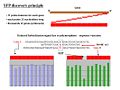
) - SFP (or Single feature polymorphism)
- DArT (or Diversity Arrays TechnologyDiversity Arrays TechnologyDiversity Arrays Technology is the name of a technology used in molecular genetics to develop sequence markers for genotyping and other genetic analysis....
) - RAD markers (or Restriction site associated DNA markersRestriction site associated DNA markersRestriction site Associated DNA markers are a type of genetic marker that can be used for genetic mapping. The use of RAD markers for genetic mapping is often called RAD mapping...
)
They can be further categorized as dominant or co-dominant. Dominant markers allow for analyzing many loci at one time, e.g. RAPD. A primer amplifying a dominant marker could amplify at many loci in one sample of DNA with one PCR reaction. Co-dominant markers analyze one locus at a time. A primer amplifying a co-dominant marker would yield one targeted product.Dominant markers, as RAPDs and high-efficiency markers (like AFLPs and SMPLs), allow the analysis of many loci per experiment within requiring previous information about their sequence.
Codominant markers (RFLPs, microsatellites, etc) allow the analysis of only a locus per experiment, so they are more informative because the allelic variations of that locus can be distinguished. As a consequence, you can identify linkage groups between different genetic maps but, for their development it is necessary to know the sequence (which is still expensive and is considered one of their down sides).
Uses
Genetic markers can be used to study the relationship between an inherited disease and its geneticGenetics
Genetics , a discipline of biology, is the science of genes, heredity, and variation in living organisms....
cause (for example, a particular mutation
Mutation
In molecular biology and genetics, mutations are changes in a genomic sequence: the DNA sequence of a cell's genome or the DNA or RNA sequence of a virus. They can be defined as sudden and spontaneous changes in the cell. Mutations are caused by radiation, viruses, transposons and mutagenic...
of a gene
Gene
A gene is a molecular unit of heredity of a living organism. It is a name given to some stretches of DNA and RNA that code for a type of protein or for an RNA chain that has a function in the organism. Living beings depend on genes, as they specify all proteins and functional RNA chains...
that results in a defective protein
Protein
Proteins are biochemical compounds consisting of one or more polypeptides typically folded into a globular or fibrous form, facilitating a biological function. A polypeptide is a single linear polymer chain of amino acids bonded together by peptide bonds between the carboxyl and amino groups of...
). It is known that pieces of DNA that lie near each other on a chromosome tend to be inherited together. This property enables the use of a marker, which can then be used to determine the precise inheritance pattern of the gene that has not yet been exactly localized.
Genetic markers have to be easily identifiable, associated with a specific locus
Locus (genetics)
In the fields of genetics and genetic computation, a locus is the specific location of a gene or DNA sequence on a chromosome. A variant of the DNA sequence at a given locus is called an allele. The ordered list of loci known for a particular genome is called a genetic map...
, and highly polymorphic
Polymorphism (biology)
Polymorphism in biology occurs when two or more clearly different phenotypes exist in the same population of a species — in other words, the occurrence of more than one form or morph...
, because homozygotes do not provide any information. Detection of the marker can be direct by RNA sequencing, or indirect using allozyme
Allozyme
Variant forms of an enzyme that are coded by different alleles at the same locus are called allozymes. These are opposed to isozymes, which are enzymes that perform the same function, but which are coded by genes located at different loci....
s.
Some of the methods used to study the genome
Genome
In modern molecular biology and genetics, the genome is the entirety of an organism's hereditary information. It is encoded either in DNA or, for many types of virus, in RNA. The genome includes both the genes and the non-coding sequences of the DNA/RNA....
or phylogenetics
Phylogenetics
In biology, phylogenetics is the study of evolutionary relatedness among groups of organisms , which is discovered through molecular sequencing data and morphological data matrices...
are RFLP, Amplified fragment length polymorphism
Amplified fragment length polymorphism
Amplified Fragment Length Polymorphism PCR is a PCR-based tool used in genetics research, DNA fingerprinting, and in the practice of genetic engineering. Developed in the early 1990s by Keygene, AFLP uses restriction enzymes to digest genomic DNA, followed by ligation of adaptors to the sticky...
(AFLP), RAPD, SSR. They can be used to create genetic maps of whatever organism is being studied.
There was a debate over what the transmissible agent of CTVT (canine transmissible venereal tumor
Canine transmissible venereal tumor
Canine transmissible venereal tumor , also called transmissible venereal tumor , Canine transmissible venereal sarcoma , Sticker tumor and infectious sarcoma is a histiocytic tumor of the dog and other canids that mainly affects the external genitalia, and is transmitted from animal to animal...
) was. Many researchers hypothesized that virus like particles were responsible for transforming the cell, while others thought that the cell itself was able to infect other canines as an allograft. With the aid of genetic markers, researchers were able to provide conclusive evidence that the cancerous tumor cell evolved into a transmissible parasite. Furthermore, molecular genetic markers were used to resolve the issue of natural transmission, the breed of origin (phylogenetics
Phylogenetics
In biology, phylogenetics is the study of evolutionary relatedness among groups of organisms , which is discovered through molecular sequencing data and morphological data matrices...
), and the age of the canine tumor.
Genetic Markers have also been used to measure the genomic response to selection in livestock. Natural and artificial selection leads to a change in the genetic makeup of the cell. The presence of different alleles due to a distorted segregation at the genetic markers is indicative of the difference between selected and non-selected livestock.
Insulin production
Genetic markers also play a role in genetic engineeringGenetic engineering
Genetic engineering, also called genetic modification, is the direct human manipulation of an organism's genome using modern DNA technology. It involves the introduction of foreign DNA or synthetic genes into the organism of interest...
, as they can be used to produce normal, functioning proteins to replace defective ones. The damaged or faulty section of DNA is removed and replaced with the identical, but functioning, gene sequence from another source.
This is done by removal of the faulty section of DNA and its replacement with the functioning gene from another source, usually a human donor. These gene sections are placed in solution with bacterial cells, a small number of which take up the genetic material and reproduce the new DNA sequence. Engineers need to know which bacteria have been successful in duplicating these genes so another gene is added, altering the bacteria's resistance to antibiotics. Replica plating
Replica plating
In molecular biology and microbiology, replica plating is a technique in which one or more secondary Petri plates containing different solid selective growth media are inoculated with the same colonies of microorganisms from a primary plate , reproducing the original spatial...
or a fermenter is used to grow enough bacteria to test resistance to antibiotics. It is important that the cultures are not mixed.
This process can be used as a treatment for diabetes mellitus
Diabetes mellitus
Diabetes mellitus, often simply referred to as diabetes, is a group of metabolic diseases in which a person has high blood sugar, either because the body does not produce enough insulin, or because cells do not respond to the insulin that is produced...
. Bacterial DNA often has two resistancy genes: one for tetracycline and one for ampicillin
Ampicillin
Ampicillin is a beta-lactam antibiotic that has been used extensively to treat bacterial infections since 1961. Until the introduction of ampicillin by the British company Beecham, penicillin therapies had only been effective against Gram-positive organisms such as staphylococci and streptococci...
. The insulin gene can be inserted in the middle of the ampicillin gene after it has been removed using restriction endonucleases. If the gene has been taken up, the bacteria both produces insulin and is also no longer ampicillin resistant. The bacteria are then allowed to grow on an agar
Agar
Agar or agar-agar is a gelatinous substance derived from a polysaccharide that accumulates in the cell walls of agarophyte red algae. Throughout history into modern times, agar has been chiefly used as an ingredient in desserts throughout Asia and also as a solid substrate to contain culture medium...
plate containing a culture medium. The bacteria grow and produce colonies on the agar jelly. A piece of filter paper can be placed onto the top of this agar plate so that the exact positions of the colonies are remembered. This produces a copy which can then be transferred onto a second agar plate containing ampicillin. All of the bacteria that are not resistant to ampicillin will die. These locations on the second plate show the places on the first plate where bacteria are not resistant and, therefore, produce insulin. Another similar method is followed, in which an epitope sequence is added to insert. When the insert is expressed so is the epitope. Then this epitope can be effectively bound using an antibody
Antibody
An antibody, also known as an immunoglobulin, is a large Y-shaped protein used by the immune system to identify and neutralize foreign objects such as bacteria and viruses. The antibody recognizes a unique part of the foreign target, termed an antigen...
on a filter paper. And the expressing colonies can be easily selected.