


Gram-negative

Encyclopedia
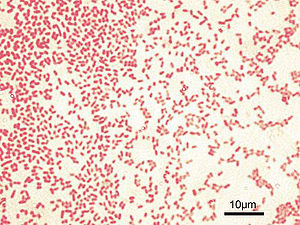
Bacteria
Bacteria are a large domain of prokaryotic microorganisms. Typically a few micrometres in length, bacteria have a wide range of shapes, ranging from spheres to rods and spirals...
that do not retain crystal violet
Crystal violet
Crystal violet or Gentian violet is a triarylmethane dye. The dye is used as a histological stain and in Gram’s method of classifying bacteria. Crystal violet has antibacterial, antifungal, and anthelmintic properties and was formerly important as a topical antiseptic...
dye in the Gram staining
Gram staining
Gram staining is a method of differentiating bacterial species into two large groups ....
protocol. In a Gram
Hans Christian Gram
Hans Christian Joachim Gram was a Danish bacteriologist.He was the son of Frederik Terkel Julius Gram, a professor of jurisprudence, and Louise Christiane Roulund....
stain test, a counterstain
Counterstain
A counterstain is a stain with color contrasting to the principal stain, making the stained structure more easily visible.An example is the malachite green counterstain to the fuchsine stain in the Gimenez staining technique....
(commonly safranin
Safranin
Safranin is a biological stain used in histology and cytology. Safranin is used as a counterstain in some staining protocols, colouring all cell nuclei red. This is the classic counterstain in a Gram stain...
) is added after the crystal violet, coloring all Gram-negative bacteria with a red or pink color. The test itself is useful in classifying two distinct types of bacteria based on the structural differences of their bacterial cell walls. Gram-positive bacteria will retain the crystal violet dye when washed in a decolorizing solution.
The pathogenic capability of Gram-negative bacteria is often associated with certain components of Gram-negative cell walls, in particular, the lipopolysaccharide
Lipopolysaccharide
Lipopolysaccharides , also known as lipoglycans, are large molecules consisting of a lipid and a polysaccharide joined by a covalent bond; they are found in the outer membrane of Gram-negative bacteria, act as endotoxins and elicit strong immune responses in animals.-Functions:LPS is the major...
layer (also known as LPS or endotoxin
Endotoxin
Endotoxins are toxins associated with some Gram-negative bacteria. An "endotoxin" is a toxin that is a structural molecule of the bacteria that is recognized by the immune system.-Gram negative:...
layer). In humans, LPS triggers an innate immune response characterized by cytokine
Cytokine
Cytokines are small cell-signaling protein molecules that are secreted by the glial cells of the nervous system and by numerous cells of the immune system and are a category of signaling molecules used extensively in intercellular communication...
production and immune system
Immune system
An immune system is a system of biological structures and processes within an organism that protects against disease by identifying and killing pathogens and tumor cells. It detects a wide variety of agents, from viruses to parasitic worms, and needs to distinguish them from the organism's own...
activation. Inflammation
Inflammation
Inflammation is part of the complex biological response of vascular tissues to harmful stimuli, such as pathogens, damaged cells, or irritants. Inflammation is a protective attempt by the organism to remove the injurious stimuli and to initiate the healing process...
is a common result of cytokine (from the Greek cyto, cell and kinesis, movement) production, which can also produce host toxicity.
Characteristics
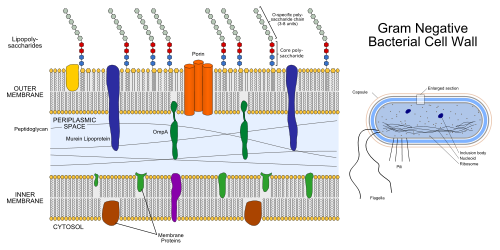

- Cytoplasmic membrane
- Thin peptidoglycanPeptidoglycanPeptidoglycan, also known as murein, is a polymer consisting of sugars and amino acids that forms a mesh-like layer outside the plasma membrane of bacteria , forming the cell wall. The sugar component consists of alternating residues of β- linked N-acetylglucosamine and N-acetylmuramic acid...
layer (which is much thinner than in Gram-positive bacteria) - Outer membraneOuter membraneThe bacterial outer membrane is found in Gram-negative bacteria. Its composition is distinct from that of the cytoplasmic membrane - among other things, the outer leaflet of the membrane includes a complex lipopolysaccharide whose lipid portion acts as an endotoxin - and it is linked to the cell's...
containing lipopolysaccharideLipopolysaccharideLipopolysaccharides , also known as lipoglycans, are large molecules consisting of a lipid and a polysaccharide joined by a covalent bond; they are found in the outer membrane of Gram-negative bacteria, act as endotoxins and elicit strong immune responses in animals.-Functions:LPS is the major...
(LPS, which consists of lipid ALipid ALipid A is a lipid component of an endotoxin held responsible for toxicity of Gram-negative bacteria. It is the innermost of the three regions of the lipopolysaccharide molecule, and its hydrophobic nature allows it to anchor the LPS to the outer membrane...
, core polysaccharide, and O antigen) outside the peptidoglycan layer - PorinPorin (protein)Porins are beta barrel proteins that cross a cellular membrane and act as a pore through which molecules can diffuse. Unlike other membrane transport proteins, porins are large enough to allow passive diffusion, i.e., they act as channels that are specific to different types of molecules...
s exist in the outer membrane, which act like pores for particular molecules - There is a space between the layers of peptidoglycan and the secondary cell membrane called the periplasmic spacePeriplasmic spaceThe periplasmic space or periplasm is a space between the peptidoglycan cell wall and inner membrane of Gram-negative bacteria or the equivalent space outside the inner membrane of Gram-positive bacteria. It may constitute up to 40% of the total cell volume in Gram-negative species, and is...
- The S-layerS-layerAn S-layer is a part of the cell envelope commonly found in bacteria, as well as among archaea.It consists of a monomolecular layer composed of identical proteins or glycoproteins. This two-dimensional structure is built via self-assembly and encloses the whole cell surface. Thus, the S-layer...
is directly attached to the outer membrane, rather than the peptidoglycan - If present, flagella have four supporting rings instead of two
- No teichoic acidTeichoic acidTeichoic acids are bacterial polysaccharides of glycerol phosphate or ribitol phosphate linked via phosphodiester bonds.-Location and structure:...
s or lipoteichoic acidLipoteichoic acidLipoteichoic acid is a major constituent of the cell wall of Gram-positive bacteria. These organisms have an inner membrane and, external to it, a thick peptidoglycan layer. It consists of teichoic acids, long chains of ribitol phosphate and is anchored to the lipid bilayer via a glyceride...
s are present - LipoproteinLipoproteinA lipoprotein is a biochemical assembly that contains both proteins and lipids water-bound to the proteins. Many enzymes, transporters, structural proteins, antigens, adhesins, and toxins are lipoproteins...
s are attached to the polysaccharide backbone. - Most of them contain Braun's lipoproteinBraun's lipoproteinBraun's lipoprotein , found in gram-negative cell walls, is one of the most abundant membrane proteins; its molecular weight is about 7.2 kDa...
, which serves as a link between the outer membrane and the peptidoglycan chain by a covalent bond - Most do not sporulate (Coxiella burnetiiCoxiella burnetiiCoxiella burnetii is an obligate intracellular bacterial pathogen, and is the causative agent of Q fever. The genus Coxiella is morphologically similar to Rickettsia, but with a variety of genetic and physiological differences. C...
, which produces spore-like structures, is a notable exception)
Classification
Along with cell shape, Gram staining is a rapid diagnostic tool and used to be used to group species at the subdivision of Bacteria.In fact, historically the kindgom Monera
Monera
Monera is a superseded kingdom that contains unicellular organisms without a nucleus , such as bacteria....
was divided into four divisions
Taxonomic rank
In biological classification, rank is the level in a taxonomic hierarchy. Examples of taxonomic ranks are species, genus, family, and class. Each rank subsumes under it a number of less general categories...
based on Gram staining: Firmacutes [sic] (+), Gracillicutes (-), Mollicutes (0) and Mendocutes (var.).
Since 1987, the monophyly
Monophyly
In common cladistic usage, a monophyletic group is a taxon which forms a clade, meaning that it contains all the descendants of the possibly hypothetical closest common ancestor of the members of the group. The term is synonymous with the uncommon term holophyly...
of the Gram-negative bacteria has been disproven with molecular studies. However some authors, such as Cavalier-Smith still treat them as a monophyletic clade
Clade
A clade is a group consisting of a species and all its descendants. In the terms of biological systematics, a clade is a single "branch" on the "tree of life". The idea that such a "natural group" of organisms should be grouped together and given a taxonomic name is central to biological...
and refer to the group as subkindgom "Negibacteria".
Example species
The proteobacteriaProteobacteria
The Proteobacteria are a major group of bacteria. They include a wide variety of pathogens, such as Escherichia, Salmonella, Vibrio, Helicobacter, and many other notable genera....
are a major group of Gram-negative bacteria, including Escherichia coli
Escherichia coli
Escherichia coli is a Gram-negative, rod-shaped bacterium that is commonly found in the lower intestine of warm-blooded organisms . Most E. coli strains are harmless, but some serotypes can cause serious food poisoning in humans, and are occasionally responsible for product recalls...
(E. coli), Salmonella
Salmonella
Salmonella is a genus of rod-shaped, Gram-negative, non-spore-forming, predominantly motile enterobacteria with diameters around 0.7 to 1.5 µm, lengths from 2 to 5 µm, and flagella which grade in all directions . They are chemoorganotrophs, obtaining their energy from oxidation and reduction...
, Shigella
Shigella
Shigella is a genus of Gram-negative, nonspore forming, non-motile, rod-shaped bacteria closely related to Escherichia coli and Salmonella. The causative agent of human shigellosis, Shigella causes disease in primates, but not in other mammals. It is only naturally found in humans and apes. During...
, and other Enterobacteriaceae
Enterobacteriaceae
The Enterobacteriaceae is a large family of bacteria that includes many of the more familiar pathogens, such as Salmonella, Escherichia coli, Yersinia pestis, Klebsiella and Shigella. This family is the only representative in the order Enterobacteriales of the class Gammaproteobacteria in the...
, Pseudomonas
Pseudomonas
Pseudomonas is a genus of gammaproteobacteria, belonging to the family Pseudomonadaceae containing 191 validly described species.Recently, 16S rRNA sequence analysis has redefined the taxonomy of many bacterial species. As a result, the genus Pseudomonas includes strains formerly classified in the...
, Moraxella
Moraxella catarrhalis
Moraxella catarrhalis is a fastidious, nonmotile, Gram-negative, aerobic, oxidase-positive diplococcus that can cause infections of the respiratory system, middle ear, eye, central nervous system and joints of humans.-History:...
, Helicobacter
Helicobacter
Helicobacter is a genus of Gram-negative bacteria possessing a characteristic helix shape. They were initially considered to be members of the Campylobacter genus, but since 1989 they have been grouped in their own genus...
, Stenotrophomonas
Stenotrophomonas
Stenotrophomonas is a genus of Gram-negative bacteria. With species ranging from common soil organisms to opportunistic human pathogens , the molecular taxonomy of the genus is still somewhat unclear....
, Bdellovibrio
Bdellovibrio
Bdellovibrio is a genus of Gram-negative, obligate aerobic bacteria.One of the more notable characteristics of this genus is that members parasitize other Gram-negative bacteria by entering into their periplasmic space and feeding on the biopolymers, e.g. proteins and nucleic acids, of their hosts...
, acetic acid bacteria
Acetic acid bacteria
Acetic acid bacteria are bacteria that derive their energy from the oxidation of ethanol to acetic acid during fermentation. They are Gram-negative, aerobic, rod-shaped bacteria. Not to be confused with the genus Acetobacterium which are anaerobic homoacetogenic facultative autotrophs and can...
, Legionella
Legionella
Legionella is a pathogenic Gram negative bacterium, including species that cause legionellosis or Legionnaires' disease, most notably L. pneumophila. It may be readily visualized with a silver stain....
and numerous others. Other notable groups of Gram-negative bacteria include the cyanobacteria, spirochaete
Spirochaete
Spirochaetes belong to a phylum of distinctive Gram-negative bacteria, which have long, helically coiled cells...
s, green sulfur
Green sulfur bacteria
The green sulfur bacteria are a family of obligately anaerobic photoautotrophic bacteria. Most closely related to the distant Bacteroidetes, they are accordingly assigned their own phylum....
and green non-sulfur bacteria.
Medically relevant Gram-negative cocci
Coccus
Coccus can be used to describe any bacterium that has a spherical shape. It is one of the three distinct types of bacteria shapes, the other two being bacillus and spirillum cells...
include three organisms, which cause a sexually transmitted disease
Sexually transmitted disease
Sexually transmitted disease , also known as a sexually transmitted infection or venereal disease , is an illness that has a significant probability of transmission between humans by means of human sexual behavior, including vaginal intercourse, oral sex, and anal sex...
(Neisseria gonorrhoeae
Neisseria gonorrhoeae
Neisseria gonorrhoeae, also known as gonococci , or gonococcus , is a species of Gram-negative coffee bean-shaped diplococci bacteria responsible for the sexually transmitted infection gonorrhea.N...
), a meningitis
Meningitis
Meningitis is inflammation of the protective membranes covering the brain and spinal cord, known collectively as the meninges. The inflammation may be caused by infection with viruses, bacteria, or other microorganisms, and less commonly by certain drugs...
(Neisseria meningitidis
Neisseria meningitidis
Neisseria meningitidis, often referred to as meningococcus, is a bacterium that can cause meningitis and other forms of meningococcal disease such as meningococcemia, a life threatening sepsis. N. meningitidis is a major cause of morbidity and mortality during childhood in industrialized countries...
), and respiratory symptoms (Moraxella catarrhalis
Moraxella catarrhalis
Moraxella catarrhalis is a fastidious, nonmotile, Gram-negative, aerobic, oxidase-positive diplococcus that can cause infections of the respiratory system, middle ear, eye, central nervous system and joints of humans.-History:...
).
Medically relevant Gram-negative bacilli
Bacillus (shape)
The word bacillus may be used to describe any rod-shaped bacterium, and such bacilli are found in many different taxonomic groups of bacteria. However, the name Bacillus, capitalized and italicized, refers to a specific genus of bacteria...
include a multitude of species. Some of them primarily cause respiratory problems (Hemophilus influenzae, Klebsiella pneumoniae
Klebsiella pneumoniae
Klebsiella pneumoniae is a Gram-negative, non-motile, encapsulated, lactose fermenting, facultative anaerobic, rod shaped bacterium found in the normal flora of the mouth, skin, and intestines....
, Legionella pneumophila
Legionella pneumophila
Legionella pneumophila is a thin, ærobic, pleomorphic, flagellated, non-spore forming, Gram-negative bacterium of the genus Legionella. L. pneumophila is the primary human pathogenic bacterium in this group and is the causative agent of legionellosis or Legionnaires' disease.-Characterization:L...
, Pseudomonas aeruginosa
Pseudomonas aeruginosa
Pseudomonas aeruginosa is a common bacterium that can cause disease in animals, including humans. It is found in soil, water, skin flora, and most man-made environments throughout the world. It thrives not only in normal atmospheres, but also in hypoxic atmospheres, and has, thus, colonized many...
), primarily urinary problems (Escherichia coli
Escherichia coli
Escherichia coli is a Gram-negative, rod-shaped bacterium that is commonly found in the lower intestine of warm-blooded organisms . Most E. coli strains are harmless, but some serotypes can cause serious food poisoning in humans, and are occasionally responsible for product recalls...
, Proteus mirabilis
Proteus mirabilis
Proteus mirabilis is a Gram-negative, facultatively anaerobic, rod shaped bacterium. It shows swarming motility, and urease activity. P. mirabilis causes 90% of all Proteus infections in humans.-Diagnosis:...
, Enterobacter cloacae
Enterobacter cloacae
Enterobacter cloacae is a clinically significant Gram-negative, facultatively-anaerobic, rod-shaped bacterium.-Microbiology:*BioHazard Level: 1 *Growth Temperature: 30°CAppropriate growth media:nutrient agar, nutrient broth...
, Serratia marcescens
Serratia marcescens
Serratia marcescens is a species of Gram-negative, rod-shaped bacterium in the family Enterobacteriaceae. A human pathogen, S. marcescens is involved in nosocomial infections, particularly catheter-associated bacteremia, urinary tract infections and wound infections, and is responsible for 1.4% of...
), and primarily gastrointestinal problems (Helicobacter pylori
Helicobacter pylori
Helicobacter pylori , previously named Campylobacter pyloridis, is a Gram-negative, microaerophilic bacterium found in the stomach. It was identified in 1982 by Barry Marshall and Robin Warren, who found that it was present in patients with chronic gastritis and gastric ulcers, conditions that were...
, Salmonella enteritidis, Salmonella typhi).
Gram-negative bacteria associated with nosocomial infection
Nosocomial infection
A nosocomial infection , also known as a hospital-acquired infection or HAI, is an infection whose development is favoured by a hospital environment, such as one acquired by a patient during a hospital visit or one developing among hospital staff...
s include Acinetobacter baumannii
Acinetobacter baumannii
Acinetobacter baumannii is a species of pathogenic bacteria, referred to as an aerobic gram-negative bacterium, that is resistant to most antibiotics. As a result of its resistance to drug treatment, some estimates state the disease is killing tens of thousands of U.S...
, which cause bacteremia, secondary meningitis, and ventilator-associated pneumonia in intensive-care units of hospital establishments.
Medical treatment
One of the several unique characteristics of Gram-negative bacteria is the structure of the outer membraneOuter membrane
The bacterial outer membrane is found in Gram-negative bacteria. Its composition is distinct from that of the cytoplasmic membrane - among other things, the outer leaflet of the membrane includes a complex lipopolysaccharide whose lipid portion acts as an endotoxin - and it is linked to the cell's...
. The outer leaflet of the membrane comprises a complex lipopolysaccharide
Lipopolysaccharide
Lipopolysaccharides , also known as lipoglycans, are large molecules consisting of a lipid and a polysaccharide joined by a covalent bond; they are found in the outer membrane of Gram-negative bacteria, act as endotoxins and elicit strong immune responses in animals.-Functions:LPS is the major...
whose lipid
Lipid
Lipids constitute a broad group of naturally occurring molecules that include fats, waxes, sterols, fat-soluble vitamins , monoglycerides, diglycerides, triglycerides, phospholipids, and others...
portion acts as an endotoxin
Endotoxin
Endotoxins are toxins associated with some Gram-negative bacteria. An "endotoxin" is a toxin that is a structural molecule of the bacteria that is recognized by the immune system.-Gram negative:...
. If endotoxin enters the circulatory system, it causes a toxic reaction, with the sufferer developing a high temperature, high respiration rate, and low blood pressure. This may lead to endotoxic shock, which may be fatal.
This outer membrane protects the bacteria from several antibiotic
Antibiotic
An antibacterial is a compound or substance that kills or slows down the growth of bacteria.The term is often used synonymously with the term antibiotic; today, however, with increased knowledge of the causative agents of various infectious diseases, antibiotic has come to denote a broader range of...
s, dyes, and detergent
Detergent
A detergent is a surfactant or a mixture of surfactants with "cleaning properties in dilute solutions." In common usage, "detergent" refers to alkylbenzenesulfonates, a family of compounds that are similar to soap but are less affected by hard water...
s that would normally damage the inner membrane or cell wall (peptidoglycan
Peptidoglycan
Peptidoglycan, also known as murein, is a polymer consisting of sugars and amino acids that forms a mesh-like layer outside the plasma membrane of bacteria , forming the cell wall. The sugar component consists of alternating residues of β- linked N-acetylglucosamine and N-acetylmuramic acid...
). The outer membrane provides these bacteria with resistance to lysozyme
Lysozyme
Lysozyme, also known as muramidase or N-acetylmuramide glycanhydrolase, are glycoside hydrolases, enzymes that damage bacterial cell walls by catalyzing hydrolysis of 1,4-beta-linkages between N-acetylmuramic acid and N-acetyl-D-glucosamine residues in a peptidoglycan and between...
and penicillin
Penicillin
Penicillin is a group of antibiotics derived from Penicillium fungi. They include penicillin G, procaine penicillin, benzathine penicillin, and penicillin V....
. However, alternative medicinal treatments such as lysozyme with EDTA
EDTA
Ethylenediaminetetraacetic acid, widely abbreviated as EDTA , is a polyamino carboxylic acid and a colourless, water-soluble solid. Its conjugate base is named ethylenediaminetetraacetate. It is widely used to dissolve limescale. Its usefulness arises because of its role as a hexadentate ligand...
and the antibiotic ampicillin
Ampicillin
Ampicillin is a beta-lactam antibiotic that has been used extensively to treat bacterial infections since 1961. Until the introduction of ampicillin by the British company Beecham, penicillin therapies had only been effective against Gram-positive organisms such as staphylococci and streptococci...
have been developed to combat the protective outer membrane of some pathogenic Gram-negative organisms. Other drugs can be used, significant ones being chloramphenicol
Chloramphenicol
Chloramphenicol is a bacteriostatic antimicrobial that became available in 1949. It is considered a prototypical broad-spectrum antibiotic, alongside the tetracyclines, and as it is both cheap and easy to manufacture it is frequently found as a drug of choice in the third world.Chloramphenicol is...
, streptomycin
Streptomycin
Streptomycin is an antibiotic drug, the first of a class of drugs called aminoglycosides to be discovered, and was the first antibiotic remedy for tuberculosis. It is derived from the actinobacterium Streptomyces griseus. Streptomycin is a bactericidal antibiotic. Streptomycin cannot be given...
, and nalidixic acid
Nalidixic acid
Nalidixic acid is the first of the synthetic quinolone antibiotics...
.
See also
- Gram-positive bacteria
- Braun's lipoproteinBraun's lipoproteinBraun's lipoprotein , found in gram-negative cell walls, is one of the most abundant membrane proteins; its molecular weight is about 7.2 kDa...
- Gram indeterminate
- lower plants