


Wolof language

Encyclopedia
Wolof is a language spoken in Senegal
, The Gambia
, and Mauritania
, and is the native language of the Wolof people
. Like the neighbouring languages Serer and Fula
, it belongs to the Atlantic branch
of the Niger–Congo language family
. Unlike most other languages of Sub-Saharan Africa
, Wolof is not a tonal language.
Wolof is the most widely spoken language in Senegal, spoken not only by members of the Wolof ethnic group (approximately 40 percent of the population) but also by most other Senegalese.
Note however that, this figure is misleading because other tribes who have been Wolofized and speak the Wolof language are added to this figure when in actual fact they are not Wolofs at all.
Wolof dialect
s may vary between countries (Senegal and the Gambia) and the rural and urban areas. "Dakar-Wolof", for instance, is an urban mixture of Wolof, French
, Arabic
, and even a little English
- spoken in Dakar
, the capital of Senegal.
"Wolof" is the standard spelling, and is a term that may also refer to the Wolof ethnic group or to things originating from Wolof culture or tradition. As an aid to pronunciation, some older French publications use the spelling "Ouolof"; for the same reason, some English publications adopt the spelling "Wollof", predominantly referring to Gambian Wolof. Prior to the 20th century, the forms "Volof", and "Olof" were used.
Wolof has had some influence on Western European languages. Banana is possibly a Wolof word in English, and the English word yam
is believed to be derived from Wolof/Fula
nyami, "to eat food."
It should be stated that, the word "nyam" and its derivatives "nyami" attributed to the Wolof people
or Fula here actually comes from the language of the Serer people
, from the standard Serer-Sine word "gari ñam" meaning "to eat", from the Serer
Kingdom of Sine
. The Wolof people
who have immigrated to another Serer Kingdom called the Kingdom of Saloum picked it up from the Serer people
of Saloum
(the indigenous people). In Serer Saloum, the word is "ñaam" (nyam) which means "to eat". Whilst in Serer-Sine (proper Serer) it is "gari ñam" (gari nyam) meaning "to eat", in Saloum
it is merely shortened to "ñaam". The word derives from the proper Serer word "ñam" (nyam) which means "food". It is from that the Senegambian word "ñaambi" (cassava
) originated from. These words are used by all Senegambians not just by the Serer people
(the progenitors of these words), but also by the Wolof people
, the Fula people
, the Mandinka people
etc. The Serer people
also being ancestors of the Wolof people
as they are the ancestors of the Toucouleur people and Lebou people, their language has also been borrowed and diluted by these groups. "Cheikh Anta Diop
had defended the hypothesis that the Wollofs
were not originally a group apart but the result of a process of metissage so to speak of different ethnic groups: Serere
, Lebou, Toucoulor, Mandinka
and Sarahuli who, in their evolution i.e. the Wollofs
, transformed themselves into an autonomous "tribe" with a strong capacity to assimilate, absorb or integrate with all other ethnic groups. The Serer people
also have an ancient tradition of farming not just millet
and other crops but cassava
("ñaambi") as well.
Hip or hep (e.g., African-American's now clichéd "hip cat") is believed by many etymologists to derive from the Wolof hepicat, "one who has his eyes open" or "one who is aware".
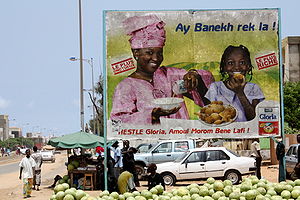 Wolof is spoken by more than 10 million people and about 40 percent (approximately 5 million people) of Senegal's population speak Wolof as their native language. Increased mobility, and especially the growth of the capital Dakar, created the need for a common language: today, an additional 40 percent of the population speak Wolof as a second or acquired language
. In the whole region from Dakar
to Saint-Louis
, and also west and southwest of Kaolack
, Wolof is spoken by the vast majority of the people. Typically when various ethnic groups in Senegal come together in cities and towns, they speak Wolof. It is therefore spoken in almost every regional and departmental capital in Senegal. Nevertheless, the official language of Senegal is French
.
As stated above, great care should be taken when forming an opinion based on the figures prescribed here. These figures are misleading because other tribes who have been Wolofized and speak the Wolof language are added to this figure when in actual fact they are not Wolofs at all. Furthermore, not only is Serer and Fula
just like Wolof etc recognised and taught in schools, not everyone speaks or understands Wolof. There are Serers
, Fulas
, Mandinkas
, Jolas
etc who cannot speak or understand Wolof. Moreover, not only Wolof people live in cities and towns. There are cities and towns which are predominantly Serers
just as there are cities and towns which are predominantly Wolofs. Furthermore, there are Wolof villages just as there are Serer villages.
In the Gambia
, about three percent of the population speak Wolof as a first language, but Wolof has a disproportionate influence because of its prevalence in Banjul
, the Gambia's capital, where 25 percent of the population use it as a first language. In Serrekunda
, the Gambia's largest town, although only a tiny minority are ethnic Wolofs, approximately 10 percent of the population speaks and/or understands Wolof. The official language of the Gambia is English
; Mandinka (40 percent), Wolof (7 percent) and Fula (15 percent) are as yet not used in formal education.
In Mauritania
, about seven percent (approximately 185,000 people) of the population speak Wolof. There, the language is used only around the southern coastal regions. Mauritania's official language is Arabic
; French is used as a lingua franca.
. It is often said to be closely related to Fulani due to a misreading by Wilson (1989) of the data in Sapir (1971) that has long been used to classify the Atlantic languages. However, Serere (2009, 2010) confirms Sapir's findings that Wolof is not close to Fulani; he finds the closest relatives of Wolof are several obscure languages along the Casamance River
.
s in the sense of the Indo-European languages
; rather, Wolof marks aspect
and focus of an action. The literal translation given in the table below is an exact word-by-word translation in the original word order, where the meanings of the individual words are separated by dashes.
To listen to the pronunciation of some Wolof words, click here
It should be noted that the "Wolof words" prescribed in this table mostly derived from the Serer language which the Wolofs have borrowed and adopted. This borrowing is understandable since the Serers
are the ancestors of the Wolofs. Example of borrowed words include (but are not limited to):
Few words are definitely borrowed and corrupted from the Fula language
"Jërë" (Jërëjëf) and the word "loppitaan" is obviously borrowed from the French word "L’hôpital".
(IPA).
The Latin-based
orthography of Wolof in Senegal
was set by government decrees between 1971 and 1985. The language institute "Centre de linguistique appliquée de Dakar
" (CLAD) is widely acknowledged as an authority when it comes to spelling rules for Wolof.
Wolof is most often written in this orthography, in which phonemes have a clear one-to-one correspondence to graphemes.
(A traditional Arabic-based transcription of Wolof called Wolofal
dates back to the pre-colonial period and is still used by many people.)
The first syllable of words is stress
ed; long vowels are pronounced with more time, but are not automatically stressed, as they are in English.
Single vowels are short, geminated vowels are long, so Wolof "o" [ɔ] is short and pronounced like "ou" in (British) English "sought", but Wolof "oo" [ɔ:] is long and pronounced like the "aw" in (British) English "sawed". If a closed vowel is long, the diacritic symbol is usually written only above the first vowel, e.g. "óo", but some sources deviate from this CLAD standard and set it above both vowels, e.g. "óó".
The very common Wolof letter "ë" is pronounced [ə], like "a" in English "sofa".
The characters (U+00F1) Latin small letter n with tilde "ñ" and (U+00D1) Latin capital letter n with tilde "Ñ" are also used. They are pronounced like the same letter in Spanish "señor".
"c" is between "t" in English (of England) "fortune" and "ch" in English "choose", while "j" is between "d" in English (of England) "duke" and "j" in "June". "x" is like "ch" in German "Bach", while "q" is like "c" in English "cool". "g" is always like "g" in English "garden", and "s" is always like "s" in English "stop". "w" is as in "wind" and "y" as in "yellow".
Example: The verb dem means "to go" and cannot be changed; the temporal pronoun maa ngi means "I/me, here and now"; the temporal pronoun dinaa means "I am soon / I will soon / I will be soon". With that, the following sentences can be built now: Maa ngi dem. "I am going (here and now)." - Dinaa dem. "I will go (soon)."
Example: The verb dem means "to go"; the temporal pronoun naa means "I already/definitely", the temporal pronoun dinaa means "I am soon / I will soon / I will be soon"; the temporal pronoun damay means "I (am) regularly/usually". Now the following sentences can be constructed: Dem naa. "I go already / I have already gone." - Dinaa dem. "I will go soon / I am just going to go." - Damay dem. "I usually/regularly/normally go."
If the speaker absolutely wants to express that an action took place in the past, this is not done by conjugation, but by adding the suffix -(w)oon to the verb. (Please bear in mind that in a sentence the temporal pronoun is still used in a conjugated form along with the past marker.)
Example: Demoon naa Ndakaaru. "I already went to Dakar."
It should be noted that the word "góor" ("goor" or "gor") originated from the Serer language. These words orignated from the Serer words "o koor" or "goor" which means "man". "O kor" or "gor" also from the Serer language
, means "husband". It is from this the Serer
word "gorie" ("honour" or "honourable") comes. All these words and their derivatives are used by other Senegambians including the Wolof, but they all originated from the language of the Serer people
.
For the most part, Wolof does not have noun concord ("agreement") classes as in Bantu or Romance languages. But the markers of noun definiteness (usually called "definite articles" in grammatical terminology) do agree with the noun they modify. There are at least ten articles in Wolof, some of them indicating a singular noun, others a plural noun. In "City Wolof" (the type of Wolof spoken in big cities like Dakar), the article -bi is often used as a generic article when the actual article is not known.
Any loan noun from French or English uses –bi –- butik-bi, xarit-bi, 'the boutique, the friend'
Most Arabic or religious terms use –ji -- jumma-ji, jigéen-ji, 'the mosque, the girl'
Nouns referring to persons typically use -ki -- nit-ki, nit-ñi, 'the person, the people'
Miscellaneous articles: si, gi, wi, mi, li, yi.
s (first, second, third, etc.) are formed by adding the ending –éélu to the cardinal number
.
For example two is ñaar and second is ñaaréélu
The one exception to this system is “first”, which is bu njëk (or the adapted French word premier: përëmye)
{| class="wikitable"
{| class="wikitable"
|
! colspan="2" align="center" | Situative (Presentative)
(Present Continuous)
! colspan="2" align="center" | Terminative
(Past tense for action verbs or present tense for static verbs)
! colspan="2" align="center" | Objective
(Emphasis on Object)
! colspan="2" align="center" | Processive (Explicative and/or Descriptive)
(Emphasis on Verb)
! colspan="2" align="center" | Subjective
(Emphasis on Subject)
! colspan="2" align="center" | Neutral
|-
|
| Perfect
| Imperfect
| Perfect
| Future
| Perfect
| Imperfect
| Perfect
| Imperfect
| Perfect
| Imperfect
| Perfect
| Imperfect
|-
|1st Person singular "I"
|maa ngi
(I am+ Verb+ -ing)
|maa ngiy
|naa
(I + past tense action verbs or present tense static verbs)
|dinaa
(I will ... / future)
|laa
(Puts the emphasis on the Object of the sentence)
|laay
(Indicates a habitual or future action)
|dama
(Puts the emphasis on the Verb or the state 'condition' of the sentence)
|damay
(Indicates a habitual or future action)
|maa
(Puts the emphasis on the Subject of the sentence)
|maay
(Indicates a habitual or future action)
|ma
|may
|-
|2nd Person singular "you"
|yaa ngi
|yaa ngiy
|nga
|dinga
|nga
|ngay
|danga
|dangay
|yaa
|yaay
|nga
|ngay
|-
|3rd Person singular "he/she/it"
|mu ngi
|mu ngiy
|na
|dina
|la
|lay
|dafa
|dafay
|moo
|mooy
|mu
|muy
|-
|1st Person plural "we"
|nu ngi
|nu ngiy
|nanu
|dinanu
|lanu
|lanuy
|danu
|danuy
|noo
|nooy
|nu
|nuy
|-
|2nd Person plural "you"
|yéena ngi
|yéena ngiy
|ngeen
|dingeen
|ngeen
|ngeen di
|dangeen
|dangeen di
|yéena
|yéenay
|ngeen
|ngeen di
|-
|3rd Person plural "they"
|ñu ngi
|ñu ngiy
|nañu
|dinañu
|lañu
|lañuy
|dañu
|dañuy
|ñoo
|ñooy
|ñu
|ñuy
|-
|}
Note that many of the words stated in this table are borrowed from the language of the Serer people
(Serer). Some of these borrowed words include (but not limited to):
Words such as “dafa” and “dina” are obviously borrowed from Arabic
In urban Wolof it is common to use the forms of the 3rd person plural also for the 1st person plural.
It is also important to note that the verb follows certain temporal pronouns and precedes others.
was translated into Wolof and published in 1987, second edition 2004, and in 2008 with some minor typographical corrections.
The 1994 song '7 seconds
' by Youssou N'Dour
and Neneh Cherry
is partially sung in Wolof.
Senegal
Senegal , officially the Republic of Senegal , is a country in western Africa. It owes its name to the Sénégal River that borders it to the east and north...
, The Gambia
The Gambia
The Republic of The Gambia, commonly referred to as The Gambia, or Gambia , is a country in West Africa. Gambia is the smallest country on mainland Africa, surrounded by Senegal except for a short coastline on the Atlantic Ocean in the west....
, and Mauritania
Mauritania
Mauritania is a country in the Maghreb and West Africa. It is bordered by the Atlantic Ocean in the west, by Western Sahara in the north, by Algeria in the northeast, by Mali in the east and southeast, and by Senegal in the southwest...
, and is the native language of the Wolof people
Wolof people
The Wolof are an ethnic group found in Senegal, The Gambia, and Mauritania.In Senegal, the Wolof form an ethnic plurality with about 43.3% of the population are Wolofs...
. Like the neighbouring languages Serer and Fula
Fula language
The Fula or Fulani language is a language of West Africa. It is spoken as a first language by the and related groups from Senegambia and Guinea to Cameroon and Sudan...
, it belongs to the Atlantic branch
Atlantic languages
The Atlantic or West Atlantic languages of West Africa are an obsolete proposed major group of the Niger–Congo languages. They are those languages west of Kru which have the noun-class systems characteristic of the Niger–Congo family; in this they are distinguished from their Mande neighbors, which...
of the Niger–Congo language family
Niger–Congo languages
The Niger–Congo languages constitute one of the world's major language families, and Africa's largest in terms of geographical area, number of speakers, and number of distinct languages. They may constitute the world's largest language family in terms of distinct languages, although this question...
. Unlike most other languages of Sub-Saharan Africa
Sub-Saharan Africa
Sub-Saharan Africa as a geographical term refers to the area of the African continent which lies south of the Sahara. A political definition of Sub-Saharan Africa, instead, covers all African countries which are fully or partially located south of the Sahara...
, Wolof is not a tonal language.
Wolof is the most widely spoken language in Senegal, spoken not only by members of the Wolof ethnic group (approximately 40 percent of the population) but also by most other Senegalese.
Note however that, this figure is misleading because other tribes who have been Wolofized and speak the Wolof language are added to this figure when in actual fact they are not Wolofs at all.
Wolof dialect
Dialect
The term dialect is used in two distinct ways, even by linguists. One usage refers to a variety of a language that is a characteristic of a particular group of the language's speakers. The term is applied most often to regional speech patterns, but a dialect may also be defined by other factors,...
s may vary between countries (Senegal and the Gambia) and the rural and urban areas. "Dakar-Wolof", for instance, is an urban mixture of Wolof, French
French language
French is a Romance language spoken as a first language in France, the Romandy region in Switzerland, Wallonia and Brussels in Belgium, Monaco, the regions of Quebec and Acadia in Canada, and by various communities elsewhere. Second-language speakers of French are distributed throughout many parts...
, Arabic
Arabic language
Arabic is a name applied to the descendants of the Classical Arabic language of the 6th century AD, used most prominently in the Quran, the Islamic Holy Book...
, and even a little English
English language
English is a West Germanic language that arose in the Anglo-Saxon kingdoms of England and spread into what was to become south-east Scotland under the influence of the Anglian medieval kingdom of Northumbria...
- spoken in Dakar
Dakar
Dakar is the capital city and largest city of Senegal. It is located on the Cap-Vert Peninsula on the Atlantic coast and is the westernmost city on the African mainland...
, the capital of Senegal.
"Wolof" is the standard spelling, and is a term that may also refer to the Wolof ethnic group or to things originating from Wolof culture or tradition. As an aid to pronunciation, some older French publications use the spelling "Ouolof"; for the same reason, some English publications adopt the spelling "Wollof", predominantly referring to Gambian Wolof. Prior to the 20th century, the forms "Volof", and "Olof" were used.
Wolof has had some influence on Western European languages. Banana is possibly a Wolof word in English, and the English word yam
Yam (vegetable)
Yam is the common name for some species in the genus Dioscorea . These are perennial herbaceous vines cultivated for the consumption of their starchy tubers in Africa, Asia, Latin America and Oceania...
is believed to be derived from Wolof/Fula
Fula language
The Fula or Fulani language is a language of West Africa. It is spoken as a first language by the and related groups from Senegambia and Guinea to Cameroon and Sudan...
nyami, "to eat food."
It should be stated that, the word "nyam" and its derivatives "nyami" attributed to the Wolof people
Wolof people
The Wolof are an ethnic group found in Senegal, The Gambia, and Mauritania.In Senegal, the Wolof form an ethnic plurality with about 43.3% of the population are Wolofs...
or Fula here actually comes from the language of the Serer people
Serer people
The Serer people along with the Jola people are acknowledged to be the oldest inhabitants of The Senegambia....
, from the standard Serer-Sine word "gari ñam" meaning "to eat", from the Serer
Serer people
The Serer people along with the Jola people are acknowledged to be the oldest inhabitants of The Senegambia....
Kingdom of Sine
Kingdom of Sine
The Kingdom of Sine was a pre-colonial Serer kingdom along the north bank of the Saloum River delta in modern Senegal. Much of the kingdom's population was and still is Serer.-History:...
. The Wolof people
Wolof people
The Wolof are an ethnic group found in Senegal, The Gambia, and Mauritania.In Senegal, the Wolof form an ethnic plurality with about 43.3% of the population are Wolofs...
who have immigrated to another Serer Kingdom called the Kingdom of Saloum picked it up from the Serer people
Serer people
The Serer people along with the Jola people are acknowledged to be the oldest inhabitants of The Senegambia....
of Saloum
Saloum
The Kingdom of Saloum in Senegal is a traditional kingdom which was renamed Saloum in the late 15th century by the son of a Serer and a Guelowar from the kingdom of Kaabu to the south. The ancient and present capital of the Kingdom of Saloum is the city of Kahone. Previous to that, it was known...
(the indigenous people). In Serer Saloum, the word is "ñaam" (nyam) which means "to eat". Whilst in Serer-Sine (proper Serer) it is "gari ñam" (gari nyam) meaning "to eat", in Saloum
Saloum
The Kingdom of Saloum in Senegal is a traditional kingdom which was renamed Saloum in the late 15th century by the son of a Serer and a Guelowar from the kingdom of Kaabu to the south. The ancient and present capital of the Kingdom of Saloum is the city of Kahone. Previous to that, it was known...
it is merely shortened to "ñaam". The word derives from the proper Serer word "ñam" (nyam) which means "food". It is from that the Senegambian word "ñaambi" (cassava
Cassava
Cassava , also called yuca or manioc, a woody shrub of the Euphorbiaceae native to South America, is extensively cultivated as an annual crop in tropical and subtropical regions for its edible starchy tuberous root, a major source of carbohydrates...
) originated from. These words are used by all Senegambians not just by the Serer people
Serer people
The Serer people along with the Jola people are acknowledged to be the oldest inhabitants of The Senegambia....
(the progenitors of these words), but also by the Wolof people
Wolof people
The Wolof are an ethnic group found in Senegal, The Gambia, and Mauritania.In Senegal, the Wolof form an ethnic plurality with about 43.3% of the population are Wolofs...
, the Fula people
Fula people
Fula people or Fulani or Fulbe are an ethnic group spread over many countries, predominantly in West Africa, but found also in Central Africa and Sudanese North Africa...
, the Mandinka people
Mandinka people
The Mandinka, Malinke are one of the largest ethnic groups in West Africa with an estimated population of eleven million ....
etc. The Serer people
Serer people
The Serer people along with the Jola people are acknowledged to be the oldest inhabitants of The Senegambia....
also being ancestors of the Wolof people
Wolof people
The Wolof are an ethnic group found in Senegal, The Gambia, and Mauritania.In Senegal, the Wolof form an ethnic plurality with about 43.3% of the population are Wolofs...
as they are the ancestors of the Toucouleur people and Lebou people, their language has also been borrowed and diluted by these groups. "Cheikh Anta Diop
Cheikh Anta Diop
Cheikh Anta Diop was a historian, anthropologist, physicist, and politician who studied the human race's origins and pre-colonial African culture. He is regarded as an important figure in the development of the Afrocentric viewpoint, in particular for his theory that the ancient Egyptians were...
had defended the hypothesis that the Wollofs
Wolof people
The Wolof are an ethnic group found in Senegal, The Gambia, and Mauritania.In Senegal, the Wolof form an ethnic plurality with about 43.3% of the population are Wolofs...
were not originally a group apart but the result of a process of metissage so to speak of different ethnic groups: Serere
Serer people
The Serer people along with the Jola people are acknowledged to be the oldest inhabitants of The Senegambia....
, Lebou, Toucoulor, Mandinka
Mandinka people
The Mandinka, Malinke are one of the largest ethnic groups in West Africa with an estimated population of eleven million ....
and Sarahuli who, in their evolution i.e. the Wollofs
Wolof people
The Wolof are an ethnic group found in Senegal, The Gambia, and Mauritania.In Senegal, the Wolof form an ethnic plurality with about 43.3% of the population are Wolofs...
, transformed themselves into an autonomous "tribe" with a strong capacity to assimilate, absorb or integrate with all other ethnic groups. The Serer people
Serer people
The Serer people along with the Jola people are acknowledged to be the oldest inhabitants of The Senegambia....
also have an ancient tradition of farming not just millet
Millet
The millets are a group of small-seeded species of cereal crops or grains, widely grown around the world for food and fodder. They do not form a taxonomic group, but rather a functional or agronomic one. Their essential similarities are that they are small-seeded grasses grown in difficult...
and other crops but cassava
Cassava
Cassava , also called yuca or manioc, a woody shrub of the Euphorbiaceae native to South America, is extensively cultivated as an annual crop in tropical and subtropical regions for its edible starchy tuberous root, a major source of carbohydrates...
("ñaambi") as well.
Hip or hep (e.g., African-American's now clichéd "hip cat") is believed by many etymologists to derive from the Wolof hepicat, "one who has his eyes open" or "one who is aware".
Geographical distribution
Language
Language may refer either to the specifically human capacity for acquiring and using complex systems of communication, or to a specific instance of such a system of complex communication...
. In the whole region from Dakar
Dakar
Dakar is the capital city and largest city of Senegal. It is located on the Cap-Vert Peninsula on the Atlantic coast and is the westernmost city on the African mainland...
to Saint-Louis
Saint-Louis, Senegal
Saint-Louis, or Ndar as it is called in Wolof, is the capital of Senegal's Saint-Louis Region. Located in the northwest of Senegal, near the mouth of the Senegal River, and 320 km north of Senegal's capital city Dakar, it has a population officially estimated at 176,000 in 2005. Saint-Louis...
, and also west and southwest of Kaolack
Kaolack
Kaolack is a town of 172,305 people on the north bank of the Saloum River and the N1 road in Senegal. It is the capital of the Kaolack Region, which borders The Gambia to the south. Kaolack is an important regional market town and is Senegal's main peanut trading and processing center...
, Wolof is spoken by the vast majority of the people. Typically when various ethnic groups in Senegal come together in cities and towns, they speak Wolof. It is therefore spoken in almost every regional and departmental capital in Senegal. Nevertheless, the official language of Senegal is French
French language
French is a Romance language spoken as a first language in France, the Romandy region in Switzerland, Wallonia and Brussels in Belgium, Monaco, the regions of Quebec and Acadia in Canada, and by various communities elsewhere. Second-language speakers of French are distributed throughout many parts...
.
As stated above, great care should be taken when forming an opinion based on the figures prescribed here. These figures are misleading because other tribes who have been Wolofized and speak the Wolof language are added to this figure when in actual fact they are not Wolofs at all. Furthermore, not only is Serer and Fula
Fula language
The Fula or Fulani language is a language of West Africa. It is spoken as a first language by the and related groups from Senegambia and Guinea to Cameroon and Sudan...
just like Wolof etc recognised and taught in schools, not everyone speaks or understands Wolof. There are Serers
Serer people
The Serer people along with the Jola people are acknowledged to be the oldest inhabitants of The Senegambia....
, Fulas
Fula people
Fula people or Fulani or Fulbe are an ethnic group spread over many countries, predominantly in West Africa, but found also in Central Africa and Sudanese North Africa...
, Mandinkas
Mandinka people
The Mandinka, Malinke are one of the largest ethnic groups in West Africa with an estimated population of eleven million ....
, Jolas
Jola people
The Jola are an ethnic group found in Senegal , The Gambia, and Guinea-Bissau. There are great numbers on the Atlantic coast between the southern banks of the Gambia River, the Casamance region of Senegal and the northern part of Guinea-Bissau...
etc who cannot speak or understand Wolof. Moreover, not only Wolof people live in cities and towns. There are cities and towns which are predominantly Serers
Serer people
The Serer people along with the Jola people are acknowledged to be the oldest inhabitants of The Senegambia....
just as there are cities and towns which are predominantly Wolofs. Furthermore, there are Wolof villages just as there are Serer villages.
In the Gambia
The Gambia
The Republic of The Gambia, commonly referred to as The Gambia, or Gambia , is a country in West Africa. Gambia is the smallest country on mainland Africa, surrounded by Senegal except for a short coastline on the Atlantic Ocean in the west....
, about three percent of the population speak Wolof as a first language, but Wolof has a disproportionate influence because of its prevalence in Banjul
Banjul
-Transport:Ferries sail from Banjul to Barra. The city is served by the Banjul International Airport. Banjul is on the Trans–West African Coastal Highway connecting it to Dakar and Bissau, and will eventually provide a paved highway link to 11 other nations of ECOWAS.Banjul International Airport...
, the Gambia's capital, where 25 percent of the population use it as a first language. In Serrekunda
Serrekunda
Serrekunda is the largest city in The Gambia, lying southwest of Banjul. Its population as of 2006, was 335,733 people. Although Banjul is The Gambia's capital, it is on an island, making further growth difficult and channeling much of the growth to Serekunda.Serrekunda is known for its market,...
, the Gambia's largest town, although only a tiny minority are ethnic Wolofs, approximately 10 percent of the population speaks and/or understands Wolof. The official language of the Gambia is English
English language
English is a West Germanic language that arose in the Anglo-Saxon kingdoms of England and spread into what was to become south-east Scotland under the influence of the Anglian medieval kingdom of Northumbria...
; Mandinka (40 percent), Wolof (7 percent) and Fula (15 percent) are as yet not used in formal education.
In Mauritania
Mauritania
Mauritania is a country in the Maghreb and West Africa. It is bordered by the Atlantic Ocean in the west, by Western Sahara in the north, by Algeria in the northeast, by Mali in the east and southeast, and by Senegal in the southwest...
, about seven percent (approximately 185,000 people) of the population speak Wolof. There, the language is used only around the southern coastal regions. Mauritania's official language is Arabic
Arabic language
Arabic is a name applied to the descendants of the Classical Arabic language of the 6th century AD, used most prominently in the Quran, the Islamic Holy Book...
; French is used as a lingua franca.
Classification
Wolof is one of the Senegambian languages, which are characterized by consonant mutationConsonant mutation
Consonant mutation is when a consonant in a word changes according to its morphological and/or syntactic environment.Mutation phenomena occur in languages around the world. A prototypical example of consonant mutation is the initial consonant mutation of all modern Celtic languages...
. It is often said to be closely related to Fulani due to a misreading by Wilson (1989) of the data in Sapir (1971) that has long been used to classify the Atlantic languages. However, Serere (2009, 2010) confirms Sapir's findings that Wolof is not close to Fulani; he finds the closest relatives of Wolof are several obscure languages along the Casamance River
Casamance River
The Casamance River flows westward for the most part into the Atlantic Ocean along a path about 200 miles in length. However, only 80 miles of it are navigable. The Casamance is the principal river of the Kolda, Sédhiou, and Ziguinchor Regions in the southern portion of Senegal between The...
.
Example phrases
This paragraph uses the exact orthography developed by the CLAD institute, which can be found in Arame Fal's dictionary (see bibliography below). For the literal translation, please note that Wolof does not have tenseGrammatical tense
A tense is a grammatical category that locates a situation in time, to indicate when the situation takes place.Bernard Comrie, Aspect, 1976:6:...
s in the sense of the Indo-European languages
Indo-European languages
The Indo-European languages are a family of several hundred related languages and dialects, including most major current languages of Europe, the Iranian plateau, and South Asia and also historically predominant in Anatolia...
; rather, Wolof marks aspect
Grammatical aspect
In linguistics, the grammatical aspect of a verb is a grammatical category that defines the temporal flow in a given action, event, or state, from the point of view of the speaker...
and focus of an action. The literal translation given in the table below is an exact word-by-word translation in the original word order, where the meanings of the individual words are separated by dashes.
To listen to the pronunciation of some Wolof words, click here
| Wolof | English | Literal translation into English |
|---|---|---|
| (As)salaamaalekum !Response: Maalekum salaam ! This greeting is not Wolof—it is Arabic (used by Arabic speakers), but is commonly used. |
Hello!Response: Hello! | (Arabic) peace be with youResponse: and with you be peace |
| Na nga def ? / Naka nga def ? / Noo def?Response: Maa ngi fi rekk | How do you do? / How are you doing?Response: I am fine | How - you (already) - doResponse: I here - be - here - only |
| Naka mu ?Response: Maa ngi fi | What's up?Response: I'm fine | How is it?Response: I'm here |
| Numu demee? / Naka mu demee?/Response: Nice / Mu ngi dox | How's it going?Response: Fine / Nice / It's going | How is it going?Response: Nice (from English) / It's walking (going) |
| Lu bees ?Response: Dara (beesul) | What's new?Response: Nothing (is new) | What is it that is new?Response: Nothing/something (is not new) |
| Ba beneen (yoon). | See you soon (next time) | Until - other - (time) |
| Jërëjëf | Thanks / Thank you | It was worth it |
| Waaw | Yes | Yes |
| Déedéet | No | No |
| Fan la ... am ? | Where is a ...? | Where - that which is - ... - existing/having |
| Fan la fajkat am ? | Where is a physician/doctor? | Where - the one who is - heal-maker - existing/having |
| Fan la ... nekk ? | Where is the ...? | Where - it which is - ... - found? |
| Ana ...? | Where is ...? | Where is ...? |
| Ana loppitaan bi? | Where is the hospital? | Where is - hospital - the? |
| Noo tudd(a)* ? / Naka nga tudd(a) ?Response: ... laa tudd(a) / Maa ngi tudd(a) ... (* Gambian Wolof has an after word-ending doubled consonants ) |
What is your name?Response: My name is .... | What you (already) - being called? Response: ... I (objective) - called / I am called ... |
It should be noted that the "Wolof words" prescribed in this table mostly derived from the Serer language which the Wolofs have borrowed and adopted. This borrowing is understandable since the Serers
Serer people
The Serer people along with the Jola people are acknowledged to be the oldest inhabitants of The Senegambia....
are the ancestors of the Wolofs. Example of borrowed words include (but are not limited to):
- Def
- Naka
- Maa
- Ngi
- Fi
- Rekk
- Demee
- Fan
- La
- Mu...
Few words are definitely borrowed and corrupted from the Fula language
Fula language
The Fula or Fulani language is a language of West Africa. It is spoken as a first language by the and related groups from Senegambia and Guinea to Cameroon and Sudan...
"Jërë" (Jërëjëf) and the word "loppitaan" is obviously borrowed from the French word "L’hôpital".
Orthography and pronunciation
Note: Phonetic transcriptions are printed between brackets [] following the rules of the International Phonetic AlphabetInternational Phonetic Alphabet
The International Phonetic Alphabet "The acronym 'IPA' strictly refers [...] to the 'International Phonetic Association'. But it is now such a common practice to use the acronym also to refer to the alphabet itself that resistance seems pedantic...
(IPA).
The Latin-based
Alphabets derived from the Latin
A Latin alphabet is an alphabetical writing system that uses letters of the original Roman Latin alphabet and often various extensions, the Latin script...
orthography of Wolof in Senegal
Senegal
Senegal , officially the Republic of Senegal , is a country in western Africa. It owes its name to the Sénégal River that borders it to the east and north...
was set by government decrees between 1971 and 1985. The language institute "Centre de linguistique appliquée de Dakar
Centre de linguistique appliquée de Dakar
The "Centre de linguistique appliquée de Dakar" , abbreviated CLAD,is a language institute, which especially plays an important role in the orthographical standardization of the Wolof language....
" (CLAD) is widely acknowledged as an authority when it comes to spelling rules for Wolof.
Wolof is most often written in this orthography, in which phonemes have a clear one-to-one correspondence to graphemes.
(A traditional Arabic-based transcription of Wolof called Wolofal
Wolofal
Wolofal is a derivation of the Arabic script for writing the Wolof language. It is basically the name of a West African Ajami script as used for that language.Wolofal was the first script for writing Wolof language...
dates back to the pre-colonial period and is still used by many people.)
The first syllable of words is stress
Stress (linguistics)
In linguistics, stress is the relative emphasis that may be given to certain syllables in a word, or to certain words in a phrase or sentence. The term is also used for similar patterns of phonetic prominence inside syllables. The word accent is sometimes also used with this sense.The stress placed...
ed; long vowels are pronounced with more time, but are not automatically stressed, as they are in English.
Vowels
Wolof adds diacritic marks to the vowel letters to distinguish between open and closed vowels. Example: "o" [ɔ] is open like (British) English "often", "ó" [o] is closed similar to the o-sound in English "most" (but without the u-sound at the end). Similarly, "e" [ɛ] is open like English "get", while "é" [e] is closed similar to the sound of "a" in English "gate" (but without the i-sound at the end).Single vowels are short, geminated vowels are long, so Wolof "o" [ɔ] is short and pronounced like "ou" in (British) English "sought", but Wolof "oo" [ɔ:] is long and pronounced like the "aw" in (British) English "sawed". If a closed vowel is long, the diacritic symbol is usually written only above the first vowel, e.g. "óo", but some sources deviate from this CLAD standard and set it above both vowels, e.g. "óó".
The very common Wolof letter "ë" is pronounced [ə], like "a" in English "sofa".
Consonants
The characters (U+014B) Latin small letter eng "ŋ" and (U+014A) Latin capital letter eng "Ŋ" are used in the Wolof alphabet. They are pronounced like "ng" in English "hang".The characters (U+00F1) Latin small letter n with tilde "ñ" and (U+00D1) Latin capital letter n with tilde "Ñ" are also used. They are pronounced like the same letter in Spanish "señor".
"c" is between "t" in English (of England) "fortune" and "ch" in English "choose", while "j" is between "d" in English (of England) "duke" and "j" in "June". "x" is like "ch" in German "Bach", while "q" is like "c" in English "cool". "g" is always like "g" in English "garden", and "s" is always like "s" in English "stop". "w" is as in "wind" and "y" as in "yellow".
Pronoun conjugation instead of verbal conjugation
In Wolof, verbs are unchangeable words which cannot be conjugated. To express different tenses or aspects of an action, the personal pronouns are conjugated - not the verbs. Therefore, the term temporal pronoun has become established for this part of speech.Example: The verb dem means "to go" and cannot be changed; the temporal pronoun maa ngi means "I/me, here and now"; the temporal pronoun dinaa means "I am soon / I will soon / I will be soon". With that, the following sentences can be built now: Maa ngi dem. "I am going (here and now)." - Dinaa dem. "I will go (soon)."
Conjugation with respect to aspect instead of tense
In Wolof, tenses like present tense, past tense, and future tense are just of secondary importance, they even play almost no role. Of crucial importance is the aspect of an action from the speaker's point of view. The most important distinction is whether an action is perfective, i.e., finished, or imperfective, i.e., still going on, from the speaker's point of view, regardless whether the action itself takes place in the past, present, or future. Other aspects indicate whether an action takes place regularly, whether an action will take place for sure, and whether an action wants to emphasize the role of the subject, predicate, or object of the sentence. As a result, conjugation is not done by tenses, but by aspects. Nevertheless, the term temporal pronoun became usual for these conjugated pronouns, although aspect pronoun might be a better term.Example: The verb dem means "to go"; the temporal pronoun naa means "I already/definitely", the temporal pronoun dinaa means "I am soon / I will soon / I will be soon"; the temporal pronoun damay means "I (am) regularly/usually". Now the following sentences can be constructed: Dem naa. "I go already / I have already gone." - Dinaa dem. "I will go soon / I am just going to go." - Damay dem. "I usually/regularly/normally go."
If the speaker absolutely wants to express that an action took place in the past, this is not done by conjugation, but by adding the suffix -(w)oon to the verb. (Please bear in mind that in a sentence the temporal pronoun is still used in a conjugated form along with the past marker.)
Example: Demoon naa Ndakaaru. "I already went to Dakar."
Gender
Wolof lacks gender-specific pronouns: there is one word encompassing the English 'he', 'she', and 'it'. The descriptors bu góor (male / masculine) or bu jigéen (female / feminine) are often added to words like xarit, 'friend', and rakk, 'younger sibling' in order to indicate the person's gender.It should be noted that the word "góor" ("goor" or "gor") originated from the Serer language. These words orignated from the Serer words "o koor" or "goor" which means "man". "O kor" or "gor" also from the Serer language
Serer people
The Serer people along with the Jola people are acknowledged to be the oldest inhabitants of The Senegambia....
, means "husband". It is from this the Serer
Serer people
The Serer people along with the Jola people are acknowledged to be the oldest inhabitants of The Senegambia....
word "gorie" ("honour" or "honourable") comes. All these words and their derivatives are used by other Senegambians including the Wolof, but they all originated from the language of the Serer people
Serer people
The Serer people along with the Jola people are acknowledged to be the oldest inhabitants of The Senegambia....
.
For the most part, Wolof does not have noun concord ("agreement") classes as in Bantu or Romance languages. But the markers of noun definiteness (usually called "definite articles" in grammatical terminology) do agree with the noun they modify. There are at least ten articles in Wolof, some of them indicating a singular noun, others a plural noun. In "City Wolof" (the type of Wolof spoken in big cities like Dakar), the article -bi is often used as a generic article when the actual article is not known.
Any loan noun from French or English uses –bi –- butik-bi, xarit-bi, 'the boutique, the friend'
Most Arabic or religious terms use –ji -- jumma-ji, jigéen-ji, 'the mosque, the girl'
Nouns referring to persons typically use -ki -- nit-ki, nit-ñi, 'the person, the people'
Miscellaneous articles: si, gi, wi, mi, li, yi.
Cardinal numbers
The Wolof numeral system is based on the numbers "5" and "10". It is extremely regular in formation, comparable to Chinese. Example: benn "one", juróom "five", juróom-benn "six" (literally, "five-one"), fukk "ten", fukk ak juróom benn "sixteen" (literally, "ten and five one"), ñett-fukk "thirty" (literally, "three-ten"). Alternatively, "thirty" is fanweer, which is roughly the number of days in a lunar month (literally "fan" is day and "weer" is moon.)| 0 | tus / neen / zéro [French] / sero / dara ["nothing"] |
| 1 | benn |
| 2 | ñaar / yaar |
| 3 | ñett / ñatt / yett / yatt |
| 4 | ñeent / ñenent |
| 5 | juróom |
| 6 | juróom-benn |
| 7 | juróom-ñaar |
| 8 | juróom-ñett |
| 9 | juróom-ñeent |
| 10 | fukk |
| 11 | fukk ak benn |
| 12 | fukk ak ñaar |
| 13 | fukk ak ñett |
| 14 | fukk ak ñeent |
| 15 | fukk ak juróom |
| 16 | fukk ak juróom-benn |
| 17 | fukk ak juróom-ñaar |
| 18 | fukk ak juróom-ñett |
| 19 | fukk ak juróom-ñeent |
| 20 | ñaar-fukk |
| 26 | ñaar-fukk ak juróom-benn |
| 30 | ñett-fukk / fanweer |
| 40 | ñeent-fukk |
| 50 | juróom-fukk |
| 60 | juróom-benn-fukk |
| 66 | juróom-benn-fukk ak juróom-benn |
| 70 | juróom-ñaar-fukk |
| 80 | juróom-ñett-fukk |
| 90 | juróom-ñeent-fukk |
| 100 | téeméer |
| 101 | téeméer ak benn |
| 106 | téeméer ak juróom-benn |
| 110 | téeméer ak fukk |
| 200 | ñaari téeméer |
| 300 | ñetti téeméer |
| 400 | ñeenti téeméer |
| 500 | juróomi téeméer |
| 600 | juróom-benni téeméer |
| 700 | juróom-ñaari téeméer |
| 800 | juróom-ñetti téeméer |
| 900 | juróom-ñeenti téeméer |
| 1000 | junni / junne |
| 1100 | junni ak téeméer |
| 1600 | junni ak juróom-benni téeméer |
| 1945 | junni ak juróom-ñeenti téeméer ak ñeent-fukk ak juróom |
| 1969 | junni ak juróom-ñeenti téeméer ak juróom-benn-fukk ak juróom-ñeent |
| 2000 | ñaari junni |
| 3000 | ñetti junni |
| 4000 | ñeenti junni |
| 5000 | juróomi junni |
| 6000 | juróom-benni junni |
| 7000 | juróom-ñaari junni |
| 8000 | juróom-ñetti junni |
| 9000 | juróom-ñeenti junni |
| 10000 | fukki junni |
| 100000 | téeméeri junni |
| 1000000 | tamndareet / million |
Ordinal numbers
Ordinal numberOrdinal number
In set theory, an ordinal number, or just ordinal, is the order type of a well-ordered set. They are usually identified with hereditarily transitive sets. Ordinals are an extension of the natural numbers different from integers and from cardinals...
s (first, second, third, etc.) are formed by adding the ending –éélu to the cardinal number
Cardinal number
In mathematics, cardinal numbers, or cardinals for short, are a generalization of the natural numbers used to measure the cardinality of sets. The cardinality of a finite set is a natural number – the number of elements in the set. The transfinite cardinal numbers describe the sizes of infinite...
.
For example two is ñaar and second is ñaaréélu
The one exception to this system is “first”, which is bu njëk (or the adapted French word premier: përëmye)
| 1st | bu njëk |
| 2nd | ñaaréélu |
| 3rd | ñettéélu |
| 4th | ñeentéélu |
| 5th | juróoméélu |
| 6th | juróom-bennéélu |
| 7th | juróom-ñaaréélu |
| 8th | juróom-ñettéélu |
| 9th | juróom-ñeentéélu |
| 10th | fukkéélu |
{| class="wikitable"
{| class="wikitable"
Conjugation of the temporal pronouns
{| class="wikitable" border=1 cellpadding=3 cellspacing=0 style="border-collapse: collapse;"|
! colspan="2" align="center" | Situative (Presentative)
(Present Continuous)
! colspan="2" align="center" | Terminative
(Past tense for action verbs or present tense for static verbs)
! colspan="2" align="center" | Objective
(Emphasis on Object)
! colspan="2" align="center" | Processive (Explicative and/or Descriptive)
(Emphasis on Verb)
! colspan="2" align="center" | Subjective
(Emphasis on Subject)
! colspan="2" align="center" | Neutral
|-
|
| Perfect
| Imperfect
| Perfect
| Future
| Perfect
| Imperfect
| Perfect
| Imperfect
| Perfect
| Imperfect
| Perfect
| Imperfect
|-
|1st Person singular "I"
|maa ngi
(I am+ Verb+ -ing)
|maa ngiy
|naa
(I + past tense action verbs or present tense static verbs)
|dinaa
(I will ... / future)
|laa
(Puts the emphasis on the Object of the sentence)
|laay
(Indicates a habitual or future action)
|dama
(Puts the emphasis on the Verb or the state 'condition' of the sentence)
|damay
(Indicates a habitual or future action)
|maa
(Puts the emphasis on the Subject of the sentence)
|maay
(Indicates a habitual or future action)
|ma
|may
|-
|2nd Person singular "you"
|yaa ngi
|yaa ngiy
|nga
|dinga
|nga
|ngay
|danga
|dangay
|yaa
|yaay
|nga
|ngay
|-
|3rd Person singular "he/she/it"
|mu ngi
|mu ngiy
|na
|dina
|la
|lay
|dafa
|dafay
|moo
|mooy
|mu
|muy
|-
|1st Person plural "we"
|nu ngi
|nu ngiy
|nanu
|dinanu
|lanu
|lanuy
|danu
|danuy
|noo
|nooy
|nu
|nuy
|-
|2nd Person plural "you"
|yéena ngi
|yéena ngiy
|ngeen
|dingeen
|ngeen
|ngeen di
|dangeen
|dangeen di
|yéena
|yéenay
|ngeen
|ngeen di
|-
|3rd Person plural "they"
|ñu ngi
|ñu ngiy
|nañu
|dinañu
|lañu
|lañuy
|dañu
|dañuy
|ñoo
|ñooy
|ñu
|ñuy
|-
|}
Note that many of the words stated in this table are borrowed from the language of the Serer people
Serer people
The Serer people along with the Jola people are acknowledged to be the oldest inhabitants of The Senegambia....
(Serer). Some of these borrowed words include (but not limited to):
- Maa
- Laa
- Laay
- Lay
- Yaa
- Yaay
- Ngay etc ...
Words such as “dafa” and “dina” are obviously borrowed from Arabic
In urban Wolof it is common to use the forms of the 3rd person plural also for the 1st person plural.
It is also important to note that the verb follows certain temporal pronouns and precedes others.
Literature
The New TestamentNew Testament
The New Testament is the second major division of the Christian biblical canon, the first such division being the much longer Old Testament....
was translated into Wolof and published in 1987, second edition 2004, and in 2008 with some minor typographical corrections.
The 1994 song '7 seconds
7 Seconds (song)
"7 Seconds" is a song composed by Youssou N'Dour, Neneh Cherry, Cameron McVey and Jonathan Sharp. Released as a single by Youssou N'Dour and Neneh Cherry, the song was a huge international hit in 1994. It remained on the charts for nearly half a year and reached the top three in many countries,...
' by Youssou N'Dour
Youssou N'Dour
Youssou N'Dour is a Senegalese singer, percussionist and occasional actor. In 2004, Rolling Stone described him as, in Senegal and much of Africa, "perhaps the most famous singer alive." He helped develop a style of popular music in Senegal, known in the Serer language as mbalax, a type of music...
and Neneh Cherry
Neneh Cherry
Neneh Mariann Cherry is a Swedish singer-songwriter, rapper, and occasional DJ and broadcaster...
is partially sung in Wolof.
External links
- Wolof Language Resources
- Ethnologue Site on the Wolof Language
- An Annotated Guide to Learning the Wolof Language
- Yahoo group about Wolof (in English and German)
- Wolof Online
- Wolof English Dictionary (this dictionary mixes Senagalese and Gambian variants without notice, and does not use a standard orthography)
- A French-Wolof-French dictionary partially available at Google Books.
- Firicat.com (an online Wolof to English translator; you can add your own words to this dictionary; refers almost exclusively to the Gambian variants and does not use a standard orthography)
- PanAfrican L10n page on Wolof
- OSAD spécialisée dans l’éducation non formelle et l’édition des ouvrages en langues nationales
- JangaWolof.wordpress.com (A blog about the Wolof language and culture)
- xLingua - Online-Dictionary German-Wolof/Wolof-German, 2009