

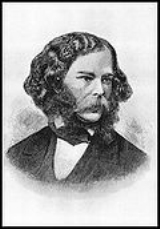
George Henry Lewes

Encyclopedia
George Henry Lewes was an English
philosopher and critic
of literature
and theatre
. He became part of the mid-Victorian ferment of ideas which encouraged discussion of Darwinism
, positivism
, and religious scepticism. However, he is perhaps best known today for having openly lived with George Eliot
, a soul-mate whose life and writings were enriched by their friendship, although they were never married.
. His mother married a retired sea captain when he was six and frequent changes of home meant he was educated in London, Jersey
, Brittany
, and finally at Dr Charles Burney
's school in Greenwich
. Having abandoned successively a commercial and a medical career, he seriously thought of becoming an actor and appeared several times on stage between 1841 and 1850. Finally he devoted himself to literature, science and philosophy.
As early as 1836 he belonged to a club formed for the study of philosophy, and had sketched out a physiological treatment of the philosophy of the Scottish school. Two years later he went to Germany, probably with the intention of studying philosophy
.
He became friends with Leigh Hunt, and through him, entered London literary society and met John Stuart Mill
, Thomas Carlyle
and Charles Dickens
.
In 1841 he married Agnes Jervis, daughter of Swynfen Stevens Jervis.
, in 1851, and by 1854 they had decided to live together. Lewes and Agnes Jervis had agreed to have an open marriage
, and in addition to the three children they had together, Agnes had also had several children by other men. Since Lewes was named on the birth certificate as the father of one of these children despite knowing this to be false, and was therefore considered complicit in adultery, he was not able to divorce Agnes. In July 1854 Lewes and Evans travelled to Weimar
and Berlin
together for the purpose of research.
The trip to Germany also served as a honeymoon as Evans and Lewes were now effectively married, with Evans calling herself Marian Evans Lewes, and referring to Lewes as her husband. It was not unusual for men in Victorian society to have affairs; Charles Dickens
, Friedrich Engels
and Wilkie Collins
had committed relationships with women they were not married to, though more discreetly than Lewes. What was scandalous was the Leweses' open admission of the relationship.
Of his three sons only one, Charles Lewes, survived him; he became a London county councillor.
, afterwards republished under the title Actors and Acting (1875), and The Spanish Drama (1846). As a youngster, he witnessed a performance by Edmund Kean
which stayed with him as an unforgettable experience. He also witnessed and wrote of his impressions of performances by William Charles Macready
and other famous stars of the 19th century London stage. He is considered to be the first practitioner of modern theatre criticism and the realistic approach to acting.
In 1845–46, Lewes published The Biographical History of Philosophy, an attempt to depict the life of philosophers as an ever-renewed fruitless labour to attain the unattainable. In 1847–48, he published two novels — Ranthrope, and Rose, Blanche and Violet — which, though displaying considerable skill in plot, construction, and characterization, have taken no permanent place in literature. The same is to be said of an ingenious attempt to rehabilitate Robespierre
(1849). In 1850 he collaborated with Thornton Leigh Hunt
in the foundation of the Leader, of which he was the literary editor. In 1853 he republished under the title of Comte's Philosophy of the Sciences a series of papers which had appeared in that journal.
The culmination of Lewes's work in prose literature is the Life of Goethe
(1855), probably the best known of his writings. Lewes's versatility, and his combination of scientific with literary tastes, eminently fitted him to appreciate the wide-ranging activity of the German poet. The work became well-known in Germany itself, despite the boldness of its criticism and the unpopularity of some of its views (e.g. on the relation of the second to the first part of Faust
).
, Lewes became its editor, but he retained the post for less than two years, when he was succeeded by John Morley.
This marks the transition from more strictly scientific to philosophic work. Lewes had been interested in philosophy from early youth; one of his earliest essays was an appreciative account of Hegel
's Aesthetics. Under the influence of the positivism
of Auguste Comte
and John Stuart Mill
's System of Logic, he abandoned all faith in the possibility of metaphysics
, and recorded this abandonment in his History of Philosophy. Yet he did not at any time give unqualified assent to Comte's teachings, and with wider reading and reflection his mind moved further away from the positivist stance. In the preface to the third edition of his History of Philosophy he avowed a change in this direction, and this movement is even more plainly discernible in subsequent editions of the work.
The final outcome of his intellectual progress is The Problems of Life and Mind. His sudden death cut short the work, yet it is complete enough to allow a judgment on the author's matured conceptions on biological, psychological and metaphysical problems.
The first two volumes on The Foundations of a Creed laid down Lewes' foundation — a rapprochement between metaphysics and science. He was still positivist enough to pronounce all inquiry into the ultimate nature of things fruitless: what matter, form, and spirit are in themselves is a futile question that belongs to the sterile region of "metempirics". But philosophical questions may be susceptible to a precise solution through scientific method
. Thus, since the relation of subject to object falls within our experience, it is a proper matter for philosophic investigation.
His treatment of the question of the relation of subject to object confused the scientific truth that mind and body coexist in the living organism and the philosophic truth that all knowledge of objects implies a knowing subject. In Shadworth Hodgson
's phrase, he mixed up the genesis of mental forms with their nature (see Philosophy of Reflexion, ii. 40-58). Thus he reached a monistic
doctrine that mind and matter are two aspects of the same existence by attending simply to the parallelism between psychical and physical processes as a given fact (or probable fact) of our experience, leaving out of account their relation as subject and object in the cognitive act.
His identification of the two as phases of one existence is open to criticism not only from the point of view of philosophy but from that of science. In his treatment of such ideas as "sensibility," "sentience" and the like, he does not always make it clear whether he is speaking of physical or of psychical phenomena. Among other philosophic questions discussed in these two volumes the nature of casual relation is perhaps the one which is handled with most freshness and suggestiveness.
The third volume, The Physical Basis of Mind, further develops the writer's views on organic activities as a whole. He insists on the radical distinction between organic and inorganic processes and the impossibility of explaining the former by purely mechanical principles. All parts of the nervous system have the same elementary property; sensibility. Thus sensibility belongs as much to the lower centres of the spinal cord as to the brain, the former, more elementary, form contributing to the subconscious
region of mental life, while the higher functions of the nervous system, which make up our conscious mental life, are more complex modifications of this fundamental property of nerve substance.
The nervous organism acts as a whole, particular mental operations cannot be referred to definite regions of the brain, and the hypothesis
of nervous activity by an isolated pathway from one nerve cell to another is altogether illusory. By insisting on the complete coincidence between the regions of nerve action and sentience, that these are but different aspects of one thing, he was able to attack the doctrine of animal and human automatism
which affirms that feeling or consciousness is merely an incidental concomitant of nerve action in no way essential to the chain of physical events.
Lewes's views on psychology
, partly explained in the earlier volumes of the Problems, are more fully worked out in the last two (3rd series). He discussed the method of psychology with much insight. Against Comte and his followers he claimed a place for introspection in psychological research. As well as this subjective method there must be an objective one, a reference to nervous conditions and socio-historical data. Biology would help explain mental functions such as feeling and thinking, it would not help us to understand differences of mental faculty in different races and stages of human development. The organic conditions of these differences will probably for ever escape detection, hence they can be explained only as the products of the social environment. The relationship of mental phenomena to social and historical conditions is probably Lewes's most important contribution to psychology.
He also emphasized the complexity of mental phenomena. Every mental state is regarded as compounded of three factors in different proportions — sensible affection, logical grouping and motor impulse. But Lewes's work in psychology consists less in discoveries than in method. His biological experience prepared him to view mind as a complex unity of which the highest processes are identical with and evolved out of the lower. Thus the operation of thought, or "the logic of signs," is a more complicated form of the elementary operations of sensation and instinct or "the logic of feeling."
The last volume of the Problems illustrates this position. It is a valuable repository of psychological facts, many of them drawn from obscure regions of mental life and from abnormal experience. To suggest and to stimulate the mind, rather than to supply it with any complete system of knowledge, may be said to be Lewes's service to philosophy. The exceptional rapidity and versatility of his intelligence seems to account at once for the freshness in his way of envisaging the subject matter of philosophy and psychology, and for the want of satisfactory elaboration and of systematic co-ordination.
England
England is a country that is part of the United Kingdom. It shares land borders with Scotland to the north and Wales to the west; the Irish Sea is to the north west, the Celtic Sea to the south west, with the North Sea to the east and the English Channel to the south separating it from continental...
philosopher and critic
Critic
A critic is anyone who expresses a value judgement. Informally, criticism is a common aspect of all human expression and need not necessarily imply skilled or accurate expressions of judgement. Critical judgements, good or bad, may be positive , negative , or balanced...
of literature
Literature
Literature is the art of written works, and is not bound to published sources...
and theatre
Theatre
Theatre is a collaborative form of fine art that uses live performers to present the experience of a real or imagined event before a live audience in a specific place. The performers may communicate this experience to the audience through combinations of gesture, speech, song, music or dance...
. He became part of the mid-Victorian ferment of ideas which encouraged discussion of Darwinism
Darwinism
Darwinism is a set of movements and concepts related to ideas of transmutation of species or of evolution, including some ideas with no connection to the work of Charles Darwin....
, positivism
Positivism
Positivism is a a view of scientific methods and a philosophical approach, theory, or system based on the view that, in the social as well as natural sciences, sensory experiences and their logical and mathematical treatment are together the exclusive source of all worthwhile information....
, and religious scepticism. However, he is perhaps best known today for having openly lived with George Eliot
George Eliot
Mary Anne Evans , better known by her pen name George Eliot, was an English novelist, journalist and translator, and one of the leading writers of the Victorian era...
, a soul-mate whose life and writings were enriched by their friendship, although they were never married.
Biography
Lewes, born in London, was an illegitimate son of a minor poet, John Lee Lewes, and Elizabeth Ashweek and grandson of comic actor Charles Lee LewesCharles Lee Lewes
-Biography:He was born the son of a hosier in London. After attending a school at Ambleside he returned to London, where he found employment as a postman. In about 1760 he went on the stage in the provinces, and some three years later began to appear in minor parts at Covent Garden Theatre...
. His mother married a retired sea captain when he was six and frequent changes of home meant he was educated in London, Jersey
Jersey
Jersey, officially the Bailiwick of Jersey is a British Crown Dependency off the coast of Normandy, France. As well as the island of Jersey itself, the bailiwick includes two groups of small islands that are no longer permanently inhabited, the Minquiers and Écréhous, and the Pierres de Lecq and...
, Brittany
Brittany
Brittany is a cultural and administrative region in the north-west of France. Previously a kingdom and then a duchy, Brittany was united to the Kingdom of France in 1532 as a province. Brittany has also been referred to as Less, Lesser or Little Britain...
, and finally at Dr Charles Burney
Charles Burney
Charles Burney FRS was an English music historian and father of authors Frances Burney and Sarah Burney.-Life and career:...
's school in Greenwich
Greenwich
Greenwich is a district of south London, England, located in the London Borough of Greenwich.Greenwich is best known for its maritime history and for giving its name to the Greenwich Meridian and Greenwich Mean Time...
. Having abandoned successively a commercial and a medical career, he seriously thought of becoming an actor and appeared several times on stage between 1841 and 1850. Finally he devoted himself to literature, science and philosophy.
As early as 1836 he belonged to a club formed for the study of philosophy, and had sketched out a physiological treatment of the philosophy of the Scottish school. Two years later he went to Germany, probably with the intention of studying philosophy
Philosophy
Philosophy is the study of general and fundamental problems, such as those connected with existence, knowledge, values, reason, mind, and language. Philosophy is distinguished from other ways of addressing such problems by its critical, generally systematic approach and its reliance on rational...
.
He became friends with Leigh Hunt, and through him, entered London literary society and met John Stuart Mill
John Stuart Mill
John Stuart Mill was a British philosopher, economist and civil servant. An influential contributor to social theory, political theory, and political economy, his conception of liberty justified the freedom of the individual in opposition to unlimited state control. He was a proponent of...
, Thomas Carlyle
Thomas Carlyle
Thomas Carlyle was a Scottish satirical writer, essayist, historian and teacher during the Victorian era.He called economics "the dismal science", wrote articles for the Edinburgh Encyclopedia, and became a controversial social commentator.Coming from a strict Calvinist family, Carlyle was...
and Charles Dickens
Charles Dickens
Charles John Huffam Dickens was an English novelist, generally considered the greatest of the Victorian period. Dickens enjoyed a wider popularity and fame than had any previous author during his lifetime, and he remains popular, having been responsible for some of English literature's most iconic...
.
In 1841 he married Agnes Jervis, daughter of Swynfen Stevens Jervis.
Relationship with George Eliot
Lewes met writer Marian Evans, later to be famous as George EliotGeorge Eliot
Mary Anne Evans , better known by her pen name George Eliot, was an English novelist, journalist and translator, and one of the leading writers of the Victorian era...
, in 1851, and by 1854 they had decided to live together. Lewes and Agnes Jervis had agreed to have an open marriage
Open marriage
Open marriage typically refers to a marriage in which the partners agree that each may engage in extramarital sexual relationships, without this being regarded as infidelity. There are many different styles of open marriage, with the partners having varying levels of input on their spouse's...
, and in addition to the three children they had together, Agnes had also had several children by other men. Since Lewes was named on the birth certificate as the father of one of these children despite knowing this to be false, and was therefore considered complicit in adultery, he was not able to divorce Agnes. In July 1854 Lewes and Evans travelled to Weimar
Weimar
Weimar is a city in Germany famous for its cultural heritage. It is located in the federal state of Thuringia , north of the Thüringer Wald, east of Erfurt, and southwest of Halle and Leipzig. Its current population is approximately 65,000. The oldest record of the city dates from the year 899...
and Berlin
Berlin
Berlin is the capital city of Germany and is one of the 16 states of Germany. With a population of 3.45 million people, Berlin is Germany's largest city. It is the second most populous city proper and the seventh most populous urban area in the European Union...
together for the purpose of research.
The trip to Germany also served as a honeymoon as Evans and Lewes were now effectively married, with Evans calling herself Marian Evans Lewes, and referring to Lewes as her husband. It was not unusual for men in Victorian society to have affairs; Charles Dickens
Charles Dickens
Charles John Huffam Dickens was an English novelist, generally considered the greatest of the Victorian period. Dickens enjoyed a wider popularity and fame than had any previous author during his lifetime, and he remains popular, having been responsible for some of English literature's most iconic...
, Friedrich Engels
Friedrich Engels
Friedrich Engels was a German industrialist, social scientist, author, political theorist, philosopher, and father of Marxist theory, alongside Karl Marx. In 1845 he published The Condition of the Working Class in England, based on personal observations and research...
and Wilkie Collins
Wilkie Collins
William Wilkie Collins was an English novelist, playwright, and author of short stories. He was very popular during the Victorian era and wrote 30 novels, more than 60 short stories, 14 plays, and over 100 non-fiction pieces...
had committed relationships with women they were not married to, though more discreetly than Lewes. What was scandalous was the Leweses' open admission of the relationship.
Of his three sons only one, Charles Lewes, survived him; he became a London county councillor.
Lewes and literature
During the next ten years Lewes supported himself by contributing, to quarterly and other reviews, articles discussing a wide range of subjects, often imperfect but revealing acute critical judgment enlightened by philosophic study. The most valuable are those on dramaDrama
Drama is the specific mode of fiction represented in performance. The term comes from a Greek word meaning "action" , which is derived from "to do","to act" . The enactment of drama in theatre, performed by actors on a stage before an audience, presupposes collaborative modes of production and a...
, afterwards republished under the title Actors and Acting (1875), and The Spanish Drama (1846). As a youngster, he witnessed a performance by Edmund Kean
Edmund Kean
Edmund Kean was an English actor, regarded in his time as the greatest ever.-Early life:Kean was born in London. His father was probably Edmund Kean, an architect’s clerk, and his mother was an actress, Anne Carey, daughter of the 18th century composer and playwright Henry Carey...
which stayed with him as an unforgettable experience. He also witnessed and wrote of his impressions of performances by William Charles Macready
William Charles Macready
-Life:He was born in London, and educated at Rugby.It was his intention to go up to Oxford, but in 1809 the embarrassed affairs of his father, the lessee of several provincial theatres, called him to share the responsibilities of theatrical management. On 7 June 1810 he made a successful first...
and other famous stars of the 19th century London stage. He is considered to be the first practitioner of modern theatre criticism and the realistic approach to acting.
In 1845–46, Lewes published The Biographical History of Philosophy, an attempt to depict the life of philosophers as an ever-renewed fruitless labour to attain the unattainable. In 1847–48, he published two novels — Ranthrope, and Rose, Blanche and Violet — which, though displaying considerable skill in plot, construction, and characterization, have taken no permanent place in literature. The same is to be said of an ingenious attempt to rehabilitate Robespierre
Maximilien Robespierre
Maximilien François Marie Isidore de Robespierre is one of the best-known and most influential figures of the French Revolution. He largely dominated the Committee of Public Safety and was instrumental in the period of the Revolution commonly known as the Reign of Terror, which ended with his...
(1849). In 1850 he collaborated with Thornton Leigh Hunt
Thornton Leigh Hunt
Thornton Leigh Hunt was the first editor of the British daily broadsheet newspaper The Daily Telegraph....
in the foundation of the Leader, of which he was the literary editor. In 1853 he republished under the title of Comte's Philosophy of the Sciences a series of papers which had appeared in that journal.
The culmination of Lewes's work in prose literature is the Life of Goethe
Johann Wolfgang von Goethe
Johann Wolfgang von Goethe was a German writer, pictorial artist, biologist, theoretical physicist, and polymath. He is considered the supreme genius of modern German literature. His works span the fields of poetry, drama, prose, philosophy, and science. His Faust has been called the greatest long...
(1855), probably the best known of his writings. Lewes's versatility, and his combination of scientific with literary tastes, eminently fitted him to appreciate the wide-ranging activity of the German poet. The work became well-known in Germany itself, despite the boldness of its criticism and the unpopularity of some of its views (e.g. on the relation of the second to the first part of Faust
Faust
Faust is the protagonist of a classic German legend; a highly successful scholar, but also dissatisfied with his life, and so makes a deal with the devil, exchanging his soul for unlimited knowledge and worldly pleasures. Faust's tale is the basis for many literary, artistic, cinematic, and musical...
).
Science
From about 1853 Lewes's writings show that he was occupying himself with scientific and more particularly biological work, though he always showed a distinctly scientific bent in his writings. Considering that he had not had technical training these studies are a testimony to his intellect. More than popular expositions of accepted scientific truths, they contain able criticisms of conventionally accepted ideas and embody the results of individual research and individual reflection. He made several suggestions, some of which have since been accepted by physiologists, of which the most valuable is that now known as the doctrine of the functional indifference of the nerves — that what were known as the specific energies of the optic, auditory and other nerves are simply differences in their mode of action due to the differences of the peripheral structures or sense-organs with which they are connected. This idea was subsequently proposed independently by Wundt.Philosophy
In 1865, on the starting of the Fortnightly ReviewFortnightly Review
Fortnightly Review was one of the most important and influential magazines in nineteenth-century England. It was founded in 1865 by Anthony Trollope, Frederic Harrison, Edward Spencer Beesly, and six others with an investment of £9,000; the first edition appeared on 15 May 1865...
, Lewes became its editor, but he retained the post for less than two years, when he was succeeded by John Morley.
This marks the transition from more strictly scientific to philosophic work. Lewes had been interested in philosophy from early youth; one of his earliest essays was an appreciative account of Hegel
Georg Wilhelm Friedrich Hegel
Georg Wilhelm Friedrich Hegel was a German philosopher, one of the creators of German Idealism. His historicist and idealist account of reality as a whole revolutionized European philosophy and was an important precursor to Continental philosophy and Marxism.Hegel developed a comprehensive...
's Aesthetics. Under the influence of the positivism
Positivism
Positivism is a a view of scientific methods and a philosophical approach, theory, or system based on the view that, in the social as well as natural sciences, sensory experiences and their logical and mathematical treatment are together the exclusive source of all worthwhile information....
of Auguste Comte
Auguste Comte
Isidore Auguste Marie François Xavier Comte , better known as Auguste Comte , was a French philosopher, a founder of the discipline of sociology and of the doctrine of positivism...
and John Stuart Mill
John Stuart Mill
John Stuart Mill was a British philosopher, economist and civil servant. An influential contributor to social theory, political theory, and political economy, his conception of liberty justified the freedom of the individual in opposition to unlimited state control. He was a proponent of...
's System of Logic, he abandoned all faith in the possibility of metaphysics
Metaphysics
Metaphysics is a branch of philosophy concerned with explaining the fundamental nature of being and the world, although the term is not easily defined. Traditionally, metaphysics attempts to answer two basic questions in the broadest possible terms:...
, and recorded this abandonment in his History of Philosophy. Yet he did not at any time give unqualified assent to Comte's teachings, and with wider reading and reflection his mind moved further away from the positivist stance. In the preface to the third edition of his History of Philosophy he avowed a change in this direction, and this movement is even more plainly discernible in subsequent editions of the work.
The final outcome of his intellectual progress is The Problems of Life and Mind. His sudden death cut short the work, yet it is complete enough to allow a judgment on the author's matured conceptions on biological, psychological and metaphysical problems.
The first two volumes on The Foundations of a Creed laid down Lewes' foundation — a rapprochement between metaphysics and science. He was still positivist enough to pronounce all inquiry into the ultimate nature of things fruitless: what matter, form, and spirit are in themselves is a futile question that belongs to the sterile region of "metempirics". But philosophical questions may be susceptible to a precise solution through scientific method
Scientific method
Scientific method refers to a body of techniques for investigating phenomena, acquiring new knowledge, or correcting and integrating previous knowledge. To be termed scientific, a method of inquiry must be based on gathering empirical and measurable evidence subject to specific principles of...
. Thus, since the relation of subject to object falls within our experience, it is a proper matter for philosophic investigation.
His treatment of the question of the relation of subject to object confused the scientific truth that mind and body coexist in the living organism and the philosophic truth that all knowledge of objects implies a knowing subject. In Shadworth Hodgson
Shadworth Hodgson
Shadworth Hollway Hodgson was an English philosopher.He worked independently, without academic affiliation. He was acknowledged by William James as a forerunner of Pragmatism, although he viewed his work as a completion of Kant's project...
's phrase, he mixed up the genesis of mental forms with their nature (see Philosophy of Reflexion, ii. 40-58). Thus he reached a monistic
Monism
Monism is any philosophical view which holds that there is unity in a given field of inquiry. Accordingly, some philosophers may hold that the universe is one rather than dualistic or pluralistic...
doctrine that mind and matter are two aspects of the same existence by attending simply to the parallelism between psychical and physical processes as a given fact (or probable fact) of our experience, leaving out of account their relation as subject and object in the cognitive act.
His identification of the two as phases of one existence is open to criticism not only from the point of view of philosophy but from that of science. In his treatment of such ideas as "sensibility," "sentience" and the like, he does not always make it clear whether he is speaking of physical or of psychical phenomena. Among other philosophic questions discussed in these two volumes the nature of casual relation is perhaps the one which is handled with most freshness and suggestiveness.
The third volume, The Physical Basis of Mind, further develops the writer's views on organic activities as a whole. He insists on the radical distinction between organic and inorganic processes and the impossibility of explaining the former by purely mechanical principles. All parts of the nervous system have the same elementary property; sensibility. Thus sensibility belongs as much to the lower centres of the spinal cord as to the brain, the former, more elementary, form contributing to the subconscious
Subconscious
The term subconscious is used in many different contexts and has no single or precise definition. This greatly limits its significance as a definition-bearing concept, and in consequence the word tends to be avoided in academic and scientific settings....
region of mental life, while the higher functions of the nervous system, which make up our conscious mental life, are more complex modifications of this fundamental property of nerve substance.
The nervous organism acts as a whole, particular mental operations cannot be referred to definite regions of the brain, and the hypothesis
Hypothesis
A hypothesis is a proposed explanation for a phenomenon. The term derives from the Greek, ὑποτιθέναι – hypotithenai meaning "to put under" or "to suppose". For a hypothesis to be put forward as a scientific hypothesis, the scientific method requires that one can test it...
of nervous activity by an isolated pathway from one nerve cell to another is altogether illusory. By insisting on the complete coincidence between the regions of nerve action and sentience, that these are but different aspects of one thing, he was able to attack the doctrine of animal and human automatism
Automaton
An automaton is a self-operating machine. The word is sometimes used to describe a robot, more specifically an autonomous robot. An alternative spelling, now obsolete, is automation.-Etymology:...
which affirms that feeling or consciousness is merely an incidental concomitant of nerve action in no way essential to the chain of physical events.
Lewes's views on psychology
Psychology
Psychology is the study of the mind and behavior. Its immediate goal is to understand individuals and groups by both establishing general principles and researching specific cases. For many, the ultimate goal of psychology is to benefit society...
, partly explained in the earlier volumes of the Problems, are more fully worked out in the last two (3rd series). He discussed the method of psychology with much insight. Against Comte and his followers he claimed a place for introspection in psychological research. As well as this subjective method there must be an objective one, a reference to nervous conditions and socio-historical data. Biology would help explain mental functions such as feeling and thinking, it would not help us to understand differences of mental faculty in different races and stages of human development. The organic conditions of these differences will probably for ever escape detection, hence they can be explained only as the products of the social environment. The relationship of mental phenomena to social and historical conditions is probably Lewes's most important contribution to psychology.
He also emphasized the complexity of mental phenomena. Every mental state is regarded as compounded of three factors in different proportions — sensible affection, logical grouping and motor impulse. But Lewes's work in psychology consists less in discoveries than in method. His biological experience prepared him to view mind as a complex unity of which the highest processes are identical with and evolved out of the lower. Thus the operation of thought, or "the logic of signs," is a more complicated form of the elementary operations of sensation and instinct or "the logic of feeling."
The last volume of the Problems illustrates this position. It is a valuable repository of psychological facts, many of them drawn from obscure regions of mental life and from abnormal experience. To suggest and to stimulate the mind, rather than to supply it with any complete system of knowledge, may be said to be Lewes's service to philosophy. The exceptional rapidity and versatility of his intelligence seems to account at once for the freshness in his way of envisaging the subject matter of philosophy and psychology, and for the want of satisfactory elaboration and of systematic co-ordination.
Publications
- The Biographical History of Philosophy (1846). Adamant Media 2002: ISBN 0543969851
- The Spanish Drama (1846)
- Ranthorpe (1847). Adamant Media 2005: ISBN 1402175647
- Rose, Blanche and Violet (1848)
- Robespierre (1849)
- Comte's Philosophy of the Sciences (1853). Adamant Media 2000: ISBN 1402199503
- Life of Goethe (1855). Adamant Media 2000: ISBN 0543930777
- Seaside Studies (1858)
- Physiology of Common Life (1859)
- Studies in Animal Life (1862)
- Aristotle, A Chapter from the History of Science (1864). Adamant Media 2001: ISBN 0543817539
- Actors and Acting (1875)
- The Problems of Life and Mind
- First Series: The Foundations of a Creed vol I (1875). Kessinger Publishing 2004: ISBN 1417925558
- The Foundations of a Creed vol II (1875). University of Michigan Library: ISBN 1425555780
- Second Series: The Physical Basis of Mind (1877)
- Third Series: Mind as a Function of Organism (1879)
- New Quarterly (London, October, 1879)
- J. W. Cross, George EliotGeorge EliotMary Anne Evans , better known by her pen name George Eliot, was an English novelist, journalist and translator, and one of the leading writers of the Victorian era...
's Life as Related in her Letters and Journals (three volumes, New York, 1885)