

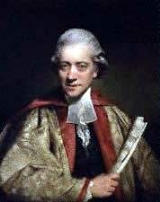
Charles Burney

Encyclopedia
Charles Burney FRS
(7 April 1726 – 12 April 1814) was an English
music historian
and father of authors Frances Burney and Sarah Burney
.
, and educated at Shrewsbury School
. He was later sent to the public school at Chester, where his first music master was a Mr Baker, organist of the cathedral, and a pupil of Dr John Blow
. Returning to Shrewsbury at the age of fifteen, Burney continued his musical studies for three years under his half-brother, James Burney, organist of St Mary's church, and was then sent to London as a pupil of Dr Thomas Arne for three years.
Burney wrote some music for Thomson's Alfred, which was produced at Drury Lane
theatre on 30 March 1745. In 1749 he was appointed organist of St Dionis-Backchurch, Fenchurch Street
, with a salary of £30 a year; and he was also engaged to take the harpsichord
in the "New Concerts" then recently established at the King's Arms, Cornhill. In that year he married Esther Sleepe, who died in 1761; in 1769 he married Mrs Stephen Allen of Lynn. It was for his health that he went in 1751 to Lynn Regis
in Norfolk
, where he was elected organist, with an annual salary of £100, and lived for nine years. During that time he began to entertain the idea of writing a general history of music. His Ode for St Cecilia's Day was performed at Ranelagh Gardens
in 1759; and in 1760 he returned to London in good health and with a young family; the eldest child, a girl of eight, surprised the public by her attainments as a harpsichord player. The concertos for harpsichord which Burney published soon after his return to London were much admired. In 1766 he produced, at Drury Lane
, a translation and adaptation of Jean-Jacques Rousseau
's opera Le Devin du village
, under the title of The Cunning Man.
The University of Oxford
honoured Burney, on 23 June 1769, with the degrees of Bachelor and Doctor of Music, and his own work was performed. This consisted of an anthem, with an overture, solos, recitatives and choruses, accompanied by instruments, besides a vocal anthem in eight parts, which was not performed. In 1769 he published An Essay towards a History of Comets. Amidst his various professional avocations, Burney never lost sight of his main project—his History of Music-and decided to travel abroad and collect materials that could not be found in Britain. Accordingly, he left London in June 1770, carrying numerous letters of introduction, and travelled to Paris
, Geneva
, Turin
, Milan
, Padua
, Venice
, Bologna
, Florence
, Rome
and Naples
. The results of his observations were published in The Present State of Music in France and Italy (1771). This was very well received. In July 1772 Burney again visited the continent, to do further research, and, after his return to London, published his tour under the title of The Present State of Music in Germany, the Netherlands and United Provinces (1773). In 1773 he was chosen as a fellow of the Royal Society
.
In 1776 appeared the first volume (in quarto) of his long-projected History of Music. In 1782 Burney published his second volume; and in 1789 the third and fourth. Though criticized by Forkel
in Germany
and by the Spanish ex-Jesuit, Requeno, who, in his Saggj sul Ristabilimento dell' Arte Armonica de' Greci e Romani Canton (Parma, 1798), attacks Burney's account of ancient Greek music, and calls him lo scompigliato Burney, the History of Music was generally well-received. The fourth volume covers the birth and development of opera and the musical scene in England in Burney's time. Burney's first tour was translated into German by Ebeling, and printed at Hamburg in 1772; and his second tour, translated into German by Bode, was published at Hamburg in 1773. A Dutch translation of his second tour, with notes by J. W. Lustig, organist at Groningen, was published there in 1786. The Dissertation on the Music of the Ancients, in the first volume of Burney's History, was translated into German by Johann Joachim Eschenburg, and printed at Leipzig, 1781. Burney derived much aid from the first two volumes of Padre Martini's very learned Storia della Musica (Bologna, 1757–1770).
In 1774 he had written A Plan for a Music School. In 1779 he wrote for the Royal Society an account of the young William Crotch
, whose remarkable musical talent excited so much attention at that time. In 1784 he published, with an Italian. title-page, the music annually performed in the pope's chapel at Rome during Passion Week
. In 1785 he published, for the benefit of the Musical Fund, an account of the first commemoration
of George Friedrich Handel in Westminster Abbey
in the preceding year, with an excellent life of Handel. In 1796 he published Memoirs and Letters of Metastasio
.
Towards the close of his life Burney was paid £1000 for contributing to Rees's Cyclopaedia
all the musical articles not belonging to the department of natural philosophy and mathematics. In 1783, through the treasury influence of his friend Edmund Burke
, he was appointed organist to the chapel of Chelsea Hospital, and moved from St Martin's Street, Leicester Square
, to live in the hospital for the rest of his life. He was made a member of the Institute of France, and nominated a correspondent in the class of the fine arts, in the year 1810. From 1806 until his death he enjoyed a pension of £300 granted by Fox. He died at Chelsea College on 12 April 1814, and was interred in the burying-ground of the college. A tablet was erected to his memory in Westminster Abbey
.
in 1781 for Henry Thrale
's library. His bust was cut by Nollekens in 1805. He also appears in James Barry's
The Thames (also known as Triumph of Navigation) that was painted in 1791 for the Society of the Arts and Manufactures. He had a wide circle of acquaintance among the distinguished artists and literary men of his day. At one time he thought of writing a life of his friend Dr Samuel Johnson
, but retired before the crowd of biographers who rushed into that field.
His eldest son, James Burney
, was a distinguished officer in the royal navy, who died a rear-admiral in 1821; his second son was the Rev. Charles Burney
; and his second daughter was Frances or Fanny, the famous novelist, later Madame D'Arblay
. Her published diary and letters contain many minute and interesting particulars of her father's public and private life, and of his friends and contemporaries, including his initial opposition to her marriage to the French refugee Alexandre D'Arblay in 1793 and to her sister Charlotte's remarriage to the pamphleteer and stockjobber Ralph Broome
in 1798. A life of Burney was compiled by Madame D'Arblay and appeared in 1832, but it has been criticized consistently for being eulogistic. His daughter by his second marriage, Sarah Burney
, was also a novelist. Her letters also provide interesting, less adulatory information about her father. Although Sarah looked after him in his old age, their personal relations remained poor.
drew inspiration from The Present State of Music in France and Italy (1771), according to later writers: "Dr. Burney published an account of his tour... which was extremely well received, and deemed by the best judges so good a model for travellers who were inclined to give a description of what they had seen or observed, that Dr. Johnson professedly imitated it in his own Tour of the Hebrides, saying, "I had that clever dog Burney's Musical Tour in my eye."
Burney appears in a story by Lillian de la Torre (Lillian Bueno McCue, 1902-1993), a US writer of historical mysteries, entitled "The Viotti Stradivarius," part of her series featuring Samuel Johnson
as a "detector" (detective). The story features a fictitious meeting between Burney, his daughter Fanny, Giovanni Battista Viotti
and his Stradivarius, and Grigory Grigoryevich Orlov
, along with Johnson and James Boswell
, in connection with the theft and recovery of the Orlov diamond.
Royal Society
The Royal Society of London for Improving Natural Knowledge, known simply as the Royal Society, is a learned society for science, and is possibly the oldest such society in existence. Founded in November 1660, it was granted a Royal Charter by King Charles II as the "Royal Society of London"...
(7 April 1726 – 12 April 1814) was an English
England
England is a country that is part of the United Kingdom. It shares land borders with Scotland to the north and Wales to the west; the Irish Sea is to the north west, the Celtic Sea to the south west, with the North Sea to the east and the English Channel to the south separating it from continental...
music historian
Music history
Music history, sometimes called historical musicology, is the highly diverse subfield of the broader discipline of musicology that studies the composition, performance, reception, and criticism of music over time...
and father of authors Frances Burney and Sarah Burney
Sarah Burney
Sarah Harriet Burney was an English novelist, the daughter of musicologist and composer Charles Burney, and half-sister of the novelist and diarist Frances Burney .- Life :Sarah Burney's mother, Elizabeth Allen, was the second wife of...
.
Life and career
Charles Burney was born at ShrewsburyShrewsbury
Shrewsbury is the county town of Shropshire, in the West Midlands region of England. Lying on the River Severn, it is a civil parish home to some 70,000 inhabitants, and is the primary settlement and headquarters of Shropshire Council...
, and educated at Shrewsbury School
Shrewsbury School
Shrewsbury School is a co-educational independent school for pupils aged 13 to 18, founded by Royal Charter in 1552. The present campus to which the school moved in 1882 is located on the banks of the River Severn in Shrewsbury, Shropshire, England...
. He was later sent to the public school at Chester, where his first music master was a Mr Baker, organist of the cathedral, and a pupil of Dr John Blow
John Blow
John Blow was an English Baroque composer and organist, appointed to Westminster Abbey in 1669. His pupils included William Croft, Jeremiah Clarke and Henry Purcell. In 1685 he was named a private musician to James II. His only stage composition, Venus and Adonis John Blow (baptised 23 February...
. Returning to Shrewsbury at the age of fifteen, Burney continued his musical studies for three years under his half-brother, James Burney, organist of St Mary's church, and was then sent to London as a pupil of Dr Thomas Arne for three years.
Burney wrote some music for Thomson's Alfred, which was produced at Drury Lane
Drury Lane
Drury Lane is a street on the eastern boundary of the Covent Garden area of London, running between Aldwych and High Holborn. The northern part is in the borough of Camden and the southern part in the City of Westminster....
theatre on 30 March 1745. In 1749 he was appointed organist of St Dionis-Backchurch, Fenchurch Street
Fenchurch Street
Fenchurch Street is a street in the City of London home to a number of shops, pubs and offices. It links Aldgate at its eastern end with Lombard Street and Gracechurch Street to the west. To the south of Fenchurch Street and towards its eastern end is Fenchurch Street railway station...
, with a salary of £30 a year; and he was also engaged to take the harpsichord
Harpsichord
A harpsichord is a musical instrument played by means of a keyboard. It produces sound by plucking a string when a key is pressed.In the narrow sense, "harpsichord" designates only the large wing-shaped instruments in which the strings are perpendicular to the keyboard...
in the "New Concerts" then recently established at the King's Arms, Cornhill. In that year he married Esther Sleepe, who died in 1761; in 1769 he married Mrs Stephen Allen of Lynn. It was for his health that he went in 1751 to Lynn Regis
King's Lynn
King's Lynn is a sea port and market town in the ceremonial county of Norfolk in the East of England. It is situated north of London and west of Norwich. The population of the town is 42,800....
in Norfolk
Norfolk
Norfolk is a low-lying county in the East of England. It has borders with Lincolnshire to the west, Cambridgeshire to the west and southwest and Suffolk to the south. Its northern and eastern boundaries are the North Sea coast and to the north-west the county is bordered by The Wash. The county...
, where he was elected organist, with an annual salary of £100, and lived for nine years. During that time he began to entertain the idea of writing a general history of music. His Ode for St Cecilia's Day was performed at Ranelagh Gardens
Ranelagh Gardens
Ranelagh Gardens were public pleasure gardens located in Chelsea, then just outside London, England in the 18th century.-History:The Ranelagh Gardens were so called because they occupied the site of Ranelagh House, built in 1688-89 by the first Earl of Ranelagh, Treasurer of Chelsea Hospital ,...
in 1759; and in 1760 he returned to London in good health and with a young family; the eldest child, a girl of eight, surprised the public by her attainments as a harpsichord player. The concertos for harpsichord which Burney published soon after his return to London were much admired. In 1766 he produced, at Drury Lane
Drury Lane
Drury Lane is a street on the eastern boundary of the Covent Garden area of London, running between Aldwych and High Holborn. The northern part is in the borough of Camden and the southern part in the City of Westminster....
, a translation and adaptation of Jean-Jacques Rousseau
Jean-Jacques Rousseau
Jean-Jacques Rousseau was a Genevan philosopher, writer, and composer of 18th-century Romanticism. His political philosophy influenced the French Revolution as well as the overall development of modern political, sociological and educational thought.His novel Émile: or, On Education is a treatise...
's opera Le Devin du village
Le Devin du Village
Le devin du village is an interméde, a one-act opera by Jean-Jacques Rousseau, who also wrote the libretto.It was first performed before the court at Fontainebleau on 18 October 1752 and at the Paris Opéra on 1 March 1753. King Louis XV loved the work so much that he offered Rousseau the great...
, under the title of The Cunning Man.
The University of Oxford
University of Oxford
The University of Oxford is a university located in Oxford, United Kingdom. It is the second-oldest surviving university in the world and the oldest in the English-speaking world. Although its exact date of foundation is unclear, there is evidence of teaching as far back as 1096...
honoured Burney, on 23 June 1769, with the degrees of Bachelor and Doctor of Music, and his own work was performed. This consisted of an anthem, with an overture, solos, recitatives and choruses, accompanied by instruments, besides a vocal anthem in eight parts, which was not performed. In 1769 he published An Essay towards a History of Comets. Amidst his various professional avocations, Burney never lost sight of his main project—his History of Music-and decided to travel abroad and collect materials that could not be found in Britain. Accordingly, he left London in June 1770, carrying numerous letters of introduction, and travelled to Paris
Paris
Paris is the capital and largest city in France, situated on the river Seine, in northern France, at the heart of the Île-de-France region...
, Geneva
Geneva
Geneva In the national languages of Switzerland the city is known as Genf , Ginevra and Genevra is the second-most-populous city in Switzerland and is the most populous city of Romandie, the French-speaking part of Switzerland...
, Turin
Turin
Turin is a city and major business and cultural centre in northern Italy, capital of the Piedmont region, located mainly on the left bank of the Po River and surrounded by the Alpine arch. The population of the city proper is 909,193 while the population of the urban area is estimated by Eurostat...
, Milan
Milan
Milan is the second-largest city in Italy and the capital city of the region of Lombardy and of the province of Milan. The city proper has a population of about 1.3 million, while its urban area, roughly coinciding with its administrative province and the bordering Province of Monza and Brianza ,...
, Padua
Padua
Padua is a city and comune in the Veneto, northern Italy. It is the capital of the province of Padua and the economic and communications hub of the area. Padua's population is 212,500 . The city is sometimes included, with Venice and Treviso, in the Padua-Treviso-Venice Metropolitan Area, having...
, Venice
Venice
Venice is a city in northern Italy which is renowned for the beauty of its setting, its architecture and its artworks. It is the capital of the Veneto region...
, Bologna
Bologna
Bologna is the capital city of Emilia-Romagna, in the Po Valley of Northern Italy. The city lies between the Po River and the Apennine Mountains, more specifically, between the Reno River and the Savena River. Bologna is a lively and cosmopolitan Italian college city, with spectacular history,...
, Florence
Florence
Florence is the capital city of the Italian region of Tuscany and of the province of Florence. It is the most populous city in Tuscany, with approximately 370,000 inhabitants, expanding to over 1.5 million in the metropolitan area....
, Rome
Rome
Rome is the capital of Italy and the country's largest and most populated city and comune, with over 2.7 million residents in . The city is located in the central-western portion of the Italian Peninsula, on the Tiber River within the Lazio region of Italy.Rome's history spans two and a half...
and Naples
Naples
Naples is a city in Southern Italy, situated on the country's west coast by the Gulf of Naples. Lying between two notable volcanic regions, Mount Vesuvius and the Phlegraean Fields, it is the capital of the region of Campania and of the province of Naples...
. The results of his observations were published in The Present State of Music in France and Italy (1771). This was very well received. In July 1772 Burney again visited the continent, to do further research, and, after his return to London, published his tour under the title of The Present State of Music in Germany, the Netherlands and United Provinces (1773). In 1773 he was chosen as a fellow of the Royal Society
Royal Society
The Royal Society of London for Improving Natural Knowledge, known simply as the Royal Society, is a learned society for science, and is possibly the oldest such society in existence. Founded in November 1660, it was granted a Royal Charter by King Charles II as the "Royal Society of London"...
.
In 1776 appeared the first volume (in quarto) of his long-projected History of Music. In 1782 Burney published his second volume; and in 1789 the third and fourth. Though criticized by Forkel
Johann Nikolaus Forkel
Johann Nikolaus Forkel , was a German musician, musicologist and music theorist.-Biography:...
in Germany
Germany
Germany , officially the Federal Republic of Germany , is a federal parliamentary republic in Europe. The country consists of 16 states while the capital and largest city is Berlin. Germany covers an area of 357,021 km2 and has a largely temperate seasonal climate...
and by the Spanish ex-Jesuit, Requeno, who, in his Saggj sul Ristabilimento dell' Arte Armonica de' Greci e Romani Canton (Parma, 1798), attacks Burney's account of ancient Greek music, and calls him lo scompigliato Burney, the History of Music was generally well-received. The fourth volume covers the birth and development of opera and the musical scene in England in Burney's time. Burney's first tour was translated into German by Ebeling, and printed at Hamburg in 1772; and his second tour, translated into German by Bode, was published at Hamburg in 1773. A Dutch translation of his second tour, with notes by J. W. Lustig, organist at Groningen, was published there in 1786. The Dissertation on the Music of the Ancients, in the first volume of Burney's History, was translated into German by Johann Joachim Eschenburg, and printed at Leipzig, 1781. Burney derived much aid from the first two volumes of Padre Martini's very learned Storia della Musica (Bologna, 1757–1770).
In 1774 he had written A Plan for a Music School. In 1779 he wrote for the Royal Society an account of the young William Crotch
William Crotch
William Crotch was an English composer, organist and artist.Born in Norwich to a master carpenter he showed early musical talent . The three and a half year old Master William Crotch was taken to London by his ambitious mother, where he not only played on the organ of the Chapel Royal in St....
, whose remarkable musical talent excited so much attention at that time. In 1784 he published, with an Italian. title-page, the music annually performed in the pope's chapel at Rome during Passion Week
Passion Week
Passion Week is a name for the week beginning on Passion Sunday, as the Fifth Sunday of Lent was once called in the Roman Rite.However, even before Pope John XXIII's Code of Rubrics changed the name of this Sunday from "Passion Sunday" to "First Sunday of the Passion" , the liturgical books gave...
. In 1785 he published, for the benefit of the Musical Fund, an account of the first commemoration
Handel Commemoration
The Handel festival or ‘Commemoration’ took place in Westminster Abbey in 1784, to commemorate the twenty-fifth anniversary of the death of George Frideric Handel in 1759....
of George Friedrich Handel in Westminster Abbey
Westminster Abbey
The Collegiate Church of St Peter at Westminster, popularly known as Westminster Abbey, is a large, mainly Gothic church, in the City of Westminster, London, United Kingdom, located just to the west of the Palace of Westminster. It is the traditional place of coronation and burial site for English,...
in the preceding year, with an excellent life of Handel. In 1796 he published Memoirs and Letters of Metastasio
Metastasio
Pietro Antonio Domenico Trapassi, better known by his pseudonym of Metastasio, was an Italian poet and librettist, considered the most important writer of opera seria libretti.-Early life:...
.
Towards the close of his life Burney was paid £1000 for contributing to Rees's Cyclopaedia
Rees's Cyclopaedia
Rees's Cyclopædia, or The New Cyclopaedia, or, Universal Dictionary of the Arts and Sciences was an important 19th Century encyclopaedia which was regarded by some as subversive when it first appeared. It was edited by Revd...
all the musical articles not belonging to the department of natural philosophy and mathematics. In 1783, through the treasury influence of his friend Edmund Burke
Edmund Burke
Edmund Burke PC was an Irish statesman, author, orator, political theorist and philosopher who, after moving to England, served for many years in the House of Commons of Great Britain as a member of the Whig party....
, he was appointed organist to the chapel of Chelsea Hospital, and moved from St Martin's Street, Leicester Square
Leicester Square
Leicester Square is a pedestrianised square in the West End of London, England. The Square lies within an area bound by Lisle Street, to the north; Charing Cross Road, to the east; Orange Street, to the south; and Whitcomb Street, to the west...
, to live in the hospital for the rest of his life. He was made a member of the Institute of France, and nominated a correspondent in the class of the fine arts, in the year 1810. From 1806 until his death he enjoyed a pension of £300 granted by Fox. He died at Chelsea College on 12 April 1814, and was interred in the burying-ground of the college. A tablet was erected to his memory in Westminster Abbey
Westminster Abbey
The Collegiate Church of St Peter at Westminster, popularly known as Westminster Abbey, is a large, mainly Gothic church, in the City of Westminster, London, United Kingdom, located just to the west of the Palace of Westminster. It is the traditional place of coronation and burial site for English,...
.
Likenesses and accounts
Burney's portrait was painted by ReynoldsJoshua Reynolds
Sir Joshua Reynolds RA FRS FRSA was an influential 18th-century English painter, specialising in portraits and promoting the "Grand Style" in painting which depended on idealization of the imperfect. He was one of the founders and first President of the Royal Academy...
in 1781 for Henry Thrale
Henry Thrale
Henry Thrale was an 18th century English Member of Parliament and a close friend of Samuel Johnson. Like his father, he was the proprietor of the large London brewery, H. Thrale & Co....
's library. His bust was cut by Nollekens in 1805. He also appears in James Barry's
James Barry (painter)
James Barry , Irish painter, best remembered for his six part series of paintings entitled The Progress of Human Culture in the Great Room of the Royal Society of Arts...
The Thames (also known as Triumph of Navigation) that was painted in 1791 for the Society of the Arts and Manufactures. He had a wide circle of acquaintance among the distinguished artists and literary men of his day. At one time he thought of writing a life of his friend Dr Samuel Johnson
Samuel Johnson
Samuel Johnson , often referred to as Dr. Johnson, was an English author who made lasting contributions to English literature as a poet, essayist, moralist, literary critic, biographer, editor and lexicographer...
, but retired before the crowd of biographers who rushed into that field.
His eldest son, James Burney
James Burney
James Burney was an English rear-admiral, who accompanied Captain Cook on his last two voyages.-Family:Burney was born in London, the son of the composer and music scholar Charles Burney and his wife Esther Sleepe...
, was a distinguished officer in the royal navy, who died a rear-admiral in 1821; his second son was the Rev. Charles Burney
Charles Burney (scholar)
Charles Burney, Junior FRS, DD was an English classical scholar, schoolmaster and clergyman.-Family and education:...
; and his second daughter was Frances or Fanny, the famous novelist, later Madame D'Arblay
Fanny Burney
Frances Burney , also known as Fanny Burney and, after her marriage, as Madame d’Arblay, was an English novelist, diarist and playwright. She was born in Lynn Regis, now King’s Lynn, England, on 13 June 1752, to musical historian Dr Charles Burney and Mrs Esther Sleepe Burney...
. Her published diary and letters contain many minute and interesting particulars of her father's public and private life, and of his friends and contemporaries, including his initial opposition to her marriage to the French refugee Alexandre D'Arblay in 1793 and to her sister Charlotte's remarriage to the pamphleteer and stockjobber Ralph Broome
Ralph Broome (pamphleteer)
-Life and career:The third son of Ralph Broome of the manor of Bushton, Wiltshire, Broome was sent as a cadet to India, where he acquired Oriental languages, including Persian, and became a judge advocate with the rank of captain in the Bengal Army. While there he fathered a daughter Miriam by an...
in 1798. A life of Burney was compiled by Madame D'Arblay and appeared in 1832, but it has been criticized consistently for being eulogistic. His daughter by his second marriage, Sarah Burney
Sarah Burney
Sarah Harriet Burney was an English novelist, the daughter of musicologist and composer Charles Burney, and half-sister of the novelist and diarist Frances Burney .- Life :Sarah Burney's mother, Elizabeth Allen, was the second wife of...
, was also a novelist. Her letters also provide interesting, less adulatory information about her father. Although Sarah looked after him in his old age, their personal relations remained poor.
Cultural references
Dr JohnsonSamuel Johnson
Samuel Johnson , often referred to as Dr. Johnson, was an English author who made lasting contributions to English literature as a poet, essayist, moralist, literary critic, biographer, editor and lexicographer...
drew inspiration from The Present State of Music in France and Italy (1771), according to later writers: "Dr. Burney published an account of his tour... which was extremely well received, and deemed by the best judges so good a model for travellers who were inclined to give a description of what they had seen or observed, that Dr. Johnson professedly imitated it in his own Tour of the Hebrides, saying, "I had that clever dog Burney's Musical Tour in my eye."
Burney appears in a story by Lillian de la Torre (Lillian Bueno McCue, 1902-1993), a US writer of historical mysteries, entitled "The Viotti Stradivarius," part of her series featuring Samuel Johnson
Samuel Johnson
Samuel Johnson , often referred to as Dr. Johnson, was an English author who made lasting contributions to English literature as a poet, essayist, moralist, literary critic, biographer, editor and lexicographer...
as a "detector" (detective). The story features a fictitious meeting between Burney, his daughter Fanny, Giovanni Battista Viotti
Giovanni Battista Viotti
Giovanni Battista Viotti was an Italian violinist whose virtuosity was famed and whose work as a composer featured a prominent violin and an appealing lyrical tunefulness...
and his Stradivarius, and Grigory Grigoryevich Orlov
Grigory Grigoryevich Orlov
Count Grigory Grigoryevich Orlov was the lover of Empress Catherine the Great of Russia who fathered two of her children.He was the son of Gregory Orlov, governor of Great Novgorod. He was educated in the corps of cadets at St Petersburg, began his military career in the Seven Years' War, and was...
, along with Johnson and James Boswell
James Boswell
James Boswell, 9th Laird of Auchinleck was a lawyer, diarist, and author born in Edinburgh, Scotland; he is best known for the biography he wrote of one of his contemporaries, the English literary figure Samuel Johnson....
, in connection with the theft and recovery of the Orlov diamond.
Compositions
- Incidental music for Thomson's Alfred (1845)
- The Cunning Man, an adaptation of Jean-Jacques Rousseau's opera Le Devin du village
- Six Sonatas for the harpsichord
- Two Sonatas for the harp or piano, with accompaniments for violin and violoncello
- Sonatas for two violins and a bass: two sets
- Six Lessons for the harpsichord
- Six Duets for two German flutes
- Three Concertos for the harpsichord
- Six concert pieces with an introduction and fugue for the organ
- Six Concertos for the violin, etc., in eight parts
- Two Sonatas for pianoforte, violin and violoncello
- A Cantata, etc.
- Anthems, etc.
- XII. Canzonetti a due voci in Canone, poesia deli' Abate Metastasio.
External links
- Hester Thrale's account of Charles Burney
- An on-line edition of the 4th volume of his History of Music covering the modern period to the date of publication is here