Flabellum

Encyclopedia
A flabellum in Catholic liturgical use, is a fan
made of metal, leather, silk, parchment or feathers, intended to keep away insects from the consecrated Body and Blood of Christ and from the priest, as well as to show honour. The ceremonial use of such fans dates back to ancient Egypt
, and an example was found in the tomb of Tutankhamun
. A flabellum is also a fan-shaped structure on the fifth legs of horseshoe crab
s (Xiphosura).
Church from very early days. The Apostolic Constitutions
, a work of the fourth century, state (VIII, 12): "Let two of the deacon
s, on each side of the altar
, hold a fan, made up of thin membranes, or of the feathers of the peacock, or of fine cloth, and let them silently drive away the small animals that fly about, that they may not come near to the cups
".
was discontinued in the Latin Church
about the fourteenth century.
Apart from the foregoing liturgical uses, a flabellum, in the shape of a fan, later of an umbrella
or canopy
, was used as a mark of honour for bishop
s and prince
s. Prior to Vatican II, two fans of this kind were used at the Vatican
whenever the pope
was carried in state on the sedia gestatoria
to or from the altar or audience-chamber. Through the influence of Count Ditalmo di Brozza, the fans formerly used at the Vatican were, in 1902, presented to Mrs. Joseph Drexel of Philadelphia, USA, by Pope Leo XIII
, and in return she gave a new pair to the Vatican. The old ones are exhibited in the museum of the University of Pennsylvania
. The spread is formed of great ostrich plumes tipped with peacock feathers; on the palm (base of the fan) are the papal arms, worked in heavy gold on a crimson field, the tiara
being studded with rubies and emeralds. The new pair of flabella is on display in the Vatican museum.
Lisbon
Patriarchal Cathedral also holds two Flabella and one Sedia Gestatoria
in its museum. It is thought the right of the Cardinal patriarchs to use such honour was granted after the efforts of king John V of Portugal that obtained the titles and other honours such as the use of a dove, symbolizing the holy spirit, above the Cardinal Patriarch's carriage
, in imitation of that of the Popes.
and Greek-Catholic Churches the sacred fan (Greek
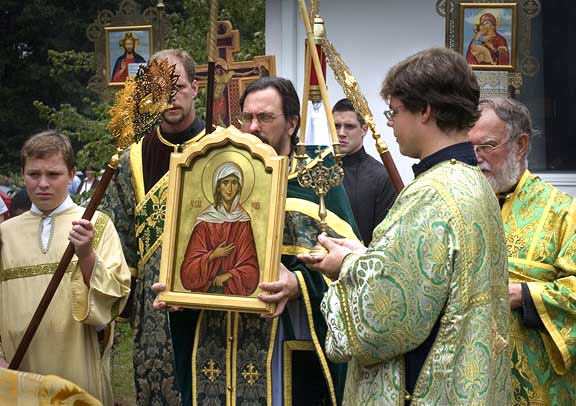
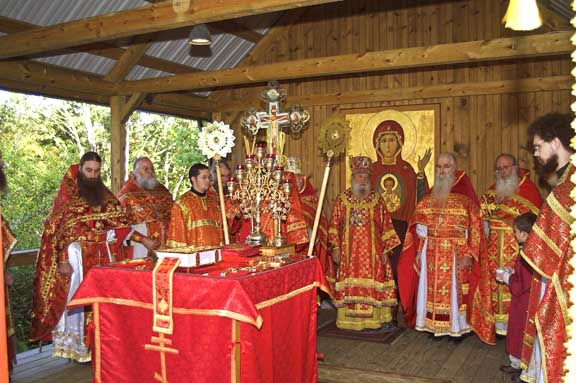
: άγιον ριπίδιον, hagion ripidion, plural: άγια ριπίδια, hagia ripidia; sometimes εξαπτέρυγον, hexapterygon, plural: εξαπτέρυγα hexapteryga—literally, "six-winged"), is still used to the present day. It is generally made of metal, round, having the icon
ographic likeness of a seraph
with six wings surrounding a face, and is set on the end of a pole. Fans of carved, gilded, or painted wood are also found. They are usually made in pairs.
The deacon, according to the Service Books
, stands by the Holy Table (altar) to fan the Sacred Gifts
by waving it gently over them from the time of the Offertory to the Communion—in the Liturgy of St. Basil he does this only during the Consecration. This originally served the purpose of keeping flying insects away from the Sacred Gifts. Nowadays, the Gifts are usually covered, shortly following their sanctification, whenever the priest or deacon does not have his hand immediately near them so, while this action of fanning is called for in the service books to this day, the deacon normally only does so on the day of his ordination. At his ordination
, a deacon, receives the fan from the bishop with his vestments and service book and is presented to the people for them to exclaim “Worthy!” holding the fan, and then stands behind the Holy Table (altar) to fan the Sacred Gifts
according to the otherwise archaic practise.
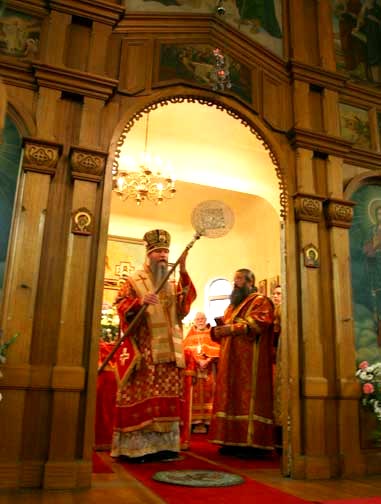
Among the Eastern Orthodox, the fans will be carried during the Great Entrance and at all procession
s; among the Russians
they are often also used to honour a particularly sacred icon
or relic
. When not in use, the fans are usually kept in stands behind the Holy Table
in the Greek
tradition and, in the Slavic traditions, may either be kept there or out of sight elsewhere in the altar
. The latter is especially true in northern Russia, where, instead of the processional Cross
and fans, icons of Christ
and the Theotokos are usually placed behind the Holy Table.
Fans used by the Maronites
, Oriental Orthodox and Assyrians
are distinctive, having little hoops of metal or bells all around the circumference of the disks. At particularly solemn points of the liturgy, these are shaken gently to produce a tinkling and jingling sound, akin to the sound of multiple Sanctus bells.
(813), there is a silver flabellum (Migne, P. L., CLXXIV, 1257), and for the chapel of Cisoin, near Lisle
, another flabellum of silver is noted in the will of Everard (died 937), the founder of that abbey. When, in 1777, Martène wrote his "Voyage Littéraire", the Abbey of Tournus, on the Saône
river in France, possessed an old flabellum, which had an ivory handle two feet long, and was beautifully carved; the two sides of the ivory circular disc were engraved with fourteen figures of saints. Pieces of this fan, dating from the eighth century, are in the Musée Cluny at Paris, and in the Collection Carrand.
Very ornate and impractical flabella were made in gold and jewels in the Romanesque
period; the example in the Metropolitan Museum is especially intricate.
Examples of the Eastern Christian style is also found in the Slavic ripidion of the thirteenth century, preserved at Moscow, and in the one shown in the Megaspileon monastery in Greece. On this latter disc are carved the Theotokos
and Child and it is encircled by eight medallions containing the images of cherubim and of the Four Evangelists
.
The inventory, taken in 1222, of the treasury of Salisbury
, enumerates a silver fan and two of parchment.
The richest and most beautiful specimen is the flabellum of the thirteenth century in the Abbey of Kremsmünster in Upper Austria. It has the shape of a Greek cross and is ornamented with fretwork
and the representation of the Resurrection of Christ.
St. Paul's Cathedral, London, had a fan made of peacock feathers, and York Cathedral's inventory mentions a silver handle of a fan, which was gilded and had upon it the enamelled picture of the bishop. Haymo (Hamo Hethe), Bishop of Rochester
(died 1352), gave to his church a fan of silver with an ivory handle.
Fan (implement)
A hand-held fan is an implement used to induce an airflow for the purpose of cooling or refreshing oneself. Any broad, flat surface waved back-and-forth will create a small airflow and therefore can be considered a rudimentary fan...
made of metal, leather, silk, parchment or feathers, intended to keep away insects from the consecrated Body and Blood of Christ and from the priest, as well as to show honour. The ceremonial use of such fans dates back to ancient Egypt
Ancient Egypt
Ancient Egypt was an ancient civilization of Northeastern Africa, concentrated along the lower reaches of the Nile River in what is now the modern country of Egypt. Egyptian civilization coalesced around 3150 BC with the political unification of Upper and Lower Egypt under the first pharaoh...
, and an example was found in the tomb of Tutankhamun
Tutankhamun
Tutankhamun , Egyptian , ; approx. 1341 BC – 1323 BC) was an Egyptian pharaoh of the 18th dynasty , during the period of Egyptian history known as the New Kingdom...
. A flabellum is also a fan-shaped structure on the fifth legs of horseshoe crab
Horseshoe crab
The Atlantic horseshoe crab, Limulus polyphemus, is a marine chelicerate arthropod. Despite its name, it is more closely related to spiders, ticks, and scorpions than to crabs. Horseshoe crabs are most commonly found in the Gulf of Mexico and along the northern Atlantic coast of North America...
s (Xiphosura).
History
Flabella were in use in both pagan rituals and in the ChristianChristian
A Christian is a person who adheres to Christianity, an Abrahamic, monotheistic religion based on the life and teachings of Jesus of Nazareth as recorded in the Canonical gospels and the letters of the New Testament...
Church from very early days. The Apostolic Constitutions
Apostolic Constitutions
The Apostolic Constitutions is a Christian collection of eight treatises which belongs to genre of the Church Orders. The work can be dated from 375 to 380 AD. The provenience is usually regarded as Syria, probably Antioch...
, a work of the fourth century, state (VIII, 12): "Let two of the deacon
Deacon
Deacon is a ministry in the Christian Church that is generally associated with service of some kind, but which varies among theological and denominational traditions...
s, on each side of the altar
Altar
An altar is any structure upon which offerings such as sacrifices are made for religious purposes. Altars are usually found at shrines, and they can be located in temples, churches and other places of worship...
, hold a fan, made up of thin membranes, or of the feathers of the peacock, or of fine cloth, and let them silently drive away the small animals that fly about, that they may not come near to the cups
Chalice (cup)
A chalice is a goblet or footed cup intended to hold a drink. In general religious terms, it is intended for drinking during a ceremony.-Christian:...
".
Western Christianity
Flabella were originally used liturgically in the West as well as the East, but their use in the MassMass (liturgy)
"Mass" is one of the names by which the sacrament of the Eucharist is called in the Roman Catholic Church: others are "Eucharist", the "Lord's Supper", the "Breaking of Bread", the "Eucharistic assembly ", the "memorial of the Lord's Passion and Resurrection", the "Holy Sacrifice", the "Holy and...
was discontinued in the Latin Church
Latin Church
The Latin Church is the largest particular church within the Catholic Church. It is a particular church not on the level of the local particular churches known as dioceses or eparchies, but on the level of autonomous ritual churches, of which there are 23, the remaining 22 of which are Eastern...
about the fourteenth century.
Apart from the foregoing liturgical uses, a flabellum, in the shape of a fan, later of an umbrella
Umbrella
An umbrella or parasol is a canopy designed to protect against rain or sunlight. The term parasol usually refers to an item designed to protect from the sun; umbrella refers to a device more suited to protect from rain...
or canopy
Baldachin
A baldachin, or baldaquin , is a canopy of state over an altar or throne. It had its beginnings as a cloth canopy, but in other cases it is a sturdy, permanent architectural feature, particularly over high altars in cathedrals, where such a structure is more correctly called a ciborium when it is...
, was used as a mark of honour for bishop
Bishop
A bishop is an ordained or consecrated member of the Christian clergy who is generally entrusted with a position of authority and oversight. Within the Catholic Church, Eastern Orthodox, Oriental Orthodox Churches, in the Assyrian Church of the East, in the Independent Catholic Churches, and in the...
s and prince
Prince
Prince is a general term for a ruler, monarch or member of a monarch's or former monarch's family, and is a hereditary title in the nobility of some European states. The feminine equivalent is a princess...
s. Prior to Vatican II, two fans of this kind were used at the Vatican
Apostolic Palace
The Apostolic Palace is the official residence of the Pope, which is located in Vatican City. It is also known as the Sacred Palace, the Papal Palace and the Palace of the Vatican...
whenever the pope
Pope
The Pope is the Bishop of Rome, a position that makes him the leader of the worldwide Catholic Church . In the Catholic Church, the Pope is regarded as the successor of Saint Peter, the Apostle...
was carried in state on the sedia gestatoria
Sedia gestatoria
The sedia gestatoria is a portable throne on which Popes were carried until 1978. It consists of a richly adorned, silk-covered armchair, fastened on a suppedaneum, on each side of which are two gilded rings; through these rings pass the long rods with which twelve footmen , in red uniforms, carry...
to or from the altar or audience-chamber. Through the influence of Count Ditalmo di Brozza, the fans formerly used at the Vatican were, in 1902, presented to Mrs. Joseph Drexel of Philadelphia, USA, by Pope Leo XIII
Pope Leo XIII
Pope Leo XIII , born Vincenzo Gioacchino Raffaele Luigi Pecci to an Italian comital family, was the 256th Pope of the Roman Catholic Church, reigning from 1878 to 1903...
, and in return she gave a new pair to the Vatican. The old ones are exhibited in the museum of the University of Pennsylvania
University of Pennsylvania
The University of Pennsylvania is a private, Ivy League university located in Philadelphia, Pennsylvania, United States. Penn is the fourth-oldest institution of higher education in the United States,Penn is the fourth-oldest using the founding dates claimed by each institution...
. The spread is formed of great ostrich plumes tipped with peacock feathers; on the palm (base of the fan) are the papal arms, worked in heavy gold on a crimson field, the tiara
Papal Tiara
The Papal Tiara, also known incorrectly as the Triple Tiara, or in Latin as the Triregnum, in Italian as the Triregno and as the Trirègne in French, is the three-tiered jewelled papal crown, supposedly of Byzantine and Persian origin, that is a prominent symbol of the papacy...
being studded with rubies and emeralds. The new pair of flabella is on display in the Vatican museum.
Lisbon
Lisbon
Lisbon is the capital city and largest city of Portugal with a population of 545,245 within its administrative limits on a land area of . The urban area of Lisbon extends beyond the administrative city limits with a population of 3 million on an area of , making it the 9th most populous urban...
Patriarchal Cathedral also holds two Flabella and one Sedia Gestatoria
Sedia gestatoria
The sedia gestatoria is a portable throne on which Popes were carried until 1978. It consists of a richly adorned, silk-covered armchair, fastened on a suppedaneum, on each side of which are two gilded rings; through these rings pass the long rods with which twelve footmen , in red uniforms, carry...
in its museum. It is thought the right of the Cardinal patriarchs to use such honour was granted after the efforts of king John V of Portugal that obtained the titles and other honours such as the use of a dove, symbolizing the holy spirit, above the Cardinal Patriarch's carriage
Carriage
A carriage is a wheeled vehicle for people, usually horse-drawn; litters and sedan chairs are excluded, since they are wheelless vehicles. The carriage is especially designed for private passenger use and for comfort or elegance, though some are also used to transport goods. It may be light,...
, in imitation of that of the Popes.
Eastern Christianity
In the Eastern OrthodoxEastern Orthodox Church
The Orthodox Church, officially called the Orthodox Catholic Church and commonly referred to as the Eastern Orthodox Church, is the second largest Christian denomination in the world, with an estimated 300 million adherents mainly in the countries of Belarus, Bulgaria, Cyprus, Georgia, Greece,...
and Greek-Catholic Churches the sacred fan (Greek
Greek language
Greek is an independent branch of the Indo-European family of languages. Native to the southern Balkans, it has the longest documented history of any Indo-European language, spanning 34 centuries of written records. Its writing system has been the Greek alphabet for the majority of its history;...
: άγιον ριπίδιον, hagion ripidion, plural: άγια ριπίδια, hagia ripidia; sometimes εξαπτέρυγον, hexapterygon, plural: εξαπτέρυγα hexapteryga—literally, "six-winged"), is still used to the present day. It is generally made of metal, round, having the icon
Icon
An icon is a religious work of art, most commonly a painting, from Eastern Christianity and in certain Eastern Catholic churches...
ographic likeness of a seraph
Seraph
A seraph is a type of celestial being in Judaism and Christianity...
with six wings surrounding a face, and is set on the end of a pole. Fans of carved, gilded, or painted wood are also found. They are usually made in pairs.
The deacon, according to the Service Books
Euchologion
The Euchologion is one of the chief liturgical books of the Orthodox Church and Eastern Catholic Churches, containing the portions of the services which are said by the bishop, priest, or deacon...
, stands by the Holy Table (altar) to fan the Sacred Gifts
Eucharist
The Eucharist , also called Holy Communion, the Sacrament of the Altar, the Blessed Sacrament, the Lord's Supper, and other names, is a Christian sacrament or ordinance...
by waving it gently over them from the time of the Offertory to the Communion—in the Liturgy of St. Basil he does this only during the Consecration. This originally served the purpose of keeping flying insects away from the Sacred Gifts. Nowadays, the Gifts are usually covered, shortly following their sanctification, whenever the priest or deacon does not have his hand immediately near them so, while this action of fanning is called for in the service books to this day, the deacon normally only does so on the day of his ordination. At his ordination
Ordination
In general religious use, ordination is the process by which individuals are consecrated, that is, set apart as clergy to perform various religious rites and ceremonies. The process and ceremonies of ordination itself varies by religion and denomination. One who is in preparation for, or who is...
, a deacon, receives the fan from the bishop with his vestments and service book and is presented to the people for them to exclaim “Worthy!” holding the fan, and then stands behind the Holy Table (altar) to fan the Sacred Gifts
Eucharist
The Eucharist , also called Holy Communion, the Sacrament of the Altar, the Blessed Sacrament, the Lord's Supper, and other names, is a Christian sacrament or ordinance...
according to the otherwise archaic practise.
Among the Eastern Orthodox, the fans will be carried during the Great Entrance and at all procession
Procession
A procession is an organized body of people advancing in a formal or ceremonial manner.-Procession elements:...
s; among the Russians
Russian Orthodox Church
The Russian Orthodox Church or, alternatively, the Moscow Patriarchate The ROC is often said to be the largest of the Eastern Orthodox churches in the world; including all the autocephalous churches under its umbrella, its adherents number over 150 million worldwide—about half of the 300 million...
they are often also used to honour a particularly sacred icon
Icon
An icon is a religious work of art, most commonly a painting, from Eastern Christianity and in certain Eastern Catholic churches...
or relic
Relic
In religion, a relic is a part of the body of a saint or a venerated person, or else another type of ancient religious object, carefully preserved for purposes of veneration or as a tangible memorial...
. When not in use, the fans are usually kept in stands behind the Holy Table
Altar
An altar is any structure upon which offerings such as sacrifices are made for religious purposes. Altars are usually found at shrines, and they can be located in temples, churches and other places of worship...
in the Greek
Greek Orthodox Church
The Greek Orthodox Church is the body of several churches within the larger communion of Eastern Orthodox Christianity sharing a common cultural tradition whose liturgy is also traditionally conducted in Koine Greek, the original language of the New Testament...
tradition and, in the Slavic traditions, may either be kept there or out of sight elsewhere in the altar
Sanctuary
A sanctuary is any place of safety. They may be categorized into human and non-human .- Religious sanctuary :A religious sanctuary can be a sacred place , or a consecrated area of a church or temple around its tabernacle or altar.- Sanctuary as a sacred place :#Sanctuary as a sacred place:#:In...
. The latter is especially true in northern Russia, where, instead of the processional Cross
Processional Cross
A processional cross is a crucifix or cross which is carried in Christian processions. Such crosses have a long history: the Gregorian mission of Saint Augustine of Canterbury to England carried one before them "like a standard", according to Bede. Other sources suggest that all churches were...
and fans, icons of Christ
Christ
Christ is the English term for the Greek meaning "the anointed one". It is a translation of the Hebrew , usually transliterated into English as Messiah or Mashiach...
and the Theotokos are usually placed behind the Holy Table.
Fans used by the Maronites
Maronites
Maronites , is an ethnoreligious group in the Middle East that have been historically tied with Lebanon. They derive their name from the Syriac saint Mar Maron whose followers moved to Mount Lebanon from northern Syria establishing the Maronite Church....
, Oriental Orthodox and Assyrians
Assyrian people
The Assyrian people are a distinct ethnic group whose origins lie in ancient Mesopotamia...
are distinctive, having little hoops of metal or bells all around the circumference of the disks. At particularly solemn points of the liturgy, these are shaken gently to produce a tinkling and jingling sound, akin to the sound of multiple Sanctus bells.
Historical examples
Among the ornaments found belonging to the church of St. Riquier, in PonthieuPonthieu
Ponthieu was one of six feudal counties that eventually merged together to become part of the Province of Picardy, in northern France. Its chief town is Abbeville.- History :...
(813), there is a silver flabellum (Migne, P. L., CLXXIV, 1257), and for the chapel of Cisoin, near Lisle
Lisle
Lisle is a type of cotton fabric that has been processed to give it a smooth finish. The process burns off lint and threads as well as fibre ends, leaving a smooth edge...
, another flabellum of silver is noted in the will of Everard (died 937), the founder of that abbey. When, in 1777, Martène wrote his "Voyage Littéraire", the Abbey of Tournus, on the Saône
Saône
The Saône is a river of eastern France. It is a right tributary of the River Rhône. Rising at Vioménil in the Vosges department, it joins the Rhône in Lyon....
river in France, possessed an old flabellum, which had an ivory handle two feet long, and was beautifully carved; the two sides of the ivory circular disc were engraved with fourteen figures of saints. Pieces of this fan, dating from the eighth century, are in the Musée Cluny at Paris, and in the Collection Carrand.
Very ornate and impractical flabella were made in gold and jewels in the Romanesque
Romanesque art
Romanesque art refers to the art of Western Europe from approximately 1000 AD to the rise of the Gothic style in the 13th century, or later, depending on region. The preceding period is increasingly known as the Pre-Romanesque...
period; the example in the Metropolitan Museum is especially intricate.
Examples of the Eastern Christian style is also found in the Slavic ripidion of the thirteenth century, preserved at Moscow, and in the one shown in the Megaspileon monastery in Greece. On this latter disc are carved the Theotokos
Theotokos
Theotokos is the Greek title of Mary, the mother of Jesus used especially in the Eastern Orthodox, Oriental Orthodox, and Eastern Catholic Churches. Its literal English translations include God-bearer and the one who gives birth to God. Less literal translations include Mother of God...
and Child and it is encircled by eight medallions containing the images of cherubim and of the Four Evangelists
Four Evangelists
In Christian tradition the Four Evangelists are Matthew, Mark, Luke, and John, the authors attributed with the creation of the four Gospel accounts in the New Testament that bear the following titles:*Gospel according to Matthew*Gospel according to Mark...
.
The inventory, taken in 1222, of the treasury of Salisbury
Salisbury
Salisbury is a cathedral city in Wiltshire, England and the only city in the county. It is the second largest settlement in the county...
, enumerates a silver fan and two of parchment.
The richest and most beautiful specimen is the flabellum of the thirteenth century in the Abbey of Kremsmünster in Upper Austria. It has the shape of a Greek cross and is ornamented with fretwork
Fretwork
Fretwork is an interlaced decorative design that is either carved in low relief on a solid background, or cut out with a fretsaw, coping saw, jigsaw or scroll saw. Most fretwork patterns are geometric in design. The materials most commonly used are wood and metal. Fretwork is used to adorn...
and the representation of the Resurrection of Christ.
St. Paul's Cathedral, London, had a fan made of peacock feathers, and York Cathedral's inventory mentions a silver handle of a fan, which was gilded and had upon it the enamelled picture of the bishop. Haymo (Hamo Hethe), Bishop of Rochester
Bishop of Rochester
The Bishop of Rochester is the ordinary of the Church of England Diocese of Rochester in the Province of Canterbury.The diocese covers the west of the county of Kent and is centred in the city of Rochester where the bishop's seat is located at the Cathedral Church of Christ and the Blessed Virgin...
(died 1352), gave to his church a fan of silver with an ivory handle.