


Fan (implement)

Encyclopedia
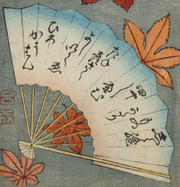
Circular sector
A circular sector or circle sector, is the portion of a disk enclosed by two radii and an arc, where the smaller area is known as the minor sector and the larger being the major sector. In the diagram, θ is the central angle in radians, r the radius of the circle, and L is the arc length of the...
of a circle and made of a thin material (such as paper or feathers) mounted on slats which revolve around a pivot so that it can be closed when not in use.
The movement of a hand-held fan provides cooling by increasing the airflow over the skin which in turn increases the evaporation
Evaporation
Evaporation is a type of vaporization of a liquid that occurs only on the surface of a liquid. The other type of vaporization is boiling, which, instead, occurs on the entire mass of the liquid....
rate of sweat
Sweating
Perspiration is the production of a fluid consisting primarily of water as well as various dissolved solids , that is excreted by the sweat glands in the skin of mammals...
droplets on the skin. This evaporation has a cooling effect due to the latent heat
Latent heat
Latent heat is the heat released or absorbed by a chemical substance or a thermodynamic system during a process that occurs without a change in temperature. A typical example is a change of state of matter, meaning a phase transition such as the melting of ice or the boiling of water. The term was...
of evaporation of water. Fans are convenient to carry around, especially folding fans.
East Asia
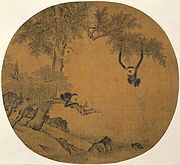
Bamboo
Bamboo is a group of perennial evergreens in the true grass family Poaceae, subfamily Bambusoideae, tribe Bambuseae. Giant bamboos are the largest members of the grass family....
side-mounted fans from the 2nd century BC. The Chinese character
Chinese character
Chinese characters are logograms used in the writing of Chinese and Japanese , less frequently Korean , formerly Vietnamese , or other languages...
for "fan" (扇) is etymologically derived from a picture of feathers under a roof. The Chinese fixed fan, pien-mien, means 'to agitate the air'. A particular status and gender would be associated with a specific type of fan. During the Song Dynasty
Song Dynasty
The Song Dynasty was a ruling dynasty in China between 960 and 1279; it succeeded the Five Dynasties and Ten Kingdoms Period, and was followed by the Yuan Dynasty. It was the first government in world history to issue banknotes or paper money, and the first Chinese government to establish a...
, famous artists were often commissioned to paint fans. The Chinese dancing fan was developed in the 7th century. The Chinese form of the hand fan was a row of feathers mounted in the end of a handle. In the later centuries, Chinese poems and four-word idioms were used to decorate the fans by using Chinese calligraphy pens.
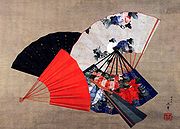
Japan
Japan is an island nation in East Asia. Located in the Pacific Ocean, it lies to the east of the Sea of Japan, China, North Korea, South Korea and Russia, stretching from the Sea of Okhotsk in the north to the East China Sea and Taiwan in the south...
around the 6th to 8th century. It was a court fan called the after the court women's dress named Akome. According to the Song Sui (History of Song), a Japanese monk offered the folding fans (twenty wooden-bladed fans and two paper fans ) to the emperor of China in 988. Later in 11th century, Korean envoys brought along Korean folding fans which were of Japanese origin as gifts to Chinese court. The popularity of folding fans was such that sumptuary laws were promulgated during Heian period
Heian period
The is the last division of classical Japanese history, running from 794 to 1185. The period is named after the capital city of Heian-kyō, or modern Kyōto. It is the period in Japanese history when Buddhism, Taoism and other Chinese influences were at their height...
which restricted the decoration of both hiogi and paper folding fans.
They were made by tying thin stripes of hinoki (or Japanese cypress) together with thread. The number of strips of wood differed according to the person's rank. Later in the 16th century Portuguese traders introduced it to the west and soon both men and women throughout the continent adopted it. They are used today by Shinto
Shinto
or Shintoism, also kami-no-michi, is the indigenous spirituality of Japan and the Japanese people. It is a set of practices, to be carried out diligently, to establish a connection between present day Japan and its ancient past. Shinto practices were first recorded and codified in the written...
priests in formal costume and in the formal costume of the Japanese court (they can be seen used by the Emperor and Empress during coronation and marriage) and are brightly painted with long tassels. Simple Japanese paper fans are sometimes known as harisen
Harisen
The harisen is a giant paper fan, usually made in a closed fashion, It is used in Japanese comedy shows as a form of physical comedy .-In popular culture:*The psychopathic character Kazuo Kiriyama is given a harisen in the movie Battle...
. In Japanese pop culture, harisen are featured in anime
Anime
is the Japanese abbreviated pronunciation of "animation". The definition sometimes changes depending on the context. In English-speaking countries, the term most commonly refers to Japanese animated cartoons....
and graphic novels as comedic weapons.
Printed fan leaves and painted fans are done on a paper ground. The paper was originally hand made and displayed the characteristic watermarks. Machine made paper fans, introduced in the 19th century, are smoother with an even texture.
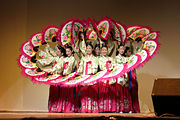
Geisha
, Geiko or Geigi are traditional, female Japanese entertainers whose skills include performing various Japanese arts such as classical music and dance.-Terms:...
of all types (but maiko most often) use folding fans in their fan dances as well, and the Korean fan dance of buchaechum is very popular.
Japanese fans are made of paper on a bamboo frame, usually with a design painted on them. In addition to folding fans (ōgi), the non-bending fans (uchiwa) are popular and commonplace. The fan is primarily used for fanning oneself in hot weather.
The fan symbolizes friendship, respect and good wishes. They are given on special occasions, and they are also an important stage prop in Japanese dance.
It was also used in the military as a way of sending signals on the field of battle, however fans were mainly used for social and court activities. In Japan, fans were variously used by warriors as a form of weapon, by actors and dancers for performances, and by children as a toy.
In China, the folding fan, introduced from Japan, came into fashion during the Ming dynasty
Ming Dynasty
The Ming Dynasty, also Empire of the Great Ming, was the ruling dynasty of China from 1368 to 1644, following the collapse of the Mongol-led Yuan Dynasty. The Ming, "one of the greatest eras of orderly government and social stability in human history", was the last dynasty in China ruled by ethnic...
between the years of 1368 and 1644, and Hangzhou
Hangzhou
Hangzhou , formerly transliterated as Hangchow, is the capital and largest city of Zhejiang Province in Eastern China. Governed as a sub-provincial city, and as of 2010, its entire administrative division or prefecture had a registered population of 8.7 million people...
was a center of folding fan production. The Mai Ogi (or Chinese dancing fan) has ten sticks and a thick paper mount showing the family crest. Chinese painters crafted many fan decoration designs. The slats, of ivory
Ivory
Ivory is a term for dentine, which constitutes the bulk of the teeth and tusks of animals, when used as a material for art or manufacturing. Ivory has been important since ancient times for making a range of items, from ivory carvings to false teeth, fans, dominoes, joint tubes, piano keys and...
, bone
Bone
Bones are rigid organs that constitute part of the endoskeleton of vertebrates. They support, and protect the various organs of the body, produce red and white blood cells and store minerals. Bone tissue is a type of dense connective tissue...
, mica
Mica
The mica group of sheet silicate minerals includes several closely related materials having highly perfect basal cleavage. All are monoclinic, with a tendency towards pseudohexagonal crystals, and are similar in chemical composition...
, mother of pearl
Pearl
A pearl is a hard object produced within the soft tissue of a living shelled mollusk. Just like the shell of a mollusk, a pearl is made up of calcium carbonate in minute crystalline form, which has been deposited in concentric layers. The ideal pearl is perfectly round and smooth, but many other...
, sandalwood
Sandalwood
Sandalwood is the name of a class of fragrant woods from trees in the genus Santalum. The woods are heavy, yellow, and fine-grained, and unlike many other aromatic woods they retain their fragrance for decades. As well as using the harvested and cut wood in-situ, essential oils are also extracted...
, or tortoise shell
Tortoiseshell material
Tortoiseshell or tortoise shell is a material produced mainly from the shell of the hawksbill turtle, an endangered species. It was widely used in the 1960s and 1970s in the manufacture of items such as combs, sunglasses, guitar picks and knitting needles...
, were carved and covered with paper
Paper
Paper is a thin material mainly used for writing upon, printing upon, drawing or for packaging. It is produced by pressing together moist fibers, typically cellulose pulp derived from wood, rags or grasses, and drying them into flexible sheets....
or fabric
Textile
A textile or cloth is a flexible woven material consisting of a network of natural or artificial fibres often referred to as thread or yarn. Yarn is produced by spinning raw fibres of wool, flax, cotton, or other material to produce long strands...
. Folding fans have "montures" which are the sticks and guards. The leaves are usually painted by craftsman. Social significance was attached to the fan in the Far East. The management of the fan became a highly regarded feminine art. The function and employment of the fan reached its high point of social significance (fans were even used as a weapon - called the iron fan, or tiě shān in Chinese, tessen in Japanese; see Korean fighting fan for Korean use).
Europe

Ancient Greece
Ancient Greece is a civilization belonging to a period of Greek history that lasted from the Archaic period of the 8th to 6th centuries BC to the end of antiquity. Immediately following this period was the beginning of the Early Middle Ages and the Byzantine era. Included in Ancient Greece is the...
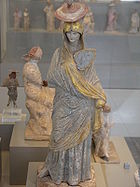
at least since the 4th century BC and was known under the name rhipis (Greek
Greek language
Greek is an independent branch of the Indo-European family of languages. Native to the southern Balkans, it has the longest documented history of any Indo-European language, spanning 34 centuries of written records. Its writing system has been the Greek alphabet for the majority of its history;...
: ῥιπίς). In Europe
Europe
Europe is, by convention, one of the world's seven continents. Comprising the westernmost peninsula of Eurasia, Europe is generally 'divided' from Asia to its east by the watershed divides of the Ural and Caucasus Mountains, the Ural River, the Caspian and Black Seas, and the waterways connecting...
, during the Middle Ages
Middle Ages
The Middle Ages is a periodization of European history from the 5th century to the 15th century. The Middle Ages follows the fall of the Western Roman Empire in 476 and precedes the Early Modern Era. It is the middle period of a three-period division of Western history: Classic, Medieval and Modern...
, the fan was absent. Christian Europe's earliest fan was the flabellum
Flabellum
A flabellum , in Catholic liturgical use, is a fan made of metal, leather, silk, parchment or feathers, intended to keep away insects from the consecrated Body and Blood of Christ and from the priest, as well as to show honour. The ceremonial use of such fans dates back to ancient Egypt, and an...
(or ceremonial fan), which dates to the 6th century. These were used during services to drive insects away from the consecrated bread and wine. Their use died out in western Europe during the Middle Ages, but continues in the Eastern Orthodox and Ethiopian Churches. Hand fans were reintroduced to Europe in the 13th and 14th centuries. Fans from the Middle East were brought back by Crusaders. In the 15th century, Portuguese traders brought fans to Europe from China and Japan. Fans became generally popular.
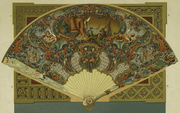
In the 17th century the folding fan, introduced from East Asia, became popular in Europe. These fans are particularly well displayed in the portraits of the high-born women of the era. Queen Elizabeth 1st of England can be seen to carry both folding fans decorated with pom poms on their guardsticks as well as the older style rigid fan, usually decorated with feathers and jewels. These rigid style fans often hung from the skirts of ladies, but of the fans of this era it is only the more exotic folding ones which have survived. Those folding fans of the 15th century found in museums today have either leather leaves with cut out designs forming a lace-like design or a more rigid leaf with inlays of more exotic materials like mica. One of the characteristics of these fans is the rather crude bone or ivory sticks and the way the leather leaves are often slotted onto the sticks rather than glued as with later folding fans. Fans made entirely of decorated sticks without a fan 'leaf' were known as brisé fans
Brisé fans
A brisé fan is made of sticks with no fan leaf. This green silk brisé fan is Italian and, dating from about 1620-40, is the earliest example in the Victoria and Albert Museum's collection. Fans were made in Japan and China from the tenth century AD, but did not reach Europe until the second half of...
. However, despite the relative crude methods of construction folding fans were at this era high status, exotic items on par with elaborate gloves as gifts to royalty.
In the 17th century the rigid fan which was seen in portraits of the previous century had fallen out of favour as folding fans gained dominance in Europe. Fans started to display well painted leaves, often with a religious or classical subject. The reverse side of these early fans also started to display elaborate flower designs. The sticks are often plain ivory or tortoiseshell, sometimes inlaid with gold or silver pique work. The way the sticks sit close to each other, often with little or no space between them is one of the distinguishing characteristics of fans of this era.
In 1685 the Edict of Nantes
Edict of Nantes
The Edict of Nantes, issued on 13 April 1598, by Henry IV of France, granted the Calvinist Protestants of France substantial rights in a nation still considered essentially Catholic. In the Edict, Henry aimed primarily to promote civil unity...
was revoked in France
France
The French Republic , The French Republic , The French Republic , (commonly known as France , is a unitary semi-presidential republic in Western Europe with several overseas territories and islands located on other continents and in the Indian, Pacific, and Atlantic oceans. Metropolitan France...
. This caused large scale immigration from France to the surrounding Protestant countries (such as England) of many fan craftsman. This dispersion in skill is reflected in the growing quality of many fans from these non-French countries after this date.

Silk
Silk is a natural protein fiber, some forms of which can be woven into textiles. The best-known type of silk is obtained from the cocoons of the larvae of the mulberry silkworm Bombyx mori reared in captivity...
, or parchment
Parchment
Parchment is a thin material made from calfskin, sheepskin or goatskin, often split. Its most common use was as a material for writing on, for documents, notes, or the pages of a book, codex or manuscript. It is distinct from leather in that parchment is limed but not tanned; therefore, it is very...
were decorated and painted by artists. Fans were also imported from China by the East India Companies at this time. Around the middle 18th century, inventors started designing mechanical fans. Wind-up fans (similar to wind-up clocks) were popular in the 18th century. In the 19th century in the West
Western world
The Western world, also known as the West and the Occident , is a term referring to the countries of Western Europe , the countries of the Americas, as well all countries of Northern and Central Europe, Australia and New Zealand...
, European fashion caused fan decoration and size to vary.
It has been said that in the courts of England, Spain and elsewhere fans were used in a more or less secret, unspoken code of messages These fan languages were a way to cope with the restricting social etiquette. However, modern research has proved that this was a marketing ploy developed in the 18th century (FANA Journal, spring 2004, Fact & Fiction about the language of the fan by J.P. Ryan) - one that has kept its appeal remarkably over the succeeding centuries. This is now used for marketing by fan makers like Cussons & Sons & Co. Ltd who produced a series of advertisements in 1954 showing "the language of the fan" with fans supplied by the well known French fan maker Duvelleroy
Duvelleroy
Duvelleroy is a fan maker house founded in Paris, France in 1827 by Jean-Pierre Duvelleroy, and acquired in 1940 by Jules-Charles Maignan. It is one of the rare French fan makers still in existence today.- Founded in Paris, 1827 :...
.
Categories
Hand fans have two general categories:- Flat fans (Chinese: , pǐng shàn; Japanese: , uchiwa, cannot be folded): circular fans, palm-leaf fans, straw fans, feather fans, etc.
- Folding fans (Chinese: , zhě shàn; Japanese: , sensu, can be freely opened): silk folding fans, paper folding fans, sandalwood fans, etc.
Museums
- Musée de l'ÉventailMusée de l'ÉventailThe Musée de l'Éventail , or more formally L'Atelier Hoguet Musée de l'Éventail, is a private museum of fans and fan-making located in the 10th arrondissement at 2, boulevard de Strasbourg, Paris, France. It is open several afternoons per week; an admission fee is charged...
(ParisParisParis is the capital and largest city in France, situated on the river Seine, in northern France, at the heart of the Île-de-France region...
) - The Fan Museum in Greenwich (Greenwich, London)
- The Hand Fan Museum in Healdsburg, CaliforniaHand Fan MuseumThe Hand Fan Museum is based in Healdsburg, California, USA. It opened in 2002 and has a permanent collection of over 2,500 fans spanning the centuries and the myriad styles of fans...
Books
- Checcoli, Anna. " Il ventaglio e i suoi segreti ", Tassinari, 2009
- Checcoli, Anna. " Ventagli Cinesi Giapponesi ed Orientali ", Tassinari, 2009
- Rhead, G. Wooliscroft. The History of the Fan, Kegan Paul, 1910
- Irons, Neville John. Fans of Imperial China. Kaiserreich Kunst Ltd, 1982 ISBN 0-9079-1800-X
- Armstrong, Nancy. Book of Fans. Smithmark Publishing, 1984. ISBN 0-8317-0952-9
- Armstrong, Nancy. Fans, Souvenir Press, 1984 ISBN 0-2856-2591-8
- Faulkner, Rupert. Hiroshige Fan Prints, V&A publications, 2001 ISBN 1-85177-332-0
- Fendel, Cynthia. Novelty Hand Fans, Fashionable Functional Fun Accessories of the Past. Hand Fan Productions, 2006 ISBN 978-0-9708852-1-0
- Fendel, Cynthia. Celluloid Hand Fans. Hand Fan Productions, 2001. ISBN 0-9708852-0-2
- Mayor, Susan. A Collectors Guide to Fans, Charles Letts, 1990
- Mayor, Susan. The Letts Guide to Collecting Fans. Charles Letts, 1991 ISBN 1-8523-8128-0
- Alexander, Helene. The Fan Museum, Third Millennium Publishing, 2001 ISBN 0-954031-91-1
- Alexander, Helene & Hovinga-Van Eijsden, Fransje. A Touch of Dutch - Fans from the Royal House of Orange-Nassau, The Fan Museum, February 2008, ISBN 0-9540319-5-4
- Cowen, Pamela. A Fanfare for the Sun King: Unfolding Fans for Louis XIV, Third Millennium Publishing (September, 2003) ISBN 1-903942-20-9
- Hutt, Julia & Alexander, Helene. Ogi: A History of the Japanese Fan. Art Media Resources; Bilingual edition (February 1, 1992) ISBN 1-872357-08-3
- Qian, Gonglin. Chinese Fans: Artistry and Aesthetics (Arts of China, #2). Long River Press (August 31, 2004) ISBN 1-59265-020-1
- North, Audrey. Australia's fan heritage. Boolarong Publications (1985). ISBN 0-86439-001-7
- Hart, Avril & Taylor, Emma. Fans (V & A Fashion Accessories Series). Publisher- V & A Publications. ISBN 1-85177-213-8
- Bennett, Anna G. Unfolding beauty: The art of the fan : the collection of Esther Oldham and the Museum of Fine Arts, Boston. Thames and Hudson (1988). ISBN 0-87846-279-1
- Bennett, Anna G. & Berson, Ruth Fans in fashion. Publisher Charles E. Tuttle Co. Inc & The Fine Arts Museums of San Francisco (1981) ISBN 0-88401-037-6
- Roberts, Jane. Unfolding Pictures: Fans in the Royal Collection. Publisher - Royal Collection (January 30, 2006. ISBN 1-902163-16-8
- Gitter, Kurt A. Japanese fan paintings from western collections. Publisher - New Orleans Museum of ArtNew Orleans Museum of ArtThe New Orleans Museum of Art is the oldest fine arts museum in the city of New Orleans. It is situated within City Park, a short distance from the intersection of Carrollton Avenue and Esplanade Avenue, and near the terminus of the "Canal Street - City Park" streetcar line...
(1985). ISBN 0-89494-021-X - Tam, C.S. Fan Paintings by Late Ch'ing Shanghai Masters. Publisher - Urban Council for an exhibition in the Hong Kong Museum of Art (1977)
- Vannotti, Franco. Peinture Chinoise de la Dynastie Ts'ing (1644–1912). Collections Baur, Geneve (1974)
- Das, Justin. Pankha -Traditional crafted hand fans of the Indian Subcontinent from the collection of Justin Das - The fan museum, Greenwich (2004)
External links
- mm's fan collection with monographies on love symbols on fans, celluloid fans, George Barbier and more
- Hand fan collection Anna Checcoli
- All About Hand Fans with Cynthia Fendel
- Hand Fan Productions
- Hand Fan Museum
- The Fan Circle International
- Tessen warrior fan
- The Fan Museum in Greenwich, London
- Fan Association of North America
- Fans in the Staten Island Historical Society Online Collections Database
- La Place de l'Eventail
- Galerie Le Curieux, Paris
- Fans in the 16th and 17th Centuries
- LG éventails - contemporary hand fans by Sylvain Le Guen
- Allhandfans - Site entirely dedicated to the hand fan