
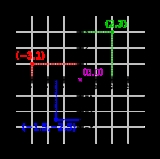
Coordinate system
In
mathematics and applications, a coordinate system is a system for assigning a tuple of numbers to each point in an n-dimensional space. "Numbers" in many cases means real numbers, but, depending on context, can mean
complex numbers or elements of some other field. If the space or
manifold is curved, it may not be possible to provide one consistent coordinate system for the entire space. In this case, a set of coordinate systems, called charts, are put together to form an
atlas covering the whole space.
When the space has some additional algebraic structure, then the coordinates will also transform under rings or groups; a particularly famous example in this case are the Lie groups.
Encyclopedia
In
mathematics and applications, a
coordinate system is a system for assigning a tuple of numbers to each point in an n-dimensional space. "Numbers" in many cases means real numbers, but, depending on context, can mean
complex numbers or elements of some other field. If the space or
manifold is curved, it may not be possible to provide one consistent coordinate system for the entire space. In this case, a set of coordinate systems, called
charts, are put together to form an
atlas covering the whole space.
When the space has some additional algebraic structure, then the coordinates will also transform under rings or groups; a particularly famous example in this case are the Lie groups.
Although any specific coordinate system is useful for numerical calculations in a given space, the
space itself is considered to exist independently of any particular choice of coordinates. By convention the
origin of the coordinate system in Cartesian coordinates is the point , which may be assigned to any given point of Euclidean space.
In some coordinate systems some points are associated with multiple tuples of coordinates, e.g. the origin in polar coordinates:
r = 0 but ? can be any angle.
Examples
An example of a coordinate system is to describe a point
P in the Euclidean space
Rn by an n-tuple
- P =
of real numbers
- r1, ..., rn.
These numbers
r1, ...,
rn are called the
coordinates of the point
P.
If a subset
S of a Euclidean space is mapped continuously onto another topological space, this defines coordinates in the image of S. That can be called a
parametrization of the image, since it assigns numbers to points. That correspondence is unique only if the mapping is
bijective.
The system of assigning longitude and
latitude to geographical locations is a coordinate system. In this case the
parametrization fails to be unique at the north and south poles.
Transformations
A
coordinate transformation is a conversion from one system to another, to describe the same space.
With every
bijection from the space to itself two coordinate transformations can be associated:
- such that the new coordinates of the image of each point are the same as the old coordinates of the original point
- such that the old coordinates of the image of each point are the same as the new coordinates of the original point
For example, in 1D, if the mapping is a translation of 3 to the right, the first moves the origin from 0 to 3, so that the coordinate of each point becomes 3 less, while the second moves the origin from 0 to -3, so that the coordinate of each point becomes 3 more.
Systems commonly used
Some coordinate systems are the following:
- The Cartesian coordinate system , which, for three-dimensional flat space, uses three numbers representing distances.
- Curvilinear coordinates are a generalization of coordinate systems generally; the system is based on the intersection of curves.
- The polar coordinate systems:
- Plücker coordinates are a way of representing lines in 3D Euclidean space using a six-tuple of numbers as homogeneous coordinates.
- Generalized coordinates are used in the Lagrangian treatment of mechanics.
- Canonical coordinates are used in the Hamiltonian treatment of mechanics.
- Intrinsic coordinates describe a point upon a curve by the length of the curve to that point and the angle the tangent to that point makes with the x-axis.
- Parallel coordinates visualise a point in n-dimensional space as a polyline connecting points on n vertical lines.
Astronomical systems
- Celestial coordinate system
- extragalactic coordinate systems
- supergalactic coordinate system - based on plane of local supercluster of galaxies
- comoving coordinates - valid to particle horizon
Less common coordinate systems
The following coordinate systems have special uses. They all have the properties of being orthogonal coordinate systems, that is the coordinate surface meet at right angles.
- Elliptic cylindrical coordinates
- Ellipsoidal coordinates
- Prolate spheroidal coordinates
- Oblate spheroidal coordinates
- Conical coordinates
- Parabolic cylindrical coordinates
- Parabolic coordinates
- Paraboloidal coordinates
- Bipolar cylindrical coordinates
- Toroidal coordinates
- Bispherical coordinates
See also