
In Depth
See Also

Flight dynamics

Flight dynamics is the study of orientation of air Aircraft

An aircraft is any machine [i] capable of atmospheric [i] flight [i]. ... 

 and space Spacecraft

A spacecraft is a vehicle designed to operate beyond the surface of the Earth in outer space [i]. ... 

 vehicle Vehicle

This article is about the means of transport.... 

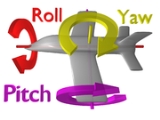
s and how to control the critical flight parameters, typically named pitch, roll and yaw. Pitch is rotation around the lateral or transverse axis Rotation

Rotation is the movement of an object in a circular motion.... 

. This axis is parallel to the wings, thus the nose pitches up and the tail down, or vice-versa. An aircraft pitches up to climb and pitches down to dive. An aircraft increases or decreases the lift generated by the wings when it pitches up or down by increasing or decreasing the angle of attack Angle of attack

Angle of attack is a term used in aerodynamics [i] to describe the angle [i] between the airfoil's chord line [i] ... 

  through the lateral axis.

Discussions

  Discussion Features

   Ask a question about 'Flight dynamics'

   Start a new discussion about 'Flight dynamics'

   Answer questions about 'Flight dynamics'

   'Flight dynamics' discussion forum


Encyclopedia


Flight dynamics is the study of orientation of air Aircraft

An aircraft is any machine [i] capable of atmospheric [i] flight [i]. ... 

 and space Spacecraft

A spacecraft is a vehicle designed to operate beyond the surface of the Earth in outer space [i]. ... 

 vehicle Vehicle

This article is about the means of transport.... 

s and how to control the critical flight parameters, typically named pitch, roll and yaw.

Pitch is rotation around the lateral or transverse axis Rotation

Rotation is the movement of an object in a circular motion.... 

. This axis is parallel to the wings, thus the nose pitches up and the tail down, or vice-versa.

An aircraft pitches up to climb and pitches down to dive. An aircraft increases or decreases the lift generated by the wings when it pitches up or down by increasing or decreasing the angle of attack Angle of attack

Angle of attack is a term used in aerodynamics [i] to describe the angle [i] between the airfoil's chord line [i] ... 

  through the lateral axis.

Roll is rotation around the longitudinal axis—an axis drawn through the body of the vehicle from tail to nose. This is also known as bank.

Yaw is rotation about the normal Surface normal

A surface normal, or just normal to a
... 

 axis—an axis perpendicular Perpendicular

In geometry [i], two lines [i] are considered perpendicular if one falls on the other in such a way ... 

 to the pitch and roll axes. If an airplane model placed on a flat surface is spun or pivoted around the center of mass Center of mass

In physics [i], the center of mass of a system of particles is a specific point at which, for many purpo ... 

  it would be described as yawing.

Aerospace engineers develop control laws and control systems to allow pilots to control their aircraft in the three dimension Dimension

In common usage, a dimension is a parameter [i] or measurement [i] required to define the characteristi ... 

s described above. The control systems exert forces in various directions, which generate moments about the aerodynamic center of the aircraft, and thus rotate the aircraft in pitch, roll, or yaw. For example, a pitching moment Pitching moment

The pitching moment of an airfoil [i], in aerodynamics [i], is a moment [i] produced by a vertical force ... 

 is a vertical force applied at a distance forward or aft from the aerodynamic center of the aircraft, causing the aircraft to pitch up or down.

Coordinate Systems


In flight dynamics, pitch, roll and yaw angles measure changes in attitude, relative to axes that remain "attached" to the vehicle:
  • The positive Y axis goes out the right wing of the vehicle
  • The positive Z axis goes out the underside of the vehicle


Roll, pitch and yaw constitute rotation around X, Y, and Z, respectively, as depicted in the diagram above.

In analysing the dynamics, we are concerned both with rotation and translation of this axis set with respect to a fixed inertial frame. For all practical purposes a local Earth axis set is used, this has X and Y axis in the local horizontal plane, usually with the x-axis coinciding with the projection of the velocity vector at the start of the motion, on to this plane. The z axis is vertical, pointing generally towards the Earth's centre, completing an orthogonal set.

The motions relevant to dynamic stability are usually too short in duration for the motion of the Earth itself to be considered relevant.

In general, the body axes are not aligned with the Earth axes. The body orientation may be defined by three Euler Angles Euler angles

Euler angles are the classical way of representing rotation [i]s in 3-dimensional [i] Euclidean space [i] ... 

, the Tait-Bryan angles, a quaternion Quaternion

In mathematics [i], quaternions are a non-commutative [i] extension of complex number [i]s. ... 

, or a direction cosine matrix . A rotation matrix is particularly convenient for converting velocity, force, angular velocity Angular velocity

In physics [i] angular velocity is the speed [i] at which something rotates together with the direction ... 

, and torque Torque

In physics [i], torque can informally be thought of as "rotational force". ... 

 vectors between body and Earth coordinate frames.

Body axes tend to be used with missile and rocket configurations. Aircraft stability uses wind axes in which the x-axis points along the velocity vector. For straight and level flight this is found from body axes by rotating nose down through the angle of attack Angle of attack

Angle of attack is a term used in aerodynamics [i] to describe the angle [i] between the airfoil's chord line [i] ... 

.

Stability deals with small perturbations in angular displacements about the orientation at the start of the motion. This consists of two components; rotation about each axis, and angular displacements due change in orientation of each axis. The latter term is of second order for the purpose of stability analysis, and is ignored.

Design Cases


In analysing the stability of an aircraft, it is usual to consider perturbations about a nominal equilibrium position. So the analysis would be applied, for example, assuming:

Steady level flight
Turn at constant speed
Approach and landing
Take off

The speed, height and trim angle of attack are different for each flight condition, in addition, the aircraft will be configured differently, e.g at low speed flaps may be deployed and the undercarriage Undercarriage

-
||-
||-
||-
||}
The undercarriage or landing gear is the structure that supports an aircraft [i] ... 

 may be down.

Except for asymmetric designs , the longitudinal equations of motion may be treated independently of the lateral motion .

The following considers perturbations about a nominal straight and level flight path.

To keep the analysis simple, the control surfaces are assumed fixed throughout the motion, this is stick-fixed stability. Stick-free analysis requires the further complication of taking the motion of the control surfaces into account.

Furthermore, the flight is assumed to take place in still air, and the aircraft is treated as a rigid body.

Longitudinal Modes


It is common practice to derive a fourth order characteristic equation to describe the longitudinal motion, and then factorise it approximately into a high frequency mode and a low frequency mode. This requires a level of algebraic manipulation which most readers will doubtless find tedious, and adds little to the understanding of aircraft dynamics. The approach adopted here is to use our qualitative knowledge of aircraft behaviour to simplify the equations from the outset, reaching the same result by a more accessible route.

The two longitudinal motions are called the short period pitch oscillation , and the phugoid.

Short Period Pitch Oscillation


Pulling the joystick back suddenly causes the aircraft to pitch up. The aircraft, if it is stable will settle down at the new trim incidence, but will tend to overshoot. The transition is characterised by a damped simple harmonic motion Simple harmonic motion

Simple harmonic motion is the motion of a simple harmonic oscillator [i] ... 

 about the new trim. There is very little change in the trajectory over the time it takes for the oscillation to damp out.

This damped Damping

Damping is any effect, either deliberately engendered or inherent to a system, that tends to reduce the ... 

 harmonic motion Simple harmonic motion

Simple harmonic motion is the motion of a simple harmonic oscillator [i] ... 

 is called the short period pitch oscillation, it arises from the tendency of a stable aircraft to point in the general direction of flight. It is very similar in nature to the weathercock mode of missile or rocket configurations. The motion involves mainly the pitch attitude and incidence . The direction of the velocity vector, relative to inertial axes is . The velocity vector is:


where , are the inertial axes components of velocity. According to Newton's Second Law Newton's laws of motion

Newton's Laws of Motion are three physical law [i]s which provide relationships [i] ... 

, the acceleration Acceleration

In physics [i] or physical science, acceleration is defined as the rate of change of velocity [i].... 

s are proportional to the forces, so the forces in inertial axes are:


where m is the mass Mass

Mass is a property of a physical [i] object that quantifies the amount of matter [i] and energy [i] ... 

.
By the nature of the motion, the speed variation is negligible over the period of the oscillation, so:


But the forces are generated by the pressure Pressure

Pressure is the force [i] per unit area [i] applied on a surface in a direction perpendicular [i] ... 

 distribution on the body, and are referred to the velocity vector. But the velocity axes set is not an inertial frame so we must resolve the fixed axes forces into wind axes. Also, we are only concerned with the force along the z-axis:


Or:


In words, the wind axes force is equal to the centrifugal Centrifugal force

Centrifugal force is a term which may refer to two different force [i]s which are related to rotation [i] ... 

 acceleration.

The moment equation is the time derivative of the angular momentum Angular momentum

In physics [i] the angular momentum of an object with respect to a reference point is a measure for the ... 

:


where M is the pitching moment, and B is the moment of inertia about the pitch axis.
Let: , the pitch rate.
The equations of motion, with all forces and moments referred to wind axes are, therefore:


We are only concerned with perturbations in forces and moments, due to perturbations in the states and q, and their time derivatives. These are characterised by stability derivatives Stability derivatives

Stability derivatives are a means of linearising the equations of motion of an atmospheric flight vehicl... 

 determined from the flight condition. The possible stability derivatives are:

Lift due to incidence, this is negative because the z-axis is downwards whilst positive incidence causes an upwards force.

Lift due to pitch rate, arises from the increase in tail incidence, hence is also negative, but small compared with .

Pitching moment Pitching moment

The pitching moment of an airfoil [i], in aerodynamics [i], is a moment [i] produced by a vertical force ... 

 due to incidence - the static stability term. Static stability Pitching moment

The pitching moment of an airfoil [i], in aerodynamics [i], is a moment [i] produced by a vertical force ... 

 requires this to be negative.

Pitching moment due to pitch rate - the pitch damping term, this is always negative.

Since the tail is operating in the flowfield of the wing, changes in the wing incidence cause changes in the downwash, but there is a delay for the change in wing flowfield to affect the tail lift, this is represented as a moment proportional to the rate of change of incidence:

Increasing the wing incidence without increasing the tail incidence produces a nose up moment, so is expected to be positive.

The equations of motion, with small perturbation forces and moments become:


These may be manipulated to yield as second order linear differential equation Differential equation

In mathematics [i], a differential equation is an equation [i] in which the derivative [i]s of a function [i]... 

 in :


This represents a damped Damping

Damping is any effect, either deliberately engendered or inherent to a system, that tends to reduce the ... 

 simple harmonic motion Simple harmonic motion

Simple harmonic motion is the motion of a simple harmonic oscillator [i] ... 

.

We should expect to be small compared with unity, so the coefficient of will be positive, provided . This expression is dominated by , which defines the longitudinal static stability Pitching moment

The pitching moment of an airfoil [i], in aerodynamics [i], is a moment [i] produced by a vertical force ... 

 of the aircraft, it must be negative for stability. The damping term is reduced by the downwash effect, and it is difficult to design an aircraft with both rapid natural response and heavy damping. Usually, the response is underdamped but stable.

Phugoid


If the stick is held fixed, the aircraft will not maintain straight and level flight, but will start to dive. level out and climb again. It will repeat this cycle until the pilot intervenes. This long period oscillation in speed and height is called the phugoid mode. This is analysed by assuming that the SSPO performs its proper function and maintains the angle of attack near its nominal value. The two states which are mainly affected are the climb angle and speed. The small perturbation equations of motion are:


which means the centrifugal force is equal to the perturbation in lift force.
For the speed, resolving along the trajectory:


where g is the gravitational acceleration.
the acceleration along the trajectory is equal to the net x-wise force minus the component of weight. We should not expect significant aerodynamic derivatives to depend on the climb angle, so only and need be considered. is the drag increment with increased speed, it is negative, likewise is the lift increment due to speed increment, it is also negative because lift acts in the opposite sense to the z-axis.

The equations of motion become:


These may be expressed as a second order equation in climb angle or speed perturbation:


Now lift is very nearly equal to weight:


where is the air density, is the wing area, W the weight and is the lift coefficient , we have, approximately:


The period of the phugoid,T, is obtained from the coefficient of u:


Or:


Since the lift is very much greater than the drag, the phugoid is at best lightly damped.

Lateral Modes


With a symmetrical rocket or missile, the directional stability Directional stability

Directional stability is the tendency of a moving body to align itself with the direction of motion.
... 

 in yaw is the same as the pitch stability; it resembles the short period pitch oscillation, with yaw plane equivalents to the pitch plane stability derivatives. For this reason pitch and yaw directional stability are collectively known as the 'weathercock' stability of the missile.

Aircraft lack the symmetry between pitch and yaw, so that directional stability in yaw is derived from a different set of stability derivatives, The yaw plane equivalent to the short period pitch oscillation, which describes yaw plane directional stability is called Dutch roll. Unlike pitch plane motions, the lateral modes involve both roll and yaw motion.

Dutch Roll


It is customary to derive the equations of motion by formal manipulation in what, to the engineer, amounts to a piece of mathematical sleight of hand. The current approach follows the pitch plane analysis in formulating the equations in terms of concepts which are reasonably familiar.

Applying an impulse via the rudder pedals should induce Dutch roll, which is the oscillation in roll and yaw, with the roll motion lagging yaw by a quarter cycle, so that the wing tips follow elliptical paths with respect to the aircraft.

The yaw plane translational equation, as in the pitch plane, equates the centrifugal acceleration to the side force.


where is the sideslip angle, Y the side force and r the yaw rate.

The moment equations are a bit trickier. The trim condition is with the aircraft at an angle of attack with respect to the airflow, The body x-axis does not align with the velocity vector, which is the reference direction for wind axes. In other words, wind axes are not principal axes . Consider the motion of an element of mass in position -z,x in the direction of the y-axis, i.e. into the plane of the paper.


If the roll rate is p, the velocity of the particle is:

The force on this particle is made up of two terms, the first is proportional to the rate of change of v, the second is due to the change in direction of this component of velocity as the body moves. The latter terms gives rise to cross products of small quantities , which are later discarded. In this analysis, they are discarded from the outset for the sake of clarity. In effect, we assume that the direction of the velocity of the particle due to the simultaneous roll and yaw rates does not change significantly throughout the motion. With this simplifying assumption, the acceleration of the particle becomes:

The yawing moment is given by:

There is an additional yawing moment due to the offset of the particle in the y direction

The yawing moment is found by summing over all particles of the body:

where N is the yawing moment, E is a product of inertia, and C is the moment of inertia about the yaw axis.
A similar reasoning yields the roll equation:

where L is the rolling moment and A the roll moment of inertia.

Lateral Stability Derivatives


The states are ,r and p, with moments N and L, and force Y. There are nine stability derivatives relevant to this motion:


Side force due to side slip.

Sideslip generates a sideforce from the fin and the fuselage. In addition, if the wing has dihedral, positive side slip increases the incidence on the starboard wing and reduces it on the port so there is a net component of lift opposing the sidslip. Similarly, sweep back of the wings has the same effect on local incidence, but since the wings are not inclined in the vertical plane sweep does not contribute to . With high angles of sweep, in high performance aircraft, anhedral may be used to offset this effect. However, the resulting effect is to reverse the sign of the wing contribution to . Usually negative.

Side force due to roll rate.

Roll rate causes incidence at the fin, which generates a side force. Also, positive roll increases the lift on the starboard wing and reduces it on the port. If the wing is mounted at a dihedral angle, this will result in a sideforce contribution. Usually negative.

Side force due to yaw rate.

Yawing generates incidence at the fin, causing a side force.

Yawing moment due to sideslip. Directional stiffness.

This characterises the tendency to point into wind, it must be positive for a statically stable aircraft.

Yawing moment due to roll rate.

Roll rate generates fin lift, which causes a yawing moment. It also changes the lift on the wings, altering the induced drag contribution of each wing, causing a yawing moment. Positive roll causes positive yawing moment.

Yawing moment due to yaw rate.

Positive yaw rate generates fin lift, increases the speed of the port wing and slowing down the starboard wing, with corresponding changes in drag. Always negative.

Rolling moment due to sideslip. So-called dihedral effect.

Sideslip generates fin lift causing negative roll. Dihedral causes negative roll in response to sideslip. Wing sweep back also causes negative roll. With highly swept wings the rolling moment may be excesive for all stability requirements, and anhedral is used to offset the effect of sweep.

Rolling moment due to roll rate. Roll damping.

Positive roll increases lift on starboard wing, reduces it on port wing, also generates fin lift. Always negative.

Rolling moment due to yaw rate.


Positive yaw increases speed of port wing, whilst reducing speed of starboard, causing a positive rolling moment. The contribution of the fin is similarly positive.

Equations of Motion


Since Dutch roll is a handling mode, analogous to the short period pitch oscillation, we shall ignore any effect it might have on the trajectory. The body rate r is made up of the rate of change of sideslip angle and the rate of turn. Taking the latter as zero, because we assume no effect on the trajectory, we have, for the limited purpose of studying the Dutch roll:

The yaw and roll equations, with the stability derivatives become:


The inertial moment due to the roll acceleration is considered small compared with the aerodynamic terms, so the equations become:


This becomes a second order equation governing either roll rate or sideslip:


The equation for roll rate is identical. But the roll angle, is given by:

If p is a damped simple harmonic motion, so is , but the roll must be in quadrature with the roll rate, and hence also with the sideslip. The motion consists of oscillations in roll and yaw, with the roll motion lagging 90 degrees behing the yaw. The wing tips trace out elliptical paths.

Stability requires the 'stiffness' and 'damping' terms to be positive. These are:


The denominator is dominated by , the roll damping derivative, which is always negative, so the denominators of these two expressions will be positive.

Considering the 'stiffness' term: will be positive because is always negative and is positive by design. is usually negative, whilst is positive. Excessive dihdral can de-stabilise the Dutch roll, so configurations with highly swept wings require anhedral to offset the wing sweep contribution to .

The damping term is dominated by the product of the roll damping and the yaw damping derivatives, these are both negative, so their product is positive. The Dutch roll should therefore be damped.

The motion is accompanied by slight lateral motion of the centre of gravity, and a more 'exact' analysis will introduce terms in etc. In view of the accuracy with which stability derivatives can be calculated, this is an unnecessary pedantry, which serves to obscure the relationship between aircraft geometry and handling, which is the fundamental objective of this article.

Roll Subsidence


Jerking the stick sideways and returning it to centre causes a net change in roll orientation.

The roll motion is characterised by an absence of natural stability, there are no stability derivatives which generate moments in response to the inertial roll angle. A roll disturbance induces a roll rate which is only cancelled by pilot or autopilot intervention. This takes place with insignificant changes in sideslip or yaw rate, so the equation of motion reduces to:


is negative, so the roll rate will decay with time. The roll rate reduces to zero, but there is no direct control over the roll angle.

Spiral Mode


Simply holding the stick still, the aircraft has a tendency to gradually veer off to one side of the straight flightpath.

In studying the trajectory, it is the direction of the velocity vector, rather than that of the body, which is of interest. The direction of the velocity vector when projected on to the horizontal will be called the track, denoted . The body orientation is called the heading, denoted . The force equation of motion includes a component of weight:


where g is the gravitational acceleration, and U is the speed.

Including the stability derivatives:


Roll rates and yaw rates are expected to be small, so the contributions of and will be ignored.

The sideslip and roll rate vary gradually, so their time derivative Derivative

In mathematics [i], the derivative is defined as the instantaneous rate of change of a function [i] ... 

s are ignored. The yaw and roll equations reduce to:


Solving for and p:


Substituting for sideslip and roll rate in the force equation results in a first order equation in roll angle:

This is an exponential growth or decay, depending on whether the coefficient of is positive or negative. The denominator is usually negative, which requires . This is in direct conflict with the Dutch roll stability requirement, and it is difficult to design an aircraft which has both a stable Dutch roll and spiral mode.

Since the spiral mode has a long time constant, the pilot can intervene to effectively stabilise it, but an aircraft with an unstable Dutch roll would be difficult to fly. It is usual to design the aircraft with a stable Dutch roll mode, but slightly unstable spiral mode.

References


  • Babister A W: Aircraft Dynamic Stability and Response. Elsever 1980, ISBN 0-08-024768-7

See also

  • Wright Glider of 1902 Wright Glider

    The Wright Brothers [i] developed a series of three manned gliders after preliminary tests with a kite as they ... 

  • Aeronautics Aeronautics

    Aeronautics is the science [i] involved with the study, design, and manufacture of flight [i] capable ma ... 

  • Aircraft attitude
  • Attitude control
  • Pitching moment Pitching moment

    The pitching moment of an airfoil [i], in aerodynamics [i], is a moment [i] produced by a vertical force ... 

  • Euler angles Euler angles

    Euler angles are the classical way of representing rotation [i]s in 3-dimensional [i] Euclidean space [i] ... 

  • Tait-Bryan angles
  • Aircraft flight mechanics
  • Rotation matrix
  • Stability derivatives Stability derivatives

    Stability derivatives are a means of linearising the equations of motion of an atmospheric flight vehicl... 

  • Rigid body dynamics
  • Crosswind landing Crosswind landing

    A Crosswind landing is a landing [i] manoeuvre in which a significant component of the prevailing wind i ...