
All Topics  
Bologna process


   Email Print
   Bookmark   Link


Bologna process


The purpose of the Bologna process (or Bologna accords) is to create the European higher education area
European Higher Education Area

The European Higher Education Area is the objective of the Bologna process - to create more comparable, compatible and coherent systems of higher education in Europe....
 by making academic degree
Academic degree

A degree is any of a wide range of status levels conferred by institutions of higher education, such as University, normally as the result of successfully completing a program of study....
 standards and quality assurance standards more comparable and compatible throughout Europe
Europe

Europe is, conventionally, one of the world's seven continents. Comprising the westernmost peninsula of Eurasia, Europe is generally divided from Asia to its east by the water divide of the Ural Mountains, the Ural , the Caspian Sea, and by the Caucasus Mountains to the southeast....
, in particular under the Lisbon Recognition Convention
Lisbon Recognition Convention

The Lisbon Recognition Convention is an international convention of the Council of Europe elaborated together with the United Nations Educational, Scientific and Cultural Organization....
. It is named after the place it was proposed, the University of Bologna
University of Bologna

The University of Bologna is the oldest continually operating degree-granting university in the world:, the word 'university' being first used by this institution at its foundation....
 in the Italian city of Bologna
Bologna

Bologna is the capital city of Emilia-Romagna in northern Italy, in the Po Valley , between the Po River and the Apennine Mountains, exactly between the Reno River and the S?vena River....
, with the signing in 1999 of the Bologna declaration
Bologna declaration

The Bologna declaration is the main guiding document of the Bologna process. It was adopted by ministers of education of 29 European countries at their meeting in Bologna in 1999....
 by Ministers of Education from 29 European countries. This was opened up to other countries signatory to the European Cultural Convention of the Council of Europe
Council of Europe

The Council of Europe is the oldest international organisation working towards European integration, having been founded in 1949. It has a particular emphasis on legal standards, human rights, democracy development, the rule of law and cultural co-operation....
; further governmental meetings have been held in Prague
Prague

Prague is the Capital and World's largest cities of the Czech Republic. Its official name is Hlavn? mesto Praha, meaning Prague, the Capital City....
 (2001), Berlin
Berlin

Berlin is the Capital of Germany city and one of sixteen States of Germany of Germany. With a population of 3.4 million within its city limits, Berlin is the country's largest city....
 (2003), Bergen (2005) and London
London

London is the capital of both England and the United Kingdom, and the most populous municipality in the European Union. An important settlement for two millennia, History of London goes back to its founding by the Roman Empire....
 in Spring 2007.

Before the signing of the Bologna declaration, the Magna Charta Universitatum had been issued at a meeting of university rectors celebrating the 900th anniversary of the University of Bologna
University of Bologna

The University of Bologna is the oldest continually operating degree-granting university in the world:, the word 'university' being first used by this institution at its foundation....
 – and thus of (Western) European universities – in 1988.


Discussion
Ask a question about 'Bologna process'
Start a new discussion about 'Bologna process'
Answer questions from other users
Full Discussion Forum


Encyclopedia


The purpose of the Bologna process (or Bologna accords) is to create the European higher education area
European Higher Education Area

The European Higher Education Area is the objective of the Bologna process - to create more comparable, compatible and coherent systems of higher education in Europe....
 by making academic degree
Academic degree

A degree is any of a wide range of status levels conferred by institutions of higher education, such as University, normally as the result of successfully completing a program of study....
 standards and quality assurance standards more comparable and compatible throughout Europe
Europe

Europe is, conventionally, one of the world's seven continents. Comprising the westernmost peninsula of Eurasia, Europe is generally divided from Asia to its east by the water divide of the Ural Mountains, the Ural , the Caspian Sea, and by the Caucasus Mountains to the southeast....
, in particular under the Lisbon Recognition Convention
Lisbon Recognition Convention

The Lisbon Recognition Convention is an international convention of the Council of Europe elaborated together with the United Nations Educational, Scientific and Cultural Organization....
. It is named after the place it was proposed, the University of Bologna
University of Bologna

The University of Bologna is the oldest continually operating degree-granting university in the world:, the word 'university' being first used by this institution at its foundation....
 in the Italian city of Bologna
Bologna

Bologna is the capital city of Emilia-Romagna in northern Italy, in the Po Valley , between the Po River and the Apennine Mountains, exactly between the Reno River and the S?vena River....
, with the signing in 1999 of the Bologna declaration
Bologna declaration

The Bologna declaration is the main guiding document of the Bologna process. It was adopted by ministers of education of 29 European countries at their meeting in Bologna in 1999....
 by Ministers of Education from 29 European countries. This was opened up to other countries signatory to the European Cultural Convention of the Council of Europe
Council of Europe

The Council of Europe is the oldest international organisation working towards European integration, having been founded in 1949. It has a particular emphasis on legal standards, human rights, democracy development, the rule of law and cultural co-operation....
; further governmental meetings have been held in Prague
Prague

Prague is the Capital and World's largest cities of the Czech Republic. Its official name is Hlavn? mesto Praha, meaning Prague, the Capital City....
 (2001), Berlin
Berlin

Berlin is the Capital of Germany city and one of sixteen States of Germany of Germany. With a population of 3.4 million within its city limits, Berlin is the country's largest city....
 (2003), Bergen (2005) and London
London

London is the capital of both England and the United Kingdom, and the most populous municipality in the European Union. An important settlement for two millennia, History of London goes back to its founding by the Roman Empire....
 in Spring 2007.

Before the signing of the Bologna declaration, the Magna Charta Universitatum had been issued at a meeting of university rectors celebrating the 900th anniversary of the University of Bologna
University of Bologna

The University of Bologna is the oldest continually operating degree-granting university in the world:, the word 'university' being first used by this institution at its foundation....
 – and thus of (Western) European universities – in 1988. One year before the Bologna declaration, education ministers Claude Allegre
Claude Allègre

Claude All?gre is a France politician and scientist....
 (France), Jürgen Rüttgers
Jürgen Rüttgers

J?rgen R?ttgers is a Germany politician and Minister-President of North Rhine-Westphalia, widely known for his views on immigration and the famous phrase "Kinder statt Inder" which was a media interpretation of "Statt Inder an die Computer m?ssen unsere Kinder an die Computer" , at a time when immigrants from India were feared to come by...
 (Germany), Luigi Berlinguer (Italy) and the Baroness Blackstone (UK) signed the Sorbonne declaration in Paris 1998, committing themselves to "harmonising the architecture of the European Higher Education system".

The Council of Europe
Council of Europe

The Council of Europe is the oldest international organisation working towards European integration, having been founded in 1949. It has a particular emphasis on legal standards, human rights, democracy development, the rule of law and cultural co-operation....
 together with the members of the Europe Region of UNESCO
UNESCO

United Nations Educational, Scientific and Cultural Organization is a specialized agency of the United Nations established on 16 November 1945....
 have jointly prepared the Lisbon recognition convention
Lisbon Recognition Convention

The Lisbon Recognition Convention is an international convention of the Council of Europe elaborated together with the United Nations Educational, Scientific and Cultural Organization....
 on recognition of academic qualifications as part of the process, which has been ratified by the majority of the countries party to the Bologna process.

Signatories


Current signatories and thus members of the "European Higher Education Area
European Higher Education Area

The European Higher Education Area is the objective of the Bologna process - to create more comparable, compatible and coherent systems of higher education in Europe....
" are :

  • from 1999: Austria
    Austria

    Austria , officially the Republic of Austria , is a landlocked country in Central Europe. It borders both Germany and the Czech Republic to the north, Slovakia and Hungary to the east, Slovenia and Italy to the south, and Switzerland and Liechtenstein to the west....
    , Belgium
    Belgium

    * A small German-speaking Community of Belgium exists in eastern Wallonia. Belgium's linguistic diversity and related political and cultural conflicts are reflected in the history of Belgium and a complex Communities and regions of Belgium....
    , Bulgaria
    Bulgaria

    The state of Bulgaria , Scientific transliteration Balgarija, officially the Republic of Bulgaria has played a significant role in the Balkans in south-eastern Europe for over fourteen centuries....
    , the Czech Republic
    Czech Republic

    The Czech Republic , is a landlocked country in Central Europe. The country borders Poland to the northeast, Germany to the west, Austria to the south and Slovakia to the east....
    , Denmark
    Denmark

    Denmark is a Scandinavian country in northern Europe and the senior member of the Kingdom of Denmark. It is the southernmost of the Nordic countries....
    , Estonia
    Estonia

    Estonia , officially the Republic of Estonia is a country in the Baltic region of Northern Europe. It is bordered to the north by Finland across the Gulf of Finland, to the west by Sweden across the Baltic Sea, to the south by Latvia , and to the east by the Russia ....
    , Finland
    Finland

    Finland , officially the Republic of Finland , is a Nordic countries situated in the Fennoscandian region of northern Europe. It borders Sweden on the west, Russia on the east, and Norway on the north, while Estonia lies to its south across the Gulf of Finland....
    , France
    France

    France , officially the French Republic , is a country whose Metropolitan France is located in Western Europe and that also comprises various Overseas departments and territories of France....
    , Germany
    Germany

    Germany , officially the Federal Republic of Germany , is a country in Central Europe. It is bordered to the north by the North Sea, Denmark, and the Baltic Sea; to the east by Poland and the Czech Republic; to the south by Austria and Switzerland; and to the west by France, Luxembourg, Belgium, and the Netherlands....
    , Greece
    Greece

    Greece , officially the Hellenic Republic , is a country in southeastern Europe, situated on the southern end of the Balkans. It has borders with Albania, Bulgaria and the former Yugoslav Republic of Macedonia to the north, and Turkey to the east....
    , Hungary
    Hungary

    Hungary , officially in English the Republic of Hungary , is a landlocked country in the Carpathian Basin of Central Europe, bordered by Austria, Slovakia, Ukraine, Romania, Serbia, Croatia, and Slovenia....
    , Iceland
    Iceland

    Iceland, officially the Republic of Iceland , is an island country located in the North Atlantic Ocean between mainland Europe and Greenland....
    , Ireland
    Ireland

    Ireland is the List of islands by area in Europe, and the twentieth-largest island in the world. It lies to the north-west of continental Europe and is surrounded by hundreds of islands and islet....
    , Italy
    Italy

    Italy , officially the Italian Republic , is a country located on the Italian Peninsula in Southern Europe and on the two largest islands in the Mediterranean Sea, Sicily and Sardinia....
    , Latvia
    Latvia

    Latvia The Latvians are a Baltic peoples culturally related to the Estonians and Lithuanians, with the Latvian language having many similarities with Lithuanian language, but not with the Estonian language....
    , Lithuania
    Lithuania

    Lithuania , officially the Republic of Lithuania is a country in Northern Europe, the southernmost of the three Baltic states. Situated along the southeastern shore of the Baltic Sea, it shares borders with Latvia to the north, Belarus to the southeast, Poland, and the Russian exclave of Kaliningrad Oblast to the southwest....
    , Luxembourg
    Luxembourg

    Luxembourg , officially the Grand Duchy of Luxembourg , is a small landlocked country in western Europe, bordered by Belgium, France, and Germany....
    , Malta
    Malta

    Malta , officially the Republic of Malta , is a densely populated developed country European microstates microstate in the European Union....
    , the Netherlands, Norway
    Norway

    Norway , officially the Kingdom of Norway, is a constitutional monarchy in Northern Europe that occupies the western portion of the Scandinavian Peninsula....
    , Poland
    Poland

    Poland , officially the Republic of Poland , is a country in Central Europe. Poland is bordered by Germany to the west; the Czech Republic and Slovakia to the south; Ukraine, Belarus and Lithuania to the east; and the Baltic Sea and Kaliningrad Oblast, a Russian Enclave and exclave, to the north....
    , Portugal
    Portugal

    Portugal , officially the Portuguese Republic , is a country on the Iberian Peninsula. Located in southwestern Europe, Portugal is the westernmost country of mainland Europe and is bordered by the Atlantic Ocean to the west and south and by Spain to the north and east....
    , Romania
    Romania

    Romania is a country located in Southeastern Europe Central Europe, North of the Balkan Peninsula, on the Lower Danube, within and outside the Carpathian Mountains, bordering on the Black Sea....
    , Slovakia
    Slovakia

    Slovakia . It was amended in September 1998 to allow direct election of the president and again in February 2001 due to EU admission requirements....
    , Slovenia
    Slovenia

    Slovenia , officially the Republic of Slovenia , is a country in southern Central Europe bordering Italy to the west, the Adriatic Sea to the southwest, Croatia to the south and east, Hungary to the northeast, and Austria to the north....
    , Spain
    Spain

    Spain or the Kingdom of Spain , is a country located in Southern Europe on the Iberian Peninsula.The Spanish constitution does not establish any official denomination of the country, even though Espa?a , Estado espa?ol and Naci?n espa?ola are used interchangeably....
    , Sweden
    Sweden

    Sweden , officially the Kingdom of Sweden , is a Nordic countries on the Scandinavian Peninsula in Northern Europe. Sweden has land borders with Norway to the west and Finland to the northeast, and it is connected to Denmark by the ?resund Bridge in the south....
    , Switzerland
    Switzerland

    Switzerland is a landlocked Swiss Alps country of roughly 7.7 million people in Western Europe with an area of 41,285 km?. Switzerland is a federal republic consisting of 26 states called Cantons of Switzerland....
    , United Kingdom
    United Kingdom

    The United Kingdom of Great Britain and Northern Ireland, commonly known as the United Kingdom , the UK or Britain,is a sovereign state located off the northwestern coast of continental Europe....
  • from 2001: Croatia
    Croatia

    Croatia , officially the Republic of Croatia , is a Central European country at the crossroads of Pannonian Plain, Balkans, and the Mediterranean Sea....
    , Cyprus
    Cyprus

    Cyprus , officially the Republic of Cyprus , is an island country situated in the eastern Mediterranean Sea, east of Greece, west of Lebanon, Syria, and Israel, south of Turkey and north of Egypt....
    , Liechtenstein
    Liechtenstein

    The Principality of Liechtenstein is a Landlocked country#Doubly landlocked country alpine country microstate in Western Europe, bordered by Switzerland to the west and by Austria to the east....
    , Turkey
    Turkey

    Turkey , known officially as the Republic of Turkey , is a Eurasian country that stretches across the Anatolian peninsula in southwest Asia and Thrace in the Balkans region of Southern Europe....
  • from 2003: Albania
    Albania

    Albania , officially the Republic of Albania , is a country in Balkans. It is bordered by Greece to the south-east, Montenegro to the north, Kosovo to the northeast, and the Republic of Macedonia to the east....
    , Andorra
    Andorra

    Andorra , officially the Principality of Andorra , also called the Principality of the Valleys of Andorra, is a small landlocked country in western Europe, located in the eastern Pyrenees mountains and bordered by Spain and France....
    , Bosnia and Herzegovina
    Bosnia and Herzegovina

    Bosnia and Herzegovina is a country on the Balkans peninsula of South Eastern Europe with an area of 51,129 square kilometres . Bordered by Croatia to the north, west and south, Serbia to the east, and Montenegro to the south, Bosnia and Herzegovina is Landlocked#Nearly landlocked, except for 26 kilometres of the Adriatic Sea coas...
    , Holy See
    Holy See

    The Holy See is the episcopal jurisdiction of the Bishop of Rome, commonly known as the Pope, and is the preeminent episcopal see of the Roman Catholic Church, forming the central government of the Church....
    , Russia
    Russia

    Russia , or the Russian Federation , is a list of countries spanning more than one continent country extending over much of northern Eurasia....
    , Serbia
    Serbia

    Serbia , officially the Republic of Serbia , is a country in Central Europe and Balkans Europe, covering the southern part of the Pannonian Plain and the central part of the Balkans....
    , Former Yugoslav Republic of Macedonia (FYROM)
  • from 2005: Armenia
    Armenia

    Armenia , officially the Republic of Armenia , is a landlocked mountainous country in South Caucasus between the Black Sea and the Caspian Sea....
    , Azerbaijan
    Azerbaijan

    Azerbaijan , officially the Republic of Azerbaijan , is the largest and most populous country in the South Caucasus, located partially in Eastern Europe and partially in Western Asia....
    , Georgia
    Georgia (country)

    Georgia is a transcontinental country in the Caucasus region, located at the dividing line between Europe and Asia. It is bordered by the Russia to the north, Azerbaijan to the east, Armenia to the south, and Turkey to the southwest....
    , Moldova
    Moldova

    Moldova , officially the Republic of Moldova is a landlocked country in Eastern Europe, located between Romania to the west and Ukraine to the north, east and south....
     and Ukraine
    Ukraine

    Ukraine is a country in Eastern Europe. It is bordered by Russia to the east; Belarus to the north; Poland, Slovakia, and Hungary to the west; Romania and Moldova to the southwest; and the Black Sea and Sea of Azov to the south....
  • from May 2007: Montenegro
    Montenegro

    Montenegro , Montenegrin language/Serbian language: ???? ????, Crna Gora , ) is a country located in Balkans. It has a coast on the Adriatic Sea to the south and is bordered by Croatia to the west, Bosnia and Herzegovina to the northwest, Serbia to the north, Kosovo to the east and Albania to the south....


This makes Monaco
Monaco

Monaco , officially the Principality of Monaco , is a small sovereign city-state located in South Western Europe . The territory lies on the northern coast of the Mediterranean Sea....
 and San Marino
San Marino

The Most Serene Republic of San Marino is a country in the Apennine Mountains. It is a landlocked country Enclave and exclave, completely surrounded by Italy....
 the only members of the Council of Europe
Council of Europe

The Council of Europe is the oldest international organisation working towards European integration, having been founded in 1949. It has a particular emphasis on legal standards, human rights, democracy development, the rule of law and cultural co-operation....
 which did not adopt the Bologna Process (although they might consider joining once France and Italy have implemented it). All member states of the EU are participating in the process. Other countries eligible to join the initiative are Belarus
Belarus

Belarus is a landlocked country in Eastern Europe, bordered by Russia to the north and east, Ukraine to the south, Poland to the west, and Lithuania and Latvia to the north....
 and Kazakhstan
Kazakhstan

Kazakhstan, also Kazakstan , officially the Republic of Kazakhstan, is a large Eurasian country in Central Asia and Eastern Europe. Ranked as the List of countries by area as well as the world's largest landlocked country, it has a territory of 2,727,300 km? ....
.

The following organisations are also part of the follow-up of the process: ESU, EUA
European University Association

The European University Association represents and supports more than 750 institutions of higher education in 46 countries, providing them with a forum for cooperation and exchange of information on higher education and research policies....
, EURASHE, EI, ENQA
European Association for Quality Assurance in Higher Education

The European Association for Quality Assurance in Higher Education came into being in 2000 as the European Network for Quality Assurance in Higher Education....
, UNICE as well as the Council of Europe
Council of Europe

The Council of Europe is the oldest international organisation working towards European integration, having been founded in 1949. It has a particular emphasis on legal standards, human rights, democracy development, the rule of law and cultural co-operation....
, the European Commission
European Commission

The European Commission is the executive of the European Union. The body is responsible for proposing legislation, implementing decisions, upholding the Treaties of the European Union and the general day-to-day running of the Union....
 and UNESCO
UNESCO

United Nations Educational, Scientific and Cultural Organization is a specialized agency of the United Nations established on 16 November 1945....
. Other networks at this level include ENIC
European Network of Information Centres

The European Network of Information Centres were established as a join initiative of UNESCO and the Council of Europe. They are intended to implement the Lisbon recognition convention and, in general, to develop policy and practice for the recognition of qualifications....
, NARIC and EURODOC
Eurodoc

Eurodoc is the European federation of national organisations of young researchers. Young researchers are these researchers currently undertaking their doctorate or PhD holders in their first years of their post-doctoral research career ....
.

Rejected countries/entities

Four countries or entities applied to be included in the Bologna process, but have been rejected so far.

Kyrgyz Republic

Although the Kyrgyz Republic ratified the Lisbon Recognition Convention in 2004, it is not a State party to the European Cultural Convention of the Council of Europe, and there is – as far as is known – no consideration of expanding the geographical scope of this Convention. It therefore seems clear that the Kyrgyz Republic is not eligible to join the Bologna Process under the criteria defined in Berlin.

Northern Cyprus

Northern Cyprus is not recognized as an independent political entity by any member of the Bologna Process except Turkey. It is therefore not a member of any international intergovernmental organisation, and it is not a party to the European Cultural Convention of the Council of Europe
Council of Europe

The Council of Europe is the oldest international organisation working towards European integration, having been founded in 1949. It has a particular emphasis on legal standards, human rights, democracy development, the rule of law and cultural co-operation....
. Therefore, North Cyprus is not eligible to join the Bologna Process under the criteria defined in Berlin.

Israel

Israel
Israel

Israel officially the State of Israel , is a country in the Middle East located on the eastern shore of the Mediterranean Sea. It borders Lebanon in the north, Syria in the northeast, Jordan in the east, and Egypt on the southwest, and contains geographically diverse features within its relatively small area....
 is not a party to the European Cultural Convention of the Council of Europe, although it has observer status. Hence, Israel participates in the meetings of the Council of Europe's Steering Committees under the European Cultural Convention – such as the CDESR – as an observer. While Israel is not a part of geographical Europe, it is a part of the UNESCO Europe Region. Israel is also a signatory party to the Lisbon Recognition Convention. Under the criteria defined in the Berlin Communiqué, it seems clear that Israel is not eligible for access to the Bologna Process.

Republic of Kosovo

Kosovo
Kosovo

Kosovo is a disputed region in the Balkans. Its majority is governed by the partially-recognised Republic of Kosovo . Serbia does not recognise the secession of Kosovo and considers it a United Nations-governed entity within its sovereign territory, the Autonomous Province of Kosovo and Metohija that was re-created by Slobodan M...
 is not a party to the European Cultural Convention of the Council of Europe. Its status under public international law is disputed, although several states have recognised Kosovo as a state. Therefore, Kosovo cannot become a member of the Bologna Process at the time being.

Framework

The basic framework adopted is of three cycles of higher education qualification. As outlined in the Bergen Declaration of 2005, the cycles are defined in terms of qualification
Qualification

The term qualification may refer to:*Professional certification *A certificate of having passed a course such as a GCSE*Product certification ...
s and ECTS
European Credit Transfer and Accumulation System

European Credit Transfer and Accumulation System is a standard for comparing the study attainment and performance of students of higher education across the European Union and other collaborating European countries....
 credits:

  • 1st cycle: typically 180-240 ECTS credits, usually awarding a Bachelor's degree
    Bachelor's degree

    A bachelor's degree is usually an undergraduate academic degree awarded for a course or major that generally lasts for three, four, or in some cases and countries, five or six years....
    .
  • 2nd cycle: typically 90-120 ECTS credits (a minimum of 60 on 2nd-cycle level). Usually awarding a Master's degree
    Master's degree

    A master's degree provides a mastery or high-order overview of a specific field of study or area of profession. Within the area studied, graduates possess advanced knowledge of a specialized body of theory and applied topics; high order skills in analysis, Critical thinking and/or professional application; and the ability to problem solving a...
    .
  • 3rd cycle: Doctoral
    Doctorate

    A doctorate is an academic degree that in most countries represents the highest level of formal study or research in a given field. In some countries it also refers to a class of degrees which qualify the holder to practice in a specific profession ....
     degree. No ECTS range given.


In most cases, these will take 3, 2, and 3 years respectively to complete. The actual naming of the degrees may vary from country to country.

One academic year corresponds to 60 ECTS-credits that are equivalent to 1,500-1,800 hours of study. The new model comes closer to the North American and Japanese systems. It gives greater weight to practical training and to intensive research projects. The way credits are measured reflects how hard a student has worked. The new evaluation methods reflect not only a student's performance on exams, but also his or her lab experiments, presentations, hours spent on study, innovation capacities, and so forth.

Goals

The Bologna process was a major reform created with the claimed goal of providing responses to issues such as the public responsibility for higher education and research, higher education governance, the social dimension of higher education and research, and the values and roles of higher education and research in modern, globalized, and increasingly complex societies with the most demanding qualification needs.

With the Bologna process implementation, higher education systems in European countries are to be organized in such a way that:

  • it is easy to move from one country to the other (within the European Higher Education Area) – for the purpose of further study or employment;
  • the attractiveness of European higher education is increased so many people from non-European countries also come to study and/or work in Europe;
  • the European Higher Education Area provides Europe with a broad, high quality and advanced knowledge base, and ensures the further development of Europe as a stable, peaceful and tolerant community benefiting from a cutting edge European Research Area;
  • there will also be a greater convergence between the U.S. and Europe as European higher education adopts aspects of the American system.


Criticism

The new changes were closer to the UK
United Kingdom

The United Kingdom of Great Britain and Northern Ireland, commonly known as the United Kingdom , the UK or Britain,is a sovereign state located off the northwestern coast of continental Europe....
 and Ireland
Ireland

Ireland is the List of islands by area in Europe, and the twentieth-largest island in the world. It lies to the north-west of continental Europe and is surrounded by hundreds of islands and islet....
's models than that used in most of Continental Europe
Continental Europe

Continental Europe, also referred to as mainland Europe or simply the Continent, is the continent of Europe, explicitly excluding European islands and, at times, peninsulas....
. In many countries the process was not implemented without criticism.

Economic aspects


There is much scepticism and criticism of the Bologna process from the side of academics. Thus Dr Chris Lorenz of the Free University of Amsterdam has argued that:
"the basic idea behind all educational EU-plans is economic: the basic idea is the enlargement of scale of the European systems of higher education, ... in order to enhance its 'competitiveness' by cutting down costs. Therefore a Europe-wide standardization of the 'values' produced in each of the national higher educational systems is called for." Just as the World Trade Organization
World Trade Organization

The World Trade Organization is an international organization designed to supervise and Free trade international trade. The WTO came into being on 1 January 1995, and is the successor to the General Agreement on Tariffs and Trade , which was created in 1947, and continued to operate for almost five decades as a de facto international org...
 and GATS propose educational reforms that would effectively erode all effective forms of democratic political control over higher education, so "it is obvious that the economic view on higher education recently developed and formulated by the EU Declarations is similar to and compatible with the view developed by the WTO and by GATS."


Academic aspects


In much of continental Europe
Continental Europe

Continental Europe, also referred to as mainland Europe or simply the Continent, is the continent of Europe, explicitly excluding European islands and, at times, peninsulas....
, the previous higher education system was modelled after the German system, in which there is a clear difference of vocational and academic higher education. This mostly has an impact on the old engineer's degree
Engineer's degree

An engineer's degree is a Graduate school academic degree intermediate in rank between a master's degree and a doctorate in the United States. In Europe, it can be an approximately five-year degree roughly equivalent to a master's degree....
s. The conflation of the two types of degrees can be counterproductive in the following cases:
  • The vocational three-year degrees are not intended for further study, so those students who also want to advance to a master's degree will be at a disadvantage.
  • The master's degree
    Master's degree

    A master's degree provides a mastery or high-order overview of a specific field of study or area of profession. Within the area studied, graduates possess advanced knowledge of a specialized body of theory and applied topics; high order skills in analysis, Critical thinking and/or professional application; and the ability to problem solving a...
     effectively becomes the minimum qualification for a professional engineer, rather than the bachelor's degree
    Bachelor's degree

    A bachelor's degree is usually an undergraduate academic degree awarded for a course or major that generally lasts for three, four, or in some cases and countries, five or six years....
    .
  • The academic three-year degrees prepare only for continuing towards master's, so students who enter the workforce at that point will not be properly prepared. Yet they would have the same academic title as the fully trained vocationally educated engineers (see: Fachhochschule
    Fachhochschule

    A Fachhochschule or University of Applied Sciences is a German type of university, sometimes specialized in certain topical areas . Fachhochschulen were founded in Germany and later adopted by Austria, Liechtenstein and Switzerland....
    ).


The end-result of the change is that the agreements between professional bodies
Professional body

A professional association is a non-profit organization seeking to further a particular profession, the interests of individuals engaged in that profession, and the public interest....
 will require reevaluation in some cases as qualifications change.

Other reforms as riders

The Bologna process has been implemented concurrently with other reforms, which have been attached as "riders
Rider (legislation)

In legislative practice, a rider is an additional provision annexed to a bill under the consideration of a legislature, having little connection with the subject matter of the bill....
" to the implementation itself. These reforms go far beyond the minimum provisions necessary to implement the Bologna process, and include introducing tuition fees, overhauling departments, and changing the organization of universities. These reforms have been criticized as unnecessary, detrimental to the quality of education, or even undemocratic.

For example, in Finland, the official goal was to improve students' performance and to enable them to gain diplomas faster by introducing stricter standards. However, students feel that the workload has increased, and the new standards lead to a micromanaged and too narrow curricula (so-called putkitutkinto). The Bologna process is said to lead to universities being "diploma factories". Also, for example at TKK
TKK

TKK can stand for:*Thrill Kill Kult, a common abbreviation for the electronic industrial music band My Life With the Thrill Kill Kult*Helsinki University of Technology - a Finland university...
, most students (85%) fail to achieve the official goal of 120 credits in two years — the average is 81 credits. The number of students failing to achieve the minimum credits to receive student benefit
Student benefit

Student benefits are transfer payments that are given to students for purposes of full-time study, and require progress in studies, or obtaining academic credits....
 has risen 40% following the implementation of the process.

Part of the explanation is that student life in Finland
Helsinki University of Technology

Helsinki University of Technology is the premier technical university in Finland. It is located in Otaniemi, Espoo in the area of Greater Helsinki....
 tends towards ample extracurricular activities. The silent agreement has been that the gain in life experience and extended personal networks more than makes up for the increased study time. Because these personal networks include alumni in influential positions, students have long been able to resist attempts to improve their nominal studying performance by the sacrificing extracurricular activities. The Bologna process as a pan-European effort has extended over and above these student/alumni networks.

Effects by state

Contrary to popular belief, the Bologna Process was not based on a European Union initiative. It constitutes an intergovernmental agreement, between both EU and non-EU countries. Therefore, it does not have the status of EU legislation. Also, as the Bologna Declaration is not a treaty or convention, there are no legal obligations for the signatory states. The (extent of) participation and cooperation is completely voluntary. This can be regarded both as a positive and as a negative thing. On the one hand, one could say that this "bottom-up" voluntary convergence does justice to the sovereignty of the states, which is especially important in the field of education. On the other hand, the avoidance of EU structures can be regretted for democratic reasons. The Bologna Declaration can be said to be a deal done in a smoke-filled room, by governmental officials, without any participation of the European parliament. Also the involvement of the national parliaments has been limited.

Although the Bologna Declaration was created outside and without the EU institutions, the European Commission plays an increasingly important role in the implementation of the Process. The Commission has supported several European projects (the Tuning project, the TEEP project) connected to quality assurance etc. Most countries do not currently fit the framework – instead they have their own time-honoured systems. The process will have many knock-on effects such as bilateral agreements between countries and institutions which recognise each others' degrees. However, the process is now moving away from a strict convergence in terms of time spent on qualifications, towards a competency-based system. The system will have an undergraduate and postgraduate division, with the bachelor degree in the former and the master and doctoral in the latter.

In mainland Europe five year plus first degrees are common, with some taking up to eight years not being unheard of. This leads to many not completing their studies; many of these countries are now introducing bachelor-level qualifications. This situation is changing rapidly as the Bologna Process is implemented.

Depending on the country and the development of its higher education system, some introduced ECTS
European Credit Transfer and Accumulation System

European Credit Transfer and Accumulation System is a standard for comparing the study attainment and performance of students of higher education across the European Union and other collaborating European countries....
, discussed their degree structures and qualifications, financing and management of higher education, mobility programmes etc. At the institutional level the reform involved higher education institutions, their faculties or departments, student and staff representatives and many other actors. The priorities varied from country to country and from institution to institution.

Austria

The situation in Austria
Austria

Austria , officially the Republic of Austria , is a landlocked country in Central Europe. It borders both Germany and the Czech Republic to the north, Slovakia and Hungary to the east, Slovenia and Italy to the south, and Switzerland and Liechtenstein to the west....
 is similar to that in Germany
Germany

Germany , officially the Federal Republic of Germany , is a country in Central Europe. It is bordered to the north by the North Sea, Denmark, and the Baltic Sea; to the east by Poland and the Czech Republic; to the south by Austria and Switzerland; and to the west by France, Luxembourg, Belgium, and the Netherlands....
: the traditional "lowest" degrees are the Magister
Magister (degree)

Magister is an academic degree used in various systems of higher education....
 and the Diplom
Diplom

Diplom is an academic degree in some European countries including Germany, Austria, Switzerland, Estonia, Croatia, Serbia, Education in Ukraine, Belarus, Greece and Hungary....
-Ingenieur, which can be obtained after at least four to six years of study. However, beginning with the year 2000, many curricula have already been converted into separate bachelor (Bakkalaureat, although this term will be replaced by Bachelor in most studies by 2007) and master (Magisterstudium) programmes, with nominal durations of six semesters (three years) and three to four semesters (1.5–2 years), respectively. With few exceptions (e.g. studies of human and veterinary medicine), all university curricula will be remodeled to this format within the next years.

Enrollment in a doctoral programme generally requires a master's level degree in a related field. The nominal duration of doctoral programmes is two or three years, but the actual time to graduation varies considerably and is generally longer than that.

Belgium

In Belgium
Belgium

* A small German-speaking Community of Belgium exists in eastern Wallonia. Belgium's linguistic diversity and related political and cultural conflicts are reflected in the history of Belgium and a complex Communities and regions of Belgium....
 the candidate's degree took 2 years (in some cases 3), with an additional 2 to 3 years (in some cases 4) to obtain a license
License

The verb license or grant license means to give permission. The noun license refers to that permission as well as to the document memorializing that permission....
. This has been replaced by an academic bachelor's degree of 3 years and a master's degree of 1 or 2 years (in some cases 3 or even 4). The professional (non-academic) graduate degree has been replaced by a professional bachelor degree of 3 years.

Bosnia and Herzegovina

Bosnia and Herzegovina has not passed new higher education law (as of summer 2008), but universities (and faculties within universities) have started reforming already.

Croatia


In Croatia
Croatia

Croatia , officially the Republic of Croatia , is a Central European country at the crossroads of Pannonian Plain, Balkans, and the Mediterranean Sea....
, the implementation of the Bologna process started in the academic year 2005/2006. The existing academic degrees were generally transformed like this:
  • The degree granted with a diploma was transformed into a baccalaureus (in Croatian: prvostupnik) and the programmes were usually shortened from 4 years to around 3.
  • The degree granted with a magisterij was mostly eliminated or transformed into a master's degree, achieved after two additional years of study.
  • The degree of doktorat (PhD, dr.sc.) remains, but it can be received after 3 more years, i.e. 8 years in total.


Therefore, the typical length of studies is now 3 years for Bachelor or Baccalaureus, then 2 years for Master or magistar, and then 3 years for Doctor of Science or doktor znanosti. In local use, there is a distinction in titles between vocational degrees and academic degrees at the baccalareus level (the academic degrees holders add univ. before their title, denoting a university programme). A distinction is also made between engineering programs and other programs at levels below PhD – engineering program graduates append engineer (inženjer – ing.) to their title. It is not yet officially clear how those differences map to the arts and science differentiation present in the Anglo-American system. It is expected that most faculties issuing engineering degrees will translate them as science degrees.

There are several notable exceptions:
  • The first higher education degree in economics still lasts four years, while the master's degree in economics is obtained after an additional one year (this refers only to University of Zagreb's
    University of Zagreb

    The University of Zagreb is the oldest Croatian university in continuous operation and also the oldest university in southeastern Europe....
     Faculty of Economics).
  • Medicine and medicine-related studies do not assign a baccalaureus degree and instead last 6 or 5 years like before.


The translation system put into law for holders of the old degrees, however, recognises that they were more comprehensive then the scaled down programs that are replacing them in the new system and thus the translation goes as follows:
  • diploma holders translate into masters (magistar inženjer for engineering diploma holders and magistar for others)
  • the old master's degree holders title is grandfathered into the new system (magistar znanosti – master of science) and is considered and intermediate title between the new master's degree and a doctor's degree for local use, and is expected to go into disuse as the title holders either gain a PhD (which is available under mostly generous terms compared to new masters) or with their demise, since there is no way to gain the title under the new system.
  • doctor's degrees are not translated, but rather remain the same as in the old system


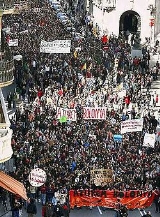
In May 2008 around 5000 students protested against the ineffective implementation (weak funding, unclearly defined new rules etc.), and thus poor results of the Bologna reform.

Denmark

Before the adaptation to international standards, the lowest degree that could be obtained at universities in Denmark
Denmark

Denmark is a Scandinavian country in northern Europe and the senior member of the Kingdom of Denmark. It is the southernmost of the Nordic countries....
 was equivalent to a Master degree (Kandidat). Officially, Bachelor degrees have been introduced after 3 years' university studies, but very few choose to stop at this stage, without the additional 2 years required to obtain a Masters degree. Various medium-length (2-4 years) professional degrees have been adapted so they now have status as professional bachelor degrees (3½ years), and opposed to academic bachelor degrees they are considered to be "valid" degrees.

Estonia

Since 2002 all Bachelors (honours) degrees have been three-year courses in Estonia
Estonia

Estonia , officially the Republic of Estonia is a country in the Baltic region of Northern Europe. It is bordered to the north by Finland across the Gulf of Finland, to the west by Sweden across the Baltic Sea, to the south by Latvia , and to the east by the Russia ....
 (4 years if students enrolled before 2001). Masters courses take two years and doctorates four years. The Masters degree is always a postgraduate degree.

Finland

In the Finnish pre-Bologna system, the higher education was strictly divided between the universities and polytechnics. In universities, the degrees were divided in most fields into a three-year Bachelor's degree kandidaatti, which was followed by the two-year higher Master's degree maisteri. In these fields, the Bologna process causes no changes. The degrees retain their former domestic names but in English usage, Bachelor and Master are used to describe the degrees.

In the field of engineering, the universities did not offer bachelor-level degrees, but only a 5½-year master's program (diplomi-insinööri
Diplomi-insinööri

Diplomi-insin??ri is a Finnish academic degree. In English, the official translation of the degree is Master of Science . The Finnish and German names originate from the German "Diplom", meaning "university diploma", in contrast to engineers with no university certification ....
). This program has now been divided into a three-year bachelor-level degree tekniikan kandidaatti and a two-year master-level degree diplomi-insinööri, for which the English names are Bachelor of Science (Eng) and Master of Science (Eng), respectively. A corresponding change has also been made in the military higher education, where the officer's degree was divided between a bachelor's and master's program.

Only medicine retains its non-standard degree structure, where the Licentiate
Licentiate

Licentiate is the title of a person who holds an academic degree called a license. This degree exists in various African, Asian, European and Latin American countries but can represent different educational levels....
 — higher than Master's, less extensive than Doctor of Medicine degree — serves as the basic degree. A six-year program of at least 360 ECTS
European Credit Transfer and Accumulation System

European Credit Transfer and Accumulation System is a standard for comparing the study attainment and performance of students of higher education across the European Union and other collaborating European countries....
 credits leads directly to the degree Licenciate of Medicine (lääketieteen lisensiaatti). There is an intermediate title (but curiously, not an academic degree) of lääketieteen kandidaatti, and there is no Master's degree. Licentiates of Medicine may continue to Doctor's degree.

The degrees from polytechnics are considered Bachelor's degrees in international usage. However, in domestic usage, bachelors transferring from polytechnics to universities may be required a maximum of 60 ECTS credits of additional studies prior emabarking the master's level studies. In conjunction with Bologna process, the polytechnics have obtained the right to award master's degrees. However, such programs remain rather minor phenomenon. The polytechnic master's degree does not qualify for doctoral studies.

The Finnish postgraduate education retains its non-standard two-level degree structure. The Licenciate's degree (lisensiaatti) may be undertaken after circa two years' postgraduate study. This degree requires the coursework of the doctoral degree but has much less stringent thesis requirements. The Doctor's degree, with a full dissertation, takes about four years to complete. Most Finnish universities encourage their post-graduate students to skip the intermediate licenciate degree.

In grading, Finnish universities may use their own 5-point system (0 fail, 5 best), which can be criterion-referenced
Criterion-referenced test

A criterion-referenced test is one that provides for translating Test scores into a statement about the behavior to be expected of a person with that score or their relationship to a specified subject matter....
 rather than norm-referenced
Norm-referenced test

A norm-referenced test / NRT is a type of Test , assessment, or evaluation which yields an estimate of the position of the tested individual in a predefined population, with respect to the trait being measured....
, and where ECTS points given are not affected by the grade.

France


In France the baccalauréat is awarded at the end of secondary education and allows students to enter university. It is followed by a two-year Diplôme d'études universitaires générales (DEUG), followed by a third year, the licence. The licence is the equivalent of a UK Bachelor's degree
Bachelor's degree

A bachelor's degree is usually an undergraduate academic degree awarded for a course or major that generally lasts for three, four, or in some cases and countries, five or six years....
.

After the licence, students can choose to enter the maîtrise, which is a one-year research degree. The maîtrise may be followed by either a one-year vocational degree, the diplôme d'études supérieures spécialisées (DESS), or a one-year research degree, the Diplôme d'études approfondies (DEA
DEA (former French degree)

A Master of Advanced Studies is a graduate degree in various countries....
). The DEA is preparation for a doctorate, and can be considered equivalent to an M. Phil.
Master's degree

A master's degree provides a mastery or high-order overview of a specific field of study or area of profession. Within the area studied, graduates possess advanced knowledge of a specialized body of theory and applied topics; high order skills in analysis, Critical thinking and/or professional application; and the ability to problem solving a...
. After the DEA
DEA (former French degree)

A Master of Advanced Studies is a graduate degree in various countries....
, students may pursue a doctorat, which takes at least three years.

Higher education in France is also provided by non-university institutions dedicated to specific subjects. For example, the Diplôme d'ingénieur (engineering diploma) is awarded to students after five years of study in state-recognized Ecoles d'ingénieurs, especially the Grandes Ecoles
Grandes écoles

The Grandes ?coles of France are higher education establishments outside the mainstream framework of the public university system. Unlike French public universities which have an obligation to accept all candidates of the same region who hold a Baccalaur?at, the selection criteria of Grandes ?coles rests mainly on competitive wri...
. Degrees from these schools are generally favoured over university degrees due to their selective admissions procedures. In contrast, public universities are legally obliged to accept any students who have passed High School.

The baccalauréat and the doctorat are unchanged in the new Bologna system, but the DEUG and the old licence have been merged into a new, three-year licence. The maîtrise, DESS, and DEA have also been combined into a two-year master's degree, which can be work-oriented (master professionnel) or research-oriented (master recherche). The Diplôme d'ingénieur degree is still separate from the university degree but students with such a degree may lawfully claim a Master degree as well.

Strikes occurred in France in 2002-2003 and 2007 against the reforms.

Germany

In Germany
Germany

Germany , officially the Federal Republic of Germany , is a country in Central Europe. It is bordered to the north by the North Sea, Denmark, and the Baltic Sea; to the east by Poland and the Czech Republic; to the south by Austria and Switzerland; and to the west by France, Luxembourg, Belgium, and the Netherlands....
 the process is already underway, many subjects of the humanities and social studies can be completed with a B.A.
Bachelor of Arts

Bachelor of Arts , from the Latin language Artium Baccalaureus, is an Undergraduate education bachelor's degree awarded for either a course or a program in either the liberal arts, the sciences or both....
 and many subjects of the natural sciences with a B.Sc.
Bachelor of Science

A Bachelor of Science is an bachelor's degree academic degree awarded for completed courses that generally last three to five years ....
 at an increasing number of universities. The Bachelor's degree in engineering can be a B.Eng.
Bachelor of Engineering

Bachelor of Engineering is an undergraduate academic degree awarded to a student after three to five years of studying engineering at universities in Australia, Canada, China, Egypt, Finland, Germany, India, Indonesia, Ireland, Korea, Malaysia, New Zealand, the Netherlands, Nigeria, Pakistan, Singapore, South Africa, Zimbabwe, the United Sta...
 or a B.Sc.
Bachelor of Science

A Bachelor of Science is an bachelor's degree academic degree awarded for completed courses that generally last three to five years ....
, depending on the focus of studies. The new postgraduate Master's degrees (M.A.
Master of Arts (postgraduate)

A Master of Arts is a Postgraduate education academic degree master degree awarded by University in many countries. The degree is typically studied for in English language, Fine Arts, History, Humanities, Philosophy, Social Sciences or Theology and can be either fully-taught, research-based, or a combination of the two....
, M.Sc.
Master of Science

A Master of Science is a postgraduate academic master's degree awarded by universities in a large number of countries. The degree is typically studied for in the sciences and occasionally in the social sciences....
, M.Eng.
Master of Engineering

A Master of Engineering , often abbreviated M.Eng , can be either an academic degree or Professional degree Masters degree in the field of engineering....
 and other) are seen as equivalent to the old five year first degrees Diplom
Diplom

Diplom is an academic degree in some European countries including Germany, Austria, Switzerland, Estonia, Croatia, Serbia, Education in Ukraine, Belarus, Greece and Hungary....
 (one subject, can be in all sciences) and Magister Artium (interdisciplinary, common in social and cultural sciences). The number of old degree courses is declining and they will be replaced by the new degrees up until 2010 in some states
States of Germany

Germany is a federation consisting of sixteen states, known in German language as L?nder . Since Land is the literal German word for "country", the term Bundesl?nder is commonly used colloquially, as it is more specific, though technically incorrect within the corpus of German law....
.

Greece

Greece joined the Bologna Process from the very beginning in 1999. Since 2007, more intensive steps towards the establishment of the European Higher Education Area were completed.

During the years 2006 – 2007, the Greek government led by New Democracy
New Democracy (Greece)

New Democracy , founded in 1974, is the main centre-right political party in Greece. After an initial period of success in the 1970s, ND spent most of the 1980s and 1990s in opposition....
, with the consent of PASOK
PASOK

PASOK is an abbreviation that may refer to:...
, tried to implement the declaration of Bologna through massive reforms aiming at the university system. These actions led to universities being taken over by the students, massive protests, police violence and riots. These reactions led to the failure of the constitutional change of the article 16
Article 16 of the Constitution of the Hellenic Republic

The article 16 of the Greek Constitution is an article of the Constitution of the Hellenic Republic which prohibits private universities.The significance and notability of the articles lies in the politics surrounding the attempted educational reforms and the opposition to it by students of public universities....
 that prohibits the founding of private universities and also blocked the reform in the laws regarding the internal workings of universities.

In 2008 a group of engineering schools in Greece took steps to silently implement parts of the Bologna declaration. The daily Eleftherotypia wrote on 18 March 2008 that the major engineering schools in Greece will issue certificates to all their graduates recognizing their diplomas as masters level degrees. Engineering studies in Greece last 5 years and by identifying the corresponding diplomas as masters, the schools silently adopt Bologna's directive that the undergraduate studies should be at least 3 years long, thus leaving room for master level studies in the 5 year period required for an engineering degree in Greece. Engineering schools in Greece objected to the Bologna process for years, which might explain the silent adoption of the process.

Hungary

In Hungary
Hungary

Hungary , officially in English the Republic of Hungary , is a landlocked country in the Carpathian Basin of Central Europe, bordered by Austria, Slovakia, Ukraine, Romania, Serbia, Croatia, and Slovenia....
, the Bologna system will be applied to those starting their university education in September 2006. From this year, only 108 majors will be available for selection (instead of more than 400 in the previous year), out of which six are exempt from the Bachelor vs. Master division: lawyer, physician, dentist, veterinary, pharmacist and architect.

According to an online poll (query date: 24-FEB-06) of the National Tertiary Education Information Centre 65% of the voters think it was unnecessary to adopt this system. Its unpopularity first of all comes from the fact that the new system provides much less guarantee for students to get a practically useful Master's degree because many of them will be dismissed after the three years' Bachelor education. It's also not popular that students are supposed to take up more unrelated subjects in the first three years at several majors, due to the much more reduced number of majors.

Source in Hungarian:


Ireland

In Ireland
Republic of Ireland

Ireland is an Island country in north-western Europe. The modern Sovereignty state occupies about five-sixths of the island of Ireland, which was partitioned by the British on 3 May 1921....
 most honours bachelors degree are three to four years with master's and doctorates being broadly similar to the UK. Ordinary bachelors degrees are also first cycle qualifications. The masters degree is always a postgraduate degree, either taught or achieved through research. The generic outcomes for Irish degrees are spelled out in the National Framework of Qualifications published in 2003.

Italy

Italy
Italy

Italy , officially the Italian Republic , is a country located on the Italian Peninsula in Southern Europe and on the two largest islands in the Mediterranean Sea, Sicily and Sardinia....
 seems to fit the framework since the adoption, in 1999, of the so-called 3+2 system.

The first degree is the Laurea
Laurea

In Italy, the laurea is the main post-secondary academic degree.Until very recently, lauree took much longer to earn than undergraduate degrees elsewhere in Europe and North America....
 triennale
that can be achieved after 3 years of studies.

Students can then complete 2 more years of specialization which lead to the Laurea Magistrale. The "Laurea Magistrale" corresponds to a Master's Degree, and gives access to 3rd cycle programmes (doctorates). It should not be confused with Italian "Masters", less popular 2nd cycle degrees which do not give access to doctorates: "First Level Masters" can be pursued by those who hold at least a "Laurea triennale" degree, while "Second Level Masters" require a "Laurea Magistrale" before entry.

Exceptions to the 3+2 system are the unique cycle degrees: medicine (6 years, plus a postgraduate specialization), pharmacy, veterinary science, architecture and law (5 years).

The dottorato di ricerca
Dottorato di ricerca

The dottorato di ricerca is the highest Italy academic degree, the formal equivalent of a Ph.D..The dottorato is a relatively recent addition to the Italian academic landscape, having been instituted in 1980....
 (doctorate) requires 3 or 4 years of work.

Former Yugoslav Republic of Macedonia (FYROM)

FYROM became a member of the Bologna Process in 2003, having started with the changes in the higher education system much earlier in 2000 when the Ministry of Education and Science passed the new Law on Higher Education. The Law requires universities to start introducing the ECTS and designing study and subject programs according to the principles of the Bologna process.

The existing academic degree granted with a diploma was transformed into a baccalaureus and the programmes were shortened from 4 years to around 3. The degree granted with a magisterium is transformed into a master's degree, achieved after 5 years of study. Medicine and medicine related studies still last 6 or 5 years. The degree of doktorat (PhD, dr.sc.) remains but it can be received after 3 more years, i.e. 8 years in total: 3 years (Bachelor or Baccalaureus) + 2 years (Master) + 3 years (doctor of science or doktor na nauki).

The implementation of the Bologna process/ ECTS on the Law Faculty "Iustinianus Primus"-Skopje: .

Moldova

Republic of Moldova adhered to the Process of Bologna in 2005.

Montenegro


In Montenegro
Montenegro

Montenegro , Montenegrin language/Serbian language: ???? ????, Crna Gora , ) is a country located in Balkans. It has a coast on the Adriatic Sea to the south and is bordered by Croatia to the west, Bosnia and Herzegovina to the northwest, Serbia to the north, Kosovo to the east and Albania to the south....
, the implementation of the Bologna process started in the academic year 2007.

The Netherlands


The old "HBO" (polytechnical education) has moved to the bachelor / master system. It generally requires four years of education to obtain a Bachelor degree at these institutions. After these four years, graduates can apply for a master program at a university. These master programs generally require one to two years to complete.

Previously there used to be a "propedeuse
Propedeuse

Upon the introduction of the international Bachelor's degree-Master's degree system, the Netherlands has maintained a diploma called the propedeuse, often referred to as "P" by student in The Netherlands....
" (propaedeutics
Propaedeutics

Propaedeutics or Propedeutics is a historical term for an introductory course into a discipline: art, science, etc. Etymology: wiktionary:pro- + Greek: paideutik?s, pertaining to teaching....
) (1-2 year) followed by three or four years of further studies to obtain a "doctoraal" degree (drs, ir or mr); not to be confused with the doctoral degree (dr) which furthermore requires the writing of a dissertation and several scientific publications and may be comparable to a PhD. This process is now replaced with the "twee fase structuur" with a Bachelor
Bachelor's degree

A bachelor's degree is usually an undergraduate academic degree awarded for a course or major that generally lasts for three, four, or in some cases and countries, five or six years....
 of three years and a Master
Master's degree

A master's degree provides a mastery or high-order overview of a specific field of study or area of profession. Within the area studied, graduates possess advanced knowledge of a specialized body of theory and applied topics; high order skills in analysis, Critical thinking and/or professional application; and the ability to problem solving a...
 of one, two, or three years.

Poland

Education in Poland starts at the age of 7 with 6 years of primary school (Polish szkola podstawowa). Next is the lower secondary level consists of 3 years in middle school (gimnazjum), starting at age 13/14, ends with an exam. This is followed by upper secondary level, which gives the students several options, the most common being the 3-year liceum ogólnoksztalcace or 4 years technikum (technical school). Both end with a maturity examination (matura), and may be followed by several forms of upper education. The Polish equivalent of an Associate's degree, Bachelor of Arts degree or Bachelor of Science degree (given by a university) is claimed to be licencjat, while in a technical university (politechnika) one gets the title of Engineer (inzynier). Magister is claimed to be the Polish equivalent of Master's degree. Doktor is the Polish equivalent of a doctoral degree (Ph.D.). However, some British universities (such as LSE) currently require a magister (which is already considered to be a Master's degree) or a licencjat from 2003 onwards with an average grade of 4+ (5 being the maximum grade and thus very difficult to average) British universities are also requesting that entrants for BA programs have very high matura scores (i.e. a minimum mark of 90%). It should also be noted that a magister can be completed part-time (usually with classes every weekend or every other weekend) in five years in total.

Portugal


Due to the pan-Europe
Europe

Europe is, conventionally, one of the world's seven continents. Comprising the westernmost peninsula of Eurasia, Europe is generally divided from Asia to its east by the water divide of the Ural Mountains, the Ural , the Caspian Sea, and by the Caucasus Mountains to the southeast....
an Bologna Process
Bologna process

The purpose of the Bologna process is to create the European higher education area by making academic degree standards and quality assurance standards more comparable and compatible throughout Europe, in particular under the Lisbon Recognition Convention....
, after 2005 new licenciatura (licentiate
Licentiate

Licentiate is the title of a person who holds an academic degree called a license. This degree exists in various African, Asian, European and Latin American countries but can represent different educational levels....
) degrees were organized at both university and polytechnic institutions of Portugal
List of colleges and universities in Portugal

This is a list of Portugal institutions providing higher education. Higher education in Portugal is organized into two systems: university and Polytechnic ....
 – they are now a first study cycle (3 years) offered by Portuguese institutions of higher education
Higher education in Portugal

Higher education in Portugal is divided into two main subsystems: university and Polytechnic education. It is provided in autonomous public university, private university, public or private university institutes, polytechnic institutions and higher education institutions of other types....
, and are the only requirement for any applicant who wish to undertake the second study cycle (2 years) which awards a master's degree
Master's degree

A master's degree provides a mastery or high-order overview of a specific field of study or area of profession. Within the area studied, graduates possess advanced knowledge of a specialized body of theory and applied topics; high order skills in analysis, Critical thinking and/or professional application; and the ability to problem solving a...
. Some new Bologna courses are integrated 5-year programmes or more, awarding a single master's degree (joint degree), a common practice in medicine
Medicine

Medicine is the art and science of healing. It encompasses a range of health care practices evolved to maintain and restore health by the prevention and treatment of illness....
, a 6-year programme, and some other fields taught at the universities. In engineering, although the use of two separated cycles, only having the masters' degree (2nd cycle of study) one can be a full chartered engineer. The new master's degrees attained after 5 or 6 years of successful study, corresponds to the same time duration of many old undergraduate degrees known as licenciatura. The new licenciatura attained after 3 years of successful study corresponds to the time duration of the old bacharelato which is a discontinued degree formerly awarded by polytechnics, in use between the 1970s and early 2000s, roughly equivalent to a extended associate's degree
Associate's degree

An associate degree is an academic degree awarded by community colleges, junior colleges, four-year universities, business colleges and some bachelor's degree-granting colleges/universities upon completion of a course of study usually lasting two years....
. Both the old and new master's degrees are the first graduate degree before a doctorate
Doctorate

A doctorate is an academic degree that in most countries represents the highest level of formal study or research in a given field. In some countries it also refers to a class of degrees which qualify the holder to practice in a specific profession ....
, and both the old and new licenciatura degrees are undergraduate degrees. Before the changes, the licenciatura diploma (4 to 6-year course) was required for those applicants who wished to undertake (the old) master's and/or doctorate programs but admission were only allowed for licenciatura degree owners with grades over 14 (out of 20). After the changes introduced by the Bologna process, the master's degree
Master's degree

A master's degree provides a mastery or high-order overview of a specific field of study or area of profession. Within the area studied, graduates possess advanced knowledge of a specialized body of theory and applied topics; high order skills in analysis, Critical thinking and/or professional application; and the ability to problem solving a...
 is conferred at the end of a programme roughly equivalent in time duration to many old licenciatura programmes. However, the Bologna process was elaborated in order to attain an improved education system based on the development of competences rather than on the transmission of knowledge. Its goal was the development of a reformed and modernized system of easily readable and comparable degrees, aimed to simplify comparison between qualifications across Europe through a total reorganisation of curricula and teaching methods in every new cycle of study. The flexibility and transparency provided is oriented to enable students to have their qualifications recognised more widely, facilitating freedom of movement around a more transparent EHEA (European Higher Education Area
European Higher Education Area

The European Higher Education Area is the objective of the Bologna process - to create more comparable, compatible and coherent systems of higher education in Europe....
) which is based on two main cycles: undergraduate (1st cycle of study) and graduate (2nd cycle of study); as well as providing postgraduate degrees (3rd cycle of study) for advanced applicants aiming the doctorate degree.

As of 2007, critics allege that this was not achieved as many institutions relabeled their old licenciatura as the new master's without making any substantial alteration to the curriculum. The changings creating 3 to 6 years new licenciaturas and master's degrees that correspond to either 4 to 8 years of study in the previous model, has generated considerable confusion among some people and institutions. It is also alleged that many of those master's degrees offered by certain institutions, were not designed to prepare the students for further study (3rd cycle).

Romania

Romania made major steps towards the European Higher Education Area by reorganizing the entire education system. The new structure was approved by the National Rectors Council in November 2003 releasing on 5th of November 2003 the Declaration of the National Higher Education Conference.

The new legislation of June 2004 (No. 288/2004) stipulates the reorganization of the university studies, in accordance with Bologna declaration and Prague 2001, Berlin 2003 ministerial meetings, in three main cycles: Bachelor, Master and Doctoral. The implementation begun with the 2005-2006 generation of students and consists in a short-term higher education (180 ECTS) after which the student receives a diploma de absolvire or a long-term higher education (240-360 ECTS) after which one can receive an engineer diploma, diploma de inginer, (300 ECTS), architect diploma, diploma de architect, (360 ECTS) or bachelor diploma de licenta in other fields (240-360 ECTS). The first stage of the higher education can be followed by an advanced studies program (60-90 ECTS) in the same field as the diploma obtained after a long-term higher education, giving the student a diploma for advanced studies diploma de studii aprofundate. Master studies last for 2 to 4 semesters (60-120 ECTS).

Russia

The Russia
Russia

Russia , or the Russian Federation , is a list of countries spanning more than one continent country extending over much of northern Eurasia....
n higher education framework was basically incompatible with the process: the generic "lowest" degree in all universities since Soviet era is the Specialist which can be obtained after completing 5-6 years of studies. Since the mid-90s, many universities have introduced limited educational programmes allowing students to graduate with a Bachelor's degree
Bachelor's degree

A bachelor's degree is usually an undergraduate academic degree awarded for a course or major that generally lasts for three, four, or in some cases and countries, five or six years....
 (4 years) and then earn a Master's degree
Master's degree

A master's degree provides a mastery or high-order overview of a specific field of study or area of profession. Within the area studied, graduates possess advanced knowledge of a specialized body of theory and applied topics; high order skills in analysis, Critical thinking and/or professional application; and the ability to problem solving a...
 (another 1-2 years) while preserving the old 5-6 year scheme. In October 2007 Russia enacted a move to two-tier education in line with Bologna process model. The universities inserted a BSc diploma in the middle of their standard specialist programs; transition to real MS qualification has not been completed yet.

It's worth mentioning that even though Specialists are eligible for post-graduate courses (Aspirantura) as well as Masters are, Bachelors are not. Specialist degree is now being discontinued, so new students don't have this option. At the same time, while specialist education was free, the MS part of six-year program is not; students graduating in 2009–2010 will have to pay for what was free to their predecessors. The labor market regards BSc diplomas as inferior to "classic" education, thus MS stage remains mandatory for most graduates.

Also, some politicians in Russia are trying to link the transition to Bologna Process with attempts to bypass an article of russian Constitution, which guarantees a free higher education for every citizen of Russian Federation. But the Master degree is not free and must be payed. This fact is seen as a violation of the russian Constitution. Most of russian students and professors are calling this process "nothing, but a mindless and dangerous act", which will initiate a tsunami of ill-prepared bachelors, trying to get a job. At the same time Russia will forever lose it`s educating tradition, which in past allowed this country to prepare a wide-scope specialists and brilliant scientists.

Serbia

In Serbia
Serbia

Serbia , officially the Republic of Serbia , is a country in Central Europe and Balkans Europe, covering the southern part of the Pannonian Plain and the central part of the Balkans....
, the implementation of the Bologna process started in some schools in 2005. The existing academic degree granted with a diploma was transformed into a baccalaureus and the programmes last for 4 or, in some cases, 3 years. The degree granted with a magistratura was mostly eliminated or transformed into a master's degree, achieved after 5 years of study. Medicine and medicine related studies still last 6 or 5 years. The degree of doktorat (PhD) remains.

Currently, there is a lot of turmoil in the Serbian education system. The implementation of the Bologna process spawned a lot of problems, with one of the major problems being the introduction of very high tuition fees in public universities under the cover of the process. The fees, which are in some cases extremely high, have caused unrest among the student population. Currently, there isn't a single benefit of the Bologna process in Serbia. Because Serbia is not a part of the ERASMUS program, the students find it hard or even impossible to transfer between the European universities, thus have no use of their ECTS credits.

Spain

The structure of university degrees in Spain
Spain

Spain or the Kingdom of Spain , is a country located in Southern Europe on the Iberian Peninsula.The Spanish constitution does not establish any official denomination of the country, even though Espa?a , Estado espa?ol and Naci?n espa?ola are used interchangeably....
 is quite different from the Anglo-Saxon
Anglosphere

The word Anglosphere describes a concept of a group of anglophone nations which share historical, political, and cultural characteristics rooted in or attributed to the historical experience of the United Kingdom....
 model.

For years it has had two kinds of initial degrees: 3-year "Diplomatura" or "Ingeniería Técnica" (technical engineering) degrees and 4, 5 or 6-year "Licenciatura" or "Ingeniería" degrees. These two kinds of degrees used to be completely separate, the former leading to a medium-level technical profession (like Nursing, Social Work, School Teaching, medium-level Engineering, etc.) and the latter giving access to higher-level professions or academic disciplines (Physics, Chemistry, History, Psychology, Medicine, Sociology, Philosophy, Economics, higher Engineering, etc.) and opening the path to the Doctorate. Although the "Diplomatura" degrees used to be a sort of blocked path, over the years the possibility was opened to go on (with an extra year or half-year of study) to the last two years of a "Licenciatura" usually in a related but different field. But a "Diplomatura" has never been the exact equivalent of a BA/BSc, nor the "Licenciatura" that of an MA/MSC.

The new degrees have started for the master's level in 2006, and are scheduled to start at the undergraduate level in 2008. The new degrees will be: "Graduado" for the Bachelor's degree, after 4 years of study, except for Pharmacy or Dentistry, after 5 years, and Medicine, after 6 years; "Master" with an extra year or two; and "Doctor" for the doctorate.

The reform will also mean the end of a long standing Spanish tradition of centralised definition of degrees, both in their names and in a large part of their contents. Universities will have a very large autonomy to define their programmes and the name of their degrees, and will have to account for the results by means of an evaluation and accreditation process.

Sweden

A bill proposing new regulations in the field of Higher Education was presented to Parliament in 2005. The new system came into force in July 2007. In the new system of degrees there will be two degrees of different lengths in each cycle.
CycleSwedishEnglishLength (undergraduate)Length (postgraduate)
1HögskoleexamenUniversity Diploma2 yearsN/A
1KandidatexamenBachelor's degree3 yearsHögskoleexamen + 1 year
2MagisterexamenDegree of Master, 1 year (sometimes called "Swedish master's degree")4 yearsKandidatexamen + 1 year
2MasterexamenDegree of Master, 2 years5 yearsKandidatexamen + 2 years, or magisterexamen + 1 year
3LicentiatexamenDegree of Licentiate
Licentiate

Licentiate is the title of a person who holds an academic degree called a license. This degree exists in various African, Asian, European and Latin American countries but can represent different educational levels....
N/AKandidatexamen or higher + 2 years
3DoktorsexamenDegree of DoctorN/AKandidatexamen or higher + 4 years


Students might not always be offered all of the combinations above for obtaining a degree. For example, the högskoleexamen is not offered for most educations, and many educations require students to obtain the kandidatexamen before obtaining a magisterexamen or a masterexamen. Most third cycle programmes require the student to have obtained at least a magisterexamen before being allowed to enroll, although the legal requirement only is the kandidatexamen.

All degrees and qualifications are described using learning outcomes.

In July 2007, a new system of credits compatible with the European Credit Transfer and Accumulation System
European Credit Transfer and Accumulation System

European Credit Transfer and Accumulation System is a standard for comparing the study attainment and performance of students of higher education across the European Union and other collaborating European countries....
, ECTS, was introduced, where one academic credit point (högskolepoäng) in the new system corresponds to one ECTS credit point, or two thirds of a credit point in the old system (poäng).

Some Swedish universities have decided to introduce the ECTS standard grading scale for all students, while others only will use it for international students. However, since so called criterion-referenced grading is practiced instead of relative grading
Norm-referenced test

A norm-referenced test / NRT is a type of Test , assessment, or evaluation which yields an estimate of the position of the tested individual in a predefined population, with respect to the trait being measured....
 in the Swedish educational system, the 10%, 25%, 30%, 25% and 10% distribution of the students among A, B, C, D and E will not be obeyed.

Some universities have decided to only give grade Failed or Passed (F or P) at certain courses, for example internship and thesis projects, or at some assignments, for example laboratory exercises.

Switzerland


Turkey


Ukraine

Since the mid-90s, Ukraine
Ukraine

Ukraine is a country in Eastern Europe. It is bordered by Russia to the east; Belarus to the north; Poland, Slovakia, and Hungary to the west; Romania and Moldova to the southwest; and the Black Sea and Sea of Azov to the south....
 took steps to reform its education frameworks in consistence with the Bologna process. By mid-2000s, most Universities grant lower Bachelor's degree
Bachelor's degree

A bachelor's degree is usually an undergraduate academic degree awarded for a course or major that generally lasts for three, four, or in some cases and countries, five or six years....
 (about 4 years) and higher Master's degree
Master's degree

A master's degree provides a mastery or high-order overview of a specific field of study or area of profession. Within the area studied, graduates possess advanced knowledge of a specialized body of theory and applied topics; high order skills in analysis, Critical thinking and/or professional application; and the ability to problem solving a...
 (about 6 years). In the Soviet times the only degree was Specialist, which is discontinued by now. Masters are eligible for post-graduate courses. The post-graduate system (Aspirantura) has not been reformed, with Kandydat nauk and Doktor nauk
Doktor nauk

Doktor nauk is a higher doctorate degree, the second and the highest post-graduate academic degree in the Soviet Union, Russia and in many post-Soviet states....
 degrees being granted.

United Kingdom


The UK is unusual in that graduates with a Bachelor's (Honours) degree can undertake doctoral studies without first having to obtain a Master's degree. Support for this is widespread in the UK because it costs students less to obtain a Ph. D, both in terms of time and money, than in other EU countries. It should also be noted that unlike many university systems in many other countries, British undergraduates are required to undertake a significant amount of independent research, usually in the form of an independent research project and thesis. Opponents argue that a Master's degree experience is required to train the student for their doctoral studies – both in practical techniques and enhanced knowledge of a field.

England and Wales

The first academic degrees in England and Wales available to undergraduates
Undergraduate education

Undergraduate education is education taken prior to gaining a first degree, hence in many subjects in many educational systems, undergraduate education is post-secondary education up to the level of a bachelor's degree, such as in the United States, where a university entry level is known as undergraduate, while students of higher degrees are...
 students are either a three-year ("Honours") Bachelor's degree, or a four-year degree equivalent to a three-year Bachelor's plus an integrated one-year Master's, or a three-year degree plus a year spent in employment ("sandwich courses") or in a foreign university. Postgraduate Master's degrees generally take only one additional academic year to complete beyond the initial 3-year Bachelor's degree. Note, however, that the academic year for postgraduate Master's programmes in UK usually lasts twelve months (full-time). A research doctorate
Doctorate

A doctorate is an academic degree that in most countries represents the highest level of formal study or research in a given field. In some countries it also refers to a class of degrees which qualify the holder to practice in a specific profession ....
 leading to the Doctor of Philosophy
Doctor of Philosophy

Doctor of Philosophy, abbreviated Ph.D. or PhD for the Latin , meaning "teacher of philosophy", is an postgraduate academic degree awarded by University....
 degree may be completed after 3 or 4 years of additional full-time study.

Scotland

Scottish students can leave school and enter University at age seventeen with national Higher Grade certificates, as Scottish university
List of universities in Scotland

The following is a list of universities in Scotland, detailing the year of foundation, the location and other information.The oldest university in Scotland is the University of St Andrews, established in 1413, while the newest is the Queen Margaret University, converted in 2007....
 courses generally last a year longer than in England and Wales. It is often possible for school students to take Advanced Highers, equivalent to English A-levels, and join the courses at the second year.

A unique aspect is that the Ancient Universities of Scotland
Ancient universities of Scotland

The ancient universities of Scotland are medieval universities and renaissance university which continue to exist until the present day. The majority of the ancient universities of the British Isles are located within Scotland, and have a number of distinctive features in common, being governed by a series of measures laid down in the Univers...
 issue a Master of Arts
Master of Arts (Scotland)

A Master of Arts in Scotland is an academic degree in humanities and social sciences awarded by the ancient universities of Scotland ? St Andrews University, the University of Glasgow, the University of Aberdeen and Edinburgh University....
 as the first degree
Academic degree

A degree is any of a wide range of status levels conferred by institutions of higher education, such as University, normally as the result of successfully completing a program of study....
 in humanities
Humanities

The humanities are academic disciplines which study the human condition, using methods that are primarily analytic, critical, or speculative, as distinguished from the mainly empirical approaches of the natural science and social sciences....
.

Bologna process seminars

Several Bologna process seminars have been held as of October 2008.

The first seminar devoted to a single academic discipline was held in June 2004 in Dresden
Dresden

Dresden is the capital city of the Germany Federal Free state of Saxony. It is situated in a valley on the River Elbe. The Dresden conurbation is part of the Saxon triangle metropolitan area....
, Germany
Germany

Germany , officially the Federal Republic of Germany , is a country in Central Europe. It is bordered to the north by the North Sea, Denmark, and the Baltic Sea; to the east by Poland and the Czech Republic; to the south by Austria and Switzerland; and to the west by France, Luxembourg, Belgium, and the Netherlands....
: its title was "Chemistry Studies in the European Higher Education Area". The same seminar also approved Eurobachelor.

Bibliography

  • Kertz-Welzel, Alexandra. "Motivation zur Weiterbildung: Master- und Bachelor-Abschlüsse in den USA." Diskussion Musikpädagogik 29 (2006): 33-35.


See also

  • European Credit Transfer and Accumulation System
    European Credit Transfer and Accumulation System

    European Credit Transfer and Accumulation System is a standard for comparing the study attainment and performance of students of higher education across the European Union and other collaborating European countries....
  • Education by country
  • Chemistry Quality Eurolabels
    Chemistry Quality Eurolabels

    The Chemistry Quality Eurolabels or European Quality Labels in Chemistry is a marketing scheme for chemistry degrees at institutions located within the 45 countries involved in the Bologna process....


External links

  • – by the German Education Server
  • Bologna Bergen Summit 2005. Norwegian perspective on the ten lines of action for the Bologna Process
  • Council of Europe
  • Admissions Officers' and Credential Evaluators' (ACE) professional section of the EAIE – European Association for International Education
    European Association for International Education

    European Association for International Education is a non-profit organisation whose main purpose is the stimulation and facilitation of the internationalisation of higher education in Europe and elsewhere in the world....
    . Includes updates on implementation from individual countries.
  • European University Association. Analysis of Bologna Process, trends in education and background information with numerous reports in pdf format to download.
  • The UK Higher Education Europe Unit. UK perspective the ten lines of action for the Bologna Process.
  • Australian Department of Science, Education and Training. Link to pdf file for full report on DEST analysis of Bologna Process and impact on Australian education.
  • , World Education News and Reviews, compilation of articles.
  • Presents relevant data on aspects of student life in 23 European countries