
Dark-eyed Junco

Encyclopedia
The Dark-eyed Junco is the best-known species
of the junco
s, a genus of small grayish American sparrow
s. This bird is common across much of temperate
North America
and in summer ranges far into the Arctic
. It is a very variable species, much like the related Fox Sparrow
(Passerella iliaca), and its systematics
is still not completely untangled.
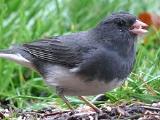
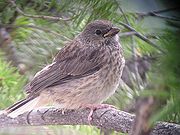
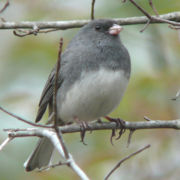 Adults generally have gray heads, necks, and breasts, gray or brown backs and wings, and a white belly, but show a confusing amount of variation in plumage details. The white outer tail feathers flash distinctively in flight and while hopping on the ground. The bill is usually pale pinkish.
Males tend to have darker, more conspicuous markings than the females. Also they are 5–6.5 in (13–17 cm) in length. Juveniles often have pale streaks and may even be mistaken for Vesper Sparrow
s (Pooecetes gramineus) until they acquire adult plumage at 2 to 3 months. But junco fledglings' heads are generally quite uniform in color already, and initially their bills still have conspicuous yellowish edges to the gape
, remains of the fleshy wattles that guide the parents when they feed the nestlings.
The song is a trill similar to the Chipping Sparrow
's (Spizella passerina), except that the Red-backed Junco's (see below) song is more complex, similar to that of the Yellow-eyed Junco
(Junco phaeonotus). Calls include tick sounds and very high-pitched tinkling chips.
A sample of the song can be heard at the USGS web site here (MP3
) or at the Cornell Lab of Ornithology web site here.
in his 1758 Systema naturae
as Fringilla hyemalis. The description consisted merely of the laconic remark "F[ringilla] nigra, ventre albo. ("A black 'finch
' with white belly"), a reference to a source, and a statement that it came from "America".
Linnaeus' source was Mark Catesby
who described the Slate-colored Junco before binomial nomenclature
as his "snow-bird", moineau de neige or passer nivalis ("snow sparrow") thus:
Still, at least the Slate-colored Junco is unmistakable enough to make it readily recognizable even from Linnaeus' minimal description. Its modern scientific name means "winter junco", from Latin
hyemalis "of the winter".
, making up 2 large groups and 3–5 small or monotypic
ones. The five basic groups were formerly considered separate species (and the Guadalupe Junco
frequently still is), but they interbreed extensively in areas of contact. Birders
trying to identify subspecies are advised to consult detailed identification references.
This group has dark slate-gray head, breast and upperparts. Females are brownish gray, sometimes with reddish-brown flanks. They breed in North America
n taiga forests from Alaska
to Newfoundland and south to the Appalachian Mountains
, wintering through most of the USA. They are relatively common across their range.
The White-winged Junco
has a medium-gray head, breast, and upperparts with white wing bars. Females are washed brownish. It has more white in the tail than the other forms. It is a common endemic breeder in the Black Hills
area of South Dakota
, Wyoming
, Nebraska
, and Montana
, and winters south to northeastern New Mexico
.
These have a blackish-gray head and breast with a brown back and wings and reddish flanks, tending toward duller and paler plumage in the inland and southern parts of its range. This is the most common form in the west, found in the Pacific coast mountains from southeastern Alaska
to extreme northern Baja California
, wintering to the Great Plains
and northern Sonora
. There is an unresolved debate whether this large and distinct group is not better treated as a full species.
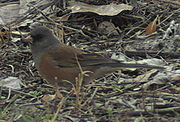
Often considered part of the Oregon group, it has a lighter gray head and breast than the Oregon group with contrasting dark lores. The back and wings are brown. It has pinkish-cinnamon color that is richer and covers more of the flanks and breast than in Oregon Juncos. It breeds in the northern Rocky Mountains
from southern Alberta
to eastern Idaho
and western Wyoming
; it winters in central Idaho and nearby Montana and from southwestern South Dakota
, southern Wyoming, and northern Utah to northern Sonora and Chihuahua.
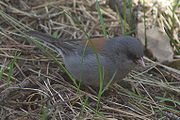
This subspecies is essentially rather light gray on top with a rusty back. It breeds in the southern Rocky Mountains from Colorado
to central Arizona
and New Mexico, and winters into northern Mexico.
Often included with J. h. caniceps as Gray-headed Juncos. It differs from the Gray-headed Junco proper in having a more silvery bill with a dark upper mandible, a variable amount of rust on the wings, and pale underparts. This makes it similar to the Yellow-eyed Junco
(J. phaeonotus) except for the dark eye. It is found in the southern mountains of Arizona and New Mexico. It does not overlap with the Yellow-eyed Junco in breeding range.
Th extremely rare Guadalupe Junco
is also considered part of this species by some authors, namely the IUCN which restores it to subspecies status in 2008. Other authors consider it a species in its own right – perhaps a rather young one, but certainly this population has evolved more rapidly than the mainland juncos due to its small population size
and the founder effect
.
 Their breeding habitat is coniferous or mixed forest areas throughout North America. In otherwise optimal conditions they also utilize other habitat, but at the southern margin of its range it can only persist in its favorite habitat. Northern birds migrate
further south, arriving in their winter quarters between mid-September and November and leaving to breed from mid-March onwards, with almost all gone by the end of April or so. Many populations are permanent residents or altitudinal migrants, while in cold years birds may choose to stay in the winter range and breed there. In winter, juncos are familiar in and around towns, and in many places are the most common birds at feeders. The Slate-colored Junco is a rare vagrant to western Europe
and may successfully winter in Great Britain
, usually in domestic gardens.
These birds forage on the ground. In winter, they often forage in flocks that may contain several subspecies. They mainly eat insects and seeds.
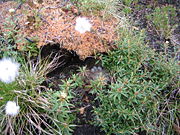 They usually nest in a cup-shaped depression on the ground, well hidden by vegetation or other material, although nests are sometimes found in the lower branches of a shrub or tree. The nests have an outer diameter of about 10 cm and are lined with fine grasses and hair. Normally two clutch
es of 4 eggs are laid during the breeding season. The slightly glossy eggs are grayish or pale bluish-white and heavily spotted (sometimes splotched) with various shades of brown, purple or gray. The spotting is concentrated at the large end of the egg. The eggs are incubated by the female for 12 to 13 days. Young leave nest between 11 and 14 days after hatching.
The Dark-eyed Junco (Junco hyemalis) is the best-known species
of the junco
s, a genus of small grayish American sparrow
s. This bird is common across much of temperate
North America
and in summer ranges far into the Arctic
. It is a very variable species, much like the related Fox Sparrow
(Passerella iliaca), and its systematics
is still not completely untangled.
Adults generally have gray heads, necks, and breasts, gray or brown backs and wings, and a white belly, but show a confusing amount of variation in plumage details. The white outer tail feathers flash distinctively in flight and while hopping on the ground. The bill is usually pale pinkish.
Males tend to have darker, more conspicuous markings than the females. Also they are 5–6.5 in (13–17 cm) in length. Juveniles often have pale streaks and may even be mistaken for Vesper Sparrow
s (Pooecetes gramineus) until they acquire adult plumage at 2 to 3 months. But junco fledglings' heads are generally quite uniform in color already, and initially their bills still have conspicuous yellowish edges to the gape
, remains of the fleshy wattles that guide the parents when they feed the nestlings.
The song is a trill similar to the Chipping Sparrow
's (Spizella passerina), except that the Red-backed Junco's (see below) song is more complex, similar to that of the Yellow-eyed Junco
(Junco phaeonotus). Calls include tick sounds and very high-pitched tinkling chips.
A sample of the song can be heard at the USGS web site here (MP3
) or at the Cornell Lab of Ornithology web site here.
in his 1758 Systema naturae
as Fringilla hyemalis. The description consisted merely of the laconic remark "F[ringilla] nigra, ventre albo. ("A black 'finch
' with white belly"), a reference to a source, and a statement that it came from "America".
Linnaeus' source was Mark Catesby
who described the Slate-colored Junco before binomial nomenclature
as his "snow-bird", moineau de neige or passer nivalis ("snow sparrow") thus:
Still, at least the Slate-colored Junco is unmistakable enough to make it readily recognizable even from Linnaeus' minimal description. Its modern scientific name means "winter junco", from Latin
hyemalis "of the winter".
, making up 2 large groups and 3–5 small or monotypic
ones. The five basic groups were formerly considered separate species (and the Guadalupe Junco
frequently still is), but they interbreed extensively in areas of contact. Birders
trying to identify subspecies are advised to consult detailed identification references.
This group has dark slate-gray head, breast and upperparts. Females are brownish gray, sometimes with reddish-brown flanks. They breed in North America
n taiga forests from Alaska
to Newfoundland and south to the Appalachian Mountains
, wintering through most of the USA. They are relatively common across their range.
The White-winged Junco
has a medium-gray head, breast, and upperparts with white wing bars. Females are washed brownish. It has more white in the tail than the other forms. It is a common endemic breeder in the Black Hills
area of South Dakota
, Wyoming
, Nebraska
, and Montana
, and winters south to northeastern New Mexico
.
These have a blackish-gray head and breast with a brown back and wings and reddish flanks, tending toward duller and paler plumage in the inland and southern parts of its range. This is the most common form in the west, found in the Pacific coast mountains from southeastern Alaska
to extreme northern Baja California
, wintering to the Great Plains
and northern Sonora
. There is an unresolved debate whether this large and distinct group is not better treated as a full species.
Often considered part of the Oregon group, it has a lighter gray head and breast than the Oregon group with contrasting dark lores. The back and wings are brown. It has pinkish-cinnamon color that is richer and covers more of the flanks and breast than in Oregon Juncos. It breeds in the northern Rocky Mountains
from southern Alberta
to eastern Idaho
and western Wyoming
; it winters in central Idaho and nearby Montana and from southwestern South Dakota
, southern Wyoming, and northern Utah to northern Sonora and Chihuahua.
This subspecies is essentially rather light gray on top with a rusty back. It breeds in the southern Rocky Mountains from Colorado
to central Arizona
and New Mexico, and winters into northern Mexico.
Often included with J. h. caniceps as Gray-headed Juncos. It differs from the Gray-headed Junco proper in having a more silvery bill with a dark upper mandible, a variable amount of rust on the wings, and pale underparts. This makes it similar to the Yellow-eyed Junco
(J. phaeonotus) except for the dark eye. It is found in the southern mountains of Arizona and New Mexico. It does not overlap with the Yellow-eyed Junco in breeding range.
Th extremely rare Guadalupe Junco
is also considered part of this species by some authors, namely the IUCN which restores it to subspecies status in 2008. Other authors consider it a species in its own right – perhaps a rather young one, but certainly this population has evolved more rapidly than the mainland juncos due to its small population size
and the founder effect
.
Their breeding habitat is coniferous or mixed forest areas throughout North America. In otherwise optimal conditions they also utilize other habitat, but at the southern margin of its range it can only persist in its favorite habitat. Northern birds migrate
further south, arriving in their winter quarters between mid-September and November and leaving to breed from mid-March onwards, with almost all gone by the end of April or so. Many populations are permanent residents or altitudinal migrants, while in cold years birds may choose to stay in the winter range and breed there. In winter, juncos are familiar in and around towns, and in many places are the most common birds at feeders. The Slate-colored Junco is a rare vagrant to western Europe
and may successfully winter in Great Britain
, usually in domestic gardens.
These birds forage on the ground. In winter, they often forage in flocks that may contain several subspecies. They mainly eat insects and seeds.
They usually nest in a cup-shaped depression on the ground, well hidden by vegetation or other material, although nests are sometimes found in the lower branches of a shrub or tree. The nests have an outer diameter of about 10 cm and are lined with fine grasses and hair. Normally two clutch
es of 4 eggs are laid during the breeding season. The slightly glossy eggs are grayish or pale bluish-white and heavily spotted (sometimes splotched) with various shades of brown, purple or gray. The spotting is concentrated at the large end of the egg. The eggs are incubated by the female for 12 to 13 days. Young leave nest between 11 and 14 days after hatching.
The Dark-eyed Junco (Junco hyemalis) is the best-known species
of the junco
s, a genus of small grayish American sparrow
s. This bird is common across much of temperate
North America
and in summer ranges far into the Arctic
. It is a very variable species, much like the related Fox Sparrow
(Passerella iliaca), and its systematics
is still not completely untangled.
Adults generally have gray heads, necks, and breasts, gray or brown backs and wings, and a white belly, but show a confusing amount of variation in plumage details. The white outer tail feathers flash distinctively in flight and while hopping on the ground. The bill is usually pale pinkish.
Males tend to have darker, more conspicuous markings than the females. Also they are 5–6.5 in (13–17 cm) in length. Juveniles often have pale streaks and may even be mistaken for Vesper Sparrow
s (Pooecetes gramineus) until they acquire adult plumage at 2 to 3 months. But junco fledglings' heads are generally quite uniform in color already, and initially their bills still have conspicuous yellowish edges to the gape
, remains of the fleshy wattles that guide the parents when they feed the nestlings.
The song is a trill similar to the Chipping Sparrow
's (Spizella passerina), except that the Red-backed Junco's (see below) song is more complex, similar to that of the Yellow-eyed Junco
(Junco phaeonotus). Calls include tick sounds and very high-pitched tinkling chips.
A sample of the song can be heard at the USGS web site here (MP3
) or at the Cornell Lab of Ornithology web site here.
in his 1758 Systema naturae
as Fringilla hyemalis. The description consisted merely of the laconic remark "F[ringilla] nigra, ventre albo. ("A black 'finch
' with white belly"), a reference to a source, and a statement that it came from "America".
Linnaeus' source was Mark Catesby
who described the Slate-colored Junco before binomial nomenclature
as his "snow-bird", moineau de neige or passer nivalis ("snow sparrow") thus:
Still, at least the Slate-colored Junco is unmistakable enough to make it readily recognizable even from Linnaeus' minimal description. Its modern scientific name means "winter junco", from Latin
hyemalis "of the winter".
, making up 2 large groups and 3–5 small or monotypic
ones. The five basic groups were formerly considered separate species (and the Guadalupe Junco
frequently still is), but they interbreed extensively in areas of contact. Birders
trying to identify subspecies are advised to consult detailed identification references.
This group has dark slate-gray head, breast and upperparts. Females are brownish gray, sometimes with reddish-brown flanks. They breed in North America
n taiga forests from Alaska
to Newfoundland and south to the Appalachian Mountains
, wintering through most of the USA. They are relatively common across their range.
The White-winged Junco
has a medium-gray head, breast, and upperparts with white wing bars. Females are washed brownish. It has more white in the tail than the other forms. It is a common endemic breeder in the Black Hills
area of South Dakota
, Wyoming
, Nebraska
, and Montana
, and winters south to northeastern New Mexico
.
These have a blackish-gray head and breast with a brown back and wings and reddish flanks, tending toward duller and paler plumage in the inland and southern parts of its range. This is the most common form in the west, found in the Pacific coast mountains from southeastern Alaska
to extreme northern Baja California
, wintering to the Great Plains
and northern Sonora
. There is an unresolved debate whether this large and distinct group is not better treated as a full species.
Often considered part of the Oregon group, it has a lighter gray head and breast than the Oregon group with contrasting dark lores. The back and wings are brown. It has pinkish-cinnamon color that is richer and covers more of the flanks and breast than in Oregon Juncos. It breeds in the northern Rocky Mountains
from southern Alberta
to eastern Idaho
and western Wyoming
; it winters in central Idaho and nearby Montana and from southwestern South Dakota
, southern Wyoming, and northern Utah to northern Sonora and Chihuahua.
This subspecies is essentially rather light gray on top with a rusty back. It breeds in the southern Rocky Mountains from Colorado
to central Arizona
and New Mexico, and winters into northern Mexico.
Often included with J. h. caniceps as Gray-headed Juncos. It differs from the Gray-headed Junco proper in having a more silvery bill with a dark upper mandible, a variable amount of rust on the wings, and pale underparts. This makes it similar to the Yellow-eyed Junco
(J. phaeonotus) except for the dark eye. It is found in the southern mountains of Arizona and New Mexico. It does not overlap with the Yellow-eyed Junco in breeding range.
Th extremely rare Guadalupe Junco
is also considered part of this species by some authors, namely the IUCN which restores it to subspecies status in 2008. Other authors consider it a species in its own right – perhaps a rather young one, but certainly this population has evolved more rapidly than the mainland juncos due to its small population size
and the founder effect
.
Their breeding habitat is coniferous or mixed forest areas throughout North America. In otherwise optimal conditions they also utilize other habitat, but at the southern margin of its range it can only persist in its favorite habitat. Northern birds migrate
further south, arriving in their winter quarters between mid-September and November and leaving to breed from mid-March onwards, with almost all gone by the end of April or so. Many populations are permanent residents or altitudinal migrants, while in cold years birds may choose to stay in the winter range and breed there. In winter, juncos are familiar in and around towns, and in many places are the most common birds at feeders. The Slate-colored Junco is a rare vagrant to western Europe
and may successfully winter in Great Britain
, usually in domestic gardens.
These birds forage on the ground. In winter, they often forage in flocks that may contain several subspecies. They mainly eat insects and seeds.
They usually nest in a cup-shaped depression on the ground, well hidden by vegetation or other material, although nests are sometimes found in the lower branches of a shrub or tree. The nests have an outer diameter of about 10 cm and are lined with fine grasses and hair. Normally two clutch
es of 4 eggs are laid during the breeding season. The slightly glossy eggs are grayish or pale bluish-white and heavily spotted (sometimes splotched) with various shades of brown, purple or gray. The spotting is concentrated at the large end of the egg. The eggs are incubated by the female for 12 to 13 days. Young leave nest between 11 and 14 days after hatching.

Species
In biology, a species is one of the basic units of biological classification and a taxonomic rank. A species is often defined as a group of organisms capable of interbreeding and producing fertile offspring. While in many cases this definition is adequate, more precise or differing measures are...
of the junco
Junco
A Junco , genus Junco, is a small North American bird. Junco systematics are still confusing after decades of research, with various authors accepting between three and twelve species...
s, a genus of small grayish American sparrow
American sparrow
American sparrows are a group of mainly New World passerine birds, forming part of the family Emberizidae. American sparrows are seed-eating birds with conical bills, brown or gray in color, and many species have distinctive head patterns....
s. This bird is common across much of temperate
Temperate
In geography, temperate or tepid latitudes of the globe lie between the tropics and the polar circles. The changes in these regions between summer and winter are generally relatively moderate, rather than extreme hot or cold...
North America
North America
North America is a continent wholly within the Northern Hemisphere and almost wholly within the Western Hemisphere. It is also considered a northern subcontinent of the Americas...
and in summer ranges far into the Arctic
Arctic
The Arctic is a region located at the northern-most part of the Earth. The Arctic consists of the Arctic Ocean and parts of Canada, Russia, Greenland, the United States, Norway, Sweden, Finland, and Iceland. The Arctic region consists of a vast, ice-covered ocean, surrounded by treeless permafrost...
. It is a very variable species, much like the related Fox Sparrow
Fox Sparrow
The Fox Sparrow is a large American sparrow. It is the only member of the genus Passerella, although some authors split the genus into four species .-Taxonomy:...
(Passerella iliaca), and its systematics
Systematics
Biological systematics is the study of the diversification of terrestrial life, both past and present, and the relationships among living things through time. Relationships are visualized as evolutionary trees...
is still not completely untangled.
Description
Males tend to have darker, more conspicuous markings than the females. Also they are 5–6.5 in (13–17 cm) in length. Juveniles often have pale streaks and may even be mistaken for Vesper Sparrow
Vesper Sparrow
The Vesper Sparrow is a medium-sized American sparrow. It is the only member of the genus Pooecetes.Adults have light brown upperparts and light underparts, both with darker streaking. They have a white eye ring and a long dark brown tail which shows white outer feathers in flight.Their breeding...
s (Pooecetes gramineus) until they acquire adult plumage at 2 to 3 months. But junco fledglings' heads are generally quite uniform in color already, and initially their bills still have conspicuous yellowish edges to the gape
Gape
In bird anatomy, the gape is the interior of the open mouth of a bird and the gape flange is the region where the two mandibles join together, at the base of the beak...
, remains of the fleshy wattles that guide the parents when they feed the nestlings.
The song is a trill similar to the Chipping Sparrow
Chipping Sparrow
The Chipping Sparrow is a species of American sparrow in the family Emberizidae. It is widespread, fairly tame, and common across most of its North American range.-Description:...
's (Spizella passerina), except that the Red-backed Junco's (see below) song is more complex, similar to that of the Yellow-eyed Junco
Yellow-eyed Junco
The Yellow-eyed Junco is a species of junco, small American sparrows. It is the only North American junco with yellow eyes....
(Junco phaeonotus). Calls include tick sounds and very high-pitched tinkling chips.
A sample of the song can be heard at the USGS web site here (MP3
MP3
MPEG-1 or MPEG-2 Audio Layer III, more commonly referred to as MP3, is a patented digital audio encoding format using a form of lossy data compression...
) or at the Cornell Lab of Ornithology web site here.
Taxonomy
The Dark-eyed Junco was first described by LinnaeusCarolus Linnaeus
Carl Linnaeus , also known after his ennoblement as , was a Swedish botanist, physician, and zoologist, who laid the foundations for the modern scheme of binomial nomenclature. He is known as the father of modern taxonomy, and is also considered one of the fathers of modern ecology...
in his 1758 Systema naturae
Systema Naturae
The book was one of the major works of the Swedish botanist, zoologist and physician Carolus Linnaeus. The first edition was published in 1735...
as Fringilla hyemalis. The description consisted merely of the laconic remark "F[ringilla] nigra, ventre albo. ("A black 'finch
Finch
The true finches are passerine birds in the family Fringillidae. They are predominantly seed-eating songbirds. Most are native to the Northern Hemisphere, but one subfamily is endemic to the Neotropics, one to the Hawaiian Islands, and one subfamily – monotypic at genus level – is found...
' with white belly"), a reference to a source, and a statement that it came from "America".
Linnaeus' source was Mark Catesby
Mark Catesby
Mark Catesby was an English naturalist. Between 1731 and 1743 Catesby published his Natural History of Carolina, Florida and the Bahama Islands, the first published account of the flora and fauna of North America...
who described the Slate-colored Junco before binomial nomenclature
Binomial nomenclature
Binomial nomenclature is a formal system of naming species of living things by giving each a name composed of two parts, both of which use Latin grammatical forms, although they can be based on words from other languages...
as his "snow-bird", moineau de neige or passer nivalis ("snow sparrow") thus:
"The Bill of this Bird is white: The Breast and Belly white. All the rest of the Body black; but in some places dusky, inclining to Lead-color. In Virginia and Carolina they appear only in Winter : and in Snow they appear most. In Summer none are seen. Whether they retire and breed in the North (which is most probable) or where they go, when they leave these Countries in Spring, is to me unknown." [italics in original]
Still, at least the Slate-colored Junco is unmistakable enough to make it readily recognizable even from Linnaeus' minimal description. Its modern scientific name means "winter junco", from Latin
Latin
Latin is an Italic language originally spoken in Latium and Ancient Rome. It, along with most European languages, is a descendant of the ancient Proto-Indo-European language. Although it is considered a dead language, a number of scholars and members of the Christian clergy speak it fluently, and...
hyemalis "of the winter".
Subspecies
There are several subspeciesSubspecies
Subspecies in biological classification, is either a taxonomic rank subordinate to species, ora taxonomic unit in that rank . A subspecies cannot be recognized in isolation: a species will either be recognized as having no subspecies at all or two or more, never just one...
, making up 2 large groups and 3–5 small or monotypic
Monotypic
In biology, a monotypic taxon is a taxonomic group with only one biological type. The term's usage differs slightly between botany and zoology. The term monotypic has a separate use in conservation biology, monotypic habitat, regarding species habitat conversion eliminating biodiversity and...
ones. The five basic groups were formerly considered separate species (and the Guadalupe Junco
Guadalupe Junco
The Guadalupe Junco, Junco hyemalis insularis, is a bird endemic to Guadalupe Island off Pacific Mexico. It is often considered a subspecies of the Dark-eyed Junco, for example by the IUCN which lumps these taxa in the 2008 IUCN Red List...
frequently still is), but they interbreed extensively in areas of contact. Birders
Birdwatching
Birdwatching or birding is the observation of birds as a recreational activity. It can be done with the naked eye, through a visual enhancement device like binoculars and telescopes, or by listening for bird sounds. Birding often involves a significant auditory component, as many bird species are...
trying to identify subspecies are advised to consult detailed identification references.
Slate-colored Juncos
- Junco hyemalis hyemalis
- Junco hyemalis carolinensis
- Junco hyemalis cismontanus (perhaps an Oregon x Slate-colored cross)
This group has dark slate-gray head, breast and upperparts. Females are brownish gray, sometimes with reddish-brown flanks. They breed in North America
North America
North America is a continent wholly within the Northern Hemisphere and almost wholly within the Western Hemisphere. It is also considered a northern subcontinent of the Americas...
n taiga forests from Alaska
Alaska
Alaska is the largest state in the United States by area. It is situated in the northwest extremity of the North American continent, with Canada to the east, the Arctic Ocean to the north, and the Pacific Ocean to the west and south, with Russia further west across the Bering Strait...
to Newfoundland and south to the Appalachian Mountains
Appalachian Mountains
The Appalachian Mountains #Whether the stressed vowel is or ,#Whether the "ch" is pronounced as a fricative or an affricate , and#Whether the final vowel is the monophthong or the diphthong .), often called the Appalachians, are a system of mountains in eastern North America. The Appalachians...
, wintering through most of the USA. They are relatively common across their range.
White-winged Junco
- Junco hyemalis aikeni
The White-winged Junco
White-winged Junco
The White-winged Junco is a subspecies of the Dark-eyed Junco. It is superficially similar to the Slate-colored Junco. It was formerly classified as a distinct species....
has a medium-gray head, breast, and upperparts with white wing bars. Females are washed brownish. It has more white in the tail than the other forms. It is a common endemic breeder in the Black Hills
Black Hills
The Black Hills are a small, isolated mountain range rising from the Great Plains of North America in western South Dakota and extending into Wyoming, USA. Set off from the main body of the Rocky Mountains, the region is something of a geological anomaly—accurately described as an "island of...
area of South Dakota
South Dakota
South Dakota is a state located in the Midwestern region of the United States. It is named after the Lakota and Dakota Sioux American Indian tribes. Once a part of Dakota Territory, South Dakota became a state on November 2, 1889. The state has an area of and an estimated population of just over...
, Wyoming
Wyoming
Wyoming is a state in the mountain region of the Western United States. The western two thirds of the state is covered mostly with the mountain ranges and rangelands in the foothills of the Eastern Rocky Mountains, while the eastern third of the state is high elevation prairie known as the High...
, Nebraska
Nebraska
Nebraska is a state on the Great Plains of the Midwestern United States. The state's capital is Lincoln and its largest city is Omaha, on the Missouri River....
, and Montana
Montana
Montana is a state in the Western United States. The western third of Montana contains numerous mountain ranges. Smaller, "island ranges" are found in the central third of the state, for a total of 77 named ranges of the Rocky Mountains. This geographical fact is reflected in the state's name,...
, and winters south to northeastern New Mexico
New Mexico
New Mexico is a state located in the southwest and western regions of the United States. New Mexico is also usually considered one of the Mountain States. With a population density of 16 per square mile, New Mexico is the sixth-most sparsely inhabited U.S...
.
Oregon Juncos
- Junco hyemalis montanus
- Junco hyemalis oreganus
- Junco hyemalis pinosus
- Junco hyemalis pontilis
- Junco hyemalis shufeldti
- Junco hyemalis thurberi
- Junco hyemalis townsendi
These have a blackish-gray head and breast with a brown back and wings and reddish flanks, tending toward duller and paler plumage in the inland and southern parts of its range. This is the most common form in the west, found in the Pacific coast mountains from southeastern Alaska
Alaska
Alaska is the largest state in the United States by area. It is situated in the northwest extremity of the North American continent, with Canada to the east, the Arctic Ocean to the north, and the Pacific Ocean to the west and south, with Russia further west across the Bering Strait...
to extreme northern Baja California
Baja California
Baja California officially Estado Libre y Soberano de Baja California is one of the 31 states which, with the Federal District, comprise the 32 Federal Entities of Mexico. It is both the northernmost and westernmost state of Mexico. Before becoming a state in 1953, the area was known as the North...
, wintering to the Great Plains
Great Plains
The Great Plains are a broad expanse of flat land, much of it covered in prairie, steppe and grassland, which lies west of the Mississippi River and east of the Rocky Mountains in the United States and Canada. This area covers parts of the U.S...
and northern Sonora
Sonora
Sonora officially Estado Libre y Soberano de Sonora is one of the 31 states which, with the Federal District, comprise the 32 Federal Entities of Mexico. It is divided into 72 municipalities; the capital city is Hermosillo....
. There is an unresolved debate whether this large and distinct group is not better treated as a full species.
Pink-sided Junco
- Junco hyemalis mearnsi
Often considered part of the Oregon group, it has a lighter gray head and breast than the Oregon group with contrasting dark lores. The back and wings are brown. It has pinkish-cinnamon color that is richer and covers more of the flanks and breast than in Oregon Juncos. It breeds in the northern Rocky Mountains
Rocky Mountains
The Rocky Mountains are a major mountain range in western North America. The Rocky Mountains stretch more than from the northernmost part of British Columbia, in western Canada, to New Mexico, in the southwestern United States...
from southern Alberta
Alberta
Alberta is a province of Canada. It had an estimated population of 3.7 million in 2010 making it the most populous of Canada's three prairie provinces...
to eastern Idaho
Idaho
Idaho is a state in the Rocky Mountain area of the United States. The state's largest city and capital is Boise. Residents are called "Idahoans". Idaho was admitted to the Union on July 3, 1890, as the 43rd state....
and western Wyoming
Wyoming
Wyoming is a state in the mountain region of the Western United States. The western two thirds of the state is covered mostly with the mountain ranges and rangelands in the foothills of the Eastern Rocky Mountains, while the eastern third of the state is high elevation prairie known as the High...
; it winters in central Idaho and nearby Montana and from southwestern South Dakota
South Dakota
South Dakota is a state located in the Midwestern region of the United States. It is named after the Lakota and Dakota Sioux American Indian tribes. Once a part of Dakota Territory, South Dakota became a state on November 2, 1889. The state has an area of and an estimated population of just over...
, southern Wyoming, and northern Utah to northern Sonora and Chihuahua.
Gray-headed Junco
- Junco hyemalis caniceps
This subspecies is essentially rather light gray on top with a rusty back. It breeds in the southern Rocky Mountains from Colorado
Colorado
Colorado is a U.S. state that encompasses much of the Rocky Mountains as well as the northeastern portion of the Colorado Plateau and the western edge of the Great Plains...
to central Arizona
Arizona
Arizona ; is a state located in the southwestern region of the United States. It is also part of the western United States and the mountain west. The capital and largest city is Phoenix...
and New Mexico, and winters into northern Mexico.
Red-backed Junco
- Junco hyemalis dorsalis
Often included with J. h. caniceps as Gray-headed Juncos. It differs from the Gray-headed Junco proper in having a more silvery bill with a dark upper mandible, a variable amount of rust on the wings, and pale underparts. This makes it similar to the Yellow-eyed Junco
Yellow-eyed Junco
The Yellow-eyed Junco is a species of junco, small American sparrows. It is the only North American junco with yellow eyes....
(J. phaeonotus) except for the dark eye. It is found in the southern mountains of Arizona and New Mexico. It does not overlap with the Yellow-eyed Junco in breeding range.
Guadalupe Junco
- Junco hyemalis insularis
Th extremely rare Guadalupe Junco
Guadalupe Junco
The Guadalupe Junco, Junco hyemalis insularis, is a bird endemic to Guadalupe Island off Pacific Mexico. It is often considered a subspecies of the Dark-eyed Junco, for example by the IUCN which lumps these taxa in the 2008 IUCN Red List...
is also considered part of this species by some authors, namely the IUCN which restores it to subspecies status in 2008. Other authors consider it a species in its own right – perhaps a rather young one, but certainly this population has evolved more rapidly than the mainland juncos due to its small population size
Small population size
Small populations behave differently from larger populations. They often result in population bottlenecks, which have harmful consequences for the survival of that population.-Demographic effects:...
and the founder effect
Founder effect
In population genetics, the founder effect is the loss of genetic variation that occurs when a new population is established by a very small number of individuals from a larger population. It was first fully outlined by Ernst Mayr in 1942, using existing theoretical work by those such as Sewall...
.
Ecology
Bird migration
Bird migration is the regular seasonal journey undertaken by many species of birds. Bird movements include those made in response to changes in food availability, habitat or weather. Sometimes, journeys are not termed "true migration" because they are irregular or in only one direction...
further south, arriving in their winter quarters between mid-September and November and leaving to breed from mid-March onwards, with almost all gone by the end of April or so. Many populations are permanent residents or altitudinal migrants, while in cold years birds may choose to stay in the winter range and breed there. In winter, juncos are familiar in and around towns, and in many places are the most common birds at feeders. The Slate-colored Junco is a rare vagrant to western Europe
Europe
Europe is, by convention, one of the world's seven continents. Comprising the westernmost peninsula of Eurasia, Europe is generally 'divided' from Asia to its east by the watershed divides of the Ural and Caucasus Mountains, the Ural River, the Caspian and Black Seas, and the waterways connecting...
and may successfully winter in Great Britain
Great Britain
Great Britain or Britain is an island situated to the northwest of Continental Europe. It is the ninth largest island in the world, and the largest European island, as well as the largest of the British Isles...
, usually in domestic gardens.
These birds forage on the ground. In winter, they often forage in flocks that may contain several subspecies. They mainly eat insects and seeds.
Clutch (eggs)
A clutch of eggs refers to all the eggs produced by birds or reptiles, often at a single time, particularly those laid in a nest.In birds, destruction of a clutch by predators, , results in double-clutching...
es of 4 eggs are laid during the breeding season. The slightly glossy eggs are grayish or pale bluish-white and heavily spotted (sometimes splotched) with various shades of brown, purple or gray. The spotting is concentrated at the large end of the egg. The eggs are incubated by the female for 12 to 13 days. Young leave nest between 11 and 14 days after hatching.
External links
- USGS site with comprehensive information including sound samples
- Dark-eyed Junco Information and Photos
- Juncos: What do we know? An expert discussion of atypical individuals, the fine points of subspecific identification, and the proper understanding of the cismontanus population, from the ID-Frontiers mailing list (January 2004), supplemented with photographs and paintings.
The Dark-eyed Junco (Junco hyemalis) is the best-known species
Species
In biology, a species is one of the basic units of biological classification and a taxonomic rank. A species is often defined as a group of organisms capable of interbreeding and producing fertile offspring. While in many cases this definition is adequate, more precise or differing measures are...
of the junco
Junco
A Junco , genus Junco, is a small North American bird. Junco systematics are still confusing after decades of research, with various authors accepting between three and twelve species...
s, a genus of small grayish American sparrow
American sparrow
American sparrows are a group of mainly New World passerine birds, forming part of the family Emberizidae. American sparrows are seed-eating birds with conical bills, brown or gray in color, and many species have distinctive head patterns....
s. This bird is common across much of temperate
Temperate
In geography, temperate or tepid latitudes of the globe lie between the tropics and the polar circles. The changes in these regions between summer and winter are generally relatively moderate, rather than extreme hot or cold...
North America
North America
North America is a continent wholly within the Northern Hemisphere and almost wholly within the Western Hemisphere. It is also considered a northern subcontinent of the Americas...
and in summer ranges far into the Arctic
Arctic
The Arctic is a region located at the northern-most part of the Earth. The Arctic consists of the Arctic Ocean and parts of Canada, Russia, Greenland, the United States, Norway, Sweden, Finland, and Iceland. The Arctic region consists of a vast, ice-covered ocean, surrounded by treeless permafrost...
. It is a very variable species, much like the related Fox Sparrow
Fox Sparrow
The Fox Sparrow is a large American sparrow. It is the only member of the genus Passerella, although some authors split the genus into four species .-Taxonomy:...
(Passerella iliaca), and its systematics
Systematics
Biological systematics is the study of the diversification of terrestrial life, both past and present, and the relationships among living things through time. Relationships are visualized as evolutionary trees...
is still not completely untangled.
Description
Males tend to have darker, more conspicuous markings than the females. Also they are 5–6.5 in (13–17 cm) in length. Juveniles often have pale streaks and may even be mistaken for Vesper Sparrow
Vesper Sparrow
The Vesper Sparrow is a medium-sized American sparrow. It is the only member of the genus Pooecetes.Adults have light brown upperparts and light underparts, both with darker streaking. They have a white eye ring and a long dark brown tail which shows white outer feathers in flight.Their breeding...
s (Pooecetes gramineus) until they acquire adult plumage at 2 to 3 months. But junco fledglings' heads are generally quite uniform in color already, and initially their bills still have conspicuous yellowish edges to the gape
Gape
In bird anatomy, the gape is the interior of the open mouth of a bird and the gape flange is the region where the two mandibles join together, at the base of the beak...
, remains of the fleshy wattles that guide the parents when they feed the nestlings.
The song is a trill similar to the Chipping Sparrow
Chipping Sparrow
The Chipping Sparrow is a species of American sparrow in the family Emberizidae. It is widespread, fairly tame, and common across most of its North American range.-Description:...
's (Spizella passerina), except that the Red-backed Junco's (see below) song is more complex, similar to that of the Yellow-eyed Junco
Yellow-eyed Junco
The Yellow-eyed Junco is a species of junco, small American sparrows. It is the only North American junco with yellow eyes....
(Junco phaeonotus). Calls include tick sounds and very high-pitched tinkling chips.
A sample of the song can be heard at the USGS web site here (MP3
MP3
MPEG-1 or MPEG-2 Audio Layer III, more commonly referred to as MP3, is a patented digital audio encoding format using a form of lossy data compression...
) or at the Cornell Lab of Ornithology web site here.
Taxonomy
The Dark-eyed Junco was first described by LinnaeusCarolus Linnaeus
Carl Linnaeus , also known after his ennoblement as , was a Swedish botanist, physician, and zoologist, who laid the foundations for the modern scheme of binomial nomenclature. He is known as the father of modern taxonomy, and is also considered one of the fathers of modern ecology...
in his 1758 Systema naturae
Systema Naturae
The book was one of the major works of the Swedish botanist, zoologist and physician Carolus Linnaeus. The first edition was published in 1735...
as Fringilla hyemalis. The description consisted merely of the laconic remark "F[ringilla] nigra, ventre albo. ("A black 'finch
Finch
The true finches are passerine birds in the family Fringillidae. They are predominantly seed-eating songbirds. Most are native to the Northern Hemisphere, but one subfamily is endemic to the Neotropics, one to the Hawaiian Islands, and one subfamily – monotypic at genus level – is found...
' with white belly"), a reference to a source, and a statement that it came from "America".
Linnaeus' source was Mark Catesby
Mark Catesby
Mark Catesby was an English naturalist. Between 1731 and 1743 Catesby published his Natural History of Carolina, Florida and the Bahama Islands, the first published account of the flora and fauna of North America...
who described the Slate-colored Junco before binomial nomenclature
Binomial nomenclature
Binomial nomenclature is a formal system of naming species of living things by giving each a name composed of two parts, both of which use Latin grammatical forms, although they can be based on words from other languages...
as his "snow-bird", moineau de neige or passer nivalis ("snow sparrow") thus:
"The Bill of this Bird is white: The Breast and Belly white. All the rest of the Body black; but in some places dusky, inclining to Lead-color. In Virginia and Carolina they appear only in Winter : and in Snow they appear most. In Summer none are seen. Whether they retire and breed in the North (which is most probable) or where they go, when they leave these Countries in Spring, is to me unknown." [italics in original]
Still, at least the Slate-colored Junco is unmistakable enough to make it readily recognizable even from Linnaeus' minimal description. Its modern scientific name means "winter junco", from Latin
Latin
Latin is an Italic language originally spoken in Latium and Ancient Rome. It, along with most European languages, is a descendant of the ancient Proto-Indo-European language. Although it is considered a dead language, a number of scholars and members of the Christian clergy speak it fluently, and...
hyemalis "of the winter".
Subspecies
There are several subspeciesSubspecies
Subspecies in biological classification, is either a taxonomic rank subordinate to species, ora taxonomic unit in that rank . A subspecies cannot be recognized in isolation: a species will either be recognized as having no subspecies at all or two or more, never just one...
, making up 2 large groups and 3–5 small or monotypic
Monotypic
In biology, a monotypic taxon is a taxonomic group with only one biological type. The term's usage differs slightly between botany and zoology. The term monotypic has a separate use in conservation biology, monotypic habitat, regarding species habitat conversion eliminating biodiversity and...
ones. The five basic groups were formerly considered separate species (and the Guadalupe Junco
Guadalupe Junco
The Guadalupe Junco, Junco hyemalis insularis, is a bird endemic to Guadalupe Island off Pacific Mexico. It is often considered a subspecies of the Dark-eyed Junco, for example by the IUCN which lumps these taxa in the 2008 IUCN Red List...
frequently still is), but they interbreed extensively in areas of contact. Birders
Birdwatching
Birdwatching or birding is the observation of birds as a recreational activity. It can be done with the naked eye, through a visual enhancement device like binoculars and telescopes, or by listening for bird sounds. Birding often involves a significant auditory component, as many bird species are...
trying to identify subspecies are advised to consult detailed identification references.
Slate-colored Juncos
- Junco hyemalis hyemalis
- Junco hyemalis carolinensis
- Junco hyemalis cismontanus (perhaps an Oregon x Slate-colored cross)
This group has dark slate-gray head, breast and upperparts. Females are brownish gray, sometimes with reddish-brown flanks. They breed in North America
North America
North America is a continent wholly within the Northern Hemisphere and almost wholly within the Western Hemisphere. It is also considered a northern subcontinent of the Americas...
n taiga forests from Alaska
Alaska
Alaska is the largest state in the United States by area. It is situated in the northwest extremity of the North American continent, with Canada to the east, the Arctic Ocean to the north, and the Pacific Ocean to the west and south, with Russia further west across the Bering Strait...
to Newfoundland and south to the Appalachian Mountains
Appalachian Mountains
The Appalachian Mountains #Whether the stressed vowel is or ,#Whether the "ch" is pronounced as a fricative or an affricate , and#Whether the final vowel is the monophthong or the diphthong .), often called the Appalachians, are a system of mountains in eastern North America. The Appalachians...
, wintering through most of the USA. They are relatively common across their range.
White-winged Junco
- Junco hyemalis aikeni
The White-winged Junco
White-winged Junco
The White-winged Junco is a subspecies of the Dark-eyed Junco. It is superficially similar to the Slate-colored Junco. It was formerly classified as a distinct species....
has a medium-gray head, breast, and upperparts with white wing bars. Females are washed brownish. It has more white in the tail than the other forms. It is a common endemic breeder in the Black Hills
Black Hills
The Black Hills are a small, isolated mountain range rising from the Great Plains of North America in western South Dakota and extending into Wyoming, USA. Set off from the main body of the Rocky Mountains, the region is something of a geological anomaly—accurately described as an "island of...
area of South Dakota
South Dakota
South Dakota is a state located in the Midwestern region of the United States. It is named after the Lakota and Dakota Sioux American Indian tribes. Once a part of Dakota Territory, South Dakota became a state on November 2, 1889. The state has an area of and an estimated population of just over...
, Wyoming
Wyoming
Wyoming is a state in the mountain region of the Western United States. The western two thirds of the state is covered mostly with the mountain ranges and rangelands in the foothills of the Eastern Rocky Mountains, while the eastern third of the state is high elevation prairie known as the High...
, Nebraska
Nebraska
Nebraska is a state on the Great Plains of the Midwestern United States. The state's capital is Lincoln and its largest city is Omaha, on the Missouri River....
, and Montana
Montana
Montana is a state in the Western United States. The western third of Montana contains numerous mountain ranges. Smaller, "island ranges" are found in the central third of the state, for a total of 77 named ranges of the Rocky Mountains. This geographical fact is reflected in the state's name,...
, and winters south to northeastern New Mexico
New Mexico
New Mexico is a state located in the southwest and western regions of the United States. New Mexico is also usually considered one of the Mountain States. With a population density of 16 per square mile, New Mexico is the sixth-most sparsely inhabited U.S...
.
Oregon Juncos
- Junco hyemalis montanus
- Junco hyemalis oreganus
- Junco hyemalis pinosus
- Junco hyemalis pontilis
- Junco hyemalis shufeldti
- Junco hyemalis thurberi
- Junco hyemalis townsendi
These have a blackish-gray head and breast with a brown back and wings and reddish flanks, tending toward duller and paler plumage in the inland and southern parts of its range. This is the most common form in the west, found in the Pacific coast mountains from southeastern Alaska
Alaska
Alaska is the largest state in the United States by area. It is situated in the northwest extremity of the North American continent, with Canada to the east, the Arctic Ocean to the north, and the Pacific Ocean to the west and south, with Russia further west across the Bering Strait...
to extreme northern Baja California
Baja California
Baja California officially Estado Libre y Soberano de Baja California is one of the 31 states which, with the Federal District, comprise the 32 Federal Entities of Mexico. It is both the northernmost and westernmost state of Mexico. Before becoming a state in 1953, the area was known as the North...
, wintering to the Great Plains
Great Plains
The Great Plains are a broad expanse of flat land, much of it covered in prairie, steppe and grassland, which lies west of the Mississippi River and east of the Rocky Mountains in the United States and Canada. This area covers parts of the U.S...
and northern Sonora
Sonora
Sonora officially Estado Libre y Soberano de Sonora is one of the 31 states which, with the Federal District, comprise the 32 Federal Entities of Mexico. It is divided into 72 municipalities; the capital city is Hermosillo....
. There is an unresolved debate whether this large and distinct group is not better treated as a full species.
Pink-sided Junco
- Junco hyemalis mearnsi
Often considered part of the Oregon group, it has a lighter gray head and breast than the Oregon group with contrasting dark lores. The back and wings are brown. It has pinkish-cinnamon color that is richer and covers more of the flanks and breast than in Oregon Juncos. It breeds in the northern Rocky Mountains
Rocky Mountains
The Rocky Mountains are a major mountain range in western North America. The Rocky Mountains stretch more than from the northernmost part of British Columbia, in western Canada, to New Mexico, in the southwestern United States...
from southern Alberta
Alberta
Alberta is a province of Canada. It had an estimated population of 3.7 million in 2010 making it the most populous of Canada's three prairie provinces...
to eastern Idaho
Idaho
Idaho is a state in the Rocky Mountain area of the United States. The state's largest city and capital is Boise. Residents are called "Idahoans". Idaho was admitted to the Union on July 3, 1890, as the 43rd state....
and western Wyoming
Wyoming
Wyoming is a state in the mountain region of the Western United States. The western two thirds of the state is covered mostly with the mountain ranges and rangelands in the foothills of the Eastern Rocky Mountains, while the eastern third of the state is high elevation prairie known as the High...
; it winters in central Idaho and nearby Montana and from southwestern South Dakota
South Dakota
South Dakota is a state located in the Midwestern region of the United States. It is named after the Lakota and Dakota Sioux American Indian tribes. Once a part of Dakota Territory, South Dakota became a state on November 2, 1889. The state has an area of and an estimated population of just over...
, southern Wyoming, and northern Utah to northern Sonora and Chihuahua.
Gray-headed Junco
- Junco hyemalis caniceps
This subspecies is essentially rather light gray on top with a rusty back. It breeds in the southern Rocky Mountains from Colorado
Colorado
Colorado is a U.S. state that encompasses much of the Rocky Mountains as well as the northeastern portion of the Colorado Plateau and the western edge of the Great Plains...
to central Arizona
Arizona
Arizona ; is a state located in the southwestern region of the United States. It is also part of the western United States and the mountain west. The capital and largest city is Phoenix...
and New Mexico, and winters into northern Mexico.
Red-backed Junco
- Junco hyemalis dorsalis
Often included with J. h. caniceps as Gray-headed Juncos. It differs from the Gray-headed Junco proper in having a more silvery bill with a dark upper mandible, a variable amount of rust on the wings, and pale underparts. This makes it similar to the Yellow-eyed Junco
Yellow-eyed Junco
The Yellow-eyed Junco is a species of junco, small American sparrows. It is the only North American junco with yellow eyes....
(J. phaeonotus) except for the dark eye. It is found in the southern mountains of Arizona and New Mexico. It does not overlap with the Yellow-eyed Junco in breeding range.
Guadalupe Junco
- Junco hyemalis insularis
Th extremely rare Guadalupe Junco
Guadalupe Junco
The Guadalupe Junco, Junco hyemalis insularis, is a bird endemic to Guadalupe Island off Pacific Mexico. It is often considered a subspecies of the Dark-eyed Junco, for example by the IUCN which lumps these taxa in the 2008 IUCN Red List...
is also considered part of this species by some authors, namely the IUCN which restores it to subspecies status in 2008. Other authors consider it a species in its own right – perhaps a rather young one, but certainly this population has evolved more rapidly than the mainland juncos due to its small population size
Small population size
Small populations behave differently from larger populations. They often result in population bottlenecks, which have harmful consequences for the survival of that population.-Demographic effects:...
and the founder effect
Founder effect
In population genetics, the founder effect is the loss of genetic variation that occurs when a new population is established by a very small number of individuals from a larger population. It was first fully outlined by Ernst Mayr in 1942, using existing theoretical work by those such as Sewall...
.
Ecology
Bird migration
Bird migration is the regular seasonal journey undertaken by many species of birds. Bird movements include those made in response to changes in food availability, habitat or weather. Sometimes, journeys are not termed "true migration" because they are irregular or in only one direction...
further south, arriving in their winter quarters between mid-September and November and leaving to breed from mid-March onwards, with almost all gone by the end of April or so. Many populations are permanent residents or altitudinal migrants, while in cold years birds may choose to stay in the winter range and breed there. In winter, juncos are familiar in and around towns, and in many places are the most common birds at feeders. The Slate-colored Junco is a rare vagrant to western Europe
Europe
Europe is, by convention, one of the world's seven continents. Comprising the westernmost peninsula of Eurasia, Europe is generally 'divided' from Asia to its east by the watershed divides of the Ural and Caucasus Mountains, the Ural River, the Caspian and Black Seas, and the waterways connecting...
and may successfully winter in Great Britain
Great Britain
Great Britain or Britain is an island situated to the northwest of Continental Europe. It is the ninth largest island in the world, and the largest European island, as well as the largest of the British Isles...
, usually in domestic gardens.
These birds forage on the ground. In winter, they often forage in flocks that may contain several subspecies. They mainly eat insects and seeds.
Clutch (eggs)
A clutch of eggs refers to all the eggs produced by birds or reptiles, often at a single time, particularly those laid in a nest.In birds, destruction of a clutch by predators, , results in double-clutching...
es of 4 eggs are laid during the breeding season. The slightly glossy eggs are grayish or pale bluish-white and heavily spotted (sometimes splotched) with various shades of brown, purple or gray. The spotting is concentrated at the large end of the egg. The eggs are incubated by the female for 12 to 13 days. Young leave nest between 11 and 14 days after hatching.
External links
- USGS site with comprehensive information including sound samples
- Dark-eyed Junco Information and Photos
- Juncos: What do we know? An expert discussion of atypical individuals, the fine points of subspecific identification, and the proper understanding of the cismontanus population, from the ID-Frontiers mailing list (January 2004), supplemented with photographs and paintings.
The Dark-eyed Junco (Junco hyemalis) is the best-known species
Species
In biology, a species is one of the basic units of biological classification and a taxonomic rank. A species is often defined as a group of organisms capable of interbreeding and producing fertile offspring. While in many cases this definition is adequate, more precise or differing measures are...
of the junco
Junco
A Junco , genus Junco, is a small North American bird. Junco systematics are still confusing after decades of research, with various authors accepting between three and twelve species...
s, a genus of small grayish American sparrow
American sparrow
American sparrows are a group of mainly New World passerine birds, forming part of the family Emberizidae. American sparrows are seed-eating birds with conical bills, brown or gray in color, and many species have distinctive head patterns....
s. This bird is common across much of temperate
Temperate
In geography, temperate or tepid latitudes of the globe lie between the tropics and the polar circles. The changes in these regions between summer and winter are generally relatively moderate, rather than extreme hot or cold...
North America
North America
North America is a continent wholly within the Northern Hemisphere and almost wholly within the Western Hemisphere. It is also considered a northern subcontinent of the Americas...
and in summer ranges far into the Arctic
Arctic
The Arctic is a region located at the northern-most part of the Earth. The Arctic consists of the Arctic Ocean and parts of Canada, Russia, Greenland, the United States, Norway, Sweden, Finland, and Iceland. The Arctic region consists of a vast, ice-covered ocean, surrounded by treeless permafrost...
. It is a very variable species, much like the related Fox Sparrow
Fox Sparrow
The Fox Sparrow is a large American sparrow. It is the only member of the genus Passerella, although some authors split the genus into four species .-Taxonomy:...
(Passerella iliaca), and its systematics
Systematics
Biological systematics is the study of the diversification of terrestrial life, both past and present, and the relationships among living things through time. Relationships are visualized as evolutionary trees...
is still not completely untangled.
Description
Males tend to have darker, more conspicuous markings than the females. Also they are 5–6.5 in (13–17 cm) in length. Juveniles often have pale streaks and may even be mistaken for Vesper Sparrow
Vesper Sparrow
The Vesper Sparrow is a medium-sized American sparrow. It is the only member of the genus Pooecetes.Adults have light brown upperparts and light underparts, both with darker streaking. They have a white eye ring and a long dark brown tail which shows white outer feathers in flight.Their breeding...
s (Pooecetes gramineus) until they acquire adult plumage at 2 to 3 months. But junco fledglings' heads are generally quite uniform in color already, and initially their bills still have conspicuous yellowish edges to the gape
Gape
In bird anatomy, the gape is the interior of the open mouth of a bird and the gape flange is the region where the two mandibles join together, at the base of the beak...
, remains of the fleshy wattles that guide the parents when they feed the nestlings.
The song is a trill similar to the Chipping Sparrow
Chipping Sparrow
The Chipping Sparrow is a species of American sparrow in the family Emberizidae. It is widespread, fairly tame, and common across most of its North American range.-Description:...
's (Spizella passerina), except that the Red-backed Junco's (see below) song is more complex, similar to that of the Yellow-eyed Junco
Yellow-eyed Junco
The Yellow-eyed Junco is a species of junco, small American sparrows. It is the only North American junco with yellow eyes....
(Junco phaeonotus). Calls include tick sounds and very high-pitched tinkling chips.
A sample of the song can be heard at the USGS web site here (MP3
MP3
MPEG-1 or MPEG-2 Audio Layer III, more commonly referred to as MP3, is a patented digital audio encoding format using a form of lossy data compression...
) or at the Cornell Lab of Ornithology web site here.
Taxonomy
The Dark-eyed Junco was first described by LinnaeusCarolus Linnaeus
Carl Linnaeus , also known after his ennoblement as , was a Swedish botanist, physician, and zoologist, who laid the foundations for the modern scheme of binomial nomenclature. He is known as the father of modern taxonomy, and is also considered one of the fathers of modern ecology...
in his 1758 Systema naturae
Systema Naturae
The book was one of the major works of the Swedish botanist, zoologist and physician Carolus Linnaeus. The first edition was published in 1735...
as Fringilla hyemalis. The description consisted merely of the laconic remark "F[ringilla] nigra, ventre albo. ("A black 'finch
Finch
The true finches are passerine birds in the family Fringillidae. They are predominantly seed-eating songbirds. Most are native to the Northern Hemisphere, but one subfamily is endemic to the Neotropics, one to the Hawaiian Islands, and one subfamily – monotypic at genus level – is found...
' with white belly"), a reference to a source, and a statement that it came from "America".
Linnaeus' source was Mark Catesby
Mark Catesby
Mark Catesby was an English naturalist. Between 1731 and 1743 Catesby published his Natural History of Carolina, Florida and the Bahama Islands, the first published account of the flora and fauna of North America...
who described the Slate-colored Junco before binomial nomenclature
Binomial nomenclature
Binomial nomenclature is a formal system of naming species of living things by giving each a name composed of two parts, both of which use Latin grammatical forms, although they can be based on words from other languages...
as his "snow-bird", moineau de neige or passer nivalis ("snow sparrow") thus:
"The Bill of this Bird is white: The Breast and Belly white. All the rest of the Body black; but in some places dusky, inclining to Lead-color. In Virginia and Carolina they appear only in Winter : and in Snow they appear most. In Summer none are seen. Whether they retire and breed in the North (which is most probable) or where they go, when they leave these Countries in Spring, is to me unknown." [italics in original]
Still, at least the Slate-colored Junco is unmistakable enough to make it readily recognizable even from Linnaeus' minimal description. Its modern scientific name means "winter junco", from Latin
Latin
Latin is an Italic language originally spoken in Latium and Ancient Rome. It, along with most European languages, is a descendant of the ancient Proto-Indo-European language. Although it is considered a dead language, a number of scholars and members of the Christian clergy speak it fluently, and...
hyemalis "of the winter".
Subspecies
There are several subspeciesSubspecies
Subspecies in biological classification, is either a taxonomic rank subordinate to species, ora taxonomic unit in that rank . A subspecies cannot be recognized in isolation: a species will either be recognized as having no subspecies at all or two or more, never just one...
, making up 2 large groups and 3–5 small or monotypic
Monotypic
In biology, a monotypic taxon is a taxonomic group with only one biological type. The term's usage differs slightly between botany and zoology. The term monotypic has a separate use in conservation biology, monotypic habitat, regarding species habitat conversion eliminating biodiversity and...
ones. The five basic groups were formerly considered separate species (and the Guadalupe Junco
Guadalupe Junco
The Guadalupe Junco, Junco hyemalis insularis, is a bird endemic to Guadalupe Island off Pacific Mexico. It is often considered a subspecies of the Dark-eyed Junco, for example by the IUCN which lumps these taxa in the 2008 IUCN Red List...
frequently still is), but they interbreed extensively in areas of contact. Birders
Birdwatching
Birdwatching or birding is the observation of birds as a recreational activity. It can be done with the naked eye, through a visual enhancement device like binoculars and telescopes, or by listening for bird sounds. Birding often involves a significant auditory component, as many bird species are...
trying to identify subspecies are advised to consult detailed identification references.
Slate-colored Juncos
- Junco hyemalis hyemalis
- Junco hyemalis carolinensis
- Junco hyemalis cismontanus (perhaps an Oregon x Slate-colored cross)
This group has dark slate-gray head, breast and upperparts. Females are brownish gray, sometimes with reddish-brown flanks. They breed in North America
North America
North America is a continent wholly within the Northern Hemisphere and almost wholly within the Western Hemisphere. It is also considered a northern subcontinent of the Americas...
n taiga forests from Alaska
Alaska
Alaska is the largest state in the United States by area. It is situated in the northwest extremity of the North American continent, with Canada to the east, the Arctic Ocean to the north, and the Pacific Ocean to the west and south, with Russia further west across the Bering Strait...
to Newfoundland and south to the Appalachian Mountains
Appalachian Mountains
The Appalachian Mountains #Whether the stressed vowel is or ,#Whether the "ch" is pronounced as a fricative or an affricate , and#Whether the final vowel is the monophthong or the diphthong .), often called the Appalachians, are a system of mountains in eastern North America. The Appalachians...
, wintering through most of the USA. They are relatively common across their range.
White-winged Junco
- Junco hyemalis aikeni
The White-winged Junco
White-winged Junco
The White-winged Junco is a subspecies of the Dark-eyed Junco. It is superficially similar to the Slate-colored Junco. It was formerly classified as a distinct species....
has a medium-gray head, breast, and upperparts with white wing bars. Females are washed brownish. It has more white in the tail than the other forms. It is a common endemic breeder in the Black Hills
Black Hills
The Black Hills are a small, isolated mountain range rising from the Great Plains of North America in western South Dakota and extending into Wyoming, USA. Set off from the main body of the Rocky Mountains, the region is something of a geological anomaly—accurately described as an "island of...
area of South Dakota
South Dakota
South Dakota is a state located in the Midwestern region of the United States. It is named after the Lakota and Dakota Sioux American Indian tribes. Once a part of Dakota Territory, South Dakota became a state on November 2, 1889. The state has an area of and an estimated population of just over...
, Wyoming
Wyoming
Wyoming is a state in the mountain region of the Western United States. The western two thirds of the state is covered mostly with the mountain ranges and rangelands in the foothills of the Eastern Rocky Mountains, while the eastern third of the state is high elevation prairie known as the High...
, Nebraska
Nebraska
Nebraska is a state on the Great Plains of the Midwestern United States. The state's capital is Lincoln and its largest city is Omaha, on the Missouri River....
, and Montana
Montana
Montana is a state in the Western United States. The western third of Montana contains numerous mountain ranges. Smaller, "island ranges" are found in the central third of the state, for a total of 77 named ranges of the Rocky Mountains. This geographical fact is reflected in the state's name,...
, and winters south to northeastern New Mexico
New Mexico
New Mexico is a state located in the southwest and western regions of the United States. New Mexico is also usually considered one of the Mountain States. With a population density of 16 per square mile, New Mexico is the sixth-most sparsely inhabited U.S...
.
Oregon Juncos
- Junco hyemalis montanus
- Junco hyemalis oreganus
- Junco hyemalis pinosus
- Junco hyemalis pontilis
- Junco hyemalis shufeldti
- Junco hyemalis thurberi
- Junco hyemalis townsendi
These have a blackish-gray head and breast with a brown back and wings and reddish flanks, tending toward duller and paler plumage in the inland and southern parts of its range. This is the most common form in the west, found in the Pacific coast mountains from southeastern Alaska
Alaska
Alaska is the largest state in the United States by area. It is situated in the northwest extremity of the North American continent, with Canada to the east, the Arctic Ocean to the north, and the Pacific Ocean to the west and south, with Russia further west across the Bering Strait...
to extreme northern Baja California
Baja California
Baja California officially Estado Libre y Soberano de Baja California is one of the 31 states which, with the Federal District, comprise the 32 Federal Entities of Mexico. It is both the northernmost and westernmost state of Mexico. Before becoming a state in 1953, the area was known as the North...
, wintering to the Great Plains
Great Plains
The Great Plains are a broad expanse of flat land, much of it covered in prairie, steppe and grassland, which lies west of the Mississippi River and east of the Rocky Mountains in the United States and Canada. This area covers parts of the U.S...
and northern Sonora
Sonora
Sonora officially Estado Libre y Soberano de Sonora is one of the 31 states which, with the Federal District, comprise the 32 Federal Entities of Mexico. It is divided into 72 municipalities; the capital city is Hermosillo....
. There is an unresolved debate whether this large and distinct group is not better treated as a full species.
Pink-sided Junco
- Junco hyemalis mearnsi
Often considered part of the Oregon group, it has a lighter gray head and breast than the Oregon group with contrasting dark lores. The back and wings are brown. It has pinkish-cinnamon color that is richer and covers more of the flanks and breast than in Oregon Juncos. It breeds in the northern Rocky Mountains
Rocky Mountains
The Rocky Mountains are a major mountain range in western North America. The Rocky Mountains stretch more than from the northernmost part of British Columbia, in western Canada, to New Mexico, in the southwestern United States...
from southern Alberta
Alberta
Alberta is a province of Canada. It had an estimated population of 3.7 million in 2010 making it the most populous of Canada's three prairie provinces...
to eastern Idaho
Idaho
Idaho is a state in the Rocky Mountain area of the United States. The state's largest city and capital is Boise. Residents are called "Idahoans". Idaho was admitted to the Union on July 3, 1890, as the 43rd state....
and western Wyoming
Wyoming
Wyoming is a state in the mountain region of the Western United States. The western two thirds of the state is covered mostly with the mountain ranges and rangelands in the foothills of the Eastern Rocky Mountains, while the eastern third of the state is high elevation prairie known as the High...
; it winters in central Idaho and nearby Montana and from southwestern South Dakota
South Dakota
South Dakota is a state located in the Midwestern region of the United States. It is named after the Lakota and Dakota Sioux American Indian tribes. Once a part of Dakota Territory, South Dakota became a state on November 2, 1889. The state has an area of and an estimated population of just over...
, southern Wyoming, and northern Utah to northern Sonora and Chihuahua.
Gray-headed Junco
- Junco hyemalis caniceps
This subspecies is essentially rather light gray on top with a rusty back. It breeds in the southern Rocky Mountains from Colorado
Colorado
Colorado is a U.S. state that encompasses much of the Rocky Mountains as well as the northeastern portion of the Colorado Plateau and the western edge of the Great Plains...
to central Arizona
Arizona
Arizona ; is a state located in the southwestern region of the United States. It is also part of the western United States and the mountain west. The capital and largest city is Phoenix...
and New Mexico, and winters into northern Mexico.
Red-backed Junco
- Junco hyemalis dorsalis
Often included with J. h. caniceps as Gray-headed Juncos. It differs from the Gray-headed Junco proper in having a more silvery bill with a dark upper mandible, a variable amount of rust on the wings, and pale underparts. This makes it similar to the Yellow-eyed Junco
Yellow-eyed Junco
The Yellow-eyed Junco is a species of junco, small American sparrows. It is the only North American junco with yellow eyes....
(J. phaeonotus) except for the dark eye. It is found in the southern mountains of Arizona and New Mexico. It does not overlap with the Yellow-eyed Junco in breeding range.
Guadalupe Junco
- Junco hyemalis insularis
Th extremely rare Guadalupe Junco
Guadalupe Junco
The Guadalupe Junco, Junco hyemalis insularis, is a bird endemic to Guadalupe Island off Pacific Mexico. It is often considered a subspecies of the Dark-eyed Junco, for example by the IUCN which lumps these taxa in the 2008 IUCN Red List...
is also considered part of this species by some authors, namely the IUCN which restores it to subspecies status in 2008. Other authors consider it a species in its own right – perhaps a rather young one, but certainly this population has evolved more rapidly than the mainland juncos due to its small population size
Small population size
Small populations behave differently from larger populations. They often result in population bottlenecks, which have harmful consequences for the survival of that population.-Demographic effects:...
and the founder effect
Founder effect
In population genetics, the founder effect is the loss of genetic variation that occurs when a new population is established by a very small number of individuals from a larger population. It was first fully outlined by Ernst Mayr in 1942, using existing theoretical work by those such as Sewall...
.
Ecology
Bird migration
Bird migration is the regular seasonal journey undertaken by many species of birds. Bird movements include those made in response to changes in food availability, habitat or weather. Sometimes, journeys are not termed "true migration" because they are irregular or in only one direction...
further south, arriving in their winter quarters between mid-September and November and leaving to breed from mid-March onwards, with almost all gone by the end of April or so. Many populations are permanent residents or altitudinal migrants, while in cold years birds may choose to stay in the winter range and breed there. In winter, juncos are familiar in and around towns, and in many places are the most common birds at feeders. The Slate-colored Junco is a rare vagrant to western Europe
Europe
Europe is, by convention, one of the world's seven continents. Comprising the westernmost peninsula of Eurasia, Europe is generally 'divided' from Asia to its east by the watershed divides of the Ural and Caucasus Mountains, the Ural River, the Caspian and Black Seas, and the waterways connecting...
and may successfully winter in Great Britain
Great Britain
Great Britain or Britain is an island situated to the northwest of Continental Europe. It is the ninth largest island in the world, and the largest European island, as well as the largest of the British Isles...
, usually in domestic gardens.
These birds forage on the ground. In winter, they often forage in flocks that may contain several subspecies. They mainly eat insects and seeds.
Clutch (eggs)
A clutch of eggs refers to all the eggs produced by birds or reptiles, often at a single time, particularly those laid in a nest.In birds, destruction of a clutch by predators, , results in double-clutching...
es of 4 eggs are laid during the breeding season. The slightly glossy eggs are grayish or pale bluish-white and heavily spotted (sometimes splotched) with various shades of brown, purple or gray. The spotting is concentrated at the large end of the egg. The eggs are incubated by the female for 12 to 13 days. Young leave nest between 11 and 14 days after hatching.
External links
- USGS site with comprehensive information including sound samples
- Dark-eyed Junco Information and Photos
- Juncos: What do we know? An expert discussion of atypical individuals, the fine points of subspecific identification, and the proper understanding of the cismontanus population, from the ID-Frontiers mailing list (January 2004), supplemented with photographs and paintings.