

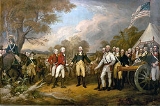
Daniel Morgan

Encyclopedia
Daniel Morgan was an American pioneer, soldier, and United States Representative from Virginia
. One of the most gifted battlefield tacticians of the American Revolutionary War
, he later commanded troops during the suppression of the Whiskey Rebellion
.
. All four of his grandparents
were Welsh
immigrants who lived in Pennsylvania. Morgan was the fifth of seven children of Joseph Morgan (1702–1748) and Elizabeth Lloyd (1706–1748). When Morgan was 16, he left home following a fight with his father. After working at odd jobs in Pennsylvania
, he moved to the Shenandoah Valley
. He finally settled on the Virginia frontier, near what is now Winchester, Virginia
.
Morgan was a large man, poorly educated, and enjoyed drinking and gambling. He worked clearing land, in a sawmill, and as a teamster
. In just a year, he saved enough to buy his own team. Morgan had served as a civilian teamster during the French and Indian War
. During the advance on Fort Duquesne
(Pittsburgh) by General Braddock
's command, he was punished with 499 lashes (a usually fatal sentence) for punching his superior officer. Morgan thus acquired a hatred for the British Army.
He later served as a rifleman in the Provincial forces assigned to protect the western border settlements from French-backed Indian raids. Some time after the end of the war, he purchased a farm situated between Winchester and Battletown. By 1774 he had grown so prosperous that he owned ten slaves. That year he served in Dunmore's War
taking part in raids on Shawnee
villages in the Ohio Country
.
in 1775, the Continental Congress
created the Continental Army
. They called for the formation of 10 rifle companies
from the middle colonies to support the Siege of Boston
, and late in June of 1775 Virginia agreed to send two. The Virginia House of Burgesses
chose Daniel Morgan to form one of these companies and serve as its commander with the rank of captain. Morgan had served as an officer in the Virginia Colonial Militia since the French and Indian War. He recruited 96 men in 10 days and assembled them at Winchester on July 14. He then marched them 600 miles (965.6 km) to Boston, Massachusetts in only 21 days, arriving on Aug. 6, 1775. He led this outstanding group of marksmen nicknamed "Morgan's Riflemen."
What set Morgans Riflemen apart from other companies was the technology they had with their rifles. They had rifled barrels with thin walls and curved grooves inside the barrels which made them light and much more accurate than the British muskets. Morgan used this advantage to initiate guerrilla tactics by which he first killed the Indian guides the British used to find their way through the rugged terrain and also to kill the British officers that led the troops. While this tactic was viewed as dishonorable by the British elites, it was in fact an extremely effective method that created chaos and discord for the British Army.
. Colonel Benedict Arnold
convinced General Washington to send an eastern offensive in support of Montgomery
's invasion. Washington agreed to send three rifle companies from among his forces at Boston, if they volunteered. All of the companies at Boston volunteered, so lotteries were used to choose who should go, and Morgan's company was among those chosen. Arnold selected Captain Morgan to lead all three companies as a unit. The expedition set out from Fort Western
on Sept. 25, with Morgan's men leading the advance party.
At the start, the Arnold Expedition had about 1,000 men, but by the time they arrived near Quebec on Nov. 9 it had been reduced to 600. (Note: historians have never reached a consensus on the use of a standard name for this epic journey.) When Montgomery arrived, they launched their disastrous assault, the Battle of Quebec
, on the morning of Dec. 31. The Patriots attacked in two thrusts, the two groups commanded by Montgomery and Arnold.
Arnold led the attack against the lower city from the north, but went down early with a bullet in his leg. Morgan took over leadership of this force, and they successfully entered the city following him over the first barricade. Montgomery's force was attempting to storm the wall, unfortunately in the midst of a terrible blizzard. Montgomery and most of the front line, with the exception of the young Aaron Burr
, were killed or wounded in the first volley. When Montgomery fell, his attack faltered, and the British General Carleton
led hundreds of local Quebec militia to encircle the second attack. He moved cannons and men to the first barricade, behind Morgan's force. Split up in the lower city, subject to fire from all sides, they were forced to surrender piecemeal. Shortly before surrendering, Morgan surrendered his sword to a local French priest, refusing to give it up before Carleton for a formal surrender, which Morgan viewed as humiliating to him. Morgan was among the 372 men captured. He remained a prisoner of war until exchanged in January 1777.
for his efforts at Quebec. He was assigned to raise and command a new infantry regiment, the 11th Virginia Regiment
of the Continental Line.
On June 13, 1777, Morgan was also placed in command of the Provisional Rifle Corps, a light infantry
unit of 500 riflemen selected primarily from Pennsylvania, Maryland and Virginia units of the main army. Many were drawn from his own permanent unit, the 11th Virginia Regiment. Washington assigned them to harass General William Howe
's rear guard, and Morgan followed and attacked them during their entire withdrawal across New Jersey
.
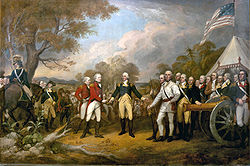 Morgan's regiment was reassigned to the army's Northern Department
and on Aug. 30 he joined General Horatio Gates
to aid in resisting Burgoyne's
offense. He is prominently depicted in the painting of the Surrender of General Burgoyne at Saratoga by John Trumbull
.
's 300-man New Hampshire
infantry, as the advance to the main forces. At Freeman's Farm, they ran into the advance of General Simon Fraser's wing of Burgoyne's force. Every officer in the British advance party died in the first exchange, and the advance guard retreated.
Morgan's men charged without orders, but the charge fell apart when they ran into the main column led by General Hamilton
. Benedict Arnold arrived, and he and Morgan managed to reform the unit. As the British began to form on the fields at Freeman's farm, Morgan's men continued to break these formations with accurate rifle fire from the woods on the far side of the field. They were joined by another seven regiments from Bemis Heights.
For the rest of the afternoon, American fire held the British in check, but repeated American charges were repelled by British bayonets.
Passing through the Canadian loyalists, Morgan's Virginia sharpshooters got the British light infantry trapped in a crossfire between themselves and Dearborn's regiment. Although the light infantry broke, General Fraser was trying to rally them, encouraging his men to hold their positions when Benedict Arnold arrived. Arnold spotted him and called to Morgan: "That man on the grey horse is a host unto himself and must be disposed of — direct the attention of some of the sharpshooters amongst your riflemen to him!" Morgan reluctantly ordered Fraser shot by a sniper, and Timothy Murphy obliged him.
With Fraser mortally wounded, the British light infantry fell back into and through the redoubt
s occupied by Burgoyne's main force. Morgan was one of those who then followed Arnold's lead to turn a counter-attack from the British middle. Burgoyne retired to his starting positions, but about 500 men poorer for the effort. That night, he withdrew to the village of Saratoga
(renamed Schuylerville
in honor of Philip Schuyler
) about eight miles to the northwest.
During the next week, as Burgoyne dug in, Morgan and his men moved to his north. Their ability to cut up any patrols sent in their direction convinced the British that retreat was not possible.
, but was not involved in any major battles. He was not involved in the Battle of Monmouth
but actively pursued the withdrawing British forces and captured many prisoners and supplies. When the Virginia Line was reorganized on Sept. 14, 1778, Morgan became the colonel of the 7th Virginia Regiment
.
Throughout this period, Morgan became increasingly dissatisfied with the army and the Congress. He had never been politically active or cultivated a relationship with the Congress. As a result, he was repeatedly passed over for promotion to brigadier
, favor going to men with less combat experience but better political connections. While still a colonel with Washington, he had temporarily commanded Weedon's brigade, and felt himself ready for the position. Besides this frustration, his legs and back aggravated him from the abuse taken during the Quebec Expedition. He was finally allowed to resign on June 30, 1779, and returned home to Winchester.
In June 1780, he was urged to re-enter the service by General Gates, but declined. Gates was taking command in the Southern Department, and Morgan felt that being outranked by so many militia officers would limit his usefulness. After Gates' disaster at the Battle of Camden
, Morgan thrust all other considerations aside, and went to join the Southern command at Hillsborough, North Carolina
.
Morgan met his new Department Commander, Nathanael Greene
, on Dec. 3, 1780 at Charlotte, North Carolina
. Greene did not change his command assignment, but did give him new orders. Greene had decided to split his army and annoy the enemy in order to buy time to rebuild his force. He gave Morgan's command of about 700 men the job of foraging and enemy harassment in the backcountry of South Carolina
, while avoiding direct battle.
When this strategy became apparent, the British General Cornwallis sent Colonel Banastre Tarleton
's British Legion to track him down. Morgan talked with many of the militia who had fought Tarleton before, and decided to disobey his orders, by setting up a direct confrontation.
 Morgan chose to make his stand at Cowpens, South Carolina
. On the morning of Jan. 17, 1781, they met Tarleton in the Battle of Cowpens
. Morgan had been joined by militia forces under Andrew Pickens
and William Washington
's dragoons. Tarleton's legion was supplemented with the light infantry from several regiments of regulars.
Morgan's plan took advantage of Tarleton's tendency for quick action and his disdain for the militia, as well as the longer range and accuracy of his Virginia riflemen. The marksmen were positioned to the front, followed by the militia, with the regulars at the hilltop. The first two units were to withdraw as soon as they were seriously threatened, but after inflicting damage. This would invite a premature charge from the British.
The tactic resulted in a double envelopment
. As the British forces approached, the Americans, with their backs turned to the British, reloaded their muskets. When the British got too close, they turned and fired at point-blank range in their faces. In less than an hour, Tarleton's 1,076 men suffered 110 killed and 830 captured. The captives included 200 wounded. Although Tarleton escaped, the Americans captured all his supplies and equipment, including the officers' slaves. Morgan's cunning plan at Cowpens is widely considered to be the tactical masterpiece of the war and one of the most successfully executed double envelopments of all of modern military history.
Cornwallis had lost not only Tarleton's legion, but also his light infantry, which limited his speed of reaction for the rest of the campaign. For his actions, Virginia gave Morgan land and an estate that had been abandoned by a Tory. The damp and chill of the campaign had aggravated his sciatica
to the point where he was in constant pain; on February 10, he returned to his Virginia farm. In July 1781, Morgan briefly joined Lafayette to pursue Banastre Tarleton once more, this time in Virginia, but they were unsuccessful.
, in 1782. He named the home Saratoga
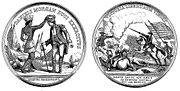
after his victory in New York. The Congress awarded him a gold medal in 1790 to commemorate his victory at Cowpens.
In 1794 he was briefly recalled to national service to help suppress the Whiskey Rebellion
. Serving under General "Light-Horse Harry" Lee, Morgan led one wing of the militia army into Western Pennsylvania
. The massive show of force brought an end to the protests without a shot being fired. After the uprising had been suppressed, Morgan commanded the remnant of the army that remained in Pennsylvania for a time.
Morgan ran for election to the United States House of Representatives
twice, as a Federalist. He lost in 1794, but won next time to serve a term from 1797 to 1799. He died in 1802 at his daughter's home in Winchester on his 66th birthday. Daniel Morgan was buried in Old Stone Presbyterian Church graveyard and moved to the Mt. Hebron Cemetery in Winchester
, after the Civil War
.
.
In 1821 Virginia named a new county—Morgan County
—in his honor. (It is now in West Virginia
.) The states of Alabama
, Georgia
, Illinois, Indiana
, Kentucky
, Missouri
, Ohio
, and Tennessee followed their example. The North Carolina city of Morganton
is also named after Morgan.
In 1881 (on the occasion of the hundredth anniversary of the Cowpens battle), a statue of Morgan was placed in the central town square of Spartanburg, South Carolina
. The square (Morgan Square) and statue remain today (see photo in Spartanburg article).
In the early 1950s, an attempt was made to remove his body to Cowpens
, but the Frederick-Winchester Historical Society blocked the move by securing an injunction in circuit court. The event was pictured by a staged photo that appeared in Life magazine
.
In 1973, the home Saratoga
was declared a National Historic Landmark
.
Morgan and his actions served as one of the key sources for the fictional character of Benjamin Martin
in The Patriot
, a motion picture released in 2000.
Virginia
The Commonwealth of Virginia , is a U.S. state on the Atlantic Coast of the Southern United States. Virginia is nicknamed the "Old Dominion" and sometimes the "Mother of Presidents" after the eight U.S. presidents born there...
. One of the most gifted battlefield tacticians of the American Revolutionary War
American Revolutionary War
The American Revolutionary War , the American War of Independence, or simply the Revolutionary War, began as a war between the Kingdom of Great Britain and thirteen British colonies in North America, and ended in a global war between several European great powers.The war was the result of the...
, he later commanded troops during the suppression of the Whiskey Rebellion
Whiskey Rebellion
The Whiskey Rebellion, or Whiskey Insurrection, was a tax protest in the United States in the 1790s, during the presidency of George Washington. Farmers who sold their corn in the form of whiskey had to pay a new tax which they strongly resented...
.
Early years
Most authorities believe that Morgan was born in Hunterdon County, New JerseyHunterdon County, New Jersey
Hunterdon County is a county located in the western section of the U.S. state of New Jersey. As of the 2010 United States Census, the population was 128,349. It is part of the New York Metropolitan Area. Its county seat is Flemington....
. All four of his grandparents
Edward Morgan Log House
The Edward Morgan Log House is a historic house built c. 1700. An early owner of the house, and possibly its builder, was the Welsh Quaker settler, Edward Morgan, the maternal grandfather of Daniel Boone. Despite Morgan's Welsh heritage, the house is built in a medieval Germanic style. It is...
were Welsh
Welsh people
The Welsh people are an ethnic group and nation associated with Wales and the Welsh language.John Davies argues that the origin of the "Welsh nation" can be traced to the late 4th and early 5th centuries, following the Roman departure from Britain, although Brythonic Celtic languages seem to have...
immigrants who lived in Pennsylvania. Morgan was the fifth of seven children of Joseph Morgan (1702–1748) and Elizabeth Lloyd (1706–1748). When Morgan was 16, he left home following a fight with his father. After working at odd jobs in Pennsylvania
Pennsylvania
The Commonwealth of Pennsylvania is a U.S. state that is located in the Northeastern and Mid-Atlantic regions of the United States. The state borders Delaware and Maryland to the south, West Virginia to the southwest, Ohio to the west, New York and Ontario, Canada, to the north, and New Jersey to...
, he moved to the Shenandoah Valley
Shenandoah Valley
The Shenandoah Valley is both a geographic valley and cultural region of western Virginia and West Virginia in the United States. The valley is bounded to the east by the Blue Ridge Mountains, to the west by the eastern front of the Ridge-and-Valley Appalachians , to the north by the Potomac River...
. He finally settled on the Virginia frontier, near what is now Winchester, Virginia
Winchester, Virginia
Winchester is an independent city located in the northwestern portion of the Commonwealth of Virginia in the USA. The city's population was 26,203 according to the 2010 Census...
.
Morgan was a large man, poorly educated, and enjoyed drinking and gambling. He worked clearing land, in a sawmill, and as a teamster
Teamster
A teamster, in modern American English, is a truck driver. The trade union named after them is the International Brotherhood of Teamsters , one of the largest unions in the United States....
. In just a year, he saved enough to buy his own team. Morgan had served as a civilian teamster during the French and Indian War
French and Indian War
The French and Indian War is the common American name for the war between Great Britain and France in North America from 1754 to 1763. In 1756, the war erupted into the world-wide conflict known as the Seven Years' War and thus came to be regarded as the North American theater of that war...
. During the advance on Fort Duquesne
Fort Duquesne
Fort Duquesne was a fort established by the French in 1754, at the junction of the Allegheny and Monongahela rivers in what is now downtown Pittsburgh in the state of Pennsylvania....
(Pittsburgh) by General Braddock
Edward Braddock
General Edward Braddock was a British soldier and commander-in-chief for the 13 colonies during the actions at the start of the French and Indian War...
's command, he was punished with 499 lashes (a usually fatal sentence) for punching his superior officer. Morgan thus acquired a hatred for the British Army.
He later served as a rifleman in the Provincial forces assigned to protect the western border settlements from French-backed Indian raids. Some time after the end of the war, he purchased a farm situated between Winchester and Battletown. By 1774 he had grown so prosperous that he owned ten slaves. That year he served in Dunmore's War
Dunmore's War
Dunmore's War was a war in 1774 between the Colony of Virginia and the Shawnee and Mingo American Indian nations....
taking part in raids on Shawnee
Shawnee
The Shawnee, Shaawanwaki, Shaawanooki and Shaawanowi lenaweeki, are an Algonquian-speaking people native to North America. Historically they inhabited the areas of Ohio, Virginia, West Virginia, Western Maryland, Kentucky, Indiana, and Pennsylvania...
villages in the Ohio Country
Ohio Country
The Ohio Country was the name used in the 18th century for the regions of North America west of the Appalachian Mountains and in the region of the upper Ohio River south of Lake Erie...
.
American Revolution
After the American Revolutionary War began at the Battles of Lexington and ConcordBattles of Lexington and Concord
The Battles of Lexington and Concord were the first military engagements of the American Revolutionary War. They were fought on April 19, 1775, in Middlesex County, Province of Massachusetts Bay, within the towns of Lexington, Concord, Lincoln, Menotomy , and Cambridge, near Boston...
in 1775, the Continental Congress
Continental Congress
The Continental Congress was a convention of delegates called together from the Thirteen Colonies that became the governing body of the United States during the American Revolution....
created the Continental Army
Continental Army
The Continental Army was formed after the outbreak of the American Revolutionary War by the colonies that became the United States of America. Established by a resolution of the Continental Congress on June 14, 1775, it was created to coordinate the military efforts of the Thirteen Colonies in...
. They called for the formation of 10 rifle companies
Company (military unit)
A company is a military unit, typically consisting of 80–225 soldiers and usually commanded by a Captain, Major or Commandant. Most companies are formed of three to five platoons although the exact number may vary by country, unit type, and structure...
from the middle colonies to support the Siege of Boston
Siege of Boston
The Siege of Boston was the opening phase of the American Revolutionary War, in which New England militiamen—who later became part of the Continental Army—surrounded the town of Boston, Massachusetts, to prevent movement by the British Army garrisoned within...
, and late in June of 1775 Virginia agreed to send two. The Virginia House of Burgesses
House of Burgesses
The House of Burgesses was the first assembly of elected representatives of English colonists in North America. The House was established by the Virginia Company, who created the body as part of an effort to encourage English craftsmen to settle in North America...
chose Daniel Morgan to form one of these companies and serve as its commander with the rank of captain. Morgan had served as an officer in the Virginia Colonial Militia since the French and Indian War. He recruited 96 men in 10 days and assembled them at Winchester on July 14. He then marched them 600 miles (965.6 km) to Boston, Massachusetts in only 21 days, arriving on Aug. 6, 1775. He led this outstanding group of marksmen nicknamed "Morgan's Riflemen."
What set Morgans Riflemen apart from other companies was the technology they had with their rifles. They had rifled barrels with thin walls and curved grooves inside the barrels which made them light and much more accurate than the British muskets. Morgan used this advantage to initiate guerrilla tactics by which he first killed the Indian guides the British used to find their way through the rugged terrain and also to kill the British officers that led the troops. While this tactic was viewed as dishonorable by the British elites, it was in fact an extremely effective method that created chaos and discord for the British Army.
The invasion of Canada
Later in 1775, Congress authorized an invasion of CanadaInvasion of Canada (1775)
The Invasion of Canada in 1775 was the first major military initiative by the newly formed Continental Army during the American Revolutionary War. The objective of the campaign was to gain military control of the British Province of Quebec, and convince the French-speaking Canadiens to join the...
. Colonel Benedict Arnold
Benedict Arnold
Benedict Arnold V was a general during the American Revolutionary War. He began the war in the Continental Army but later defected to the British Army. While a general on the American side, he obtained command of the fort at West Point, New York, and plotted to surrender it to the British forces...
convinced General Washington to send an eastern offensive in support of Montgomery
Richard Montgomery
Richard Montgomery was an Irish-born soldier who first served in the British Army. He later became a brigadier-general in the Continental Army during the American Revolutionary War and he is most famous for leading the failed 1775 invasion of Canada.Montgomery was born and raised in Ireland...
's invasion. Washington agreed to send three rifle companies from among his forces at Boston, if they volunteered. All of the companies at Boston volunteered, so lotteries were used to choose who should go, and Morgan's company was among those chosen. Arnold selected Captain Morgan to lead all three companies as a unit. The expedition set out from Fort Western
Fort Western
Fort Western was a colonial outpost at the head of navigation on the Kennebec River at modern Augusta, Maine, United States.It was built in 1754 by a Boston land company to promote settlement in the area. The fort was a log palisade with blockhouses which protected a store and warehouse. It was...
on Sept. 25, with Morgan's men leading the advance party.
At the start, the Arnold Expedition had about 1,000 men, but by the time they arrived near Quebec on Nov. 9 it had been reduced to 600. (Note: historians have never reached a consensus on the use of a standard name for this epic journey.) When Montgomery arrived, they launched their disastrous assault, the Battle of Quebec
Battle of Quebec (1775)
The Battle of Quebec was fought on December 31, 1775 between American Continental Army forces and the British defenders of the city of Quebec, early in the American Revolutionary War. The battle was the first major defeat of the war for the Americans, and it came at a high price...
, on the morning of Dec. 31. The Patriots attacked in two thrusts, the two groups commanded by Montgomery and Arnold.
Arnold led the attack against the lower city from the north, but went down early with a bullet in his leg. Morgan took over leadership of this force, and they successfully entered the city following him over the first barricade. Montgomery's force was attempting to storm the wall, unfortunately in the midst of a terrible blizzard. Montgomery and most of the front line, with the exception of the young Aaron Burr
Aaron Burr
Aaron Burr, Jr. was an important political figure in the early history of the United States of America. After serving as a Continental Army officer in the Revolutionary War, Burr became a successful lawyer and politician...
, were killed or wounded in the first volley. When Montgomery fell, his attack faltered, and the British General Carleton
Guy Carleton, 1st Baron Dorchester
Guy Carleton, 1st Baron Dorchester, KB , known between 1776 and 1786 as Sir Guy Carleton, was an Irish-British soldier and administrator...
led hundreds of local Quebec militia to encircle the second attack. He moved cannons and men to the first barricade, behind Morgan's force. Split up in the lower city, subject to fire from all sides, they were forced to surrender piecemeal. Shortly before surrendering, Morgan surrendered his sword to a local French priest, refusing to give it up before Carleton for a formal surrender, which Morgan viewed as humiliating to him. Morgan was among the 372 men captured. He remained a prisoner of war until exchanged in January 1777.
11th Virginia Regiment
When he rejoined Washington early in 1777, Morgan was surprised to learn that he had been promoted to colonelColonel
Colonel , abbreviated Col or COL, is a military rank of a senior commissioned officer. It or a corresponding rank exists in most armies and in many air forces; the naval equivalent rank is generally "Captain". It is also used in some police forces and other paramilitary rank structures...
for his efforts at Quebec. He was assigned to raise and command a new infantry regiment, the 11th Virginia Regiment
11th Virginia Regiment
The 11th Virginia Regiment was a Continental Army regiment that fought in the American Revolutionary War.Authorized by the Second Continental Congress on 16 September 1776, it was organized on 3 February 1777 and consisted of four companies from the Virginia counties of Loudoun, Frederick, Prince...
of the Continental Line.
On June 13, 1777, Morgan was also placed in command of the Provisional Rifle Corps, a light infantry
Light infantry
Traditionally light infantry were soldiers whose job was to provide a skirmishing screen ahead of the main body of infantry, harassing and delaying the enemy advance. Light infantry was distinct from medium, heavy or line infantry. Heavy infantry were dedicated primarily to fighting in tight...
unit of 500 riflemen selected primarily from Pennsylvania, Maryland and Virginia units of the main army. Many were drawn from his own permanent unit, the 11th Virginia Regiment. Washington assigned them to harass General William Howe
William Howe, 5th Viscount Howe
William Howe, 5th Viscount Howe, KB, PC was a British army officer who rose to become Commander-in-Chief of British forces during the American War of Independence...
's rear guard, and Morgan followed and attacked them during their entire withdrawal across New Jersey
New Jersey
New Jersey is a state in the Northeastern and Middle Atlantic regions of the United States. , its population was 8,791,894. It is bordered on the north and east by the state of New York, on the southeast and south by the Atlantic Ocean, on the west by Pennsylvania and on the southwest by Delaware...
.
Saratoga
Continental Army
The Continental Army was formed after the outbreak of the American Revolutionary War by the colonies that became the United States of America. Established by a resolution of the Continental Congress on June 14, 1775, it was created to coordinate the military efforts of the Thirteen Colonies in...
and on Aug. 30 he joined General Horatio Gates
Horatio Gates
Horatio Lloyd Gates was a retired British soldier who served as an American general during the Revolutionary War. He took credit for the American victory at the Battle of Saratoga – Benedict Arnold, who led the attack, was finally forced from the field when he was shot in the leg – and...
to aid in resisting Burgoyne's
John Burgoyne
General John Burgoyne was a British army officer, politician and dramatist. He first saw action during the Seven Years' War when he participated in several battles, mostly notably during the Portugal Campaign of 1762....
offense. He is prominently depicted in the painting of the Surrender of General Burgoyne at Saratoga by John Trumbull
John Trumbull
John Trumbull was an American artist during the period of the American Revolutionary War and was notable for his historical paintings...
.
Freeman's Farm
Morgan led his regiment, with the added support of Henry DearbornHenry Dearborn
Henry Dearborn was an American physician, a statesman and a veteran of both the American Revolutionary War and the War of 1812. Born to Simon Dearborn and Sarah Marston in North Hampton, New Hampshire, he spent much of his youth in Epping, where he attended public schools...
's 300-man New Hampshire
New Hampshire
New Hampshire is a state in the New England region of the northeastern United States of America. The state was named after the southern English county of Hampshire. It is bordered by Massachusetts to the south, Vermont to the west, Maine and the Atlantic Ocean to the east, and the Canadian...
infantry, as the advance to the main forces. At Freeman's Farm, they ran into the advance of General Simon Fraser's wing of Burgoyne's force. Every officer in the British advance party died in the first exchange, and the advance guard retreated.
Morgan's men charged without orders, but the charge fell apart when they ran into the main column led by General Hamilton
James Inglis Hamilton
General James Inglis Hamilton, was a Scottish soldier. He enlisted the British Army in 1755 and he commanded several regiments. He was the only colonel of the 113th Regiment of Foot...
. Benedict Arnold arrived, and he and Morgan managed to reform the unit. As the British began to form on the fields at Freeman's farm, Morgan's men continued to break these formations with accurate rifle fire from the woods on the far side of the field. They were joined by another seven regiments from Bemis Heights.
For the rest of the afternoon, American fire held the British in check, but repeated American charges were repelled by British bayonets.
Bemis Heights
Burgoyne's next offensive resulted in the Battle of Bemis Heights on Oct. 7. Morgan was assigned command of the left (or western) flank of the American position. The British plan was to turn that flank, using an advance by 1,500 men. This brought Morgan's brigade once again up against General Fraser's forces.Passing through the Canadian loyalists, Morgan's Virginia sharpshooters got the British light infantry trapped in a crossfire between themselves and Dearborn's regiment. Although the light infantry broke, General Fraser was trying to rally them, encouraging his men to hold their positions when Benedict Arnold arrived. Arnold spotted him and called to Morgan: "That man on the grey horse is a host unto himself and must be disposed of — direct the attention of some of the sharpshooters amongst your riflemen to him!" Morgan reluctantly ordered Fraser shot by a sniper, and Timothy Murphy obliged him.
With Fraser mortally wounded, the British light infantry fell back into and through the redoubt
Redoubt
A redoubt is a fort or fort system usually consisting of an enclosed defensive emplacement outside a larger fort, usually relying on earthworks, though others are constructed of stone or brick. It is meant to protect soldiers outside the main defensive line and can be a permanent structure or a...
s occupied by Burgoyne's main force. Morgan was one of those who then followed Arnold's lead to turn a counter-attack from the British middle. Burgoyne retired to his starting positions, but about 500 men poorer for the effort. That night, he withdrew to the village of Saratoga
Saratoga, New York
Saratoga is a town in Saratoga County, New York, United States. The population was 5,141 at the 2000 census. It is also the commonly used, but not official, name for the neighboring and much more populous city, Saratoga Springs. The major village in the town of Saratoga is Schuylerville which is...
(renamed Schuylerville
Schuylerville, New York
Schuylerville is a village in Saratoga County, New York, United States. The population was 1,197 at the 2000 census. The village is named after the Schuyler family....
in honor of Philip Schuyler
Philip Schuyler
Philip John Schuyler was a general in the American Revolution and a United States Senator from New York. He is usually known as Philip Schuyler, while his son is usually known as Philip J. Schuyler.-Early life:...
) about eight miles to the northwest.
During the next week, as Burgoyne dug in, Morgan and his men moved to his north. Their ability to cut up any patrols sent in their direction convinced the British that retreat was not possible.
New Jersey and retirement
After Saratoga, Morgan's unit rejoined Washington's main army, near Philadelphia. Throughout 1778 he hit British columns and supply lines in New JerseyNew Jersey
New Jersey is a state in the Northeastern and Middle Atlantic regions of the United States. , its population was 8,791,894. It is bordered on the north and east by the state of New York, on the southeast and south by the Atlantic Ocean, on the west by Pennsylvania and on the southwest by Delaware...
, but was not involved in any major battles. He was not involved in the Battle of Monmouth
Battle of Monmouth
The Battle of Monmouth was an American Revolutionary War battle fought on June 28, 1778 in Monmouth County, New Jersey. The Continental Army under General George Washington attacked the rear of the British Army column commanded by Lieutenant General Sir Henry Clinton as they left Monmouth Court...
but actively pursued the withdrawing British forces and captured many prisoners and supplies. When the Virginia Line was reorganized on Sept. 14, 1778, Morgan became the colonel of the 7th Virginia Regiment
7th Virginia Regiment
The 7th Virginia Regiment was raised on January 11, 1776 at Gloucester, Virginia for service with the Continental Army. The regiment would see action at the Battle of Brandywine, Battle of Germantown , Battle of Monmouth and the Siege of Charleston...
.
Throughout this period, Morgan became increasingly dissatisfied with the army and the Congress. He had never been politically active or cultivated a relationship with the Congress. As a result, he was repeatedly passed over for promotion to brigadier
Brigadier
Brigadier is a senior military rank, the meaning of which is somewhat different in different military services. The brigadier rank is generally superior to the rank of colonel, and subordinate to major general....
, favor going to men with less combat experience but better political connections. While still a colonel with Washington, he had temporarily commanded Weedon's brigade, and felt himself ready for the position. Besides this frustration, his legs and back aggravated him from the abuse taken during the Quebec Expedition. He was finally allowed to resign on June 30, 1779, and returned home to Winchester.
In June 1780, he was urged to re-enter the service by General Gates, but declined. Gates was taking command in the Southern Department, and Morgan felt that being outranked by so many militia officers would limit his usefulness. After Gates' disaster at the Battle of Camden
Battle of Camden
The Battle of Camden was a major victory for the British in the Southern theater of the American Revolutionary War...
, Morgan thrust all other considerations aside, and went to join the Southern command at Hillsborough, North Carolina
Hillsborough, North Carolina
Hillsborough is a town in Orange County, North Carolina, United States. The population was 5,653 at the 2008 census. It is the county seat of Orange County....
.
The Southern Campaign
He met Gates at Hillsborough, and was given command of the light infantry corps on Oct. 2. At last, on Oct. 13, 1780, Morgan received his promotion to Brigadier General.Morgan met his new Department Commander, Nathanael Greene
Nathanael Greene
Nathanael Greene was a major general of the Continental Army in the American Revolutionary War. When the war began, Greene was a militia private, the lowest rank possible; he emerged from the war with a reputation as George Washington's most gifted and dependable officer. Many places in the United...
, on Dec. 3, 1780 at Charlotte, North Carolina
Charlotte, North Carolina
Charlotte is the largest city in the U.S. state of North Carolina and the seat of Mecklenburg County. In 2010, Charlotte's population according to the US Census Bureau was 731,424, making it the 17th largest city in the United States based on population. The Charlotte metropolitan area had a 2009...
. Greene did not change his command assignment, but did give him new orders. Greene had decided to split his army and annoy the enemy in order to buy time to rebuild his force. He gave Morgan's command of about 700 men the job of foraging and enemy harassment in the backcountry of South Carolina
South Carolina
South Carolina is a state in the Deep South of the United States that borders Georgia to the south, North Carolina to the north, and the Atlantic Ocean to the east. Originally part of the Province of Carolina, the Province of South Carolina was one of the 13 colonies that declared independence...
, while avoiding direct battle.
When this strategy became apparent, the British General Cornwallis sent Colonel Banastre Tarleton
Banastre Tarleton
General Sir Banastre Tarleton, 1st Baronet, GCB was a British soldier and politician.He is today probably best remembered for his military service during the American War of Independence. He became the focal point of a propaganda campaign claiming that he had fired upon surrendering Continental...
's British Legion to track him down. Morgan talked with many of the militia who had fought Tarleton before, and decided to disobey his orders, by setting up a direct confrontation.
The Battle of Cowpens
Cowpens, South Carolina
Cowpens is a town in Spartanburg County, South Carolina, United States. The population was 2,162 at the 2010 census.-Geography:Cowpens is located at ....
. On the morning of Jan. 17, 1781, they met Tarleton in the Battle of Cowpens
Battle of Cowpens
The Battle of Cowpens was a decisive victory by Patriot Revolutionary forces under Brigadier General Daniel Morgan, in the Southern campaign of the American Revolutionary War...
. Morgan had been joined by militia forces under Andrew Pickens
Andrew Pickens (congressman)
Andrew Pickens was a militia leader in the American Revolution and a member of the United States House of Representatives from South Carolina.-Early life:...
and William Washington
William Washington
William Washington , was an officer of the Continental Army during the American Revolutionary War, who held a final rank of Brigadier General in the newly created United States after the war...
's dragoons. Tarleton's legion was supplemented with the light infantry from several regiments of regulars.
Morgan's plan took advantage of Tarleton's tendency for quick action and his disdain for the militia, as well as the longer range and accuracy of his Virginia riflemen. The marksmen were positioned to the front, followed by the militia, with the regulars at the hilltop. The first two units were to withdraw as soon as they were seriously threatened, but after inflicting damage. This would invite a premature charge from the British.
The tactic resulted in a double envelopment
Pincer movement
The pincer movement or double envelopment is a military maneuver. The flanks of the opponent are attacked simultaneously in a pinching motion after the opponent has advanced towards the center of an army which is responding by moving its outside forces to the enemy's flanks, in order to surround it...
. As the British forces approached, the Americans, with their backs turned to the British, reloaded their muskets. When the British got too close, they turned and fired at point-blank range in their faces. In less than an hour, Tarleton's 1,076 men suffered 110 killed and 830 captured. The captives included 200 wounded. Although Tarleton escaped, the Americans captured all his supplies and equipment, including the officers' slaves. Morgan's cunning plan at Cowpens is widely considered to be the tactical masterpiece of the war and one of the most successfully executed double envelopments of all of modern military history.
Cornwallis had lost not only Tarleton's legion, but also his light infantry, which limited his speed of reaction for the rest of the campaign. For his actions, Virginia gave Morgan land and an estate that had been abandoned by a Tory. The damp and chill of the campaign had aggravated his sciatica
Sciatica
Sciatica is a set of symptoms including pain that may be caused by general compression or irritation of one of five spinal nerve roots that give rise to each sciatic nerve, or by compression or irritation of the left or right or both sciatic nerves. The pain is felt in the lower back, buttock, or...
to the point where he was in constant pain; on February 10, he returned to his Virginia farm. In July 1781, Morgan briefly joined Lafayette to pursue Banastre Tarleton once more, this time in Virginia, but they were unsuccessful.
After the Revolution
After Morgan returned home to Charles Town, he became gradually less active. He turned his attention to investing in land, rather than clearing it, and eventually built an estate of over 250000 acre. As part of his settling down, he joined the Presbyterian Church and built a new house near Winchester, VirginiaWinchester, Virginia
Winchester is an independent city located in the northwestern portion of the Commonwealth of Virginia in the USA. The city's population was 26,203 according to the 2010 Census...
, in 1782. He named the home Saratoga
Saratoga (Boyce, Virginia)
Saratoga, also known as the General Daniel Morgan House, is a home near Boyce, Virginia. It is a gray limestone Georgian house built by Brig. Gen. Daniel Morgan, best known for his victory over the British at the Battle of Cowpens in 1781...
after his victory in New York. The Congress awarded him a gold medal in 1790 to commemorate his victory at Cowpens.
In 1794 he was briefly recalled to national service to help suppress the Whiskey Rebellion
Whiskey Rebellion
The Whiskey Rebellion, or Whiskey Insurrection, was a tax protest in the United States in the 1790s, during the presidency of George Washington. Farmers who sold their corn in the form of whiskey had to pay a new tax which they strongly resented...
. Serving under General "Light-Horse Harry" Lee, Morgan led one wing of the militia army into Western Pennsylvania
Western Pennsylvania
Western Pennsylvania consists of the western third of the state of Pennsylvania in the United States. Pittsburgh is the largest city in the region, with a metropolitan area population of about 2.4 million people, and serves as its economic and cultural center. Erie, Altoona, and Johnstown are its...
. The massive show of force brought an end to the protests without a shot being fired. After the uprising had been suppressed, Morgan commanded the remnant of the army that remained in Pennsylvania for a time.
Morgan ran for election to the United States House of Representatives
United States House of Representatives
The United States House of Representatives is one of the two Houses of the United States Congress, the bicameral legislature which also includes the Senate.The composition and powers of the House are established in Article One of the Constitution...
twice, as a Federalist. He lost in 1794, but won next time to serve a term from 1797 to 1799. He died in 1802 at his daughter's home in Winchester on his 66th birthday. Daniel Morgan was buried in Old Stone Presbyterian Church graveyard and moved to the Mt. Hebron Cemetery in Winchester
Winchester, Virginia
Winchester is an independent city located in the northwestern portion of the Commonwealth of Virginia in the USA. The city's population was 26,203 according to the 2010 Census...
, after the Civil War
American Civil War
The American Civil War was a civil war fought in the United States of America. In response to the election of Abraham Lincoln as President of the United States, 11 southern slave states declared their secession from the United States and formed the Confederate States of America ; the other 25...
.
Legacy
Daniel Morgan's great-great-grandfather was also the uncle of the famous Welsh privateer and pirate, Henry MorganHenry Morgan
Admiral Sir Henry Morgan was an Admiral of the Royal Navy, a privateer, and a pirate who made a name for himself during activities in the Caribbean, primarily raiding Spanish settlements...
.
In 1821 Virginia named a new county—Morgan County
Morgan County, West Virginia
Morgan County is a county located in the U.S. state of West Virginia. As of 2010, it's population was 17,541. Its county seat is Berkeley Springs. The county is one of three in Hagerstown-Martinsburg, MD-WV Metropolitan Statistical Area...
—in his honor. (It is now in West Virginia
West Virginia
West Virginia is a state in the Appalachian and Southeastern regions of the United States, bordered by Virginia to the southeast, Kentucky to the southwest, Ohio to the northwest, Pennsylvania to the northeast and Maryland to the east...
.) The states of Alabama
Morgan County, Alabama
Morgan County is the most populous county in the Decatur Metropolitan Area, and the second most populous county in the Huntsville-Decatur Combined Statistical Area in the U.S. State of Alabama. It was created by the Alabama Territorial legislature on February 6, 1818 from land acquired from the...
, Georgia
Morgan County, Georgia
Morgan County is a county located in the U.S. state of Georgia. As of 2000, the population was 15,457. The 2005 Census Estimate shows a population of 17,492. The county seat is Madison, Georgia.-Geography:...
, Illinois, Indiana
Morgan County, Indiana
Morgan County is a county located in the U.S. state of Indiana. As of 2010, the population was 68,894. The county seat is Martinsville. Morgan is one of seven counties contiguous to Marion County, and is located between Indianapolis, in Marion County, and Bloomington, located in Monroe County...
, Kentucky
Morgan County, Kentucky
Morgan County is a county located in the U.S. state of Kentucky. As of 2000, the population was 13,948. Its county seat is West Liberty. The county is among the dry counties, which means that the sale of alcohol is restricted or prohibited.- Geography :...
, Missouri
Morgan County, Missouri
Morgan County is a county located in the U.S. state of Missouri. As of July 2007, the population was 20,820. Its county seat is Versailles.-History :...
, Ohio
Morgan County, Ohio
**----...
, and Tennessee followed their example. The North Carolina city of Morganton
Morganton, North Carolina
Morganton is a city in Burke County, North Carolina, United States. Reader's Digest included Morganton in its list of top ten places to raise a family. The town was recently profiled in The 50 Best Small Southern Towns. The population was 17,310 at the 2000 census...
is also named after Morgan.
In 1881 (on the occasion of the hundredth anniversary of the Cowpens battle), a statue of Morgan was placed in the central town square of Spartanburg, South Carolina
Spartanburg, South Carolina
thgSpartanburg is the largest city in and the county seat of Spartanburg County, South Carolina, United States. It is the second-largest city of the three primary cities in the Upstate region of South Carolina, and is located northwest of Columbia, west of Charlotte, and about northeast of...
. The square (Morgan Square) and statue remain today (see photo in Spartanburg article).
In the early 1950s, an attempt was made to remove his body to Cowpens
Cowpens, South Carolina
Cowpens is a town in Spartanburg County, South Carolina, United States. The population was 2,162 at the 2010 census.-Geography:Cowpens is located at ....
, but the Frederick-Winchester Historical Society blocked the move by securing an injunction in circuit court. The event was pictured by a staged photo that appeared in Life magazine
Life (magazine)
Life generally refers to three American magazines:*A humor and general interest magazine published from 1883 to 1936. Time founder Henry Luce bought the magazine in 1936 solely so that he could acquire the rights to its name....
.
In 1973, the home Saratoga
Saratoga (Boyce, Virginia)
Saratoga, also known as the General Daniel Morgan House, is a home near Boyce, Virginia. It is a gray limestone Georgian house built by Brig. Gen. Daniel Morgan, best known for his victory over the British at the Battle of Cowpens in 1781...
was declared a National Historic Landmark
National Historic Landmark
A National Historic Landmark is a building, site, structure, object, or district, that is officially recognized by the United States government for its historical significance...
.
Morgan and his actions served as one of the key sources for the fictional character of Benjamin Martin
Benjamin Martin
Benjamin Martin was a lexicographer who compiled one of the early English dictionaries, the Lingua Britannica Reformata . He also was a lecturer on science and maker of scientific instruments.-Life:...
in The Patriot
The Patriot (2000 film)
The Patriot is a 2000 historical war film directed by Roland Emmerich, written by Robert Rodat, and starring Mel Gibson, Chris Cooper, and Heath Ledger. It was produced by the Mutual Film Company and Centropolis Entertainment and was distributed by Columbia Pictures...
, a motion picture released in 2000.
Further reading
- Bodie, Idella. The Old Waggoner (Juvenile nonfiction). Sandlapper Publishing, 2000. ISBN 0-87844-165-4
- Calahan, North. Daniel Morgan: Ranger of the Revolution. AMS Press, 1961; ISBN 0-404-09017-6
- Graham, James The Life of General Daniel Morgan of the Virginia Line of the Army of the United States: with portions of his correspondence. Zebrowski Historical Publishing, 1859; ISBN 1-880484-06-4
- Higginbotham, DonDon HigginbothamDon Higginbotham was an American historian and Dowd Professor of History and Peace, War, and Defense at the University of North Carolina at Chapel Hill. A leading scholar of George Washington, he was a pioneering practitioner of the “new” military history and an expert on colonial and...
. Daniel Morgan: Revolutionary Rifleman. University of North Carolina Press, 1961. ISBN 0-8078-1386-9