
All Topics  
Siege of Boston

 
Siege of Boston

   Email Print
   Bookmark   Link


Siege of Boston


} |- | |}

The Siege of Boston (April 19, 1775 – March 17, 1776) was the opening phase of the American Revolutionary War
American Revolutionary War

The American Revolutionary War , also known as the American War of Independence, began as a war between the Kingdom of Great Britain and Thirteen Colonies on the North America, and ended in a global war between several European great powers....
, in which New England
New England

New England is a region of the United States located in the northeastern corner of the country, bounded by the Atlantic Ocean, Canada and New York State, and consisting of the modern U.S....
 militiamen—who later became part of the Continental Army
Continental Army

The American Continental Army was an army formed after the outbreak of the American Revolutionary War by the colonies that became the United States. Established by a resolution of the Continental Congress on June 15, 1775, the army was created to coordinate the military efforts of the Thirteen Colonies in their struggle against the rule of Kingdom...
—surrounded the town of Boston, Massachusetts
Boston, Massachusetts

Boston is the State capital and largest city of the Commonwealth of Massachusetts, and is one of the oldest cities in the United States. The largest city in New England, Boston is considered the economic and cultural center of the region, and is sometimes regarded as the unofficial "Capital of New England." Boston city proper had a 2007 est...
, to prevent movement by the British Army
British Army

The British Army is the Army branch of the British Armed Forces. It came into being with the unification of the Kingdoms of Kingdom of England and Kingdom of Scotland into the Kingdom of Great Britain in 1707....
 garrison
Garrison

Garrison is the collective term for a body of troops stationed in a particular location, originally to guard it, of more than 50 men, but now often simply using it as a home base....
ed within. The Americans, led by George Washington
George Washington

George Washington was the leader of the Continental Army in the American Revolutionary War and served as the List of Presidents of the United States President of the United States of the United States of Americas ....
, eventually forced the British to withdraw from the town after an 11-month siege. It was the longest single conflict of the war.

The siege began on April 19 after the battles of Lexington and Concord
Battles of Lexington and Concord

The Battles of Lexington and Concord were the first military engagements of the American Revolutionary War. They were fought on April 19, 1775, in Middlesex County, Massachusetts, Province of Massachusetts Bay, within the towns of Lexington, Massachusetts, Concord, Massachusetts, Lincoln, Massachusetts, Arlington, Massachusetts, and Cambridge...
, when the militia from many Massachusetts communities surrounded Boston and blocked land access to the then-peninsula
Peninsula

A peninsula is a piece of Landform that is nearly surrounded by water but connected to mainland via an isthmus. Word origin: Latin paeninsula : paene, almost + insula, island....
r town, limiting British resupply to naval operations.


Discussion
Ask a question about 'Siege of Boston'
Start a new discussion about 'Siege of Boston'
Answer questions from other users
Full Discussion Forum


Recent Posts


Encyclopedia


} |- | |}

The Siege of Boston (April 19, 1775 – March 17, 1776) was the opening phase of the American Revolutionary War
American Revolutionary War

The American Revolutionary War , also known as the American War of Independence, began as a war between the Kingdom of Great Britain and Thirteen Colonies on the North America, and ended in a global war between several European great powers....
, in which New England
New England

New England is a region of the United States located in the northeastern corner of the country, bounded by the Atlantic Ocean, Canada and New York State, and consisting of the modern U.S....
 militiamen—who later became part of the Continental Army
Continental Army

The American Continental Army was an army formed after the outbreak of the American Revolutionary War by the colonies that became the United States. Established by a resolution of the Continental Congress on June 15, 1775, the army was created to coordinate the military efforts of the Thirteen Colonies in their struggle against the rule of Kingdom...
—surrounded the town of Boston, Massachusetts
Boston, Massachusetts

Boston is the State capital and largest city of the Commonwealth of Massachusetts, and is one of the oldest cities in the United States. The largest city in New England, Boston is considered the economic and cultural center of the region, and is sometimes regarded as the unofficial "Capital of New England." Boston city proper had a 2007 est...
, to prevent movement by the British Army
British Army

The British Army is the Army branch of the British Armed Forces. It came into being with the unification of the Kingdoms of Kingdom of England and Kingdom of Scotland into the Kingdom of Great Britain in 1707....
 garrison
Garrison

Garrison is the collective term for a body of troops stationed in a particular location, originally to guard it, of more than 50 men, but now often simply using it as a home base....
ed within. The Americans, led by George Washington
George Washington

George Washington was the leader of the Continental Army in the American Revolutionary War and served as the List of Presidents of the United States President of the United States of the United States of Americas ....
, eventually forced the British to withdraw from the town after an 11-month siege. It was the longest single conflict of the war.

The siege began on April 19 after the battles of Lexington and Concord
Battles of Lexington and Concord

The Battles of Lexington and Concord were the first military engagements of the American Revolutionary War. They were fought on April 19, 1775, in Middlesex County, Massachusetts, Province of Massachusetts Bay, within the towns of Lexington, Massachusetts, Concord, Massachusetts, Lincoln, Massachusetts, Arlington, Massachusetts, and Cambridge...
, when the militia from many Massachusetts communities surrounded Boston and blocked land access to the then-peninsula
Peninsula

A peninsula is a piece of Landform that is nearly surrounded by water but connected to mainland via an isthmus. Word origin: Latin paeninsula : paene, almost + insula, island....
r town, limiting British resupply to naval operations. The Continental Congress
Continental Congress

The Continental Congress was a convention of delegates from the Thirteen Colonies that became the governing body of the United States during the American Revolution....
 chose to adopt the militia and form the Continental Army, and unanimously elected George Washington as its Commander in Chief. In June 1775, the British seized Bunker and Breeds Hills
Battle of Bunker Hill

The Battle of Bunker Hill took place on June 17, 1775 on Breed's Hill, as part of the Siege of Boston during the American Revolutionary War. General Israel Putnam was in charge of the revolutionary forces, while Major-General William Howe, 5th Viscount Howe commanded the Kingdom of Great Britain forces....
, but the casualties they suffered were so heavy that they could not break the siege. For the rest of the siege, there was little action other than occasional raids, minor skirmishes, and sniper fire. Both sides had to deal with resource supply and personnel issues over the course of the siege.

In November 1775, General Washington sent a 25 year-old bookseller-turned-soldier named Henry Knox
Henry Knox

Henry Knox was an United States bookseller from Boston, Massachusetts who became the chief artillery officer of the Continental Army and later the nation's first United States Secretary of War....
 to bring heavy artillery that had been captured at Fort Ticonderoga
Capture of Fort Ticonderoga

On May 10, 1775, Fort Ticonderoga was captured by a small force of American Patriot s led by Ethan Allen and Colonel Benedict Arnold. They surprised and captured, without significant injury or incident, the small Kingdom of Great Britain garrison at Fort Ticonderoga, and looted the personal belongings of the garrison and its hangers-on....
 to Boston. In a technically complex and demanding operation, Knox brought many cannons to the Boston area in January 1776. In March 1776, these artillery were used to fortify Dorchester Heights
Fortification of Dorchester Heights

The Fortification of Dorchester Heights was a decisive action early in the American Revolutionary War that precipitated the end of the siege of Boston and the withdrawal of British troops from that city....
, overlooking Boston and its harbor and threatening the British naval supply lifeline. The British commander William Howe
William Howe, 5th Viscount Howe

William Howe, 5th Viscount Howe, Order of the Bath, Privy Council of Great Britain was a United Kingdom General who was Commander-in-Chief of British forces during the American Revolutionary War, one of the three Howe brothers....
, realizing he could no longer hold the town, chose to evacuate it. He withdrew the British forces, departing on March 17 (celebrated today as Evacuation Day
Evacuation Day

Evacuation Day refers to the date of evacuation of the Military of the United Kingdom from American cities in the American Revolutionary War. It also refers to the evacuation of French troops from the Middle East after World War II....
) for Halifax, Nova Scotia.

Background

Prior to 1775, the British had imposed taxes and import duties on the American colonies, to which the colonists objected, since they lacked representation in the British Parliament. In response to the Boston Tea Party
Boston Tea Party

The Boston Tea Party was an act of direct action protest by the American colonists against the Kingdom of Great Britain in which they destroyed many crates of tea belonging to the British East India Company and dumped it into the Boston Harbor....
 and other acts of protest, 4,000 British troops under the leadership of General Thomas Gage
Thomas Gage

Thomas Gage was a Great Britain general, best known for his role in the early days of the American Revolution.Born to a noble family in England, he entered military service, seeing action in the French and Indian War, where he served alongside a future opponent, George Washington....
 were sent to occupy the city of Boston and to pacify the restive Province of Massachusetts Bay
Province of Massachusetts Bay

The Province of Massachusetts Bay was a British overseas territories chartered October 7, 1691 in North America by William and Mary, the joint monarchs of the Kingdom of England and the Kingdom of Scotland....
. Gage, among other actions authorized by the British parliament
Parliament of Great Britain

The Parliament of Great Britain was formed in 1707 following the ratification of the Act of Union 1707 by both the Parliament of England and Parliament of Scotland....
 in the so-called Intolerable Acts
Intolerable Acts

The Intolerable Acts or the Coercive Acts are names used to describe a series of laws passed by the Parliament of Great Britain in 1774 relating to Britain's colonies in North America....
, disbanded the local provincial government (led by John Hancock
John Hancock

John Hancock was a merchant, statesman, and prominent Patriot of the American Revolution. He served as President of the Continental Congress of the Second Continental Congress and was the first Governor of Massachusetts of the Massachusetts....
 and Samuel Adams
Samuel Adams

Samuel Adams was a statesman, Political philosophy, and one of the Founding Fathers of the United States. As a politician in Province of Massachusetts Bay, Adams was a leader of the movement that became the American Revolution, and was one of the architects of the principles of Republicanism in the United States that shaped the political cul...
), which reformed itself into a Provincial Congress
Massachusetts Provincial Congress

The Massachusetts Provincial Congress was a provisional government created in the Province of Massachusetts Bay early in the American Revolution....
, and continued to meet. The Provincial Congress called for the organization of local militias and coordinated the accumulation of weapons and other military supplies. Under the terms of the Boston Port Act
Boston Port Act

The Boston Port Act is an Act of Parliament of the Parliament of Great Britain which became law on March 30, 1774, and is one of the measures that were designed to secure Great Britain's jurisdictions over her Colonial American dominions....
, Gage closed the Boston port, which caused much unemployment and discontent.

When British forces were sent to take military supplies from the town of Concord
Concord, Massachusetts

Concord is a town in Middlesex County, Massachusetts, Massachusetts, in the United States. As of the 2000 Census, the town population was about 17,000....
 on April 19, 1775, militia companies from surrounding towns opposed them in the Battles of Lexington and Concord
Battles of Lexington and Concord

The Battles of Lexington and Concord were the first military engagements of the American Revolutionary War. They were fought on April 19, 1775, in Middlesex County, Massachusetts, Province of Massachusetts Bay, within the towns of Lexington, Massachusetts, Concord, Massachusetts, Lincoln, Massachusetts, Arlington, Massachusetts, and Cambridge...
. At Concord, some of the British forces were routed in a confrontation at the North Bridge
Old North Bridge, Concord, Massachusetts

The North Bridge, often colloquially called the Old North Bridge, across the Concord River in Concord, Massachusetts, is a historical site in the Battles of Lexington and Concord, the first battle day in the Revolutionary War....
. The British troops were again attacked in a running battle on their return to Boston, suffering heavy casualties. All of the New England
New England

New England is a region of the United States located in the northeastern corner of the country, bounded by the Atlantic Ocean, Canada and New York State, and consisting of the modern U.S....
 colonies (and later colonies further south) raised militias in response to this alarm, and sent them to Boston.

Siege

Lexington Concord Siege of Boston

Digging in

In the immediate aftermath of the battles of the 19th, the Massachusetts militia
Massachusetts militia

Militia of the Colony and later Commonwealth of Massachusetts....
, under the loose leadership of William Heath
William Heath

William Heath was an American farmer, soldier, and political leader from Massachusetts who served as a major general in the Continental Army during the American Revolutionary War....
, who was superseded by General Artemas Ward
Artemas Ward

Artemas Ward was an United States Major general in the American Revolutionary War and a United States Congress from Massachusetts. President John Adams described him as "...universally esteemed, beloved and confided in by his army and his country." Ward was much more effective as a political leader than as a soldier....
 late on the 20th, formed a siege line extending from Chelsea
Chelsea, Massachusetts

Chelsea is a city in Suffolk County, Massachusetts, Massachusetts, United States directly across the Mystic River from the city of Boston, Massachusetts....
, around the peninsulas of Boston and Charlestown, to Roxbury
Roxbury, Massachusetts

Roxbury is a neighborhood within Boston, Massachusetts, Massachusetts USA. It was one of the first towns founded in the Massachusetts Bay Colony in 1630, and became a city in 1846 until annexed to Boston on January 5, 1868....
, effectively surrounding Boston on three sides. They particularly blocked the Charlestown Neck (the only land access to Charlestown), and the Boston Neck (the only land access to Boston, which was then a peninsula), leaving only the harbor and sea access under British control. In the days immediately following, the size of the colonial forces grew, as militias from New Hampshire
Province of New Hampshire

The Province of New Hampshire was a British overseas territories organized on October 7, 1691, during the period of British colonization of the Americas....
, Rhode Island
Colony of Rhode Island and Providence Plantations

Providence Plantation was founded in 1636 by Roger Williams , a theologian, nonconformist, and linguist on land gifted by the Narragansett sachem Canonicus....
, and Connecticut
Connecticut Colony

The Colony of Connecticut was an English colony that became the U.S. state of Connecticut. Originally known as the River Colony, it was organized on March 3, 1636 as a haven for Puritan noblemen....
 arrived on the scene. General Gage wrote of his surprise of the number of rebels surrounding the city: "The rebels are not the despicable rabble too many have supposed them to be....In all their wars against the French they never showed such conduct, attention, and perseverance as they do now."

In the surrounded city of Boston, General Gage turned his attention to fortifying easily defensible positions. In the south, at Roxbury
Roxbury, Massachusetts

Roxbury is a neighborhood within Boston, Massachusetts, Massachusetts USA. It was one of the first towns founded in the Massachusetts Bay Colony in 1630, and became a city in 1846 until annexed to Boston on January 5, 1868....
, Gage ordered lines of defenses with 10 twenty-four pound guns. On the peninsula of Boston itself, four hills were quickly fortified. They were to be the main defense of the city. Over time, each of these hills were strengthened. Gage also decided to abandon Charlestown, removing the beleaguered forces (that had retreated from Concord) to Boston. The town of Charlestown itself was entirely vacant, and the high lands of Charlestown (Bunker Hill and Breed's Hill) were left undefended, as were the heights of Dorchester
Dorchester Heights

Dorchester Heights is the central area of South Boston. It is the highest area in the neighborhood and commands a view of both Boston Harbor and downtown....
, which had a commanding view of the harbor and the city.

The British at first greatly restricted movement in and out of the city, fearing infiltration of weapons. Besieged and besiegers eventually reached an informal agreement allowing traffic on the Boston Neck, provided no firearms were carried. Residents of Boston turned in almost 2,000 muskets, and most of the Patriot
Patriot (American Revolution)

Patriots was the name the colonists of the Kingdom of Great Britain Thirteen Colonies who rebelled against British control during the American Revolution called themselves....
 residents left the city. Many Loyalist
Loyalist (American Revolution)

Loyalists were Thirteen Colonies who remained loyal to the Kingdom of Great Britain during and after the American Revolutionary War. They were often referred to as Tories, Royalists, or King's Men by the Patriot , those that supported the American cause....
s who lived outside the city of Boston left their homes and fled into the city. Most of them felt that it was not safe to live outside of the city, because the Patriots were now in control of the countryside. Some of the men, after arriving in Boston, joined Loyalist regiments attached to the British army.

Since the siege did not blockade the harbor, the city remained open for the Royal Navy
Royal Navy

The Royal Navy of the United Kingdom is the oldest of the British Armed Forces . From the mid-18th century until well into the 20th century, it was the most powerful navy in the world, playing a key part in establishing the British Empire as the dominant world power from 1815 until the early 1940s....
 under Vice Admiral Samuel Graves
Samuel Graves

Admiral Samuel Graves Royal Navy was a United Kingdom Admiral who is probably best known for his role early in the American Revolutionary War....
 to sail in supplies from Nova Scotia
Nova Scotia

Nova Scotia is a Canadian Provinces and territories of Canada located on Canada's southeastern coast. It is the most populous province in Atlantic Canada....
 and other places. Colonial forces could do little to stop these shipments due to the naval supremacy of the British fleet and the complete absence of a Continental Navy
Continental Navy

The Continental Navy was formed during the American Revolution in 1775. Through the efforts of the Continental Navy's apparent patron, John Adams and vigorous Congressional support in the face of stiff opposition, the fleet cumulatively became relatively substantial when considering the limitations imposed upon the Patriot supply pool....
 in the spring of 1775. Nevertheless, the town and the British forces were on short rations, and prices rose quickly. In addition, the American forces generally had information about what was happening in the city, but General Gage had no effective intelligence of rebel activities.

Early skirmishes

On May 3, the Massachusetts Provincial Congress authorized Benedict Arnold
Benedict Arnold

Benedict Arnold V was a General officer during the American Revolutionary War who originally fought for the American Continental Army, but switched sides to the British Empire....
 to raise forces for taking Fort Ticonderoga
Fort Ticonderoga

Fort Ticonderoga is a large eighteenth-century fort built at a narrows at the south end of Lake Champlain where a short traverse gives access to the north end of Lake George in the state of New York....
 near the southern end of Lake Champlain
Lake Champlain

Lake Champlain is a natural, freshwater lake in North America, located mainly within the borders of the United States but partially situated across the Canada ? United States border in the Canadian province of Quebec....
 in the Province of New York
Province of New York

The Province of New York resulted from the capture of the Dutch Republic colony of Provincie New Netherland by the Kingdom of England, and included all of the present U.S....
, which was known to have heavy weapons, and to be only lightly defended. Arnold arrived in Castleton
Castleton, Vermont

Castleton is a New England town in Rutland County, Vermont, Vermont, United States. Castleton is about to the west of Rutland , Vermont, and about east of the New York/Vermont state border....
 (in what is now Vermont
Vermont

Vermont is a U.S. state in the New England region of the Northeastern United States United States. The state ranks 43rd by land area, , and 45th by total area....
, but was then disputed territory between New York and New Hampshire) on the 9th, where he joined with Ethan Allen
Ethan Allen

Ethan Allen was an early American revolutionary and guerrilla warfare leader who fought against the Province of New York's settlement of Vermont, and later for Vermont's independence during the American Revolutionary War....
 and a militia company from Connecticut, all of whom had independently arrived at the idea of taking Ticonderoga. This company, under the joint leadership of Colonel Arnold and Allen captured Fort Ticonderoga
Capture of Fort Ticonderoga

On May 10, 1775, Fort Ticonderoga was captured by a small force of American Patriot s led by Ethan Allen and Colonel Benedict Arnold. They surprised and captured, without significant injury or incident, the small Kingdom of Great Britain garrison at Fort Ticonderoga, and looted the personal belongings of the garrison and its hangers-on....
 and Fort Crown Point
Fort Crown Point

His Majesty's Fort of Crown Point or more simply Crown Point was a Kingdom of Great Britain fort built in 1759 on Lake Champlain to secure the region against the French....
. They also captured the one large military vessel on Lake Champlain in a raid on Fort Saint-Jean
Fort Saint-Jean

Fort Saint-Jean may refer to:*Fort Saint-Jean *Fort Saint-Jean ** Saint-Jean-sur-Richelieu, Quebec, city developed around the original Fort...
. They recovered over 180 cannon, as well as other weaponry and supplies that the nascent Continental Army
Continental Army

The American Continental Army was an army formed after the outbreak of the American Revolutionary War by the colonies that became the United States. Established by a resolution of the Continental Congress on June 15, 1775, the army was created to coordinate the military efforts of the Thirteen Colonies in their struggle against the rule of Kingdom...
 would find useful in ending the siege of Boston.

In Boston, the city had no regular supply of fresh meat, and many horses needed hay. On May 21, Gage ordered a party to go to Grape Island
Grape Island (Massachusetts)

Grape Island is an island in the Hingham Bay area of the Boston Harbor Islands National Recreation Area. The island has a permanent size of , plus an intertidal zone of a further , and is composed of two drumlins, reaching an elevation of above sea level, and connected by a marshy lowland....
, in the outer harbor
Boston Harbor

Boston Harbor is a natural harbor located adjacent ot the city of Boston, Massachusetts. It is home to the Port of Boston, a major shipping facility in the northeast....
, and bring hay to Boston. When the local Americans on the mainland noticed this, they took alarm, and the militia were called out. As the British party arrived, they came under fire from the American militia. The militia set fire to a barn on the island, destroying 80 tons of hay, and prevented the British from taking more than 3 tons.

American forces, partly in response to the Grape Island incident, were clearing the harbor islands of livestock and supplies useful to the British. On May 27, in the Battle of Chelsea Creek
Battle of Chelsea Creek

The Battle of Chelsea Creek was the second military engagement of the Boston campaign of the American Revolutionary War. It is also known as the Battle of Noddle's Island, Battle of Hog Island and the Battle of the Chelsea Estuary....
, the British Marines
Royal Marines

The Royal Marines are the marine and amphibious warfare infantry of the United Kingdom and, along with the Royal Navy and Royal Fleet Auxiliary, form the Naval Service....
 attempted to stop removal of livestock from some of the islands. The Americans resisted, and, in the course of the action, the British schooner Diana
HM Armed Schooner Diana

HM Armed Schooner Diana was the first British vessel captured and destroyed by colonial forces during the American Revolutionary War.The 120 ton schooner was afloat for little more than a year....
 ran aground and was destroyed, but not before the Americans recovered its weaponry. In an attempt to help quell the rebellion, Gage issued a proclamation on June 12 offering to pardon all of those who would lay down their arms, with the exception of John Hancock
John Hancock

John Hancock was a merchant, statesman, and prominent Patriot of the American Revolution. He served as President of the Continental Congress of the Second Continental Congress and was the first Governor of Massachusetts of the Massachusetts....
 and Samuel Adams
Samuel Adams

Samuel Adams was a statesman, Political philosophy, and one of the Founding Fathers of the United States. As a politician in Province of Massachusetts Bay, Adams was a leader of the movement that became the American Revolution, and was one of the architects of the principles of Republicanism in the United States that shaped the political cul...
. Instead of quelling the rebellion, it ignited anger among the Americans, and more people began to take up arms.

Breed's Hill

Bunker Hill By Pyle
Throughought May, the British had been receiving reinforcements, until they reached a strength of about 6,000 men. On May 25, three Generals arrived on HMS Cerberus
HMS Cerberus (1758)

HMS Cerberus was a 28 gun sixth rate frigate of the Royal Navy.She was ordered on 6 May 1757 from the yards of Pleasant Fenn, East Cowes and was laid down on 13 June 1757....
: William Howe
William Howe, 5th Viscount Howe

William Howe, 5th Viscount Howe, Order of the Bath, Privy Council of Great Britain was a United Kingdom General who was Commander-in-Chief of British forces during the American Revolutionary War, one of the three Howe brothers....
, John Burgoyne
John Burgoyne

General John Burgoyne was a Kingdom of Great Britain army officer, politician and dramatist. During the American War of Independence, on October 17, 1777, at the Battle of Saratoga he surrendered his Convention Army....
, and Henry Clinton
Henry Clinton (American War of Independence)

General Sir Henry Clinton Order of the Bath was a Kingdom of Great Britain army officer and politician who is best known for his service as a general during the American Revolutionary War, during most of which he was the British Commander-in-Chief, North America in North America....
. Gage began planning to break out of the city.

The plan decided on by the British command was to fortify both Bunker Hill and Dorchester Heights. They fixed the date for taking Dorchester Heights at June 18. On June 15, the colonists' Committee of Safety
Committee of Safety (American Revolution)

Many Committees of Safety were established throughout Colonial America at the start of the American Revolution. These committees started to appear in the 1760s as means to discuss the concerns of the time, and often consisted of every male adult in the community....
 learned of the British plans. In response, they sent instructions to General Ward to fortify Bunker Hill and the heights of Charlestown; he assigned Colonel William Prescott
William Prescott

William Prescott was an American colonel in the American Revolutionary War who commanded the rebel forces in the Battle of Bunker Hill. Prescott became widely attributed for the famous quote, "Do not fire until you see the whites of their eyes," an important instruction to his soldiers in order to conserve ammunition....
 the task. On the nighth of June 16, Prescott led 1200 men over the Charlestown Neck, and constructed fortifications on Bunker Hill and Breed's Hill.

On June 17, in the Battle of Bunker Hill
Battle of Bunker Hill

The Battle of Bunker Hill took place on June 17, 1775 on Breed's Hill, as part of the Siege of Boston during the American Revolutionary War. General Israel Putnam was in charge of the revolutionary forces, while Major-General William Howe, 5th Viscount Howe commanded the Kingdom of Great Britain forces....
, British forces under General Howe took the Charlestown peninsula. The British succeeded in their tactical objective of taking the high ground on the Charlestown peninsula, but they suffered significant losses. With some 1,000 men killed or wounded, including 92 officers killed, the British losses were so heavy that there were no further direct attacks on American forces. The Americans, while ultimately losing the battle, had again stood against the British regulars with some success, as they had successfully repelled two assaults on Breed's Hill during the engagement. From this point, the siege essentially became a stalemate
Stalemate

Stalemate is a situation in chess where the player whose turn it is to move is not in check but has no legal moves. One of the rules of chess is that stalemate ends the game, with the result a draw ....
.

Stalemate

On July 3, George Washington arrived to take charge of the new Continental Army
Continental Army

The American Continental Army was an army formed after the outbreak of the American Revolutionary War by the colonies that became the United States. Established by a resolution of the Continental Congress on June 15, 1775, the army was created to coordinate the military efforts of the Thirteen Colonies in their struggle against the rule of Kingdom...
. He set up his headquarters at a house in Cambridge
Longfellow National Historic Site

The Longfellow National Historic Site, also known as the Vassall-Craigie-Longfellow House, is a historic site located at 105 Brattle Street in Cambridge, Massachusetts....
 that would later also become well-known as the home of Henry Wadsworth Longfellow
Henry Wadsworth Longfellow

Henry Wadsworth Longfellow was an United States educator and poet whose works include "Paul Revere's Ride ", The Song of Hiawatha, and "Evangeline"....
. By this time forces and supplies were arriving, including companies of riflemen from as far away as Maryland
Maryland

Maryland is a U.S. state located in the Mid Atlantic States of the United States, bordering Virginia, West Virginia and the Washington, D.C. to the south and west, Pennsylvania to the north, and Delaware to the east....
 and Virginia
Virginia

The Commonwealth of Virginia is an United States U.S. state on the East Coast of the United States of the Southern United States. The state is known as the "Old Dominion" and sometimes as "Mother of Presidents", because it is the birthplace of Lists of United States Presidents by place of birth#By state....
. Washington began the work of molding the militias into something more closely resembling an army, appointing senior officers (where the militias had typically elected their leaders), and introducing more organization and disciplinary measures to the encamped militias. He required officers of different ranks to wear differentiating apparel, so that they might be distinguished from their underlings and superiors. Toward the end of July, about 2,000 riflemen
Rifleman

Rifleman is a private soldier in a rifle unit of infantry....
 arrived in units raised in Pennsylvania
Province of Pennsylvania

The Province of Pennsylvania, also known as Pennsylvania Colony, was a North American colony granted to William Penn on March 4, 1681 by King Charles II of England....
, Maryland
Province of Maryland

The Province of Maryland was an English colony in North America that existed from 1632 until 1776, when it joined the other twelve of the Thirteen colonies in establishing the United States and became the U.S....
, and Virginia. The accuracy of the rifle
Rifle

A rifle is a firearm designed to be fired from the shoulder, with a barrel that has a helical groove or pattern of grooves cut into the barrel walls....
 was previously unknown in New England, and these forces were used to harass the besieged forces.

Washington also ordered the defenses to be improved. Trenches were dug on the Boston Neck, and then extended toward Boston. However, these activities had little effect on the British occupation. The working parties, the soldiers who worked on the fortifications on the front lines, were fired on from time to time, as were sentries
Sentry

Sentry may refer to:*A sentry is a guard at a gate or other point of passage. See General Orders for Sentries*Sentry , an automatic near-Earth asteroid collision monitoring system...
 guarding the works. On July 30, in retaliation for an American attack, the British pushed back an American advanced guard, and burned a few houses in Roxbury. Four days later, on August 2, an American rifleman was killed, and his body hung up by the neck. In retaliation, other American riflemen marched to the lines and began to attack the British troops. They continued their sharp shooting all day, killing or wounding many of the British, and losing only one man. On August 30, the British made a surprise breakout from the Boston Neck, set fire to a tavern, and withdrew to their defenses. On the same night, 300 Americans attacked Lighthouse Island
Boston Light

Boston Light, also known as Boston Harbor Light, is a lighthouse located on Little Brewster Island in outer Boston Harbor, Massachusetts....
 and burned the lighthouse, killing several British soldiers and capturing 23 at the loss of one life. On another August night, Washington sent 1,200 men to dig entrenchments on a hill near the Charlestown Neck. Despite a British bombardment, the Americans successfully dug the trenches.

In early September, Washington began drawing up plans for two moves; first, to dispatch 1,000 men from Boston and invade Canada
Invasion of Canada (1775)

The Invasion of Canada in 1775 was the first major military initiative by colonial separatist forces during the American Revolutionary War. One expedition left Fort Ticonderoga under Richard Montgomery, besieged and captured Fort Saint-Jean , and very nearly captured British General Guy Carleton, 1st Baron Dorchester when taking Montreal....
, and second, to launch an attack on Boston. Washington felt that he could afford to send some troops to Canada, as he had received intelligence from British deserters and American spies that the British had no intention of launching an attack from Boston until they were reinforced. On September 11, about 1,100 troops under the command of Benedict Arnold
Benedict Arnold

Benedict Arnold V was a General officer during the American Revolutionary War who originally fought for the American Continental Army, but switched sides to the British Empire....
 left for Canada
Arnold Expedition

In September 1775, Benedict Arnold led a force of 1,100 Continental Army troops on an expedition through the wilderness of what is now Maine that was part of a two-pronged Invasion of Canada of the British Province of Quebec ....
. Washington summoned a council of war, and made a case for an all out amphibious assault on Boston, by sending troops across Back Bay in flat-bottomed boats which could hold 50 men each. Washington believed it would be extremely difficult to keep the men together when winter came. After discussion, the plan was unanimously rejected, and the decision was not to attack "for the present at least."

September also saw the beginning of the Continental Navy
Continental Navy

The Continental Navy was formed during the American Revolution in 1775. Through the efforts of the Continental Navy's apparent patron, John Adams and vigorous Congressional support in the face of stiff opposition, the fleet cumulatively became relatively substantial when considering the limitations imposed upon the Patriot supply pool....
, when on the 2nd Washington authorized the appropriation and outfitting of local fishing vessels for intelligence-gathering and interdiction of supplies to the British, to the extent possible. This authorization was in addition to authorizations of privateer
Privateer

A privateer was a private warship authorized by a country's government by letters of marque to attack foreign shipping. Strictly, a privateer was only entitled by its state to attack and rob enemy vessels during wartime....
ing activities by the provincial Congresses of Connecticut and Rhode Island.

In early November, 400 British soldiers went to Lechmere's Point
Lechmere Square

Lechmere Square is located at the intersection of Cambridge St. and First St. in East Cambridge, Massachusetts. It was originally named for the Colonial-era landowner Richard Lechmere, a Loyalist who returned to England at the beginning of the American Revolution....
 on a raiding expedition to acquire some livestock. They made off with 10 head of cattle, but lost two lives in the skirmish with colonial troops sent to defend the point. On November 29, colonial Captain John Manley
John Manley (naval officer)

John Manley was an officer in the Continental Navy and the United States Navy.From Boston, Massachusetts, Manley was selected for command of the schooner USS Lee on 24 October 1775....
, commanding the schooner
Schooner

A schooner is a type of sailing ship characterized by the use of fore-and-aft rig sails on two or more mast s. Schooners were first used by the Netherlands in the 16th or 17th century, and further developed in North America from the early 18th century onwards....
 Lee
USS Lee (1775)

The first USS Lee was a schooner under the Continental Army during the American Revolutionary War. She was named for General Charles Lee ....
, captured one of the most valuable prizes of the siege, the British brigantine
Brigantine

In sailing, a brigantine is a vessel with two masts, only the forward of which is square rigged.Originally the brigantine was a small ship carrying both oars and sails....
 Nancy, just outside Boston Harbor. She was carrying a large supply of ordnance
Ordnance

Ordnance may refer to:...
 and military stores intended for the British troops in Boston.

As winter approached, both sides faced their own problems. The Americans were so short on gunpowder that soldiers were given spears to fight with in the event of a British attack. Many of the American troops remained unpaid and many of their enlistments would be up at the end of the year. On the British side Howe, who had replaced Gage as commander in October, was faced with different problems. Wood was so scarce that they began cutting down trees and tearing down old houses. To add to this, supplying the city had become increasingly difficult because of winter storms and American privateers patrolling the waters outside of Boston. The British troops were so hungry that many were ready to desert as soon as they could. Worse, scurvy
Scurvy

Scurvy is a disease resulting from a deficiency of vitamin C, which is required for the synthesis of collagen in humans. The chemical name for vitamin C, ascorbic acid, is derived from the Latin name of scurvy, scorbutus....
 and smallpox
Smallpox

Smallpox is an infectious disease unique to humans, caused by either of two virus variants, Variola major and Variola minor. The disease is also known by the Latin names Variola or Variola vera, which is a derivative of the Latin varius, meaning spotted, or varus, meaning "pimple"....
 had broken out in the city.

Washington again proposed to assault Boston in October, but his officers thought it best to wait until the harbor had frozen over. In February, when the water had frozen between Roxbury and Boston Common, Washington thought that in spite of his shortage in powder he would try an assault by rushing across the ice; but his officers again advised against it. Washington's desire to launch an attack on Boston arose from his fear that his army would desert in the winter, and how easily he knew that Howe could break the lines of his army in its present condition. He had not yet learned how completely he could trust in Howe's inactivity; he abandoned an attack across the ice with great reluctance in exchange for a more cautious plan, to fortify Dorchester Heights using cannon arrived from Fort Ticonderoga.

In mid-January, on orders from London, British Major General Henry Clinton and a small fleet set sail for the Carolinas with 1,500 men. Their objective was to take a port in the southern colonies for further military operations in the Southern theater
Southern theater of the American Revolutionary War

The Southern theater of the American Revolutionary War was the central area of operations in the second half of the American Revolutionary War. During the first three years of the conflict, the primary military encounters had been in the north, focused on campaigns around the cities of Boston campaign, New York and New Jersey campaign, and Ph...
 In early February a British raiding party crossed the ice and burned several farmhouses in Dorchester.

End of the Siege


Between November 1775 and February 1776, Henry Knox and a team of engineers used sledges to retrieve 60 tons of heavy artillery that had been captured at Fort Ticonderoga
Capture of Fort Ticonderoga

On May 10, 1775, Fort Ticonderoga was captured by a small force of American Patriot s led by Ethan Allen and Colonel Benedict Arnold. They surprised and captured, without significant injury or incident, the small Kingdom of Great Britain garrison at Fort Ticonderoga, and looted the personal belongings of the garrison and its hangers-on....
. Bringing them across the frozen Hudson
Hudson River

The Hudson River, called Muh-he-kun-ne-tuk , the Great Mohegan by the Iroquois, or as the Lenape Native Americans called it in Unami, Muhheakantuck, is a river that flows from north to south through eastern New York....
 and Connecticut River
Connecticut River

The Connecticut River is the largest river in New England, flowing south from the Connecticut Lakes in northern New Hampshire, along the border between New Hampshire and Vermont, through Western Massachusetts and central Connecticut into Long Island Sound at Old Saybrook, Connecticut....
s in a technically challenging and complex operation, they arrived back at Cambridge on January 24, 1776.

Fortification of Dorchester Heights


Some of the Ticonderoga cannons, which were of a size and range not previously available to the Americans, were emplaced in fortifications around the city, and on the night of March 2, the Americans began to bombard the city with those cannon, to which the British responded with cannonades of their own. The American guns, under the direction of Colonel Knox, continued to exchange fire with the British until March 4. The exchange of fire did little damage to either side, although it did damage houses and kill some British soldiers in Boston. On March 5, Washington moved more of the Ticonderoga cannon and several thousand men overnight to occupy Dorchester Heights
Dorchester Heights

Dorchester Heights is the central area of South Boston. It is the highest area in the neighborhood and commands a view of both Boston Harbor and downtown....
, overlooking Boston. Since it was the middle of winter and the continental army was unable to dig into the frozen ground on Dorchester Heights, rather than entrenching themselves, Washington's men used logs, branches and anything else available to fortify the position overnight. General Howe is said to have exclaimed, "My God, these fellows have done more work in one night than I could make my army do in three months." The British fleet was within range of the American guns on Dorchester Heights, putting it and the troops in the city at risk.

The immediate response of the British was a two hour cannon barrage at the heights, which had no effect because the British guns could not reach the American guns at such height. After the failure of the barrage, Howe and his officers agreed that the colonists must be removed from the heights if they were to hold Boston. They planned an assault on the heights; however, due to a storm the attack never took place, and the British elected instead to withdraw.

On March 8, some prominent Bostonians sent a letter to Washington, stating that the British would not destroy the town if they were allowed to depart unmolested. Washington was given the letter, but formally rejected it, as it was not addressed to him by either name or title. However, the letter had the intended effect: when the evacuation began, there was no American fire to hinder the British departure. On March 9, after seeing movement on Nook's Hill on Dorchester, the British opened a massive fire barrage that lasted all night. It killed four men with one cannonball, but that was all the damage that was done. The next day, the colonists went out and collected the 700 cannonballs that had been fired at them.

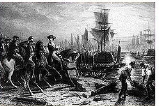
Evacuation

On March 10, General Howe issued a proclamation ordering the inhabitants to give up all linen and woolen goods that could be used by the colonists to continue the war. A Loyalist, Crean Brush, was authorized to receive these goods, in return for which he gave certificates that were effectively worthless. Over the next week, the British fleet sat in Boston harbor waiting for favorable winds, while loyalists and the remaining British soldiers were loaded onto the ships. During this time, American naval activities outside the harbor successfully captured and diverted to ports under colonial control several British supply ships. On March 15, the wind became favorable, but before they could leave, it turned against them. On March 17 the wind once again turned favorable. The troops, who were authorized to burn the town if there were any disturbances while they were marching to their ships, began to move out at 4:00 a.m. By 9:00 a.m., all ships were underway. The fleet departing from Boston included 120 ships, with more than 11,000 people aboard. Of those, 9,906 were British troops, 667 were women, and 553 were children.

Aftermath


Americans clean up

Once the British fleet sailed away, the Americans moved to reclaim Boston and Charlestown. At first, they thought that the British were still on Bunker Hill, but it turned out that the British had left dummies in place. Due to the risk of smallpox, at first only men picked for their prior exposure to the disease entered Boston under the command of Artemas Ward. More of the colonial army entered on March 20, once the risk of disease was judged low. While Washington had essentially acceded to the British threat to burn Boston, and had not hindered their departure from the city, he did not make their escape from the outer harbor entirely easy. He directed Captain Manley to harass the departing British fleet, in which he had some success, capturing among other prizes the ship carrying Crean Brush and his plunder.

General Howe, when his fleet finally left the outer harbor, left in his wake a small contingent of vessels whose primary purpose was to intercept any arriving British vessels. While they successfully redirected to Halifax numerous ships carrying British troops originally destined for Boston, some unsuspecting British troop ships landed in Boston, only to fall into American hands.

The British departure ended major military activities in the New England colonies. Washington, fearing that the British were going to attack New York City, departed on April 4 with his army for Manhattan
Manhattan

Manhattan is one of the five borough of New York City, located primarily on Manhattan Island at the mouth of the Hudson River.With a United States Census of 1,620,867 living in a land area of 22.96 square miles , Manhattan, coextensive with New York County, is the most population density county in the United States, w...
, which would begin the New York and New Jersey campaign
New York and New Jersey campaign

The New York and New Jersey campaign was a series of battles in the American Revolutionary War between Kingdom of Great Britain forces under William Howe, 5th Viscount Howe and an American army under General George Washington....
.

Fate of the British Generals

General Howe would be severely criticized in the British press and Parliament for his failures in the Boston campaign. General Gage was never given another command. General Burgoyne would see action in the Saratoga Campaign
Saratoga campaign

}|-||-||}The Saratoga campaign was a series of battles in 1777 during the American Revolutionary War for control of the Hudson River.The campaign ended in the climactic Battles of Saratoga which resulted in the capture of the British Army under John Burgoyne....
, a disaster that saw his capture, as well as that of 7,500 troops under his command. General Clinton would command the British forces in America for four years (1778-1782), only to be recalled.

Fate of the Loyalists

Many Massachusetts Loyalists left with the British when they evacuated Boston. Some returned to England to rebuild lives there, and some returned to America after the war. Many stayed in Nova Scotia, settling in places like Saint John
Saint John, New Brunswick

Saint John is the largest city in the province of New Brunswick, and the oldest incorporated city in Canada. In 2006 the city proper had a population of 68,043....
, and many became active in the future development of Nova Scotia
Nova Scotia

Nova Scotia is a Canadian Provinces and territories of Canada located on Canada's southeastern coast. It is the most populous province in Atlantic Canada....
 and New Brunswick.

Fate of the City of Boston

Boston effectively ceased to be a military target. It continued to be a focal point for revolutionary activities, with its port acting as an important point for fitting ships of war and privateers. Its leading citizens would have important roles in the development of the future United States
United States

The United States of America is a Federal government constitutional republic comprising U.S. state and a federal district. The country is situated mostly in central North America, where its Contiguous United States and Washington, D.C., the Capital districts and territories, lie between the Pacific Ocean and Atlantic Oceans, Borders of the U...
. Boston and other area communities mark the March 17 end of the siege as Evacuation Day
Evacuation Day

Evacuation Day refers to the date of evacuation of the Military of the United Kingdom from American cities in the American Revolutionary War. It also refers to the evacuation of French troops from the Middle East after World War II....
.

See also

  • Battles of Lexington and Concord
    Battles of Lexington and Concord

    The Battles of Lexington and Concord were the first military engagements of the American Revolutionary War. They were fought on April 19, 1775, in Middlesex County, Massachusetts, Province of Massachusetts Bay, within the towns of Lexington, Massachusetts, Concord, Massachusetts, Lincoln, Massachusetts, Arlington, Massachusetts, and Cambridge...
  • Battle of Bunker Hill
    Battle of Bunker Hill

    The Battle of Bunker Hill took place on June 17, 1775 on Breed's Hill, as part of the Siege of Boston during the American Revolutionary War. General Israel Putnam was in charge of the revolutionary forces, while Major-General William Howe, 5th Viscount Howe commanded the Kingdom of Great Britain forces....
  • Battle of Machias
    Battle of Machias

    The Battle of Machias was the first naval engagement of the American Revolutionary War. It took place on June 11?12, 1775, in and around the port of Machias, Maine in what is now eastern Maine....
    , Boston-based ship captured in Machias Bay
    Machias Bay

    Machias Bay is a bay in Washington County, Maine, Maine that opens into the Gulf of Maine.Located at the mouth of the Machias River between the towns of Machiasport, Maine, Machias, Maine, East Machias, Maine, Whiting, Maine, and Cutler, Maine, it is separated from Little Machias Bay to the east by the Cutler Peninsula, from Little Kennebec...
  • Battle of Gloucester
    Battle of Gloucester (1775)

    The Battle of Gloucester was a minor battle fought during the American Revolutionary War in Gloucester, Massachusetts on August 8, 1775. Captain John Linzee, commanding the HMS Falcon , chased two American schooners that were returning from the West Indies....
    , capture of British seamen attempting to enforce blockade in Gloucester
    Gloucester, Massachusetts

    Gloucester is a city on Cape Ann in Essex County, Massachusetts, Massachusetts, in the United States. It is part of North Shore . As of the Census of 2003, the city population was 30,730....
     Harbor
  • Burning of Falmouth
    Burning of Falmouth

    The Burning of Falmouth on October 18, 1775, was an attack on the town of Falmouth, Massachusetts by British Captain Henry Mowat commanding HMS Halifax ....
    , Falmouth (modern Portland, Maine
    Portland, Maine

    Portland is the largest city in the U.S. state of Maine and the county seat of Cumberland County, Maine. The city population was 64,249 at the 2000 United States Census....
    ) burned in retaliation for Patriot activity
  • Evacuation Day
    Evacuation Day (Massachusetts)

    In Suffolk County, Massachusetts, March 17 is Evacuation Day, an official holiday commemorating the evacuation of the city of Boston, Massachusetts by United Kingdom forces during the American Revolutionary War....


Footnotes