

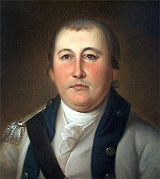
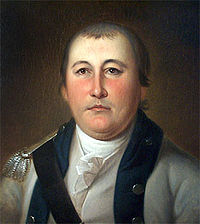
William Washington

Encyclopedia
Continental Army
The Continental Army was formed after the outbreak of the American Revolutionary War by the colonies that became the United States of America. Established by a resolution of the Continental Congress on June 14, 1775, it was created to coordinate the military efforts of the Thirteen Colonies in...
during the American Revolutionary War
American Revolutionary War
The American Revolutionary War , the American War of Independence, or simply the Revolutionary War, began as a war between the Kingdom of Great Britain and thirteen British colonies in North America, and ended in a global war between several European great powers.The war was the result of the...
, who held a final rank of Brigadier General in the newly created United States
United States
The United States of America is a federal constitutional republic comprising fifty states and a federal district...
after the war. Primarily known as a commander of light dragoons
Dragoon
The word dragoon originally meant mounted infantry, who were trained in horse riding as well as infantry fighting skills. However, usage altered over time and during the 18th century, dragoons evolved into conventional light cavalry units and personnel...
, mounted troops under Washington's command engaged in a number of notable battles in the Carolinas during the campaigns of 1780 and 1781.
Before The War
Born in Stafford County, VirginiaStafford County, Virginia
Stafford County is a county located in the Commonwealth of Virginia, a U.S. state, and just across the Rappahannock River from the City of Fredericksburg. As of the 2000 census, the population was 92,446, increasing to 128,961 in 2010.. Its county seat is Stafford. In 2006, and again in 2009,...
, he was the second son of Bailey Washington and Catherine (née Storke) Washington (primary source evidence, including correspondence between George Washington
George Washington
George Washington was the dominant military and political leader of the new United States of America from 1775 to 1799. He led the American victory over Great Britain in the American Revolutionary War as commander-in-chief of the Continental Army from 1775 to 1783, and presided over the writing of...
and William, establishes the fact that they were second cousins). William and his older brother, Henry, are said to have drawn straws to see who would get to join the Continental Army and who would stay home and manage the family plantations. William won. William Washington (not to be confused with William Augustine Washington of Westmoreland County, Virginia
Westmoreland County, Virginia
As of the census of 2000, there were 16,718 people, 6,846 households, and 4,689 families residing in the county. The population density was . There were 9,286 housing units at an average density of...
) was raised with a Southern planter upbringing and believed in the values of being a gentleman. He was tutored by Reverend Mr. Stuart who was a clergy from Virginia. William Washington learned the Greek language and studied several areas of theology for a potential career in the church. Instead of a career in the ministry he laid aside the Bible and took up arms against the British Government during the Revolutionary War.
The Revolutionary War
Washington was elected a Captain of Stafford County Minutemen on September 12, 1775, and became part of the 3rd Virginia Regiment3rd Virginia Regiment
The 3rd Virginia Regiment was raised on December 28, 1775 at Alexandria, Virginia for service with the Continental Army. The 3d Virginia's initial commander was Colonel Hugh Mercer, who was quickly promoted to brigadier general. Its second commander, George Weedon, was also promoted to brigadier...
, Continental Line on February 25, 1776, commanding its 7th Company. His lieutenant and second-in-command was future President of the United States
President of the United States
The President of the United States of America is the head of state and head of government of the United States. The president leads the executive branch of the federal government and is the commander-in-chief of the United States Armed Forces....
James Monroe
James Monroe
James Monroe was the fifth President of the United States . Monroe was the last president who was a Founding Father of the United States, and the last president from the Virginia dynasty and the Republican Generation...
. Their first combat was the Battle of Harlem Heights
Battle of Harlem Heights
The Battle of Harlem Heights was fought during the New York and New Jersey campaign of the American Revolutionary War. The action took place in what is now the Morningside Heights and west Harlem neighborhoods of Manhattan in New York City on September 16, 1776....
on September 14, 1776, during which he may have been wounded by enemy musket fire. At the Battle of Trenton
Battle of Trenton
The Battle of Trenton took place on December 26, 1776, during the American Revolutionary War, after General George Washington's crossing of the Delaware River north of Trenton, New Jersey. The hazardous crossing in adverse weather made it possible for Washington to lead the main body of the...
, under command of Nathanael Greene
Nathanael Greene
Nathanael Greene was a major general of the Continental Army in the American Revolutionary War. When the war began, Greene was a militia private, the lowest rank possible; he emerged from the war with a reputation as George Washington's most gifted and dependable officer. Many places in the United...
and after a night of scouting the countryside with Monroe to prevent detection, Washington led a successful assault into the town. His company drove in Hessian pickets, and seized two cannon on King Street, personally capturing their crews. Washington received wounds to both hands during the action and received thanks from Continental Army Commander-in-Chief George Washington.
Major
Major is a rank of commissioned officer, with corresponding ranks existing in almost every military in the world.When used unhyphenated, in conjunction with no other indicator of rank, the term refers to the rank just senior to that of an Army captain and just below the rank of lieutenant colonel. ...
and assigned to the newly-created 4th Continental Light Dragoons
4th Continental Light Dragoons
The 4th Continental Light Dragoons also known as Moylan's Horse was raised on January 5, 1777 at Philadelphia, Pennsylvania for service with the Continental Army under Colonel Stephen Moylan...
. In the fall of 1778, he was assigned to the 3rd Continental Light Dragoons
3rd Continental Light Dragoons
The 3rd Continental Light Dragoons, also known as Baylor's Horse or Lady Washington's Horse, was a mounted regiment of the Continental Army raised on January 1, 1777 at Morristown, New Jersey...
, severely mauled in a surprise attack
Baylor Massacre
A raid, widely known as the "Baylor Massacre" or the "Tappan Massacre", was a surprise attack on September 27, 1778, against the 3rd Regiment of Continental Light Dragoons under the command of Colonel George Baylor during the American Revolutionary War. It occurred in the present-day town of River...
on the night of September 27 at Old Tappan, New Jersey
Old Tappan, New Jersey
As of the 2010 United States Census, there were 5,750 people. The population density was 1,725.7 people per square mile. The racial makeup of the borough was 74.8% Caucasian, 22.2% Asian, 0.7% African American, 0.1% Native American, 0.6% from other races, and 1.5% from two or more races. Hispanics...
, by a force of British
United Kingdom
The United Kingdom of Great Britain and Northern IrelandIn the United Kingdom and Dependencies, other languages have been officially recognised as legitimate autochthonous languages under the European Charter for Regional or Minority Languages...
light infantry
Light infantry
Traditionally light infantry were soldiers whose job was to provide a skirmishing screen ahead of the main body of infantry, harassing and delaying the enemy advance. Light infantry was distinct from medium, heavy or line infantry. Heavy infantry were dedicated primarily to fighting in tight...
. Only 55 of the lightly armed dragoons escaped the attack and their commander, Lt. Col. George Baylor
George Baylor
George Baylor was an officer in the Continental Army, serving throughout the American Revolution.-Military career:...
, was wounded and captured. Washington was promoted to Lieutenant Colonel
Lieutenant colonel
Lieutenant colonel is a rank of commissioned officer in the armies and most marine forces and some air forces of the world, typically ranking above a major and below a colonel. The rank of lieutenant colonel is often shortened to simply "colonel" in conversation and in unofficial correspondence...
and placed in command of the 3rd Light Dragoons on November 20, 1778. Washington’s unit spent the summer of 1779 recruiting and remounting, and on November 19, 1779, was transferred to the Southern theatre of war, and marched to join the army of Major General
Major General
Major general or major-general is a military rank used in many countries. It is derived from the older rank of sergeant major general. A major general is a high-ranking officer, normally subordinate to the rank of lieutenant general and senior to the ranks of brigadier and brigadier general...
Benjamin Lincoln
Benjamin Lincoln
Benjamin Lincoln was an American army officer. He served as a major general in the Continental Army during the American Revolutionary War...
in Charleston, South Carolina
Charleston, South Carolina
Charleston is the second largest city in the U.S. state of South Carolina. It was made the county seat of Charleston County in 1901 when Charleston County was founded. The city's original name was Charles Towne in 1670, and it moved to its present location from a location on the west bank of the...
.
On March 10, 1780, Washington’s regiment joined forces with the remnants of the 1st Continental Light Dragoons at Bacon's Bridge, South Carolina, to reconnoiter and screen against the advancing British. On March 26, his first encounter with the British Legion under command of Lieutenant Colonel Banastre Tarleton
Banastre Tarleton
General Sir Banastre Tarleton, 1st Baronet, GCB was a British soldier and politician.He is today probably best remembered for his military service during the American War of Independence. He became the focal point of a propaganda campaign claiming that he had fired upon surrendering Continental...
, resulted in a minor victory near Rantowle's Bridge on the Stono River in South Carolina. Afterward on the Ashley River during the fight at Rutledge’s Plantation on March 26, 1780, Lt. Col. Washington again bested a detachment of Tarleton’s dragoons and infantry. Tarleton, however, attacked the encampment of General Isaac Huger
Isaac Huger
Isaac Huger was a planter and Continental Army general during the American Revolutionary War.-Life and work:...
at Monck’s Corner on the night of April 14, 1780, and routed the Continentals, including the 3rd Light Dragoons, which lost 15 dead, 17 wounded, and 100 dragoons captured, along with 83 horses. Washington and his remaining troops fled across the Santee River to escape capture. The severe attrition of Washington's command forced its amalgamation with the 1st Continental Light Dragoons
1st Continental Light Dragoons
The 1st Continental Light Dragoons, also known as Bland's Horse, was a mounted regiment of the Continental Army organized between 13 June and 10 September 1776 in Williamsburg, Virginia from eastern and northern Virginia for service with the Continental Army.The regiment was first authorized 8 June...
under Lt. Col. Anthony Walton White
Anthony Walton White
Anthony Walton White was a cavalry officer in the Continental Army during the American Revolutionary War.-Early life:Anthony W. White was the son of Anthony White...
. This force was again defeated at Lenud’s Ferry, waiting to cross the flooded Santee, on May 5, 1780. White was captured and Washington assumed command of the 1st-and-3rd Dragoons. The force withdrew to North Carolina when Lincoln surrendered the southern army and Charleston on May 12.
The reconstituted Southern army, now under General Horatio Gates
Horatio Gates
Horatio Lloyd Gates was a retired British soldier who served as an American general during the Revolutionary War. He took credit for the American victory at the Battle of Saratoga – Benedict Arnold, who led the attack, was finally forced from the field when he was shot in the leg – and...
, was severely defeated at the Battle of Camden
Battle of Camden
The Battle of Camden was a major victory for the British in the Southern theater of the American Revolutionary War...
, South Carolina, on August 16, 1780, which opened up the South to British control. Washington was placed under the command of General Daniel Morgan
Daniel Morgan
Daniel Morgan was an American pioneer, soldier, and United States Representative from Virginia. One of the most gifted battlefield tacticians of the American Revolutionary War, he later commanded troops during the suppression of the Whiskey Rebellion.-Early years:Most authorities believe that...
. Under General Morgan he participated in a series of raids in the western part of South Carolina
South Carolina
South Carolina is a state in the Deep South of the United States that borders Georgia to the south, North Carolina to the north, and the Atlantic Ocean to the east. Originally part of the Province of Carolina, the Province of South Carolina was one of the 13 colonies that declared independence...
. Two notable successes were the capture of Rugeley's Mill near Camden on December 4, 1780, and the defeat of a Tory partisan unit at Hammond's Old Store in the Little River District on December 27, 1780. At Rugeley’s Mill, Washington with 60 troops bluffed 112 Loyalists into surrendering a strongly fortified homestead without firing a shot by use of a "Quaker Gun
Quaker Gun
A Quaker Gun is a deception tactic that was commonly used in warfare during the 18th and 19th centuries. Although resembling an actual cannon, the Quaker Gun was simply a wooden log, usually painted black, used to deceive an enemy. Misleading the enemy as to the strength of an emplacement was an...
", mounting a felled tree trunk on wagon axles to resemble a cannon. At Hammond’s Store Washington routed 250 Georgia Loyalists, killing or wounding 150 and capturing the rest. These successes led to Tarleton being ordered to chase down Morgan's "flying corps", leading to the Battle of Cowpens
Battle of Cowpens
The Battle of Cowpens was a decisive victory by Patriot Revolutionary forces under Brigadier General Daniel Morgan, in the Southern campaign of the American Revolutionary War...
on January 17, 1781.
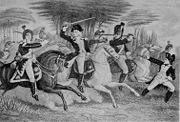
Washington, with 80 Continental dragoons and 45 mounted Georgia infantry, attacked Tarleton's rear and right flank when the battle seemed to have faulted for the British. The attack proved a decisive blow in inflicting an overwhelming defeat on the British force. During Tarleton's retreat, with Washington in close pursuit, the British commander turned and gave combat. Washington managed to wound Tarleton’s right hand with a sabre blow, while Tarleton creased Washington’s knee with a pistol shot that wounded his horse. For his valor at Cowpens, Washington received a silver medal awarded by the Continental Congress
Continental Congress
The Continental Congress was a convention of delegates called together from the Thirteen Colonies that became the governing body of the United States during the American Revolution....
executed under the direction of Thomas Jefferson. The unique silver medal was designed by French medallic artists Du Pre and De Vivier. (A British version of this duel can be found under Chapter 33 Year 1781.)
After the Battle of Cowpens, Washington’s dragoons assisted the retreat of General Nathanael Greene
Nathanael Greene
Nathanael Greene was a major general of the Continental Army in the American Revolutionary War. When the war began, Greene was a militia private, the lowest rank possible; he emerged from the war with a reputation as George Washington's most gifted and dependable officer. Many places in the United...
to Dan River
Dan River
The Dan River flows in the U.S. states of North Carolina and Virginia. It originates in Patrick County, Virginia, and crosses the state border into Stokes County, North Carolina. It then flows into Rockingham County. From there it goes back into Virginia. It reenters North Carolina near the...
in Virginia
Virginia
The Commonwealth of Virginia , is a U.S. state on the Atlantic Coast of the Southern United States. Virginia is nicknamed the "Old Dominion" and sometimes the "Mother of Presidents" after the eight U.S. presidents born there...
by rear guard actions against forces commanded by Lord Cornwallis. Afterward, Washington returned to North Carolina
North Carolina
North Carolina is a state located in the southeastern United States. The state borders South Carolina and Georgia to the south, Tennessee to the west and Virginia to the north. North Carolina contains 100 counties. Its capital is Raleigh, and its largest city is Charlotte...
to act as vanguard for Greene's army.
On April 25, 1781, at the Battle of Hobkirk's Hill
Battle of Hobkirk's Hill
The Battle of Hobkirk's Hill was a battle of the American Revolutionary War fought on April 25, 1781, near Camden, South Carolina...
, Greene was attacked by British Colonel Lord Rawdon. Ordered to attack Rawdon’s flank, Washington was unable to complete the maneuver while policing prisoners, forcing Greene to retreat.
On September 8, 1781, the Battle of Eutaw Springs
Battle of Eutaw Springs
The Battle of Eutaw Springs was a battle of the American Revolutionary War, and was the last major engagement of the war in the Carolinas.-Background:...
, the last major battle in the Carolinas, was Washington's final action. Midway through the battle Greene ordered Washington to charge a portion of the British line positioned in a blackjack thicket
Blackjack oak
Quercus marilandica is a small oak, one of the red oak group Quercus sect. Lobatae, but fairly isolated from the others...
along Eutaw Creek. The thicket proved impenetrable and British fire repulsed the mounted charges. During the last charge, Washington’s mount was shot out from under him, and he was pinned beneath his horse. He was bayoneted and taken prisoner, held under house arrest in the Charleston area for the remainder of the war.
The British commander in the South, Lord Cornwallis, would later comment that “there could be no more formidable antagonist in a charge, at the head of his cavalry, than Colonel William Washington.”
Post American Revolution
On April 21, 1782, Washington married Jane Elliott of Sandy Hill, South Carolina. Elliott and Washington met when she made his regiment a battle flag that was carried into combat from Cowpens to Eutaw Springs. After the war, the married couple settled near Charleston, South Carolina, on Sandy Hill plantation—originally owned by Jane Elliott—with ownership of other properties in the St. Paul Parish. The couple took up farming (a low-country planter) and raising thoroughbred horses. Washington was elected to the State legislature from 1787 to 1804 but refused to run for State Governor because he, in his words, “was not born a Carolinian.” Washington also accepted a post of brigadier general commanding the Seventh Brigade of the South Carolina State Militia in 1794.During the naval war with France in 1798 former President George Washington was appointed by President Adams' Administration as commander of the American Army. George Washington offered a general's commission and staff position to William Washington, and he accepted the rank of Brigadier General and served on George Washington’s staff. He served the United States Army as a general from 1798 to June 15, 1800, and concerned himself with the defenses of South Carolina and Georgia.
After a lingering illness, William Washington died on March 6, 1810, at the age of fifty eight. He was buried at Live Oak, a plantation near Sandy Hill. He was survived by his wife, a son, and a daughter. His daughter was married to General Alexander Spotswood, a grandson of Virginia Governor Alexander Spotswood
Alexander Spotswood
Alexander Spotswood was a Lieutenant-Colonel in the British Army and a noted Lieutenant Governor of Virginia. He is noted in Virginia and American history for a number of his projects as Governor, including his exploring beyond the Blue Ridge Mountains, his establishing what was perhaps the first...
.
In retrospect, William Washington is viewed as a fine officer and premier cavalry commander. He showed skill, bravery, and daring on the battlefield inspiring victory and confidence in the war of American Independence from the British Crown.
Further reading
- Haller, Stephen. William Washington: Cavalryman of the Revolution. Heritage Books, 2001. ISBN 0-7884-1803-3.
- Lumpkin, Henry. From Savannah to Yorktown: The American Revolution in the South. Columbia: University of South Carolina Press, 1981.
- Warley, Felix B. An Oration, Delivered in Saint Michael's Church, in the City of Charleston, South Carolina, on Tuesday, the 19 June 1810, on the Death of the Late Gen. William Washington. Charleston: W. P. Young, 1810.
- Military Heritage did a feature on William Augustine Washington (Arnold Blumberg, Military Heritage, April 2002, Volume 3, No. 5, p. 12, p. 14, and p. 16). Cavalry Commander William (NMN) Washington of Stafford County has sometimes been confused in name with William Augustine Washington of Westmoreland County.