
Home      Discussion      Topics      Dictionary      Almanac
Signup       Login
Fort Duquesne

Fort Duquesne

Overview
Fort Duquesne was a fort established by the French
French colonization of the Americas
The French colonization of the Americas began in the 16th century, and continued in the following centuries as France established a colonial empire in the Western Hemisphere. France founded colonies in much of eastern North America, on a number of Caribbean islands, and in South America...

 in 1754, at the junction of the Allegheny
Allegheny River
The Allegheny River is a principal tributary of the Ohio River; it is located in the Eastern United States. The Allegheny River joins with the Monongahela River to form the Ohio River at the "Point" of Point State Park in Downtown Pittsburgh, Pennsylvania...

 and Monongahela
Monongahela River
The Monongahela River is a river on the Allegheny Plateau in north-central West Virginia and southwestern Pennsylvania in the United States...

 rivers in what is now downtown Pittsburgh
Pittsburgh, Pennsylvania
Pittsburgh is the second-largest city in the US Commonwealth of Pennsylvania and the county seat of Allegheny County. Regionally, it anchors the largest urban area of Appalachia and the Ohio River Valley, and nationally, it is the 22nd-largest urban area in the United States...

 in the state of Pennsylvania
Pennsylvania
The Commonwealth of Pennsylvania is a U.S. state that is located in the Northeastern and Mid-Atlantic regions of the United States. The state borders Delaware and Maryland to the south, West Virginia to the southwest, Ohio to the west, New York and Ontario, Canada, to the north, and New Jersey to...

.
Discussion
Ask a question about 'Fort Duquesne'
Start a new discussion about 'Fort Duquesne'
Answer questions from other users
Full Discussion Forum
 
Unanswered Questions
Recent Discussions
Encyclopedia
Fort Duquesne was a fort established by the French
French colonization of the Americas
The French colonization of the Americas began in the 16th century, and continued in the following centuries as France established a colonial empire in the Western Hemisphere. France founded colonies in much of eastern North America, on a number of Caribbean islands, and in South America...

 in 1754, at the junction of the Allegheny
Allegheny River
The Allegheny River is a principal tributary of the Ohio River; it is located in the Eastern United States. The Allegheny River joins with the Monongahela River to form the Ohio River at the "Point" of Point State Park in Downtown Pittsburgh, Pennsylvania...

 and Monongahela
Monongahela River
The Monongahela River is a river on the Allegheny Plateau in north-central West Virginia and southwestern Pennsylvania in the United States...

 rivers in what is now downtown Pittsburgh
Pittsburgh, Pennsylvania
Pittsburgh is the second-largest city in the US Commonwealth of Pennsylvania and the county seat of Allegheny County. Regionally, it anchors the largest urban area of Appalachia and the Ohio River Valley, and nationally, it is the 22nd-largest urban area in the United States...

 in the state of Pennsylvania
Pennsylvania
The Commonwealth of Pennsylvania is a U.S. state that is located in the Northeastern and Mid-Atlantic regions of the United States. The state borders Delaware and Maryland to the south, West Virginia to the southwest, Ohio to the west, New York and Ontario, Canada, to the north, and New Jersey to...

.

It was destroyed and replaced by Fort Pitt
Fort Pitt (Pennsylvania)
Fort Pitt was a fort built at the location of Pittsburgh, Allegheny County, Pennsylvania.-French and Indian War:The fort was built from 1759 to 1761 during the French and Indian War , next to the site of former Fort Duquesne, at the confluence the Allegheny River and the Monongahela River...

 in 1758; over two centuries later, the site formerly occupied by Fort Duquesne is now Point State Park
Point State Park
Point State Park is a Pennsylvania state park on in Downtown Pittsburgh, Allegheny County, Pennsylvania, USA, at the confluence of the Allegheny and Monongahela rivers, forming the Ohio River....

.

Background


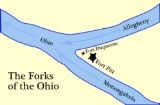
Fort Duquesne, built at a point where the Allegheny and Monongahela rivers come together to form the Ohio River
Ohio River
The Ohio River is the largest tributary, by volume, of the Mississippi River. At the confluence, the Ohio is even bigger than the Mississippi and, thus, is hydrologically the main stream of the whole river system, including the Allegheny River further upstream...

, was long seen as important for controlling the Ohio Country
Ohio Country
The Ohio Country was the name used in the 18th century for the regions of North America west of the Appalachian Mountains and in the region of the upper Ohio River south of Lake Erie...

, both for settlement and for trade. Englishman William Trent had established a highly successful trading post
Fur trade
The fur trade is a worldwide industry dealing in the acquisition and sale of animal fur. Since the establishment of world market for in the early modern period furs of boreal, polar and cold temperate mammalian animals have been the most valued...

 at the forks as early as the 1740s, to do business with a number of nearby American Indian
Native Americans in the United States
Native Americans in the United States are the indigenous peoples in North America within the boundaries of the present-day continental United States, parts of Alaska, and the island state of Hawaii. They are composed of numerous, distinct tribes, states, and ethnic groups, many of which survive as...

 villages. Both the French and the British
British colonization of the Americas
British colonization of the Americas began in 1607 in Jamestown, Virginia and reached its peak when colonies had been established throughout the Americas...

 were keen to gain advantage in the area. As the area was within the drainage basin of the Mississippi River
Mississippi River
The Mississippi River is the largest river system in North America. Flowing entirely in the United States, this river rises in western Minnesota and meanders slowly southwards for to the Mississippi River Delta at the Gulf of Mexico. With its many tributaries, the Mississippi's watershed drains...

, the French claimed it as theirs. Many of the charters of the British colonies on the east coast of North America granted land indefinitely to the west, setting the scene for conflict.

In the early 1750s, a the French commenced construction of a line of forts, starting with Fort Presque Isle
Fort Presque Isle
Fort Presque Isle was a fort built by French soldiers in 1753 along Presque Isle Bay at present-day Erie, Pennsylvania...

 on Lake Erie
Lake Erie
Lake Erie is the fourth largest lake of the five Great Lakes in North America, and the tenth largest globally. It is the southernmost, shallowest, and smallest by volume of the Great Lakes and therefore also has the shortest average water residence time. It is bounded on the north by the...

 near present-day Erie, Pennsylvania
Erie, Pennsylvania
Erie is a city located in northwestern Pennsylvania in the United States. Named for the lake and the Native American tribe that resided along its southern shore, Erie is the state's fourth-largest city , with a population of 102,000...

, followed by Fort Le Boeuf
Fort Le Boeuf
Fort Le Boeuf, , was a fort established by the French in 1753 on a fork of French Creek, in present-day Waterford, in northwest Pennsylvania...

, about 15 miles inland near present-day Waterford
Waterford, Pennsylvania
Waterford is a borough in Erie County, Pennsylvania, United States. The population was 1,449 at the 2000 census. It is part of the Erie Metropolitan Statistical Area.-Geography:Waterford is located at ....

, and Fort Machault
Fort Machault
Fort Machault was a fort built by the French in 1754 near the confluence of French Creek with the Allegheny River, at present-day Franklin, in northwest Pennsylvania. The fort was part of a line that included Fort Presque Isle, Fort Le Boeuf, and Fort Duquesne.- Description:The fort was built on a...

, on the Allegheny River in Venango County
Venango County, Pennsylvania
Venango County is a county located in the U.S. state of Pennsylvania. As of the 2010 census, the population was 54,984. Its county seat is Franklin.-History:Venango County was created on March 12, 1800 from parts of Allegheny and Lycoming Counties...

 in present-day Franklin.

Lieutenant Governor of the Virginia Colony, Robert Dinwiddie
Robert Dinwiddie
Robert Dinwiddie was a British colonial administrator who served as lieutenant governor of colonial Virginia from 1751 to 1758, first under Governor Willem Anne van Keppel, 2nd Earl of Albemarle, and then, from July 1756 to January 1758, as deputy for John Campbell, 4th Earl of Loudoun...

, saw this as threatening to the extensive claims
Ohio Company
The Ohio Company, formally known as the Ohio Company of Virginia, was a land speculation company organized for the settlement by Virginians of the Ohio Country and to trade with the Indians there...

 to land in the area by Virginians (including himself). In late autumn 1753, Dinwiddie dispatched a young envoy named George Washington to the area to deliver a letter to the French commander, asking them to leave, and to assess French strength and intentions. Washington reached Fort Le Boeuf in December and was politely rebuffed by the French.

Fort's construction and replacement


Following Washington's return to Virginia in January 1754, Dinwiddie sent Virginia
Virginia
The Commonwealth of Virginia , is a U.S. state on the Atlantic Coast of the Southern United States. Virginia is nicknamed the "Old Dominion" and sometimes the "Mother of Presidents" after the eight U.S. presidents born there...

ns to build Fort Prince George
Fort Prince George
Fort Prince George was an uncompleted fort on what is now the site of Pittsburgh, at the confluence of the Allegheny and Monongahela Rivers in Allegheny County, Pennsylvania. The site was originally a trading post established by Ohio Company trader William Trent in the 1740s...

 at the forks. Work began on the fort on February 17. By April 18, a much larger French force of five hundred strong arrived at the forks, forcing the small British garrison there to surrender. The French knocked down the tiny British fort and built Fort Duquesne, named in honor of Marquis Duquesne
Marquis Duquesne
Michel-Ange Du Quesne de Menneville, Marquis Du Quesne was a French Governor General of New France. He was born in Toulon....

, the governor-general of New France
New France
New France was the area colonized by France in North America during a period beginning with the exploration of the Saint Lawrence River by Jacques Cartier in 1534 and ending with the cession of New France to Spain and Great Britain in 1763...

. The fort was built on the same model as Fort Frontenac
Fort Frontenac
Fort Frontenac was a French trading post and military fort built in 1673 in Kingston, Ontario, Canada. It was positioned at the mouth of the Cataraqui River where the St. Lawrence River leaves Lake Ontario , in a location traditionally known as Cataraqui...

 on Lake Ontario.

Even though location at the Forks of the Ohio looked strong on paper, controlling the confluence of three rivers, reality was rather different. The site was low and swampy, and prone to flooding. In addition, the position was dominated by nearby highlands, which would allow an enemy to bombard the fort with ease. The Canadien commander, Claude-Pierre Pécaudy de Contrecœur
Claude-Pierre Pécaudy de Contrecœur
Claude-Pierre Pécaudy de Contrecœur was an officer in the colonial regular troops , seigneur, and member of the Legislative Council of New France. Born on December 28, 1705 at Contrecœur, Quebec, son of Francois-Antoine Pécaudy de Contrecoeur, a seigneur and officer in the colonial regulars, and...

, was preparing to abandon the fort in the face of Braddock's advance
Braddock expedition
The Braddock expedition, also called Braddock's campaign or, more commonly, Braddock's Defeat, was a failed British military expedition which attempted to capture the French Fort Duquesne in the summer of 1755 during the French and Indian War. It was defeated at the Battle of the Monongahela on...

 in 1755, and was only saved when the advancing British force was annihilated (see below). When the Forbes expedition approached in 1758, the French were not as lucky.

Washington, who had been promoted to Lt. Colonel of the newly created Virginia Regiment
Virginia Regiment
The Virginia Regiment was formed in 1754 by Virginia's Royal Governor Robert Dinwiddie, initially as an all volunteer militia corps, and he promoted George Washington, the future first president of the United States of America, to its command upon the death of Colonel Joshua Fry...

, left on April 2 as part of a small force with the dual purpose of constructing a road and defending the fort upon their arrival. Washington was at Wills Creek in south central Pennsylvania when he received news of the surrender of Fort Prince George. On May 25, Washington assumed command of the expedition upon the death of Colonel Joshua Fry
Joshua Fry
Colonel Joshua Fry was a surveyor, adventurer, mapmaker, soldier, and member of the House of Burgesses, the legislature of the colony of Virginia...

. Two days later, Washington encountered a Canadien scouting party near a place now known as Jumonville Glen
Battle of Jumonville Glen
The Battle of Jumonville Glen, also known as the Jumonville affair, was the opening battle of the French and Indian War fought on May 28, 1754 near what is present-day Uniontown in Fayette County, Pennsylvania...

 (several miles east of present-day Uniontown
Uniontown, Pennsylvania
Uniontown is a city in Fayette County, Pennsylvania, southeast of Pittsburgh and part of the Pittsburgh Metro Area. Population in 1900, 7,344; in 1910, 13,344; in 1920, 15,692; and in 1940, 21,819. The population was 10,372 at the 2010 census...

). Washington attacked the Canadiens killing 10 in the early morning hours, and took 21 prisoners, of whom many were killed by the Indians. He then ordered construction of Fort Necessity at a large clearing known as the Great Meadows. On July 3, the counterattacking French and Canadiens forced Washington to surrender Fort Necessity
Battle of the Great Meadows
The Battle of Fort Necessity, or the Battle of the Great Meadows took place on July 3, 1754 in what is now the mountaintop hamlet of Farmington in Fayette County, Pennsylvania. The engagement was one of the first battles of the French and Indian War and George Washington's only military surrender...

 but allowed Washington and his men to return home without their armaments.

The French held Fort Duquesne during the French and Indian War
French and Indian War
The French and Indian War is the common American name for the war between Great Britain and France in North America from 1754 to 1763. In 1756, the war erupted into the world-wide conflict known as the Seven Years' War and thus came to be regarded as the North American theater of that war...

, and it became one of the focal points for that war because of its strategic location. The French held the fort successfully early in the war, turning back the expedition led
Braddock expedition
The Braddock expedition, also called Braddock's campaign or, more commonly, Braddock's Defeat, was a failed British military expedition which attempted to capture the French Fort Duquesne in the summer of 1755 during the French and Indian War. It was defeated at the Battle of the Monongahela on...

 by General Edward Braddock
Edward Braddock
General Edward Braddock was a British soldier and commander-in-chief for the 13 colonies during the actions at the start of the French and Indian War...

. George Washington served as one of General Braddock's aides. A smaller attack
Battle of Fort Duquesne
The Battle of Fort Duquesne was a British assault on the eponymous French fort that was repulsed with heavy losses on 14 September 1758, during the French and Indian War....

 by James Grant
James Grant (general)
James Grant, Laird of Ballindalloch was a major general in the British Army during the American War of Independence. He served as Governor of East Florida from 1763 to 1771.-Early career:...

 in September 1758 was repulsed with heavy losses. Two months later, on November 25, the Forbes Expedition
Forbes Expedition
The Forbes Expedition was a British military expedition led by Brigadier-General John Forbes in 1758, during the French and Indian War. Its objective was the capture of Fort Duquesne, a French fort constructed at the confluence of the Allegheny and Monongahela Rivers in 1754.The expedition...

 under General John Forbes
John Forbes (General)
John Forbes was a British general in the French and Indian War. He is best known for leading the Forbes Expedition that captured the French outpost at Fort Duquesne and for naming the city of Pittsburgh, Pennsylvania after British Secretary of State William Pitt the Elder.-Early life:Forbes was...

 captured the site after the French destroyed Fort Duquesne the day before. The British built a much larger fort on the site, and named it Fort Pitt
Fort Pitt (Pennsylvania)
Fort Pitt was a fort built at the location of Pittsburgh, Allegheny County, Pennsylvania.-French and Indian War:The fort was built from 1759 to 1761 during the French and Indian War , next to the site of former Fort Duquesne, at the confluence the Allegheny River and the Monongahela River...

.

Present-day site


Fort Duquesne was located where the Allegheny and Monongahela rivers meet to form the Ohio. The location in downtown Pittsburgh
Pittsburgh, Pennsylvania
Pittsburgh is the second-largest city in the US Commonwealth of Pennsylvania and the county seat of Allegheny County. Regionally, it anchors the largest urban area of Appalachia and the Ohio River Valley, and nationally, it is the 22nd-largest urban area in the United States...

 is now known as Point State Park
Point State Park
Point State Park is a Pennsylvania state park on in Downtown Pittsburgh, Allegheny County, Pennsylvania, USA, at the confluence of the Allegheny and Monongahela rivers, forming the Ohio River....

 or "the Point." The park includes a brick outline of the fort's walls. In May 2007, Thomas Kutys, an archaeologist with A.D. Marble & Company, a Cultural Resource Management firm based in Conshohocken, Pennsylvania
Conshohocken, Pennsylvania
Conshohocken is a borough on the Schuylkill River in Montgomery County, Pennsylvania, in suburban Philadelphia. Historically a large mill town and industrial and manufacturing center, after the decline of industry in recent years Conshohocken has developed into a center of riverfront commercial and...

, rediscovered a stone and brick drain thought to have drained one of the fort's many buildings. Due to its depth in the ground, this drain may be all of the fort that has survived. The entire northern half of the site the fort is thought to have occupied was destroyed by the heavy industrial usage of the area in the 19th century. http://www.philly.com/inquirer/local/pa/20070516_Phila__archaeologist_hits_it_big_in_Pittsburgh.html

See also


  • Great Britain in the Seven Years War
    Great Britain in the Seven Years War
    The Kingdom of Great Britain was one of the major participants in the Seven Years' War which lasted between 1756 and 1763. Britain emerged from the war as the world's leading colonial power having gained a number of new territories at the Treaty of Paris in 1763 and established itself as the...

  • France in the Seven Years War
    France in the Seven Years War
    France was one of the leading participants in the Seven Years' War which lasted between 1754 and 1763. France entered the war with hopes of achieving a lasting victory both in Europe against Prussia, Britain and their German Allies and across the globe against their major colonial rivals...

  • List of French forts in North America

Sources

  • Anderson, Fred. Crucible of War: The Seven Years’ War and the Fate of Empire in British North America, 1754–1766. New York: Knopf, 2000. ISBN 0375406425.
  • Hunter, William A. Forts on the Pennsylvania Frontier, 1753–1758. Originally published 1960; Wennawoods reprint, 1999.
  • Stotz, Charles Morse. Outposts Of The War For Empire: The French and English In Western Pennsylvania: Their Armies, Their Forts, Their People 1749–1764. Pittsburgh: University of Pittsburgh Press, 2005. ISBN 0822942623.