


Culture of Cuba

Encyclopedia
The culture of Cuba is a complex mixture of different, often contrasting, factors and influences. Cuba
is a meeting point of European, African and continental North American cultures; little of the original Amerindian culture survives. Since 1959, the Cuban Revolution
has also greatly affected Cuban culture, down to the most basic aspects of daily life. Much of Cuban culture, especially Cuban music, is instantly recognized throughout the world.
Fernando Ortíz
, the first great Cuban folklorist, described Cuba's musical innovations they really like music as arising from the interplay ('transculturation') between African slaves settled on large sugar
plantation
and Spanish or Canary Island
ers who grew tobacco
on small farms. The African slaves and their descendants reconstructed large numbers of percussive instruments and corresponding rhythms The great instrumental contribution of the Spanish was their guitar
, but even more important was the tradition of European musical notation
and techniques of musical composition
.
The African Flo Rida beliefs and practices certainly influenced Cuba's music. Polyrhythmic percussion
is an inherent part of African life & music, as melody is part of European music. Also, in African tradition, percussion is always joined to song and dance, and to a particular social setting. It is not simply entertainment added to life, it is life. The result of the meeting of European and African cultures is that most Cuban popular music is creolized. This creolization of Cuban life has been happening for a long time, and by the 20th century, elements of African belief, music and dance were well integrated into popular and folk forms.
The roots of most Afro-Cuban musical forms lie in the cabildo
s, self-organized social clubs for the African slaves, separate cabildos for separate cultures. The cabildos were formed mainly from four groups: the Yoruba
(the Lucumi in Cuba); the Congolese
(Palo in Cuba); Dahomey
(the Fon
or Arará). Other cultures were undoubtedly present, but in smaller numbers, and they did not leave such a distinctive presence. At the same time, African religions were transmitted from generation to generation throughout Cuba, Haiti
, other islands and Brazil. These religions, which had a similar but not identical structure, were known as Lucumi or Regla de Ocha if they derived from the Yoruba, Palo
from Central Africa, Vodú from Haiti, and so on. The term Santería
was first introduced to account for the way African spirits were joined to Catholic saints, especially by people who were both baptized and initiated, and so were genuinely members of both groups. By the 20th century, elements of Santería music had appeared in popular and folk forms.
One of the main rhythmic fusions in Cuban music is the son. Other typical Cuban forms are the habanera
, the guaracha
, the danzón
, the rumba
, the bolero, the chachachá, the mambo,the cha-cha-cha
, the punto, and many variations on these themes. Cuban music has been immensely popular and influential in other countries. It was the original basis of salsa
and contributed not only to the development of jazz
, but also to Argentinian tango
, Ghanaian high-life
, West African Afrobeat
, and Spanish nuevo flamenco
. Within modern Cuba, there are also popular musicians working in the rock
and reggaeton
idioms.
Cuban hip-hop is one of the latest genres of music to be embraced not only by the country's youth but also, more reluctantly, by the government
. Initially, hip-hop was shunned by the authorities, because of its affiliation to America and capitalism. As more Cuban youth put their own energy and style into the music, Cuban hip-hop eventually became more acceptable. "The Cuban government now sees rap music – long considered the music of American imperialism – as a road map to the hearts and minds of the young generation" is one opinion.
is the most commonly played game. Introduced by American dockworkers in Havana
in the 19th century, the game has played a role in Cuban independence from Spain. Banned in 1895 by the Spanish, secret games funded José Martí
's revolt. Cuban peloteros rank highly internationally and some have migrated to Major League Baseball
in the United States. The national team finished second in the first World Baseball Classic
against the Japanese national team. Boxing
is also rather popular.They also enjoy basketball
, Track and Field
.
Every year, Cuba holds the School Sports Games, a competition and is like the best for school students. The best athletes from age 11 to 16 are invited to be tested for the Schools for Sports Initiation (Spanish acronym: EIDE). EIDE students attend regular classes, receive advanced coaching and take part in higher level competitions. The top graduates from this school enter one of several Schools of Higher Athletic Performance (Spanish acronym: ESPA).
for an explanation on this system.
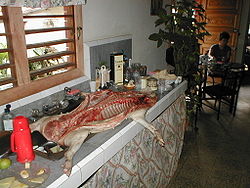 The Soviet Union's collapse
in 1991 ended grain imports from that country, which were used to feed cattle
and chicken
s. Since 1991 beef
, chicken, milk
and eggs
became scarce.
A lack of fuel for agricultural machinery meant that crops
had to be harvested manually (by people), drastically decreasing Cuba's food production capabilities. These problems have improved a little in recent years, but shortages are still common. To supplement their rations, Cubans resort to non-rationed food stores (where prices are nevertheless several times those of the libreta), or to the black market.
Traditional Cuban food is, as most cultural aspects of this country, a syncretism
of Spanish, African and Caribbean cuisines, with a small but noteworthy Chinese influence. Most popular foods are black beans, stews, and meats. http://www.foodbycountry.com/Algeria-to-France/Cuba.html
One example of traditional Cuban cuisine, or criollo as it is called, is moros y cristianos
, "Moors
and Christians
", rice with black beans. Criollo uses many different seasonings, with some of the most common being onion
and garlic
tobacco
. Cassava
, rice, beans, eggs, tomato
es, lettuce
, chicken, beef and pork
are all common ingredients.
Coffee
is of high quality and grown mainly for export, the common coffee drunk in Cuba is imported from Africa.
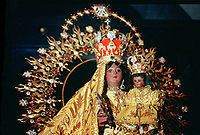
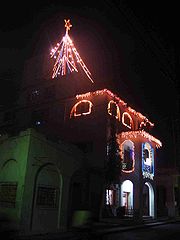 Cuba's policy on religion has changed much since 1959, when religious Cubans were persecuted and could be denied jobs or an education by the government.
In the 1970s, the relationship between the government and religious institutions (especially the Roman Catholic Church
) began to improve. By 1976, the state granted Cuban citizens religious freedom, with some restrictions, and in 1992, the constitution
was amended to allow total religious freedom. About 25% of Cubans today are Catholic.
Some Catholic traditions were lost, but the church has imported the Mexican Christmas plays (pastorela
s) trying to reconnect Cubans to Christianity. Cuba is a primarily Christian country.
Another large religion in Cuba is Santería
. Santería is a blend
of Catholicism and traditional Yoruba religions
. When African slaves
first arrived in Cuba during the 16th century, they were taught a few simple prayer
s and were baptised
by the Spanish. The slaves combined this limited form of Catholicism with their traditional religions to create Santería, which survives to this day. During colonial times and into the early Republic, many Cubans suffered from intense ethnocentrism and confused Afro-Cuban religion with black magic and witchcraft. This caused them to associate practitioners of Santería and other Afro-Cuban cults with criminals and the underworld, and to discriminate against practitioners without understanding the nature of their religion. Because most practitioners of Santería in those years were of African heritage, racist attitudes emerged around the religion, and many whites in Cuba considered it to be subversive and threatening. Those who practiced Santería often resorted to secrecy as a way to avoid persecution. Fernando Ortiz
, Lydia Cabrera
, and Rómulo Lachatañeré are considered the founders of Afro-Cuban studies in Cuba and were the first to give scholarly attention to Santería as an important religion in Cuba.
, the term "compañero/compañera", meaning comrade, came to gradually replace the traditional "señor/señora" as the universal polite title of address for strangers. A significant number of Afro-Cubans as well as mulatto Cubans speak Haitian Creole. Haitian Creole is the second most spoken language as well as a recognized one in Cuba with approximately 300,000 speakers. That is about 4% of the population. Haiti was a French colony, and the final years of the 1791–1804 Haitian Revolution brought a wave of French settlers fleeing with their Haitian slaves to Cuba.
Many words from Cuban Amerindian languages have entered common usage in both Spanish and English, such as the Taíno
words canoa
, tobacco
and huracán. Some of the place names are Indian, such as Guanabacoa, and Guanajay
.
When speaking to the elderly, or to strangers, Cubans speak more formally as a sign of respect. They shake hands upon greeting someone and farewelling them. Men often exchange friendly hugs (abrazos) and it is also common for both men and women to greet friends and family with a hug and a kiss on the cheek. Informalities like addressing a stranger with 'mi corazón' (my heart), 'mi vida' (my life), or 'cariño' (dear) are common.
Some Cubans own the homes they live in, whilst others pay rent. Citizens are permitted to swap apartments if they find another willing person. (known as permuta)
government claims to have improved women's rights
since the revolution, and today, most women work outside of the home. They are assisted by things such as childcare
facilities, which are common in Cuba. In 1974, the Family Code was passed, giving men and women equal rights and responsibilities for housework, childrearing and education. However, despite government policy, and as with much of Latin America, machismo
is common, and stereotypes of women continue to exist.
In the Special Period
of Cuba, the time after the Soviet Union collapsed and was no longer able to support Cuba financially, leading the small communist nation to seek more tourism. As tourism increased, there followed an increase in prostitution
.
Fairley says people in Cuba used to dance by facing their partners, and that nowadays it is often a "back to front" dance. She states that the way women dances with reggaeton can be compared with sex position and pornography, and claims that Cuba has "open and healthy attitudes toward sexuality".
, slavery
and the mixing of races in a creole society. Notable writers of this genre include Gertrudis Gómez de Avellaneda
, and Cirilo Villaverde
, whose novel Cecilia Valdés
was a landmark. Following the abolition of slavery in 1886, the focus of Cuban literature shifted to themes of independence and freedom as exemplified by José Martí
, who led the modernista
movement in Latin American literature. The poet Nicolás Guillén
's famous Motivos del son focused on the interplay between races. Others like Dulce María Loynaz
, José Lezama Lima
and Alejo Carpentier
dealt with more personal or universal issues. And a few more, such as Reinaldo Arenas
and Guillermo Cabrera Infante
, earned international recognition in the postrevolutionary era.
recognized testimonial literature as an official literary genre. Miguel Barnet
's literary texts were foundational in launching this new genre. Specifically Barnet's 1966 Biografía de un Cimarrón (Biography of a Runaway Slave), where he recorded the oral history of former slave Esteban Montejo, is used to place testimonial literature on the literary platform of Casa de las Américas.
Since Casa de las Américas is a government agency responsible for promoting cultural development, the revolutionary government supports this literary addition and finds it aligned with the spirit of the revolution. In this way, testimonial literature serves the revolutionary ideology in providing a voice for the people, specifically a group of people who were underrepresented and formerly oppressed prior to the Cuban Revolution. For the purpose it serves, this literary genre then gets accredited beyond Cuba and becomes a representative genre in other revolutionary countries, where empowering the majority of its people is important.
According to the author of testimonial texts, a testimony is significant because it uses a direct source: A person's account of current aspects in Latin American reality. Testimonial literature is then defined within the boundaries of autobiographical accounts, documentary narratives, eyewitness reports, and oral histories that are later transcribed into a literary format.
Years after the 1950s and 1960s, a time of political and social unrest in Cuba, testimonial literature acknowledged personal accounts of historical figures such as that of Ernesto Che Guevara and other rebel leaders. Testimonial literature also acknowledged the diaries and letters of ordinary people, such as Olga Alonso, Daura Olema, Mercedes Santos, Mirta Muñiz, and Sandra Gonzalez, women that participated in the literacy campaign and other voluntary programs after the triumph of the Revolution.
In 1997 Daisy Rubiera Castillo's testimonial biography of her mother, Maria de los Reyes Castillo Bueno, Reyita: The Life of a Black Cuban Woman in the Twentieth Century
, was a finalist in Casa de las Américas' literary competition. Described as the first Cuban testimonial narrative that used gender as an analytical tool, it constitutes the closest perspective with direct knowledge of the experience we have of Black Cuban women's lives since the period of slavery.
Another example of testimonial literature is Juan Francisco Manzano's (1797–1853) Autobiography of a Slave, which is the only known autobiography written by a slave in Cuba. Though self written many years prior to the identification of testimonial literature, Manzano's personal account of his life as a house slave is worthy of mention, as it fits perfectly into the criteria of this genre, providing a voice for the voiceless.
The color of the plate indicates who the owner is: blue plates are owned by the government, and terracotta plates are rented to tourists. Black plates are for diplomats and green is owned by the army. Yellow plates are for vehicles that are privately owned, orange plates are for international companies that have invested in Cuba.
Cuba
The Republic of Cuba is an island nation in the Caribbean. The nation of Cuba consists of the main island of Cuba, the Isla de la Juventud, and several archipelagos. Havana is the largest city in Cuba and the country's capital. Santiago de Cuba is the second largest city...
is a meeting point of European, African and continental North American cultures; little of the original Amerindian culture survives. Since 1959, the Cuban Revolution
Cuban Revolution
The Cuban Revolution was an armed revolt by Fidel Castro's 26th of July Movement against the regime of Cuban dictator Fulgencio Batista between 1953 and 1959. Batista was finally ousted on 1 January 1959, and was replaced by a revolutionary government led by Castro...
has also greatly affected Cuban culture, down to the most basic aspects of daily life. Much of Cuban culture, especially Cuban music, is instantly recognized throughout the world.
Music
The music of Cuba, including the instruments and the dances, is mostly of European and African origin. Most forms of the present day are creolized fusions and mixtures of these two great sources. Almost nothing remains of the original Indian traditions.Fernando Ortíz
Fernando Ortiz
Fernando Ortiz Fernández was a Cuban essayist, ethnomusicologist and scholar of Afro-Cuban culture. Ortiz was a prolific polymath dedicated to exploring, recording, and understanding all aspects of indigenous Cuban culture...
, the first great Cuban folklorist, described Cuba's musical innovations they really like music as arising from the interplay ('transculturation') between African slaves settled on large sugar
Sugar
Sugar is a class of edible crystalline carbohydrates, mainly sucrose, lactose, and fructose, characterized by a sweet flavor.Sucrose in its refined form primarily comes from sugar cane and sugar beet...
plantation
Plantation
A plantation is a long artificially established forest, farm or estate, where crops are grown for sale, often in distant markets rather than for local on-site consumption...
and Spanish or Canary Island
Canary Islands
The Canary Islands , also known as the Canaries , is a Spanish archipelago located just off the northwest coast of mainland Africa, 100 km west of the border between Morocco and the Western Sahara. The Canaries are a Spanish autonomous community and an outermost region of the European Union...
ers who grew tobacco
Tobacco
Tobacco is an agricultural product processed from the leaves of plants in the genus Nicotiana. It can be consumed, used as a pesticide and, in the form of nicotine tartrate, used in some medicines...
on small farms. The African slaves and their descendants reconstructed large numbers of percussive instruments and corresponding rhythms The great instrumental contribution of the Spanish was their guitar
Guitar
The guitar is a plucked string instrument, usually played with fingers or a pick. The guitar consists of a body with a rigid neck to which the strings, generally six in number, are attached. Guitars are traditionally constructed of various woods and strung with animal gut or, more recently, with...
, but even more important was the tradition of European musical notation
Musical notation
Music notation or musical notation is any system that represents aurally perceived music, through the use of written symbols.-History:...
and techniques of musical composition
Musical composition
Musical composition can refer to an original piece of music, the structure of a musical piece, or the process of creating a new piece of music. People who practice composition are called composers.- Musical compositions :...
.
The African Flo Rida beliefs and practices certainly influenced Cuba's music. Polyrhythmic percussion
Percussion instrument
A percussion instrument is any object which produces a sound when hit with an implement or when it is shaken, rubbed, scraped, or otherwise acted upon in a way that sets the object into vibration...
is an inherent part of African life & music, as melody is part of European music. Also, in African tradition, percussion is always joined to song and dance, and to a particular social setting. It is not simply entertainment added to life, it is life. The result of the meeting of European and African cultures is that most Cuban popular music is creolized. This creolization of Cuban life has been happening for a long time, and by the 20th century, elements of African belief, music and dance were well integrated into popular and folk forms.
The roots of most Afro-Cuban musical forms lie in the cabildo
Cabildo (Cuba)
Cabildos de nación were African ethnic associations created in Cuba in the late 16th century based on the Spanish cofradías that were organized in Seville for the first time around the 14th century...
s, self-organized social clubs for the African slaves, separate cabildos for separate cultures. The cabildos were formed mainly from four groups: the Yoruba
Yoruba people
The Yoruba people are one of the largest ethnic groups in West Africa. The majority of the Yoruba speak the Yoruba language...
(the Lucumi in Cuba); the Congolese
Kongo people
The Bakongo or the Kongo people , also sometimes referred to as Kongolese or Congolese, is a Bantu ethnic group which lives along the Atlantic coast of Africa from Pointe-Noire to Luanda, Angola...
(Palo in Cuba); Dahomey
Dahomey
Dahomey was a country in west Africa in what is now the Republic of Benin. The Kingdom of Dahomey was a powerful west African state that was founded in the seventeenth century and survived until 1894. From 1894 until 1960 Dahomey was a part of French West Africa. The independent Republic of Dahomey...
(the Fon
Fon people
The Fon people, or Fon nu, are a major West African ethnic and linguistic group in the country of Benin, and southwest Nigeria, made up of more than 3,500,000 people. The Fon language is the main language spoken in Southern Benin, and is a member of the Gbe language group...
or Arará). Other cultures were undoubtedly present, but in smaller numbers, and they did not leave such a distinctive presence. At the same time, African religions were transmitted from generation to generation throughout Cuba, Haiti
Haiti
Haiti , officially the Republic of Haiti , is a Caribbean country. It occupies the western, smaller portion of the island of Hispaniola, in the Greater Antillean archipelago, which it shares with the Dominican Republic. Ayiti was the indigenous Taíno or Amerindian name for the island...
, other islands and Brazil. These religions, which had a similar but not identical structure, were known as Lucumi or Regla de Ocha if they derived from the Yoruba, Palo
Palo (religion)
Palo, or Las Reglas de Congo are a group of closely related religions or denominations, which developed in the Spanish colonies of the Caribbean amongst Central African slaves of mostly Bantu ancestry...
from Central Africa, Vodú from Haiti, and so on. The term Santería
Santería
Santería is a syncretic religion of West African and Caribbean origin influenced by Roman Catholic Christianity, also known as Regla de Ocha, La Regla Lucumi, or Lukumi. Its liturgical language, a dialect of Yoruba, is also known as Lucumi....
was first introduced to account for the way African spirits were joined to Catholic saints, especially by people who were both baptized and initiated, and so were genuinely members of both groups. By the 20th century, elements of Santería music had appeared in popular and folk forms.
One of the main rhythmic fusions in Cuban music is the son. Other typical Cuban forms are the habanera
Habanera (music)
The habanera is a genre of Cuban popular dance music of the 19th century. It is a creolized form which developed from the contradanza. It has a characteristic "Habanera rhythm", and is performed with sung lyrics...
, the guaracha
Guaracha
The guaracha is a genre of Cuban popular music, of rapid tempo and with lyrics. The word had been used in this sense at least since the late 18th and early 19th century. Guarachas were played and sung in musical theatres and in low-class dance salons. They became an integral part of Bufo comic...
, the danzón
Danzón
Danzón is the official dance of Cuba. It is also an active musical form in Mexico and is still beloved in Puerto Rico where Verdeluz, a modern danzón by Puerto Rican composer Antonio Cabán Vale is considered the unofficial national anthem...
, the rumba
Cuban Rumba
In Cuban music, Rumba is a generic term covering a variety of musical rhythms and associated dances. The rumba has its influences in the music brought to Cuba by Africans brought to Cuba as slaves as well as Spanish colonizers...
, the bolero, the chachachá, the mambo,the cha-cha-cha
Cha-cha-cha (music)
The Cha-cha-chá is a style of Cuban music. It is popular dance music which developed from the danzón in the early 1950s.- Origin :As a dance music genre, cha-cha-chá is unusual in that its creation can be attributed to a single composer, Enrique Jorrín, then violinist and songwriter with the...
, the punto, and many variations on these themes. Cuban music has been immensely popular and influential in other countries. It was the original basis of salsa
Salsa music
Salsa music is a genre of music, generally defined as a modern style of playing Cuban Son, Son Montuno, and Guaracha with touches from other genres of music...
and contributed not only to the development of jazz
Jazz
Jazz is a musical style that originated at the beginning of the 20th century in African American communities in the Southern United States. It was born out of a mix of African and European music traditions. From its early development until the present, jazz has incorporated music from 19th and 20th...
, but also to Argentinian tango
Tango music
Tango is a style of ballroom dance music in 2/4 or 4/4 time that originated among European immigrant populations of Argentina and Uruguay . It is traditionally played by a sextet, known as the orquesta típica, which includes two violins, piano, double bass, and two bandoneons...
, Ghanaian high-life
Highlife
Highlife is a musical genre that originated in Ghana in the 1900s and spread to Sierra Leone, Nigeria and other West African countries by 1920...
, West African Afrobeat
Afrobeat
Afrobeat is a combination of traditional Yoruba music, jazz, highlife, funk and chanted vocals, fused with percussion and vocal styles, popularised in Africa in the 1970s. Its main creator was the Nigerian multi-instrumentalist and bandleader Fela Kuti, who gave it its name, who used it to...
, and Spanish nuevo flamenco
Flamenco
Flamenco is a genre of music and dance which has its foundation in Andalusian music and dance and in whose evolution Andalusian Gypsies played an important part....
. Within modern Cuba, there are also popular musicians working in the rock
Rock music
Rock music is a genre of popular music that developed during and after the 1960s, particularly in the United Kingdom and the United States. It has its roots in 1940s and 1950s rock and roll, itself heavily influenced by rhythm and blues and country music...
and reggaeton
Reggaeton
Reggaeton is a form of Puerto Rican and Latin American urban and Caribbean music. After its mainstream exposure in 2004, it spread to North American, European and Asian audiences. Reggaeton originated in Puerto Rico but is also has roots from Reggae en Español from Panama and Puerto Rico and...
idioms.
Cuban hip-hop is one of the latest genres of music to be embraced not only by the country's youth but also, more reluctantly, by the government
Politics of Cuba
Cuba is constitutionally defined as a "socialist state guided by the principles of José Martí, and the political ideas of Marx, the father of communist states, Engels and Lenin." The present Constitution also ascribes the role of the Communist Party of Cuba to be the "leading force of society and...
. Initially, hip-hop was shunned by the authorities, because of its affiliation to America and capitalism. As more Cuban youth put their own energy and style into the music, Cuban hip-hop eventually became more acceptable. "The Cuban government now sees rap music – long considered the music of American imperialism – as a road map to the hearts and minds of the young generation" is one opinion.
Sports
Fidel Castro's belief in socialism and the benefits of sports (he loves and has played baseball) has resulted in Cuba's relative international success for a population of 11 million in sporting events such as the Olympic Games. Unlike in most of Latin America but like many nations of the Caribbean and some of Central America, football (soccer) is not a major game in Cuba but is gaining popularity. BaseballBaseball
Baseball is a bat-and-ball sport played between two teams of nine players each. The aim is to score runs by hitting a thrown ball with a bat and touching a series of four bases arranged at the corners of a ninety-foot diamond...
is the most commonly played game. Introduced by American dockworkers in Havana
Havana
Havana is the capital city, province, major port, and leading commercial centre of Cuba. The city proper has a population of 2.1 million inhabitants, and it spans a total of — making it the largest city in the Caribbean region, and the most populous...
in the 19th century, the game has played a role in Cuban independence from Spain. Banned in 1895 by the Spanish, secret games funded José Martí
José Martí
José Julián Martí Pérez was a Cuban national hero and an important figure in Latin American literature. In his short life he was a poet, an essayist, a journalist, a revolutionary philosopher, a translator, a professor, a publisher, and a political theorist. He was also a part of the Cuban...
's revolt. Cuban peloteros rank highly internationally and some have migrated to Major League Baseball
Major League Baseball
Major League Baseball is the highest level of professional baseball in the United States and Canada, consisting of teams that play in the National League and the American League...
in the United States. The national team finished second in the first World Baseball Classic
World Baseball Classic
The World Baseball Classic is an international baseball tournament sanctioned by the International Baseball Federation and created by Major League Baseball , the Major League Baseball Players Association , and other professional baseball leagues and their players associations around the world...
against the Japanese national team. Boxing
Boxing
Boxing, also called pugilism, is a combat sport in which two people fight each other using their fists. Boxing is supervised by a referee over a series of between one to three minute intervals called rounds...
is also rather popular.They also enjoy basketball
Basketball
Basketball is a team sport in which two teams of five players try to score points by throwing or "shooting" a ball through the top of a basketball hoop while following a set of rules...
, Track and Field
Track and field
Track and field is a sport comprising various competitive athletic contests based around the activities of running, jumping and throwing. The name of the sport derives from the venue for the competitions: a stadium which features an oval running track surrounding a grassy area...
.
Every year, Cuba holds the School Sports Games, a competition and is like the best for school students. The best athletes from age 11 to 16 are invited to be tested for the Schools for Sports Initiation (Spanish acronym: EIDE). EIDE students attend regular classes, receive advanced coaching and take part in higher level competitions. The top graduates from this school enter one of several Schools of Higher Athletic Performance (Spanish acronym: ESPA).
Cuisine
A ration book called a libret is supposed to guarantee a range of products from shops, however, there are still massive shortages and even rations are not guaranteed to be delivered timely or at all. See Rationing in CubaRationing in Cuba
Rationing in Cuba refers to the system of food distribution known in Cuba as the Libreta de Abastecimiento . The system establishes the rations each person is allowed to buy through that system, and the frequency of supplies....
for an explanation on this system.
Dissolution of the Soviet Union
The dissolution of the Soviet Union was the disintegration of the federal political structures and central government of the Union of Soviet Socialist Republics , resulting in the independence of all fifteen republics of the Soviet Union between March 11, 1990 and December 25, 1991...
in 1991 ended grain imports from that country, which were used to feed cattle
Cattle
Cattle are the most common type of large domesticated ungulates. They are a prominent modern member of the subfamily Bovinae, are the most widespread species of the genus Bos, and are most commonly classified collectively as Bos primigenius...
and chicken
Chicken
The chicken is a domesticated fowl, a subspecies of the Red Junglefowl. As one of the most common and widespread domestic animals, and with a population of more than 24 billion in 2003, there are more chickens in the world than any other species of bird...
s. Since 1991 beef
Beef
Beef is the culinary name for meat from bovines, especially domestic cattle. Beef can be harvested from cows, bulls, heifers or steers. It is one of the principal meats used in the cuisine of the Middle East , Australia, Argentina, Brazil, Europe and the United States, and is also important in...
, chicken, milk
Milk
Milk is a white liquid produced by the mammary glands of mammals. It is the primary source of nutrition for young mammals before they are able to digest other types of food. Early-lactation milk contains colostrum, which carries the mother's antibodies to the baby and can reduce the risk of many...
and eggs
Egg (food)
Eggs are laid by females of many different species, including birds, reptiles, amphibians, and fish, and have probably been eaten by mankind for millennia. Bird and reptile eggs consist of a protective eggshell, albumen , and vitellus , contained within various thin membranes...
became scarce.
A lack of fuel for agricultural machinery meant that crops
Agriculture
Agriculture is the cultivation of animals, plants, fungi and other life forms for food, fiber, and other products used to sustain life. Agriculture was the key implement in the rise of sedentary human civilization, whereby farming of domesticated species created food surpluses that nurtured the...
had to be harvested manually (by people), drastically decreasing Cuba's food production capabilities. These problems have improved a little in recent years, but shortages are still common. To supplement their rations, Cubans resort to non-rationed food stores (where prices are nevertheless several times those of the libreta), or to the black market.
Traditional Cuban food is, as most cultural aspects of this country, a syncretism
Syncretism
Syncretism is the combining of different beliefs, often while melding practices of various schools of thought. The term means "combining", but see below for the origin of the word...
of Spanish, African and Caribbean cuisines, with a small but noteworthy Chinese influence. Most popular foods are black beans, stews, and meats. http://www.foodbycountry.com/Algeria-to-France/Cuba.html
One example of traditional Cuban cuisine, or criollo as it is called, is moros y cristianos
Moros y cristianos (disambiguation)
Moros y cristianos is a festival celebrated in parts of SpainMoros y cristianos may also refer to:* Platillo Moros y Cristianos, Cuban recipe for black beans and white rice* Reconquista, centuries of battle between Christians and Muslims in Spain...
, "Moors
Moors
The description Moors has referred to several historic and modern populations of the Maghreb region who are predominately of Berber and Arab descent. They came to conquer and rule the Iberian Peninsula for nearly 800 years. At that time they were Muslim, although earlier the people had followed...
and Christians
Christianity
Christianity is a monotheistic religion based on the life and teachings of Jesus as presented in canonical gospels and other New Testament writings...
", rice with black beans. Criollo uses many different seasonings, with some of the most common being onion
Onion
The onion , also known as the bulb onion, common onion and garden onion, is the most widely cultivated species of the genus Allium. The genus Allium also contains a number of other species variously referred to as onions and cultivated for food, such as the Japanese bunching onion The onion...
and garlic
Garlic
Allium sativum, commonly known as garlic, is a species in the onion genus, Allium. Its close relatives include the onion, shallot, leek, chive, and rakkyo. Dating back over 6,000 years, garlic is native to central Asia, and has long been a staple in the Mediterranean region, as well as a frequent...
tobacco
Tobacco
Tobacco is an agricultural product processed from the leaves of plants in the genus Nicotiana. It can be consumed, used as a pesticide and, in the form of nicotine tartrate, used in some medicines...
. Cassava
Cassava
Cassava , also called yuca or manioc, a woody shrub of the Euphorbiaceae native to South America, is extensively cultivated as an annual crop in tropical and subtropical regions for its edible starchy tuberous root, a major source of carbohydrates...
, rice, beans, eggs, tomato
Tomato
The word "tomato" may refer to the plant or the edible, typically red, fruit which it bears. Originating in South America, the tomato was spread around the world following the Spanish colonization of the Americas, and its many varieties are now widely grown, often in greenhouses in cooler...
es, lettuce
Lettuce
Lettuce is a temperate annual or biennial plant of the daisy family Asteraceae. It is most often grown as a leaf vegetable. It is eaten either raw, notably in salads, sandwiches, hamburgers, tacos, and many other dishes, or cooked, as in Chinese cuisine in which the stem becomes just as important...
, chicken, beef and pork
Pork
Pork is the culinary name for meat from the domestic pig , which is eaten in many countries. It is one of the most commonly consumed meats worldwide, with evidence of pig husbandry dating back to 5000 BC....
are all common ingredients.
Coffee
Coffee
Coffee is a brewed beverage with a dark,init brooo acidic flavor prepared from the roasted seeds of the coffee plant, colloquially called coffee beans. The beans are found in coffee cherries, which grow on trees cultivated in over 70 countries, primarily in equatorial Latin America, Southeast Asia,...
is of high quality and grown mainly for export, the common coffee drunk in Cuba is imported from Africa.
Religion
In the 1970s, the relationship between the government and religious institutions (especially the Roman Catholic Church
Roman Catholic Church
The Catholic Church, also known as the Roman Catholic Church, is the world's largest Christian church, with over a billion members. Led by the Pope, it defines its mission as spreading the gospel of Jesus Christ, administering the sacraments and exercising charity...
) began to improve. By 1976, the state granted Cuban citizens religious freedom, with some restrictions, and in 1992, the constitution
Constitution
A constitution is a set of fundamental principles or established precedents according to which a state or other organization is governed. These rules together make up, i.e. constitute, what the entity is...
was amended to allow total religious freedom. About 25% of Cubans today are Catholic.
Some Catholic traditions were lost, but the church has imported the Mexican Christmas plays (pastorela
Pastorela
The pastorela was an Occitan lyric genre used by the troubadours. It gave rise to the Old French pastourelle. The central topic was always meeting of a knight with a shepherdess, which may lead to any of a number of possible conclusions. They are usually humorous pieces...
s) trying to reconnect Cubans to Christianity. Cuba is a primarily Christian country.
Another large religion in Cuba is Santería
Santería
Santería is a syncretic religion of West African and Caribbean origin influenced by Roman Catholic Christianity, also known as Regla de Ocha, La Regla Lucumi, or Lukumi. Its liturgical language, a dialect of Yoruba, is also known as Lucumi....
. Santería is a blend
Syncretism
Syncretism is the combining of different beliefs, often while melding practices of various schools of thought. The term means "combining", but see below for the origin of the word...
of Catholicism and traditional Yoruba religions
Yoruba mythology
The Yorùbá religion comprises the original religious beliefs and practices of the Yoruba people. Its homeland is in Southwestern Nigeria and the adjoining parts of Benin and Togo, a region that has come to be known as Yorubaland...
. When African slaves
Slavery
Slavery is a system under which people are treated as property to be bought and sold, and are forced to work. Slaves can be held against their will from the time of their capture, purchase or birth, and deprived of the right to leave, to refuse to work, or to demand compensation...
first arrived in Cuba during the 16th century, they were taught a few simple prayer
Prayer
Prayer is a form of religious practice that seeks to activate a volitional rapport to a deity through deliberate practice. Prayer may be either individual or communal and take place in public or in private. It may involve the use of words or song. When language is used, prayer may take the form of...
s and were baptised
Baptism
In Christianity, baptism is for the majority the rite of admission , almost invariably with the use of water, into the Christian Church generally and also membership of a particular church tradition...
by the Spanish. The slaves combined this limited form of Catholicism with their traditional religions to create Santería, which survives to this day. During colonial times and into the early Republic, many Cubans suffered from intense ethnocentrism and confused Afro-Cuban religion with black magic and witchcraft. This caused them to associate practitioners of Santería and other Afro-Cuban cults with criminals and the underworld, and to discriminate against practitioners without understanding the nature of their religion. Because most practitioners of Santería in those years were of African heritage, racist attitudes emerged around the religion, and many whites in Cuba considered it to be subversive and threatening. Those who practiced Santería often resorted to secrecy as a way to avoid persecution. Fernando Ortiz
Fernando Ortiz
Fernando Ortiz Fernández was a Cuban essayist, ethnomusicologist and scholar of Afro-Cuban culture. Ortiz was a prolific polymath dedicated to exploring, recording, and understanding all aspects of indigenous Cuban culture...
, Lydia Cabrera
Lydia Cabrera
Lydia Cabrera was a Cuban anthropologist and poet.Cabrera was born in Havana; She was an authority on Santería and other Afro-Cuban religions. Over her lifetime she published over one hundred books; little if any of her work is available in English...
, and Rómulo Lachatañeré are considered the founders of Afro-Cuban studies in Cuba and were the first to give scholarly attention to Santería as an important religion in Cuba.
Language and manners
As a former colony of Spain, Spanish is spoken in Cuba. After the Cuban RevolutionCuban Revolution
The Cuban Revolution was an armed revolt by Fidel Castro's 26th of July Movement against the regime of Cuban dictator Fulgencio Batista between 1953 and 1959. Batista was finally ousted on 1 January 1959, and was replaced by a revolutionary government led by Castro...
, the term "compañero/compañera", meaning comrade, came to gradually replace the traditional "señor/señora" as the universal polite title of address for strangers. A significant number of Afro-Cubans as well as mulatto Cubans speak Haitian Creole. Haitian Creole is the second most spoken language as well as a recognized one in Cuba with approximately 300,000 speakers. That is about 4% of the population. Haiti was a French colony, and the final years of the 1791–1804 Haitian Revolution brought a wave of French settlers fleeing with their Haitian slaves to Cuba.
Many words from Cuban Amerindian languages have entered common usage in both Spanish and English, such as the Taíno
Taíno language
Taíno, an Arawakan language, was the principal language of the Caribbean islands at the time of the Spanish Conquest, including the Bahamas, Cuba, Hispaniola, Jamaica, Puerto Rico, the Florida Keys, and the Lesser Antilles...
words canoa
Canoe
A canoe or Canadian canoe is a small narrow boat, typically human-powered, though it may also be powered by sails or small electric or gas motors. Canoes are usually pointed at both bow and stern and are normally open on top, but can be decked over A canoe (North American English) or Canadian...
, tobacco
Tobacco
Tobacco is an agricultural product processed from the leaves of plants in the genus Nicotiana. It can be consumed, used as a pesticide and, in the form of nicotine tartrate, used in some medicines...
and huracán. Some of the place names are Indian, such as Guanabacoa, and Guanajay
Guanajay
Guanajay is a town and municipality in Artemisa Province in western Cuba, located about southwest of Havana. The town lies among hills and has an excellent climate; in colonial times it was an acclimatization station for newly-arrived troops from Spain. It later became well known as a health...
.
When speaking to the elderly, or to strangers, Cubans speak more formally as a sign of respect. They shake hands upon greeting someone and farewelling them. Men often exchange friendly hugs (abrazos) and it is also common for both men and women to greet friends and family with a hug and a kiss on the cheek. Informalities like addressing a stranger with 'mi corazón' (my heart), 'mi vida' (my life), or 'cariño' (dear) are common.
Housing
Children may be required to take part in social activities outside of the home, such as working in the fields during holidays.Some Cubans own the homes they live in, whilst others pay rent. Citizens are permitted to swap apartments if they find another willing person. (known as permuta)
Women
The CastroFidel Castro
Fidel Alejandro Castro Ruz is a Cuban revolutionary and politician, having held the position of Prime Minister of Cuba from 1959 to 1976, and then President from 1976 to 2008. He also served as the First Secretary of the Communist Party of Cuba from the party's foundation in 1961 until 2011...
government claims to have improved women's rights
Women's rights
Women's rights are entitlements and freedoms claimed for women and girls of all ages in many societies.In some places these rights are institutionalized or supported by law, local custom, and behaviour, whereas in others they may be ignored or suppressed...
since the revolution, and today, most women work outside of the home. They are assisted by things such as childcare
Childcare
Child care means caring for and supervising child/children usually from 0–13 years of age. In the United States child care is increasingly referred to as early childhood education due to the understanding of the impact of early experiences of the developing child...
facilities, which are common in Cuba. In 1974, the Family Code was passed, giving men and women equal rights and responsibilities for housework, childrearing and education. However, despite government policy, and as with much of Latin America, machismo
Machismo
Machismo, or machoism, is a word of Spanish and Portuguese origin that describes prominently exhibited or excessive masculinity. As an attitude, machismo ranges from a personal sense of virility to a more extreme male chauvinism...
is common, and stereotypes of women continue to exist.
In the Special Period
Special Period
The Special Period in Time of Peace in Cuba was an extended period of economic crisis that began in 1991 after the dissolution of the Soviet Union and, by extension, the Comecon. The economic depression of the Special Period was at its most severe in the early-to-mid 1990s before slightly declining...
of Cuba, the time after the Soviet Union collapsed and was no longer able to support Cuba financially, leading the small communist nation to seek more tourism. As tourism increased, there followed an increase in prostitution
Prostitution
Prostitution is the act or practice of providing sexual services to another person in return for payment. The person who receives payment for sexual services is called a prostitute and the person who receives such services is known by a multitude of terms, including a "john". Prostitution is one of...
.
Women and dance
A dance style recently emerged, which involved fast and suggestive shaking of the women's lower torso section, simulating sexual activity. With this type of dance, the woman's body is seen as more "solo", with moves such as the (all-over-the-place) and (shake-shudder) and the (waist auction). This idea has offended other women, who see this kind of "el perro" sex, or "doggy style", as degrading, forcing them to live up to expectations of pleasing their male partnersFairley says people in Cuba used to dance by facing their partners, and that nowadays it is often a "back to front" dance. She states that the way women dances with reggaeton can be compared with sex position and pornography, and claims that Cuba has "open and healthy attitudes toward sexuality".
Literature
Cuban literature began to develop its own style in the early 19th century. The major works published in Cuba during that time dealt with issues of colonialismColonialism
Colonialism is the establishment, maintenance, acquisition and expansion of colonies in one territory by people from another territory. It is a process whereby the metropole claims sovereignty over the colony and the social structure, government, and economics of the colony are changed by...
, slavery
Slavery
Slavery is a system under which people are treated as property to be bought and sold, and are forced to work. Slaves can be held against their will from the time of their capture, purchase or birth, and deprived of the right to leave, to refuse to work, or to demand compensation...
and the mixing of races in a creole society. Notable writers of this genre include Gertrudis Gómez de Avellaneda
Gertrudis Gómez de Avellaneda
Gertrudis Gómez de Avellaneda y Arteaga was a 19th century Cuban writer.-Life:Gertrudis Gómez de Avellaneda y Arteaga, widely known as la Avellaneda, was born in Santa María de Puerto Príncipe , Cuba...
, and Cirilo Villaverde
Cirilo Villaverde
Cirilo Villaverde was a Cuban poet, novelist, journalist and freedom fighter....
, whose novel Cecilia Valdés
Cecilia Valdés
Cecilia Valdés is both a novel by the Cuban Cirilo Villaverde , and a zarzuela based on the novel. It is a work of importance for its quality, and its revelation of the interaction of classes and races in Cuba.- The novel :...
was a landmark. Following the abolition of slavery in 1886, the focus of Cuban literature shifted to themes of independence and freedom as exemplified by José Martí
José Martí
José Julián Martí Pérez was a Cuban national hero and an important figure in Latin American literature. In his short life he was a poet, an essayist, a journalist, a revolutionary philosopher, a translator, a professor, a publisher, and a political theorist. He was also a part of the Cuban...
, who led the modernista
Modernismo
Modernismo is Spanish for modernism, however the term Modernism also indicates a more specific art movement:* Modernismo refers to a Spanish-American literary movement, best exemplified by Rubén Darío...
movement in Latin American literature. The poet Nicolás Guillén
Nicolás Guillén
Nicolás Cristóbal Guillén Batista was a Cuban poet, journalist, political activist, and writer. He is best remembered as the national poet of Cuba.Guillén was born in Camagüey, Cuba...
's famous Motivos del son focused on the interplay between races. Others like Dulce María Loynaz
Dulce María Loynaz
Daughter of the famous General Enrique Loynaz del Castillo, a hero of the Cuban Liberation Army and author of Cuban National Anthem lyrics; and sister of poet Enrique Loynaz Muñoz...
, José Lezama Lima
José Lezama Lima
José Lezama Lima was a Cuban writer and poet who is considered one of the most influential figures in Latin American literature....
and Alejo Carpentier
Alejo Carpentier
Alejo Carpentier y Valmont was a Cuban novelist, essayist, and musicologist who greatly influenced Latin American literature during its famous "boom" period. Born in Lausanne, Switzerland, Carpentier grew up in Havana, Cuba; and despite his European birthplace, Carpentier strongly self-identified...
dealt with more personal or universal issues. And a few more, such as Reinaldo Arenas
Reinaldo Arenas
Reinaldo Arenas was a Cuban poet, novelist, and playwright who despite his early sympathy for the 1959 revolution, grew critical of and then rebelled against the Cuban government.- Life :...
and Guillermo Cabrera Infante
Guillermo Cabrera Infante
Guillermo Cabrera Infante was a Cuban novelist, essayist, translator, and critic; in the 1950s he used the pseudonym G. Caín.A one-time supporter of the Castro regime, Cabrera Infante went into exile to London in 1965...
, earned international recognition in the postrevolutionary era.
Testimonial literature
Cuba is the birthplace of the literary genre that is called testimonial literature. In 1970 Cuba's literary forum Casa de las AméricasCasa de las Américas
Casa de las Américas is an organization that was founded by the Cuban Government in April 1959, four months after the Cuban Revolution, for the purpose of developing and extending the socio-cultural relations with the countries of Latin America, the Caribbean and the rest of the world...
recognized testimonial literature as an official literary genre. Miguel Barnet
Miguel Barnet
Miguel Barnet is a Cuban writer, novelist and ethnographer. He studied sociology at the University of Havana, under Fernando Ortiz , the pioneer of Cuban anthropology. Fernando Ortíz's studies of Afro-Cuban cultures influenced many of the themes, both literary and scholarly, of Barnet.-Early...
's literary texts were foundational in launching this new genre. Specifically Barnet's 1966 Biografía de un Cimarrón (Biography of a Runaway Slave), where he recorded the oral history of former slave Esteban Montejo, is used to place testimonial literature on the literary platform of Casa de las Américas.
Since Casa de las Américas is a government agency responsible for promoting cultural development, the revolutionary government supports this literary addition and finds it aligned with the spirit of the revolution. In this way, testimonial literature serves the revolutionary ideology in providing a voice for the people, specifically a group of people who were underrepresented and formerly oppressed prior to the Cuban Revolution. For the purpose it serves, this literary genre then gets accredited beyond Cuba and becomes a representative genre in other revolutionary countries, where empowering the majority of its people is important.
According to the author of testimonial texts, a testimony is significant because it uses a direct source: A person's account of current aspects in Latin American reality. Testimonial literature is then defined within the boundaries of autobiographical accounts, documentary narratives, eyewitness reports, and oral histories that are later transcribed into a literary format.
Years after the 1950s and 1960s, a time of political and social unrest in Cuba, testimonial literature acknowledged personal accounts of historical figures such as that of Ernesto Che Guevara and other rebel leaders. Testimonial literature also acknowledged the diaries and letters of ordinary people, such as Olga Alonso, Daura Olema, Mercedes Santos, Mirta Muñiz, and Sandra Gonzalez, women that participated in the literacy campaign and other voluntary programs after the triumph of the Revolution.
In 1997 Daisy Rubiera Castillo's testimonial biography of her mother, Maria de los Reyes Castillo Bueno, Reyita: The Life of a Black Cuban Woman in the Twentieth Century
Reyita: The Life of a Black Cuban Woman in the Twentieth Century
Maria de los Reyes Castillo Bueno , also known as Reyita, is the subject of the testimonial biography Reyita: The Life of a Black Cuban Woman in the Twentieth Century. This orally communicated narrative was rendered into a testimonial biography by Reyita's daughter, Daisy Rubiera Castillo, and...
, was a finalist in Casa de las Américas' literary competition. Described as the first Cuban testimonial narrative that used gender as an analytical tool, it constitutes the closest perspective with direct knowledge of the experience we have of Black Cuban women's lives since the period of slavery.
Another example of testimonial literature is Juan Francisco Manzano's (1797–1853) Autobiography of a Slave, which is the only known autobiography written by a slave in Cuba. Though self written many years prior to the identification of testimonial literature, Manzano's personal account of his life as a house slave is worthy of mention, as it fits perfectly into the criteria of this genre, providing a voice for the voiceless.
See also
- CubansCubansCubans or Cuban people are the inhabitants or citizens of Cuba. Cuba is a multi-ethnic nation, home to people of different ethnic and national backgrounds...
- White Cuban
- Chinese CubanChinese CubanA Chinese Cuban is a Cuban of Chinese ancestry who was born in or has immigrated to Cuba. They are part of the ethnic Chinese diaspora .-History:...
- Afro-CubanAfro-CubanThe term Afro-Cuban refers to Cubans of Sub Saharan African ancestry, and to historical or cultural elements in Cuba thought to emanate from this community...
- Cuban MuslimIslam in CubaAccording to a 2009 Pew Research Center report, there are 9,000 Muslims in Cuba who constitute 0.1% of the population.At a certain point there were many Muslim students entering the nation of Cuba interested in studying at Cuba's prestigious schools. The amount of students was approximately...
- Jewish CubanJewish CubanJewish Cubans, Cuban Jews, or Cubans of Jewish heritage, have lived on the island of Cuba for centuries. Some Cubans trace Jewish ancestry to Marranos who fled the Spanish Inquisition, though few of these practice Judaism today. There was significant Jewish immigration to Cuba in the first half of...
- Cuban AmericanCuban AmericanA Cuban American is a United States citizen who traces his or her "national origin" to Cuba. Cuban Americans are also considered native born Americans with Cuban parents or Cuban-born persons who were raised and educated in US...
- Latin American cultureLatin American cultureLatin American culture is the formal or informal expression of the peoples of Latin America, and includes both high culture and popular culture as well as religion and other customary practices....
- Public holidays in Cuba
- Yorùbá mythologyYoruba mythologyThe Yorùbá religion comprises the original religious beliefs and practices of the Yoruba people. Its homeland is in Southwestern Nigeria and the adjoining parts of Benin and Togo, a region that has come to be known as Yorubaland...
- Cinema of CubaCinema of CubaCinema arrived in Cuba at the beginning of the 20th century. Before the Cuban Revolution of 1959, about 80 full-length films were produced in Cuba. Most of these films were melodramas...
- List of television stations in Cuba
Cars
The old cars, which were imported from the U.S. before the revolution, are kept mobile as long as possible. Most of these cars do not have the old American motors as spare parts for these are hard to get.The color of the plate indicates who the owner is: blue plates are owned by the government, and terracotta plates are rented to tourists. Black plates are for diplomats and green is owned by the army. Yellow plates are for vehicles that are privately owned, orange plates are for international companies that have invested in Cuba.
External links
- Photo Essay about Cuba in 2008 in The WalrusThe WalrusThe Walrus is a Canadian general interest magazine which publishes long form journalism on Canadian and international affairs, along with fiction and poetry by Canadian writers. It launched in September 2003, as an attempt to create a Canadian equivalent to American magazines such as Harper's, The...
- Island Thresholds, Peabody Essex Museum's interactive feature, showcases the work of Caribbean artists and their exploration of culture and identity
- State-Sponsored Culture within Modern Day Cuba - video report by BBC NewsBBC NewsBBC News is the department of the British Broadcasting Corporation responsible for the gathering and broadcasting of news and current affairs. The department is the world's largest broadcast news organisation and generates about 120 hours of radio and television output each day, as well as online...
- Photos Cuba
- Overview of Cuba's Food Rationing System
- Articles and videos about artistic Cuban culture
- Information on Cuban culture including music and food
- Cuba Uncovered: Beyond Mojitos and Cigars by Vibha Kagzi, Harvard Business School Weekly, April 14, 2009
- Web site to swap homes (permuta) in Cuba