

Crêpe

Encyclopedia
Pancake
A pancake is a thin, flat, round cake prepared from a batter, and cooked on a hot griddle or frying pan. Most pancakes are quick breads; some use a yeast-raised or fermented batter. Most pancakes are cooked one side on a griddle and flipped partway through to cook the other side...
, usually made from wheat flour
Wheat flour
Wheat flour is a powder made from the grinding of wheat used for human consumption. More wheat flour is produced than any other flour. Wheat varieties are called "clean," "white," or "brown" if they have high gluten content, and they are called "soft" or "weak" flour if gluten content is low...
(crêpes de Froment) or buckwheat flour (galettes). The word is of French origin, deriving from the Latin crispa, meaning "curled". While crêpes originate from Brittany
Brittany
Brittany is a cultural and administrative region in the north-west of France. Previously a kingdom and then a duchy, Brittany was united to the Kingdom of France in 1532 as a province. Brittany has also been referred to as Less, Lesser or Little Britain...
, a region in the northwest of France, their consumption is widespread in France. In Brittany, crêpes are traditionally served with cider
Cider
Cider or cyder is a fermented alcoholic beverage made from apple juice. Cider varies in alcohol content from 2% abv to 8.5% abv or more in traditional English ciders. In some regions, such as Germany and America, cider may be termed "apple wine"...
. Crêpes are served with a variety of fillings, from the most simple with only sugar to flambé
Flambé
Flambé is a cooking procedure in which alcohol is added to a hot pan to create a burst of flames. The word means flamed in French ....
ed crêpes Suzette
Crêpe Suzette
Crêpe Suzette is a French dessert consisting of a crêpe with beurre Suzette, , a sauce of caramelized sugar and butter, tangerine or orange juice, zest, and Grand Marnier or orange Curaçao liqueur on top, served flambé.-Preparation:...
or elaborate savoury fillings.
Preparation
Crêpes are made by pouring a thin liquid batterBatter (cooking)
Batter is a semi-liquid mixture of one or more flours combined with liquids such as water, milk or eggs used to prepare various foods. Often a leavening agent such as baking powder is included to aerate and fluff up the batter as it cooks, or the mixture may be naturally fermented for this purpose...
onto a hot frying pan or flat circular hot plate, often with a trace of butter on the pan's surface. The batter is spread evenly over the cooking surface of the pan or plate either by tilting the pan or by distributing the batter with an offset spatula
Spatula
The term spatula is used to refer to various small implements with a broad, flat, flexible blade used to mix, spread and lift materials including foods, drugs, plaster and paints...
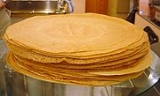
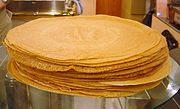
. There are also specially designed crêpe makers with a heatable circular surface that can be dipped in the batter and quickly pulled out to produce an ideal thickness and evenness of cooking. A cooked crêpe is a very thin pancake.
Common savoury fillings for crêpes served for lunch or dinner
Dinner
Dinner is usually the name of the main meal of the day. Depending upon culture, dinner may be the second, third or fourth meal of the day. Originally, though, it referred to the first meal of the day, eaten around noon, and is still occasionally used for a noontime meal, if it is a large or main...
are cheese, ham, and eggs, ratatouille
Ratatouille
Ratatouille is a traditional French Provençal stewed vegetable dish, originating in Nice. The full name of the dish is ratatouille niçoise.- Origin :...
, mushrooms, artichoke
Artichoke
-Plants:* Globe artichoke, a partially edible perennial thistle originating in southern Europe around the Mediterranean* Jerusalem artichoke, a species of sunflower with an edible tuber...
(in certain regions), and various meat products.
When sweet, they can be eaten as part of breakfast
Breakfast
Breakfast is the first meal taken after rising from a night's sleep, most often eaten in the early morning before undertaking the day's work...
or as a dessert
Dessert
In cultures around the world, dessert is a course that typically comes at the end of a meal, usually consisting of sweet food. The word comes from the French language as dessert and this from Old French desservir, "to clear the table" and "to serve." Common Western desserts include cakes, biscuits,...
. They can be filled and topped with various sweet toppings, often including Nutella
Nutella
Nutella is the brand name of a chocolate spread. Nutella, manufactured by the Italian company Ferrero, was introduced on the market in 1963. The recipe was developed from an earlier Ferrero spread released in 1944. Nutella is now sold in over 75 countries....
spread, preserves, sugar (granulated or powdered), maple syrup
Maple syrup
Maple syrup is a syrup usually made from the xylem sap of sugar maple, red maple, or black maple trees, although it can also be made from other maple species such as the bigleaf maple. In cold climates, these trees store starch in their trunks and roots before the winter; the starch is then...
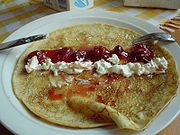
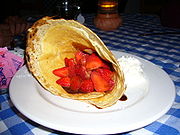
, lemon juice, whipped cream, fruit spreads, custard, and sliced soft fruits or confiture.
Types and special crêpes
Crêpes are especially popular throughout France. The common ingredients include flour, eggs, milk, butter, and a pinch of salt. Crêpes are usually of two types: sweet crêpes (crêpes sucrées) made with wheat flour and slightly sweetened; and savoury galetteGalette
Galette is a general term used in the French cuisine to designate various types of flat, round or freeform crusty cakes, similar in concept to a Chinese bing. One notable type is the galette des Rois eaten on the day of Epiphany...
s (crêpes salées) made with buckwheat
Buckwheat
Buckwheat refers to a variety of plants in the dicot family Polygonaceae: the Eurasian genus Fagopyrum, the North American genus Eriogonum, and the Northern Hemisphere genus Fallopia. Either of the latter two may be referred to as "wild buckwheat"...
flour and unsweetened. The name "galette" came from the French word galet ("pebble"), since the first gallettes were made on a large pebble heated in a fire. Batter made from buckwheat flour is gluten
Gluten
Gluten is a protein composite found in foods processed from wheat and related grain species, including barley and rye...
-free, which makes it possible for people who have a gluten allergy or intolerance
Food intolerance
Food intolerance or non-allergic food hypersensitivity is a term used widely for varied physiological responses associated with a particular food, or compound found in a range of foods....
to eat this type of crêpe.
Mille crêpe is a French cake made of many crêpe layers. The word mille means "a thousand", implying the many layers of crêpe.
Belgium
Belgium , officially the Kingdom of Belgium, is a federal state in Western Europe. It is a founding member of the European Union and hosts the EU's headquarters, and those of several other major international organisations such as NATO.Belgium is also a member of, or affiliated to, many...
crêpe is the crêpe Suzette
Crêpe Suzette
Crêpe Suzette is a French dessert consisting of a crêpe with beurre Suzette, , a sauce of caramelized sugar and butter, tangerine or orange juice, zest, and Grand Marnier or orange Curaçao liqueur on top, served flambé.-Preparation:...
, a crêpe with lightly grated orange peel and liqueur
Liqueur
A liqueur is an alcoholic beverage that has been flavored with fruit, herbs, nuts, spices, flowers, or cream and bottled with added sugar. Liqueurs are typically quite sweet; they are usually not aged for long but may have resting periods during their production to allow flavors to marry.The...
(usually Grand Marnier
Grand Marnier
Grand Marnier is a liqueur created in 1880 by Alexandre Marnier-Lapostolle. It is made from a blend of true cognacs and distilled essence of bitter orange. Grand Marnier is 40% alcohol . It is produced in several varieties, most of which can be consumed "neat" as a digestif and can be used in...
) which is subsequently lit upon presentation.
Cherry Kijafa Crêpes are also often common and are made with a traditional crêpe base, but filled with cherries simmered in a Kijafa wine sauce.
Some chefs insist that Beef Wellington
Beef Wellington
Beef Wellington is a preparation of fillet steak coated with pâté and duxelles, which is then wrapped in puff pastry and baked...
include a crêpe, wrapping the coated meat to retain moisture, thereby preventing the pastry from going soggy.
A common recipe practiced among bodybuilders is what is called a "bodybuilder's crêpe", made with whey
Whey
Whey or Milk Serum is the liquid remaining after milk has been curdled and strained. It is a by-product of the manufacture of cheese or casein and has several commercial uses. Sweet whey is manufactured during the making of rennet types of hard cheese like cheddar or Swiss cheese...
protein
Protein
Proteins are biochemical compounds consisting of one or more polypeptides typically folded into a globular or fibrous form, facilitating a biological function. A polypeptide is a single linear polymer chain of amino acids bonded together by peptide bonds between the carboxyl and amino groups of...
powder, flavoring, egg white, and other ingredients such as cottage cheese
Cottage cheese
Cottage cheese is a cheese curd product with a mild flavor. It is drained, but not pressed, so some whey remains and the individual curds remain loose. The curd is usually washed to remove acidity, giving sweet curd cheese. It is not aged or colored. Different styles of cottage cheese are made from...
, oats, and peanut butter. They are prepared the same way as normal crêpes are, but can sometimes cook much faster.
Crêperies
A crêperie may be a takeaway restaurant or stall, serving crêpes as a form of fast food or street foodStreet food
Street food is ready-to-eat food or drink sold in a street or other public place, such as a market or fair, by a hawker or vendor, often from a portable stall. While some street foods are regional, many are not, having spread beyond their region of origin. Most street food are both finger and fast...
, or may be a more formal sit-down restaurant or café.
Crêperies are typical of Brittany
Brittany
Brittany is a cultural and administrative region in the north-west of France. Previously a kingdom and then a duchy, Brittany was united to the Kingdom of France in 1532 as a province. Brittany has also been referred to as Less, Lesser or Little Britain...
in France; however, crêperies can be found throughout France and in many other countries.
Because a crêpe may be served as both a main meal or a dessert, crêperies may be quite diverse in their selection and may offer other baked goods such as baguette
Baguette
A baguette is "a long thin loaf of French bread" that is commonly made from basic lean dough...
s. They may also serve coffee, tea, buttermilk
Buttermilk
Buttermilk refers to a number of dairy drinks. Originally, buttermilk was the liquid left behind after churning butter out of cream. It also refers to a range of fermented milk drinks, common in warm climates where unrefrigerated fresh milk otherwise sours quickly...
and cider
Cider
Cider or cyder is a fermented alcoholic beverage made from apple juice. Cider varies in alcohol content from 2% abv to 8.5% abv or more in traditional English ciders. In some regions, such as Germany and America, cider may be termed "apple wine"...
(a popular drink to accompany crêpes).
In other countries
In SwedishSwedish language
Swedish is a North Germanic language, spoken by approximately 10 million people, predominantly in Sweden and parts of Finland, especially along its coast and on the Åland islands. It is largely mutually intelligible with Norwegian and Danish...
, a crêpe is called Pannkaka, in Dutch
Dutch language
Dutch is a West Germanic language and the native language of the majority of the population of the Netherlands, Belgium, and Suriname, the three member states of the Dutch Language Union. Most speakers live in the European Union, where it is a first language for about 23 million and a second...
a pannenkoek or Flensjes, and in Afrikaans
Afrikaans
Afrikaans is a West Germanic language, spoken natively in South Africa and Namibia. It is a daughter language of Dutch, originating in its 17th century dialects, collectively referred to as Cape Dutch .Afrikaans is a daughter language of Dutch; see , , , , , .Afrikaans was historically called Cape...
a pannekoek, which is usually served with cinnamon
Cinnamon
Cinnamon is a spice obtained from the inner bark of several trees from the genus Cinnamomum that is used in both sweet and savoury foods...
sugar. In Italy, crêpes are called crespella. In the Spanish regions of Galicia and Asturias
Asturias
The Principality of Asturias is an autonomous community of the Kingdom of Spain, coextensive with the former Kingdom of Asturias in the Middle Ages...
they are traditionally served at carnivals. In Galicia they're called filloas, and may also be made with pork blood instead of milk. In Asturias they are called fayueles or frixuelos, and in Turkey, "Akıtma".
In areas of Eastern Europe formerly belonging to the Austro-Hungarian empire, there is a thin pancake comparable to a crêpe that in Austro-Bavarian
Austro-Bavarian
Bavarian , also Austro-Bavarian, is a major group of Upper German varieties spoken in the south east of the German language area.-History and origin:...
is called Palatschinken
Palatschinken
Palatschinke is the Austrian and Bavarian name of the thin, crêpe-like variety of pancake common in Central and Eastern Europe.-The pancake:...
or Omletten; in ; and in Bosnian
Bosnian language
Bosnian is a South Slavic language, spoken by Bosniaks. As a standardized form of the Shtokavian dialect, it is one of the three official languages of Bosnia and Herzegovina....
, Serbian
Serbian language
Serbian is a form of Serbo-Croatian, a South Slavic language, spoken by Serbs in Serbia, Bosnia and Herzegovina, Montenegro, Croatia and neighbouring countries....
, Bulgarian
Bulgarian language
Bulgarian is an Indo-European language, a member of the Slavic linguistic group.Bulgarian, along with the closely related Macedonian language, demonstrates several linguistic characteristics that set it apart from all other Slavic languages such as the elimination of case declension, the...
, Macedonian
Macedonian language
Macedonian is a South Slavic language spoken as a first language by approximately 2–3 million people principally in the region of Macedonia but also in the Macedonian diaspora...
, Montenegrin
Montenegrin language
Montenegrin is a name used for the Serbo-Croatian language as spoken by Montenegrins; it also refers to an incipient standardized form of the Shtokavian dialect of Serbo-Croatian used as the official language of Montenegro...
, Czech
Czech language
Czech is a West Slavic language with about 12 million native speakers; it is the majority language in the Czech Republic and spoken by Czechs worldwide. The language was known as Bohemian in English until the late 19th century...
, Croatian
Croatian language
Croatian is the collective name for the standard language and dialects spoken by Croats, principally in Croatia, Bosnia and Herzegovina, the Serbian province of Vojvodina and other neighbouring countries...
and ; in . In the Balkan region such as the countries of Albania
Albania
Albania , officially known as the Republic of Albania , is a country in Southeastern Europe, in the Balkans region. It is bordered by Montenegro to the northwest, Kosovo to the northeast, the Republic of Macedonia to the east and Greece to the south and southeast. It has a coast on the Adriatic Sea...
, Bosnia, Croatia, Macedonia
Republic of Macedonia
Macedonia , officially the Republic of Macedonia , is a country located in the central Balkan peninsula in Southeast Europe. It is one of the successor states of the former Yugoslavia, from which it declared independence in 1991...
, Montenegro, and Serbia
Serbia
Serbia , officially the Republic of Serbia , is a landlocked country located at the crossroads of Central and Southeast Europe, covering the southern part of the Carpathian basin and the central part of the Balkans...
, palačinka or palaçinka may be eaten with fruit jam, quark cheese, sugar, honey, or the hazelnut-chocolate cream Nutella
Nutella
Nutella is the brand name of a chocolate spread. Nutella, manufactured by the Italian company Ferrero, was introduced on the market in 1963. The recipe was developed from an earlier Ferrero spread released in 1944. Nutella is now sold in over 75 countries....
. In Ashkenazi Jewish cuisine, there is a similar dish known as the blintz
Blintz
A blin, blintze, or blintz is a thin pancake. It is somewhat similar to a crêpe with the main difference being that yeast may be used in blini, but not in crêpes.-Etymology, origins, culture :...
. The Oxford English Dictionary derives the German and Slavic words from the Hungarians palacsinta, which it derives from the Romanian plăcintă ("pie, pancake"), which comes in turn from classical Latin placenta ("small flat cake"). In Chile and Argentina they are called panqueques and are often eaten with dulce de leche
Dulce de leche
Dulce de leche is a thick,creamy, caramel-like milk-based sauce or spread.Literally translated, dulce de leche means "sweet from milk". It is prepared by slowly heating sweetened milk to create a product that derives its taste from caramelised sugar. It is a popular sweet in Latin America, where...
(known in English as "milk caramel").
The names for thin crêpes in other parts of Europe are:
Dishes with similar appearance, taste and preparation methods exist in other parts of the world as well. In India, a crêpe made of fermented rice batter is called a dosa
Dosa
Dosa or Dhosai is a fermented crepe or pancake made from rice batter and black lentils. It is indigenous to and is a staple dish in the southern Indian states of Andhra Pradesh, Karnataka, Kerala, and Tamil Nadu, as well as being popular in Sri Lanka...
, which often has savoury fillings. Another variety is called Patibola and is sweet in taste due to milk, jaggery
Jaggery
Jaggery is a traditional unrefined non-centrifugal whole cane sugar consumed in Asia, Africa, Latin America, and the Caribbean. It is a concentrated product of cane juice without separation of the molasses and crystals, and can vary from golden brown to dark brown in color...
or sugar. The injera
Injera
Injera is a yeast-risen flatbread with a unique, slightly spongy texture. Traditionally made out of teff flour, it is a national dish in Ethiopia and Eritrea...
of Ethiopian
Ethiopia
Ethiopia , officially known as the Federal Democratic Republic of Ethiopia, is a country located in the Horn of Africa. It is the second-most populous nation in Africa, with over 82 million inhabitants, and the tenth-largest by area, occupying 1,100,000 km2...
/Eritrea
Eritrea
Eritrea , officially the State of Eritrea, is a country in the Horn of Africa. Eritrea derives it's name from the Greek word Erethria, meaning 'red land'. The capital is Asmara. It is bordered by Sudan in the west, Ethiopia in the south, and Djibouti in the southeast...
n/Somali
Somali people
Somalis are an ethnic group located in the Horn of Africa, also known as the Somali Peninsula. The overwhelming majority of Somalis speak the Somali language, which is part of the Cushitic branch of the Afro-Asiatic language family...
/Yemen
Yemen
The Republic of Yemen , commonly known as Yemen , is a country located in the Middle East, occupying the southwestern to southern end of the Arabian Peninsula. It is bordered by Saudi Arabia to the north, the Red Sea to the west, and Oman to the east....
i cuisine is often described as a thick crêpe. Also in Somalia, malawax is very similar to a crêpe. It is mostly eaten at breakfast.
Crêpes in culture
In France, crêpes are traditionally served on Candlemas (La Chandeleur), February 2. This day was originally Virgin Mary's Blessing Day but became known as "avec Crêpe Day", referring to the tradition of offering crêpes. The belief was that if you could catch the crêpe with a frying panFrying pan
A frying pan, frypan, or skillet is a flat-bottomed pan used for frying, searing, and browning foods. It is typically in diameter with relatively low sides that flare outwards, a long handle, and no lid. Larger pans may have a small grab handle opposite the main handle...
after tossing it in the air with your left hand and holding a gold coin in your right hand, you would become rich that year.