
|
|
|
|
Maple syrup
|
| |
|
| |
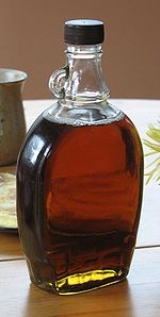
Maple syrup is a sweetener made from the sap of maple trees. In Canada and the United States it is most often eaten with waffles and pancakes. It is sometimes used as an ingredient in baking, the making of candy, preparing desserts, or as a sugar source and flavoring agent in making beer.

Discussion
Ask a question about 'Maple syrup'
Start a new discussion about 'Maple syrup'
Answer questions from other users
|
Encyclopedia
Maple syrup is a sweetener made from the sap of maple trees. In Canada and the United States it is most often eaten with waffles and pancakes. It is sometimes used as an ingredient in baking, the making of candy, preparing desserts, or as a sugar source and flavoring agent in making beer. Sucrose is the most prevalent sugar in maple syrup.
It was first collected and used by Native Americans/First Nations and was later adopted by European settlers.
History
Algonquins According to Native American oral tradition, maple syrup and maple sugar were being made long before Europeans began to record North American history. Native Americans in Eastern North America were the first to discover "sinzibuckwud," the Algonquin word for maple syrup, meaning "drawn from wood."
The Algonquins were the first to recognize the sap as a source of energy and nutrition. They would use a tomahawk to make a V-shaped incision in the tree. Then, they would insert reeds or concave pieces of bark to run the sap into buckets made from birch bark. The sap was slightly concentrated, either by throwing hot stones in the bucket, or by leaving it overnight and disposing of the layer of ice which had formed on top. It was drunk as a sweet drink or used in cooking.
To boil the water, they used a cauldron made of cooked earth. They boiled maple sap over simple fires protected only by a roof of tree branches. This was the first version of the sugar shack. Over the years, this method has evolved to the point where the sugar shack is not only a place where maple syrup is produced, but also a gathering place where a traditional meal can be enjoyed.
Early Settlers in Quebec and New England/Vermont Region of the US
In the 1700s, the European settlers and fur traders introduced wooden buckets, made by hollowing out a log. When the log was full, they poured the water into a cast-iron cauldron.
They boiled outside, in the woods, where their tree resource was located. To protect themselves from wind and rain, they built a little camp. Often times whole families would move to the woods to do the sap gathering and sap boiling, hence the term "sugar camp". They literally moved to the woods and camped out, as the boiling process in early times was excessively time consuming. In the early days of colonization, it was the Natives who showed French settlers how to tap the trunk of a tree at the outset of spring, harvest the sap and boil it to evaporate some of the water. This custom quickly became an integral part of colony life and during the 17th and 18th centuries, syrup was a major source of high quality pure sugar. Later they would learn to bore holes in the trees and hang their buckets on home-made spouts.
By the 1850s, the "sugar shack" or "sugarhouse" (the outdoor shack or building used to boil down the sap) arrived as we know it today. The settlers had refined the methods for collecting the sap. The sap was transported using large barrel pulled by horses or oxen and brought to the sugar shack for processing. At this time, the maple sugar was the only available sugar, and it was called “country sugar”. Maple sugar production was especially important due to the fact that other types of sugar were hard to find and expensive. It was as common on the table as salt is today.
Production methods have been streamlined since colonial days, yet remain basically the same. Sap must first be collected and boiled down carefully to obtain pure syrup without chemical agents or preservatives.
Early maple syrup was made by boiling approximately forty gallons (160 l) of sap over an open fire until one gallon (4 l) of syrup was obtained. This was both time consuming and labor intensive, considering the sap needed to be hauled to the fire.
This process underwent little change over the first two hundred years of recorded maple syrup making. Around the time of the American Civil War, syrup makers started using a large flat sheet metal pan as it was more efficient for boiling than a heavy rounded iron kettle which let much of the heated air slide past.
Virtually all syrup makers in the past were self-sufficient dairy farmers who made both syrup and sugar for their own use and for extra income. The process continued to evolve as a result of the innovations developed in their work. In 1864, a Canadian borrowed some design ideas from sorghum evaporators and put a series of baffles in the flat pans to channel the boiling sap. In 1872 a Vermonter developed an evaporator with two pans and a metal arch or firebox which greatly decreased boiling time. Seventeen years later, in 1889, another Canadian bent the tin that formed the bottom of a pan into a series of flues which increased the heated surface area of the pan and again decreased boiling time.
For the most part technology stayed at this point for almost another century, until the 1960’s, when it was no longer a self sufficient enterprise with large families as farm hands. Because syrup making was so labor intensive, farmers could no longer afford to hire large crews it took to gather all the buckets and haul the sap to the evaporator house. During the energy crunch of the 1970’s, syrup makers responded with another surge of technological breakthroughs. Tubing systems, which had been experimented with since the early part of the century, were perfected and the sap came directly from the tree to the evaporator house. Vacuum pumps were added to the tubing systems. Pre-heaters were developed to "recycle" heat lost in the steam. Reverse-osmosis machines were developed to take a portion of water out of the sap before it was boiled. Several producers even obtained surplus desalinization machines from the U.S. Navy and used them to take a portion of water out of the sap prior to boiling. In fact, one is still in use by producer South-East of Grand Rapids, Michigan.
The technological developments continue. Improvements continued in tubing. Similarly, new filtering techniques, "supercharged" preheaters, and better storage containers have been developed. Research continues on pest control and improved woodlot management.
Production
Maple syrup production is centered in northeastern North America, and is commonly associated with Quebec in Canada and Vermont in the U.S. However, given the correct weather conditions, it can be made wherever maple trees grow. Usually, the maple species used are the sugar maple (Acer saccharum) and the black maple (Acer nigrum), because of a high sugar content in the sap of roughly two percent. A maple syrup production farm is called a "sugar bush" or "the sugarwoods". Sap is often boiled in a "sugar house" (also known as a "sugar shack" or cabane à sucre), a building which is louvered at the top to vent the steam from the boiling sap.
Canada makes more than 80 percent of the world's maple syrup, producing about in 2005. The vast majority of this comes from Quebec: the province is by far the world's largest producer, with about 75 percent of the world production ( in 2005). Production in Quebec is controlled through a supply-management system. with producers receiving quota allotments from the Fédération des producteurs acéricoles du Québec. The province also maintains it own "strategic reserves" of maple syrup, which reached its highest point in 2004, when it totalled 60 million pounds, or 4.5 million gallons.
The provinces of Ontario, Nova Scotia, New Brunswick and Prince Edward Island produce smaller amounts. The province of Manitoba also produces maple syrup using the sap off the Manitoba Maple tree (acer negundo, also known as a "Box Elder"). Manitoba Maple syrup is much darker in colour and flavour than maple syrup made from a sugar maple, and the difference between the two is akin to that between golden brown sugar and dark brown sugar.
Vermont is the biggest U.S. producer, with in 2007, followed by Maine with and New York with . Wisconsin, Ohio, New Hampshire, Michigan, Pennsylvania, Massachusetts, and Connecticut all produced marketable quantities of maple syrup of less than each in 2007.
Production in 2008:
Canada: 4.9 million gallons (more than 90 percent of that came from Quebec);
Vermont: 450,000 gallons;
New York: 322,000 gallons;
Maine: 215,000 gallons;
Wisconsin: 130,000 gallons;
Ohio: 118,000 gallons;
Michigan: 100,000 gallons;
Pennsylvania: 95,000 gallons;
New Hampshire: 85,000 gallons.
Traditionally, maple syrup was harvested by tapping a maple tree through the bark and into the wood, then letting the sap run into a bucket, which required daily collecting; less labour-intensive methods such as the use of continuous plastic pipelines have since superseded this, in all but cottage-scale production.
Production is concentrated in February, March, and April, depending on local weather conditions. Freezing nights and warm days are needed in order to induce sap flows. The change in temperature from above to below freezing causes water uptake from the soil, and temperatures above freezing cause a stem pressure to develop, which, along with gravity, causes sap to flow out of tapholes or other wounds in the stem or branches. To collect the sap, holes are bored into the maple trees and tubes (taps, spouts, spiles) are inserted. Sap flows through the spouts into buckets or into plastic tubing. Modern use of plastic tubing with a partial vacuum has enabled increased production. A hole must be drilled in a new location each year, as the old hole will produce sap for only one season due to the natural healing process of the tree, called walling-off. Maple sap is collected from the buckets and taken to the sugar house; if plastic tubing and pipelines are used, then the pipelines are arranged so that the sap will flow by gravity into the sugar house, or if that is not possible, into holding tanks from which the sap is pumped or transported by tanker truck to the sugar house.
It takes approximately 40 liters (10 gal) of sap to be boiled down to 1 liter (1 quart) of syrup. A mature sugar maple produces about 40 liters of sap during the 4-6 week sugaring season. Trees are not tapped until they have a diameter of 25 cm (10 in) at chest-height and the tree is at least 40 years old. If the tree is more than 45 cm it can be tapped twice on opposite sides. It is recommended that the drilled tap hole have a width of 8 mm (? in) and a depth of .
During cooking, the sap is fed automatically by pipe from a storage tank to a long and narrow ridged pan called the evaporator. The evaporator is usually divided into two sections, the front pan and the back pan. As the sap boils, the water evaporates; it becomes denser and sweeter. As the density of the sap increases, it works its way from the rear of the back evaporator pan to the front evaporator pan. The syrup is boiled until it reaches the correct density of maple syrup, 1333 kg/m3. The proper density of at least 66% sugar is reached when the boiling sap reached a temperature of 7 degrees F. above the boiling point of water. The density is tested with a hydrometer. If the density is too low the syrup will not be sweet enough and the syrup will spoil. If the density is too high the syrup will crystallize in bottles. When the syrup has reached the proper density, it is drawn off, filtered and bottled while hot.
Starting in the 1970s, some maple syrup producers started using reverse osmosis to remove water from sap before being further boiled down to syrup. The use of reverse osmosis allows approximately 75 to 80% of the water to be removed from the sap prior to boiling, reducing energy consumption and exposure of the syrup to high temperatures. Microbial contamination and degradation of the membranes has to be monitored.
Maple syrup is sometimes boiled down further to make maple sugar, a hard candy usually sold in pressed blocks, and maple taffy. Intermediate levels of boiling can also be used to create various intermediate products, including maple cream (less hard and granular than maple sugar) and maple butter (creamy, with a consistency slightly less thick than peanut butter).
Starting in the mid 80's, northern communities in the province of Quebec began to open the "Cabane à Sucre" or Sugar Shacks to the public. These sugar shacks were generally located on large maple farms and often were built solely for tourist purposes. These sugar shacks serve maple syrup direct to the public and also are often restaurants serving maple syrup inspired meals and treats.
Price
2007
A 2007 New England price of $31.68 per gallon reflects a rise of $1.37 over 2006.
2008
In December 2008, price quotations from the two largest syrup packers in New England ranged from $41.50 per gallon of Grade A syrup to $44 per gallon wholesale. This major price increase was present since May 2008, attributed primarily to the depletion of extra syrup stores from Quebec that had been partially serving the increased demand that grew in the past few years. Retail rates have been proportionately higher.
2009
By March of 2009, the price of a standard 540-millilitre can of syrup rose to as high as $CAN 10 in Montreal, compared with $6.50 for most of this decade, due to poor harvests in 2007 and 2008 caused by cold spring weather, which inhibited sap flow.
Grades
Canadian, U.S., and Vermont grading
In Canada, there are three grades containing several color classes, ranging from Canada #1, including Extra Light (sometimes known as AA), Light (A), and Medium (B); through #2, Amber (C); and finally #3 Dark (D). A typical year's yield will include about 25–30% of each of the #1 colors, 10% Amber, and 2% Dark. Extra-light syrups are recommended for making maple sugar candy and for use on pancakes and waffles; Light for French toast and cornbread, desserts and cereals; Medium for glazing, sweetening, or eating on its own. Number 2 grade syrups are intended for baking and flavouring. In addition, Canada #2 Amber may be labeled Ontario Amber for farm sales in that province only. Number 3 grade syrup is heavy, and restricted for use in commercial flavourings.
The United States uses somewhat different grading standards. Maple syrup is divided into two major grades: Grade A and Grade B. Grade A is further broken down into three subgrades: Light Amber (sometimes known as Fancy), Medium Amber, and Dark Amber. Grade B is darker than Grade A Dark Amber. The Vermont Agency of Agriculture Food and Markets uses a similar grading system of color and taste. The grade Vermont Fancy is similar in color and taste to U.S Grade A Light (Fancy). The Vermont grading system differs from the U.S. system in maintaining a slightly higher standard of product density. Vermont maple is boiled just a bit longer for a slightly thicker, denser product. The ratio of the volume of sap to the yielded volume of finished syrup is higher in the Vermont system. Maple syrup is sold by liquid volume, not weight. The Vermont graded product has one-half percent more solid material and less water in its composition. A non-table grade of syrup called commercial, or Grade C, is also produced. This is very dark, with a very strong flavor. Commercial maple syrup is generally used as a flavoring agent in other products.
The grades roughly correspond to various times within the season when syrups are produced. Canada #1 Extra Light and U.S. Grade A Light Amber are early-season grades, while Canada #2 and #3 and U.S. Grade B are late-season grades. Typically #1 Extra Light and Grade A (especially Grade A Light Amber) has a milder, more delicate flavor than #3 or Grade B, which is very dark with a robust flavor. The dark grades of syrup are primarily used for cooking and baking.
Off-flavours
Sometimes off-flavours are found in maple syrup. While this is more common toward the end of the season in the production of commercial grade product, it may also be present early in the season during the production of Canada #1 grade or U.S. Grade A Light. Identification of off-flavour in table grades is cause for ceasing production and either dumping the product or reclassifying the product as commercial grade if the off-flavour is slight. Off-flavours are described as: metabolism, derived from metabolic changes in the tree as spring arrives and having either a woody, popcorn, or sometimes peanutbutter-like flavour; buddy, referring to the swelling of the new buds and its impact on the flavour and having a bitter chocolate or burnt flavour; and ferment, an off-taste caused by fermentation and having a honey or fruity flavour, often accompanied by surface foam. Additionally, if trees are stressed or fighting off disease or insects (eg. gypsy moths), they will produce a folic-like acid causing a bad taste. After an ice storm, trees may also produce the same acid.
Use in food and cultural significance
Maple syrup and its artificial imitations are the preferred toppings for pancakes, waffles, and French toast in North America.
Maple syrup can also be used for a variety of uses, including: biscuits, fresh donuts, fried dough, fritters, ice cream, hot cereal, and fresh fruit (especially grapefruit). It is also used as sweetener for applesauce, baked beans, candied sweet potatoes, winter squash, cakes, pies, breads, fudge and other candy, milkshakes, tea, coffee, and hot toddies.
Maple syrup and maple sugar were used during the American Civil War and by abolitionists in the years prior to the war because most cane sugar and molasses was produced by Southern slaves. During food rationing in World War II, people in the northeastern United States were encouraged to stretch their sugar rations by sweetening foods with maple syrup and maple sugar, and recipe books were printed to help housewives employ this alternate source.
In Quebec, eastern Ontario, and New England the process has become part of the culture. One tradition is going to sugar houses (cabanes à sucre) in early spring for meals served with maple syrup-based products, especially the dish known variously as Tire sur la neige (in Quebec), maple taffee (in English Canada), and sugar on snow (in the United States). This is thickened hot syrup poured onto fresh snow and then eaten off sticks as it quickly cools. This thick maple syrup-based candy can be served in some cases served with yeast-risen doughnuts, sour dill pickles, and coffee.
Owing to the sugar maple tree's predominance in southeastern Canada (where European settlement of what would become Canada began), its leaf has come to symbolize the country, and is depicted on its flag. Several U.S. states, including New York and Vermont, have the sugar maple as their state tree. A scene of sap collection is depicted on the Vermont state quarter as well as the tins of the Vermont Maple Sugar Makers' Association, a non-governmental agricultural organization that works to protect the integrity and purity of Vermont maple products, and to promote its historic significance to the culture of Vermont.
Imitation maple syrup
Many "maple-flavored syrups" are imitations (table syrups), which are less expensive than real maple syrup. In these syrups the primary ingredient is most often high fructose corn syrup flavored with sotolon, with little (2–3%) or no real maple syrup content. They are usually thickened far beyond the viscosity of real maple syrup. Since U.S. labeling laws prohibit these products from being labeled "maple syrup", many manufacturers simply call the imitation "syrup" or "pancake syrup". Aunt Jemima, now owned by Quaker Oats, is a major North American producer of pancake syrup.
Québécois sometimes refer to imitation maple syrup as sirop de poteau ("pole syrup"), a joke referring to the syrup as having been made by tapping telephone poles.
In 1905, Crescent Foods Inc. created the popular imitation maple flavoring called Mapleine. Bought out by McCormick spices, it still distributes "Crescent Mapleine" from limited production runs.
The fenugreek seed, a spice, is used to make a very strong commercial flavoring that is similar to maple syrup, but much less expensive.
Identification of Maple Trees
Maple trees most commonly tapped for sap collection are Sugar Maple, Black Maple, Red Maple, and Silver Maple. These maple trees are common in the Northeast United States and Eastern Canada. The Sugar Maple and Black Maple provide the highest sugar content, and therefore are ideal for a better maple syrup yield and shorter boiling times. Quicker boiling often makes for a higher grade syrup. Maple trees are identified based on leaf structure, bark, fruit, and other characteristics. The bark on the Sugar Maple is dark gray to brown and has developed vertical grooves and ridges, often broken up by plates of bark. The leaf is rounded at the base, extending to generally 5 lobes without fine teeth (compared to Red and Silver Maples). The color is bright green, with a paler green underside. Sugar Maple fruit has seeds joined in a straight line, while the wings are separated by approximately 60 degrees. Each winged seed is about 1 inch (25 mm) long and matures in the fall.
See also
External links
- Taste and nutrition:
-
-
- by Jane Black, New York Times, December 20, 2006.
-
- Production:
-
- (1st edition), edited by Melvin R. Koelling and Randall B. Heiligmann, (Bulletin 856), 1996. (archived at Internet Archive#Wayback Machine) – "The Bible" of maple syrup production.
- by Kathryn Hopkins, University of Maine Cooperative Extension (Bulletin 7038)
- Site dedicated to promoting tapping of maple trees by individuals at home.
|
| |
|
|