


Jaggery

Encyclopedia
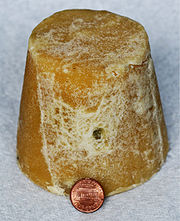
Whole cane sugar
Whole cane sugar refers to unrefined sugar, which is obtained from sugar cane. Minimal processing produces products like Panela from Latin America, Rapadura from Brazil, Muscovado from the Philippines, Jaggery which can be found in Asia, Africa, Latin America, and the Caribbean, and Sucanat...
consumed in Asia
Asia
Asia is the world's largest and most populous continent, located primarily in the eastern and northern hemispheres. It covers 8.7% of the Earth's total surface area and with approximately 3.879 billion people, it hosts 60% of the world's current human population...
, Africa
Africa
Africa is the world's second largest and second most populous continent, after Asia. At about 30.2 million km² including adjacent islands, it covers 6% of the Earth's total surface area and 20.4% of the total land area...
, Latin America
Latin America
Latin America is a region of the Americas where Romance languages – particularly Spanish and Portuguese, and variably French – are primarily spoken. Latin America has an area of approximately 21,069,500 km² , almost 3.9% of the Earth's surface or 14.1% of its land surface area...
, and the Caribbean
Caribbean
The Caribbean is a crescent-shaped group of islands more than 2,000 miles long separating the Gulf of Mexico and the Caribbean Sea, to the west and south, from the Atlantic Ocean, to the east and north...
. It is a concentrated product of cane juice without separation of the molasses
Molasses
Molasses is a viscous by-product of the processing of sugar cane, grapes or sugar beets into sugar. The word molasses comes from the Portuguese word melaço, which ultimately comes from mel, the Latin word for "honey". The quality of molasses depends on the maturity of the sugar cane or sugar beet,...
and crystals, and can vary from golden brown to dark brown in color. It contains up to 50% sucrose
Sucrose
Sucrose is the organic compound commonly known as table sugar and sometimes called saccharose. A white, odorless, crystalline powder with a sweet taste, it is best known for its role in human nutrition. The molecule is a disaccharide composed of glucose and fructose with the molecular formula...
, up to 20% invert sugars, moisture content of up to 20%, and the remainder made up of other insoluble matter such as wood ash
Wood ash
Wood ash is the residue powder left after the combustion of wood. Main producers of wood ash are wood industries and power plants.-Composition:...
, protein
Protein
Proteins are biochemical compounds consisting of one or more polypeptides typically folded into a globular or fibrous form, facilitating a biological function. A polypeptide is a single linear polymer chain of amino acids bonded together by peptide bonds between the carboxyl and amino groups of...
s and bagasse
Bagasse
Bagasse is the fibrous matter that remains after sugarcane or sorghum stalks are crushed to extract their juice. It is currently used as a biofuel and as a renewable resource in the manufacture of pulp and paper products and building materials....
fibers.
Origins and production
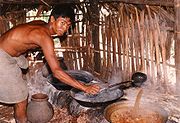
Sugarcane
Sugarcane refers to any of six to 37 species of tall perennial grasses of the genus Saccharum . Native to the warm temperate to tropical regions of South Asia, they have stout, jointed, fibrous stalks that are rich in sugar, and measure two to six metres tall...
and the palm tree. The sugar made from the sap of the date palm is both more prized and less commonly available outside of the regions where it is made. The sago
Sago
Sago is a starch extracted in the spongy center or pith, of various tropical palm stems, Metroxylon sagu. It is a major staple food for the lowland peoples of New Guinea and the Moluccas, where it is called saksak and sagu. A type of flour, called sago flour, is made from sago. The largest supply...
palm and coconut palm are also now tapped for producing jaggery in West Bengal
West Bengal
West Bengal is a state in the eastern region of India and is the nation's fourth-most populous. It is also the seventh-most populous sub-national entity in the world, with over 91 million inhabitants. A major agricultural producer, West Bengal is the sixth-largest contributor to India's GDP...
, South India
South India
South India is the area encompassing India's states of Andhra Pradesh, Karnataka, Kerala and Tamil Nadu as well as the union territories of Lakshadweep and Pondicherry, occupying 19.31% of India's area...
, Pakistan
Pakistan
Pakistan , officially the Islamic Republic of Pakistan is a sovereign state in South Asia. It has a coastline along the Arabian Sea and the Gulf of Oman in the south and is bordered by Afghanistan and Iran in the west, India in the east and China in the far northeast. In the north, Tajikistan...
, and Sri Lanka
Sri Lanka
Sri Lanka, officially the Democratic Socialist Republic of Sri Lanka is a country off the southern coast of the Indian subcontinent. Known until 1972 as Ceylon , Sri Lanka is an island surrounded by the Indian Ocean, the Gulf of Mannar and the Palk Strait, and lies in the vicinity of India and the...
. In Sri Lanka, syrup extracts from Caryota urens
Caryota urens
Caryota urens is a species of flowering plant in the palm family from Sri Lanka, Myanmar, and India where they grow in fields and rain-forest clearings. The epithet urens is Latin for 'stinging' alluding to the chemicals in the fruit...
trees are widely used for jaggery production. This is considered the best quality jaggery available in local market and is given a higher value than jaggery coming from other sources.
All types of the sugar come in blocks or pastes of solidified concentrated sugar syrup
Syrup
In cooking, a syrup is a thick, viscous liquid consisting primarily of a solution of sugar in water, containing a large amount of dissolved sugars but showing little tendency to deposit crystals...
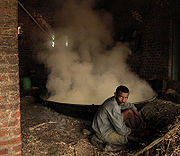
heated to 200 °C. Traditionally, the syrup is made by boiling raw sugarcane juice or palm sap
Sap
Sap may refer to:* Plant sap, the fluid transported in xylem cells or phloem sieve tube elements of a plant* Sap , a village in the Dunajská Streda District of Slovakia...
in a large shallow round-bottom vessel.
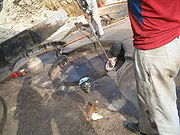
South Asia
Jaggery is used as an ingredient in both sweet and savory dishes across IndiaIndian cuisine
Indian cuisine consists of thousands of regional cuisines which date back thousands of years. The dishes of India are characterised by the extensive use of various Indian spices, herbs, vegetables and fruit. Indian cuisine is also known for the widespread practice of vegetarianism in Indian society...
and Sri Lanka
Sri Lanka
Sri Lanka, officially the Democratic Socialist Republic of Sri Lanka is a country off the southern coast of the Indian subcontinent. Known until 1972 as Ceylon , Sri Lanka is an island surrounded by the Indian Ocean, the Gulf of Mannar and the Palk Strait, and lies in the vicinity of India and the...
. For example, a pinch of it is sometimes added to sambar, rasam
Rasam
Rasam is a South Indian soup. Traditional preparation involves tamarind juice as base in addition to tomato, chili pepper and other spices as seasonings. Steamed lentils are added by some along with any preferred vegetables. Nowadays all the seasonings required are combined and ground beforehand...
, and other staples in India. Jaggery is also added to lentil
Lentil
The lentil is an edible pulse. It is a bushy annual plant of the legume family, grown for its lens-shaped seeds...
soups (dāl
Dal
Dal is a preparation of pulses which have been stripped of their outer hulls and split. It also refers to the thick stew prepared from these, an important part of Indian, Nepali, Pakistani, Sri Lankan, and Bangladeshi cuisine...
) to add sweetness to balance the spicy, salty and sour components, particularly in Bengali cuisine
Bengali cuisine
Bengali cuisine is a culinary style originating in Bengal, a region in the eastern South Asia which is now divided between the Indian state of West Bengal and the independent country of Bangladesh. Other regions, such as Tripura, and Barak Valley region of Assam also have large native Bengali...
and Gujarati cuisine
Gujarati cuisine
Gujarati cuisine refers to the cuisine of the Gujaratis from India, who are predominant in western India. It is primarily a vegetarian cuisine, despite having an extensive coastline for sea food, due influence of Jain vegetarianism and traditional Hinduism...
.
The Indian state of Maharashtra
Maharashtra
Maharashtra is a state located in India. It is the second most populous after Uttar Pradesh and third largest state by area in India...
is the largest producer and consumer of jaggery (Guḷ (गुळ) in Marathi
Marathi language
Marathi is an Indo-Aryan language spoken by the Marathi people of western and central India. It is the official language of the state of Maharashtra. There are over 68 million fluent speakers worldwide. Marathi has the fourth largest number of native speakers in India and is the fifteenth most...
). In Maharashtra, most vegetables curries
Curry
Curry is a generic description used throughout Western culture to describe a variety of dishes from Indian, Pakistani, Bangladeshi, Sri Lankan, Thai or other Southeast Asian cuisines...
and dals contain it. This is specially used during Makar Sankranti for making a dessert called tilgul
Tilgul
Tilgul is a colourful sesame candy coated with sesame seeds; in Maharashtra people exchange tilgul on Sankranti, a Hindu festival celebrated on 14 January....
. In Gujarat, known as Gôḷ (ગોળ), during Makara Sankranti, a similar preparation called Tal na Ladu or Tal Sankli is made. In rural Maharashtra, water and a piece of jaggery is given when someone arrives home from working under a hot sun.
Kakvi, a byproduct of the production of jaggery, is also used in rural Maharashtra as a sweetener. It contains many minerals not found in ordinary sugar and is considered beneficial to health by the traditional Ayurvedic
Ayurveda
Ayurveda or ayurvedic medicine is a system of traditional medicine native to India and a form of alternative medicine. In Sanskrit, words , meaning "longevity", and , meaning "knowledge" or "science". The earliest literature on Indian medical practice appeared during the Vedic period in India,...
medical system. It is an ingredient of many sweet delicacies such as gur ka chawal ("jaggery rice"), a traditional Rajasthani dish.
In Gujarat, laddus
Laddu
Laddu or Laddoo is a ball-shaped sweet popular in South Asian countries including India, Pakistan, Nepal and Bangladesh as well as countries with immigrants from South Asia. Laddu is made of flour and sugar with other ingredients that vary by recipe...
are made from wheat flour and jaggery. A well-known Maharashtrian recipe, Puran poli
Puran Poli
Puran Poli is a traditional type of sweet flatbread made in India in the states of Maharashtra, Gujarat, Karnataka, Tamil Nadu and Goa.-Ingredients:*300 gm - Channa dal or split yellow gram*300 gm - Jaggery...
, also uses it as a sweetener apart from Sugar. Jaggery is considered an easily available sweet which is shared on any good occasion. In engagement
Engagement
An engagement or betrothal is a promise to marry, and also the period of time between proposal and marriage which may be lengthy or trivial. During this period, a couple is said to be betrothed, affianced, engaged to be married, or simply engaged...
ceremonies, small particles of it are mixed with coriander seeds (ધાણા). Hence in many Gujarati communities, engagement is commonly known as Gol-Dhana (ગોળ-ધાણા), literally "jaggery and coriander seeds".
In Tamil Nadu
Tamil Nadu
Tamil Nadu is one of the 28 states of India. Its capital and largest city is Chennai. Tamil Nadu lies in the southernmost part of the Indian Peninsula and is bordered by the union territory of Pondicherry, and the states of Kerala, Karnataka, and Andhra Pradesh...
, it is used in a dish called chakkarai Pongal. It is prepared during the festival of Pongal, which is held when the harvesting season begins.
In Oriya
Oriya people
The Oriya, known classically by various names , are an ethnic group of eastern India and of eastern Indo-Aryan stock...
cuisine, cakes or piṭha
Pitha
Pitha , or pithe is a type of cake or bread common in Bangladesh and India, especially the eastern states of Assam, Orissa, West Bengal, Bihar, Jharkhand, and the northeastern region. Pithas are typically made of rice flour, although there are some types of pitha made of wheat flour...
s contain jaggery. Some marmalades made of mango and Dillenia
Dillenia
Dillenia is a genus of about 100 species of flowering plants in the family Dilleniaceae, native to tropical and subtropical regions of southern Asia, Australasia, and the Indian Ocean islands....
also contain the ingredient.
In Bengali
Bengali people
The Bengali people are an ethnic community native to the historic region of Bengal in South Asia. They speak Bengali , which is an Indo-Aryan language of the eastern Indian subcontinent, evolved from the Magadhi Prakrit and Sanskrit languages. In their native language, they are referred to as বাঙালী...
Hindu cuisine, it is commonly used in making sweet dishes, some of which mix jaggery with milk and coconut. Popular sweet dishes like laḍḍu / naṛu or paṭishapta piṭha
Pitha
Pitha , or pithe is a type of cake or bread common in Bangladesh and India, especially the eastern states of Assam, Orissa, West Bengal, Bihar, Jharkhand, and the northeastern region. Pithas are typically made of rice flour, although there are some types of pitha made of wheat flour...
mix it with coconut shreds. Jaggery is also molded into novel shapes as a type of candy
Candy
Candy, specifically sugar candy, is a confection made from a concentrated solution of sugar in water, to which flavorings and colorants are added...
.
Traditional Karnataka
Karnataka
Karnataka , the land of the Kannadigas, is a state in South West India. It was created on 1 November 1956, with the passing of the States Reorganisation Act and this day is annually celebrated as Karnataka Rajyotsava...
sweets like Payasa, Obattu (Poli), and Unday use different kinds of jaggery. A pinch is commonly added to sambar and rasam . Karnataka produces both sugar- and palm-based jaggery.
The Muzaffarnagar District in Uttar Pradesh
Uttar Pradesh
Uttar Pradesh abbreviation U.P. , is a state located in the northern part of India. With a population of over 200 million people, it is India's most populous state, as well as the world's most populous sub-national entity...
has the largest jaggery market in the world, followed by Anakapalli in the Visakhapatnam District in Andhra Pradesh
Andhra Pradesh
Andhra Pradesh , is one of the 28 states of India, situated on the southeastern coast of India. It is India's fourth largest state by area and fifth largest by population. Its capital and largest city by population is Hyderabad.The total GDP of Andhra Pradesh is $100 billion and is ranked third...
. The Kolhapur district in western Maharashtra is also famous for its variety of jaggery, which is yellow and much sought after in Maharashtra and Gujarat. Mandya
Mandya
Mandya is a city in the state of Karnataka, India. It is the headquarters of Mandya district and is located 40 km from Mysore and 100 km from Bangalore.-Etymology:...
in Karnataka is known for its jaggery production.
All over India
India
India , officially the Republic of India , is a country in South Asia. It is the seventh-largest country by geographical area, the second-most populous country with over 1.2 billion people, and the most populous democracy in the world...
, jaggery has religious significance to Hindus
Hinduism
Hinduism is the predominant and indigenous religious tradition of the Indian Subcontinent. Hinduism is known to its followers as , amongst many other expressions...
. Many of the festivals involve the offering of jaggery to deities during worship. Jaggery is considered auspicious in many parts of India, and is eaten raw before the commencement of good work or any important new venture, or after good news is shared by family and friends.
In Myanmar
Myanmar
Burma , officially the Republic of the Union of Myanmar , is a country in Southeast Asia. Burma is bordered by China on the northeast, Laos on the east, Thailand on the southeast, Bangladesh on the west, India on the northwest, the Bay of Bengal to the southwest, and the Andaman Sea on the south....
, jaggery is harvested from toddy palm
Borassus flabellifer
Borassus flabellifer, the Asian Palmyra palm, Toddy palm, Sugar palm, or Cambodian palm, is native to South and Southeast Asia, in the Indomalaya ecozone...
syrup. In central Myanmar and around Bagan
Bagan
Bagan , formerly Pagan, is an ancient city in the Mandalay Region of Burma. Formally titled Arimaddanapura or Arimaddana and also known as Tambadipa or Tassadessa , it was the capital of several ancient kingdoms in Burma...
(Pagan), toddy syrup is collected solely for the purpose of making jaggery. The translucent white syrup is boiled until it becomes golden brown, and then made into bite-sized pieces. It is considered a sweet
Confectionery
Confectionery is the set of food items that are rich in sugar, any one or type of which is called a confection. Modern usage may include substances rich in artificial sweeteners as well...
and is eaten by children and adults alike, usually in the afternoon along with a pot of green tea
Green tea
Green tea is made solely from the leaves of Camellia sinensis that have undergone minimal oxidation during processing. Green tea originates from China and has become associated with many cultures throughout Asia. It has recently become more widespread in the West, where black tea is traditionally...
. It has been referred to locally as Burmese chocolate. Toddy palm jaggery is also sometimes mixed with coconut shreds, jujube
Jujube
Ziziphus zizyphus , commonly called jujube , red date, Chinese date, Korean date, or Indian date is a species of Ziziphus in the buckthorn family Rhamnaceae, used primarily as a fruiting shade tree.-Distribution:Its precise natural distribution is uncertain due to extensive cultivation,...
puree or sesame
Sesame
Sesame is a flowering plant in the genus Sesamum. Numerous wild relatives occur in Africa and a smaller number in India. It is widely naturalized in tropical regions around the world and is cultivated for its edible seeds, which grow in pods....
, depending on the area. This type of jaggery is also used in Burmese
Cuisine of Myanmar
Burmese cuisine includes a rich collection of dishes and meals found in various regions of the country, which is also known as Myanmar. Owing to the geographic location of Myanmar, Burmese cuisine has been influenced greatly by China, India and Thailand...
cooking, usually to add color and enrich the food.
Other uses
Other uses include jaggery toffeeToffee
Toffee is a confection made by caramelizing sugar or molasses along with butter, and occasionally flour. The mixture is heated until its temperature reaches the hard crack stage of 300 to 310 °F...
s and jaggery cake made with pumpkin
Pumpkin
A pumpkin is a gourd-like squash of the genus Cucurbita and the family Cucurbitaceae . It commonly refers to cultivars of any one of the species Cucurbita pepo, Cucurbita mixta, Cucurbita maxima, and Cucurbita moschata, and is native to North America...
preserve, cashew
Cashew
The cashew is a tree in the family Anacardiaceae. Its English name derives from the Portuguese name for the fruit of the cashew tree, caju, which in turn derives from the indigenous Tupi name, acajú. It is now widely grown in tropical climates for its cashew nuts and cashew apples.-Etymology:The...
nuts, pea nuts and spices.
Jaggery may also be used in the creation of alcoholic beverages like palm wine
Palm wine
Palm wine also called Palm Toddy also called "Kallu" written in Malayalam and கள்ளு in Tamil or simply Toddy is an alcoholic beverage created from the sap of various species of palm tree such as the palmyra, and coconut palms...
.
Besides being a food, jaggery may also be used to season the inside of tandoor
Tandoor
A tandoor is a cylindrical clay oven used in cooking and baking. The tandoor is used for cooking in Azerbaijan, India, Turkey, Iran, Armenia, Georgia, Pakistan, Uzbekistan, Afghanistan, the Balkans, the Middle East, and Central Asia, as well as Burma and Bangladesh.The heat for a tandoor was...
ovens.
Health benefits
Some consider jaggery a particularly wholesome sugar, since it retains more mineral saltsDietary mineral
Dietary minerals are the chemical elements required by living organisms, other than the four elements carbon, hydrogen, nitrogen, and oxygen present in common organic molecules. Examples of mineral elements include calcium, magnesium, potassium, sodium, zinc, and iodine...
than refined sugar and it is made without chemical agents. Indian Ayurvedic medicine considers jaggery beneficial in treating throat
Throat
In vertebrate anatomy, the throat is the anterior part of the neck, in front of the vertebral column. It consists of the pharynx and larynx...
and lung
Lung
The lung is the essential respiration organ in many air-breathing animals, including most tetrapods, a few fish and a few snails. In mammals and the more complex life forms, the two lungs are located near the backbone on either side of the heart...
infections; Sahu and Saxena found that in rats jaggery can prevent lung damage from particulate matter such as coal
Coalworker's pneumoconiosis
Coal workers' pneumoconiosis , colloquially referred to as black lung disease, is caused by long exposure to coal dust. It is a common affliction of coal miners and others who work with coal, similar to both silicosis from inhaling silica dust, and to the long-term effects of tobacco smoking...
and silica
Silicosis
Silicosis, also known as Potter's rot, is a form of occupational lung disease caused by inhalation of crystalline silica dust, and is marked by inflammation and scarring in forms of nodular lesions in the upper lobes of the lungs...
dust. Gandhi felt that jaggery was healthier than refined sugar, as it was not introduced into the blood as rapidly. As such, he used it in his own personal diet
Diet (nutrition)
In nutrition, diet is the sum of food consumed by a person or other organism. Dietary habits are the habitual decisions an individual or culture makes when choosing what foods to eat. With the word diet, it is often implied the use of specific intake of nutrition for health or weight-management...
and recommended it for use in his invented goat-milk diet (and all other diets and eating styles). Jaggery is also effective in easing stomach acidity.
Names of jaggery
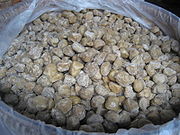
In South Asia
- Htanyat in (Burmese)
- Guḍa in SanskritSanskritSanskrit , is a historical Indo-Aryan language and the primary liturgical language of Hinduism, Jainism and Buddhism.Buddhism: besides Pali, see Buddhist Hybrid Sanskrit Today, it is listed as one of the 22 scheduled languages of India and is an official language of the state of Uttarakhand...
(गुड—literally 'a ball') - Guḍ in OriyaOriya languageOriya , officially Odia from November, 2011, is an Indian language, belonging to the Indo-Aryan branch of the Indo-European language family. It is mainly spoken in the Indian states of Orissa and West Bengal...
- Gura in Pashto
- Guṛ in AssameseAssamese languageAssamese is the easternmost Indo-Aryan language. It is used mainly in the state of Assam in North-East India. It is also the official language of Assam. It is also spoken in parts of Arunachal Pradesh and other northeast Indian states. Nagamese, an Assamese-based Creole language is widely used in...
(গুড়), BengaliBengali languageBengali or Bangla is an eastern Indo-Aryan language. It is native to the region of eastern South Asia known as Bengal, which comprises present day Bangladesh, the Indian state of West Bengal, and parts of the Indian states of Tripura and Assam. It is written with the Bengali script...
(গুড়), Bhojpuri (गुड़), Hindi (गुड़), MaithiliMaithili languageMaithili language is spoken in the eastern region of India and South-eastern region of Nepal. The native speakers of Maithili reside in Bihar, Jharkhand,parts of West Bengal and South-east Nepal...
, PunjabiPunjabi languagePunjabi is an Indo-Aryan language spoken by inhabitants of the historical Punjab region . For Sikhs, the Punjabi language stands as the official language in which all ceremonies take place. In Pakistan, Punjabi is the most widely spoken language...
(ਗੁੜ), and UrduUrduUrdu is a register of the Hindustani language that is identified with Muslims in South Asia. It belongs to the Indo-European family. Urdu is the national language and lingua franca of Pakistan. It is also widely spoken in some regions of India, where it is one of the 22 scheduled languages and an...
(گڑ) - Gor in KonkaniKonkani languageKonkaniKonkani is a name given to a group of several cognate dialects spoken along the narrow strip of land called Konkan, on the west coast of India. This is, however, somewhat an over-generalisation. Geographically, Konkan is defined roughly as the area between the river Damanganga to the north...
- Gôḷ (ગોળ) in GujaratiGujarati languageGujarati is an Indo-Aryan language, and part of the greater Indo-European language family. It is derived from a language called Old Gujarati which is the ancestor language of the modern Gujarati and Rajasthani languages...
- Gôḷ (गौळ) in RajasthaniRajasthani languageRajasthani Rajasthani Rajasthani (Devanagari: , Perso-Arabic: is a language of the Indo-Aryan languages family. It is spoken by 50 million people in Rajasthan and other states of India and in some areas of Pakistan. The number of speakers may be up to 80 million worldwide...
- Guḷ (गुळ) in MarathiMarathi languageMarathi is an Indo-Aryan language spoken by the Marathi people of western and central India. It is the official language of the state of Maharashtra. There are over 68 million fluent speakers worldwide. Marathi has the fourth largest number of native speakers in India and is the fifteenth most...
- Bella (ಬೆಲ್ಲ) in Kannada
- Bellam (బెల్లం) in TeluguTelugu languageTelugu is a Central Dravidian language primarily spoken in the state of Andhra Pradesh, India, where it is an official language. It is also spoken in the neighbouring states of Chattisgarh, Karnataka, Maharashtra, Orissa and Tamil Nadu...
- Bella in TuluTulu languageThe Tulu language |?]]]) is a Dravidian language spoken by 1.95 million native speakers mainly in the southwest part of Indian state Karnataka known as Tulu Nadu. In India, 1.72 million people speak it as their mother tongue , increased by 10 percent over the 1991 census...
. Vale Bella is a type of Jaggery which prepared from ToddyPalm winePalm wine also called Palm Toddy also called "Kallu" written in Malayalam and கள்ளு in Tamil or simply Toddy is an alcoholic beverage created from the sap of various species of palm tree such as the palmyra, and coconut palms...
. - (Mandai) vellam (வெல்லம்), (karumbu) chakkarai, or kalkandu in TamilTamil languageTamil is a Dravidian language spoken predominantly by Tamil people of the Indian subcontinent. It has official status in the Indian state of Tamil Nadu and in the Indian union territory of Pondicherry. Tamil is also an official language of Sri Lanka and Singapore...
(for jaggery made from sugarcane) and karuppaṭṭi or karippaṭṭi (for jaggery made from palm wine) - Vellam (വെല്ലം) (for jaggery made from sugarcane) in Malabar as well as North MalabarNorth MalabarNorth Malabar , is a historic as well as geographic distinction in India used to refer the area covering; present Kasaragod and Kannur Districts, Mananthavady taluk of Wayanad District and Koyilandy & Vatakara taluks of Kozhikode District in modern Kerala and the entire Mahé sub-Division of...
and Chakkara in the rest of KeralaKeralaor Keralam is an Indian state located on the Malabar coast of south-west India. It was created on 1 November 1956 by the States Reorganisation Act by combining various Malayalam speaking regions....
in Malayalam. "Sharkkara" is also a term used in Malayalam. Karuppaṭṭi or karippaṭṭi (for jaggery made from palm wine), and panam kalkandam (for sugar crystal made from coconut) - Hakuru (හකුරු) in Sinhalese
- Kurtai in MizoMizo languageThe Mizo language is natively spoken by Mizo people in Mizoram, a state in the Indian Union; Chin State of Burma and in the Chittagong Hill Tracts of Bangladesh. The language is also known as Lushai , as Lusei people are the first clan who have an external exposure...
In Latin America and the Caribbean
- Raspadura in CubaCubaThe Republic of Cuba is an island nation in the Caribbean. The nation of Cuba consists of the main island of Cuba, the Isla de la Juventud, and several archipelagos. Havana is the largest city in Cuba and the country's capital. Santiago de Cuba is the second largest city...
& PanamaPanamaPanama , officially the Republic of Panama , is the southernmost country of Central America. Situated on the isthmus connecting North and South America, it is bordered by Costa Rica to the northwest, Colombia to the southeast, the Caribbean Sea to the north and the Pacific Ocean to the south. The... - Rapadou in HaitiHaitiHaiti , officially the Republic of Haiti , is a Caribbean country. It occupies the western, smaller portion of the island of Hispaniola, in the Greater Antillean archipelago, which it shares with the Dominican Republic. Ayiti was the indigenous Taíno or Amerindian name for the island...
- RapaduraRapaduraRapadura is the Portuguese name for a form of sugarcane juice, used as a sweetener or as a candy, common in Latin American countries such as Brazil, Argentina and Venezuela and the Caribbean. See also panela...
in BrazilBrazilBrazil , officially the Federative Republic of Brazil , is the largest country in South America. It is the world's fifth largest country, both by geographical area and by population with over 192 million people... - Tapa de dulce in Costa RicaCosta RicaCosta Rica , officially the Republic of Costa Rica is a multilingual, multiethnic and multicultural country in Central America, bordered by Nicaragua to the north, Panama to the southeast, the Pacific Ocean to the west and the Caribbean Sea to the east....
- Papelón in VenezuelaVenezuelaVenezuela , officially called the Bolivarian Republic of Venezuela , is a tropical country on the northern coast of South America. It borders Colombia to the west, Guyana to the east, and Brazil to the south...
- PanelaPanelaPanela is unrefined whole cane sugar, typical of Latin America, which is basically a solid piece of sucrose and fructose obtained from the boiling and evaporation of sugarcane juice....
, Chancaca and piloncillo in the rest of Latin AmericaLatin AmericaLatin America is a region of the Americas where Romance languages – particularly Spanish and Portuguese, and variably French – are primarily spoken. Latin America has an area of approximately 21,069,500 km² , almost 3.9% of the Earth's surface or 14.1% of its land surface area...
In Southeast Asia
- Htanyet in BurmeseBurmese languageThe Burmese language is the official language of Burma. Although the constitution officially recognizes it as the Myanmar language, most English speakers continue to refer to the language as Burmese. Burmese is the native language of the Bamar and related sub-ethnic groups of the Bamar, as well as...
- Gula Melaka in MalayMalay languageMalay is a major language of the Austronesian family. It is the official language of Malaysia , Indonesia , Brunei and Singapore...
- Gula Merah or Gula Jawa in IndonesianIndonesian languageIndonesian is the official language of Indonesia. Indonesian is a normative form of the Riau Islands dialect of Malay, an Austronesian language which has been used as a lingua franca in the Indonesian archipelago for centuries....
- Panocha or Panutsa in the PhilippinesPhilippinesThe Philippines , officially known as the Republic of the Philippines , is a country in Southeast Asia in the western Pacific Ocean. To its north across the Luzon Strait lies Taiwan. West across the South China Sea sits Vietnam...
- Namtan Tanode (น้ำตาลโตนด) in ThaiThai languageThai , also known as Central Thai and Siamese, is the national and official language of Thailand and the native language of the Thai people, Thailand's dominant ethnic group. Thai is a member of the Tai group of the Tai–Kadai language family. Historical linguists have been unable to definitively...
Elsewhere
- Sukari Nguuru in SwahiliSwahili languageSwahili or Kiswahili is a Bantu language spoken by various ethnic groups that inhabit several large stretches of the Mozambique Channel coastline from northern Kenya to northern Mozambique, including the Comoro Islands. It is also spoken by ethnic minority groups in Somalia...
- Kokuto in JapanJapanJapan is an island nation in East Asia. Located in the Pacific Ocean, it lies to the east of the Sea of Japan, China, North Korea, South Korea and Russia, stretching from the Sea of Okhotsk in the north to the East China Sea and Taiwan in the south...
- Vollrohrzucker in GermanyGermanyGermany , officially the Federal Republic of Germany , is a federal parliamentary republic in Europe. The country consists of 16 states while the capital and largest city is Berlin. Germany covers an area of 357,021 km2 and has a largely temperate seasonal climate...