

Constitution of Poland

Encyclopedia
The current Constitution of Poland was adopted on 2 April 1997. Formally known as the Constitution of the Republic of Poland , it replaced the temporary amendments put into place in 1992 designed to reverse the effects of Communism
, establishing the nation as "a democratic state ruled by law and implementing the principles of social justice". It was adopted by the National Assembly of Poland
on 2 April 1997, approved by a national referendum
on 25 May 1997, and came into effect on 17 October 1997.
Poland
has had numerous previous constitutional acts during its long history
. Historically, the most significant is probably the May Constitution adopted on 3 May 1791.
was instituted. A new consensus was needed on how to acknowledge the awkward parts of Polish history; the transformation from a single-party
system into a multi-party
one and from socialism
towards a free market
economic system
; and the rise of pluralism alongside Poland's historically Roman Catholic culture
.
and the Second Republic
, Obliged to bequeath to future generations all that is valuable from our over one thousand years' heritage ... Mindful of the bitter experiences of the times when fundamental freedoms and human rights were violated in our Homeland, ...".
Many articles were written explicitly to rectify the wrongs of previous governments. In response to communist-era collective farming
, Article 23 established the family farm
as the basis of the agricultural economy. Article 74 requires public official
s to pursue ecologically sound public policy. Articles 39 and 40 prohibit the practices of forced medical experimentation, forbidding torture
and corporal punishment
, while Articles 50 and 59 acknowledge the inviolability of the home, the right to form trade union
s, and to strike
.
The preamble emphasizes freedom of religion or disbelief: "We, the Polish Nation - all citizens of the Republic, Both those who believe in God as the source of truth, justice, good and beauty, As well as those not sharing such faith but respecting those universal values as arising from other sources...". Article 25 provides further protection, that public officials "shall be impartial in matters of personal conviction, whether religious or philosophical, or in relation to outlooks on life, and shall ensure their freedom of expression within public life."
Other aspects include the affirmation of the political equality of man and woman in Article 32, and the affirmation of freedom of ethnic minorities to advance and develop their culture, in Article 35.
by Louis Andegavin on September 17, 1374. In order to guarantee the Polish throne for his daughter Jadwiga
, he agreed to abolish all but one tax the szlachta was required to pay. The Koszyce Privilege also forbade the king to grant official posts and major Polish castles to foreign knights, and obliged him to pay indemnities to nobles injured or taken captive during a war outside Polish borders.
The privileges granted by Ladislaus II
at Brześć Kujawski (April 25, 1425), Jedlnia (March 4, 1430) and Kraków
(January 9, 1433) introduced or confirmed the rule known as Neminem captivabimus nisi iure victum
which prevented a noble from being arrested unless found guilty. On May 2, 1447 the same king issued the Wilno Privilege which gave the Lithuanian
boyar
s the same rights as those possessed by the Polish szlachta.
In September and October of 1454 Casimir IV granted the Cerkwica and Nieszawa Privileges which forbade the king to set new taxes, laws or draft nobles for war unless he had the consent of local diets (sejmiki). These privileges were demanded by the szlachta as a compensation for their participation in the Thirteen Years' War. As a compensation for the unsuccessful incursion on Moldavia
which had decimated the szlachta, John Albert granted the Piotrków Privilege on April 26, 1496 which prohibited serf
s from leaving their owners' land, and banned city dwellers from buying land.
In the spring of 1505 king Alexander signed a bill adopted by the Diet
of Radom
known as Nihil novi
nisi commune consensu ("Nothing new without a common agreement"). The Nihil novi act transferred legislative power from the king to the Diet (Sejm
), or Polish parliament. This date marked the beginning of the First Rzeczpospolita
, the period of a szlachta-run "republic".
Until the death of Sigismund Augustus, the last king of the Jagiellonian dynasty, monarchs could only be elected from within the royal family. However, starting from 1573, practically any Polish noble or foreigner of royal blood could become a Polish-Lithuanian
monarch. Every newly elected king was required sign two documents - the Pacta conventa
("agreed pacts") - a confirmation of the king's pre-election promises, and Henrican articles (artykuły henrykowskie, named after the first freely elected king, Henry of Valois
). The latter document served as a virtual Polish constitution and contained the basic laws of the Commonwealth:
Sejm Constitution of 1590
In the 18th century, the introduction of Cardinal Laws
in 1768 was an important step towards codifying the existing Polish law.
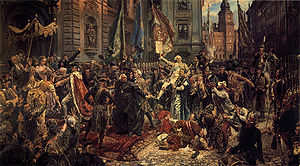
The Polish Constitution of May 3, 1791 is called "the first constitution of its kind in Europe" by historian Norman Davies
. It was instituted by the Government Act (Polish: Ustawa rządowa) adopted on that date by the Sejm
(parliament
) of the Polish-Lithuanian Commonwealth
. It was designed to redress long-standing political defects of the federative
Polish-Lithuanian Commonwealth and its Golden Liberty
. The Constitution introduced political equality between townspeople and nobility
(szlachta
) and placed the peasant
s under the protection of the government, thus mitigating the worst abuses of serfdom
. The Constitution abolished pernicious parliamentary institutions such as the liberum veto
, which at one time had placed the sejm
at the mercy of any deputy who might choose, or be bribed
by an interest or foreign power, to undo all the legislation
that had been passed by that sejm. The May 3rd Constitution sought to supplant the existing anarchy fostered by some of the country's reactionary
magnate
s, with a more egalitarian
and democratic
constitutional monarchy
.
The adoption of the May 3rd Constitution provoked the active hostility of the Polish Commonwealth's neighbors. In the War in Defense of the Constitution (1792), Poland was betrayed by its Prussia
n ally Frederick William II
and defeated by the Imperial Russia of Catherine the Great
, allied with the Targowica Confederation
, a cabal of Polish magnates who opposed reforms that might weaken their influence. Despite the defeat, and the subsequent Second Partition of Poland
, the May 3rd Constitution influenced later democratic movement
s in the world. Ultimately, Prussia, Austria and Russia partitioned Poland in 1795. It remained, after the demise of the Polish Republic in 1795, over the next 123 years of Polish partitions
, a beacon in the struggle to restore Polish sovereignty. In the words of two of its co-authors, Ignacy Potocki and Hugo Kołłątaj, it was "the last will and testament of the expiring Fatherland."
had three constitutions. They were, in historical order:
of the Polish Committee of National Liberation
condemned the April Constitution of 1935 as "unlawful and fascist" and stated that the March Constitution of 1921 would be the Polish constitution until a new one could be written. The new constitution was the Small Constitution of 1947
, later succeeded by the Constitution of the People's Republic of Poland
in 1952.
, which amended the main articles of the Constitution of the People's Republic of Poland
and formed the legal basis of the Polish State between 1992 and 1997.
Communism
Communism is a social, political and economic ideology that aims at the establishment of a classless, moneyless, revolutionary and stateless socialist society structured upon common ownership of the means of production...
, establishing the nation as "a democratic state ruled by law and implementing the principles of social justice". It was adopted by the National Assembly of Poland
National Assembly of Poland
The National Assembly is the name of both chambers of the Polish parliament, the Sejm and the Senate, when sitting in joint session...
on 2 April 1997, approved by a national referendum
Referendum
A referendum is a direct vote in which an entire electorate is asked to either accept or reject a particular proposal. This may result in the adoption of a new constitution, a constitutional amendment, a law, the recall of an elected official or simply a specific government policy. It is a form of...
on 25 May 1997, and came into effect on 17 October 1997.
Poland
Poland
Poland , officially the Republic of Poland , is a country in Central Europe bordered by Germany to the west; the Czech Republic and Slovakia to the south; Ukraine, Belarus and Lithuania to the east; and the Baltic Sea and Kaliningrad Oblast, a Russian exclave, to the north...
has had numerous previous constitutional acts during its long history
History of Poland
The History of Poland is rooted in the arrival of the Slavs, who gave rise to permanent settlement and historic development on Polish lands. During the Piast dynasty Christianity was adopted in 966 and medieval monarchy established...
. Historically, the most significant is probably the May Constitution adopted on 3 May 1791.
New character of the nation
The five years after 1992 were spent in dialogue about the new character of Poland. The nation had changed significantly since 1952 when the Constitution of the People's Republic of PolandConstitution of the People's Republic of Poland
The Constitution of the People's Republic of Poland was passed on 22 July 1952. Created by the Polish communists in the People's Republic of Poland, it was based on the 1936 Soviet Constitution , and it superseded the post-war provisional Small Constitution of 1947 which, at its turn, had declared...
was instituted. A new consensus was needed on how to acknowledge the awkward parts of Polish history; the transformation from a single-party
Single-party state
A single-party state, one-party system or single-party system is a type of party system government in which a single political party forms the government and no other parties are permitted to run candidates for election...
system into a multi-party
Multi-party system
A multi-party system is a system in which multiple political parties have the capacity to gain control of government separately or in coalition, e.g.The Conservative-Liberal Democrat coalition in the United Kingdom formed in 2010. The effective number of parties in a multi-party system is normally...
one and from socialism
Socialism
Socialism is an economic system characterized by social ownership of the means of production and cooperative management of the economy; or a political philosophy advocating such a system. "Social ownership" may refer to any one of, or a combination of, the following: cooperative enterprises,...
towards a free market
Free market
A free market is a competitive market where prices are determined by supply and demand. However, the term is also commonly used for markets in which economic intervention and regulation by the state is limited to tax collection, and enforcement of private ownership and contracts...
economic system
Economic system
An economic system is the combination of the various agencies, entities that provide the economic structure that defines the social community. These agencies are joined by lines of trade and exchange along which goods, money etc. are continuously flowing. An example of such a system for a closed...
; and the rise of pluralism alongside Poland's historically Roman Catholic culture
Culture
Culture is a term that has many different inter-related meanings. For example, in 1952, Alfred Kroeber and Clyde Kluckhohn compiled a list of 164 definitions of "culture" in Culture: A Critical Review of Concepts and Definitions...
.
Casting off the old
The attitude toward the past was articulated in the preamble, in which the citizens of Poland established a Republic "Recalling the best traditions of the FirstPolish-Lithuanian Commonwealth
The Polish–Lithuanian Commonwealth was a dualistic state of Poland and Lithuania ruled by a common monarch. It was the largest and one of the most populous countries of 16th- and 17th‑century Europe with some and a multi-ethnic population of 11 million at its peak in the early 17th century...
and the Second Republic
Second Polish Republic
The Second Polish Republic, Second Commonwealth of Poland or interwar Poland refers to Poland between the two world wars; a period in Polish history in which Poland was restored as an independent state. Officially known as the Republic of Poland or the Commonwealth of Poland , the Polish state was...
, Obliged to bequeath to future generations all that is valuable from our over one thousand years' heritage ... Mindful of the bitter experiences of the times when fundamental freedoms and human rights were violated in our Homeland, ...".
Many articles were written explicitly to rectify the wrongs of previous governments. In response to communist-era collective farming
Collective farming
Collective farming and communal farming are types of agricultural production in which the holdings of several farmers are run as a joint enterprise...
, Article 23 established the family farm
Family farm
A family farm is a farm owned and operated by a family, and often passed down from generation to generation. It is the basic unit of the mostly agricultural economy of much of human history and continues to be so in developing nations...
as the basis of the agricultural economy. Article 74 requires public official
Official
An official is someone who holds an office in an organization or government and participates in the exercise of authority .A government official or functionary is an official who is involved in public...
s to pursue ecologically sound public policy. Articles 39 and 40 prohibit the practices of forced medical experimentation, forbidding torture
Torture
Torture is the act of inflicting severe pain as a means of punishment, revenge, forcing information or a confession, or simply as an act of cruelty. Throughout history, torture has often been used as a method of political re-education, interrogation, punishment, and coercion...
and corporal punishment
Corporal punishment
Corporal punishment is a form of physical punishment that involves the deliberate infliction of pain as retribution for an offence, or for the purpose of disciplining or reforming a wrongdoer, or to deter attitudes or behaviour deemed unacceptable...
, while Articles 50 and 59 acknowledge the inviolability of the home, the right to form trade union
Trade union
A trade union, trades union or labor union is an organization of workers that have banded together to achieve common goals such as better working conditions. The trade union, through its leadership, bargains with the employer on behalf of union members and negotiates labour contracts with...
s, and to strike
Strike action
Strike action, also called labour strike, on strike, greve , or simply strike, is a work stoppage caused by the mass refusal of employees to work. A strike usually takes place in response to employee grievances. Strikes became important during the industrial revolution, when mass labour became...
.
Tradition versus pluralism
Those involved in drafting the document were not interested in creating a de facto Catholic Poland. That said, nods were given in the direction of the church, to the effect of protecting common morality. For example, in Article 18, marriage is granted the protection of the state, and in Article 53, freedom of religion, religious education, and religious upbringing are protected.The preamble emphasizes freedom of religion or disbelief: "We, the Polish Nation - all citizens of the Republic, Both those who believe in God as the source of truth, justice, good and beauty, As well as those not sharing such faith but respecting those universal values as arising from other sources...". Article 25 provides further protection, that public officials "shall be impartial in matters of personal conviction, whether religious or philosophical, or in relation to outlooks on life, and shall ensure their freedom of expression within public life."
Other aspects include the affirmation of the political equality of man and woman in Article 32, and the affirmation of freedom of ethnic minorities to advance and develop their culture, in Article 35.
Preamble
Kingdom of Poland and the Polish-Lithuanian Commonwealth
The first major privilege was granted in KošiceKošice
Košice is a city in eastern Slovakia. It is situated on the river Hornád at the eastern reaches of the Slovak Ore Mountains, near the border with Hungary...
by Louis Andegavin on September 17, 1374. In order to guarantee the Polish throne for his daughter Jadwiga
Jadwiga of Poland
Jadwiga was monarch of Poland from 1384 to her death. Her official title was 'king' rather than 'queen', reflecting that she was a sovereign in her own right and not merely a royal consort. She was a member of the Capetian House of Anjou, the daughter of King Louis I of Hungary and Elizabeth of...
, he agreed to abolish all but one tax the szlachta was required to pay. The Koszyce Privilege also forbade the king to grant official posts and major Polish castles to foreign knights, and obliged him to pay indemnities to nobles injured or taken captive during a war outside Polish borders.
The privileges granted by Ladislaus II
Jogaila
Jogaila, later 'He is known under a number of names: ; ; . See also: Jogaila : names and titles. was Grand Duke of Lithuania , king consort of Kingdom of Poland , and sole King of Poland . He ruled in Lithuania from 1377, at first with his uncle Kęstutis...
at Brześć Kujawski (April 25, 1425), Jedlnia (March 4, 1430) and Kraków
Kraków
Kraków also Krakow, or Cracow , is the second largest and one of the oldest cities in Poland. Situated on the Vistula River in the Lesser Poland region, the city dates back to the 7th century. Kraków has traditionally been one of the leading centres of Polish academic, cultural, and artistic life...
(January 9, 1433) introduced or confirmed the rule known as Neminem captivabimus nisi iure victum
Neminem captivabimus
Neminem captivabimus is a legal term in Lithuanian and Polish historical law.Short for , ....
which prevented a noble from being arrested unless found guilty. On May 2, 1447 the same king issued the Wilno Privilege which gave the Lithuanian
Grand Duchy of Lithuania
The Grand Duchy of Lithuania was a European state from the 12th /13th century until 1569 and then as a constituent part of Polish-Lithuanian Commonwealth until 1791 when Constitution of May 3, 1791 abolished it in favor of unitary state. It was founded by the Lithuanians, one of the polytheistic...
boyar
Boyar
A boyar, or bolyar , was a member of the highest rank of the feudal Moscovian, Kievan Rus'ian, Bulgarian, Wallachian, and Moldavian aristocracies, second only to the ruling princes , from the 10th century through the 17th century....
s the same rights as those possessed by the Polish szlachta.
In September and October of 1454 Casimir IV granted the Cerkwica and Nieszawa Privileges which forbade the king to set new taxes, laws or draft nobles for war unless he had the consent of local diets (sejmiki). These privileges were demanded by the szlachta as a compensation for their participation in the Thirteen Years' War. As a compensation for the unsuccessful incursion on Moldavia
Moldavia
Moldavia is a geographic and historical region and former principality in Eastern Europe, corresponding to the territory between the Eastern Carpathians and the Dniester river...
which had decimated the szlachta, John Albert granted the Piotrków Privilege on April 26, 1496 which prohibited serf
SERF
A spin exchange relaxation-free magnetometer is a type of magnetometer developed at Princeton University in the early 2000s. SERF magnetometers measure magnetic fields by using lasers to detect the interaction between alkali metal atoms in a vapor and the magnetic field.The name for the technique...
s from leaving their owners' land, and banned city dwellers from buying land.
In the spring of 1505 king Alexander signed a bill adopted by the Diet
Sejm
The Sejm is the lower house of the Polish parliament. The Sejm is made up of 460 deputies, or Poseł in Polish . It is elected by universal ballot and is presided over by a speaker called the Marshal of the Sejm ....
of Radom
Radom
Radom is a city in central Poland with 223,397 inhabitants . It is located on the Mleczna River in the Masovian Voivodeship , having previously been the capital of Radom Voivodeship ; 100 km south of Poland's capital, Warsaw.It is home to the biennial Radom Air Show, the largest and...
known as Nihil novi
Nihil novi
Nihil novi nisi commune consensu is the original Latin title of a 1505 act adopted by the Polish Sejm , meeting in the royal castle at Radom.-History:...
nisi commune consensu ("Nothing new without a common agreement"). The Nihil novi act transferred legislative power from the king to the Diet (Sejm
Sejm
The Sejm is the lower house of the Polish parliament. The Sejm is made up of 460 deputies, or Poseł in Polish . It is elected by universal ballot and is presided over by a speaker called the Marshal of the Sejm ....
), or Polish parliament. This date marked the beginning of the First Rzeczpospolita
Rzeczpospolita
Rzeczpospolita is a traditional name of the Polish State, usually referred to as Rzeczpospolita Polska . It comes from the words: "rzecz" and "pospolita" , literally, a "common thing". It comes from latin word "respublica", meaning simply "republic"...
, the period of a szlachta-run "republic".
Until the death of Sigismund Augustus, the last king of the Jagiellonian dynasty, monarchs could only be elected from within the royal family. However, starting from 1573, practically any Polish noble or foreigner of royal blood could become a Polish-Lithuanian
Polish-Lithuanian Commonwealth
The Polish–Lithuanian Commonwealth was a dualistic state of Poland and Lithuania ruled by a common monarch. It was the largest and one of the most populous countries of 16th- and 17th‑century Europe with some and a multi-ethnic population of 11 million at its peak in the early 17th century...
monarch. Every newly elected king was required sign two documents - the Pacta conventa
Pacta conventa (Poland)
Pacta conventa was a contractual agreement, from 1573 to 1764 entered into between the "Polish nation" and a newly-elected king upon his "free election" to the throne.The pacta conventa affirmed the king-elect's pledge to respect the laws of the...
("agreed pacts") - a confirmation of the king's pre-election promises, and Henrican articles (artykuły henrykowskie, named after the first freely elected king, Henry of Valois
Henry III of France
Henry III was King of France from 1574 to 1589. As Henry of Valois, he was the first elected monarch of the Polish-Lithuanian Commonwealth with the dual titles of King of Poland and Grand Duke of Lithuania from 1573 to 1575.-Childhood:Henry was born at the Royal Château de Fontainebleau,...
). The latter document served as a virtual Polish constitution and contained the basic laws of the Commonwealth:
- free election of kings;
- religious tolerance;
- the Diet to be gathered every two years;
- foreign policy controlled by the Diet;
- a royal advisory council chosen by the Diet;
- official posts restricted to Polish and Lithuanian nobles;
- taxes and monopolies set up by the Diet only;
- nobles' right to disobey the king should he break any of these laws.
Sejm Constitution of 1590
In the 18th century, the introduction of Cardinal Laws
Cardinal laws
The Cardinal Laws were a constitution enacted in Warsaw, Poland, by the Repnin Sejm of 1767–68. Ostensibly the Cardinal Laws were intended to ensure the "Golden Liberty" of the Polish-Lithuanian nobility, as demanded by nobles united in the Radom Confederation...
in 1768 was an important step towards codifying the existing Polish law.
May Constitution, 1791
The Polish Constitution of May 3, 1791 is called "the first constitution of its kind in Europe" by historian Norman Davies
Norman Davies
Professor Ivor Norman Richard Davies FBA, FRHistS is a leading English historian of Welsh descent, noted for his publications on the history of Europe, Poland, and the United Kingdom.- Academic career :...
. It was instituted by the Government Act (Polish: Ustawa rządowa) adopted on that date by the Sejm
Sejm
The Sejm is the lower house of the Polish parliament. The Sejm is made up of 460 deputies, or Poseł in Polish . It is elected by universal ballot and is presided over by a speaker called the Marshal of the Sejm ....
(parliament
Parliament
A parliament is a legislature, especially in those countries whose system of government is based on the Westminster system modeled after that of the United Kingdom. The name is derived from the French , the action of parler : a parlement is a discussion. The term came to mean a meeting at which...
) of the Polish-Lithuanian Commonwealth
Polish-Lithuanian Commonwealth
The Polish–Lithuanian Commonwealth was a dualistic state of Poland and Lithuania ruled by a common monarch. It was the largest and one of the most populous countries of 16th- and 17th‑century Europe with some and a multi-ethnic population of 11 million at its peak in the early 17th century...
. It was designed to redress long-standing political defects of the federative
Federation
A federation , also known as a federal state, is a type of sovereign state characterized by a union of partially self-governing states or regions united by a central government...
Polish-Lithuanian Commonwealth and its Golden Liberty
Golden Liberty
Golden Liberty , sometimes referred to as Golden Freedoms, Nobles' Democracy or Nobles' Commonwealth refers to a unique aristocratic political system in the Kingdom of Poland and later, after the Union of Lublin , in the Polish-Lithuanian Commonwealth...
. The Constitution introduced political equality between townspeople and nobility
Nobility
Nobility is a social class which possesses more acknowledged privileges or eminence than members of most other classes in a society, membership therein typically being hereditary. The privileges associated with nobility may constitute substantial advantages over or relative to non-nobles, or may be...
(szlachta
Szlachta
The szlachta was a legally privileged noble class with origins in the Kingdom of Poland. It gained considerable institutional privileges during the 1333-1370 reign of Casimir the Great. In 1413, following a series of tentative personal unions between the Grand Duchy of Lithuania and the Kingdom of...
) and placed the peasant
Peasant
A peasant is an agricultural worker who generally tend to be poor and homeless-Etymology:The word is derived from 15th century French païsant meaning one from the pays, or countryside, ultimately from the Latin pagus, or outlying administrative district.- Position in society :Peasants typically...
s under the protection of the government, thus mitigating the worst abuses of serfdom
Serfdom
Serfdom is the status of peasants under feudalism, specifically relating to Manorialism. It was a condition of bondage or modified slavery which developed primarily during the High Middle Ages in Europe and lasted to the mid-19th century...
. The Constitution abolished pernicious parliamentary institutions such as the liberum veto
Liberum veto
The liberum veto was a parliamentary device in the Polish-Lithuanian Commonwealth. It allowed any member of the Sejm to force an immediate end to the current session and nullify any legislation that had already been passed at the session by shouting Nie pozwalam! .From the mid-16th to the late 18th...
, which at one time had placed the sejm
Sejm
The Sejm is the lower house of the Polish parliament. The Sejm is made up of 460 deputies, or Poseł in Polish . It is elected by universal ballot and is presided over by a speaker called the Marshal of the Sejm ....
at the mercy of any deputy who might choose, or be bribed
Bribery
Bribery, a form of corruption, is an act implying money or gift giving that alters the behavior of the recipient. Bribery constitutes a crime and is defined by Black's Law Dictionary as the offering, giving, receiving, or soliciting of any item of value to influence the actions of an official or...
by an interest or foreign power, to undo all the legislation
Legislation
Legislation is law which has been promulgated by a legislature or other governing body, or the process of making it...
that had been passed by that sejm. The May 3rd Constitution sought to supplant the existing anarchy fostered by some of the country's reactionary
Reactionary
The term reactionary refers to viewpoints that seek to return to a previous state in a society. The term is meant to describe one end of a political spectrum whose opposite pole is "radical". While it has not been generally considered a term of praise it has been adopted as a self-description by...
magnate
Magnate
Magnate, from the Late Latin magnas, a great man, itself from Latin magnus 'great', designates a noble or other man in a high social position, by birth, wealth or other qualities...
s, with a more egalitarian
Egalitarianism
Egalitarianism is a trend of thought that favors equality of some sort among moral agents, whether persons or animals. Emphasis is placed upon the fact that equality contains the idea of equity of quality...
and democratic
Democracy
Democracy is generally defined as a form of government in which all adult citizens have an equal say in the decisions that affect their lives. Ideally, this includes equal participation in the proposal, development and passage of legislation into law...
constitutional monarchy
Constitutional monarchy
Constitutional monarchy is a form of government in which a monarch acts as head of state within the parameters of a constitution, whether it be a written, uncodified or blended constitution...
.
The adoption of the May 3rd Constitution provoked the active hostility of the Polish Commonwealth's neighbors. In the War in Defense of the Constitution (1792), Poland was betrayed by its Prussia
Prussia
Prussia was a German kingdom and historic state originating out of the Duchy of Prussia and the Margraviate of Brandenburg. For centuries, the House of Hohenzollern ruled Prussia, successfully expanding its size by way of an unusually well-organized and effective army. Prussia shaped the history...
n ally Frederick William II
Frederick William II of Prussia
Frederick William II was the King of Prussia, reigning from 1786 until his death. He was in personal union the Prince-Elector of Brandenburg and the sovereign prince of the Principality of Neuchâtel.-Early life:...
and defeated by the Imperial Russia of Catherine the Great
Catherine II of Russia
Catherine II, also known as Catherine the Great , Empress of Russia, was born in Stettin, Pomerania, Prussia on as Sophie Friederike Auguste von Anhalt-Zerbst-Dornburg...
, allied with the Targowica Confederation
Targowica Confederation
The Targowica Confederation was a confederation established by Polish and Lithuanian magnates on 27 April 1792, in Saint Petersburg, with the backing of the Russian Empress Catherine II. The confederation opposed the Polish Constitution of May 3, 1791, which had been adopted by the Great Sejm,...
, a cabal of Polish magnates who opposed reforms that might weaken their influence. Despite the defeat, and the subsequent Second Partition of Poland
Second Partition of Poland
The 1793 Second Partition of the Polish-Lithuanian Commonwealth was the second of three partitions that ended the existence of the Polish-Lithuanian Commonwealth by 1795. The second partition occurred in the aftermath of the War in Defense of the Constitution and the Targowica Confederation of 1792...
, the May 3rd Constitution influenced later democratic movement
Democratic Movement
Democratic Movement may refer to:*Democratic Movement *Democratic Movement *Democratic Movement *Democratic Movement *Democratic Movement *Democratic Movement...
s in the world. Ultimately, Prussia, Austria and Russia partitioned Poland in 1795. It remained, after the demise of the Polish Republic in 1795, over the next 123 years of Polish partitions
Partitions of Poland
The Partitions of Poland or Partitions of the Polish–Lithuanian Commonwealth took place in the second half of the 18th century and ended the existence of the Polish–Lithuanian Commonwealth, resulting in the elimination of sovereign Poland for 123 years...
, a beacon in the struggle to restore Polish sovereignty. In the words of two of its co-authors, Ignacy Potocki and Hugo Kołłątaj, it was "the last will and testament of the expiring Fatherland."
19th century
- Duchy of WarsawDuchy of WarsawThe Duchy of Warsaw was a Polish state established by Napoleon I in 1807 from the Polish lands ceded by the Kingdom of Prussia under the terms of the Treaties of Tilsit. The duchy was held in personal union by one of Napoleon's allies, King Frederick Augustus I of Saxony...
, 1806 http://poland.pl/cms/print.htm?id=11572, http://www.law.uj.edu.pl/users/khpp/fontesu/1807.htm - Constitution of the Kingdom of PolandConstitution of the Kingdom of PolandThe Constitution of the Kingdom of Poland was granted to the 'Congress' Kingdom of Poland by the King of Poland, Alexander I of Russia, who was obliged to issue a constitution to the newly recreated Polish state under his domain as specified by the Congress of Vienna...
,1815 - Constitution of the Free City of KrakówFree City of KrakówThe Free, Independent, and Strictly Neutral City of Kraków with its Territory , more commonly known as either the Free City of Kraków or Republic of Kraków , was a city-state created by the Congress of Vienna in 1815, and controlled by its three neighbours until 1846, when in the aftermath of the...
, 1815
Second Polish Republic (1919-1939)
Second Polish RepublicSecond Polish Republic
The Second Polish Republic, Second Commonwealth of Poland or interwar Poland refers to Poland between the two world wars; a period in Polish history in which Poland was restored as an independent state. Officially known as the Republic of Poland or the Commonwealth of Poland , the Polish state was...
had three constitutions. They were, in historical order:
- Small ConstitutionSmall Constitution of 1919The Small Constitution of 1919 was the "Legislative Sejm's ordinance of February 20, 1919, entrusting Józef Piłsudski with the further execution of the office of Chief of State" . The legislation was published as Dz. Pr. P.P...
, 1919 - March Constitution, 1921
- April Constitution, 1935
People's Republic of Poland (1945-1989)
The ManifestoPKWN Manifesto
The Manifesto of the Polish Committee of National Liberation known as July or PKWN Manifesto was a political manifesto of the Polish Committee of National Liberation, a Soviet-backed provisional government, which operated in opposition to the London-based Polish government in exile.It was...
of the Polish Committee of National Liberation
Polish Committee of National Liberation
The Polish Committee of National Liberation , also known as the Lublin Committee, was a provisional government of Poland, officially proclaimed 21 July 1944 in Chełm under the direction of State National Council in opposition to the Polish government in exile...
condemned the April Constitution of 1935 as "unlawful and fascist" and stated that the March Constitution of 1921 would be the Polish constitution until a new one could be written. The new constitution was the Small Constitution of 1947
Small Constitution of 1947
Small Constitution of 1947 was a temporary constitution issued by the communist-dominated Sejm of 1947-1952. It confirmed the practice of separation of powers and strengthened the Sejm. It was renewed in 1949, 1950 and 1951...
, later succeeded by the Constitution of the People's Republic of Poland
Constitution of the People's Republic of Poland
The Constitution of the People's Republic of Poland was passed on 22 July 1952. Created by the Polish communists in the People's Republic of Poland, it was based on the 1936 Soviet Constitution , and it superseded the post-war provisional Small Constitution of 1947 which, at its turn, had declared...
in 1952.
Third Polish Republic (1989-present)
Prior to the current 1997 Constitution, country was governed by the Small Constitution of 1992Small Constitution of 1992
Small Constitution of 1992 in Poland was a constitution regulating relations between legislative and executive branches of Poland, and the local self-government. It was voted by the Poland's first democratic Sejm elected in the free elections...
, which amended the main articles of the Constitution of the People's Republic of Poland
People's Republic of Poland
The People's Republic of Poland was the official name of Poland from 1952 to 1990. Although the Soviet Union took control of the country immediately after the liberation from Nazi Germany in 1944, the name of the state was not changed until eight years later...
and formed the legal basis of the Polish State between 1992 and 1997.
See also
- List of national constitutions
- Constitutional economicsConstitutional economicsConstitutional economics is a research program in economics and constitutionalism that has been described as extending beyond the definition of 'the economic analysis of constitutional law' in explaining the choice "of alternative sets of legal-institutional-constitutional rules that constrain the...
- ConstitutionalismConstitutionalismConstitutionalism has a variety of meanings. Most generally, it is "a complex of ideas, attitudes, and patterns of behavior elaborating the principle that the authority of government derives from and is limited by a body of fundamental law"....
- Rule according to higher lawRule according to higher lawThe rule according to a higher law means that no written law may be enforced by the government unless it conforms with certain unwritten, universal principles of fairness, morality, and justice...
External links
- English text of the Polish Constitution
- Polish Constitutional Law Constitutions, bibliography, links
- Overview
- New York University review