

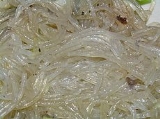
Cellophane noodles

Encyclopedia
Cellophane noodles are a type of transparent noodle
made from starch
(such as mung bean
starch, yam
, potato starch
, cassava
or canna starch
), and water.
They are generally sold in dried form, boiled to reconstitute, then used in soups, stir fried dishes, or spring roll
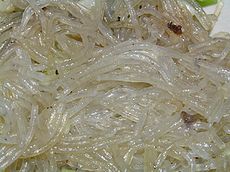
s. They are called "cellophane noodles" or "glass noodles" because of their appearance when cooked, resembling cellophane
, a clear material or a translucent light gray or brownish-gray color.
Cellophane noodles are generally round, and are available in various thicknesses. Wide, flat cellophane noodle sheets called mung bean sheets are also produced in China.
Cellophane noodles should not be confused with rice vermicelli
, which are made from rice
and are white in color rather than clear (after cooking in water).
 In Chinese
, the most commonly used names are:
They are also marketed under the name saifun, the Cantonese pronunciation of the Mandarin xì fěn , though the name fan2 si1 (粉絲) is the term most often used in Cantonese. While by itself the character fěn means powder, it etymology is probably related to diàn fěn , which means "starch"the substance from which the noodles are made.
, the primary site of production of cellophane noodles is the town of Zhangxing, in the city of Zhaoyuan
, which is administered by the prefecture-level city
of Yantai
, in the eastern province of Shandong
. However, historically, the noodles were shipped through the port of Longkou
(which is also under the administration of Yantai), and thus the noodles are known and marketed as Longkou fensi .
 In China, cellophane noodles are usually made of mung bean
starch and are a popular ingredient used in stir fries
, soups, and particularly hot pot
s. They can also be used as an ingredient in fillings for a variety of Chinese jiaozi
(dumplings) and bing
(flatbreads), especially in vegetarian versions of these dishes. Thicker cellophane noodles are also commonly used to imitate the appearance and texture of shark's fin
in vegetarian soups. Thicker varieties, most popular in China's northeast
, are used in stir fries as well as cold salad-like dishes. A popular soup using the ingredient is fried tofu with thin noodles ' onMouseout='HidePop("94116")' href="/topics/Pinyin">Pinyin
: yóu dòu fu-xiàn fěn tāng). A popular Sichuan
dish called ants climbing a tree
' onMouseout='HidePop("7941")' href="/topics/Pinyin">Pinyin
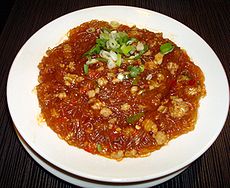
: má yǐ shàng shù) consists of stewed cellophane noodles with a spicy ground pork meat sauce.
, Shandong
were contaminated with lead
. It emerged that several unscrupulous companies were making their noodles from cornstarch
instead of mung beans in order to save costs, and, to make the cornstarch transparent, were adding lead-based whiteners to their noodles. In December 2006, Beijing authorities again inspected cellophane noodles produced by the Yantai Deshengda Longkou Vermicelli Co. Ltd. in Siduitou village, Zhangxing town, Zhaoyuan
city, Yantai, this time determining that sodium formaldehyde sulfoxylate
, a toxic and possibly carcinogenic industrial bleach
that is an illegal food additive in China, had been used in the production of the noodles. The company, which formerly sold its noodles both in China as well as overseas, was ordered to cease production and distribution.
In December 2010, Czech food inspection authorities (SZPI) again inspected Chinese cellophane noodles, this time determining that 142.00 mg/kg of aluminium
, which is an illegal amount for food in Czech (and EU) market, had been used in the production of the noodles.
In Malaysia they are known as tanghoon (冬粉). People sometimes confuse them with bihun (米粉) which are rice vermicelli
.
In Philippine cuisine, the noodles are called a similar name: sotanghon because of the popular dish of the same name made from them using chicken and wood ear
s. Like in Malaysia, they are also confused with rice vermicelli
, which are called bihon in the Philippines.
In Japanese cuisine
, they are called harusame , literally "spring rain." Unlike Chinese glass noodles, they are usually made from potato
starch. They are commonly used to make salads, or as an ingredient in hot pot
dishes. They are also often used to make Japanese adaptations of Chinese and Korean dishes.
In Tibetan cuisine, glass noodles are called phing or fing and are used in soup, pork curry or with mushrooms.
In India
and Pakistan
, glass noodles are called falooda
(see Faludeh from Persian cuisine), and are served on top of kulfi
(a traditional ice cream). They are usually made from arrowroot starch using a traditional technique. The noodles are flavorless so provide a nice balance with the sweet kulfi. Kulfi and falooda can be bought from numerous food stalls throughout Pakistan and northern parts of India.
In Korean cuisine, glass noodles are usually made from sweet potato
starch and are called dangmyeon (Hangul
: ; Hanja
: ; literally "Tang
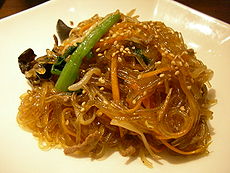
noodles"; also spelled dang myun, dangmyun, tang myun, or tangmyun). They are commonly stir-fried in sesame oil with beef and vegetables, and flavoured with soy and sugar, in a popular dish called japchae
(hangul: 잡채). They are usually thick, and are a brownish-gray color when in their uncooked form.
In Vietnamese cuisine, there are two varieties of cellophane noodles. The first, called bún tàu or bún tào, are made from mung bean
starch, and were introduced by Chinese immigrants. The second, called miến or miến dong, are made from canna
(Vietnamese
: dong riềng), and were developed in Vietnam. These cellophane noodles are a main ingredient in the dishes: miến gà, miến lươn, miến măng vịt, and miến cua. These cellophane noodles are sometimes confused with rice vermicelli
(Vietnamese
: bún
) and arrowroot
starch noodles (Vietnamese
: arrowroot: củ dong, arrowroot starch: bột dong/bột hoàng tinh/bột mì tinh).
In Thai cuisine, glass noodles are called wun sen . They are commonly mixed with pork and shrimp in a spicy salad called yam wun sen , or stir-fried as phat wun sen .
In Hawaii
, where cuisine is heavily influenced by Asian cultures, cellophane noodles are known locally as long rice, supposedly because the process of making the noodles involves extruding the starch through a potato ricer
. They are used most often in chicken long rice, a dish of cellophane noodles in chicken broth that is often served at luau
s. Glass noodles were introduced to Samoa
by Cantonese
agricultural workers in the early 1900's where they became known as "lialia," a Samoan word meaning "to twirl," after the method of twirling the noodles around chopsticks when eating. A popular dish called "sapasui" (transliteration of the Cantonese
chop suey
) is common fare at social gatherings. Sapasui, a soupy dish of boiled glass noodles mixed with braised pork, beef, or chicken and chopped vegetables, is akin to Hawaiian "long rice."
Noodle
The noodle is a type of food, made from any of a variety of doughs, formed into long thin ribbons, strips, curly-cues, waves, helices, pipes, tubes, strings, or other various shapes, sometimes folded. They are usually cooked in a mixture of boiling water and/or oil. Depending upon the type, noodles...
made from starch
Starch
Starch or amylum is a carbohydrate consisting of a large number of glucose units joined together by glycosidic bonds. This polysaccharide is produced by all green plants as an energy store...
(such as mung bean
Mung bean
The mung bean is the seed of Vigna radiata. It is native to the Indian subcontinent.-Description:They are small, ovoid in shape, and green in color...
starch, yam
Yam (vegetable)
Yam is the common name for some species in the genus Dioscorea . These are perennial herbaceous vines cultivated for the consumption of their starchy tubers in Africa, Asia, Latin America and Oceania...
, potato starch
Potato starch
Potato starch is starch extracted from potatoes. The cells of the root tubers of the potato plant contain starch grains . To extract the starch, the potatoes are crushed; the starch grains are released from the destroyed cells...
, cassava
Cassava
Cassava , also called yuca or manioc, a woody shrub of the Euphorbiaceae native to South America, is extensively cultivated as an annual crop in tropical and subtropical regions for its edible starchy tuberous root, a major source of carbohydrates...
or canna starch
Canna (plant)
Canna is a genus of nineteen species of flowering plants. The closest living relations to cannas are the other plant families of the order Zingiberales, that is the gingers, bananas, marantas, heliconias, strelitzias, etc.Canna is the only genus in the family Cannaceae...
), and water.
They are generally sold in dried form, boiled to reconstitute, then used in soups, stir fried dishes, or spring roll
Spring roll
Spring rolls is an umbrella term used in some Western cultures to describe disparate varieties of filled, rolled appetizers similar to the Chinese chūn juǎn , from which the term was derived...
s. They are called "cellophane noodles" or "glass noodles" because of their appearance when cooked, resembling cellophane
Cellophane
Cellophane is a thin, transparent sheet made of regenerated cellulose. Its low permeability to air, oils, greases, bacteria and water makes it useful for food packaging...
, a clear material or a translucent light gray or brownish-gray color.
Cellophane noodles are generally round, and are available in various thicknesses. Wide, flat cellophane noodle sheets called mung bean sheets are also produced in China.
Cellophane noodles should not be confused with rice vermicelli
Rice vermicelli
Rice vermicelli are thin noodles made from rice and are a form of rice noodles. They are sometimes referred to as rice noodles or rice sticks, but they should not be confused with cellophane noodles, which is another type of vermicelli....
, which are made from rice
Rice
Rice is the seed of the monocot plants Oryza sativa or Oryza glaberrima . As a cereal grain, it is the most important staple food for a large part of the world's human population, especially in East Asia, Southeast Asia, South Asia, the Middle East, and the West Indies...
and are white in color rather than clear (after cooking in water).
Naming
Chinese language
The Chinese language is a language or language family consisting of varieties which are mutually intelligible to varying degrees. Originally the indigenous languages spoken by the Han Chinese in China, it forms one of the branches of Sino-Tibetan family of languages...
, the most commonly used names are:
- fěn sī : with fěn meaning "powder" and sī meaning "thread"
- dōng fěn : with the literal meaning of "winter powder"
They are also marketed under the name saifun, the Cantonese pronunciation of the Mandarin xì fěn , though the name fan2 si1 (粉絲) is the term most often used in Cantonese. While by itself the character fěn means powder, it etymology is probably related to diàn fěn , which means "starch"the substance from which the noodles are made.
Production
In ChinaChina
Chinese civilization may refer to:* China for more general discussion of the country.* Chinese culture* Greater China, the transnational community of ethnic Chinese.* History of China* Sinosphere, the area historically affected by Chinese culture...
, the primary site of production of cellophane noodles is the town of Zhangxing, in the city of Zhaoyuan
Zhaoyuan City
Zhaoyuan is a county-level city within the prefecture-level city of Yantai, Shandong Province of China. It is on seashore of Bohai Sea. Zhaoyuan is well known for its abundant gold deposit and production...
, which is administered by the prefecture-level city
Prefecture-level city
A prefectural level city , prefectural city or prefectural level municipality is an administrative division of the People's Republic of China, ranking below a province and above a county in China's administrative structure. Prefectural level cities form the second level of the administrative...
of Yantai
Yantai
Yantai is a prefecture-level city in northeastern Shandong province, People's Republic of China. Located on the southern coast of the Bohai Sea and the eastern coast of the Laizhou Bay, Yantai borders the cities of Qingdao and Weihai to the southwest and east respectively.The largest fishing...
, in the eastern province of Shandong
Shandong
' is a Province located on the eastern coast of the People's Republic of China. Shandong has played a major role in Chinese history from the beginning of Chinese civilization along the lower reaches of the Yellow River and served as a pivotal cultural and religious site for Taoism, Chinese...
. However, historically, the noodles were shipped through the port of Longkou
Longkou
Longkou , formerly Huang County , is a port city in northeastern Shandong Province, on the eastern coast of the People's Republic of China. Longkou, a county-level city, is administered by the prefecture-level city of Yantai. The total population of Longkou is 620,000.-History:Longkou city was...
(which is also under the administration of Yantai), and thus the noodles are known and marketed as Longkou fensi .
Use
Mung bean
The mung bean is the seed of Vigna radiata. It is native to the Indian subcontinent.-Description:They are small, ovoid in shape, and green in color...
starch and are a popular ingredient used in stir fries
Stir frying
Stir frying is an umbrella term used to describe two Chinese cooking techniques for preparing food in a wok: chǎo and bào . The term stir-fry was introduced into the English language by Buwei Yang Chao, in her book How to Cook and Eat in Chinese, to describe the chǎo technique...
, soups, and particularly hot pot
Hot pot
Hot pot , less commonly Chinese fondue or steamboat, refers to several East Asian varieties of stew, consisting of a simmering metal pot of stock at the center of the dining table. While the hot pot is kept simmering, ingredients are placed into the pot and are cooked at the table...
s. They can also be used as an ingredient in fillings for a variety of Chinese jiaozi
Jiaozi
Jiǎozi 餃子 or 饺子 , bánh bột luộc , gyōza , Mo:Mo: or Momocha म:म: or ममचा , or pot sticker is a Chinese dumpling widely spread to Japan, Eastern and Western Asia.Jiaozi typically consist of a ground meat and/or vegetable filling wrapped into...
(dumplings) and bing
Bing (Chinese flat bread)
Bing is a Chinese term used to describe wheat flour based Chinese foods with a flattened or disk-like shape, similar to the French concept of a Galette. These foods may resemble the flatbreads, pancakes, unleavened dough foods of non-Chinese and western cuisines...
(flatbreads), especially in vegetarian versions of these dishes. Thicker cellophane noodles are also commonly used to imitate the appearance and texture of shark's fin
Shark fin soup
Shark fin soup is a popular soup item of Chinese cuisine usually served at special occasions such as weddings and banquets, or as a luxury item in Chinese culture. The shark fins provide texture while the taste comes from the other soup ingredients.There is controversy over the practice of shark...
in vegetarian soups. Thicker varieties, most popular in China's northeast
Northeast China
Northeast China, historically known in English as Manchuria, is a geographical region of China, consisting of the three provinces of Liaoning, Jilin and Heilongjiang. The region is sometimes called the Three Northeast Provinces...
, are used in stir fries as well as cold salad-like dishes. A popular soup using the ingredient is fried tofu with thin noodles ' onMouseout='HidePop("94116")' href="/topics/Pinyin">Pinyin
Pinyin
Pinyin is the official system to transcribe Chinese characters into the Roman alphabet in China, Malaysia, Singapore and Taiwan. It is also often used to teach Mandarin Chinese and spell Chinese names in foreign publications and used as an input method to enter Chinese characters into...
: yóu dòu fu-xiàn fěn tāng). A popular Sichuan
Szechuan cuisine
Szechuan cuisine, Sichuan cuisine, or Szechwan cuisine is a style of Chinese cuisine originating in the Sichuan Province of southwestern China famed for bold flavors, particularly the pungency and spiciness resulting from liberal use of garlic and chili peppers, as well as the unique flavour of...
dish called ants climbing a tree
Ants climbing a tree
Ants Climbing a Tree , also known as Ants Climb Tree or Ants Climbing Up a Tree, etc., is a classic Sichuan dish in Chinese cuisine. It consists of ground meat cooked in a sauce and poured over bean thread noodles...
' onMouseout='HidePop("7941")' href="/topics/Pinyin">Pinyin
Pinyin
Pinyin is the official system to transcribe Chinese characters into the Roman alphabet in China, Malaysia, Singapore and Taiwan. It is also often used to teach Mandarin Chinese and spell Chinese names in foreign publications and used as an input method to enter Chinese characters into...
: má yǐ shàng shù) consists of stewed cellophane noodles with a spicy ground pork meat sauce.
Health concerns
In 2004, testing by Chinese authorities determined that some brands of cellophane noodles produced in YantaiYantai
Yantai is a prefecture-level city in northeastern Shandong province, People's Republic of China. Located on the southern coast of the Bohai Sea and the eastern coast of the Laizhou Bay, Yantai borders the cities of Qingdao and Weihai to the southwest and east respectively.The largest fishing...
, Shandong
Shandong
' is a Province located on the eastern coast of the People's Republic of China. Shandong has played a major role in Chinese history from the beginning of Chinese civilization along the lower reaches of the Yellow River and served as a pivotal cultural and religious site for Taoism, Chinese...
were contaminated with lead
Lead
Lead is a main-group element in the carbon group with the symbol Pb and atomic number 82. Lead is a soft, malleable poor metal. It is also counted as one of the heavy metals. Metallic lead has a bluish-white color after being freshly cut, but it soon tarnishes to a dull grayish color when exposed...
. It emerged that several unscrupulous companies were making their noodles from cornstarch
Cornstarch
Corn starch, cornstarch, cornflour or maize starch is the starch of the corn grain obtained from the endosperm of the corn kernel.-History:...
instead of mung beans in order to save costs, and, to make the cornstarch transparent, were adding lead-based whiteners to their noodles. In December 2006, Beijing authorities again inspected cellophane noodles produced by the Yantai Deshengda Longkou Vermicelli Co. Ltd. in Siduitou village, Zhangxing town, Zhaoyuan
Zhaoyuan City
Zhaoyuan is a county-level city within the prefecture-level city of Yantai, Shandong Province of China. It is on seashore of Bohai Sea. Zhaoyuan is well known for its abundant gold deposit and production...
city, Yantai, this time determining that sodium formaldehyde sulfoxylate
Rongalite
Rongalite, also called Rongalit is sodium hydroxymethylsulfinate, or Na+HOCH2SO2-. The salt has many names, including also sodium formaldehyde sulfoxylate and Bruggolite...
, a toxic and possibly carcinogenic industrial bleach
Bleach
Bleach refers to a number of chemicals that remove color, whiten, or disinfect, often via oxidation. Common chemical bleaches include household chlorine bleach , lye, oxygen bleach , and bleaching powder...
that is an illegal food additive in China, had been used in the production of the noodles. The company, which formerly sold its noodles both in China as well as overseas, was ordered to cease production and distribution.
In December 2010, Czech food inspection authorities (SZPI) again inspected Chinese cellophane noodles, this time determining that 142.00 mg/kg of aluminium
Aluminium
Aluminium or aluminum is a silvery white member of the boron group of chemical elements. It has the symbol Al, and its atomic number is 13. It is not soluble in water under normal circumstances....
, which is an illegal amount for food in Czech (and EU) market, had been used in the production of the noodles.
Outside China
In Indonesian cuisine, they are called soun or suun.In Malaysia they are known as tanghoon (冬粉). People sometimes confuse them with bihun (米粉) which are rice vermicelli
Rice vermicelli
Rice vermicelli are thin noodles made from rice and are a form of rice noodles. They are sometimes referred to as rice noodles or rice sticks, but they should not be confused with cellophane noodles, which is another type of vermicelli....
.
In Philippine cuisine, the noodles are called a similar name: sotanghon because of the popular dish of the same name made from them using chicken and wood ear
Wood ear
Wood ear, or 木耳 , can refer to two different closely related species of edible fungus used primarily in Asian cuisine; these are commonly sold in Asian markets shredded and dried....
s. Like in Malaysia, they are also confused with rice vermicelli
Rice vermicelli
Rice vermicelli are thin noodles made from rice and are a form of rice noodles. They are sometimes referred to as rice noodles or rice sticks, but they should not be confused with cellophane noodles, which is another type of vermicelli....
, which are called bihon in the Philippines.
In Japanese cuisine
Japanese cuisine
Japanese cuisine has developed over the centuries as a result of many political and social changes throughout Japan. The cuisine eventually changed with the advent of the Medieval age which ushered in a shedding of elitism with the age of shogun rule...
, they are called harusame , literally "spring rain." Unlike Chinese glass noodles, they are usually made from potato
Potato
The potato is a starchy, tuberous crop from the perennial Solanum tuberosum of the Solanaceae family . The word potato may refer to the plant itself as well as the edible tuber. In the region of the Andes, there are some other closely related cultivated potato species...
starch. They are commonly used to make salads, or as an ingredient in hot pot
Hot pot
Hot pot , less commonly Chinese fondue or steamboat, refers to several East Asian varieties of stew, consisting of a simmering metal pot of stock at the center of the dining table. While the hot pot is kept simmering, ingredients are placed into the pot and are cooked at the table...
dishes. They are also often used to make Japanese adaptations of Chinese and Korean dishes.
In Tibetan cuisine, glass noodles are called phing or fing and are used in soup, pork curry or with mushrooms.
In India
India
India , officially the Republic of India , is a country in South Asia. It is the seventh-largest country by geographical area, the second-most populous country with over 1.2 billion people, and the most populous democracy in the world...
and Pakistan
Pakistan
Pakistan , officially the Islamic Republic of Pakistan is a sovereign state in South Asia. It has a coastline along the Arabian Sea and the Gulf of Oman in the south and is bordered by Afghanistan and Iran in the west, India in the east and China in the far northeast. In the north, Tajikistan...
, glass noodles are called falooda
Falooda
Falooda or Faluda is a cold and sweet beverage with many ingredients very popular in South Asia. Traditionally it is made by mixing rose syrup with vermicelli, psyllium or basil seeds, jelly pieces and tapioca pearls along with either milk, water or ice cream.Falooda is an adaptation of the...
(see Faludeh from Persian cuisine), and are served on top of kulfi
Kulfi
Kulfi or Qulfi is a popular frozen dairy dessert from the Indian Subcontinent. It is often described as "traditional Indian Subcontinent ice-cream". It is popular throughout countries such as Pakistan, Bangladesh, Nepal, Burma , and even the Middle East...
(a traditional ice cream). They are usually made from arrowroot starch using a traditional technique. The noodles are flavorless so provide a nice balance with the sweet kulfi. Kulfi and falooda can be bought from numerous food stalls throughout Pakistan and northern parts of India.
In Korean cuisine, glass noodles are usually made from sweet potato
Sweet potato
The sweet potato is a dicotyledonous plant that belongs to the family Convolvulaceae. Its large, starchy, sweet-tasting, tuberous roots are an important root vegetable. The young leaves and shoots are sometimes eaten as greens. Of the approximately 50 genera and more than 1,000 species of...
starch and are called dangmyeon (Hangul
Hangul
Hangul,Pronounced or ; Korean: 한글 Hangeul/Han'gŭl or 조선글 Chosŏn'gŭl/Joseongeul the Korean alphabet, is the native alphabet of the Korean language. It is a separate script from Hanja, the logographic Chinese characters which are also sometimes used to write Korean...
: ; Hanja
Hanja
Hanja is the Korean name for the Chinese characters hanzi. More specifically, it refers to those Chinese characters borrowed from Chinese and incorporated into the Korean language with Korean pronunciation...
: ; literally "Tang
Tang Dynasty
The Tang Dynasty was an imperial dynasty of China preceded by the Sui Dynasty and followed by the Five Dynasties and Ten Kingdoms Period. It was founded by the Li family, who seized power during the decline and collapse of the Sui Empire...
noodles"; also spelled dang myun, dangmyun, tang myun, or tangmyun). They are commonly stir-fried in sesame oil with beef and vegetables, and flavoured with soy and sugar, in a popular dish called japchae
Japchae
Japchae is a Korean dish made from sweet potato noodles , stir fried in sesame oil with various vegetables , sometimes served with beef, and flavoured with soy sauce, and sweetened with sugar...
(hangul: 잡채). They are usually thick, and are a brownish-gray color when in their uncooked form.
In Vietnamese cuisine, there are two varieties of cellophane noodles. The first, called bún tàu or bún tào, are made from mung bean
Mung bean
The mung bean is the seed of Vigna radiata. It is native to the Indian subcontinent.-Description:They are small, ovoid in shape, and green in color...
starch, and were introduced by Chinese immigrants. The second, called miến or miến dong, are made from canna
Canna (plant)
Canna is a genus of nineteen species of flowering plants. The closest living relations to cannas are the other plant families of the order Zingiberales, that is the gingers, bananas, marantas, heliconias, strelitzias, etc.Canna is the only genus in the family Cannaceae...
(Vietnamese
Vietnamese language
Vietnamese is the national and official language of Vietnam. It is the mother tongue of 86% of Vietnam's population, and of about three million overseas Vietnamese. It is also spoken as a second language by many ethnic minorities of Vietnam...
: dong riềng), and were developed in Vietnam. These cellophane noodles are a main ingredient in the dishes: miến gà, miến lươn, miến măng vịt, and miến cua. These cellophane noodles are sometimes confused with rice vermicelli
Rice vermicelli
Rice vermicelli are thin noodles made from rice and are a form of rice noodles. They are sometimes referred to as rice noodles or rice sticks, but they should not be confused with cellophane noodles, which is another type of vermicelli....
(Vietnamese
Vietnamese language
Vietnamese is the national and official language of Vietnam. It is the mother tongue of 86% of Vietnam's population, and of about three million overseas Vietnamese. It is also spoken as a second language by many ethnic minorities of Vietnam...
: bún
Bun
A bun is a small, usually sweet, bread. Commonly they are hand-sized or smaller, domed in shape, with a flat bottom. A bun can also be a savory bread roll similar to a bap or barmcake....
) and arrowroot
Arrowroot
Arrowroot, or obedience plant , Bermuda arrowroot, araru, ararao, is a large perennial herb found in rainforest habitats...
starch noodles (Vietnamese
Vietnamese language
Vietnamese is the national and official language of Vietnam. It is the mother tongue of 86% of Vietnam's population, and of about three million overseas Vietnamese. It is also spoken as a second language by many ethnic minorities of Vietnam...
: arrowroot: củ dong, arrowroot starch: bột dong/bột hoàng tinh/bột mì tinh).
In Thai cuisine, glass noodles are called wun sen . They are commonly mixed with pork and shrimp in a spicy salad called yam wun sen , or stir-fried as phat wun sen .
In Hawaii
Hawaii
Hawaii is the newest of the 50 U.S. states , and is the only U.S. state made up entirely of islands. It is the northernmost island group in Polynesia, occupying most of an archipelago in the central Pacific Ocean, southwest of the continental United States, southeast of Japan, and northeast of...
, where cuisine is heavily influenced by Asian cultures, cellophane noodles are known locally as long rice, supposedly because the process of making the noodles involves extruding the starch through a potato ricer
Potato ricer
A potato ricer is a kitchen implement used to process potatoes by forcing it through small holes, which are often not much wider than a grain of rice. Mashed potatoes is a food commonly made using this utensil. In technical terms, it works by a process of extrusion. A potato ricer can also be used...
. They are used most often in chicken long rice, a dish of cellophane noodles in chicken broth that is often served at luau
Luau
A luau is a Hawaiian feast. It may feature food, such as poi, kalua pig, poke, lomi salmon, opihi, haupia, and beer; and entertainment, such as Hawaiian music and hula...
s. Glass noodles were introduced to Samoa
Samoa
Samoa , officially the Independent State of Samoa, formerly known as Western Samoa is a country encompassing the western part of the Samoan Islands in the South Pacific Ocean. It became independent from New Zealand in 1962. The two main islands of Samoa are Upolu and one of the biggest islands in...
by Cantonese
Cantonese
Cantonese is a dialect spoken primarily in south China.Cantonese may also refer to:* Yue Chinese, the Chinese language that includes Cantonese* Cantonese cuisine, the cuisine of Guangdong province...
agricultural workers in the early 1900's where they became known as "lialia," a Samoan word meaning "to twirl," after the method of twirling the noodles around chopsticks when eating. A popular dish called "sapasui" (transliteration of the Cantonese
Cantonese
Cantonese is a dialect spoken primarily in south China.Cantonese may also refer to:* Yue Chinese, the Chinese language that includes Cantonese* Cantonese cuisine, the cuisine of Guangdong province...
chop suey
Chop suey
Chop suey is a Chinese dish consisting of meat and eggs, cooked quickly with vegetables such as bean sprouts, cabbage, and celery and bound in a starch-thickened sauce...
) is common fare at social gatherings. Sapasui, a soupy dish of boiled glass noodles mixed with braised pork, beef, or chicken and chopped vegetables, is akin to Hawaiian "long rice."