
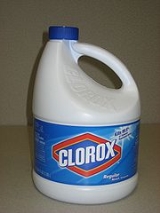
Bleach refers to a number of chemicals that remove color, whiten, or disinfect, often via oxidation. Common chemical bleaches include
household chlorine bleach (a solution of approximately 3–6%
sodium hypochlorite, NaClO),
lyeLye is a corrosive alkaline substance, commonly sodium hydroxide or historically potassium hydroxide . Previously, lye was among the many different alkalis leached from hardwood ashes...
, oxygen bleach (which contains either
hydrogen peroxideHydrogen peroxide is the simplest peroxide and an oxidizer. Hydrogen peroxide is a clear liquid, slightly more viscous than water. In dilute solution, it appears colorless. With its oxidizing properties, hydrogen peroxide is often used as a bleach or cleaning agent...
or a peroxide-releasing compound), and
bleaching powder (
calcium hypochloriteCalcium hypochlorite is a chemical compound with formula 2. It is widely used for water treatment and as a bleaching agent...
). The bleaching process was known to most ancient civilizations and has been around for thousands of years. Modern bleaches resulted from the work of 18th century scientists including Swedish chemist
Carl Wilhelm ScheeleCarl Wilhelm Scheele was a German-Swedish pharmaceutical chemist. Isaac Asimov called him "hard-luck Scheele" because he made a number of chemical discoveries before others who are generally given the credit...
,
FrenchThe French are a nation that share a common French culture and speak the French language as a mother tongue. Historically, the French population are descended from peoples of Celtic, Latin and Germanic origin, and are today a mixture of several ethnic groups...
scientists Claude Berthollet and
Antoine Germain LabarraqueAntoine-Germain Labarraque was a French chemist and pharmacist, notable for formulating and finding important uses for "Eau de Labarraque" or "Labarraque's solution", a solution of sodium hypochlorite widely used as a disinfectant and deodoriser.Labarraque's use of sodium and calcium hypochlorite...
, and
ScottishThe Scottish people , or Scots, are a nation and ethnic group native to Scotland. Historically they emerged from an amalgamation of the Picts and Gaels, incorporating neighbouring Britons to the south as well as invading Germanic peoples such as the Anglo-Saxons and the Norse.In modern use,...
chemist
Charles TennantCharles Tennant was a Scottish chemist and industrialist. He discovered bleaching powder and founded an industrial dynasty.- Biography:...
. Household chlorine bleach is created in two ways: by separating sodium hypochlorite from sea water or brine using
electrolysisIn chemistry and manufacturing, electrolysis is a method of using a direct electric current to drive an otherwise non-spontaneous chemical reaction...
, or by adding
chlorineChlorine is the chemical element with atomic number 17 and symbol Cl. It is the second lightest halogen, found in the periodic table in group 17. The element forms diatomic molecules under standard conditions, called dichlorine...
gas to
sodium hydroxide which produces sodium hypochlorite, water and sodium chloride.
Many bleaches have strong bactericidal properties, and are used for disinfecting and sterilizing.
Examples of peroxide-releasing compounds are
sodium perborateSodium perborate is a white, odorless, water-soluble chemical compound with the chemical composition 3. It crystallizes as the monohydrate, NaBO3·H2O, trihydrate, NaBO3·3H2O and tetrahydrate, NaBO3·4H2O. The monohydrate and tetrahydrate are the commercially important forms...
,
sodium percarbonateSodium percarbonate is a chemical, an adduct of sodium carbonate and hydrogen peroxide , with formula Na2CO3 · 1.5H2O2. It is a colorless, crystalline, hygroscopic and water-soluble solid...
,
sodium persulfateSodium persulfate is a chemical compound. It is a strong oxidizer. It is a severe irritant of skin, eyes, and respiratory system. It is almost non-hygroscopic and has particularly good ability to be stored for long time. It is easy and safe to handle...
, tetrasodium pyrophosphate, or urea peroxide together with catalysts and activators, e.g.,
tetraacetylethylenediamineTetraacetylethylenediamine, commonly abbreviated TAED, is an organic compound with the formula 2NCH2CH2N2. Used as peroxide bleach activator for household detergents and for paper pulp. It is produced by acetylation of ethylenediamine....
or
sodium nonanoyloxybenzenesulfonateSodium nonanoyloxybenzenesulfonate is an important component of detergents and bleaches. It is known as a bleaching activator for active oxygen sources, allowing formulas containing hydrogen peroxide releasing chemicals Sodium nonanoyloxybenzenesulfonate (NOBS) is an important component of...
.
Other examples
Chlorine dioxideChlorine dioxide is a chemical compound with the formula ClO2. This yellowish-green gas crystallizes as bright orange crystals at −59 °C. As one of several oxides of chlorine, it is a potent and useful oxidizing agent used in water treatment and in bleaching....
is used for the
bleaching of wood pulpBleaching of wood pulp is the chemical processing carried out on various types of wood pulp to decrease the color of the pulp, so that it becomes whiter. The main use of wood pulp is to make paper where whiteness is an important characteristic...
,
fatFats consist of a wide group of compounds that are generally soluble in organic solvents and generally insoluble in water. Chemically, fats are triglycerides, triesters of glycerol and any of several fatty acids. Fats may be either solid or liquid at room temperature, depending on their structure...
s and
oilAn oil is any substance that is liquid at ambient temperatures and does not mix with water but may mix with other oils and organic solvents. This general definition includes vegetable oils, volatile essential oils, petrochemical oils, and synthetic oils....
s,
celluloseCellulose is an organic compound with the formula , a polysaccharide consisting of a linear chain of several hundred to over ten thousand β linked D-glucose units....
,
flourFlour is a powder which is made by grinding cereal grains, other seeds or roots . It is the main ingredient of bread, which is a staple food for many cultures, making the availability of adequate supplies of flour a major economic and political issue at various times throughout history...
,
textileA textile or cloth is a flexible woven material consisting of a network of natural or artificial fibres often referred to as thread or yarn. Yarn is produced by spinning raw fibres of wool, flax, cotton, or other material to produce long strands...
s,
beeswaxBeeswax is a natural wax produced in the bee hive of honey bees of the genus Apis. It is mainly esters of fatty acids and various long chain alcohols...
,
skin-Dermis:The dermis is the layer of skin beneath the epidermis that consists of connective tissue and cushions the body from stress and strain. The dermis is tightly connected to the epidermis by a basement membrane. It also harbors many Mechanoreceptors that provide the sense of touch and heat...
, and in a number of other industries.
Sodium thiosulfateSodium thiosulfate , also spelled sodium thiosulphate, is a colorless crystalline compound that is more familiar as the pentahydrate, Na2S2O3•5H2O, an efflorescent, monoclinic crystalline substance also called sodium hyposulfite or “hypo.”...
also called sodium hyposulfite, sometimes shortened to thio or hypo, is used in
pHIn chemistry, pH is a measure of the acidity or basicity of an aqueous solution. Pure water is said to be neutral, with a pH close to 7.0 at . Solutions with a pH less than 7 are said to be acidic and solutions with a pH greater than 7 are basic or alkaline...
testing of bleach substance. If one first adds sodium thiosulfate to the bleach solution, it will neutralize the color-removing effects of bleach and allow one to test the pH of bleach solution with liquid indicator.
In the
food industryThe food production is a complex, global collective of diverse businesses that together supply much of the food energy consumed by the world population...
, some
organic peroxideOrganic peroxides are organic compounds containing the peroxide functional group . If the R' is hydrogen, the compound is called an organic hydroperoxide. Peresters have general structure RCOOR. The O-O bond easily breaks and forms free radicals of the form RO·...
s (
benzoyl peroxideBenzoyl peroxide is an organic compound in the peroxide family. It consists of two benzoyl groups bridged by a peroxide link. Its structural formula is [C6H5C]2O2. It is one of the most important organic peroxides in terms of applications and the scale of its production...
, etc.) and other agents (e.g.,
bromateThe bromate anion, BrO, is a bromine-based oxoanion. A bromate is a chemical compound that contains this ion. Examples of bromates include sodium bromate, , and potassium bromate, .Bromates are formed many different ways in municipal drinking water...
s) are used as
flour bleachingFlour bleaching agent is a food additive added to flour in order to make it appear whiter and to oxidize the surfaces of the flour grains and help with developing of gluten.Usual bleaching agents are:...
and maturing agents.
Peracetic acid and
ozoneOzone , or trioxygen, is a triatomic molecule, consisting of three oxygen atoms. It is an allotrope of oxygen that is much less stable than the diatomic allotrope...
are used in the manufacture of paper products, especially
newsprintNewsprint is a low-cost, non-archival paper most commonly used to print newspapers, and other publications and advertising material. It usually has an off-white cast and distinctive feel. It is designed for use in printing presses that employ a long web of paper rather than individual sheets of...
and white
Kraft paperKraft paper or kraft is paper or paperboard produced from chemical pulp produced in the kraft process.Pulp produced by the kraft process is stronger than that made by other pulping processes; acidic sulfite processes degrade cellulose more, leading to weaker fibers, and mechanical pulping...
.
Two-part bleaches are utilized in the whitening of
woodWood is a hard, fibrous tissue found in many trees. It has been used for hundreds of thousands of years for both fuel and as a construction material. It is an organic material, a natural composite of cellulose fibers embedded in a matrix of lignin which resists compression...
, especially
oakAn oak is a tree or shrub in the genus Quercus , of which about 600 species exist. "Oak" may also appear in the names of species in related genera, notably Lithocarpus...
.
Environmental impact
A Risk Assessment Report (RAR) conducted by the European Union on sodium hypochlorite conducted under Regulation EEC 793/93 concluded that this substance is safe for the environment in all its current, normal uses. This is owed to its high reactivity and instability. Disappearance of hypochlorite is practically immediate in the natural aquatic environment, reaching in a short time concentration as low as 10
-22 μg/L or less in all emission scenarios. In addition, it was found that while volatile chlorine species may be relevant in some indoor scenarios, they have negligible impact in open environmental conditions. Further, the role of hypochlorite pollution is assumed as negligible in soils.
Under conditions where sodium hypochlorite is improperly introduced to confined bodies of water (e.g., ponds, aquaria), bleach is toxic to
fishFish are a paraphyletic group of organisms that consist of all gill-bearing aquatic vertebrate animals that lack limbs with digits. Included in this definition are the living hagfish, lampreys, and cartilaginous and bony fish, as well as various extinct related groups...
and
invertebrateAn invertebrate is an animal without a backbone. The group includes 97% of all animal species – all animals except those in the chordate subphylum Vertebrata .Invertebrates form a paraphyletic group...
s. In confined spaces, fish will attempt to swim away from the source; in unconfined spaces, fish will readily escape the hazard.
Chemical interactions
HypochloriteThe hypochlorite ion, also known as chlorate anion is ClO−. A hypochlorite compound is a chemical compound containing this group, with chlorine in oxidation state +1.Hypochlorites are the salts of hypochlorous acid...
and
chlorineChlorine is the chemical element with atomic number 17 and symbol Cl. It is the second lightest halogen, found in the periodic table in group 17. The element forms diatomic molecules under standard conditions, called dichlorine...
are in
equilibriumIn a chemical reaction, chemical equilibrium is the state in which the concentrations of the reactants and products have not yet changed with time. It occurs only in reversible reactions, and not in irreversible reactions. Usually, this state results when the forward reaction proceeds at the same...
in water; the position of the equilibrium is pH dependent and low pH (acidic) favors chlorine,
Cl
2 + H
2O

H
+ + Cl
- + HClO
ChlorineChlorine is the chemical element with atomic number 17 and symbol Cl. It is the second lightest halogen, found in the periodic table in group 17. The element forms diatomic molecules under standard conditions, called dichlorine...
is a respiratory irritant that attacks
mucous membraneThe mucous membranes are linings of mostly endodermal origin, covered in epithelium, which are involved in absorption and secretion. They line cavities that are exposed to the external environment and internal organs...
s and
burnsA burn is a type of injury to flesh caused by heat, electricity, chemicals, light, radiation or friction. Most burns affect only the skin . Rarely, deeper tissues, such as muscle, bone, and blood vessels can also be injured...
the skin. As little as 3.53 ppm can be detected as an odor, and 1000 ppm is likely to be fatal after a few deep breaths. Exposure to chlorine has been limited to 0.5 ppm (8-hour time-weighted average—38 hour week) by
OSHAThe United States Occupational Safety and Health Administration is an agency of the United States Department of Labor. It was created by Congress of the United States under the Occupational Safety and Health Act, signed by President Richard M. Nixon, on December 29, 1970...
in the U.S.
Sodium hypochlorite and
ammoniaAmmonia is a compound of nitrogen and hydrogen with the formula . It is a colourless gas with a characteristic pungent odour. Ammonia contributes significantly to the nutritional needs of terrestrial organisms by serving as a precursor to food and fertilizers. Ammonia, either directly or...
react to form a number of products, depending on the temperature, concentration, and how they are mixed. The main reaction is chlorination of ammonia, first giving
chloramineChloramines are derivatives of ammonia by substitution of one, two or three hydrogen atoms with chlorine atoms. Monochloramine is an inorganic compound with the formula NH2Cl. It is an unstable colourless liquid at its melting point of -66° temperature, but it is usually handled as a dilute...
(NH
2Cl), then
dichloramineDichloramine is a reactive inorganic compound. It has the formula . The yellow gas is unstable and reacts with many materials. It is formed by a reaction between ammonia and chlorine or sodium hypochlorite...
(NHCl
2) and finally
nitrogen trichlorideNitrogen trichloride, also known as trichloramine, is the chemical compound with the formula NCl3. This yellow, oily, pungent-smelling liquid is most commonly encountered as a byproduct of chemical reactions between ammonia-derivatives and chlorine .In pure form, NCl3 is highly reactive...
(NCl
3). These materials are very irritating to the
eyeThe human eye is an organ which reacts to light for several purposes. As a conscious sense organ, the eye allows vision. Rod and cone cells in the retina allow conscious light perception and vision including color differentiation and the perception of depth...
s and
lungThe human lungs are the organs of respiration in humans. Humans have two lungs, with the left being divided into two lobes and the right into three lobes. Together, the lungs contain approximately of airways and 300 to 500 million alveoli, having a total surface area of about in...
s and are toxic above certain concentrations.
NH
3 + NaOCl → NaOH + NH
2Cl
NH
2Cl + NaOCl → NaOH + NHCl
2
NHCl
2 + NaOCl → NaOH + NCl
3
Additional reactions produce
hydrazineHydrazine is an inorganic compound with the formula N2H4. It is a colourless flammable liquid with an ammonia-like odor. Hydrazine is highly toxic and dangerously unstable unless handled in solution. Approximately 260,000 tons are manufactured annually...
, in a variation of the Olin Raschig process.
NH
3 + NH
2Cl + NaOH → N
2H
4 + NaCl + H
2O
The hydrazine generated can further react with the monochloramine in an
exothermicIn thermodynamics, the term exothermic describes a process or reaction that releases energy from the system, usually in the form of heat, but also in the form of light , electricity , or sound...
reaction:
2 NH
2Cl + N
2H
4 → 2 NH
4Cl + N
2
Industrial bleaching agents can also be sources of concern. For example, the use of elemental chlorine in the
bleaching of wood pulpBleaching of wood pulp is the chemical processing carried out on various types of wood pulp to decrease the color of the pulp, so that it becomes whiter. The main use of wood pulp is to make paper where whiteness is an important characteristic...
produces organochlorines and
persistent organic pollutantthumb|right|275px|State parties to the Stockholm Convention on Persistent Organic PollutantsPersistent organic pollutants are organic compounds that are resistant to environmental degradation through chemical, biological, and photolytic processes...
s, including dioxins. According to an industry group, the use of
chlorine dioxideChlorine dioxide is a chemical compound with the formula ClO2. This yellowish-green gas crystallizes as bright orange crystals at −59 °C. As one of several oxides of chlorine, it is a potent and useful oxidizing agent used in water treatment and in bleaching....
in these processes has reduced the dioxin generation to under detectable levels. However, respiratory risk from chlorine and highly toxic chlorinated byproducts still exists.
A recent European study indicated that sodium hypochlorite and organic chemicals (e.g.,
surfactantSurfactants are compounds that lower the surface tension of a liquid, the interfacial tension between two liquids, or that between a liquid and a solid...
s, fragrances) contained in several household cleaning products can react to generate chlorinated
volatile organic compoundVolatile organic compounds are organic chemicals that have a high vapor pressure at ordinary, room-temperature conditions. Their high vapor pressure results from a low boiling point, which causes large numbers of molecules to evaporate or sublimate from the liquid or solid form of the compound and...
s (VOCs). These chlorinated compounds are emitted during cleaning applications, some of which are toxic and probable human
carcinogenA carcinogen is any substance, radionuclide, or radiation that is an agent directly involved in causing cancer. This may be due to the ability to damage the genome or to the disruption of cellular metabolic processes...
s. The study showed that indoor air concentrations significantly increase (8-52 times for
chloroformChloroform is an organic compound with formula CHCl3. It is one of the four chloromethanes. The colorless, sweet-smelling, dense liquid is a trihalomethane, and is considered somewhat hazardous...
and 1-1170 times for
carbon tetrachlorideCarbon tetrachloride, also known by many other names is the organic compound with the formula CCl4. It was formerly widely used in fire extinguishers, as a precursor to refrigerants, and as a cleaning agent...
, respectively, above baseline quantities in the household) during the use of bleach containing products. The increase in chlorinated volatile organic compound concentrations was the lowest for plain bleach and the highest for the products in the form of “thick liquid and
gelA gel is a solid, jelly-like material that can have properties ranging from soft and weak to hard and tough. Gels are defined as a substantially dilute cross-linked system, which exhibits no flow when in the steady-state...
”. The significant increases observed in indoor air concentrations of several chlorinated VOCs (especially carbon tetrachloride and chloroform) indicate that the bleach use may be a source that could be important in terms of inhalation exposure to these compounds. While the authors suggested that using these cleaning products may significantly increase the cancer risk, this conclusion appears to be hypothetical:
- The highest level cited for concentration of carbon tetrachloride (seemingly of highest concern) is 459 micrograms per cubic meter, translating to 0.073 ppm (part per million), or 73 ppb (part per billion). The OSHA
The United States Occupational Safety and Health Administration is an agency of the United States Department of Labor. It was created by Congress of the United States under the Occupational Safety and Health Act, signed by President Richard M. Nixon, on December 29, 1970...
-allowable time-weighted average concentration over an eight-hour period is 10 ppm, almost 140 times higher;
- The OSHA
The United States Occupational Safety and Health Administration is an agency of the United States Department of Labor. It was created by Congress of the United States under the Occupational Safety and Health Act, signed by President Richard M. Nixon, on December 29, 1970...
highest allowable peak concentration (5 minute exposure for five minutes in a 4-hour period) is 200 ppm, twice as high as the reported highest peak level (from the headspaceHeadspace technology is a technique developed in the 1980s to elucidate the odor compounds present in the air surrounding various objects. Usually the objects of interest are odoriferous objects such as plants, flowers and foods. Similar techniques are also used to analyze the interesting scents...
of a bottle of a sample of bleach plus detergent).
Further studies of the use of these products and other possible exposure routes (i.e., dermal) may reveal other risks. Though the author further cited
ozone depletionOzone depletion describes two distinct but related phenomena observed since the late 1970s: a steady decline of about 4% per decade in the total volume of ozone in Earth's stratosphere , and a much larger springtime decrease in stratospheric ozone over Earth's polar regions. The latter phenomenon...
greenhouse effectThe greenhouse effect is a process by which thermal radiation from a planetary surface is absorbed by atmospheric greenhouse gases, and is re-radiated in all directions. Since part of this re-radiation is back towards the surface, energy is transferred to the surface and the lower atmosphere...
s for these gases, the very low amount of such gases, generated as prescribed, should minimize their contribution relative to other sources.
Dilution
Bleach is sold extremely concentrated and must be diluted to be used safely when disinfecting surfaces and when used to treat drinking water. When disinfecting most surfaces, 1 part bleach to 100 parts water is sufficient for sanitizing; stronger solutions may be used with caution. In an emergency, drinking water can be treated: the ratio of bleach to water for purification is 2 drops of bleach per liter of water or 8 drops of bleach per gallon (3.79L) of water; 1/2 teaspoon bleach per five gallons (19L) of water. If water is cloudy, filter the water before adding the bleach. Let treated water stand covered for 15 minutes before drinking. Additional bleach will not kill more bacteria and can endanger health.
Chemistry
The active ingredient in bleach, hypochlorite ion, is produced by the following set of chemical reactions:
Cl
2(aq) + H
2O(l)

H
+(aq) + Cl
-(aq) + HClO(aq)
The H
+ ion of the
hypochlorous acidHypochlorous acid is a weak acid with the chemical formula HClO. It forms when chlorine dissolves in water. It cannot be isolated in pure form due to rapid equilibration with its precursor...
then dissolves into solution, and so the final result is effectively:
Cl
2(aq) + H
2O(l)

2H
+(aq) + Cl
-(aq) + ClO
-(aq)
Hypochlorite tends to decompose into chloride and a highly reactive form of oxygen:
2ClO
- 
2Cl
- + O
2
Whitening
Colour in most
dyeA dye is a colored substance that has an affinity to the substrate to which it is being applied. The dye is generally applied in an aqueous solution, and requires a mordant to improve the fastness of the dye on the fiber....
s and
pigmentA pigment is a material that changes the color of reflected or transmitted light as the result of wavelength-selective absorption. This physical process differs from fluorescence, phosphorescence, and other forms of luminescence, in which a material emits light.Many materials selectively absorb...
s is produced by molecules which contain
chromophoreA chromophore is the part of a molecule responsible for its color. The color arises when a molecule absorbs certain wavelengths of visible light and transmits or reflects others. The chromophore is a region in the molecule where the energy difference between two different molecular orbitals falls...
s, such as beta carotene. Chemical bleaches work in one of two ways:
- An oxidizing bleach works by breaking the chemical bond
A chemical bond is an attraction between atoms that allows the formation of chemical substances that contain two or more atoms. The bond is caused by the electromagnetic force attraction between opposite charges, either between electrons and nuclei, or as the result of a dipole attraction...
s that make up the chromophore. This changes the molecule into a different substance that either does not contain a chromophore, or contains a chromophore that does not absorb visible light.
- A reducing bleach works by converting double bond
A double bond in chemistry is a chemical bond between two chemical elements involving four bonding electrons instead of the usual two. The most common double bond, that between two carbon atoms, can be found in alkenes. Many types of double bonds between two different elements exist, for example in...
s in the chromophore into single bonds. This eliminates the ability of the chromophore to absorb visible light.
Sunlight acts as a bleach through a process leading to similar results: high energy
photonIn physics, a photon is an elementary particle, the quantum of the electromagnetic interaction and the basic unit of light and all other forms of electromagnetic radiation. It is also the force carrier for the electromagnetic force...
s of light, often in the
violetAs the name of a color, violet is synonymous with a bluish purple, when the word "purple" is used in the common English language sense of any color between blue and red, not including either blue or red...
or
ultravioletUltraviolet light is electromagnetic radiation with a wavelength shorter than that of visible light, but longer than X-rays, in the range 10 nm to 400 nm, and energies from 3 eV to 124 eV...
range, can disrupt the bonds in the chromophore, rendering the resulting substance colorless. Extended exposure often leads to massive discoloration usually reducing the colors to white and typically very faded blue spectrums.
Antimicrobial efficacy
The broad-spectrum effectiveness of bleach, particularly sodium hypochlorite, owes to the nature of its chemical reactivity with microbes. Rather than acting in an inhibitory or toxic fashion in the manner of
antibioticAn antibacterial is a compound or substance that kills or slows down the growth of bacteria.The term is often used synonymously with the term antibiotic; today, however, with increased knowledge of the causative agents of various infectious diseases, antibiotic has come to denote a broader range of...
s, bleach quickly reacts with microbial cells to irreversibly
denatureDenaturation is a process in which proteins or nucleic acids lose their tertiary structure and secondary structure by application of some external stress or compound, such as a strong acid or base, a concentrated inorganic salt, an organic solvent , or heat...
and destroy many
pathogenA pathogen gignomai "I give birth to") or infectious agent — colloquially, a germ — is a microbe or microorganism such as a virus, bacterium, prion, or fungus that causes disease in its animal or plant host...
s. Bleach, particularly sodium hypochlorite has been shown to react with a microbe's
heat shock proteinHeat shock proteins are a class of functionally related proteins involved in the folding and unfolding of other proteins. Their expression is increased when cells are exposed to elevated temperatures or other stress. This increase in expression is transcriptionally regulated...
s, stimulating their role as intra-cellular chaperone and causing the bacteria to form into clumps (much like an egg that has been boiled) that will eventually die off. In some cases, bleach's base acidity compromises a bacterium's lipid membrane, a reaction similar to popping a balloon. The range of micro-organisms effectively killed by bleach (particularly sodium hypochlorite) is extensive, making it an extremely versatile disinfectant. The same study found that at low (micromolar) sodium hypochlorite levels,
E. coliEscherichia coli is a Gram-negative, rod-shaped bacterium that is commonly found in the lower intestine of warm-blooded organisms . Most E. coli strains are harmless, but some serotypes can cause serious food poisoning in humans, and are occasionally responsible for product recalls...
and
Vibrio choleraeVibrio cholerae is a Gram-negative, comma-shaped bacterium. Some strains of V. cholerae cause the disease cholera. V. cholerae is facultatively anaerobic and has a flagella at one cell pole. V...
activate a defense mechanism that helps protect the bacteria, though the implications of this defense mechanism have not been fully investigated.
In response to infection, the human
immune systemAn immune system is a system of biological structures and processes within an organism that protects against disease by identifying and killing pathogens and tumor cells. It detects a wide variety of agents, from viruses to parasitic worms, and needs to distinguish them from the organism's own...
will produce a strong oxidizer,
hypochlorous acidHypochlorous acid is a weak acid with the chemical formula HClO. It forms when chlorine dissolves in water. It cannot be isolated in pure form due to rapid equilibration with its precursor...
, which is generated in activated neutrophils by
myeloperoxidaseMyeloperoxidase is a peroxidase enzyme that in humans is encoded by the MPO gene. Myeloperoxidase is most abundantly expressed in neutrophil granulocytes . It is a lysosomal protein stored in azurophilic granules of the neutrophil...
-mediated peroxidation of chloride ions, and contributes to the destruction of
bacteriaBacteria are a large domain of prokaryotic microorganisms. Typically a few micrometres in length, bacteria have a wide range of shapes, ranging from spheres to rods and spirals...
.
Further reading
- Bodkins, Dr. Bailey. Bleach. Philadelphia: Virginia Printing Press, 1995.
- Trotman, E.R. Textile Scouring and Bleaching. London: Charles Griffin & Co., 1968. ISBN 0852640676.
External links