


Cavalleria rusticana

Encyclopedia
Cavalleria rusticana is an opera
in one act by Pietro Mascagni
to an Italian libretto
by Giovanni Targioni-Tozzetti
and Guido Menasci
, adapted from a play written by Giovanni Verga
based on his short story. Considered one of the classic verismo
operas, it premiered on May 17, 1890 at the Teatro Costanzi
in Rome
. Since 1893
, it has often been performed in a so-called Cav/Pag double-bill with Pagliacci
by Ruggero Leoncavallo
.
announced a competition open to all young Italian composers who had not yet had an opera performed on stage. They were invited to submit a one-act opera, of which the three best (selected by a jury of five prominent Italian critics and composers) would be staged in Rome at Sonzogno's expense.
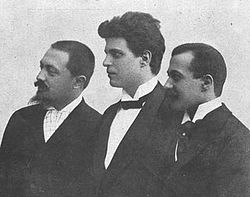 Mascagni heard about the competition only two months before the closing date and asked his friend Giovanni Targioni-Tozzetti, a poet and professor of literature in the Italian Royal Naval Academy
in Livorno
, to provide a libretto. Targioni-Tozzetti chose Cavalleria rusticana, a popular short story (and play) by Giovanni Verga
as the basis for the opera. He and his colleague Guido Menasci set about composing the libretto, sending it to Mascagni in fragments, sometimes only a few verses at a time on the back of a postcard. The opera was finally submitted on the last day for which entries would be accepted. In all, 73 operas were submitted, and on March 5, 1890, the judges selected the final three: Niccola Spinelli's Labilia, Vincenzo Ferroni's Rudello, and Pietro Mascagni's Cavalleria rusticana.
There have been two other operas based on Verga's story. The first, Mala Pasqua!
by Stanislao Gastaldon
, had been entered in the same competition with Mascagni's. However, Gastaldon withdrew it when he received an opportunity to have it performed at the Teatro Costanzi. It premiered there on 9 April 1890. In the 1907 Sonzogno competition, Domenico Monleone
submitted an opera based on the story, and likewise called Cavalleria rusticana. The opera was not successful in the competition but premiered later that year in Amsterdam and went on to a successful tour throughout Europe, ending in Turin. Sonzogno, wishing to protect the lucrative property which Mascagni's version had become, took legal action and successfully had Monleone's opera banned from performance in Italy. Monleone changed the opera ‘beyond recognition’, setting the music to a new libretto. In this form it was presented as La giostra dei falchi in 1914.
, premiered in 1932 and Guglielmo Ratcliff
, premiered in 1895), Cavalleria rusticana was his first opera to be completed and performed. It remains the best known of his fifteen operas and one operetta (Sì). Apart from Cavalleria rusticana, only Iris
and L'amico Fritz
have remained in the standard repertory, with Isabeau
and Il piccolo Marat
on the fringes of the Italian repertoire.
Its success has been phenomenal from its first performance in the Teatro Costanzi
in Rome on May 17, 1890 until the present day. At the time of Mascagni's death in 1945, the opera had been performed more than 14,000 times in Italy alone.
The first performance of Cavalleria rusticana caused a sensation, with Mascagni taking 40 curtain calls on the opening night, and winning the First Prize. That same year, following its sold-out run of performances at the Teatro Costanzi, the opera was produced throughout Italy and in Berlin. It received its London premiere at the Shaftesbury Theatre on October 19, 1891 and its Covent Garden
premiere on May 16, 1892.
 American producers vied with each other (sometimes through the courts) to be the first to present the opera in that country. Cavalleria rusticana finally had its American premiere in Philadelphia at the Grand Opera House on September 9, 1891, followed by Chicago on September 30, 1891. The opera premiered in New York on October 1, 1891 with two rival performances on the same day, an afternoon performance at the Casino, directed by Rudolph Aronson and an evening performance at the Lenox Lyceum directed by Oscar Hammerstein
.
The opera received its first performance at the Metropolitan Opera
on December 30, 1891 in a double bill with a fragment of Gluck
's Orfeo ed Euridice
, and has since received 652 performances there, the most recent of which was on April 10, 2009 with José Cura
as Turiddu and Ildikó Komlósi
as Santuzza.
village on Easter morning
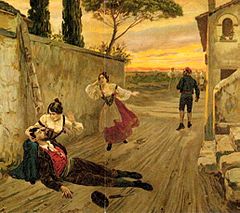 Turiddu, a young villager, had returned from military service to find that while he was gone, his fiancée, Lola, had married Alfio, the prosperous village teamster
. In revenge, Turiddu seduced Santuzza, a young woman in the village. As the opera begins, Lola, overcome by her jealousy of Santuzza, has begun an adulterous affair with Turiddu.
Offstage, Turiddu is heard singing The Siciliana
- "O Lola, lovely as the spring’s bright blooms". The curtain rises on the main square of the village. To one side is the church; to the other is Lucia's wine shop and the house where she lives with her son, Turiddu. The villagers move about the square, singing of the beautiful spring day (Gli aranci olezzano sui verdi margini - "The air is sweet with orange blossoms") and a hymn to the Blessed Virgin. Some villagers enter the church, others wander off still singing.
Santuzza, having slept with Turiddu and suspecting that he has betrayed her with Lola, is distraught and approaches Lucia as she comes out of her house. Santuzza asks for Turiddu, and Lucia replies that he has gone to another town to fetch some wine. Santuzza tells her that he was seen during the night in the village. Lucia asks her inside to talk, but just at that moment Alfio arrives on his wagon accompanied by the villagers. He praises the joys of a teamster's life and the beauty of his bride. Alfio asks Lucia for some of her fine old wine. She tells him it has run out and Turiddu has gone away to buy more. Alfio replies that he had seen Turiddu early that morning near his cottage. Lucia starts to express surprise, but Santuzza stops her.
Alfio leaves. The choir inside the church is heard singing the Regina Coeli. Outside, the villagers sing an Easter Hymn, joined by Santuzza. The villagers enter the church, while Santuzza and Lucia remain outside. Lucia asks Santuzza why she signalled her to remain silent when Alfio said that he had seen Turiddu that morning. Santuzza exclaims, Voi lo sapete - "Now you shall know", and tells Lucia the story of her seduction by Turiddu and his affair with Lola. Lucia pities Santuzza, who is considered by the villagers to be excommunicated
because of her seduction. Santuzza cannot enter the church, but begs Lucia to go inside and pray for her.
Turiddu arrives. Santuzza upbraids him for pretending to have gone away, when he was actually seeing Lola. Lola enters the square singing. She mocks Santuzza and goes inside the church. Turiddu turns to follow Lola, but Santuzza begs him to stay. Turiddu pushes her away. She clings to him. He loosens her hands, throws her to the ground, and enters the church. Alfio arrives looking for Lola. Santuzza tells him that his wife has betrayed him with Turiddu.
The square is empty as the orchestra plays the Intermezzo
.
The villagers come out of the church. Turiddu is in high spirits because he is with Lola and Santuzza appears to have gone. He invites his friends to his mother’s wine shop where he sings a drinking song, Viva, il vino spumeggiante - "Hail to the bubbling wine!". Alfio joins them. Turiddu offers him wine, but he refuses it. The women leave, taking Lola with them. In a brief exchange of words, Alfio challenges Turiddu to a duel. Following Sicilian custom, the two men embrace, and Turiddu, in a token of acceptance, bites Alfio’s ear, drawing blood which signifies a fight to the death. Alfio leaves and Turiddu calls Lucia back. He tells her that he is going outside to get some air and asks that she be a kindly mother to Santuzza if he should not return: Un bacio, mamma! Un altro bacio! — Addio! - "One kiss, mother! One more kiss! - Farewell!".
Turiddu rushes out. Lucia, weeping, wanders aimlessly around outside her house. Santuzza approaches and throws her arms around her. The villagers start to crowd around. Voices are heard in the distance and a woman cries, "They have murdered Turiddu!" Santuzza faints and Lucia collapses in the arms of the women villagers.
s, 2 piccolo
s, 2 oboe
s, 2 clarinet
s, 2 bassoon
s, 4 horns
, 2 trumpet
s, 3 trombone
s, tuba
, timpani
, percussion (triangle
, cymbal
s, bass drum
, side drum
, tamtam
, tubular bells
), harp
, organ
and strings
.
's Pagliacci
. In addition to the original Italian, recordings of the work in the English, French, German, and Hungarian languages have been released. Amongst some of the more well-known studio recordings in the Italian language are:
on December 11, 1910. Radio pioneer Lee De Forest
talked Giulio Gatti-Casazza
, the Met manager, into sending the program over the airwaves via a backstage radio transmitter and a rooftop antenna, "using a long fishing pole for his mast." Enrico Caruso and Emmy Destinn
were in the leading roles.
In Los Angeles, California
, an "Italian Night" concert was heard live "in its entirety" on May 6, 1930, as the third program of the Adohr opera series over radio station KFI
, featuring "A distinguished cast . . . headed by Lisa Roma
, noted lyric soprano. . . . Music lovers should not fail to tune in."
A notable use of the Intermezzo from Cavalleria rusticana in the United States was as the theme for a regular radio broadcast, Symphony of the Rockies, which featured "a small string group playing light classical music" in the 1930s and 1940s over Salt Lake City radio station KOA
, then owned and operated by the NBC
network. It "was a 'feed' to the entire network from the KOA studios."
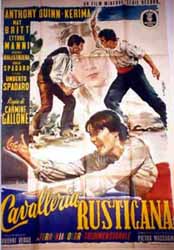 Apart from video recordings of live performances, there have been several cinematic versions of Cavalleria rusticana, the most notable of which are:
The opera's symphonic Intermezzo has figured in the sound track of several films, most notably in the opening of Raging Bull and in The Godfather Part III
, which featured a performance of the opera as a key part of the film's climax. In the Director's Cut of Watchmen
, the elderly Hollis Mason is murdered by the gang known as the knottops who mistaken him as the younger Night Owl. The Easter parade took place after Alfio challenges Turiddu to a duel
Opera
Opera is an art form in which singers and musicians perform a dramatic work combining text and musical score, usually in a theatrical setting. Opera incorporates many of the elements of spoken theatre, such as acting, scenery, and costumes and sometimes includes dance...
in one act by Pietro Mascagni
Pietro Mascagni
Pietro Antonio Stefano Mascagni was an Italian composer most noted for his operas. His 1890 masterpiece Cavalleria rusticana caused one of the greatest sensations in opera history and single-handedly ushered in the Verismo movement in Italian dramatic music...
to an Italian libretto
Libretto
A libretto is the text used in an extended musical work such as an opera, operetta, masque, oratorio, cantata, or musical. The term "libretto" is also sometimes used to refer to the text of major liturgical works, such as mass, requiem, and sacred cantata, or even the story line of a...
by Giovanni Targioni-Tozzetti
Giovanni Targioni-Tozzetti
Giovanni Targioni-Tozzetti was an Italian librettist, best known for his friendship and collaboration with the composer Pietro Mascagni...
and Guido Menasci
Guido Menasci
Guido Menasci was an Italian opera librettist.His best known work is Cavalleria rusticana written with Giovanni Targioni-Tozzetti. He also provided the libretti for Mascagni's I Rantzau, Zanetto, for Umberto Giordano's Regina Diaz and Viktor Parma's Stara pesem .Menasci was born in...
, adapted from a play written by Giovanni Verga
Giovanni Verga
Giovanni Carmelo Verga was an Italian realist writer, best known for his depictions of life in Sicily, and especially for the short story "Cavalleria Rusticana" and the novel I Malavoglia .-Life and career:The first son of Giovanni Battista Catalano Verga and Caterina Di Mauro,...
based on his short story. Considered one of the classic verismo
Verismo
Verismo was an Italian literary movement which peaked between approximately 1875 and the early 1900s....
operas, it premiered on May 17, 1890 at the Teatro Costanzi
Teatro dell'Opera di Roma
The Teatro dell'Opera di Roma is an opera house in Rome, Italy. Originally opened in November 1880 as the 2,212 seat Costanzi Theatre, it has undergone several changes of name as well modifications and improvements...
in Rome
Rome
Rome is the capital of Italy and the country's largest and most populated city and comune, with over 2.7 million residents in . The city is located in the central-western portion of the Italian Peninsula, on the Tiber River within the Lazio region of Italy.Rome's history spans two and a half...
. Since 1893
1893 in music
-Events:* February 9 - Premiere of Giuseppe Verdi's final opera Falstaff in La Scala in Milan*August 14-15 - America's oldest music organization, the Stoughton Musical Society performs at the World's Columbian Exposition...
, it has often been performed in a so-called Cav/Pag double-bill with Pagliacci
Pagliacci
Pagliacci , sometimes incorrectly rendered with a definite article as I Pagliacci, is an opera consisting of a prologue and two acts written and composed by Ruggero Leoncavallo. It recounts the tragedy of a jealous husband in a commedia dell'arte troupe...
by Ruggero Leoncavallo
Ruggero Leoncavallo
Ruggero Leoncavallo was an Italian opera composer. His two-act work Pagliacci remains one of the most popular works in the repertory, appearing as number 20 on the Operabase list of the most-performed operas worldwide.-Biography:...
.
Composition history
In July 1888 the Milanese music publisher Edoardo SonzognoEdoardo Sonzogno
Edoardo Sonzogno was an Italian publisher.A native of Milan, Sonzogno was the son of a businessman who owned a printing plant and bookstore; when he inherited the business upon his father's death he set about turning it into a publishing house, Casa Sonzogno, which opened in 1874...
announced a competition open to all young Italian composers who had not yet had an opera performed on stage. They were invited to submit a one-act opera, of which the three best (selected by a jury of five prominent Italian critics and composers) would be staged in Rome at Sonzogno's expense.
Accademia Navale di Livorno
The Italian Naval Academy is a coeducational military university in Leghorn , which is responsible for the technical training of military officers of the Italian Navy.-The Hospital of St. James:...
in Livorno
Livorno
Livorno , traditionally Leghorn , is a port city on the Tyrrhenian Sea on the western edge of Tuscany, Italy. It is the capital of the Province of Livorno, having a population of approximately 160,000 residents in 2009.- History :...
, to provide a libretto. Targioni-Tozzetti chose Cavalleria rusticana, a popular short story (and play) by Giovanni Verga
Giovanni Verga
Giovanni Carmelo Verga was an Italian realist writer, best known for his depictions of life in Sicily, and especially for the short story "Cavalleria Rusticana" and the novel I Malavoglia .-Life and career:The first son of Giovanni Battista Catalano Verga and Caterina Di Mauro,...
as the basis for the opera. He and his colleague Guido Menasci set about composing the libretto, sending it to Mascagni in fragments, sometimes only a few verses at a time on the back of a postcard. The opera was finally submitted on the last day for which entries would be accepted. In all, 73 operas were submitted, and on March 5, 1890, the judges selected the final three: Niccola Spinelli's Labilia, Vincenzo Ferroni's Rudello, and Pietro Mascagni's Cavalleria rusticana.
There have been two other operas based on Verga's story. The first, Mala Pasqua!
Mala Pasqua!
Mala Pasqua! is an opera in three acts composed by Stanislao Gastaldon to a libretto by Giovanni Domenico Bartocci-Fontana. The libretto is based on Giovanni Verga's play, Cavalleria rusticana which Verga had adapted from his short story of the same name...
by Stanislao Gastaldon
Stanislao Gastaldon
Martino Stanislao Luigi Gastaldon was an Italian composer, primarily of salon songs for solo voice and piano. However, he also composed instrumental music, two choral works, and four operas. Today, he is remembered almost exclusively for his 1881 song "Musica proibita" , still one of the most...
, had been entered in the same competition with Mascagni's. However, Gastaldon withdrew it when he received an opportunity to have it performed at the Teatro Costanzi. It premiered there on 9 April 1890. In the 1907 Sonzogno competition, Domenico Monleone
Domenico Monleone
Domenico Monleone was an Italian composer of operas, most noted for his opera Cavalleria rusticana of 1907, which for a while rivalled the success of Mascagni's work of the same name which was from the same source...
submitted an opera based on the story, and likewise called Cavalleria rusticana. The opera was not successful in the competition but premiered later that year in Amsterdam and went on to a successful tour throughout Europe, ending in Turin. Sonzogno, wishing to protect the lucrative property which Mascagni's version had become, took legal action and successfully had Monleone's opera banned from performance in Italy. Monleone changed the opera ‘beyond recognition’, setting the music to a new libretto. In this form it was presented as La giostra dei falchi in 1914.
Performance history
Although Mascagni had started writing two other operas earlier (PinottaPinotta
Pinotta is an idillio or opera in 2 acts by Pietro Mascagni from an Italian libretto by Giovanni Targioni-Tozzetti. The opera received its first performance on March 23, 1932 at the Teatro del Casinò in San Remo....
, premiered in 1932 and Guglielmo Ratcliff
Guglielmo Ratcliff
Guglielmo Ratcliff is a tragic opera in four acts by Pietro Mascagni to an Italian libretto by Andrea Maffei, translated from the German play Wilhelm Ratcliff by Heinrich Heine...
, premiered in 1895), Cavalleria rusticana was his first opera to be completed and performed. It remains the best known of his fifteen operas and one operetta (Sì). Apart from Cavalleria rusticana, only Iris
Iris (opera)
Iris is an opera in three acts by Pietro Mascagni to an original Italian libretto by Luigi Illica. Its first performance was at the Teatro Costanzi in Rome on 22 November 1898.The opera is through-composed and set in Japan during legendary times...
and L'amico Fritz
L'amico Fritz
L'amico Fritz is an opera in three acts by Pietro Mascagni, premiered in 1891 from a libretto by P. Suardon , based on the French novel L'ami Fritz by Émile Erckmann and Pierre-Alexandre Chatrian.While the opera enjoyed some success in its day and is probably Mascagni's most famous work after...
have remained in the standard repertory, with Isabeau
Isabeau
Isabeau is a leggenda drammatica or opera in three parts by Pietro Mascagni, 1911, from an Italian libretto by Luigi Illica. Mascagni conducted its first performance on June 2, 1911 at the Teatro Coliseo, Buenos Aires....
and Il piccolo Marat
Il piccolo Marat
Il piccolo Marat is a dramma lirico or opera in three acts by Pietro Mascagni, 1921, from a libretto by Giovacchino Forzano.-Performance history:...
on the fringes of the Italian repertoire.
Its success has been phenomenal from its first performance in the Teatro Costanzi
Teatro dell'Opera di Roma
The Teatro dell'Opera di Roma is an opera house in Rome, Italy. Originally opened in November 1880 as the 2,212 seat Costanzi Theatre, it has undergone several changes of name as well modifications and improvements...
in Rome on May 17, 1890 until the present day. At the time of Mascagni's death in 1945, the opera had been performed more than 14,000 times in Italy alone.
The first performance of Cavalleria rusticana caused a sensation, with Mascagni taking 40 curtain calls on the opening night, and winning the First Prize. That same year, following its sold-out run of performances at the Teatro Costanzi, the opera was produced throughout Italy and in Berlin. It received its London premiere at the Shaftesbury Theatre on October 19, 1891 and its Covent Garden
Royal Opera House
The Royal Opera House is an opera house and major performing arts venue in Covent Garden, central London. The large building is often referred to as simply "Covent Garden", after a previous use of the site of the opera house's original construction in 1732. It is the home of The Royal Opera, The...
premiere on May 16, 1892.
Oscar Hammerstein I
Oscar Hammerstein I was a businessman, theater impresario and composer in New York City. His passion for opera led him to open several opera houses, and he rekindled opera's popularity in America...
.
The opera received its first performance at the Metropolitan Opera
Metropolitan Opera
The Metropolitan Opera is an opera company, located in New York City. Originally founded in 1880, the company gave its first performance on October 22, 1883. The company is operated by the non-profit Metropolitan Opera Association, with Peter Gelb as general manager...
on December 30, 1891 in a double bill with a fragment of Gluck
Christoph Willibald Gluck
Christoph Willibald Ritter von Gluck was an opera composer of the early classical period. After many years at the Habsburg court at Vienna, Gluck brought about the practical reform of opera's dramaturgical practices that many intellectuals had been campaigning for over the years...
's Orfeo ed Euridice
Orfeo ed Euridice
Orfeo ed Euridice is an opera composed by Christoph Willibald Gluck based on the myth of Orpheus, set to a libretto by Ranieri de' Calzabigi. It belongs to the genre of the azione teatrale, meaning an opera on a mythological subject with choruses and dancing...
, and has since received 652 performances there, the most recent of which was on April 10, 2009 with José Cura
José Cura
José Cura is a prominent operatic tenor known for his intense and original interpretations of his characters, notably Verdi’s Otello and Saint-Saëns’ Samson, as well as for his unconventional and innovative concert performances. He is also able to perform high baritone roles with the extended...
as Turiddu and Ildikó Komlósi
Ildikó Komlósi
-Biography:Originary of Hungary from Békés County, she studied and was graduated at "Franz Liszt Academy of Music" in Budapest; improving her aptitudes for song at the "Scala" of Milan and at he "Guildhall School of Music and Drama" in London.-Career:...
as Santuzza.
Roles
| Role | Voice type | Premiere Cast, 17 May 1890 (Conductor: - ) |
|---|---|---|
| Santuzza, a peasant girl | soprano Soprano A soprano is a voice type with a vocal range from approximately middle C to "high A" in choral music, or to "soprano C" or higher in operatic music. In four-part chorale style harmony, the soprano takes the highest part, which usually encompasses the melody... |
Gemma Bellincioni Gemma Bellincioni Gemma Bellincioni was an Italian soprano and one of the best-known opera singers of the late 19th century. She had a particular affinity with the verismo repertoire and was renowned more for her charismatic acting than for the quality of her voice.-Her career:Matilda Cesira was Bellincioni's real... |
| Turiddu, a young villager recently returned from the army | tenor Tenor The tenor is a type of male singing voice and is the highest male voice within the modal register. The typical tenor voice lies between C3, the C one octave below middle C, to the A above middle C in choral music, and up to high C in solo work. The low extreme for tenors is roughly B2... |
Roberto Stagno Roberto Stagno Roberto Stagno , was a prominent Italian opera tenor. He became an important interpreter of verismo music when it burst on to the operatic scene during the 1890s; but he also possessed an agile bel canto technique which he employed in operas dating from earlier periods... |
| Lucia, his mother | contralto Contralto Contralto is the deepest female classical singing voice, with the lowest tessitura, falling between tenor and mezzo-soprano. It typically ranges between the F below middle C to the second G above middle C , although at the extremes some voices can reach the E below middle C or the second B above... |
Federica Casali |
| Alfio, the village teamster | baritone Baritone Baritone is a type of male singing voice that lies between the bass and tenor voices. It is the most common male voice. Originally from the Greek , meaning deep sounding, music for this voice is typically written in the range from the second F below middle C to the F above middle C Baritone (or... |
Guadenzio Salassa |
| Lola, his wife | mezzo-soprano Mezzo-soprano A mezzo-soprano is a type of classical female singing voice whose range lies between the soprano and the contralto singing voices, usually extending from the A below middle C to the A two octaves above... |
Annetta Guli |
Synopsis
Setting: a 19th century SicilianSicily
Sicily is a region of Italy, and is the largest island in the Mediterranean Sea. Along with the surrounding minor islands, it constitutes an autonomous region of Italy, the Regione Autonoma Siciliana Sicily has a rich and unique culture, especially with regard to the arts, music, literature,...
village on Easter morning
Teamster
A teamster, in modern American English, is a truck driver. The trade union named after them is the International Brotherhood of Teamsters , one of the largest unions in the United States....
. In revenge, Turiddu seduced Santuzza, a young woman in the village. As the opera begins, Lola, overcome by her jealousy of Santuzza, has begun an adulterous affair with Turiddu.
Offstage, Turiddu is heard singing The Siciliana
Siciliana
The siciliana or siciliano is a musical style or genre often included as a movement within larger pieces of music starting in the Baroque period. It is in a slow 6/8 or 12/8 time with lilting rhythms making it somewhat resemble a slow jig, and is usually in a minor key. It was used for arias in...
- "O Lola, lovely as the spring’s bright blooms". The curtain rises on the main square of the village. To one side is the church; to the other is Lucia's wine shop and the house where she lives with her son, Turiddu. The villagers move about the square, singing of the beautiful spring day (Gli aranci olezzano sui verdi margini - "The air is sweet with orange blossoms") and a hymn to the Blessed Virgin. Some villagers enter the church, others wander off still singing.
Santuzza, having slept with Turiddu and suspecting that he has betrayed her with Lola, is distraught and approaches Lucia as she comes out of her house. Santuzza asks for Turiddu, and Lucia replies that he has gone to another town to fetch some wine. Santuzza tells her that he was seen during the night in the village. Lucia asks her inside to talk, but just at that moment Alfio arrives on his wagon accompanied by the villagers. He praises the joys of a teamster's life and the beauty of his bride. Alfio asks Lucia for some of her fine old wine. She tells him it has run out and Turiddu has gone away to buy more. Alfio replies that he had seen Turiddu early that morning near his cottage. Lucia starts to express surprise, but Santuzza stops her.
Alfio leaves. The choir inside the church is heard singing the Regina Coeli. Outside, the villagers sing an Easter Hymn, joined by Santuzza. The villagers enter the church, while Santuzza and Lucia remain outside. Lucia asks Santuzza why she signalled her to remain silent when Alfio said that he had seen Turiddu that morning. Santuzza exclaims, Voi lo sapete - "Now you shall know", and tells Lucia the story of her seduction by Turiddu and his affair with Lola. Lucia pities Santuzza, who is considered by the villagers to be excommunicated
Excommunication
Excommunication is a religious censure used to deprive, suspend or limit membership in a religious community. The word means putting [someone] out of communion. In some religions, excommunication includes spiritual condemnation of the member or group...
because of her seduction. Santuzza cannot enter the church, but begs Lucia to go inside and pray for her.
Turiddu arrives. Santuzza upbraids him for pretending to have gone away, when he was actually seeing Lola. Lola enters the square singing. She mocks Santuzza and goes inside the church. Turiddu turns to follow Lola, but Santuzza begs him to stay. Turiddu pushes her away. She clings to him. He loosens her hands, throws her to the ground, and enters the church. Alfio arrives looking for Lola. Santuzza tells him that his wife has betrayed him with Turiddu.
The square is empty as the orchestra plays the Intermezzo
Intermezzo
In music, an intermezzo , in the most general sense, is a composition which fits between other musical or dramatic entities, such as acts of a play or movements of a larger musical work...
.
The villagers come out of the church. Turiddu is in high spirits because he is with Lola and Santuzza appears to have gone. He invites his friends to his mother’s wine shop where he sings a drinking song, Viva, il vino spumeggiante - "Hail to the bubbling wine!". Alfio joins them. Turiddu offers him wine, but he refuses it. The women leave, taking Lola with them. In a brief exchange of words, Alfio challenges Turiddu to a duel. Following Sicilian custom, the two men embrace, and Turiddu, in a token of acceptance, bites Alfio’s ear, drawing blood which signifies a fight to the death. Alfio leaves and Turiddu calls Lucia back. He tells her that he is going outside to get some air and asks that she be a kindly mother to Santuzza if he should not return: Un bacio, mamma! Un altro bacio! — Addio! - "One kiss, mother! One more kiss! - Farewell!".
Turiddu rushes out. Lucia, weeping, wanders aimlessly around outside her house. Santuzza approaches and throws her arms around her. The villagers start to crowd around. Voices are heard in the distance and a woman cries, "They have murdered Turiddu!" Santuzza faints and Lucia collapses in the arms of the women villagers.
Orchestration
Mascagni calls for a standard-sized orchestra consisting of 2 fluteFlute
The flute is a musical instrument of the woodwind family. Unlike woodwind instruments with reeds, a flute is an aerophone or reedless wind instrument that produces its sound from the flow of air across an opening...
s, 2 piccolo
Piccolo
The piccolo is a half-size flute, and a member of the woodwind family of musical instruments. The piccolo has the same fingerings as its larger sibling, the standard transverse flute, but the sound it produces is an octave higher than written...
s, 2 oboe
Oboe
The oboe is a double reed musical instrument of the woodwind family. In English, prior to 1770, the instrument was called "hautbois" , "hoboy", or "French hoboy". The spelling "oboe" was adopted into English ca...
s, 2 clarinet
Clarinet
The clarinet is a musical instrument of woodwind type. The name derives from adding the suffix -et to the Italian word clarino , as the first clarinets had a strident tone similar to that of a trumpet. The instrument has an approximately cylindrical bore, and uses a single reed...
s, 2 bassoon
Bassoon
The bassoon is a woodwind instrument in the double reed family that typically plays music written in the bass and tenor registers, and occasionally higher. Appearing in its modern form in the 19th century, the bassoon figures prominently in orchestral, concert band and chamber music literature...
s, 4 horns
Horn (instrument)
The horn is a brass instrument consisting of about of tubing wrapped into a coil with a flared bell. A musician who plays the horn is called a horn player ....
, 2 trumpet
Trumpet
The trumpet is the musical instrument with the highest register in the brass family. Trumpets are among the oldest musical instruments, dating back to at least 1500 BCE. They are played by blowing air through closed lips, producing a "buzzing" sound which starts a standing wave vibration in the air...
s, 3 trombone
Trombone
The trombone is a musical instrument in the brass family. Like all brass instruments, sound is produced when the player’s vibrating lips cause the air column inside the instrument to vibrate...
s, tuba
Tuba
The tuba is the largest and lowest-pitched brass instrument. Sound is produced by vibrating or "buzzing" the lips into a large cupped mouthpiece. It is one of the most recent additions to the modern symphony orchestra, first appearing in the mid-19th century, when it largely replaced the...
, timpani
Timpani
Timpani, or kettledrums, are musical instruments in the percussion family. A type of drum, they consist of a skin called a head stretched over a large bowl traditionally made of copper. They are played by striking the head with a specialized drum stick called a timpani stick or timpani mallet...
, percussion (triangle
Triangle (instrument)
The triangle is an idiophone type of musical instrument in the percussion family. It is a bar of metal, usually steel but sometimes other metals like beryllium copper, bent into a triangle shape. The instrument is usually held by a loop of some form of thread or wire at the top curve...
, cymbal
Cymbal
Cymbals are a common percussion instrument. Cymbals consist of thin, normally round plates of various alloys; see cymbal making for a discussion of their manufacture. The greater majority of cymbals are of indefinite pitch, although small disc-shaped cymbals based on ancient designs sound a...
s, bass drum
Bass drum
Bass drums are percussion instruments that can vary in size and are used in several musical genres. Three major types of bass drums can be distinguished. The type usually seen or heard in orchestral, ensemble or concert band music is the orchestral, or concert bass drum . It is the largest drum of...
, side drum
Snare drum
The snare drum or side drum is a melodic percussion instrument with strands of snares made of curled metal wire, metal cable, plastic cable, or gut cords stretched across the drumhead, typically the bottom. Pipe and tabor and some military snare drums often have a second set of snares on the bottom...
, tamtam
Gong
A gong is an East and South East Asian musical percussion instrument that takes the form of a flat metal disc which is hit with a mallet....
, tubular bells
Tubular Bells
Tubular Bells is the debut record album of English musician Mike Oldfield, released in 1973. It was the first album released by Virgin Records and an early cornerstone of the company's success...
), harp
Harp
The harp is a multi-stringed instrument which has the plane of its strings positioned perpendicularly to the soundboard. Organologically, it is in the general category of chordophones and has its own sub category . All harps have a neck, resonator and strings...
, organ
Organ (music)
The organ , is a keyboard instrument of one or more divisions, each played with its own keyboard operated either with the hands or with the feet. The organ is a relatively old musical instrument in the Western musical tradition, dating from the time of Ctesibius of Alexandria who is credited with...
and strings
String instrument
A string instrument is a musical instrument that produces sound by means of vibrating strings. In the Hornbostel-Sachs scheme of musical instrument classification, used in organology, they are called chordophones...
.
Recordings
There have been more than 120full-length recordings of Cavalleria rusticana published since it was first recorded in Germany in 1909. As in live performances of the opera, recordings of the work have often been paired with Ruggero LeoncavalloRuggero Leoncavallo
Ruggero Leoncavallo was an Italian opera composer. His two-act work Pagliacci remains one of the most popular works in the repertory, appearing as number 20 on the Operabase list of the most-performed operas worldwide.-Biography:...
's Pagliacci
Pagliacci
Pagliacci , sometimes incorrectly rendered with a definite article as I Pagliacci, is an opera consisting of a prologue and two acts written and composed by Ruggero Leoncavallo. It recounts the tragedy of a jealous husband in a commedia dell'arte troupe...
. In addition to the original Italian, recordings of the work in the English, French, German, and Hungarian languages have been released. Amongst some of the more well-known studio recordings in the Italian language are:
| Year | Cast (Santuzza, Turiddu, Alfio, Lucia) |
Conductor, Opera House and Orchestra |
Label |
|---|---|---|---|
| 1927 | May Blyth, Heddle Nash Heddle Nash William Heddle Nash was an English lyric tenor who appeared in opera and oratorio in the middle decades of the twentieth century. He also made numerous recordings that are still available on CD reissues.... , Harold Williams Harold Williams (baritone) Harold John Williams MBE was a leading Australian baritone and music teacher. Born in Sydney, he enjoyed a long and successful career in England and his native country, performing in opera, oratorio and concerts and giving radio broadcasts.-Early years:Williams was born on 3 September 1893 at... , Justine Griffiths |
Aylmer Buesst Aylmer Buesst Aylmer Buesst was an Australian conductor, teacher and scholar, who spent his career in the United Kingdom. He was mainly associated with opera and vocal music... , British National Opera Company British National Opera Company The British National Opera Company presented opera in English in London and on tour in the British provinces between 1922 and 1929. It was founded in December 1921 by singers and instrumentalists from Sir Thomas Beecham's Beecham Opera Company , which was disbanded when financial problems over... |
|
| 1929-30 | Delia Sanzio, Giovanni Breviario Giovanni Breviario Giovanni Breviario , was an Italian operatic tenor, particularly associated with Italian dramatic roles.Breviario was born at Bergamo. He studied in Milan with Dante Lari, and made his stage debut in Pola, as Manrico, in 1924... , Piero Biasini Olga de Franco |
Carlo Sabajno Carlo Sabajno Carlo Sabajno was an Italian conductor. From 1904 to 1932 he was the Gramophone Company's chief conductor and artistic director in Italy... , La Scala La Scala La Scala , is a world renowned opera house in Milan, Italy. The theatre was inaugurated on 3 August 1778 and was originally known as the New Royal-Ducal Theatre at La Scala... Orchestra and Chorus |
Audio CD: Arkadia Cat: 78046 |
| 1930 | Giannina Arangi-Lombardi Giannina Arangi-Lombardi Giannina Arangi-Lombardi was a prominent spinto soprano, particularly associated with the Italian operatic repertory.... , Antonio Melandri, Gino Lulli Ida Mannarini |
Lorenzo Molajoli Lorenzo Molajoli Lorenzo Molajoli was an Italian opera conductor who was active in recording during the 1920s and 30s.The facts surrounding the career of the conductor Lorenzo Molajoli are obscure. He was born in Rome in 1868 and studied there at the Accademia di Santa Cecilia... , Milan Symphony Orchestra Orchestra Sinfonica di Milano Giuseppe Verdi The Orchestra Sinfonica di Milano Giuseppe Verdi is an Italian orchestra based in Milan. The orchestra refers to itself as La Verdi colloquially. The orchestra's primary residence is the Auditorium di Milano Fondazione Cariplo.-History:Vladimir Delman founded the orchestra in 1993 as an... |
Audio CD: Preiser Records Cat: 90042 |
| 1940 | Lina Bruna Rasa Lina Bruna Rasa Lina Bruna Rasa was an Italian operatic soprano. She was particularly noted for her performances in the verismo repertoire and was a favourite of Pietro Mascagni who considered her the ideal Santuzza... , Beniamino Gigli Beniamino Gigli Beniamino Gigli was an Italian opera singer. The most famous tenor of his generation, he was renowned internationally for the great beauty of his voice and the soundness of his vocal technique. Music critics sometimes took him to task, however, for what was perceived to be the over-emotionalism... , Gino Bechi Gino Bechi Gino Bechi was an Italian operatic baritone, particularly associated with the Italian repertory, especially in Verdi roles.-Life and career:... , Giulietta Simionato Giulietta Simionato Giulietta Simionato was an Italian mezzo-soprano. Her career spanned from the 1930s until her retirement in 1966.-Life:Born at Forlì, Romagna, she studied in Rovigo and Padua, and made her operatic debut at Montagnana in 1928... |
Pietro Mascagni Pietro Mascagni Pietro Antonio Stefano Mascagni was an Italian composer most noted for his operas. His 1890 masterpiece Cavalleria rusticana caused one of the greatest sensations in opera history and single-handedly ushered in the Verismo movement in Italian dramatic music... , La Scala Orchestra and Chorus |
Audio CD: Naxos Naxos Records Naxos Records is a record label specializing in classical music. Through a number of imprints, Naxos also releases genres including Chinese music, jazz, world music, and early rock & roll. The company was founded in 1987 by Klaus Heymann, a German-born resident of Hong Kong.Naxos is the largest... CD Cat: 8.110714-15 |
| 1950 | Giulietta Simionato Giulietta Simionato Giulietta Simionato was an Italian mezzo-soprano. Her career spanned from the 1930s until her retirement in 1966.-Life:Born at Forlì, Romagna, she studied in Rovigo and Padua, and made her operatic debut at Montagnana in 1928... , Achille Braschi, Carlo Tagliabue Carlo Tagliabue Carlo Tagliabue was an Italian baritone.After studies with Leopoldo Gennai and Annibale Guidotti he made his debut in Lodi, Lombardy, in Loreley and Aida. His debuts in Genoa , Torino, La Scala , Rome , and Naples were all in Tristan und Isolde... , Liliana Pellegrino |
Arturo Basile Arturo Basile Arturo Basile was an Italian conductor. He was known mostly for his work in the Italian operatic repertoire, especially Puccini and Verdi.... Lyric Chorus and Orchestra of Cetra |
Audio LP: Cetra Records |
| 1951 | Valentina Petrova, Eddy Ruhl, Ivan Petrov, Lidia Malani |
Erasmo Ghiglia Maggio Musicale Fiorentino Maggio Musicale Fiorentino Maggio Musicale Fiorentino is an annual opera festival which was founded in April 1933 by conductor Vittorio Gui with the aim of presenting contemporary and forgotten operas in visually dramatic productions. It was the first music festival in Italy. The first opera presented was Verdi's early... Orchestra and Chorus |
Audio LP: Remington Records Remington Records Remington Records was a low budget record label. It existed from 1950 until 1957 and specialized in classical music. Unfortunately, the discs suffered from considerable surface noise.-History:... Cat: 199-74 |
| 1953 | Zinka Milanov Zinka Milanov Zinka Milanov was a Croatian-born operatic spinto soprano who had a major career centred on the New York Metropolitan Opera.-Biography:... , Jussi Björling Jussi Björling Johan Jonatan "Jussi" Björling was a Swedish tenor. One of the leading operatic singers of the 20th Century, Björling appeared frequently at the Royal Opera House in London, La Scala in Milan, and the Metropolitan Opera in New York City as well as at other major European opera... , Robert Merrill Robert Merrill Robert Merrill was an American operatic baritone.-Early life:Merrill was born Moishe Miller, later known as Morris Miller, in the Williamsburg section of Brooklyn, New York, to tailor Abraham Miller, originally Milstein, and his wife Lillian, née Balaban, immigrants from Warsaw, Poland.His mother... , Margaret Roggero |
Renato Cellini Renato Cellini Renato Cellini was a celebrated Italian opera conductor. His father was Enzio Cellini, who was a stage director who worked with Arturo Toscanini.- Metropolitan Opera :... RCA Victor Symphony Orchestra RCA Victor Symphony Orchestra The RCA Victor Symphony Orchestra was an American symphony orchestra founded in 1940 by the RCA Victor music label. Based in Camden, New Jersey, the orchestra made numerous recordings up through the early 1960s with notable conductors like Leopold Stokowski and Leonard Bernstein. A number of their... |
Audio CD: RCA RCA RCA Corporation, founded as the Radio Corporation of America, was an American electronics company in existence from 1919 to 1986. The RCA trademark is currently owned by the French conglomerate Technicolor SA through RCA Trademark Management S.A., a company owned by Technicolor... Cat: CD 6510-2-RG |
| 1953 | Margaret Harshaw Margaret Harshaw Margaret Harshaw was an American opera singer and voice teacher who sang for 22 consecutive seasons at the Metropolitan Opera from November 1942 to March 1964. She began her career as a mezzo-soprano in the early 1930s but then began performing roles from the soprano repertoire in 1951... , Richard Tucker Richard Tucker Richard Tucker was an American operatic tenor.-Early life:Tucker was born Rivn Ticker in Brooklyn, New York, into a family of Romanian immigrants from Bessarabia. His father, Shmul Ticker, and mother Fanya-Tsipa Ticker had already adopted the surname "Tucker" by the time their son entered first... , Frank Guarrera Frank Guarrera Frank Guarrera was an Italian-American lyric baritone who enjoyed a long and distinguished career at the Metropolitan Opera, singing with the company for a total of 680 performances. He performed 35 different roles at the Met, mostly from the Italian and French repertories, from 1948 through 1976... , Thelma Votipka Thelma Votipka Thelma Votipka was an American mezzo-soprano who sang 1,422 performances with the Metropolitan Opera, more than any other woman in the company's history .... |
Fausto Cleva Fausto Cleva Fausto Cleva was an Italian-born American operatic conductor.After studies at the Conservatorio in his native city and Milan, Cleva made his debut conducting La traviata in Carcano, near Milan, before emigrating to the United States in 1920, becoming an American citizen in 1931... Metropolitan Opera Metropolitan Opera The Metropolitan Opera is an opera company, located in New York City. Originally founded in 1880, the company gave its first performance on October 22, 1883. The company is operated by the non-profit Metropolitan Opera Association, with Peter Gelb as general manager... Orchestra and Chorus |
Audio LP: Columbia Cat: SL-123; Audio CD: Sony Sony Music Entertainment Sony Music Entertainment ' is the second-largest global recorded music company of the "big four" record companies and is controlled by Sony Corporation of America, the United States subsidiary of Japan's Sony Corporation.... Cat: |
| 1953 | Maria Callas Maria Callas Maria Callas was an American-born Greek soprano and one of the most renowned opera singers of the 20th century. She combined an impressive bel canto technique, a wide-ranging voice and great dramatic gifts... , Giuseppe Di Stefano Giuseppe Di Stefano Giuseppe Di Stefano was an Italian operatic tenor who sang professionally from the late 1940s until the early 1990s. He was known as the "Golden voice" or "The most beautiful voice", as the true successor of Beniamino Gigli... , Rolando Panerai Rolando Panerai Rolando Panerai Italian baritone, particularly associated with the Italian repertory, he enjoyed a long and distinguished career in both comic and dramatic roles.Rolando Panerai was born in Campi Bisenzio, near Florence, Italy.... , Ebe Ticozzi |
Tullio Serafin Tullio Serafin -Biography:Tullio Serafin was a leading Italian opera conductor with a long career and a very broad repertoire who revived many 19th century bel canto operas by Bellini, Rossini and Donizetti to become staples of 20th century repertoire... La Scala Orchestra and Chorus |
Audio CD: EMI EMI The EMI Group, also known as EMI Music or simply EMI, is a multinational music company headquartered in London, United Kingdom. It is the fourth-largest business group and family of record labels in the recording industry and one of the "big four" record companies. EMI Group also has a major... CD Cat: 7243 5 56287 2 5 |
| 1954 | Elena Nicolai Elena Nicolai Stoyanka Savova Nikolova, more famous by her stage name Elena Nicolai , was a Bulgarian mezzo-soprano and opera singer.-Biography:... , Mario del Monaco Mario del Monaco Mario Del Monaco was an Italian tenor who is regarded by his admirers as being one of the greatest dramatic tenors of the 20th century.... , Aldo Protti Aldo Protti Aldo Protti was an Italian baritone, particularly associated with the Italian repertory.... , Anna Maria Anelli |
Franco Ghione Franco Ghione Franco Ghione was an Italian conductor and violinist. He graduated from the Parma Conservatory and became a violinist for the Parma Theatre and the Augusteo in Rome. He began a conducting career in 1913 and conducted in many opera houses, including La Scala... Milan Symphony Orchestra Orchestra Sinfonica di Milano Giuseppe Verdi The Orchestra Sinfonica di Milano Giuseppe Verdi is an Italian orchestra based in Milan. The orchestra refers to itself as La Verdi colloquially. The orchestra's primary residence is the Auditorium di Milano Fondazione Cariplo.-History:Vladimir Delman founded the orchestra in 1993 as an... |
Audio LP: Decca Decca Records Decca Records began as a British record label established in 1929 by Edward Lewis. Its U.S. label was established in late 1934; however, owing to World War II, the link with the British company was broken for several decades.... Cat: ACL 199-200; Audio CD: Great Opera Performances Cat: GOP 66314 |
| 1957 | Renata Tebaldi Renata Tebaldi Renata Tebaldi was an Italian lirico-spinto soprano popular in the post-war period... , Jussi Björling Jussi Björling Johan Jonatan "Jussi" Björling was a Swedish tenor. One of the leading operatic singers of the 20th Century, Björling appeared frequently at the Royal Opera House in London, La Scala in Milan, and the Metropolitan Opera in New York City as well as at other major European opera... , Ettore Bastianini Ettore Bastianini Ettore Bastianini was an Italian opera singer who was particularly associated with the operas of Verdi. He had a prolific international career between 1945 and 1965 which was cut short by throat cancer. He began his professional career as a bass working in opera houses throughout Italy and in... , Rina Corsi |
Alberto Erede Alberto Erede Alberto Erede was an Italian conductor, particularly associated with operatic work.Born in Genoa, Erede studied there before studying in Milan, then with Felix Weingartner at Basle, and after this with Fritz Busch at Dresden. He made his debut in Turin in 1935, conducting Der Ring des Nibelungen.... Maggio Musicale Fiorentino Orchestra and Chorus |
Audio CD: Decca Decca Records Decca Records began as a British record label established in 1929 by Edward Lewis. Its U.S. label was established in late 1934; however, owing to World War II, the link with the British company was broken for several decades.... CD Cat: 458 2242 |
| 1958 | Caterina Mancini Caterina Mancini Caterina Mancini is an Italian dramatic coloratura soprano, primarily active in Italy in the 1950s.Mancini was born at Genzano di Roma. She made her debut in 1948, as Giselda in I Lombardi, in Florence... , Gianni Poggi Gianni Poggi Gianni Poggi was an Italian tenor, particularly associated with the Italian repertory.Born in Piacenza, Poggi studied first with Valeria Manna, and later in Milan with Emilio Ghirardini. He made his debut in Palermo, as Rodolfo, in 1947... , Aldo Protti Aldo Protti Aldo Protti was an Italian baritone, particularly associated with the Italian repertory.... , Aurora Cattelani |
Ugo Rápalo Teatro di San Carlo Teatro di San Carlo The Real Teatro di San Carlo is an opera house in Naples, Italy. It is the oldest continuously active such venue in Europe.Founded by the Bourbon Charles VII of Naples of the Spanish branch of the dynasty, the theatre was inaugurated on 4 November 1737 — the king's name day — with a performance... Orchestra and Chorus |
Audio LP: Philips Philips Records Philips Records is a record label that was founded by Dutch electronics company Philips. It was started by "Philips Phonographische Industrie" in 1950. Recordings were made with popular artists of various nationalities and also with classical artists from Germany, France and Holland. Philips also... Cat: SABL 135-7 |
| 1960 | Giulietta Simionato Giulietta Simionato Giulietta Simionato was an Italian mezzo-soprano. Her career spanned from the 1930s until her retirement in 1966.-Life:Born at Forlì, Romagna, she studied in Rovigo and Padua, and made her operatic debut at Montagnana in 1928... , Mario del Monaco Mario del Monaco Mario Del Monaco was an Italian tenor who is regarded by his admirers as being one of the greatest dramatic tenors of the 20th century.... , Cornell MacNeil Cornell MacNeil Cornell MacNeil , was an American operatic baritone known for his exceptional voice and long career with the Metropolitan Opera, which spanned 642 performances in twenty-six roles. F... , Anna di Stasio |
Tullio Serafin Tullio Serafin -Biography:Tullio Serafin was a leading Italian opera conductor with a long career and a very broad repertoire who revived many 19th century bel canto operas by Bellini, Rossini and Donizetti to become staples of 20th century repertoire... Accademia Nazionale di Santa Cecilia Accademia Nazionale di Santa Cecilia The Accademia Nazionale di Santa Cecilia is one of the oldest musical institutions in the world, based in Italy.It is based at the Auditorium Parco della Musica in Rome, and was founded by the papal bull, Ratione congruit, issued by Sixtus V in 1585, which invoked two saints prominent in Western... Orchestra and Chorus |
Audio CD: Decca Decca Records Decca Records began as a British record label established in 1929 by Edward Lewis. Its U.S. label was established in late 1934; however, owing to World War II, the link with the British company was broken for several decades.... Cat: 467 484-2 |
| 1962 | Victoria de Los Angeles Victoria de los Ángeles Victoria de los Ángeles was a Spanish Catalan operatic soprano and recitalist whose career began in the early 1940s and reached its height in the years from the mid-1950s to the mid-1960s. Her obituary in The Times noted that she must be counted “among the finest singers of the second half... , Franco Corelli Franco Corelli Franco Corelli was a famous Italian tenor who had a major international opera career between 1951 and 1976. Associated in particular with the spinto and dramatic tenor roles of the Italian repertory, he was celebrated universally for his powerhouse voice, electrifying top notes, clear timbre, a... , Mario Sereni Mario Sereni Mario Sereni is an Italian baritone, who sang leading roles at the New York Metropolitan Opera for many years.Sereni was born in Perugia, Italy. He attended the Accademia di Santa Cecilia in Rome and the Accademia Chigiana in Siena where he was a pupil of Mario Basiola... , Corinna Vozza |
Gabriele Santini Gabriele Santini Gabriele Santini was an Italian conductor, particularly associated with the Italian opera repertory.... Rome Opera Orchestra and Chorus |
Audio CD: EMI CD Cat: 72438-19968-2-9 |
| 1965 | Fiorenza Cossotto Fiorenza Cossotto Fiorenza Cossotto is an Italian mezzo soprano. She is considered by many to be one of the great mezzo-sopranos of the 20th century.-Life and career:... , Carlo Bergonzi, Giangiacomo Guelfi Giangiacomo Guelfi Giangiacomo Guelfi is an operatic baritone, particularly associated with Verdi and Puccini. Born in Rome, he studied law before turning to vocal studies, in Florence, with the great baritone Titta Ruffo. Giangiacomo made his stage debut in Spoleto, as Rigoletto in 1950... , Maria Gracia Allegri |
Herbert von Karajan Herbert von Karajan Herbert von Karajan was an Austrian orchestra and opera conductor. To the wider world he was perhaps most famously associated with the Berlin Philharmonic, of which he was principal conductor for 35 years... La Scala Orchestra and Chorus |
Audio CD: Deutsche Grammophon Deutsche Grammophon Deutsche Grammophon is a German classical record label which was the foundation of the future corporation to be known as PolyGram. It is now part of Universal Music Group since its acquisition and absorption of PolyGram in 1999, and it is also UMG's oldest active label... Cat: CD 419 257-2 |
| 1966 | Elena Souliotis Elena Souliotis Elena Souliotis was an operatic soprano."-Biography:Elena Souliotis was born in Athens, Greece of Greek and Russian parents but moved with her family to Argentina at an early age... , Mario del Monaco Mario del Monaco Mario Del Monaco was an Italian tenor who is regarded by his admirers as being one of the greatest dramatic tenors of the 20th century.... , Tito Gobbi Tito Gobbi Tito Gobbi was an Italian operatic baritone with an international reputation.-Biography:Tito Gobbi was born in Bassano del Grappa and studied law at the University of Padua before he trained as a singer. Giulio Crimi, a well-known Italian tenor of a previous generation, was Gobbi's teacher in Rome... , Anna di Stasio |
Tullio Serafin Tullio Serafin -Biography:Tullio Serafin was a leading Italian opera conductor with a long career and a very broad repertoire who revived many 19th century bel canto operas by Bellini, Rossini and Donizetti to become staples of 20th century repertoire... Orchestra e Coro di Roma |
Audio LP: Decca Decca Records Decca Records began as a British record label established in 1929 by Edward Lewis. Its U.S. label was established in late 1934; however, owing to World War II, the link with the British company was broken for several decades.... ?? |
| 1976 | Julia Varady Julia Varady Júlia Várady is a German soprano of Hungarian origin born in Nagyvárad, Hungary .At the age of six she began violin lessons at the music conservatory in Cluj-Napoca and then, aged fourteen, voice training with Emilia Popp... , Luciano Pavarotti Luciano Pavarotti right|thumb|Luciano Pavarotti performing at the opening of the Constantine Palace in [[Strelna]], 31 May 2003. The concert was part of the celebrations for the 300th anniversary of [[St... , Piero Capuccilli, Ida Bormida |
Gianandrea Gavazzeni Gianandrea Gavazzeni Gianandrea Gavazzeni was an Italian pianist, conductor , composer and musicologist.Gavazzeni was born in Bergamo. For almost 50 years, starting from 1948, he was principal conductor at La Scala, Milan, in 1966-68 being its music and artistic director.He had his Metropolitan Opera debut on 11... National Philharmonic Orchestra National Philharmonic Orchestra The National Philharmonic Orchestra was a British orchestra created exclusively for recording purposes. It was founded by RCA producer Charles Gerhardt and orchestra leader / contractor Sidney Sax due in part to the requirements of the Reader's Digest-History:... London Voices London Voices London Voices is a London-based choral ensemble led by Terry Edwards, who founded the ensemble in 1973... |
Audio CD: Decca Classics Cat: 00289 414 5902 |
| 1978 | Renata Scotto Renata Scotto Renata Scotto is an Italian soprano and opera director.Recognized for her sense of style, musicality and as a remarkable singer-actress, Scotto is considered one of the preeminent singers of her generation, specializing in the bel canto repertoire with excursions into the verismo and Verdi... , Plácido Domingo Plácido Domingo Plácido Domingo KBE , born José Plácido Domingo Embil, is a Spanish tenor and conductor known for his versatile and strong voice, possessing a ringing and dramatic tone throughout its range... , Pablo Elvira Pablo Elvira Pablo Elvira was a Puerto Rican baritone. Elvira was born in San Juan, Puerto Rico, and began his musical career playing jazz trumpet there, with his uncle, Rafael Elvira, in his orchestra, he continued in his father's band and later started his own band who played at the Hotel San Juan... , Jean Kraft Jean Kraft Jean Kraft is an American operatic mezzo-soprano. She began her career singing with the New York City Opera during the early 1960s, after which she embarked on a long and fruitful partnership with the Santa Fe Opera that lasted from 1965 through 1987. In 1970 she joined the roster of singers at... |
James Levine James Levine James Lawrence Levine is an American conductor and pianist. He is currently the music director of the Metropolitan Opera and former music director of the Boston Symphony Orchestra. Levine's first performance conducting the Metropolitan Opera was on June 5, 1971, and as of May 2011 he has... National Philharmonic Orchestra National Philharmonic Orchestra The National Philharmonic Orchestra was a British orchestra created exclusively for recording purposes. It was founded by RCA producer Charles Gerhardt and orchestra leader / contractor Sidney Sax due in part to the requirements of the Reader's Digest-History:... |
Audio CD: RCA Victor Cat: RCA RD 83091 |
| 1979 | Montserrat Caballé Montserrat Caballé Montserrat Caballé is a Spanish operatic soprano. Although she sang a wide variety of roles, she is best known as an exponent of the bel canto repertoire, notably the works of Rossini, Bellini, Donizetti and Verdi.... , José Carreras José Carreras Josep Maria Carreras i Coll , better known as José Carreras , is a Spanish Catalan tenor particularly known for his performances in the operas of Verdi and Puccini... , Matteo Manuguerra Matteo Manuguerra Matteo Manuguerra was a Tunisian-born French baritone, one of the leading Verdi baritones of the 1970s.Manuguerra was born in Tunis, Tunisia, to Italian parents, who later moved to Argentina. He came late to music, starting his vocal study at the age of 35, at the Buenos Aires Music Conservatory,... , Astrid Varnay Astrid Varnay Ibolyka Astrid Maria Varnay was an American dramatic soprano of Hungarian heritage and Swedish birth, who did most of her work in the United States and Germany. She was one of the best-known Wagnerian heroic sopranos of her generation... |
Riccardo Muti Riccardo Muti Riccardo Muti, Cavaliere di Gran Croce OMRI is an Italian conductor and music director of the Chicago Symphony Orchestra.-Childhood and education:... Philharmonia Orchestra Philharmonia Orchestra The Philharmonia Orchestra is one of the leading orchestras in Great Britain, based in London. Since 1995, it has been based in the Royal Festival Hall. In Britain it is also the resident orchestra at De Montfort Hall, Leicester and the Corn Exchange, Bedford, as well as The Anvil, Basingstoke... |
Audio CD: EMI CD Cat: EMI CMS 7 63650 2 |
| 1981 | Martina Arroyo Martina Arroyo Martina Arroyo is an operatic soprano of Puerto Rican and African-American descent who had a major international opera career during the 1960s through the 1980s... , Franco Bonisolli Franco Bonisolli Franco Bonisolli was an Italian operatic tenor, particularly associated with the Italian repertory, notably as Manrico and Calaf.-Life and career:... , Bernd Weikl Bernd Weikl Bernd Weikl is an Austrian operatic baritone, best known for his performances in the operas of Richard Wagner.- Early career :... , Juliana Falk |
Lamberto Gardelli Lamberto Gardelli Lamberto Gardelli was an Italian conductor, particularly associated with the Italian opera repertory, especially the works of Giuseppe Verdi.... Bavarian Radio Symphony Orchestra Bavarian Radio Symphony Orchestra The Bavarian Radio Symphony Orchestra, in German Symphonieorchester des Bayerischen Rundfunks is the internationally renowned orchestra of the Bayerischer Rundfunk , based in Munich, Germany. It is one of the three principal orchestras in the city of Munich, along with the Munich Philharmonic... Orchestra and Chorus |
Audio CD: Eurodisc Ariola Records Ariola Records is a German record label. As of the late 1980s, it was a subsidiary label of BMG which in turn has since become a part of the international media conglomerate Sony Music Entertainment... |
| 1985 | Elena Obraztsova Elena Obraztsova Elena Vasiliyevna Obraztsova is a Russian mezzo-soprano, widely recognised as one of the greatest opera singers of all time, thanks to her outstanding stage presence and the vocal abilities.... , Plácido Domingo Plácido Domingo Plácido Domingo KBE , born José Plácido Domingo Embil, is a Spanish tenor and conductor known for his versatile and strong voice, possessing a ringing and dramatic tone throughout its range... , Renato Bruson Renato Bruson Renato Bruson is an Italian operatic baritone. Bruson is widely considered one of the most important Verdi baritones of the late 20th and early 21st century. He was born in Granze near Padua, Italy.-Biography and career:... , Fedora Barbieri Fedora Barbieri Fedora Barbieri was an Italian mezzo-soprano.Barbieri was born in Trieste. She made her official debut in Florence in 1940, but retired in 1943 because of her marriage. She re-emerged in 1945. She was one of the first performers to investigate and perform in early operas by Monteverdi and Pergolesi... |
Georges Prêtre Georges Prêtre - Biography :He was born in Waziers , and attended the Douai Conservatory and then studied harmony under Maurice Duruflé and conducting under André Cluytens among others at the Conservatoire de Paris. Amongst his early musical interests were jazz and trumpet. After graduating, he conducted in a... La Scala Orchestra and Chorus |
Audio CD: Decca 470 570-2; DVD: DG Cat: 073 4034 |
| 1989 | Agnes Baltsa Agnes Baltsa Agnes Baltsa is a leading Greek mezzo-soprano.Baltsa was born in Lefkada. She began playing piano at the age of six, before moving to Athens in 1958 to concentrate on singing... , Plácido Domingo Plácido Domingo Plácido Domingo KBE , born José Plácido Domingo Embil, is a Spanish tenor and conductor known for his versatile and strong voice, possessing a ringing and dramatic tone throughout its range... , Juan Pons Juan Pons Joan Pons Álvarez , is a Spanish dramatic baritone, known internationally as Juan Pons.-Career:With his outstandingly successful international début in 1980 at the Teatro alla Scala of Milan with Falstaff, staged by Giorgio Strehler and conducted by Lorin Maazel, Juan Pons has revealed himself as... , Vera Baniewicz |
Giuseppe Sinopoli Giuseppe Sinopoli -Biography:Sinopoli was born in Venice, Italy, and later studied at the Benedetto Marcello Conservatory in Venice under Ernesto Rubin de Cervin and at Darmstadt, including being mentored in composition with Karlheinz Stockhausen... Philharmonia Orchestra Philharmonia Orchestra The Philharmonia Orchestra is one of the leading orchestras in Great Britain, based in London. Since 1995, it has been based in the Royal Festival Hall. In Britain it is also the resident orchestra at De Montfort Hall, Leicester and the Corn Exchange, Bedford, as well as The Anvil, Basingstoke... |
Audio CD: Deutsche Grammophon Cat: CD 429 568-2 |
| 1990 | Jessye Norman Jessye Norman Jessye Norman is an American opera singer. Norman is a well-known contemporary opera singer and recitalist, and is one of the highest paid performers in classical music... , Giuseppe Giacomini Giuseppe Giacomini Giuseppe Giacomini is an Italian dramatic tenor. An impressive tenor voice thanks of its richness and power. Known as "Bepi" amongst his fans, recently celebrated his 40th anniversary of singing.... , Dmitri Hvorostovsky Dmitri Hvorostovsky Dmitri Aleksandrovich Hvorostovsky , is a leading baritone opera singer from Russia.Hvorostovsky was born in Krasnoyarsk in Siberia. He studied at the Krasnoyarsk School of Arts under Yekatherina Yofel and made his debut at Krasnoyarsk Opera House, in the role of Marullo in Rigoletto... , Rosa Laghezza |
Semyon Bychkov Chorus and Orchestra de Paris |
Audio CD: Philips Philips Records Philips Records is a record label that was founded by Dutch electronics company Philips. It was started by "Philips Phonographische Industrie" in 1950. Recordings were made with popular artists of various nationalities and also with classical artists from Germany, France and Holland. Philips also... Cat: 432 105-2 |
| 1992 | Stefka Evstatieva Stefka Evstatieva Stefka Evstatieva is a Bulgarian operatic soprano. Born in Ruse, she studied voice at the State Academy of Music in Sofia with Elena Kisselova. She began her career with the Ruse Opera where she made her debut as Amelia in Un ballo in maschera and sang there from 1971 to 1979... , Giacomo Aragall Giacomo Aragall Jaume Aragall i Garriga better known as Giacomo Aragall is a Catalan Spanish tenor, born in Barcelona, Spain on 6 June 1939.After his initial studies in Barcelona under Jaime Francisco Puig, Giacomo Aragall travelled to Milan on a scholarship from the Liceu to study with Maestro Vladimir Badiali... , Eduard Tumagian, Alzbeta Michalková |
Alexander Rahbari Czecho-Slovak Radio Symphony Orchestra Slovak Philharmonic Choir |
Audio CD: Naxos Naxos Records Naxos Records is a record label specializing in classical music. Through a number of imprints, Naxos also releases genres including Chinese music, jazz, world music, and early rock & roll. The company was founded in 1987 by Klaus Heymann, a German-born resident of Hong Kong.Naxos is the largest... Cat: 8 660022 |
| 1997 | Nelly Miricioiu Nelly Miricioiu Nelly Miricioiu is a British operatic soprano of Romanian birth, one of the most versatile artists of recent years, singing a large repertoire ranging from bel canto to verismo with equal success.-Biography:... , Dennis O'Neill Dennis O'Neill Dennis O'Neill CBE is a Welsh operatic tenor and recording artist.-Early career:Born of Welsh and Irish parents, he studied privately with Professor Frederic Cox in Manchester and then in London... , Phillip Joll, Elizabeth Bainbridge Elizabeth Bainbridge Elizabeth Bainbridge is a retired opera singer from West Sussex, England. Her career in singing spans several decades, the majority of her successes being achieved whilst being a member of the Royal Opera House in Covent Garden, London... |
David Parry David Parry (conductor) David Parry is an English conductor who is particularly known for his work within the field of opera. Described as "a man of the theatre with whom directors love to work; he is good with singers; he knows the British opera world like the back of his hand... London Philharmonic Orchestra London Philharmonic Orchestra The London Philharmonic Orchestra , based in London, is one of the major orchestras of the United Kingdom, and is based in the Royal Festival Hall. In addition, the LPO is the main resident orchestra of the Glyndebourne Festival Opera... Geoffrey Mitchell Choir |
Audio CD: Chandos Chandos Records Chandos Records is an independent classical music recording company based in Colchester, Essex, in the United Kingdom, founded in 1979 by Brian Couzens.- Background :... Cat: CHAN 3004 |
Radio
A double performance of Cavalleria and Pagliacci was transmitted as the first-ever broadcast by New York City's Metropolitan OperaMetropolitan Opera
The Metropolitan Opera is an opera company, located in New York City. Originally founded in 1880, the company gave its first performance on October 22, 1883. The company is operated by the non-profit Metropolitan Opera Association, with Peter Gelb as general manager...
on December 11, 1910. Radio pioneer Lee De Forest
Lee De Forest
Lee De Forest was an American inventor with over 180 patents to his credit. De Forest invented the Audion, a vacuum tube that takes relatively weak electrical signals and amplifies them. De Forest is one of the fathers of the "electronic age", as the Audion helped to usher in the widespread use...
talked Giulio Gatti-Casazza
Giulio Gatti-Casazza
Giulio Gatti-Casazza was an Italian opera manager. He was general manager of La Scala in Milan, Italy and later the Metropolitan Opera in New York City.-Life and career:...
, the Met manager, into sending the program over the airwaves via a backstage radio transmitter and a rooftop antenna, "using a long fishing pole for his mast." Enrico Caruso and Emmy Destinn
Emmy Destinn
Emmy Destinn was a Czech operatic soprano with a strong and soaring lyric-dramatic voice. She had a career both in Europe and at the New York Metropolitan Opera.- Biography :...
were in the leading roles.
Few listened. There were no radios. But public receivers had been set up in several well-advertised locations in New York City, and people could catch at least an inkling of the music on earphones. The next day, The New York Times reported that static and other interference "kept the homeless song waves from finding themselves."
In Los Angeles, California
Los Angeles, California
Los Angeles , with a population at the 2010 United States Census of 3,792,621, is the most populous city in California, USA and the second most populous in the United States, after New York City. It has an area of , and is located in Southern California...
, an "Italian Night" concert was heard live "in its entirety" on May 6, 1930, as the third program of the Adohr opera series over radio station KFI
KFI
KFI is an AM radio station in Los Angeles, California. It received its license to operate on March 31, 1922 and began operating on April 16, 1922 as one of the United States' first high-powered, "clear-channel" stations...
, featuring "A distinguished cast . . . headed by Lisa Roma
Lisa Roma
Lisa Roma was an American soprano who toured in the United States with composer Maurice Ravel in 1928. She was chair of grand opera in the College of Music at the University of Southern California in Los Angeles beginning in 1930...
, noted lyric soprano. . . . Music lovers should not fail to tune in."
A notable use of the Intermezzo from Cavalleria rusticana in the United States was as the theme for a regular radio broadcast, Symphony of the Rockies, which featured "a small string group playing light classical music" in the 1930s and 1940s over Salt Lake City radio station KOA
KOA (AM)
KOA is a clear channel, news/talk radio station serving the Denver-Boulder and Colorado Springs, Colorado markets. It is owned by Clear Channel Communications and is nicknamed "the Blowtorch of the West" for its 50,000 watt signal.KOA was originally owned by General Electric and began...
, then owned and operated by the NBC
NBC
The National Broadcasting Company is an American commercial broadcasting television network and former radio network headquartered in the GE Building in New York City's Rockefeller Center with additional major offices near Los Angeles and in Chicago...
network. It "was a 'feed' to the entire network from the KOA studios."
Film
- The 1916 silent film accompanied by Mascagni's score, directed by Ugo FalenaUgo FalenaUgo Falena , was an Italian silent film director and occasional opera librettist. His films include Otello , Beatrice Cenci , William Tell , Romeo & Juliet , and a notable adaptation of Mascagni's Cavalleria rusticana featuring the soprano who sang at the premiere of the opera, itself, Gemma...
, with Gemma BellincioniGemma BellincioniGemma Bellincioni was an Italian soprano and one of the best-known opera singers of the late 19th century. She had a particular affinity with the verismo repertoire and was renowned more for her charismatic acting than for the quality of her voice.-Her career:Matilda Cesira was Bellincioni's real...
, who had created the role of Santuzza in the opera's world premiere.
- The 1953 filmCavalleria rusticana (1953 film)Cavalleria rusticana is a 1953 Italian drama film directed by Carmine Gallone. It is based on the opera Cavalleria rusticana...
directed by Carmine Gallone, using actors miming to the voices of opera singers, with a young Anthony QuinnAnthony QuinnAntonio Rodolfo Quinn-Oaxaca , more commonly known as Anthony Quinn, was a Mexican American actor, as well as a painter and writer...
as Alfio miming to the voice of Tito GobbiTito GobbiTito Gobbi was an Italian operatic baritone with an international reputation.-Biography:Tito Gobbi was born in Bassano del Grappa and studied law at the University of Padua before he trained as a singer. Giulio Crimi, a well-known Italian tenor of a previous generation, was Gobbi's teacher in Rome...
. (Released in the US with the title Fatal Desire)
- The 1968 film directed by Åke Falck, with Fiorenza CossottoFiorenza CossottoFiorenza Cossotto is an Italian mezzo soprano. She is considered by many to be one of the great mezzo-sopranos of the 20th century.-Life and career:...
as Santuzza, Gianfranco Cecchele as Turiddu, Giangiacomo GuelfiGiangiacomo GuelfiGiangiacomo Guelfi is an operatic baritone, particularly associated with Verdi and Puccini. Born in Rome, he studied law before turning to vocal studies, in Florence, with the great baritone Titta Ruffo. Giangiacomo made his stage debut in Spoleto, as Rigoletto in 1950...
as Alfio and Anna di Stasio as Lucia. (La ScalaLa ScalaLa Scala , is a world renowned opera house in Milan, Italy. The theatre was inaugurated on 3 August 1778 and was originally known as the New Royal-Ducal Theatre at La Scala...
, Milan conducted by Herbert von KarajanHerbert von KarajanHerbert von Karajan was an Austrian orchestra and opera conductor. To the wider world he was perhaps most famously associated with the Berlin Philharmonic, of which he was principal conductor for 35 years...
.)
- The 1982 film directed by Franco ZeffirelliFranco ZeffirelliFranco Zeffirelli KBE is an Italian director and producer of films and television. He is also a director and designer of operas and a former senator for the Italian center-right Forza Italia party....
, using opera singers for actors with Plácido DomingoPlácido DomingoPlácido Domingo KBE , born José Plácido Domingo Embil, is a Spanish tenor and conductor known for his versatile and strong voice, possessing a ringing and dramatic tone throughout its range...
as Turiddu, Elena ObraztsovaElena ObraztsovaElena Vasiliyevna Obraztsova is a Russian mezzo-soprano, widely recognised as one of the greatest opera singers of all time, thanks to her outstanding stage presence and the vocal abilities....
as Santuzza, Renato BrusonRenato BrusonRenato Bruson is an Italian operatic baritone. Bruson is widely considered one of the most important Verdi baritones of the late 20th and early 21st century. He was born in Granze near Padua, Italy.-Biography and career:...
as Alfio and Fedora BarbieriFedora BarbieriFedora Barbieri was an Italian mezzo-soprano.Barbieri was born in Trieste. She made her official debut in Florence in 1940, but retired in 1943 because of her marriage. She re-emerged in 1945. She was one of the first performers to investigate and perform in early operas by Monteverdi and Pergolesi...
as Lucia.
The opera's symphonic Intermezzo has figured in the sound track of several films, most notably in the opening of Raging Bull and in The Godfather Part III
The Godfather Part III
The Godfather Part III is a 1990 American gangster film written by Mario Puzo and Francis Ford Coppola, and directed by Coppola. It completes the story of Michael Corleone, a Mafia kingpin who tries to legitimize his criminal empire...
, which featured a performance of the opera as a key part of the film's climax. In the Director's Cut of Watchmen
Watchmen
Watchmen is a twelve-issue comic book limited series created by writer Alan Moore, artist Dave Gibbons, and colourist John Higgins. The series was published by DC Comics during 1986 and 1987, and has been subsequently reprinted in collected form...
, the elderly Hollis Mason is murdered by the gang known as the knottops who mistaken him as the younger Night Owl. The Easter parade took place after Alfio challenges Turiddu to a duel