

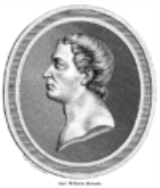
Carl Wilhelm Scheele

Encyclopedia
Carl Wilhelm Scheele was a German-Swedish
pharmaceutical chemist. Isaac Asimov
called him "hard-luck Scheele" because he made a number of chemical discoveries before others who are generally given the credit. For example, Scheele discovered oxygen
(although Joseph Priestley
published his findings first), and identified molybdenum
, tungsten
, barium
, hydrogen, and chlorine
before Humphry Davy
, among others.
, Western Pomerania
, Germany
(at the time under Swedish rule). Instead of becoming a carpenter like his father, Scheele decided to become a pharmacist. His career as a pharmacist
began with his apprenticeship at an apothecary in Gothenburg
when he was only fourteen years old. He retained this position for eight years before becoming an apothecary's clerk in Malmö
. Then Scheele worked as a pharmacist
in Stockholm
, from 1770-1775 in Uppsala
, and later in Köping
.
he called it "fire air" because it supported combustion, but he explained oxygen using phlogistical terms because he did not believe that his discovery disproved the phlogiston theory
. Before Scheele made his discovery of oxygen, he studied air. Air was thought to be an element that made up the environment in which chemical reactions took place but did not interfere with the reactions. Scheele's investigation of air enabled him to conclude that air was a mixture of "fire air" and "foul air;" in other words, a mixture of two gases. He performed numerous experiments in which he burned substances such as saltpeter (potassium nitrate
), manganese dioxide, heavy metal nitrates, silver carbonate
and mercuric oxide. In all of these experiments, he isolated gas with the same properties: his "fire air," which he believed combined with phlogiston to be released during heat-releasing reactions. However, his first publication, A Chemical Treatise on Air and Fire, was not released until 1777, at which time both Joseph Priestley
and Lavoisier had already published their experimental data and conclusions concerning oxygen and the phlogiston theory.
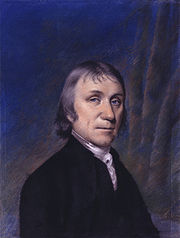 Historians of science no longer question the role of Carl Scheele in the overturning of the phlogiston theory. It is generally accepted that he was the first to discover oxygen, among a number of prominent scientists (namely his esteemed colleagues Antoine Lavoisier
, Joseph Black
, and Joseph Priestley
). In fact, it was determined that Scheele made the discovery three years prior to Priestley and at least several before Lavoisier. Joseph Priestley relied heavily on Scheele's work, perhaps so much so that he would not have made the discovery of oxygen
on his own. Correspondence between Lavoisier and Scheele indicate that Scheele achieved interesting results without the advanced laboratory equipment that Lavoisier was accustomed to. Through the studies of Lavoisier, Joseph Priestley, Scheele, and others, chemistry
was made a standardized field with consistent procedures. Although Scheele was unable to grasp the significance of his discovery of oxygen
, his work was essential for the invalidation of the long-held theory of phlogiston.
Scheele's study of the gas not yet named oxygen was sparked by a complaint by Torbern Olof Bergman. Bergman informed Scheele for the vapors led Bergman to suggest that Scheele analyze the properties of manganese dioxide. It was through his studies with manganese dioxide that Scheele developed his concept of "fire air." He ultimately obtained oxygen by heating mercuric oxide, silver carbonate
, magnesium nitrate
, and other nitrate
salts. Scheele wrote about his findings to Lavoisier who was able to see the significance of the results.
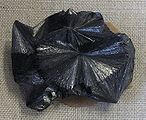
(1774), manganese
(1774), molybdenum
(1778), and tungsten
(1781), as well as several chemical compounds, including citric acid
, lactic acid
, glycerol
, hydrogen cyanide (also known, in aqueous solution, as prussic acid), hydrogen fluoride
, and hydrogen sulfide
. In addition, he discovered a process similar to pasteurization
, along with a means of mass-producing phosphorus
(1769), leading Sweden to become one of the world's leading producers of matches.
 Scheele made one other very important scientific discovery in 1774, arguably more revolutionary than his isolation of oxygen
. He identified lime
, silica, and iron
, in a specimen of pyrolusite
(impure manganese dioxide) given to him by his friend, Johann Gottlieb Gahn, but could not identify an additional component (this was the manganese, which Scheele recognized was present, but could not isolate). When he treated the pyrolusite with hydrochloric acid
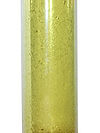
over a warm sand bath, a yellow-green gas with a strong odor was produced. He found that the gas sank to the bottom of an open bottle and was denser than ordinary air. He also noted that the gas was not soluble in water. It turned corks a yellow color and removed all color from wet, blue litmus paper and some flowers. He called this gas with bleaching abilities, "dephlogisticated muriatic acid" (dephlogisticated hydrochloric acid). Eventually, Sir Humphry Davy
named the gas chlorine
.
. Cumulative exposure to mercury
, lead
and their compounds, and other metals took their toll on Scheele, who died on 21 May 1786 at his home in Köping. He married the widow Pohl two days before he died so that he could pass on his possessions and his pharmacy to someone.
Sweden
Sweden , officially the Kingdom of Sweden , is a Nordic country on the Scandinavian Peninsula in Northern Europe. Sweden borders with Norway and Finland and is connected to Denmark by a bridge-tunnel across the Öresund....
pharmaceutical chemist. Isaac Asimov
Isaac Asimov
Isaac Asimov was an American author and professor of biochemistry at Boston University, best known for his works of science fiction and for his popular science books. Asimov was one of the most prolific writers of all time, having written or edited more than 500 books and an estimated 90,000...
called him "hard-luck Scheele" because he made a number of chemical discoveries before others who are generally given the credit. For example, Scheele discovered oxygen
Oxygen
Oxygen is the element with atomic number 8 and represented by the symbol O. Its name derives from the Greek roots ὀξύς and -γενής , because at the time of naming, it was mistakenly thought that all acids required oxygen in their composition...
(although Joseph Priestley
Joseph Priestley
Joseph Priestley, FRS was an 18th-century English theologian, Dissenting clergyman, natural philosopher, chemist, educator, and political theorist who published over 150 works...
published his findings first), and identified molybdenum
Molybdenum
Molybdenum , is a Group 6 chemical element with the symbol Mo and atomic number 42. The name is from Neo-Latin Molybdaenum, from Ancient Greek , meaning lead, itself proposed as a loanword from Anatolian Luvian and Lydian languages, since its ores were confused with lead ores...
, tungsten
Tungsten
Tungsten , also known as wolfram , is a chemical element with the chemical symbol W and atomic number 74.A hard, rare metal under standard conditions when uncombined, tungsten is found naturally on Earth only in chemical compounds. It was identified as a new element in 1781, and first isolated as...
, barium
Barium
Barium is a chemical element with the symbol Ba and atomic number 56. It is the fifth element in Group 2, a soft silvery metallic alkaline earth metal. Barium is never found in nature in its pure form due to its reactivity with air. Its oxide is historically known as baryta but it reacts with...
, hydrogen, and chlorine
Chlorine
Chlorine is the chemical element with atomic number 17 and symbol Cl. It is the second lightest halogen, found in the periodic table in group 17. The element forms diatomic molecules under standard conditions, called dichlorine...
before Humphry Davy
Humphry Davy
Sir Humphry Davy, 1st Baronet FRS MRIA was a British chemist and inventor. He is probably best remembered today for his discoveries of several alkali and alkaline earth metals, as well as contributions to the discoveries of the elemental nature of chlorine and iodine...
, among others.
Biography
Scheele was born in StralsundStralsund
- Main sights :* The Brick Gothic historic centre is a UNESCO World Heritage Site.* The heart of the old town is the Old Market Square , with the Gothic Town Hall . Behind the town hall stands the imposing Nikolaikirche , built in 1270-1360...
, Western Pomerania
Pomerania
Pomerania is a historical region on the south shore of the Baltic Sea. Divided between Germany and Poland, it stretches roughly from the Recknitz River near Stralsund in the West, via the Oder River delta near Szczecin, to the mouth of the Vistula River near Gdańsk in the East...
, Germany
Germany
Germany , officially the Federal Republic of Germany , is a federal parliamentary republic in Europe. The country consists of 16 states while the capital and largest city is Berlin. Germany covers an area of 357,021 km2 and has a largely temperate seasonal climate...
(at the time under Swedish rule). Instead of becoming a carpenter like his father, Scheele decided to become a pharmacist. His career as a pharmacist
Pharmacist
Pharmacists are allied health professionals who practice in pharmacy, the field of health sciences focusing on safe and effective medication use...
began with his apprenticeship at an apothecary in Gothenburg
Gothenburg
Gothenburg is the second-largest city in Sweden and the fifth-largest in the Nordic countries. Situated on the west coast of Sweden, the city proper has a population of 519,399, with 549,839 in the urban area and total of 937,015 inhabitants in the metropolitan area...
when he was only fourteen years old. He retained this position for eight years before becoming an apothecary's clerk in Malmö
Malmö
Malmö , in the southernmost province of Scania, is the third most populous city in Sweden, after Stockholm and Gothenburg.Malmö is the seat of Malmö Municipality and the capital of Skåne County...
. Then Scheele worked as a pharmacist
Pharmacist
Pharmacists are allied health professionals who practice in pharmacy, the field of health sciences focusing on safe and effective medication use...
in Stockholm
Stockholm
Stockholm is the capital and the largest city of Sweden and constitutes the most populated urban area in Scandinavia. Stockholm is the most populous city in Sweden, with a population of 851,155 in the municipality , 1.37 million in the urban area , and around 2.1 million in the metropolitan area...
, from 1770-1775 in Uppsala
Uppsala
- Economy :Today Uppsala is well established in medical research and recognized for its leading position in biotechnology.*Abbott Medical Optics *GE Healthcare*Pfizer *Phadia, an offshoot of Pharmacia*Fresenius*Q-Med...
, and later in Köping
Köping, Sweden
Köping is a locality and the seat of Köping Municipality in Västmanland County, Sweden. It had 17,358 inhabitants in 2005. It is known for the television series I en annan del av Köping.- History :...
.
Existing theories before Scheele
By the time he was a teenager, Scheele had learned the dominant theory of gases in the 1770s, the phlogiston theory. Phlogiston, classified as "matter of fire", was supposed to be released from any burning material, and when it was exhausted, combustion would stop. When Scheele discovered oxygenOxygen
Oxygen is the element with atomic number 8 and represented by the symbol O. Its name derives from the Greek roots ὀξύς and -γενής , because at the time of naming, it was mistakenly thought that all acids required oxygen in their composition...
he called it "fire air" because it supported combustion, but he explained oxygen using phlogistical terms because he did not believe that his discovery disproved the phlogiston theory
Phlogiston theory
The phlogiston theory , first stated in 1667 by Johann Joachim Becher, is an obsolete scientific theory that postulated the existence of a fire-like element called "phlogiston", which was contained within combustible bodies and released during combustion...
. Before Scheele made his discovery of oxygen, he studied air. Air was thought to be an element that made up the environment in which chemical reactions took place but did not interfere with the reactions. Scheele's investigation of air enabled him to conclude that air was a mixture of "fire air" and "foul air;" in other words, a mixture of two gases. He performed numerous experiments in which he burned substances such as saltpeter (potassium nitrate
Potassium nitrate
Potassium nitrate is a chemical compound with the formula KNO3. It is an ionic salt of potassium ions K+ and nitrate ions NO3−.It occurs as a mineral niter and is a natural solid source of nitrogen. Its common names include saltpetre , from medieval Latin sal petræ: "stone salt" or possibly "Salt...
), manganese dioxide, heavy metal nitrates, silver carbonate
Silver carbonate
Silver carbonate is the chemical compound with the formula Ag2CO3. Silver carbonate is yellow but typical samples are grayish due to the presence of elemental silver. It is poorly soluble in water, like most transition metal carbonates. Silver carbonate is used as a reagent in organic synthesis...
and mercuric oxide. In all of these experiments, he isolated gas with the same properties: his "fire air," which he believed combined with phlogiston to be released during heat-releasing reactions. However, his first publication, A Chemical Treatise on Air and Fire, was not released until 1777, at which time both Joseph Priestley
Joseph Priestley
Joseph Priestley, FRS was an 18th-century English theologian, Dissenting clergyman, natural philosopher, chemist, educator, and political theorist who published over 150 works...
and Lavoisier had already published their experimental data and conclusions concerning oxygen and the phlogiston theory.
Disproving the theory of phlogiston
Antoine Lavoisier
Antoine-Laurent de Lavoisier , the "father of modern chemistry", was a French nobleman prominent in the histories of chemistry and biology...
, Joseph Black
Joseph Black
Joseph Black FRSE FRCPE FPSG was a Scottish physician and chemist, known for his discoveries of latent heat, specific heat, and carbon dioxide. He was professor of Medicine at University of Glasgow . James Watt, who was appointed as philosophical instrument maker at the same university...
, and Joseph Priestley
Joseph Priestley
Joseph Priestley, FRS was an 18th-century English theologian, Dissenting clergyman, natural philosopher, chemist, educator, and political theorist who published over 150 works...
). In fact, it was determined that Scheele made the discovery three years prior to Priestley and at least several before Lavoisier. Joseph Priestley relied heavily on Scheele's work, perhaps so much so that he would not have made the discovery of oxygen
Oxygen
Oxygen is the element with atomic number 8 and represented by the symbol O. Its name derives from the Greek roots ὀξύς and -γενής , because at the time of naming, it was mistakenly thought that all acids required oxygen in their composition...
on his own. Correspondence between Lavoisier and Scheele indicate that Scheele achieved interesting results without the advanced laboratory equipment that Lavoisier was accustomed to. Through the studies of Lavoisier, Joseph Priestley, Scheele, and others, chemistry
Chemistry
Chemistry is the science of matter, especially its chemical reactions, but also its composition, structure and properties. Chemistry is concerned with atoms and their interactions with other atoms, and particularly with the properties of chemical bonds....
was made a standardized field with consistent procedures. Although Scheele was unable to grasp the significance of his discovery of oxygen
Oxygen
Oxygen is the element with atomic number 8 and represented by the symbol O. Its name derives from the Greek roots ὀξύς and -γενής , because at the time of naming, it was mistakenly thought that all acids required oxygen in their composition...
, his work was essential for the invalidation of the long-held theory of phlogiston.
Scheele's study of the gas not yet named oxygen was sparked by a complaint by Torbern Olof Bergman. Bergman informed Scheele for the vapors led Bergman to suggest that Scheele analyze the properties of manganese dioxide. It was through his studies with manganese dioxide that Scheele developed his concept of "fire air." He ultimately obtained oxygen by heating mercuric oxide, silver carbonate
Silver carbonate
Silver carbonate is the chemical compound with the formula Ag2CO3. Silver carbonate is yellow but typical samples are grayish due to the presence of elemental silver. It is poorly soluble in water, like most transition metal carbonates. Silver carbonate is used as a reagent in organic synthesis...
, magnesium nitrate
Magnesium nitrate
Magnesium nitrate is a hygroscopic salt with the formula Mg2. In air, it quickly forms the hexahydrate with the formula Mg2·6H2O . It is very soluble in both water and ethanol.-Uses:...
, and other nitrate
Nitrate
The nitrate ion is a polyatomic ion with the molecular formula NO and a molecular mass of 62.0049 g/mol. It is the conjugate base of nitric acid, consisting of one central nitrogen atom surrounded by three identically-bonded oxygen atoms in a trigonal planar arrangement. The nitrate ion carries a...
salts. Scheele wrote about his findings to Lavoisier who was able to see the significance of the results.
New elements and compounds
In addition to his joint recognition for the discovery of oxygen, Scheele is argued to have been the first to discover other chemical elements such as bariumBarium
Barium is a chemical element with the symbol Ba and atomic number 56. It is the fifth element in Group 2, a soft silvery metallic alkaline earth metal. Barium is never found in nature in its pure form due to its reactivity with air. Its oxide is historically known as baryta but it reacts with...
(1774), manganese
Manganese
Manganese is a chemical element, designated by the symbol Mn. It has the atomic number 25. It is found as a free element in nature , and in many minerals...
(1774), molybdenum
Molybdenum
Molybdenum , is a Group 6 chemical element with the symbol Mo and atomic number 42. The name is from Neo-Latin Molybdaenum, from Ancient Greek , meaning lead, itself proposed as a loanword from Anatolian Luvian and Lydian languages, since its ores were confused with lead ores...
(1778), and tungsten
Tungsten
Tungsten , also known as wolfram , is a chemical element with the chemical symbol W and atomic number 74.A hard, rare metal under standard conditions when uncombined, tungsten is found naturally on Earth only in chemical compounds. It was identified as a new element in 1781, and first isolated as...
(1781), as well as several chemical compounds, including citric acid
Citric acid
Citric acid is a weak organic acid. It is a natural preservative/conservative and is also used to add an acidic, or sour, taste to foods and soft drinks...
, lactic acid
Lactic acid
Lactic acid, also known as milk acid, is a chemical compound that plays a role in various biochemical processes and was first isolated in 1780 by the Swedish chemist Carl Wilhelm Scheele. Lactic acid is a carboxylic acid with the chemical formula C3H6O3...
, glycerol
Glycerol
Glycerol is a simple polyol compound. It is a colorless, odorless, viscous liquid that is widely used in pharmaceutical formulations. Glycerol has three hydroxyl groups that are responsible for its solubility in water and its hygroscopic nature. The glycerol backbone is central to all lipids...
, hydrogen cyanide (also known, in aqueous solution, as prussic acid), hydrogen fluoride
Hydrogen fluoride
Hydrogen fluoride is a chemical compound with the formula HF. This colorless gas is the principal industrial source of fluorine, often in the aqueous form as hydrofluoric acid, and thus is the precursor to many important compounds including pharmaceuticals and polymers . HF is widely used in the...
, and hydrogen sulfide
Hydrogen sulfide
Hydrogen sulfide is the chemical compound with the formula . It is a colorless, very poisonous, flammable gas with the characteristic foul odor of expired eggs perceptible at concentrations as low as 0.00047 parts per million...
. In addition, he discovered a process similar to pasteurization
Pasteurization
Pasteurization is a process of heating a food, usually liquid, to a specific temperature for a definite length of time, and then cooling it immediately. This process slows microbial growth in food...
, along with a means of mass-producing phosphorus
Phosphorus
Phosphorus is the chemical element that has the symbol P and atomic number 15. A multivalent nonmetal of the nitrogen group, phosphorus as a mineral is almost always present in its maximally oxidized state, as inorganic phosphate rocks...
(1769), leading Sweden to become one of the world's leading producers of matches.
Oxygen
Oxygen is the element with atomic number 8 and represented by the symbol O. Its name derives from the Greek roots ὀξύς and -γενής , because at the time of naming, it was mistakenly thought that all acids required oxygen in their composition...
. He identified lime
Lime (mineral)
Lime is a general term for calcium-containing inorganic materials, in which carbonates, oxides and hydroxides predominate. Strictly speaking, lime is calcium oxide or calcium hydroxide. It is also the name for a single mineral of the CaO composition, occurring very rarely...
, silica, and iron
Iron
Iron is a chemical element with the symbol Fe and atomic number 26. It is a metal in the first transition series. It is the most common element forming the planet Earth as a whole, forming much of Earth's outer and inner core. It is the fourth most common element in the Earth's crust...
, in a specimen of pyrolusite
Pyrolusite
Pyrolusite is a mineral consisting essentially of manganese dioxide and is important as an ore of manganese. It is a black, amorphous appearing mineral, often with a granular, fibrous or columnar structure, sometimes forming reniform crusts. It has a metallic luster, a black or bluish-black...
(impure manganese dioxide) given to him by his friend, Johann Gottlieb Gahn, but could not identify an additional component (this was the manganese, which Scheele recognized was present, but could not isolate). When he treated the pyrolusite with hydrochloric acid
Hydrochloric acid
Hydrochloric acid is a solution of hydrogen chloride in water, that is a highly corrosive, strong mineral acid with many industrial uses. It is found naturally in gastric acid....
over a warm sand bath, a yellow-green gas with a strong odor was produced. He found that the gas sank to the bottom of an open bottle and was denser than ordinary air. He also noted that the gas was not soluble in water. It turned corks a yellow color and removed all color from wet, blue litmus paper and some flowers. He called this gas with bleaching abilities, "dephlogisticated muriatic acid" (dephlogisticated hydrochloric acid). Eventually, Sir Humphry Davy
Humphry Davy
Sir Humphry Davy, 1st Baronet FRS MRIA was a British chemist and inventor. He is probably best remembered today for his discoveries of several alkali and alkaline earth metals, as well as contributions to the discoveries of the elemental nature of chlorine and iodine...
named the gas chlorine
Chlorine
Chlorine is the chemical element with atomic number 17 and symbol Cl. It is the second lightest halogen, found in the periodic table in group 17. The element forms diatomic molecules under standard conditions, called dichlorine...
.
Death
While Scheele's experiments generated substances which have long since been found to be hazardous, the compounds and elements he used to start his experiments were dangerous to begin with, especially heavy metalsHeavy metals
A heavy metal is a member of a loosely-defined subset of elements that exhibit metallic properties. It mainly includes the transition metals, some metalloids, lanthanides, and actinides. Many different definitions have been proposed—some based on density, some on atomic number or atomic weight,...
. Cumulative exposure to mercury
Mercury poisoning
Mercury poisoning is a disease caused by exposure to mercury or its compounds. Mercury is a heavy metal occurring in several forms, all of which can produce toxic effects in high enough doses...
, lead
Lead poisoning
Lead poisoning is a medical condition caused by increased levels of the heavy metal lead in the body. Lead interferes with a variety of body processes and is toxic to many organs and tissues including the heart, bones, intestines, kidneys, and reproductive and nervous systems...
and their compounds, and other metals took their toll on Scheele, who died on 21 May 1786 at his home in Köping. He married the widow Pohl two days before he died so that he could pass on his possessions and his pharmacy to someone.
See also
- ScheeliteScheeliteScheelite is a calcium tungstate mineral with the chemical formula CaWO4. It is an important ore of tungsten. Well-formed crystals are sought by collectors and are occasionally fashioned into gemstones when suitably free of flaws...
- Scheele's GreenScheele's GreenScheele's Green, also called Schloss Green, is chemically a cupric hydrogen arsenite , CuHAsO3. It is a compound similar to Paris Green...
- PharmacistPharmacistPharmacists are allied health professionals who practice in pharmacy, the field of health sciences focusing on safe and effective medication use...
- PharmacyPharmacyPharmacy is the health profession that links the health sciences with the chemical sciences and it is charged with ensuring the safe and effective use of pharmaceutical drugs...
- Pneumatic chemistryPneumatic chemistryPneumatic chemistry is a term most-closely identified with an area of scientific research of the seventeenth, eighteenth, and early nineteenth centuries. Important goals of this work were an understanding of the physical properties of gases and how they relate to chemical reactions and,...
- List of independent discoveries