

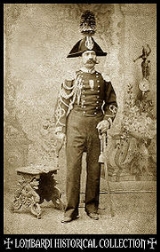
Carabinieri

Encyclopedia
The Carabinieri is the national gendarmerie
of Italy
, policing both military and civilian populations, and is a branch of the armed forces.
with the aim of providing the Kingdom of Sardinia
with a police corps. Previously, police duties were managed by the Dragoni di Sardegna corps, created in 1726 and composed of volunteers. After French soldiers had occupied Turin
at the end of the 18th century and later abandoned it to the Kingdom of Piedmont, the corps of Royal Carabinieri was instituted under the Royal Patents of July 13, 1814.
The new force was divided into divisions on the scale of one division for each province. The divisions were further divided into companies and subdivided into lieutenancies, which commanded and coordinated the local police stations and were distributed throughout the national territory in direct contact with the public.
In 1868, the Corazzieri
mounted division was formed – initially as an escort of honour for the sovereign, and since 1946 for the President of the Republic. The Union of Italy saw the number of divisions increased, and on 24 January 1861 the Carabinieri were appointed the "First Force" of the new national military organization.
regime of Benito Mussolini
(1922–1943), the Carabinieri were one of the police forces entrusted with suppressing opposition in Italy. During the same period, while part of the Italian Africa Police
(mainly in the late 1930s), they were involved in atrocities in colonial Italian East Africa
during the Second Italo-Abyssinian War
. During World War II
they fought in their function as military police against the Allied forces, and against Yugoslav partisans as part of the Italian occupation force in Yugoslavia
.
After Benito Mussolini
's fall on July 25, 1943, he was arrested by the Carabinieri as he left the king's private residence
in Rome and subsequently imprisoned on Campo Imperatore
by Carabinieri forces. After the armistice between Italy and the Allies on 3 September 1943 and the country's split into the fascist Italian Social Republic
in the north and the Kingdom of Italy
in the south, the Carabinieri split into two groups. In southern Italy the Carabinieri Command for Liberated Italy was founded in Bari, mobilizing new units for the Italian war of liberation. These units were attached to the Italian Liberation Corps and the six Italian Combat Groups of the Italian Co-Belligerent Army
, fighting with the Allied forces. In northern Italy the fascist regime organized the Guardia Nazionale Repubblicana (composed of Carabinieri, former colonial policement, Guardia di Finanza
customs police and other odds and ends), to employ it as a military police and rapid-deployment anti-guerilla force. Chronically understrength, underequipped and plagued by desertions, GNR was later joined (but not taken over) by the Black Brigades
which should have represented a new militant incarnation of the Fascist party.
Due to the role the Carabinieri had played in the downfall of Mussolini, and since the only two units which fought the German occupation of Rome were the Granatieri di Sardegna
regiments and the II Carabinieri cadet battalion, the Germans did not view the Carabinieri as loyal to the fascist cause and ordered the disbanding of all Carabinieri units in Axis-controlled territory on October 7, 1943. As German forces subsequently began to arrest and deport members of the Carabinieri to Germany for forced labour, large numbers of Carabinieri joined the Italian resistance movement
. After the war the Carabinieri counted at least 2,735 fallen and 6,500 wounded, out of approximately 14,000 who had joined the Resistance in northern and central Italy. In Yugoslavia the Carabinieri formed a battalion of the Italian partisan Garibaldi Division, which fought alongside the Yugoslav partisans against German
and Croatian Ustaše Forces
. The battalion lost over 80% of its members in combat and was awarded the Silver Medal of Military Valor
to commemorate the fallen.
, who was executed by the Germans
in Palidoro (near Rome
) during World War II. D'Acquisto exchanged his life for the lives of citizens due to be executed in retaliation for the killing of a German soldier; instead, he claimed responsibility and was executed for the offence.
In recent years Carabinieri units have been dispatched on peacekeeping
missions, including Kosovo
, Afghanistan, and Iraq. In 2003 twelve Carabinieri were killed in a suicide bombing
on their base in Nasiriyah
, near Basra
in southern Iraq, in the largest Italian military loss of life in a single action since the Second World War
.
At the Sea Island Conference of the G8
in 2004, Carabinieri were given a mandate to establish a Center of Excellence for Stability Police Units
to spearhead the development of training and doctrinal standards for civilian police units attached to international peacekeeping missions.
 The corps is headed by the , consisting of the Comandante Generale (a General
), the ( a Lieutenant General
) and the Chief of Staff, all located in Rome
. The Chief of Staff directs, coordinates and supervises all activities of the force. It directly supervises the Directors of Administration, Health, Engineering, the motor pool and the Veterinary Commission. On the Deputy Chiefs of Staff depend the National Center for Recruitment and Selection, the Administration National Center and the Legislation Office.
The Carabinieri are organised on a territorial basis for law-enforcement missions. The territorial organization represents the core of the institution; it contains 80 percent of the force and is organized hierarchically in five inter-regional, 19 regional and 102 provincial commands. Outside the territorial organisation, the Specialist Mobile Unit Command Palidoro (based in Rome) controls the Mobile Unit Division, the Specialist Unit Division and the ROS
.
and has two brigades tasked with mass manoeuvres during emergencies, defending the nation and participating in military operations abroad. It supports public order and territorial control in urban areas, and contributes to the operations of civil authorities in terms of public safety.
or Special Operational Group) is an elite unit founded in 1990 to deal with organised crime (Mafia
and others), subversive activities, terrorism
and more complex types of crime. An anti-crime section is found in every city and district public prosecutor's office.
Corazzieri
(Cuirassiers) are an elite corps and honour guard of the President of the Italian Republic
, located in the Quirinal Palace
. They are distinguished by their uniforms and height (the minimum height for admission is 190 cm, or 6 feet 3 inches). They have almost no other everyday duties, although they may be seen patrolling occasionally. Other departments are in service to constitutional bodies such as the Presidency of the Republic, the Senate, Parliament, the Judiciary, the Prime Minister
and the National Council of Economy and Labour. Carabinieri also perform military police
and security duties for the Ministry of Defence, military high commands, the offices of the military judiciary and allied military organisations in Italy and abroad. They also have personnel attached to the Department of Public Security
in various departments, as well as anti-Mafia and anti-drug investigative task forces. Carabinieri officers are charged with surveillance and security at Italian embassies and consulates abroad, performing the same services entrusted to the United States Marine Corps
in US diplomatic and consular offices.
 The main battles in which the Carabinieri took part before World War I are:
For its contributions during the First World War, the Corps was awarded its first Gold Medal of Military Valor
In World War II, Carabinieri distinguished themselves in the following battles:
From 1943 to 1945, the Carabinieri were accountable to the Control Commission of the Allied Military Government (AMGOT). Their reorganization and reform was organized by Colonel Arthur Young, a British police officer
seconded as Director of Public Safety and Director of Security.
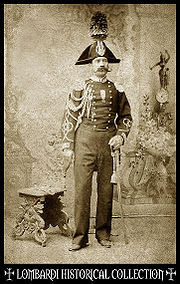
They still use a version of the historic uniform today for ceremonies.
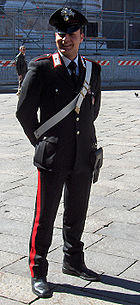
The full set of different Carabinieri uniforms today is presented here (in Italian):
 In response to the many and diverse needs of the Carabinieri, the service provides for the use of various types of weapons that are divided into "ordinary" and "special" weapons and supplied to all staff as follows:
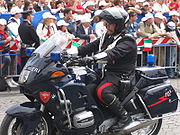
s into service. Normal Carabinieri patrol vehicles are dark blue with a white roof, with a red stripe along the side. Carabinieri license plates begin with "CC" or previously with "EI" (formerly Esercito Italiano, Italian Army), and a Carabinieri car is traditionally called a Gazzella (gazelle
). Small or medium-sized cars are used for ordinary patrol work, with larger and more powerful vehicles being used for emergency response, highway patrol, and special services. The vehicles of the Carabinieri military police and mobile units are painted in NATO camuflage scheme as done with the other Italian Army vehicles.


Gendarmerie
A gendarmerie or gendarmery is a military force charged with police duties among civilian populations. Members of such a force are typically called "gendarmes". The Shorter Oxford English Dictionary describes a gendarme as "a soldier who is employed on police duties" and a "gendarmery, -erie" as...
of Italy
Italy
Italy , officially the Italian Republic languages]] under the European Charter for Regional or Minority Languages. In each of these, Italy's official name is as follows:;;;;;;;;), is a unitary parliamentary republic in South-Central Europe. To the north it borders France, Switzerland, Austria and...
, policing both military and civilian populations, and is a branch of the armed forces.
Early history
The corps was created by King Victor Emmanuel I of SavoySavoy
Savoy is a region of France. It comprises roughly the territory of the Western Alps situated between Lake Geneva in the north and Monaco and the Mediterranean coast in the south....
with the aim of providing the Kingdom of Sardinia
Kingdom of Sardinia
The Kingdom of Sardinia consisted of the island of Sardinia first as a part of the Crown of Aragon and subsequently the Spanish Empire , and second as a part of the composite state of the House of Savoy . Its capital was originally Cagliari, in the south of the island, and later Turin, on the...
with a police corps. Previously, police duties were managed by the Dragoni di Sardegna corps, created in 1726 and composed of volunteers. After French soldiers had occupied Turin
Turin
Turin is a city and major business and cultural centre in northern Italy, capital of the Piedmont region, located mainly on the left bank of the Po River and surrounded by the Alpine arch. The population of the city proper is 909,193 while the population of the urban area is estimated by Eurostat...
at the end of the 18th century and later abandoned it to the Kingdom of Piedmont, the corps of Royal Carabinieri was instituted under the Royal Patents of July 13, 1814.
The new force was divided into divisions on the scale of one division for each province. The divisions were further divided into companies and subdivided into lieutenancies, which commanded and coordinated the local police stations and were distributed throughout the national territory in direct contact with the public.
In 1868, the Corazzieri
Corazzieri
The Cuirassiers' Regiment is an Italian elite military unit and the honor guard of the President of the Italian Republic...
mounted division was formed – initially as an escort of honour for the sovereign, and since 1946 for the President of the Republic. The Union of Italy saw the number of divisions increased, and on 24 January 1861 the Carabinieri were appointed the "First Force" of the new national military organization.
1930s and 1940s
During the fascistFascism
Fascism is a radical authoritarian nationalist political ideology. Fascists seek to rejuvenate their nation based on commitment to the national community as an organic entity, in which individuals are bound together in national identity by suprapersonal connections of ancestry, culture, and blood...
regime of Benito Mussolini
Benito Mussolini
Benito Amilcare Andrea Mussolini was an Italian politician who led the National Fascist Party and is credited with being one of the key figures in the creation of Fascism....
(1922–1943), the Carabinieri were one of the police forces entrusted with suppressing opposition in Italy. During the same period, while part of the Italian Africa Police
Italian Africa Police
The Italian Africa Police , was the Police of "Italian Africa" from 1 June 1936 and 1 December 1941.-Characteristics:...
(mainly in the late 1930s), they were involved in atrocities in colonial Italian East Africa
Italian East Africa
Italian East Africa was an Italian colonial administrative subdivision established in 1936, resulting from the merger of the Ethiopian Empire with the old colonies of Italian Somaliland and Italian Eritrea. In August 1940, British Somaliland was conquered and annexed to Italian East Africa...
during the Second Italo-Abyssinian War
Second Italo-Abyssinian War
The Second Italo–Abyssinian War was a colonial war that started in October 1935 and ended in May 1936. The war was fought between the armed forces of the Kingdom of Italy and the armed forces of the Ethiopian Empire...
. During World War II
World War II
World War II, or the Second World War , was a global conflict lasting from 1939 to 1945, involving most of the world's nations—including all of the great powers—eventually forming two opposing military alliances: the Allies and the Axis...
they fought in their function as military police against the Allied forces, and against Yugoslav partisans as part of the Italian occupation force in Yugoslavia
Yugoslavia
Yugoslavia refers to three political entities that existed successively on the western part of the Balkans during most of the 20th century....
.
After Benito Mussolini
Benito Mussolini
Benito Amilcare Andrea Mussolini was an Italian politician who led the National Fascist Party and is credited with being one of the key figures in the creation of Fascism....
's fall on July 25, 1943, he was arrested by the Carabinieri as he left the king's private residence
Villa Ada
Villa Ada is the largest park in Rome, Italy, with a surface of 450 acres/182 hectares. It is located in the northeastern part of the city. Its highest prominence is Monte Antenne, 67 m , an ancient archeological site.-History:...
in Rome and subsequently imprisoned on Campo Imperatore
Campo Imperatore
Campo Imperatore is a mountain grassland or alpine meadow formed by a high basin shaped plateau located in the Province of L'Aquila in the Abruzzo region of Italy in the Gran Sasso massif. It is the largest plateau of the Apennine ridge...
by Carabinieri forces. After the armistice between Italy and the Allies on 3 September 1943 and the country's split into the fascist Italian Social Republic
Italian Social Republic
The Italian Social Republic was a puppet state of Nazi Germany led by the "Duce of the Nation" and "Minister of Foreign Affairs" Benito Mussolini and his Republican Fascist Party. The RSI exercised nominal sovereignty in northern Italy but was largely dependent on the Wehrmacht to maintain control...
in the north and the Kingdom of Italy
Kingdom of Italy (1861–1946)
The Kingdom of Italy was a state forged in 1861 by the unification of Italy under the influence of the Kingdom of Sardinia, which was its legal predecessor state...
in the south, the Carabinieri split into two groups. In southern Italy the Carabinieri Command for Liberated Italy was founded in Bari, mobilizing new units for the Italian war of liberation. These units were attached to the Italian Liberation Corps and the six Italian Combat Groups of the Italian Co-Belligerent Army
Italian Co-Belligerent Army
The Italian Co-Belligerent Army , or the Army of the South , was the army of the Italian Royalist forces fighting on the side of the Allies during World War II....
, fighting with the Allied forces. In northern Italy the fascist regime organized the Guardia Nazionale Repubblicana (composed of Carabinieri, former colonial policement, Guardia di Finanza
Guardia di Finanza
The Guardia di Finanza is a Italian law enforcement agency under the authority of the Minister of Economy and Finance. Like the Carabinieri, it is part of the Italian Armed Forces. The Guard is essentially responsible for dealing with financial crime and smuggling; it has also evolved into Italy's...
customs police and other odds and ends), to employ it as a military police and rapid-deployment anti-guerilla force. Chronically understrength, underequipped and plagued by desertions, GNR was later joined (but not taken over) by the Black Brigades
Black Brigades
Black Brigades were one of the Fascist paramilitary groups operating in the Italian Social Republic , during the final years of World War II, and after the signing of the Italian Armistice in 1943...
which should have represented a new militant incarnation of the Fascist party.
Due to the role the Carabinieri had played in the downfall of Mussolini, and since the only two units which fought the German occupation of Rome were the Granatieri di Sardegna
Granatieri di Sardegna Mechanized Brigade
The Granatieri di Sardegna Mechanized Brigade is a mechanized infantry brigade of the Italian Army, based mainly in Rome and central Italy.- Structure :...
regiments and the II Carabinieri cadet battalion, the Germans did not view the Carabinieri as loyal to the fascist cause and ordered the disbanding of all Carabinieri units in Axis-controlled territory on October 7, 1943. As German forces subsequently began to arrest and deport members of the Carabinieri to Germany for forced labour, large numbers of Carabinieri joined the Italian resistance movement
Italian resistance movement
The Italian resistance is the umbrella term for the various partisan forces formed by pro-Allied Italians during World War II...
. After the war the Carabinieri counted at least 2,735 fallen and 6,500 wounded, out of approximately 14,000 who had joined the Resistance in northern and central Italy. In Yugoslavia the Carabinieri formed a battalion of the Italian partisan Garibaldi Division, which fought alongside the Yugoslav partisans against German
Wehrmacht
The Wehrmacht – from , to defend and , the might/power) were the unified armed forces of Nazi Germany from 1935 to 1945. It consisted of the Heer , the Kriegsmarine and the Luftwaffe .-Origin and use of the term:...
and Croatian Ustaše Forces
Ustaše
The Ustaša - Croatian Revolutionary Movement was a Croatian fascist anti-Yugoslav separatist movement. The ideology of the movement was a blend of fascism, Nazism, and Croatian nationalism. The Ustaše supported the creation of a Greater Croatia that would span to the River Drina and to the border...
. The battalion lost over 80% of its members in combat and was awarded the Silver Medal of Military Valor
Silver Medal of Military Valor
The Silver Medal of Military Valor is an Italian medal for gallantry.Italian medals for valor were first instituted by Victor Amadeus III of Sardinia on May 21, 1793, with a gold medal, and, below it, a silver medal...
to commemorate the fallen.
Present day
The Carabinieri increased in status and joined the Armed Forces on 31 March 2000. They are today particularly proud of the memory of Vice Brigadiere Salvo D'AcquistoSalvo D'Acquisto
Salvo D'Acquisto was a member of the Italian Carabinieri, awarded the Gold Medal of Military Valor in memory of his heroism.-Life:...
, who was executed by the Germans
Nazi Germany
Nazi Germany , also known as the Third Reich , but officially called German Reich from 1933 to 1943 and Greater German Reich from 26 June 1943 onward, is the name commonly used to refer to the state of Germany from 1933 to 1945, when it was a totalitarian dictatorship ruled by...
in Palidoro (near Rome
Rome
Rome is the capital of Italy and the country's largest and most populated city and comune, with over 2.7 million residents in . The city is located in the central-western portion of the Italian Peninsula, on the Tiber River within the Lazio region of Italy.Rome's history spans two and a half...
) during World War II. D'Acquisto exchanged his life for the lives of citizens due to be executed in retaliation for the killing of a German soldier; instead, he claimed responsibility and was executed for the offence.
In recent years Carabinieri units have been dispatched on peacekeeping
Peacekeeping
Peacekeeping is an activity that aims to create the conditions for lasting peace. It is distinguished from both peacebuilding and peacemaking....
missions, including Kosovo
Kosovo War
The term Kosovo War or Kosovo conflict was two sequential, and at times parallel, armed conflicts in Kosovo province, then part of FR Yugoslav Republic of Serbia; from early 1998 to 1999, there was an armed conflict initiated by the ethnic Albanian "Kosovo Liberation Army" , who sought independence...
, Afghanistan, and Iraq. In 2003 twelve Carabinieri were killed in a suicide bombing
2003 Nasiriyah bombing
The 2003 Nasiriyah bombing was a suicide attack on the Italian military police headquarters in Nasiriyah, Iraq, south of Baghdad on November 12, 2003.-Prelude:...
on their base in Nasiriyah
Nasiriyah
Nasiriyah is a city in Iraq. It is on the Euphrates about 225 miles southeast of Baghdad, near the ruins of the ancient city of Ur. It is the capital of the province of Dhi Qar...
, near Basra
Basra
Basra is the capital of Basra Governorate, in southern Iraq near Kuwait and Iran. It had an estimated population of two million as of 2009...
in southern Iraq, in the largest Italian military loss of life in a single action since the Second World War
World War II
World War II, or the Second World War , was a global conflict lasting from 1939 to 1945, involving most of the world's nations—including all of the great powers—eventually forming two opposing military alliances: the Allies and the Axis...
.
At the Sea Island Conference of the G8
G8
The Group of Eight is a forum, created by France in 1975, for the governments of seven major economies: Canada, France, Germany, Italy, Japan, the United Kingdom, and the United States. In 1997, the group added Russia, thus becoming the G8...
in 2004, Carabinieri were given a mandate to establish a Center of Excellence for Stability Police Units
Center of Excellence for Stability Police Units
The Center of Excellence for Stability Police Units is a training center and a doctrinal hub created by the Italian government on the 1st of March 2005, in accordance with the G8 Action Plan “Expanding Global Capability for Peace Support Operations”...
to spearhead the development of training and doctrinal standards for civilian police units attached to international peacekeeping missions.
Organization
General
A general officer is an officer of high military rank, usually in the army, and in some nations, the air force. The term is widely used by many nations of the world, and when a country uses a different term, there is an equivalent title given....
), the ( a Lieutenant General
Lieutenant General
Lieutenant General is a military rank used in many countries. The rank traces its origins to the Middle Ages where the title of Lieutenant General was held by the second in command on the battlefield, who was normally subordinate to a Captain General....
) and the Chief of Staff, all located in Rome
Rome
Rome is the capital of Italy and the country's largest and most populated city and comune, with over 2.7 million residents in . The city is located in the central-western portion of the Italian Peninsula, on the Tiber River within the Lazio region of Italy.Rome's history spans two and a half...
. The Chief of Staff directs, coordinates and supervises all activities of the force. It directly supervises the Directors of Administration, Health, Engineering, the motor pool and the Veterinary Commission. On the Deputy Chiefs of Staff depend the National Center for Recruitment and Selection, the Administration National Center and the Legislation Office.
The Carabinieri are organised on a territorial basis for law-enforcement missions. The territorial organization represents the core of the institution; it contains 80 percent of the force and is organized hierarchically in five inter-regional, 19 regional and 102 provincial commands. Outside the territorial organisation, the Specialist Mobile Unit Command Palidoro (based in Rome) controls the Mobile Unit Division, the Specialist Unit Division and the ROS
Raggruppamento Operativo Speciale
The Raggruppamento Operativo Speciale , is part of the Italian Carabinieri. Founded on 3 December 1990 to coordinate investigative activities against organized crime, it now the main investigative arm of the Carabinieri which deals with organized crime and terrorism...
.
The Mobile Unit Division
The Mobile Unit Division is located in TrevisoTreviso
Treviso is a city and comune in Veneto, northern Italy. It is the capital of the province of Treviso and the municipality has 82,854 inhabitants : some 3,000 live within the Venetian walls or in the historical and monumental center, some 80,000 live in the urban center proper, while the city...
and has two brigades tasked with mass manoeuvres during emergencies, defending the nation and participating in military operations abroad. It supports public order and territorial control in urban areas, and contributes to the operations of civil authorities in terms of public safety.
ROS
The ROS (Raggruppamento Operativo SpecialeRaggruppamento Operativo Speciale
The Raggruppamento Operativo Speciale , is part of the Italian Carabinieri. Founded on 3 December 1990 to coordinate investigative activities against organized crime, it now the main investigative arm of the Carabinieri which deals with organized crime and terrorism...
or Special Operational Group) is an elite unit founded in 1990 to deal with organised crime (Mafia
Mafia
The Mafia is a criminal syndicate that emerged in the mid-nineteenth century in Sicily, Italy. It is a loose association of criminal groups that share a common organizational structure and code of conduct, and whose common enterprise is protection racketeering...
and others), subversive activities, terrorism
Terrorism
Terrorism is the systematic use of terror, especially as a means of coercion. In the international community, however, terrorism has no universally agreed, legally binding, criminal law definition...
and more complex types of crime. An anti-crime section is found in every city and district public prosecutor's office.
Special Tasks Departments
Special Tasks Departments are outside the ordinary organisational framework and are used for special missions:Corazzieri
Corazzieri
The Cuirassiers' Regiment is an Italian elite military unit and the honor guard of the President of the Italian Republic...
(Cuirassiers) are an elite corps and honour guard of the President of the Italian Republic
President of the Italian Republic
The President of the Italian Republic is the head of state of Italy and, as such, is intended to represent national unity and guarantee that Italian politics comply with the Constitution. The president's term of office lasts for seven years....
, located in the Quirinal Palace
Quirinal Palace
The Quirinal Palace is a historical building in Rome, Italy, the current official residence of the President of the Italian Republic. It is located on the Quirinal Hill, the tallest of the seven hills of Rome...
. They are distinguished by their uniforms and height (the minimum height for admission is 190 cm, or 6 feet 3 inches). They have almost no other everyday duties, although they may be seen patrolling occasionally. Other departments are in service to constitutional bodies such as the Presidency of the Republic, the Senate, Parliament, the Judiciary, the Prime Minister
Prime minister
A prime minister is the most senior minister of cabinet in the executive branch of government in a parliamentary system. In many systems, the prime minister selects and may dismiss other members of the cabinet, and allocates posts to members within the government. In most systems, the prime...
and the National Council of Economy and Labour. Carabinieri also perform military police
Military police
Military police are police organisations connected with, or part of, the military of a state. The word can have different meanings in different countries, and may refer to:...
and security duties for the Ministry of Defence, military high commands, the offices of the military judiciary and allied military organisations in Italy and abroad. They also have personnel attached to the Department of Public Security
Polizia di Stato
The Polizia di Stato is one of the national police forces of Italy.It is the main police force for providing police duties and it is also responsible for patrolling motorways , railways , airports , customs as well as certain waterways, and assisting the local police...
in various departments, as well as anti-Mafia and anti-drug investigative task forces. Carabinieri officers are charged with surveillance and security at Italian embassies and consulates abroad, performing the same services entrusted to the United States Marine Corps
United States Marine Corps
The United States Marine Corps is a branch of the United States Armed Forces responsible for providing power projection from the sea, using the mobility of the United States Navy to deliver combined-arms task forces rapidly. It is one of seven uniformed services of the United States...
in US diplomatic and consular offices.
War service
- Grenoble, July 5, 1815 (baptism of fire)
- Battle of PastrengoBattle of PastrengoThe Battle of Pastrengo was fought between the Piedmontese and Austrian army on 30 April 1848, in the course of the First Italian War of Independence.-Prelude:...
, 30 April 1848 – the Carabinieri Corps was awarded its first Silver Medal of Military ValorSilver Medal of Military ValorThe Silver Medal of Military Valor is an Italian medal for gallantry.Italian medals for valor were first instituted by Victor Amadeus III of Sardinia on May 21, 1793, with a gold medal, and, below it, a silver medal... - Battle of Santa LuciaBattle of Santa LuciaThe battle of Santa Lucia was an episode in the First Italian War of Independence. On 6 May 1848, when the king of Sardinia, Carlo Alberto, sent I Corps of the Sardinian army to assault the fortified positions held before the walls of Verona by the Austrian army under field marshal Josef Radetzky...
, 6 May 1848 – the Carabinieri Corps was awarded its first Bronze Medal of Military ValorBronze Medal of Military ValorThe Bronze Medal of Military Valor is an Italian medal for gallantry.It was established by Charles Albert of Sardinia on March 26, 1833, along with the higher ranking Gold and Silver Medals for Military valor... - Battle of CustozaBattle of Custoza (1848)The Battle of Custoza was fought on July 24 and 25 1848 during the first Italian War of Independence between the armies of the Austrian Empire, led by Field Marshal Radetzky, and of the Kingdom of Sardinia, led by King Charles Albert of Piedmont....
, 24–25 July 1848 - Battle of CustozaBattle of Custoza (1866)The Battle of Custoza took place on June 24, 1866 during the Third Italian Independence War in the Italian unification process.The Austrian Imperial army with the old Venetian Army, led by Archduke Albert of Habsburg, defeated the Italian army led by Alfonso Ferrero la Marmora and Enrico Cialdini,...
, 24 June 1866 - Capture of RomeCapture of RomeThe Capture of Rome was the final event of the long process of Italian unification known as the Risorgimento, which finally unified the Italian peninsula under King Victor Emmanuel II of the House of Savoy...
, 20 September 1870 (together with the BersaglieriBersaglieriThe Bersaglieri are a corps of the Italian Army originally created by General Alessandro La Marmora on 18 June 1836 to serve in the Piedmontese Army, later to become the Royal Italian Army...
)
For its contributions during the First World War, the Corps was awarded its first Gold Medal of Military Valor
Gold Medal of Military Valor
The Gold Medal of Military Valor is an Italian medal established on 21 May 1793 by King Victor Amadeus III of Sardinia "....per bassi ufficiali e soldati che avevano fatto azioni di segnalato valore in guerra" .The face of the medal displayed the profile of the king, and on its reverse was a flag...
In World War II, Carabinieri distinguished themselves in the following battles:
- Battle of Klisoura on the Greek-Albanian front from 16 to 30 December 1940 Bronze Medal of Military ValorBronze Medal of Military ValorThe Bronze Medal of Military Valor is an Italian medal for gallantry.It was established by Charles Albert of Sardinia on March 26, 1833, along with the higher ranking Gold and Silver Medals for Military valor...
- Battle at Cafe Struga on the Albanian-Yugoslav front on 18 April 1941
- Battle of Culqualber (Ethiopia), 6 August-21 November 1941 – Corps was awarded its second Gold Medal of Military ValorGold Medal of Military ValorThe Gold Medal of Military Valor is an Italian medal established on 21 May 1793 by King Victor Amadeus III of Sardinia "....per bassi ufficiali e soldati che avevano fatto azioni di segnalato valore in guerra" .The face of the medal displayed the profile of the king, and on its reverse was a flag...
From 1943 to 1945, the Carabinieri were accountable to the Control Commission of the Allied Military Government (AMGOT). Their reorganization and reform was organized by Colonel Arthur Young, a British police officer
Police officer
A police officer is a warranted employee of a police force...
seconded as Director of Public Safety and Director of Security.
Uniforms
They were issued a distinctive uniform in dark blue with silver braid around the collar and cuffs, edges trimmed in scarlet and epaulettes in silver. The mounted division had white fringes, and the infantry had light blue. Their headgear was a distinctive hat with two points, popularly called the lucerna.They still use a version of the historic uniform today for ceremonies.
The full set of different Carabinieri uniforms today is presented here (in Italian):
Weapons
Ordinary
- Pistols: Beretta 92Beretta 92The Beretta 92 is a series of semi-automatic pistols designed and manufactured by Beretta of Italy. The model 92 was designed in 1972 and production of many variants in different calibers continues today...
(the standard service arm) – Beretta 8000Beretta 8000The Beretta 8000 series pistols are manufactured by Beretta of Italy.They first appeared on the market in 1994 as a more compact alternative to the full-sized Beretta 92 service pistol in order to offer a compromise between concealability, ease of carry, accuracy and firepower.It was originally...
for officers - Submachine gun: Mod.PM 12 S2
- Assault rifle: Beretta AR70/90Beretta AR70/90The Beretta AR70/90 is a gas operated self loading assault rifle chambered for the 5.56mm cartridge, and is the standard issue service rifle of the Italian Armed Forces. The weapon also features grenade sights, and is designed to be fitted with a rifle grenade...
- Light machine gun: FN MinimiFN MinimiThe Minimi is a Belgian 5.56mm light machine gun developed by Fabrique Nationale in Herstal by Ernest Vervier. First introduced in 1974, it has entered service with the armed forces of over thirty countries...
Special weapons
Used only by certain departments and under certain circumstances:- Pistol: Beretta 93RBeretta 93RThe Beretta Model 93R is a selective-fire machine pistol, designed and manufactured by the Italian Beretta company in the 1970s for police and military use, that is derived from their semi-automatic Model 92...
- Assault rifle: M4 carbineM4 carbineThe M4 carbine is a family of firearms tracing its lineage back to earlier carbine versions of the M16, all based on the original AR-15 designed by Eugene Stoner and made by ArmaLite. It is a shorter and lighter variant of the M16A2 assault rifle, with 80% parts commonality.It is a gas-operated,...
- Submachine gun: Heckler & Koch MP5Heckler & Koch MP5The Heckler & Koch MP5 is a 9mm submachine gun of German design, developed in the 1960s by a team of engineers from the German small arms manufacturer Heckler & Koch GmbH of Oberndorf am Neckar....
- Submachine gun: Steyr TMPSteyr TMPThe Steyr TMP is a select-fire 9x19mm Parabellum caliber machine pistol manufactured by Steyr Mannlicher of Austria. The Magazines come in 15, 20, or 30 round detachable box types. A suppressor can also be fitted...
- Shotgun: Franchi SPAS-15Franchi SPAS-15The SPAS-15 is a dual-mode 12 gauge combat shotgun manufactured by the Italian company Luigi Franchi S.p.A..-Design:The weapon is based on the SPAS-12, and has similar pump-action/semi-automatic firing modes. In semi-automatic mode a gas piston drives a bolt carrier and rotating bolt. In...
- Sharpshooter: MauserMauserMauser was a German arms manufacturer of a line of bolt-action rifles and pistols from the 1870s to 1995. Mauser designs were built for the German armed forces...
SP66, MSG-90 - Sniper rifle: Accuracy International AWP
Vehicles and equipment
Until very recently the Italian police (including the Carabinieri) operated only Italian-made vehicles, but that changed with the introduction of Land Rover Defenders and SubaruSubaru
; is the automobile manufacturing division of Japanese transportation conglomerate Fuji Heavy Industries .Subaru is internationally known for their use of the boxer engine layout popularized in cars by the Volkswagen Beetle and Porsche 911, in most of their vehicles above 1500 cc as well as...
s into service. Normal Carabinieri patrol vehicles are dark blue with a white roof, with a red stripe along the side. Carabinieri license plates begin with "CC" or previously with "EI" (formerly Esercito Italiano, Italian Army), and a Carabinieri car is traditionally called a Gazzella (gazelle
Gazelle
A gazelle is any of many antelope species in the genus Gazella, or formerly considered to belong to it. Six species are included in two genera, Eudorcas and Nanger, which were formerly considered subgenera...
). Small or medium-sized cars are used for ordinary patrol work, with larger and more powerful vehicles being used for emergency response, highway patrol, and special services. The vehicles of the Carabinieri military police and mobile units are painted in NATO camuflage scheme as done with the other Italian Army vehicles.
Cars
- Bertone Freeclimber
- Toyota Carina 2Toyota CarinaReleased in Japan August 1977, the next-generation Carina was available in Germany in December 1977 and in other European countries during 1978. In most markets it was fitted with the same 1,588 cc 2T engine as its predecessor. In the Carina, an output of was claimed...
- Subaru Legacy SWSubaru LegacyThe Subaru Legacy is a mid-size car built by the Japanese company Fuji Heavy Industries, and manufactured by its division Subaru since 1989, and is available as a sedan or wagon. Part of the original design goals for the Legacy model was to provide Subaru a vehicle in which they could compete in...
- Subaru ForesterSubaru ForesterThe Subaru Forester is an all-wheel drive crossover wagon manufactured since 1997 by Fuji Heavy Industries and sold under the Subaru brand...
- Alfa Romeo 155Alfa Romeo 155The Alfa Romeo 155 is a compact executive car produced under the Italian Alfa Romeo marque between 1992 and 1998.-Design:Built to replace the 75 and based on the parent Fiat Group's Type Three platform, the 155 was somewhat larger in dimension than the 75 but evolved its styling from that of its...
- Fiat Brava 1600
- Alfa Romeo 156Alfa Romeo 156The Alfa Romeo 156 is a compact executive car introduced by Italian automaker Alfa Romeo at the 1997 Frankfurt Motor Show as the replacement for the Alfa Romeo 155...
- Alfa Romeo 159Alfa Romeo 159The Alfa Romeo 159 is a compact executive car produced by the Italian manufacturer Alfa Romeo between 2005 and 2011. The 159 was introduced in production form at the 2005 Geneva Motor Show as a replacement for the successful Alfa Romeo 156. The 159 uses the GM/Fiat Premium platform, shared with...
- Fiat Panda 4x4Fiat PandaThe Fiat Panda is a city car from the Italian automobile manufacturer Fiat. The first Fiat Panda was introduced in 1980, and was produced until 2003 with only a few changes. It is now sometimes referred to as the "old Panda". The second model, launched in 2003, is sometimes referred to "New Panda"...
- Land Rover FreelanderLand Rover FreelanderThe Land Rover Freelander is a compact crossover SUV made by Land Rover.The current generation is sold as the LR2 in North America and as the Freelander 2 in Europe...
- Land Rover Defender-90 hard top
- Land Rover DiscoveryLand Rover DiscoveryThe Discovery was introduced into the United Kingdom in 1989. The company code-named the vehicle "Project Jay". The new model was based on the chassis and drivetrain of the more upmarket Range Rover, but with a lower price aimed at a larger market segment and intended to compete with Japanese...
II e III - Lotus EvoraLotus EvoraThe Lotus Evora is a sports car produced by British car manufacturer Lotus. The car, which was developed under the project name Project Eagle, was launched as the Evora on 22 July 2008 at the British International Motor Show.- Development :...
S - Fiat PuntoFiat PuntoThe Fiat Punto is a supermini produced by the Italian manufacturer, Fiat, since 1993.-1st generation :Internally codenamed Project 176, the Punto was announced in September 1993 and launched in late 1993 as a replacement for the ageing Fiat Uno. The Fiat Punto was voted European Car of the Year...
60 1 ^ series and ELX 2 ^ series - Fiat Stilo 1.9 JTDFiat StiloThe Fiat Stilo is a small family car available as a 3-door and a 5-door hatchback, as well as an estate , produced by the Italian automaker Fiat Automobiles. The Stilo 3-door and 5-door were launched in 2001 to replace the Fiat Bravo/Brava, with the Stilo MultiWagon following in 2002...
- Fiat DucatoFiat DucatoThe Fiat Ducato is a large van produced by Fiat. The Fiat Ducato is the same van as the Citroën Jumper and the Peugeot Boxer, which are all very popular vans to convert into motorhomes...
- Fiat Grande PuntoFiat Grande PuntoThe Fiat Grande Punto is a car manufactured by the Italian automaker Fiat. It was unveiled on May 5, 2005 and replaced by the Punto Evo in 2010. In September 2011 Fiat unveil the Punto model year 2012, the new version will replaced the Grande Punto and the Punto Evo...
- Fiat Bravo
Motorcycles
- Moto Guzzi California Courassier Moto Guzzi CaliforniaThe Moto Guzzi California is a motorcycle manufactured by Italian company Moto Guzzi since 1971, bringing together the company's heritage, their iconic air-cooled 90° V-twin engines and styling that evokes the classic American...
- BMW motorcyclesBMW motorcyclesBMW's motorcycle history began in 1921 when the company commenced manufacturing engines for other companies. Motorcycle manufacturing now operates under the BMW Motorrad brand...
F650GS and R1100-RTP
Helicopters
- Agusta A109Agusta A109The AgustaWestland AW109 is a light-weight, twin-engine, eight-seat multi-purpose helicopter built by the Anglo-Italian manufacturer AgustaWestland...
- Agusta-Bell AB 412Bell 412The Bell 412 is a utility helicopter manufactured by Bell Helicopter. It is a development of the Bell 212 model, the major difference being the composite four-blade main rotor.-Design and development:...
- Agusta-Bell AB 206Bell 206The Bell 206 is a family of two-bladed, single- or twin-engine helicopters, manufactured by Bell Helicopter at its Mirabel, Quebec plant. Originally developed as the Bell YOH-4 for the United States Army's Light Observation Helicopter program, the 206 failed to be selected...
- Bell 47J RangerBell 47J Ranger|-See also:-References:* -External links:* from The International Directory of Civil Aircraft by Gerard Frawley...
Tactical vehicles
- Land Rover Defender 110 soft top
- IVECOIvecoIveco, an acronym for Industrial Vehicle Corporation, originally an alliance of European commercial vehicle manufacturers such as Fiat , Unic and Magirus. Iveco is now an Italian truck, bus, and diesel engine manufacturer, based in Turin...
40.10WM 4X4 off-road military truck - a light armored vehicle based on the Iveco DailyIveco DailyThe Iveco Daily is a large van produced by Iveco from 1978; it was sold also as Fiat Daily until 1983. It is also available as a minibus.-First generation :...
. Includes semi-armored and fully armored variants called the VM90 Torpedo and VM90 Protected - UnimogUnimogUnimog is a range of multi-purpose auto four wheel drive medium trucks produced by Mercedes-Benz, a division of Daimler AG. The name Unimog is pronounced in German and is an acronym for the German "UNIversal-MOtor-Gerät", Gerät being the German word for machine or device...
- Puma 6x6Puma (AFV)The Puma light wheeled armoured fighting vehicle family consists of the Puma 6x6 and the Puma 4x4. The vehicles were developed and are produced by the Consorzio Iveco Fiat - Oto Melara of Italy for the Italian Army...
- Fiat 6616
- VCC1M113 armored personnel carrierThe M113 is a fully tracked armored personnel carrier that has formed the backbone of the United States Army's mechanized infantry units from the time of its first fielding in Vietnam in April 1962. The M113 was the most widely used armored vehicle of the U.S...
- RG-12RG-12The RG-12 is a multi-purpose public order vehicle with anti-personnel mine, grenade, fire bomb and small arms fire protection that is manufactured by Land Systems OMC of South Africa, with over 700 being in service globally in more than eight countries.Originally designed as a police public order...
Special Vehicles
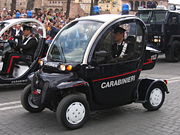
- GEMCARGlobal Electric MotorcarsGlobal Electric Motorcars , a wholly owned subsidiary of Polaris Industries, is a U.S. manufacturer in the low-speed vehicle category, producing neighborhood electric vehicles since 1998 and has sold more than 45,000 GEM battery-electric vehicles worldwide as of December 2010.Until June 2011, GEM...
See also
- Law enforcement in Italy
- GendarmerieGendarmerieA gendarmerie or gendarmery is a military force charged with police duties among civilian populations. Members of such a force are typically called "gendarmes". The Shorter Oxford English Dictionary describes a gendarme as "a soldier who is employed on police duties" and a "gendarmery, -erie" as...
- Military policeMilitary policeMilitary police are police organisations connected with, or part of, the military of a state. The word can have different meanings in different countries, and may refer to:...
- ZaptieZaptiéZaptié was the designation given to locally raised gendarmerie units in the Italian colonies of Tripolitania, Cyrenaica, Eritrea and Italian Somaliland between 1889 and 1942....
- Carlo Alberto Dalla ChiesaCarlo Alberto Dalla ChiesaCarlo Alberto Dalla Chiesa was a general of the Italian carabinieri notable for campaigning against terrorism during the 1970s in Italy, and later assassinated by the Mafia in Palermo.-Biography:...