

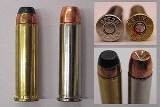
.357 Magnum

Encyclopedia
The .357 S&W Magnum or simply .357 Magnum, is a revolver
cartridge
created by Elmer Keith
, Phillip B. Sharpe, Colonel D. B. Wesson
of firearm
s manufacturer Smith & Wesson
, and Winchester
. It is based upon Smith & Wesson's earlier .38 Special
cartridge. The .357 Magnum cartridge was introduced in 1934, and its use has since become widespread. This cartridge started the "Magnum" era of handgun ammunition. The .357 Magnum cartridge has a positive reputation for stopping power
.
. At the time, the .38 Super was the only American pistol cartridge capable of defeating automobile cover and the early ballistic vests that were just beginning to emerge in the post-World War I
"Gangster Era
." Tests at the time revealed that those vests defeated any handgun cartridge traveling at less than about 1000 ft/s. Colt's .38 Super Automatic just edged over that velocity and was able to penetrate car doors and vests that bootleggers
and gangsters were employing as cover.
Though .38 and .357 would seem to be different-diameter chamberings, they are in fact identical. 0.357 inch is the true bullet diameter of the .38 Special cartridge. The .38 Special nomenclature relates to the previous use of heeled bullet
s (such as the .38 Short Colt
), which were the same diameter as the case. Thus, the only external difference in the two cartridges is a slight difference in length, solely for safety purposes as explained below.
Much credit for the .357's early development is given to hunter and experimenter Elmer Keith
. Keith's early work in loading the .38 Special
to increasingly higher pressure levels was made possible by the availability of heavy, target shooting-oriented revolvers like the Smith & Wesson 38/44 "Heavy Duty" and "Outdoorsman", .38-caliber revolvers built on .44-caliber frames. The .38-44 HV load used the .38 Special cartridge loaded to a much higher velocity than standard .38 Special ammunition. The .38-44 revolvers were made by using a .44 Special
size gun with the barrel and cylinder bored to .357 caliber (the true bullet diameter of the .38 Special). Since the frame, cylinder, and barrel were much stronger than the standard .38 Special components, it was capable of withstanding much higher pressures. The .38-44 HV round, while no longer available, was in most cases the equal of the later .357 Magnum, which works at more than double the pressure of standard .38 Special. The .357 Magnum addresses the safety issues earlier cartridges had by stretching the case by approximately 1/8 of an inch, preventing the high pressure .357 cartridge from chambering in a firearm designed for the shorter, lower pressure .38. Elmer Keith also contributed the Keith-style bullet, which increased the mass of bullet located outside of the cartridge, while leaving more room inside the cartridge for powder. The Keith bullet also employed a large, flat meplat
, thus enabling rapid energy transfer for greater wounding properties. At the same time, this bullet design does not deform like a hollow point, and as a result achieves greater penetration. These characteristics of the Keith bullet make it very suitable for hunting applications as well as target shooting.
In order to reassert itself as the leading law enforcement armament provider, Smith & Wesson
developed the .357 Magnum, with Colonel D. B. Wesson leading the effort within Smith & Wesson, along with considerable technical assistance from Phillip B. Sharpe, a member of the Technical Division Staff of the National Rifle Association
. The new round was developed from Smith & Wesson's existing .38 Special round. It used a different powder load, and ultimately the case was extended by 1/8 of an inch (0.125 in, 3.18 mm). The case extension was more a matter of safety than of necessity. Because the .38 Special and the early experimental .357 Magnum cartridges loaded by Keith were identical in physical attributes, it was possible to load an experimental .357 Magnum cartridge in a .38 Special revolver, with potentially disastrous results. Smith & Wesson's solution, of extending the case slightly, made it impossible to chamber the magnum-power round in a gun not designed for the additional pressure.
The choice of bullet for the .357 Magnum cartridge varied during its development. During the development at Smith & Wesson, the original Keith bullet was modified slightly, to the form of the Sharpe bullet, which itself was based upon the Keith bullet, but which had 5/6 of the bearing surface of the Keith bullet, Keith bullets typically being made oversized and sized down. Winchester, however, upon experimenting further during the cartridge development, modified the Sharpe bullet shape slightly, while keeping the Sharpe contour of the bullet. The final choice of bullet was hence based upon the earlier Keith and Sharpe bullets, while additionally having slight differences from both.
round. The hollow point version enjoys a reputation of being the gold standard of stopping power
among handgun cartridges and an "extremely reliable one shot stopper." For big game
, such as ungulate
s and bear
s, which have a substantially sturdier build than humans, it is inferior to the .500 Smith & Wesson, .50 Action Express
, .44 Magnum
, .454 Casull
, .41 Magnum and other larger magnum rounds. Still, it is a fine small and medium game round and will kill deer
very reliably at reasonable ranges if the right loads (140 grain and heavier hollow-point bullets, and solid semiwadcutter
bullets) are carefully used by a competent marksman. For further comparison, the .357 Magnum has a higher velocity at 100yds, than its parent .38 special has at the muzzle. Its stopping power on game is similar to the .45 Colt
and it has a flatter trajectory. It is a very versatile cartridge, and can be used with success for self-defense, plinking
, hunting, or target shooting.
Revolvers in .357 Magnum caliber have the significant advantage of also being able to fire .38 Special ammunition, with its lower cost, recoil
, noise, and muzzle flash
. This trait makes .357 revolvers ideal for novice shooters who are not yet used to firing full-strength .357 loads but do not want the expense of buying a second lower-powered gun to train with. However, a .38 Special should not generally be used with any .357 automatic handgun or rifle, such as the Magnum Research
Desert Eagle
.
It has also become popular as a "dual use" cartridge in short, light rifles like the American Old West
lever-action
s. In a rifle, the bullet will exit the barrel at about 1,800 feet per second (550 m/s), making it far more versatile than the .30 Carbine
or the .32-20 Winchester
. In the 1930s, it was found to be very effective against steel
ballistic vests, and metal-penetrating rounds were once popular in the United States among highway patrol
and other police organizations. The .357 revolver has been largely replaced by modern, high-capacity semi-automatic pistols for police use, but is still very popular for backup gun use, and among outdoorsmen, security guard
s, and civilians for self-defense and hunting.
Some common performance parameters are shown in the table below for several .357 Magnum loads. Bullet weights ranging from 110 to 180 grains are common. The 125-grain JHP loads are popular for self-defense, whereas the heavier loads are usually used for hunting. Loads are available with energies from about 400 (ft·lbf) to over 700 (ft·lbf), and penetration depths from 9 inches to over 27 inches are available for various applications and risk assessments.
Key:
Expansion – expanded bullet diameter (ballistic gelatin).
Penetration – penetration depth (ballistic gelatin).
PC – permanent cavity volume (ballistic gelatin, FBI method).
TSC – temporary stretch cavity volume (ballistic gelatin).
, which was designed for semi-automatic pistols. Ballistic performance for the two rounds is very similar. However since the .357 is usually chambered in revolvers, it can be shot in barrels longer than one would normally find in automatics, giving it an increase in performance.
In terms of accuracy, the .357 Magnum has at least the same potential for precision shooting as the benchmark .38 Special wadcutter
round—indeed, a good .357 Magnum revolver will happily shoot .38 Special wadcutter ammunition with good results. It is this accuracy and power, and the versatility of also being capable of using less-expensive, milder .38 Special ammunition, that makes a .357 Magnum revolver an excellent gun for many different disciplines, from 20 yard (18.28 m) precision shooting to long range falling-plate events. It is an excellent round for those considering handloading
ammunition, as it is economical and consistently performs well.
As mentioned above, the .357 Magnum was developed from the earlier .38 Special. This was possible because the .38 Special was originally designed to use black powder, which requires two to five times as much powder by weight to produce the same velocity with the same bullet as does the much more efficient smokeless powder
. Thus the .38 Special has a relatively large case. The 9 mm Para was introduced the same year (1902) but was originally designed for smokeless powder
, and for higher pressures (~39,200 psi). It therefore produces considerably more energy than the .38, despite its case having less than 1/2 the powder capacity. Most 9 mm powder charges fill the case to the base of the bullet, and some are heavily compressed. Many .38 Special loads use the same powders, in similar charge weights, but because the case is so much larger, those charges only fill the case about half full. Light target loads with fast burning powders may only fill the case perhaps 1/8 full. Filling the case with slower-burning powders produces much more power, but also much more pressure; far too much pressure for older, smaller-frame revolvers chambered in .38 Special. It was to accommodate these high-pressure, high-power loads that the longer .357 Magnum, together with the stronger revolvers designed to handle it, were developed.
Revolver
A revolver is a repeating firearm that has a cylinder containing multiple chambers and at least one barrel for firing. The first revolver ever made was built by Elisha Collier in 1818. The percussion cap revolver was invented by Samuel Colt in 1836. This weapon became known as the Colt Paterson...
cartridge
Cartridge (firearms)
A cartridge, also called a round, packages the bullet, gunpowder and primer into a single metallic case precisely made to fit the firing chamber of a firearm. The primer is a small charge of impact-sensitive chemical that may be located at the center of the case head or at its rim . Electrically...
created by Elmer Keith
Elmer Keith
Elmer Keith was an Idaho rancher, firearms enthusiast, and author. Keith was instrumental in the development of the first magnum revolver cartridge, the .357 Magnum, as well as the later .44 Magnum and .41 Magnum cartridges.-Personality and life:Keith's trademarks were his cigars, his ten-gallon...
, Phillip B. Sharpe, Colonel D. B. Wesson
Daniel B. Wesson
Daniel Baird Wesson was a firearms designer from the United States. He was responsible for helping develop several firearms that had a very large influence in the field.-Early years:...
of firearm
Firearm
A firearm is a weapon that launches one, or many, projectile at high velocity through confined burning of a propellant. This subsonic burning process is technically known as deflagration, as opposed to supersonic combustion known as a detonation. In older firearms, the propellant was typically...
s manufacturer Smith & Wesson
Smith & Wesson
Smith & Wesson is the largest manufacturer of handguns in the United States. The corporate headquarters is in Springfield, Massachusetts. Founded in 1852, Smith & Wesson's pistols and revolvers have become standard issue to police and armed forces throughout the world...
, and Winchester
Winchester Repeating Arms Company
The Winchester Repeating Arms Company was a prominent American maker of repeating firearms, located in New Haven, Connecticut. The Winchester brand is today used under license by two subsidiaries of the Herstal Group, Fabrique Nationale of Belgium and the Browning Arms Company of Morgan, Utah.-...
. It is based upon Smith & Wesson's earlier .38 Special
.38 Special
The .38 Smith & Wesson Special is a rimmed, centerfire cartridge designed by Smith & Wesson. It is most commonly used in revolvers, although some semi-automatic pistols and carbines also use this round...
cartridge. The .357 Magnum cartridge was introduced in 1934, and its use has since become widespread. This cartridge started the "Magnum" era of handgun ammunition. The .357 Magnum cartridge has a positive reputation for stopping power
Stopping power
Stopping power is a colloquial term used to describe the ability of a firearm or other weapon to cause a penetrating ballistic injury to a target, human or animal, sufficient to incapacitate the target where it stands....
.
Design
The .357 Magnum was collaboratively developed over a period in the early to mid-1930s by a group of individuals in a direct response to Colt's .38 Super Automatic.38 Super
The .38 Super or .38 Super Automatic is a pistol cartridge that fires a diameter bullet. The Super was introduced in the late 1920s as a higher pressure loading of the .38 ACP or .38 Auto. The old .38 ACP propelled a bullet at . The improved .38 Super Auto pushed the same bullet at...
. At the time, the .38 Super was the only American pistol cartridge capable of defeating automobile cover and the early ballistic vests that were just beginning to emerge in the post-World War I
World War I
World War I , which was predominantly called the World War or the Great War from its occurrence until 1939, and the First World War or World War I thereafter, was a major war centred in Europe that began on 28 July 1914 and lasted until 11 November 1918...
"Gangster Era
Social issues of the 1920s
The 1920s was the rise of a variety of social issues amidst a rapidly changing world. Conflicts arose concerning what was considered acceptable and respectable and what ought to be proscribed or made illegal...
." Tests at the time revealed that those vests defeated any handgun cartridge traveling at less than about 1000 ft/s. Colt's .38 Super Automatic just edged over that velocity and was able to penetrate car doors and vests that bootleggers
Rum-running
Rum-running, also known as bootlegging, is the illegal business of transporting alcoholic beverages where such transportation is forbidden by law...
and gangsters were employing as cover.
Though .38 and .357 would seem to be different-diameter chamberings, they are in fact identical. 0.357 inch is the true bullet diameter of the .38 Special cartridge. The .38 Special nomenclature relates to the previous use of heeled bullet
Heeled bullet
A heeled bullet is an archaic design of bullet where the internal diameter of the barrel is the same diameter as the cartridge case, and the bullet has a step at the rear to allow it to fit inside the case...
s (such as the .38 Short Colt
.38 Short Colt
The .38 short colt was originally a heeled bullet cartridge intended for cartridge conversions of the .36 cal cap & ball revolvers from the American Civil War-era.Later, this cartridge was fitted with an inside-lubricated bullet in the 125–135 grains range....
), which were the same diameter as the case. Thus, the only external difference in the two cartridges is a slight difference in length, solely for safety purposes as explained below.
Much credit for the .357's early development is given to hunter and experimenter Elmer Keith
Elmer Keith
Elmer Keith was an Idaho rancher, firearms enthusiast, and author. Keith was instrumental in the development of the first magnum revolver cartridge, the .357 Magnum, as well as the later .44 Magnum and .41 Magnum cartridges.-Personality and life:Keith's trademarks were his cigars, his ten-gallon...
. Keith's early work in loading the .38 Special
.38 Special
The .38 Smith & Wesson Special is a rimmed, centerfire cartridge designed by Smith & Wesson. It is most commonly used in revolvers, although some semi-automatic pistols and carbines also use this round...
to increasingly higher pressure levels was made possible by the availability of heavy, target shooting-oriented revolvers like the Smith & Wesson 38/44 "Heavy Duty" and "Outdoorsman", .38-caliber revolvers built on .44-caliber frames. The .38-44 HV load used the .38 Special cartridge loaded to a much higher velocity than standard .38 Special ammunition. The .38-44 revolvers were made by using a .44 Special
.44 Special
The .44 Special or .44 S&W Special is a smokeless powder center fire metallic cartridge developed by Smith & Wesson in 1907 as the standard chambering for their New Century revolver, introduced in 1908.-Development history:...
size gun with the barrel and cylinder bored to .357 caliber (the true bullet diameter of the .38 Special). Since the frame, cylinder, and barrel were much stronger than the standard .38 Special components, it was capable of withstanding much higher pressures. The .38-44 HV round, while no longer available, was in most cases the equal of the later .357 Magnum, which works at more than double the pressure of standard .38 Special. The .357 Magnum addresses the safety issues earlier cartridges had by stretching the case by approximately 1/8 of an inch, preventing the high pressure .357 cartridge from chambering in a firearm designed for the shorter, lower pressure .38. Elmer Keith also contributed the Keith-style bullet, which increased the mass of bullet located outside of the cartridge, while leaving more room inside the cartridge for powder. The Keith bullet also employed a large, flat meplat
Meplat
Meplat, from a French term for a flat surface, is the technical term for the tip or nose of a bullet. The shape of the meplat is important when determining how the bullet will move through the air. If uneven, the bullet will not have an ideal flight characteristic and will most likely not be of the...
, thus enabling rapid energy transfer for greater wounding properties. At the same time, this bullet design does not deform like a hollow point, and as a result achieves greater penetration. These characteristics of the Keith bullet make it very suitable for hunting applications as well as target shooting.
In order to reassert itself as the leading law enforcement armament provider, Smith & Wesson
Smith & Wesson
Smith & Wesson is the largest manufacturer of handguns in the United States. The corporate headquarters is in Springfield, Massachusetts. Founded in 1852, Smith & Wesson's pistols and revolvers have become standard issue to police and armed forces throughout the world...
developed the .357 Magnum, with Colonel D. B. Wesson leading the effort within Smith & Wesson, along with considerable technical assistance from Phillip B. Sharpe, a member of the Technical Division Staff of the National Rifle Association
National Rifle Association
The National Rifle Association of America is an American non-profit 501 civil rights organization which advocates for the protection of the Second Amendment of the United States Bill of Rights and the promotion of firearm ownership rights as well as marksmanship, firearm safety, and the protection...
. The new round was developed from Smith & Wesson's existing .38 Special round. It used a different powder load, and ultimately the case was extended by 1/8 of an inch (0.125 in, 3.18 mm). The case extension was more a matter of safety than of necessity. Because the .38 Special and the early experimental .357 Magnum cartridges loaded by Keith were identical in physical attributes, it was possible to load an experimental .357 Magnum cartridge in a .38 Special revolver, with potentially disastrous results. Smith & Wesson's solution, of extending the case slightly, made it impossible to chamber the magnum-power round in a gun not designed for the additional pressure.
The choice of bullet for the .357 Magnum cartridge varied during its development. During the development at Smith & Wesson, the original Keith bullet was modified slightly, to the form of the Sharpe bullet, which itself was based upon the Keith bullet, but which had 5/6 of the bearing surface of the Keith bullet, Keith bullets typically being made oversized and sized down. Winchester, however, upon experimenting further during the cartridge development, modified the Sharpe bullet shape slightly, while keeping the Sharpe contour of the bullet. The final choice of bullet was hence based upon the earlier Keith and Sharpe bullets, while additionally having slight differences from both.
Performance
This cartridge is regarded by many as an excellent self-defenseSelf-defense
Self-defense, self-defence or private defense is a countermeasure that involves defending oneself, one's property or the well-being of another from physical harm. The use of the right of self-defense as a legal justification for the use of force in times of danger is available in many...
round. The hollow point version enjoys a reputation of being the gold standard of stopping power
Stopping power
Stopping power is a colloquial term used to describe the ability of a firearm or other weapon to cause a penetrating ballistic injury to a target, human or animal, sufficient to incapacitate the target where it stands....
among handgun cartridges and an "extremely reliable one shot stopper." For big game
Game (food)
Game is any animal hunted for food or not normally domesticated. Game animals are also hunted for sport.The type and range of animals hunted for food varies in different parts of the world. This will be influenced by climate, animal diversity, local taste and locally accepted view about what can or...
, such as ungulate
Ungulate
Ungulates are several groups of mammals, most of which use the tips of their toes, usually hoofed, to sustain their whole body weight while moving. They make up several orders of mammals, of which six to eight survive...
s and bear
Bear
Bears are mammals of the family Ursidae. Bears are classified as caniforms, or doglike carnivorans, with the pinnipeds being their closest living relatives. Although there are only eight living species of bear, they are widespread, appearing in a wide variety of habitats throughout the Northern...
s, which have a substantially sturdier build than humans, it is inferior to the .500 Smith & Wesson, .50 Action Express
.50 Action Express
The .50 Action Express is a large caliber handgun cartridge. It was developed in 1988 by Evan Whildin of Action Arms. The .50 AE is one of the most powerful pistol cartridges in production.-Overview:...
, .44 Magnum
.44 Magnum
The .44 Remington Magnum, or simply .44 Magnum, is a large-bore cartridge originally designed for revolvers. After introduction, it was quickly adopted for carbines and rifles...
, .454 Casull
.454 Casull
The .454 Casull is a firearm cartridge, developed in 1957 by Dick Casull and Jack Fulmer. It was first announced in November 1959 by Guns & Ammo magazine. The basic design was a lengthened and structurally improved .45 Colt case...
, .41 Magnum and other larger magnum rounds. Still, it is a fine small and medium game round and will kill deer
Deer
Deer are the ruminant mammals forming the family Cervidae. Species in the Cervidae family include white-tailed deer, elk, moose, red deer, reindeer, fallow deer, roe deer and chital. Male deer of all species and female reindeer grow and shed new antlers each year...
very reliably at reasonable ranges if the right loads (140 grain and heavier hollow-point bullets, and solid semiwadcutter
Semiwadcutter
A semiwadcutter or SWC is a type of all-purpose bullet commonly used in revolvers. The SWC combines features of the wadcutter target bullet and traditional round nosed revolver bullets, and is used in both revolver and pistol cartridges for hunting, target shooting, and plinking...
bullets) are carefully used by a competent marksman. For further comparison, the .357 Magnum has a higher velocity at 100yds, than its parent .38 special has at the muzzle. Its stopping power on game is similar to the .45 Colt
.45 Colt
The .45 Colt cartridge is a handgun cartridge dating to 1872. It began as a black powder revolver round developed for the Colt Single Action Army revolver, but is offered as a magnum level handgun hunting round in modern usage. This cartridge was adopted by the U.S. Army in 1873 and served as the...
and it has a flatter trajectory. It is a very versatile cartridge, and can be used with success for self-defense, plinking
Plinking
Plinking refers to informal target shooting done at non-traditional targets such as tin cans, glass bottles, and balloons filled with water. The term is an onomatopoeia of the sound a bullet or other projectile makes when hitting a tin can, or other similar target, referring to the sharp, metallic...
, hunting, or target shooting.
Revolvers in .357 Magnum caliber have the significant advantage of also being able to fire .38 Special ammunition, with its lower cost, recoil
Recoil
Recoil is the backward momentum of a gun when it is discharged. In technical terms, the recoil caused by the gun exactly balances the forward momentum of the projectile and exhaust gasses, according to Newton's third law...
, noise, and muzzle flash
Muzzle flash
Muzzle blast is the term used to describe the release of high temperature, high pressure gases expelled from the muzzle of a firearm when it is discharged. Muzzle flash is the term used to describe the visible light of the muzzle blast. The blast and flash are caused by the combustion products of...
. This trait makes .357 revolvers ideal for novice shooters who are not yet used to firing full-strength .357 loads but do not want the expense of buying a second lower-powered gun to train with. However, a .38 Special should not generally be used with any .357 automatic handgun or rifle, such as the Magnum Research
Magnum Research
Magnum Research Inc. is a privately held corporation based in Fridley, Minnesota which manufactures and distributes firearms. The majority owners, Jim Skildum and John Risdall , have been with the company since its founding in 1979...
Desert Eagle
Desert Eagle
The Desert Eagle is a large-framed gas-operated semi-automatic pistol designed by Magnum Research in the U.S. and by IMI in Israel; the pistol is manufactured primarily in Israel by IMI...
.
It has also become popular as a "dual use" cartridge in short, light rifles like the American Old West
American Old West
The American Old West, or the Wild West, comprises the history, geography, people, lore, and cultural expression of life in the Western United States, most often referring to the latter half of the 19th century, between the American Civil War and the end of the century...
lever-action
Lever-action
Lever-action is a type of firearm action which uses a lever located around the trigger guard area, to load fresh cartridges into the chamber of the barrel when the lever is worked. Most lever-action firearms are rifles, but lever-action shotguns and a few pistols have also been made...
s. In a rifle, the bullet will exit the barrel at about 1,800 feet per second (550 m/s), making it far more versatile than the .30 Carbine
.30 Carbine
The .30 Carbine is the cartridge used in the M1 Carbine introduced in the 1940s. It is an intermediate round designed to be fired from the M1 carbine's 18-inch barrel.-History:...
or the .32-20 Winchester
.32-20 Winchester
The .32-20 Winchester, also known as the .32 WCF , was the first small-game lever-action cartridge thatWinchester produced. It was initially introduced as a blackpowder cartridge in 1882 for small-game, varmint hunting, and deer. Colt produced a single-action pistol chambered for this cartridge a...
. In the 1930s, it was found to be very effective against steel
Steel
Steel is an alloy that consists mostly of iron and has a carbon content between 0.2% and 2.1% by weight, depending on the grade. Carbon is the most common alloying material for iron, but various other alloying elements are used, such as manganese, chromium, vanadium, and tungsten...
ballistic vests, and metal-penetrating rounds were once popular in the United States among highway patrol
Highway patrol
A highway patrol is either a police unit created primarily for the purpose of overseeing and enforcing traffic safety compliance on roads and highways, or a detail within an existing local or regional police agency that is primarily concerned with such duties.Duties of highway patrols or traffic...
and other police organizations. The .357 revolver has been largely replaced by modern, high-capacity semi-automatic pistols for police use, but is still very popular for backup gun use, and among outdoorsmen, security guard
Security guard
A security guard is a person who is paid to protect property, assets, or people. Security guards are usually privately and formally employed personnel...
s, and civilians for self-defense and hunting.
Some common performance parameters are shown in the table below for several .357 Magnum loads. Bullet weights ranging from 110 to 180 grains are common. The 125-grain JHP loads are popular for self-defense, whereas the heavier loads are usually used for hunting. Loads are available with energies from about 400 (ft·lbf) to over 700 (ft·lbf), and penetration depths from 9 inches to over 27 inches are available for various applications and risk assessments.
| Manufacturer | Load | Mass (grains) | Velocity (ft/s) | Energy (ft•lbf) | Expansion (inches) | Penetration (inches) | PC (in3) | TSC (in3) |
|---|---|---|---|---|---|---|---|---|
| American | Quik-Shok JHP | 125 | 1409 | 551 | fragment | 9.0 | 2.7 | 47.5 |
| Double Tap | Gold Dot JHP | 125 | 1600 | 711 | 0.69 | 12.75 | 4.8 | 69.3 (est) |
| Federal | Classic JHP | 125 | 1450 | 584 | 0.65 | 12.0 | 4.0 | 79.8 |
| Remington | Golden Saber JHP | 125 | 1220 | 413 | 0.60 | 13.0 | 3.7 | 30.4 |
| Remington | Semiwadcutter | 158 | 1235 | 535 | 0.36 | 27.5 | 2.8 | 12.9 |
| Winchester | Silvertip JHP | 145 | 1290 | 536 | 0.65 | 14.3 | 4.7 | 33.7 |
Key:
Expansion – expanded bullet diameter (ballistic gelatin).
Penetration – penetration depth (ballistic gelatin).
PC – permanent cavity volume (ballistic gelatin, FBI method).
TSC – temporary stretch cavity volume (ballistic gelatin).
Comparison
The .357 Magnum was a direct competitor with the .38 Super.38 Super
The .38 Super or .38 Super Automatic is a pistol cartridge that fires a diameter bullet. The Super was introduced in the late 1920s as a higher pressure loading of the .38 ACP or .38 Auto. The old .38 ACP propelled a bullet at . The improved .38 Super Auto pushed the same bullet at...
, which was designed for semi-automatic pistols. Ballistic performance for the two rounds is very similar. However since the .357 is usually chambered in revolvers, it can be shot in barrels longer than one would normally find in automatics, giving it an increase in performance.
In terms of accuracy, the .357 Magnum has at least the same potential for precision shooting as the benchmark .38 Special wadcutter
Wadcutter
A wadcutter is a special-purpose bullet specially designed for shooting paper targets, usually at close range and at subsonic velocities typically under 800 ft/s . They are often used in handgun and airgun competitions...
round—indeed, a good .357 Magnum revolver will happily shoot .38 Special wadcutter ammunition with good results. It is this accuracy and power, and the versatility of also being capable of using less-expensive, milder .38 Special ammunition, that makes a .357 Magnum revolver an excellent gun for many different disciplines, from 20 yard (18.28 m) precision shooting to long range falling-plate events. It is an excellent round for those considering handloading
Handloading
Handloading or reloading is the process of loading firearm cartridges or shotgun shells by assembling the individual components , rather than purchasing completely assembled, factory-loaded cartridges...
ammunition, as it is economical and consistently performs well.
As mentioned above, the .357 Magnum was developed from the earlier .38 Special. This was possible because the .38 Special was originally designed to use black powder, which requires two to five times as much powder by weight to produce the same velocity with the same bullet as does the much more efficient smokeless powder
Smokeless powder
Smokeless powder is the name given to a number of propellants used in firearms and artillery which produce negligible smoke when fired, unlike the older gunpowder which they replaced...
. Thus the .38 Special has a relatively large case. The 9 mm Para was introduced the same year (1902) but was originally designed for smokeless powder
Smokeless powder
Smokeless powder is the name given to a number of propellants used in firearms and artillery which produce negligible smoke when fired, unlike the older gunpowder which they replaced...
, and for higher pressures (~39,200 psi). It therefore produces considerably more energy than the .38, despite its case having less than 1/2 the powder capacity. Most 9 mm powder charges fill the case to the base of the bullet, and some are heavily compressed. Many .38 Special loads use the same powders, in similar charge weights, but because the case is so much larger, those charges only fill the case about half full. Light target loads with fast burning powders may only fill the case perhaps 1/8 full. Filling the case with slower-burning powders produces much more power, but also much more pressure; far too much pressure for older, smaller-frame revolvers chambered in .38 Special. It was to accommodate these high-pressure, high-power loads that the longer .357 Magnum, together with the stronger revolvers designed to handle it, were developed.
See also
- .357 SuperMag
- .357 Remington Maximum.357 Remington MaximumThe .357 Maximum, formally known as the .357 Remington Maximum or the .357 Max, is a super magnum handgun cartridge originally developed by Elgin Gates as the wildcat .357 SuperMag. The .357 Maximum was introduced into commercial production as a joint-venture by Remington Arms Company and Ruger in...
- .357 SIG.357 SIGThe .357 SIG pistol cartridge is the product of Swiss-German firearms manufacturer SIG-Sauer, in cooperation with the American ammunition manufacturer Federal Cartridge. While it is based on a .40 S&W case necked down to accept bullets, the .357 SIG brass is slightly longer...
- Colt PythonColt PythonThe Colt Python is a .357 Magnum caliber revolver formerly manufactured by Colt's Manufacturing Company of Hartford, Connecticut. It is sometimes referred to as a "Combat Magnum". It was first introduced in 1955, the same year as Smith & Wesson's M29 .44 Magnum. The now discontinued Colt Python...
- Ruger GP-100
- Smith & Wesson Model 19
External links
- Coonan pistol - semi-automatic pistol in .357 Magnum
- .357 Magnum Videos
- Ballistics By The Inch .357magnum results.