

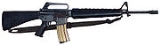
Assault rifle

Encyclopedia
Selective fire
A selective fire firearm has at least one semi–automatic and one automatic mode, which is activated by means of a selector which varies depending on the weapon's design. Some selective fire weapons utilize burst fire mechanisms to limit the maximum or total number of shots fired automatically in...
(selectable between semi-auto and fully automatic) rifle
Rifle
A rifle is a firearm designed to be fired from the shoulder, with a barrel that has a helical groove or pattern of grooves cut into the barrel walls. The raised areas of the rifling are called "lands," which make contact with the projectile , imparting spin around an axis corresponding to the...
(capable of being fired from the shoulder) that uses an intermediate cartridge
Intermediate cartridges
An intermediate cartridge is a military assault rifle cartridge that is less powerful than typical full power battle rifle cartridges such as the 7.92mm Mauser or US .30-06, but still significantly more powerful than pistol cartridges...
and a detachable magazine. Assault rifles are the standard infantry weapons
Small arms
Small arms is a term of art used by armed forces to denote infantry weapons an individual soldier may carry. The description is usually limited to revolvers, pistols, submachine guns, carbines, assault rifles, battle rifles, multiple barrel firearms, sniper rifles, squad automatic weapons, light...
in most modern armies
Army
An army An army An army (from Latin arma "arms, weapons" via Old French armée, "armed" (feminine), in the broadest sense, is the land-based military of a nation or state. It may also include other branches of the military such as the air force via means of aviation corps...
. Assault rifles are categorized in between light machine gun
Light machine gun
A light machine gun is a machine gun designed to be employed by an individual soldier, with or without an assistant, as an infantry support weapon. Light machine guns are often used as squad automatic weapons.-Characteristics:...
s, which are intended more for sustained automatic fire in a light support role, and submachine gun
Submachine gun
A submachine gun is an automatic carbine, designed to fire pistol cartridges. It combines the automatic fire of a machine gun with the cartridge of a pistol. The submachine gun was invented during World War I , but the apex of its use was during World War II when millions of the weapon type were...
s, which fire a pistol cartridge rather than a rifle cartridge.
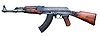
Examples of assault rifles include the Kalashnikov
AK-47
The AK-47 is a selective-fire, gas-operated 7.62×39mm assault rifle, first developed in the Soviet Union by Mikhail Kalashnikov. It is officially known as Avtomat Kalashnikova . It is also known as a Kalashnikov, an "AK", or in Russian slang, Kalash.Design work on the AK-47 began in the last year...
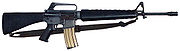
family, M16 rifle
M16 rifle
The M16 is the United States military designation for the AR-15 rifle adapted for both semi-automatic and full-automatic fire. Colt purchased the rights to the AR-15 from ArmaLite, and currently uses that designation only for semi-automatic versions of the rifle. The M16 fires the 5.56×45mm NATO...
, SA80
SA80
The SA80 is a British family of 5.56mm small arms. It is a selective fire, gas-operated assault rifle. SA80 prototypes were trialled in 1976 and production was completed in 1994....
, G36
Heckler & Koch G36
The Heckler & Koch G36 is a 5.56×45mm assault rifle, designed in the early 1990s by Heckler & Koch in Germany as a replacement for the 7.62mm G3 battle rifle. It was accepted into service with the Bundeswehr in 1997, replacing the G3...
, FN F2000
FN F2000
The FN F2000 is a 5.56×45mm NATO bullpup assault rifle, designed by FN Herstal in Belgium. The F2000 made its debut in March 2001 at the IDEX defense exhibition held in Abu Dhabi, in the United Arab Emirates.-Design details:...
, and the Steyr AUG
Steyr AUG
The AUG is an Austrian bullpup 5.56mm assault rifle, designed in the early 1970s by Steyr Mannlicher GmbH & Co KG . The AUG was adopted by the Austrian Army as the StG 77 in 1977, where it replaced the 7.62mm StG 58 automatic rifle...
.
Definition
The term assault rifle is a translation of the GermanGerman language
German is a West Germanic language, related to and classified alongside English and Dutch. With an estimated 90 – 98 million native speakers, German is one of the world's major languages and is the most widely-spoken first language in the European Union....
word Sturmgewehr (literally "storm rifle", as in "to storm a position"). The name was coined by Adolf Hitler
Adolf Hitler
Adolf Hitler was an Austrian-born German politician and the leader of the National Socialist German Workers Party , commonly referred to as the Nazi Party). He was Chancellor of Germany from 1933 to 1945, and head of state from 1934 to 1945...
to describe the Maschinenpistole 43, subsequently re-named Sturmgewehr 44, the firearm generally considered the first assault rifle that served to popularise the concept and form the basis for today's modern assault rifles.
The translation assault rifle gradually became the common term for similar firearms sharing the same technical definition as the StG 44. In a strict definition, a firearm must have at least the following characteristics to be considered an assault rifle:
- It must be an individual weapon with provision to fire from the shoulder (i.e. a buttstockStock (firearm)A stock, also known as a buttstock or shoulder stock, is a part of a rifle or other firearm, to which the barrel and firing mechanism are attached, that is held against one's shoulder when firing the gun. Stocks are also found on crossbows though a crossbow stock is more properly referred to as a...
); - It must be capable of selective fireSelective fireA selective fire firearm has at least one semi–automatic and one automatic mode, which is activated by means of a selector which varies depending on the weapon's design. Some selective fire weapons utilize burst fire mechanisms to limit the maximum or total number of shots fired automatically in...
; - It must have an intermediate-power cartridge: more power than a pistolPistolWhen distinguished as a subset of handguns, a pistol is a handgun with a chamber that is integral with the barrel, as opposed to a revolver, wherein the chamber is separate from the barrel as a revolving cylinder. Typically, pistols have an effective range of about 100 feet.-History:The pistol...
but less than a standard rifleRifleA rifle is a firearm designed to be fired from the shoulder, with a barrel that has a helical groove or pattern of grooves cut into the barrel walls. The raised areas of the rifling are called "lands," which make contact with the projectile , imparting spin around an axis corresponding to the...
or battle rifleBattle rifleA battle rifle is a military service rifle that fires a full power rifle cartridge, such as 7.62x51mm NATO. While the designation of battle rifle is usually given to post-World War II select fire infantry rifles such as the H&K G3, the FN FAL or the M14, this term can also apply to older military...
; - Its ammunitionAmmunitionAmmunition is a generic term derived from the French language la munition which embraced all material used for war , but which in time came to refer specifically to gunpowder and artillery. The collective term for all types of ammunition is munitions...
must be supplied from a detachable magazine rather than a feed-belt. - And it should at least have a firing range of 300 meters (984 feet)
Rifles that meet most of these criteria, but not all, are technically not assault rifles despite frequently being considered as such. For example, semi-automatic-only rifles like the AR-15 (which the M16 rifle is based on) that share designs with assault rifles are not assault rifles, as they are not capable of switching to automatic fire and thus are not selective fire capable. Belt-fed weapons or rifles with fixed magazines are likewise not assault rifles because they do not have detachable box magazines.
The term "assault rifle" is often more loosely used for commercial or political reasons to include other types of arms, particularly arms that fall under a strict definition of the battle rifle
Battle rifle
A battle rifle is a military service rifle that fires a full power rifle cartridge, such as 7.62x51mm NATO. While the designation of battle rifle is usually given to post-World War II select fire infantry rifles such as the H&K G3, the FN FAL or the M14, this term can also apply to older military...
, or semi-automatic
Semi-automatic rifle
A semi-automatic rifle is a type of rifle that fires a single bullet each time the trigger is pulled, automatically ejects the spent cartridge, chambers a fresh cartridge from its magazine, and is immediately ready to fire another shot...
variant of military rifles such as AR-15
AR-15
The AR-15 is a lightweight, 5.56 mm, air-cooled, gas-operated, magazine-fed semi-automatic rifle, with a rotating-lock bolt, actuated by direct impingement gas operation. It is manufactured with the extensive use of aluminum alloys and synthetic materials....
s.
The US Army defines assault rifles as "short, compact, selective-fire weapons that fire a cartridge intermediate in power between submachinegun and rifle cartridges."
Assault rifles vs. "Assault weapons"
The term assault weaponAssault weapon
Assault weapon is a non-technical term referring to any of a broad category of firearms with certain features, including some semiautomatic rifles, some pistols, and some shotguns. There are a variety of different statutory definitions of assault weapons in local, state, and federal laws in the...
is a United States
United States
The United States of America is a federal constitutional republic comprising fifty states and a federal district...
political and legal term used to describe a variety of semi-automatic
Semi-automatic firearm
A semi-automatic, or self-loading firearm is a weapon which performs all steps necessary to prepare the weapon to fire again after firing—assuming cartridges remain in the weapon's feed device or magazine...
firearms that have certain features generally associated with military assault rifles. The 1994 Federal Assault Weapons Ban
Federal assault weapons ban
The Federal Assault Weapons Ban was a subtitle of the Violent Crime Control and Law Enforcement Act of 1994, a federal law in the United States that included a prohibition on the manufacture for civilian use of certain semi-automatic firearms, so called "assault weapons"...
, which expired on September 13, 2004, codified the definition of an assault weapon. It defined the rifle type of assault weapon as a semiautomatic firearm with the ability to accept a detachable magazine containing more than 10 rounds, and two or more of the following:
- Folding or telescoping stockStock (firearm)A stock, also known as a buttstock or shoulder stock, is a part of a rifle or other firearm, to which the barrel and firing mechanism are attached, that is held against one's shoulder when firing the gun. Stocks are also found on crossbows though a crossbow stock is more properly referred to as a...
- Primary pistol gripPistol gripOn a firearm or other tool, the pistol grip is that portion of the mechanism that is held by the hand and orients the hand in a forward, vertical orientation, similar to the position one would take with a conventional pistol such as the M1911....
- Forward grip
- Threaded barrel (for a muzzle brakeMuzzle brakeMuzzle brakes and recoil compensators are devices that are fitted to the muzzle of a firearm or cannon to redirect propellant gases with the effect of countering both recoil of the gun and unwanted rising of the barrel during rapid fire...
or a suppressorSuppressorA suppressor, sound suppressor, sound moderator, or silencer, is a device attached to or part of the barrel of a firearm which reduces the amount of noise and flash generated by firing the weapon....
, commonly called a silencer) - Barrel shroudBarrel shroudA barrel shroud is a covering attached to the barrel of a firearm, that partially or completely encircles the barrel which prevents operators from injuring themselves on a hot barrel. Slides, extensions of the stock that do not fully encircle the barrel, and the receiver of a firearm itself are...
The assault weapons ban did not restrict weapons capable of fully automatic fire, such as assault rifles and machine gun
Machine gun
A machine gun is a fully automatic mounted or portable firearm, usually designed to fire rounds in quick succession from an ammunition belt or large-capacity magazine, typically at a rate of several hundred rounds per minute....
s, which have been continuously and heavily regulated since the National Firearms Act
National Firearms Act
The National Firearms Act , 73rd Congress, Sess. 2, ch. 757, , enacted on June 26, 1934, currently codified as amended as , is an Act of Congress that, in general, imposes a statutory excise tax on the manufacture and transfer of certain firearms and mandates the registration of those firearms. The...
of 1934 was passed. Subsequent laws such as the Gun Control Act of 1968
Gun Control Act of 1968
The Gun Control Act of 1968 , by president Lyndon Johnson, is a federal law in the United States that broadly regulates the firearms industry and firearms owners...
and the Firearm Owners Protection Act
Firearm Owners Protection Act
The Firearm Owners' Protection Act , , codified at et seq., is a United States federal law that revised many statutes in the Gun Control Act of 1968.-Federal Firearms License regulatory reform:...
of 1986 also affected the importation and civilian ownership of fully automatic firearms, the latter fully prohibiting sales of newly manufactured machine guns to non-law enforcement or SOT (special occupational taxpayer) dealers.
The changing face of infantry combat
From ancient times, light infantryInfantry
Infantrymen are soldiers who are specifically trained for the role of fighting on foot to engage the enemy face to face and have historically borne the brunt of the casualties of combat in wars. As the oldest branch of combat arms, they are the backbone of armies...
had fought in dispersed formations, while heavy infantry had fought in tightly packed formations. This continued as the sling
Sling (weapon)
A sling is a projectile weapon typically used to throw a blunt projectile such as a stone or lead "sling-bullet". It is also known as the shepherd's sling....
and spear
Spear
A spear is a pole weapon consisting of a shaft, usually of wood, with a pointed head.The head may be simply the sharpened end of the shaft itself, as is the case with bamboo spears, or it may be made of a more durable material fastened to the shaft, such as flint, obsidian, iron, steel or...
were replaced by musket
Musket
A musket is a muzzle-loaded, smooth bore long gun, fired from the shoulder. Muskets were designed for use by infantry. A soldier armed with a musket had the designation musketman or musketeer....
and bayonet
Bayonet
A bayonet is a knife, dagger, sword, or spike-shaped weapon designed to fit in, on, over or underneath the muzzle of a rifle, musket or similar weapon, effectively turning the gun into a spear...
. Bright coloured uniforms (German: Blue, Russian: Green; British: Red, French: White) became a standard for unit cohesion in the midst of clouds of black powder smoke. Musket
Musket
A musket is a muzzle-loaded, smooth bore long gun, fired from the shoulder. Muskets were designed for use by infantry. A soldier armed with a musket had the designation musketman or musketeer....
s were inaccurate at distances greater than 50 to 100 meters (164 to 328 feet) and were slow to reload, which lead to formation-style war as multiple ranks
Rank (formation)
A Rank is a line of military personnel, drawn up in line abreast .Commonly, troops called to 'On the right, fall in!' do so by forming in line abreast, determining their initial position in relation to a marker. This may be a position on the ground or a single person placed previously to the movement...
maximised firepower and guaranteed that at least part of the unit would be ready to fire at all times. Tight formations also aided officers
Officer (armed forces)
An officer is a member of an armed force or uniformed service who holds a position of authority. Commissioned officers derive authority directly from a sovereign power and, as such, hold a commission charging them with the duties and responsibilities of a specific office or position...
in controlling their men during combat and repelling infantry or cavalry
Cavalry
Cavalry or horsemen were soldiers or warriors who fought mounted on horseback. Cavalry were historically the third oldest and the most mobile of the combat arms...
charges.
The adaptation of rifled musket
Rifled musket
The term rifled musket or rifle musket refers to a specific type of weapon made in the mid-19th century. Originally the term referred only to muskets that had been produced as a smoothbore weapon and later had their barrels rifled...
s for military use in the mid-19th century increased range and power of guns and made battle from dense formations an extremely bloody affair, as witnessed by the high level of casualties in the American Civil War
American Civil War
The American Civil War was a civil war fought in the United States of America. In response to the election of Abraham Lincoln as President of the United States, 11 southern slave states declared their secession from the United States and formed the Confederate States of America ; the other 25...
. Skirmisher
Skirmisher
Skirmishers are infantry or cavalry soldiers stationed ahead or alongside a larger body of friendly troops. They are usually placed in a skirmish line to harass the enemy.-Pre-modern:...
tactics were given greater emphasis as gunpowder weapons increased in reliability, accuracy, and rate of fire. Cavalry adapted by dismounting, and using skirmisher
Skirmisher
Skirmishers are infantry or cavalry soldiers stationed ahead or alongside a larger body of friendly troops. They are usually placed in a skirmish line to harass the enemy.-Pre-modern:...
tactics with breechloading rifles
Breech-loading weapon
A breech-loading weapon is a firearm in which the cartridge or shell is inserted or loaded into a chamber integral to the rear portion of a barrel....
(which could be reloaded from a prone position, reducing vulnerability to enemy fire).
After the American Civil War
American Civil War
The American Civil War was a civil war fought in the United States of America. In response to the election of Abraham Lincoln as President of the United States, 11 southern slave states declared their secession from the United States and formed the Confederate States of America ; the other 25...
, further developments such as the adaptation of magazine-fed rifle
Rifle
A rifle is a firearm designed to be fired from the shoulder, with a barrel that has a helical groove or pattern of grooves cut into the barrel walls. The raised areas of the rifling are called "lands," which make contact with the projectile , imparting spin around an axis corresponding to the...
s, rapid-fire machine gun
Machine gun
A machine gun is a fully automatic mounted or portable firearm, usually designed to fire rounds in quick succession from an ammunition belt or large-capacity magazine, typically at a rate of several hundred rounds per minute....
s and high explosive shells
Shell (projectile)
A shell is a payload-carrying projectile, which, as opposed to shot, contains an explosive or other filling, though modern usage sometimes includes large solid projectiles properly termed shot . Solid shot may contain a pyrotechnic compound if a tracer or spotting charge is used...
for the artillery
Artillery
Originally applied to any group of infantry primarily armed with projectile weapons, artillery has over time become limited in meaning to refer only to those engines of war that operate by projection of munitions far beyond the range of effect of personal weapons...
, spelled the end of the dense infantry formation during World War I
World War I
World War I , which was predominantly called the World War or the Great War from its occurrence until 1939, and the First World War or World War I thereafter, was a major war centred in Europe that began on 28 July 1914 and lasted until 11 November 1918...
. What this meant in practice was that infantry units no longer engaged each other at long range in open fields; the high power of relatively unwieldy bolt-action
Bolt-action
Bolt action is a type of firearm action in which the weapon's bolt is operated manually by the opening and closing of the breech with a small handle, most commonly placed on the right-hand side of the weapon...
rifles of the day (which had been tripled by the adaptation of smokeless powder
Smokeless powder
Smokeless powder is the name given to a number of propellants used in firearms and artillery which produce negligible smoke when fired, unlike the older gunpowder which they replaced...
, along with a corresponding increase in recoil
Recoil
Recoil is the backward momentum of a gun when it is discharged. In technical terms, the recoil caused by the gun exactly balances the forward momentum of the projectile and exhaust gasses, according to Newton's third law...
and report) was no longer suited to the close-range engagement of modern warfare. Military leaders and arms manufacturers thus began grasping for a new type of weapon for this new era.
1900s–1930s: Pre-Sturmgewehr Light automatic rifles
These automatic firearms generally used pre-existing rifle cartridges, with kinetic energiesKinetic energy
The kinetic energy of an object is the energy which it possesses due to its motion.It is defined as the work needed to accelerate a body of a given mass from rest to its stated velocity. Having gained this energy during its acceleration, the body maintains this kinetic energy unless its speed changes...
between 1960–5,000 J
Joule
The joule ; symbol J) is a derived unit of energy or work in the International System of Units. It is equal to the energy expended in applying a force of one newton through a distance of one metre , or in passing an electric current of one ampere through a resistance of one ohm for one second...
(1,450–3,700-foot-pounds), velocities of 660–900 m/s (1,445–2,950 ft/s) and bullets of 9 to 13 g
Gram
The gram is a metric system unit of mass....
(139–200 grains).
Amerigo Cei-Rigotti
Cei-Rigotti
The Cei-Rigotti is an early automatic rifle created by Amerigo Cei-Rigotti, an officer in the Italian Army, in 1890, and extensively modified until its final form circa 1900....
developed a rifle with essentially all the characteristics of an assault rifle between 1890 and 1900. It was tested but did not see service. The first in-service precursor of the assault rifle was the Russia
Russia
Russia or , officially known as both Russia and the Russian Federation , is a country in northern Eurasia. It is a federal semi-presidential republic, comprising 83 federal subjects...
n Fedorov Avtomat
Fedorov Avtomat
The Fedorov Avtomat was an early assault rifle designed by Vladimir Grigoryevich Fedorov and produced in Russia in 1916. It was the first practical assault rifle to be adopted, and this concept would later become the basis for the first assault rifle to incorporate a modern layout, the StG 44...
issued for the first time in 1915 and chambered for the Japan
Japan
Japan is an island nation in East Asia. Located in the Pacific Ocean, it lies to the east of the Sea of Japan, China, North Korea, South Korea and Russia, stretching from the Sea of Okhotsk in the north to the East China Sea and Taiwan in the south...
ese 6.5x50mm Arisaka rifle cartridge
Cartridge (firearms)
A cartridge, also called a round, packages the bullet, gunpowder and primer into a single metallic case precisely made to fit the firing chamber of a firearm. The primer is a small charge of impact-sensitive chemical that may be located at the center of the case head or at its rim . Electrically...
. Like the 6.5x52mm Mannlicher-Carcano round used in the Cei-Rigotti, this was a relatively low-powered rifle cartridge already in production. The 1,960 J bullet energy of the Arisaka round from the short barrel of the Avtomat was in fact less than the 2,010 J bullet energy of the AK-47
AK-47
The AK-47 is a selective-fire, gas-operated 7.62×39mm assault rifle, first developed in the Soviet Union by Mikhail Kalashnikov. It is officially known as Avtomat Kalashnikova . It is also known as a Kalashnikov, an "AK", or in Russian slang, Kalash.Design work on the AK-47 began in the last year...
. The Fedorov Avtomat, though a service rifle, was only used in small numbers. It was however highly favored by Russian and Soviet troops and saw service until World War II. Both these rifles had selective fire
Selective fire
A selective fire firearm has at least one semi–automatic and one automatic mode, which is activated by means of a selector which varies depending on the weapon's design. Some selective fire weapons utilize burst fire mechanisms to limit the maximum or total number of shots fired automatically in...
capability and weighed under 5½ kgs loaded.
During World War I the French Chauchat
Chauchat
The Chauchat , was the standard light machine gun of the French Army during World War I. Under the leadership of General Joseph Joffre, it was commissioned into the French Army in 1916. It was also widely used by the US Army in 1917-1918 and by six other nations: Belgium, Greece, Poland, Russia,...
was introduced, a light machine gun
Light machine gun
A light machine gun is a machine gun designed to be employed by an individual soldier, with or without an assistant, as an infantry support weapon. Light machine guns are often used as squad automatic weapons.-Characteristics:...
and a precursor to the modern assault rifle. It was produced in large numbers (250,000). Like the later assault rifle it was capable of both single and automatic fire, and was loaded with a magazine and also featured a pistol grip
Pistol grip
On a firearm or other tool, the pistol grip is that portion of the mechanism that is held by the hand and orients the hand in a forward, vertical orientation, similar to the position one would take with a conventional pistol such as the M1911....
. Compared to other light machine guns of the time the Chauchat was fairly light at the weight of but it was still too cumbersome for closer quarters and had recoil that was too heavy to control when firing fully automatic due to the use of full-powered rifle rounds like original French chambering of the 8 mm Lebel
8 mm Lebel
The 8×50mmR French rifle cartridge was the first smokeless gunpowder cartridge to be made and adopted by any country. It was introduced by France in 1886. Formed by necking down the 11 mm Gras black powder cartridge, the smokeless 8 mm Lebel cartridge started a revolution in military rifle...
(8x50mmR) or variants produced later for US forces in .30-06 Springfield
.30-06 Springfield
The .30-06 Springfield cartridge or 7.62×63mm in metric notation, was introduced to the United States Army in 1906 and standardized, and was in use until the 1960s and early 1970s. It replaced the .30-03, 6 mm Lee Navy, and .30 US Army...
and other international customers in and rifle calibres. Despite some serious flaws it was so important to infantry combat that desperate German troops who had no comparable weapon of their own started using captured Chauchats. While it was chambered for the full-size calibre and therefore did not use an intermediate cartridge, it was an intermediate weapon between submachine guns and heavier machine gun
Machine gun
A machine gun is a fully automatic mounted or portable firearm, usually designed to fire rounds in quick succession from an ammunition belt or large-capacity magazine, typically at a rate of several hundred rounds per minute....
s such as the Lewis Gun
Lewis Gun
The Lewis Gun is a World War I–era light machine gun of American design that was perfected and widely used by the British Empire. It was first used in combat in World War I, and continued in service with a number of armed forces through to the end of the Korean War...
.
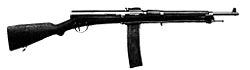
Ribeyrolle 1918 automatic carbine
The Ribeyrolles 1918 was an attempt to manufacture an automatic rifle for the French forces. It was chambered in the experimental 8x35mm round, used straight blow-back, was fed from a 25 round magazine and had an effective range of 400m....
may be the first weapon fitting the definition of an assault rifle (including select fire and portability) to use a purpose-designed intermediate round. The cartridge was based on the .351 Winchester Self-Loading
.351 Winchester Self-Loading
The .351 Winchester Self-Loading is an American rifle cartridge.Winchester introduced the .351SL in the Winchester Model 1907 self-loading rifle as a replacement for the Winchester Model 1905 and the .35SL...
case necked down to accept an 8 mm Lebel
8 mm Lebel
The 8×50mmR French rifle cartridge was the first smokeless gunpowder cartridge to be made and adopted by any country. It was introduced by France in 1886. Formed by necking down the 11 mm Gras black powder cartridge, the smokeless 8 mm Lebel cartridge started a revolution in military rifle...
bullet. It was first introduced to the Army Technical Service on July 6, 1918. Its official designation was (machine carbine; ). It was finally rejected in 1921 because it was not accurate enough at distances beyond 400 meters. Similar weapons were the Danish Weibel M/1932
Weibel M/1932
The Weibel M/1932 was a light machine gun concept of Danish origin and was considered to supplement the Madsen gun in Danish service. It was fed from a 20 round box magazine chambered in the intermediate 7x44mm round. This calibre was considered underpowered for its day but shares the same...
and Greek EPK
EPK (Pyrkal) Machine gun
The EPK Machine Gun was designed by EPK, a Greek defense company later known as Pyrkal. The gun's creation is connected to EPK's ambitions to become a major producer of infantry weapons and a relevant 1937 proposal to the Greek government...
light machine guns chambered in experimental rounds considered similar to what would become the 7.92x33mm Kurz within the following decade.
The American M1918 Browning Automatic Rifle (BAR) copied the Chauchat concept in a more reliable design but was not introduced or used in any significant numbers before the end of the First World War. Later developments added heavier barrels
Gun barrel
A gun barrel is the tube, usually metal, through which a controlled explosion or rapid expansion of gases are released in order to propel a projectile out of the end at a high velocity....
and bipod
Bipod
A bipod is a support device that is similar to a tripod or monopod, but with two legs. It provides significant stability along two axes of motion .-Firearms:...
s that made it more like today's light machine gun
Machine gun
A machine gun is a fully automatic mounted or portable firearm, usually designed to fire rounds in quick succession from an ammunition belt or large-capacity magazine, typically at a rate of several hundred rounds per minute....
or squad automatic weapon
Squad automatic weapon
A squad automatic weapon is a weapon used to give infantry squads or sections a portable source of automatic firepower. Weapons used in this role are selective-fire rifles, usually fitted with a bipod and heavier barrel to perform as Light machine guns...
, though it did help establish the doctrine of use for light selective fire rifles. These versions of the BAR were produced in large numbers, widely adopted, and served well into the 1960s with the U.S. military and other nations.
During World War I, submachine guns also entered service, such as the Villar Perosa, the Beretta Model 1918
Beretta Model 1918
The Beretta Model 1918 was a submachine gun that entered service in 1918 with the Italian armed forces and came with an overhead inserted magazine. Another variant was the Model 1918/30 with the magazine inserted underneath and came with a bayonet...
and the MP18
MP18
The MP18.1 manufactured by Theodor Bergmann Waffenbau Abteilung was the first practical submachine gun used in combat. It was introduced into service in 1918 by the German Army during World War I as the primary weapon of the Stosstruppen, assault groups specialized in trench combat...
. These weapons shared many elements with assault rifles, but they fired pistol cartridges such as the 9x19 mm Parabellum. The developers of the Thompson submachine gun
Thompson submachine gun
The Thompson is an American submachine gun, invented by John T. Thompson in 1919, that became infamous during the Prohibition era. It was a common sight in the media of the time, being used by both law enforcement officers and criminals...
(also developed during the 1910s) originally intended to use rifle-powered rounds. However, a mechanical system that could handle their power was not available and the .45 ACP
.45 ACP
The .45 ACP , also known as the .45 Auto by C.I.P., is a cartridge designed by John Browning in 1904, for use in his prototype Colt semi-automatic .45 pistol and eventually the M1911 pistol adopted by the United States Army in 1911.-Design and history:The U.S...
cartridge was chosen instead. These firearms are considered part of the submachine gun
Submachine gun
A submachine gun is an automatic carbine, designed to fire pistol cartridges. It combines the automatic fire of a machine gun with the cartridge of a pistol. The submachine gun was invented during World War I , but the apex of its use was during World War II when millions of the weapon type were...
class, but were an important step in the development of assault rifles.
1930s: Automatic intermediate weapons
Italy
Italy , officially the Italian Republic languages]] under the European Charter for Regional or Minority Languages. In each of these, Italy's official name is as follows:;;;;;;;;), is a unitary parliamentary republic in South-Central Europe. To the north it borders France, Switzerland, Austria and...
arms company Beretta
Beretta
Fabbrica d'Armi Pietro Beretta is an Italian firearms manufacturer. Their firearms are used worldwide for a variety of civilian, law enforcement, and military purposes. It is also known for manufacturing shooting clothes and accessories. Beretta is the oldest active firearms manufacturer in the...
resulted in the MAB 38 (Moschetto Automatico Beretta 1938). The MAB 38 used a Fiocchi 9M38 cartridge, a higher-powered version of the 9x19mm Parabellum pistol cartridge, which could provide longer effective range up to .
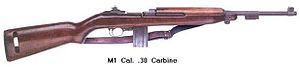
In 1942, the United States introduced the M1 carbine
M1 Carbine
The M1 carbine is a lightweight, easy to use semi-automatic carbine that became a standard firearm for the U.S. military during World War II, the Korean War and the Vietnam War, and was produced in several variants. It was widely used by U.S...
, which was an intermediate power weapon chambered for the .30 Carbine
.30 Carbine
The .30 Carbine is the cartridge used in the M1 Carbine introduced in the 1940s. It is an intermediate round designed to be fired from the M1 carbine's 18-inch barrel.-History:...
cartridge. While select-fire capability was initially planned for the M1 carbine, this was dropped from the initial version. Later in the war, selective fire variants were made (M2 and M3). The weapon had greater range and accuracy than submachine gun
Submachine gun
A submachine gun is an automatic carbine, designed to fire pistol cartridges. It combines the automatic fire of a machine gun with the cartridge of a pistol. The submachine gun was invented during World War I , but the apex of its use was during World War II when millions of the weapon type were...
s, but was not as powerful as full-size automatic rifles such as the M1918 BAR. The longer barrel provided the carbine with a higher muzzle velocity
Muzzle velocity
Muzzle velocity is the speed a projectile has at the moment it leaves the muzzle of the gun. Muzzle velocities range from approximately to in black powder muskets , to more than in modern rifles with high-performance cartridges such as the .220 Swift and .204 Ruger, all the way to for tank guns...
than pistols and submachine guns chambered for the same .30-calibre round. Which coincidentally was a 7.62x33mm round similar in size to the 7.92x33mm Kurz which was the round used in the first German assault rifles. This shows that there was a niche for the intermediate cartridge that would later influence design and the nature of infantry combat
Originally the carbine was envisioned as an inexpensive lightweight weapon for issue to rear-echelon and support troops (truckers, tankers, cooks, etc.) in place of the more expensive M1911 pistol or M1 Garand rifle. The M1 series was soon found suitable for close quarter battle engagements, a concept that would be re-applied later. The M1 carbine series would remain in service with the U.S. military primary forces until supplemented and finally replaced by the M16 rifle
M16 rifle
The M16 is the United States military designation for the AR-15 rifle adapted for both semi-automatic and full-automatic fire. Colt purchased the rights to the AR-15 from ArmaLite, and currently uses that designation only for semi-automatic versions of the rifle. The M16 fires the 5.56×45mm NATO...
in the 1960s; it continued to be used in limited roles, particularly by the U.S. Navy, Air Force, Coast Guard, and many Training Commands in the various branches of the U.S. armed forces well into the 1980s.
The 1930s was also the beginning of the important German Maschinenkarabiner program of arms development that resulted in the prototype
Prototype
A prototype is an early sample or model built to test a concept or process or to act as a thing to be replicated or learned from.The word prototype derives from the Greek πρωτότυπον , "primitive form", neutral of πρωτότυπος , "original, primitive", from πρῶτος , "first" and τύπος ,...
Maschinenkarabiner M35 that was however not adopted for service.
1940s–early 1950s: Maschinenkarabiner, Sturmgewehr & AK-47
Some of these automatic firearms used pre-existing rounds; others used new intermediate cartridges. Kinetic energy ranged between 1,400–2,100 J (1,033–1,550-foot-pounds), muzzle velocities of 600–800m/s (1,970–2,625 ft/s) and bullets of 7–9g (108–139 grains).
Germany, under the Versailles Treaty, was limited to a professional army of long service soldiers numbering only 100,000 men and forbade tanks or military aircraft. This encouraged an approach that emphasised high quality, and reduced emphasis on low cost. Infantry tactics became based on teams of General-purpose machine guns (GPMG) supporting and supported by a section of infantry. GPMG had high rates of fire to permit small numbers of men to fire at long range to defend a wide front. Enemy soldiers, briefly exposed, would be engaged with a high rate burst of fire to cause casualties before they could take cover. Close range assaults would be conducted by units with submachine guns, for greater mobility, and higher rates of fire. This tactical approach was a refinement of the "Hutier" tactics used by Germany in the last year of WWI.
Germany, like other countries, had observed and studied the emerging demand of infantry rifles evolving since World War I
World War I
World War I , which was predominantly called the World War or the Great War from its occurrence until 1939, and the First World War or World War I thereafter, was a major war centred in Europe that began on 28 July 1914 and lasted until 11 November 1918...
, and their factories made a variety of non-standard cartridges, therefore having less incentive to retain their existing calibres. The 7.92x30 mm (Kurz) cartridge was an example of these experiments; in 1941, it was improved to 7.92x33mm Kurz Infanterie Kurz Patrone ("Infantry Short Cartridge"). In 1942, it was again improved as Maschinenkarabiner Patrone S, and in 1943, Pistolen Patrone 43mE; then, finally, Infanterie Kurz Patrone 43. The similarity in size between the 7.92x33mm German cartridge and the 7.62x33mm developed for the M1 Carbine is a curious coincidence, but was ultimately nothing more than independent yet similar solutions to the same problem. The 7.92x33mm round used the same cartridge case head as the standard 7.92x57mm Mauser
7.92x57mm Mauser
The 8×57mm IS is a rimless bottlenecked rifle cartridge. The 8×57mm IS was adopted by the German Empire in 1905, and was the German service cartridge in both World Wars...
and the bullet was made from the same diameter rod.
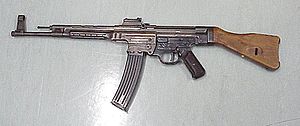
In 1942, Walther presented the Maschinenkarabiner ("automatic carbine," abbr. MKb), named MKb42(W). In the same year, Haenel presented the MKb42(H), designed by Hugo Schmeisser
Hugo Schmeisser
Hugo Schmeisser was a German developer of infantry weapons in the 20th century.Schmeisser was born in Jena, Saxe-Weimar. His father, Louis Schmeisser , was one of the best-known weapons designers in Europe...
as a result of this program. Rheinmetall-Borsig (some said Krieghoff) presented its FG42 (Fallschirmjäger Gewehr 42, sponsored by Hermann Göring
Hermann Göring
Hermann Wilhelm Göring, was a German politician, military leader, and a leading member of the Nazi Party. He was a veteran of World War I as an ace fighter pilot, and a recipient of the coveted Pour le Mérite, also known as "The Blue Max"...
) though this was in a different role, and using a heavy 7.92x57mm Mauser
7.92x57mm Mauser
The 8×57mm IS is a rimless bottlenecked rifle cartridge. The 8×57mm IS was adopted by the German Empire in 1905, and was the German service cartridge in both World Wars...
cartridge, which was not an intermediate round. Wartime tests in Russia
Russia
Russia or , officially known as both Russia and the Russian Federation , is a country in northern Eurasia. It is a federal semi-presidential republic, comprising 83 federal subjects...
indicated the MKb42(H) performed better than the other two. Schmeisser developed it first as the MP43, then MP43/1, and finally as the MP44/Sturmgewehr 44 (abbreviated StG44, or sometimes Stg 44). It immediately entered large scale production. More than 5,000 units had been produced by February 1944, and 55,000 by the following November.
Following the end of the war, Mikhail Kalashnikov
Mikhail Kalashnikov
Lieutenant General Mikhail Timofeyevich Kalashnikov is a Russian small arms designer, most famous for designing the AK-47 assault rifle, the AKM and the AK-74.-Early life:...
developed in 1947 the AK-47
AK-47
The AK-47 is a selective-fire, gas-operated 7.62×39mm assault rifle, first developed in the Soviet Union by Mikhail Kalashnikov. It is officially known as Avtomat Kalashnikova . It is also known as a Kalashnikov, an "AK", or in Russian slang, Kalash.Design work on the AK-47 began in the last year...
, inspired by the concept and layout of the German StG44, but is quite different mechanically. It fired the 7.62x39mm cartridge, which had been developed as model 43 for use in their SKS
SKS
The SKS is a Soviet semi-automatic rifle chambered for the 7.62x39mm round, designed in 1943 by Sergei Gavrilovich Simonov. SKS-45 is an acronym for Samozaryadnyj Karabin sistemy Simonova, 1945 Simonov system, 1945), or SKS 45. The Sks is a scaled down version of the PTRS-41 anti-tank rifle also...
carbines that were developed by Simonov
Sergei Gavrilovich Simonov
Sergei Gavrilovich Simonov was a Soviet weapons designer; he is one of the fathers of the modern assault rifle....
in 1945 and subsequently adopted as the SKS-45 . The round was similar to the StG44's in that the bullet was an intermediate round of the same calibre as the larger full-size Russian rifle ammunition.
Though it further supports claims that Kalashnikov closely followed his German counterpart, Russian historians point out that Hugo Schmeisser arrived to Izhevsk in late 1947, while Kalashnikov had relocated development of his rifle to the same premises only as late as 1948 (the development itself began in 1943). Still, Schmeisser greatly helped Soviet gunsmiths to master the cold stamping technology, which was extensively used in the AK design (this especially relates to the later stamped receiver variant).
Mauser
Mauser
Mauser was a German arms manufacturer of a line of bolt-action rifles and pistols from the 1870s to 1995. Mauser designs were built for the German armed forces...
had developed several prototype Sturmgewehr 45 assault rifles, first with the Gerät 06 (Device 6) using a roller-delayed blowback mechanism originally adapted from the roller-locked recoil operation of the MG42
MG42
The MG 42 is a 7.9mm universal machine gun that was developed in Nazi Germany and entered service with the Wehrmacht in 1942...
machine gun but with a fixed barrel and gas system. It was realised that with careful attention to the mechanical ratios, the gas system could be omitted. The resultant weapon, the Gerät 06(H) was supposedly slated for adoption by the Wehrmacht as the StG45
StG45
The StG 45 sometimes referred to as the MP 45, was a prototype assault rifle developed by Mauser for the Wehrmacht at the end of World War II, using an innovative roller-delayed blowback operating system...
.
France
The French Republic , The French Republic , The French Republic , (commonly known as France , is a unitary semi-presidential republic in Western Europe with several overseas territories and islands located on other continents and in the Indian, Pacific, and Atlantic oceans. Metropolitan France...
at CEAM
Atelier Mécanique de Mulhouse
Atelier Mécanique de Mulhouse , formerly known as Centre d'Études et d'Armement de Mulhouse , was a French weapons manufacturer that operated from 1946 to 1967.-History:...
. The StG45 mechanism was modified by Ludwig Vorgrimler
Ludwig Vorgrimler
Dr. Ludwig Vorgrimler is the man most commonly associated with the design of the Spanish CETME rifle, and its prolific roller-delayed offspring from the German gunmaker Heckler & Koch such as the G3 and MP5.- Early career :Vorgrimler worked as an engineer for several arms manufacturers over his...
and Theodor Löffler at the Mulhouse
Mulhouse
Mulhouse |mill]] hamlet) is a city and commune in eastern France, close to the Swiss and German borders. With a population of 110,514 and 278,206 inhabitants in the metropolitan area in 2006, it is the largest city in the Haut-Rhin département, and the second largest in the Alsace region after...
facility between 1946 and 1949. Three versions were made, chambered in .30 Carbine
.30 Carbine
The .30 Carbine is the cartridge used in the M1 Carbine introduced in the 1940s. It is an intermediate round designed to be fired from the M1 carbine's 18-inch barrel.-History:...
, 7.92x33mm Kurz as well as the 7.65x35mm cartridge developed by Cartoucherie de Valence and adopted in 1948. A 7.5x38mm cartridge using a partial aluminium bullet was abandoned in 1947. Engaged in the Indochina war and being the second NATO contributor, France cancelled the adoption of these new weapons. Vorgrimler moved to Spain and began production of CETME
CETME
CETME is an acronym for Centro de Estudios Técnicos de Materiales Especiales , a Spanish government design and development establishment. While being involved in many projects CETME was mostly known for its small arms research and development...
Modelo A,B and C precursors of Heckler & Koch's G3 battle rifle and MP5 submachine gun
Late 1950s–1960s: Lighter rifles and smaller bullets
Many of these automatic firearms used intermediate cartridges with much lighter bullets and smaller calibres, but fired at very high velocity; kinetic energy ranged between 1300–1800J (960–1,330-foot-pounds), velocities of 900–1050m/s (2,950–3,450 ft/s), and bullets of 3–4g (46–62 grains).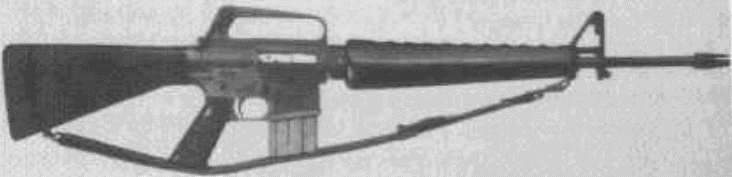
This combination of factors led to the conclusion that a fairly short-range weapon capable of rapid fire would be the most effective general-purpose weapon for infantry.
While these studies were being digested, the United States insisted on introducing their own 7.62x51mm full-power cartridge as the standard for NATO armies. It could kill at distances of more than 500 meters (though this was increasingly seen as irrelevant). At the time, the British were developing their own 7x43mm (.280 British
.280 British
The .280 British was an experimental intermediate rifle cartridge. It was later designated 7 mm MK1Z, and has also been known as 7 mm NATO, .280/30, .280 Enfield, .280 NATO, 7 mm FN Short, and 7×43mm. It was designed by the British Army in the late 1940s, with subsequent help from...
) intermediate cartridge for their modern EM-2
EM-2
The EM-2, Also known as Rifle No.9 Mk1 or "Janson rifle", was an experimental British assault rifle. It was briefly adopted by British forces in 1951, but the decision was overturned very shortly thereafter by Winston Churchill's incoming government in an effort to secure NATO standardisation of...
bullpup
Bullpup
Bullpups are firearm configurations in which the action is located behind the trigger group and alongside the shooter's face, so there is no wasted space for the buttstock as in conventional designs. This permits a shorter firearm length for the same barrel length for improved maneuverability, and...
assault rifle. Due to political pressure from the Conservative Party
Conservative Party (UK)
The Conservative Party, formally the Conservative and Unionist Party, is a centre-right political party in the United Kingdom that adheres to the philosophies of conservatism and British unionism. It is the largest political party in the UK, and is currently the largest single party in the House...
, which agreed with the American standardisation campaign, the whole project was shelved at the eve of introduction. In Belgium, the famous arms producer FN Herstal started experimenting with the German 7.92x33mm Kurzpatrone. They built a prototype of a rifle using this cartridge, but the impending NATO standardisation forced them to rebuild it to use American ammo, giving birth to the FN FAL
FN FAL
The Fusil Automatique Léger or FAL is a self-loading, selective fire battle rifle produced by the Belgian armaments manufacturer Fabrique Nationale de Herstal . During the Cold War it was adopted by many North Atlantic Treaty Organization countries, with the notable exception of the United States...
, Switzerland introduced the SIG 510
SIG 510
The SIG SG 510 or Sturmgewehr 57 is an automatic rifle manufactured by Schweizerische Industrie Gesellschaft of Switzerland. It uses a similar roller-delayed blowback system to the H&K G3 and CETME rifles...
that still fired Swiss service full-length rifle rounds but also produced the SIG 510-4 that fired the 7.62x51mm NATO round. Bolivia
Bolivia
Bolivia officially known as Plurinational State of Bolivia , is a landlocked country in central South America. It is the poorest country in South America...
and Chile
Chile
Chile ,officially the Republic of Chile , is a country in South America occupying a long, narrow coastal strip between the Andes mountains to the east and the Pacific Ocean to the west. It borders Peru to the north, Bolivia to the northeast, Argentina to the east, and the Drake Passage in the far...
adopted the SIG 510-4 as their service rifle, Bolivian/Chilean exports were licence produced by the Italian firm Beretta
Beretta
Fabbrica d'Armi Pietro Beretta is an Italian firearms manufacturer. Their firearms are used worldwide for a variety of civilian, law enforcement, and military purposes. It is also known for manufacturing shooting clothes and accessories. Beretta is the oldest active firearms manufacturer in the...
.
In conjunction with the 7.62x51mm Cartridge, The United States had developed the M14 rifle
M14 rifle
The M14 rifle, formally the United States Rifle, 7.62 mm, M14, is an American selective fire automatic rifle firing 7.62x51mm NATO ammunition. It was the standard issue U.S. rifle from 1959 to 1970. The M14 was used for U.S...
, which was largely based on the WWII M1 Garand
M1 Garand
The M1 Garand , was the first semi-automatic rifle to be generally issued to the infantry of any nation. Called "the greatest battle implement ever devised" by General George S...
, the most significant change being the addition of a 20-round detachable box magazine and selective fire
Selective fire
A selective fire firearm has at least one semi–automatic and one automatic mode, which is activated by means of a selector which varies depending on the weapon's design. Some selective fire weapons utilize burst fire mechanisms to limit the maximum or total number of shots fired automatically in...
capability. While initial tests looked promising, and professional rifleman were able to put on favorable demonstrations, the select-fire capabilities quickly proved unrealistic once the rifle was in the hands of a more average soldier; The 7.62mm NATO cartridge is a full-power rifle cartridge and produces too much recoil to control a lightweight rifle in full automatic fire. About the same time the M14 was entering service, Eugene Stoner
Eugene Stoner
Eugene Morrison Stoner is the man most associated with the design of the AR-15, which was adopted by the US military as the M16...
of ArmaLite
ArmaLite
ArmaLite is the name of a small arms engineering facility founded in the early 1950s, and once associated with the Fairchild Engine and Airplane Corporation. ArmaLite was formally incorporated as a subdivision of Fairchild on October 1, 1954...
was developing a totally new rifle named the AR-10
AR-10
The AR-10 is an American 7.62 mm battle rifle developed by Eugene Stoner in the late 1950s at ArmaLite, then a division of the Fairchild Aircraft Corporation...
, which was still designed to fire the 7.62mm NATO cartridge. As testing of the Stoner rifle progressed, army ordinance finally decided to look more seriously at the intermediate cartridge concept, and the 5.56x45mm NATO was born. Stoner scaled down his design and renamed the smaller weapon the AR-15, which would ultimately be adopted by the US armed forces as the M16 rifle
M16 rifle
The M16 is the United States military designation for the AR-15 rifle adapted for both semi-automatic and full-automatic fire. Colt purchased the rights to the AR-15 from ArmaLite, and currently uses that designation only for semi-automatic versions of the rifle. The M16 fires the 5.56×45mm NATO...
. The M16A1 version soon followed to rectify issues found during use in the Vietnam War
Vietnam War
The Vietnam War was a Cold War-era military conflict that occurred in Vietnam, Laos, and Cambodia from 1 November 1955 to the fall of Saigon on 30 April 1975. This war followed the First Indochina War and was fought between North Vietnam, supported by its communist allies, and the government of...
. The M16A2 was a further refinement and upgrade introduced in 1986 meant to use the Belgian-updated 5.56x45mm NATO
5.56x45mm NATO
5.56×45mm NATO is a rifle cartridge developed in the United States and originally chambered in the M16 rifle. Under STANAG 4172, it is a standard cartridge for NATO forces as well as many non-NATO countries. It is derived from, but not identical to, the .223 Remington cartridge...
cartridge with a heavier 62 gr steel-core "penetrator" bullet known as the SS109 or M855. The latest incarnation of the M16 rifle is the M4A1
M4 carbine
The M4 carbine is a family of firearms tracing its lineage back to earlier carbine versions of the M16, all based on the original AR-15 designed by Eugene Stoner and made by ArmaLite. It is a shorter and lighter variant of the M16A2 assault rifle, with 80% parts commonality.It is a gas-operated,...
selective fire carbine.
The smaller-calibre military cartridges such as the 5.56x45mm and 5.45x39mm
5.45x39mm
The Soviet 5.45×39mm cartridge is a rimless bottlenecked rifle cartridge. It was introduced into service in 1974 for use with the new AK-74 assault rifle. It gradually supplemented then largely replaced the 7.62x39mm round in service....
were sometimes considered less lethal than the previous generation of assault rifle rounds, such as the 7.62x39mm, which were large-calibre bullets with reduced propellant or cases. However, the lighter, small-calibre bullets achieved higher velocities, more favourable ballistic properties, and reduced carrying weight.
One aspect of the smaller calibre ammunition that is sometimes hotly debated is its fragmentation behaviour. Stopping capability is the effectiveness of the round in completely stopping the target when it hits—either killing or fully incapacitating. Within a certain range of ballistic conditions, the lighter and will, upon striking tissue, first tumble and then fragment. Beyond 100 yards (91.4 m), or when fired from shorter barrels, such bullets can often fail to fragment upon impact because of insufficient velocity. Thus, the result in a target is a rather small .22 calibre bullet hole, instead of a much larger wound channel. Effectiveness depends on what tissues of the enemy body the round destroys. Larger destroyed areas increases the probability that sufficient damage will be done to end enemy resistance. Ultimately, any pointed (spitzer) round will tumble in soft tissue. If the jacket has a cannelure, such as the U.S. 5.56x45mm M193 round, and the bullet is in the proper ballistic state and high enough velocity, the bullet will fragment, inflicting significant blood loss and internal damage, as well as a wound channel profile that is more complex to address medically. If the bullet acts as a solid, and doesn't fragment, full effectiveness occurs only if striking the brain or spinal cord, causing immediate loss of control. There is a distinct, though lesser effectiveness if the heart, large blood vessels, or liver (which last tends to tear) is hit causing fairly quick loss of blood pressure, and consequent unconsciousness.
Part of the dispute over small-calibre rounds arises here. Blood loss leads to indirect incapacitation, but often takes longer than direct destruction of tissue. U.S. Secretary of Defense Robert McNamara
Robert McNamara
Robert Strange McNamara was an American business executive and the eighth Secretary of Defense, serving under Presidents John F. Kennedy and Lyndon B. Johnson from 1961 to 1968, during which time he played a large role in escalating the United States involvement in the Vietnam War...
presented wounding ability as a reason for adoption of the M16 over the M14
M14 rifle
The M14 rifle, formally the United States Rifle, 7.62 mm, M14, is an American selective fire automatic rifle firing 7.62x51mm NATO ammunition. It was the standard issue U.S. rifle from 1959 to 1970. The M14 was used for U.S...
as a question of battlefield efficiency - that it is better to wound an adversary than kill him, as wounded must be tended to by their comrades, taking them out of the fight and demoralising them in the process. Many claim that this theory was wed to the findings of Project SALVO, but nowhere in the SALVO findings was reduced lethality of rifle rounds ever stressed or presented as an argument for adoption of a lighter/smaller calibre round. SALVO concluded that the main factor in inflicting casualties in infantry combat was solely rounds fired - aiming had negligible impact.
The theory that enemy soldiers would stop to aid a wounded comrade was questionable. The heavier 7.62 mm bullets in use were claimed to hit harder with more mass, would not deflect or destabilise as readily, and more reliably killed what they hit. (Some of the substantiated issues were later addressed in 1982 with the changes made in the M16A2, which used a heavier 62 gr bullet with different ballistic characteristics from its M16A1 predecessor.)
1970s–1990s: Development of features and form factors
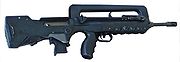
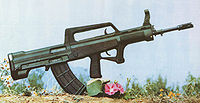
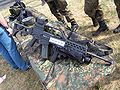
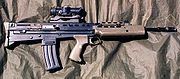
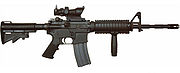
Telescopic sight
A telescopic sight, commonly called a scope, is a sighting device that is based on an optical refracting telescope. They are equipped with some form of graphic image pattern mounted in an optically appropriate position in their optical system to give an accurate aiming point...
and reflector or "reflex" sights
Reflector sight
A reflector or reflex sight is a generally non-magnifying optical device that allows the user to look through a partially reflecting glass element and see an illuminated projection of an aiming point or some other image superimposed on the field of view...
.
In the 1980s and 1990s, high velocity, smaller-calibre ammunition was becoming the standard of assault rifle ammunition. Following the trend set by the United States (which went from 7.62x51mm to 5.56x45mm), the Soviet Union
Soviet Union
The Soviet Union , officially the Union of Soviet Socialist Republics , was a constitutionally socialist state that existed in Eurasia between 1922 and 1991....
developed its own smaller-calibre cartridge: the 5.45x39mm
5.45x39mm
The Soviet 5.45×39mm cartridge is a rimless bottlenecked rifle cartridge. It was introduced into service in 1974 for use with the new AK-74 assault rifle. It gradually supplemented then largely replaced the 7.62x39mm round in service....
. In 1974, the 5.45x39 AK-74
AK-74
The AK-74 is an assault rifle developed in the early 1970s in the Soviet Union as the replacement for the earlier AKM...
became the successor to the AK-47
AK-47
The AK-47 is a selective-fire, gas-operated 7.62×39mm assault rifle, first developed in the Soviet Union by Mikhail Kalashnikov. It is officially known as Avtomat Kalashnikova . It is also known as a Kalashnikov, an "AK", or in Russian slang, Kalash.Design work on the AK-47 began in the last year...
/AKM
AKM
The AKM is a 7.62mm assault rifle designed by Mikhail Kalashnikov. It is an upgraded version of the AK-47 rifle and was developed in the 1950s....
series. Though AK-74s began utilising synthetic materials as opposed to wood, the weapon largely maintained the design of the AK-47
AK-47
The AK-47 is a selective-fire, gas-operated 7.62×39mm assault rifle, first developed in the Soviet Union by Mikhail Kalashnikov. It is officially known as Avtomat Kalashnikova . It is also known as a Kalashnikov, an "AK", or in Russian slang, Kalash.Design work on the AK-47 began in the last year...
. China
People's Republic of China
China , officially the People's Republic of China , is the most populous country in the world, with over 1.3 billion citizens. Located in East Asia, the country covers approximately 9.6 million square kilometres...
in the 1980s introduced the 5.8x42mm DBP87 round, to compete with the assault rifle rounds of NATO and Russia.
One notable development in ammunition in the 1970–1980s was the German
Germany
Germany , officially the Federal Republic of Germany , is a federal parliamentary republic in Europe. The country consists of 16 states while the capital and largest city is Berlin. Germany covers an area of 357,021 km2 and has a largely temperate seasonal climate...
Heckler & Koch
Heckler & Koch
Heckler & Koch GmbH is a German defense manufacturing company that produces various small arms. Some of their products include the SA80, MP5 submachine gun, G3 automatic rifle, the G36 assault rifle, the HK 416, the MP7 personal defense weapon, the USP series of handguns, and the high-precision...
G11
Heckler & Koch G11
The Heckler & Koch G11 is a non-production prototype assault rifle developed during the late 1960s, 1970s and 1980s by Gesellschaft für Hülsenlose Gewehrsysteme , a conglomeration of companies headed by firearm manufacturer Heckler & Koch , Dynamit Nobel The Heckler & Koch G11 is a non-production...
rifle, which used caseless ammunition
Caseless ammunition
Caseless ammunition is a type of small arms ammunition that eliminates the cartridge case that typically holds the primer, propellant, and projectile together as a unit...
. Because of German reunification
German reunification
German reunification was the process in 1990 in which the German Democratic Republic joined the Federal Republic of Germany , and when Berlin reunited into a single city, as provided by its then Grundgesetz constitution Article 23. The start of this process is commonly referred by Germans as die...
and heat-dissipation issues with the caseless ammunition, the rifle never entered full production.
New developments were rifle designs that utilised modularity, new form factors, sights, electronics, and new materials. A number of bullpup
Bullpup
Bullpups are firearm configurations in which the action is located behind the trigger group and alongside the shooter's face, so there is no wasted space for the buttstock as in conventional designs. This permits a shorter firearm length for the same barrel length for improved maneuverability, and...
rifles entered service in the late 1970s, 1980s and 1990s. Although bullpup design had existed since the 1930s, the United Kingdom
United Kingdom
The United Kingdom of Great Britain and Northern IrelandIn the United Kingdom and Dependencies, other languages have been officially recognised as legitimate autochthonous languages under the European Charter for Regional or Minority Languages...
's EM-2
EM-2
The EM-2, Also known as Rifle No.9 Mk1 or "Janson rifle", was an experimental British assault rifle. It was briefly adopted by British forces in 1951, but the decision was overturned very shortly thereafter by Winston Churchill's incoming government in an effort to secure NATO standardisation of...
was one of the few bullpup assault rifles prior to this time. Examples of the trend include the FAMAS, Steyr AUG
Steyr AUG
The AUG is an Austrian bullpup 5.56mm assault rifle, designed in the early 1970s by Steyr Mannlicher GmbH & Co KG . The AUG was adopted by the Austrian Army as the StG 77 in 1977, where it replaced the 7.62mm StG 58 automatic rifle...
, and SA80
SA80
The SA80 is a British family of 5.56mm small arms. It is a selective fire, gas-operated assault rifle. SA80 prototypes were trialled in 1976 and production was completed in 1994....
. All three are bullpup rifles that make heavy use of composites and plastics, the FAMAS and AUG both have ambidextrous controls, and the AUG, and SA80 both added a low-power telescopic sight
Telescopic sight
A telescopic sight, commonly called a scope, is a sighting device that is based on an optical refracting telescope. They are equipped with some form of graphic image pattern mounted in an optically appropriate position in their optical system to give an accurate aiming point...
to the standard service version. The QBZ-95
QBZ-95
The QBZ-95 is an assault rifle manufactured by Arsenal 266, part of Norinco and Arsenal 296, under Jianshe Corp, China South for the People's Liberation Army, the armed forces of the People's Republic of China, Chinese People's Armed Police , and Chinese law enforcement. This weapon uses a...
, SAR-21
SAR-21
The SAR 21 is a bullpup assault rifle designed and manufactured in Singapore. First revealed and subsequently adopted by the Singapore Armed Forces in 1999, it was designed & developed over a four year period and was intended to replace the locally license-built M16S1 by the Singaporean Ministry...
, and the Tavor TAR-21 follow a similar trend as well, with a bullpup configuration and heavy use of composites.
The German Heckler & Koch G36
Heckler & Koch G36
The Heckler & Koch G36 is a 5.56×45mm assault rifle, designed in the early 1990s by Heckler & Koch in Germany as a replacement for the 7.62mm G3 battle rifle. It was accepted into service with the Bundeswehr in 1997, replacing the G3...
, adopted in the late 1990s by Germany
Germany
Germany , officially the Federal Republic of Germany , is a federal parliamentary republic in Europe. The country consists of 16 states while the capital and largest city is Berlin. Germany covers an area of 357,021 km2 and has a largely temperate seasonal climate...
and Spain
Spain
Spain , officially the Kingdom of Spain languages]] under the European Charter for Regional or Minority Languages. In each of these, Spain's official name is as follows:;;;;;;), is a country and member state of the European Union located in southwestern Europe on the Iberian Peninsula...
, had integral telescopic
Telescopic sight
A telescopic sight, commonly called a scope, is a sighting device that is based on an optical refracting telescope. They are equipped with some form of graphic image pattern mounted in an optically appropriate position in their optical system to give an accurate aiming point...
and red dot
Red dot sight
A red dot sight is a common classification for a type of non-magnifying reflector sight for firearms that gives the user an aimpoint in the form of an illuminated red dot...
sights and a composite exterior. The G36C, a compact variant, featured a different barrel assembly, a shorter foregrip, and a Picatinny rail
Picatinny rail
The Picatinny rail or MIL-STD-1913 rail or STANAG 2324 rail or a "Tactical Rail" is a bracket used on some firearms in order to provide a standardized mounting platform. A similar system is the Weaver rail mount.-Description:...
in place of the standard sight assembly to accommodate a detachable sight.
Through the 1990s, modular accessories for use on rifles, of a variety of types, started to become widespread with the rapidly increasing practice of mounting Picatinny pattern rails
Picatinny rail
The Picatinny rail or MIL-STD-1913 rail or STANAG 2324 rail or a "Tactical Rail" is a bracket used on some firearms in order to provide a standardized mounting platform. A similar system is the Weaver rail mount.-Description:...
on firearms. This was primarily driven by the growing visibility and number of tactical police, counter-terrorist units, SWAT teams, special forces, and other groups that desired the capability to specifically tailor their weapons. Tactical light
Tactical light
A tactical light is a flashlight used in conjunction with a firearm to aid low light target identification, allowing the marksman to simultaneously aim and illuminate the target. Tactical lights can be handheld or mounted to the weapon with the light beam parallel to the bore...
s, visible lasers, weapon suppressor
Suppressor
A suppressor, sound suppressor, sound moderator, or silencer, is a device attached to or part of the barrel of a firearm which reduces the amount of noise and flash generated by firing the weapon....
s, infra-red lights, drum magazines, ergonomic accessories (such as vertical foregrips), folding or collapsible stocks
Stock (firearm)
A stock, also known as a buttstock or shoulder stock, is a part of a rifle or other firearm, to which the barrel and firing mechanism are attached, that is held against one's shoulder when firing the gun. Stocks are also found on crossbows though a crossbow stock is more properly referred to as a...
, and a plethora of other options appeared. As these options became available to civilians, customisation of weapons other than assault rifles, such as the SKS rifle became common.
Intertwined with the growth of the modular accessories was the concept of rifles being modular themselves. While some assault rifles can be modified through the use of attachments (such as the M4 carbine
M4 carbine
The M4 carbine is a family of firearms tracing its lineage back to earlier carbine versions of the M16, all based on the original AR-15 designed by Eugene Stoner and made by ArmaLite. It is a shorter and lighter variant of the M16A2 assault rifle, with 80% parts commonality.It is a gas-operated,...
with SOPMOD
SOPMOD
The Special Operations Peculiar MODification kit is an accessory system for the M4A1 carbine and FN SCAR Mk 16/17 used by USSOCOM...
), other assault rifles like the H&K G36, can have their entire function modified. The G36 can be converted from a standard rifle to a compact carbine
Carbine
A carbine , from French carabine, is a longarm similar to but shorter than a rifle or musket. Many carbines are shortened versions of full rifles, firing the same ammunition at a lower velocity due to a shorter barrel length....
for closer engagements or a squad automatic weapon
Squad automatic weapon
A squad automatic weapon is a weapon used to give infantry squads or sections a portable source of automatic firepower. Weapons used in this role are selective-fire rifles, usually fitted with a bipod and heavier barrel to perform as Light machine guns...
for support, simply by swapping parts. Interchangeable or quick-detachable barrel assemblies of different lengths are emerging for some weapons, with retrofit kits to provide similar capabilities on older types. The AR-15
AR-15
The AR-15 is a lightweight, 5.56 mm, air-cooled, gas-operated, magazine-fed semi-automatic rifle, with a rotating-lock bolt, actuated by direct impingement gas operation. It is manufactured with the extensive use of aluminum alloys and synthetic materials....
in particular has an entire industry that has grown to make variations of every component of the rifle. A variety of upper receivers of many types of operation (bolt, direct gas impingement, gas piston, blowback) are manufactured that allow the weapon to fire different ammunition from the standard assault rifle round (from small target rounds such as .22 LR to pistol rounds such as .380 ACP
.380 ACP
The .380 ACP pistol cartridge is a rimless, straight-walled pistol cartridge developed by firearms designer John Browning. The cartridge headspaces on the mouth of the case. It was introduced in 1908 by Colt, and has been a popular self-defense cartridge ever since...
) without permanently changing the rifle.
21st Century Developments
21st century assault rifles tend to be refinements of innovations made in previous decades. For example Israel's IMI Tavor TAR-21IMI Tavor TAR-21
The TAR-21 is an Israeli bullpup assault rifle chambered for 5.56×45mm NATO ammunition with a selective fire system, selecting between semi-automatic mode, burst mode, and full automatic fire mode. It is named after Mount Tavor, while "TAR-21" stands for "Tavor Assault Rifle - 21st Century". It is...
is a 21st-century assault rifle that continues earlier trends of design: it has a compact bullpup layout, uses the 5.56x45mm NATO
5.56x45mm NATO
5.56×45mm NATO is a rifle cartridge developed in the United States and originally chambered in the M16 rifle. Under STANAG 4172, it is a standard cartridge for NATO forces as well as many non-NATO countries. It is derived from, but not identical to, the .223 Remington cartridge...
cartridge, can be set up for left- or right- handed shooters, exists in several modular variants, is made of lightweight composite materials, and comes standard with a reflex sight. However the 21st century has come up with new innovations such as improved and new types of ammunition, advanced aiming systems and multi-caliber ability. The United States funded development of a replacement for the M16 rifle, eventually leading to the XM8 rifle
XM8 rifle
The XM8 was a developmental U.S. Military designation and project name for a lightweight assault rifle system that was under development by the United States Army from the late 1990s to early 2000s...
, an experimental 21st-century design. Based on the Heckler & Koch G36
Heckler & Koch G36
The Heckler & Koch G36 is a 5.56×45mm assault rifle, designed in the early 1990s by Heckler & Koch in Germany as a replacement for the 7.62mm G3 battle rifle. It was accepted into service with the Bundeswehr in 1997, replacing the G3...
, it had similar features, but added electronics such as a laser sight, round counter, and integral infra-red and visible lights. The XM8 was a modular design: the rifle could fulfill different roles by changing the parts. Weapons manufacturer Heckler and Koch has also created a redesigned M4 assault rifle
M4 carbine
The M4 carbine is a family of firearms tracing its lineage back to earlier carbine versions of the M16, all based on the original AR-15 designed by Eugene Stoner and made by ArmaLite. It is a shorter and lighter variant of the M16A2 assault rifle, with 80% parts commonality.It is a gas-operated,...
. The new weapons, the HK416 (firing 5.56x45 NATO) and the HK417 (firing 7.62x51 NATO), have updated features, but are not completely different weapons platforms. They feature a piston (not direct impingement
Direct impingement
Direct impingement is a type of gas operation for a firearm that directs gas from a fired cartridge directly to the bolt carrier or slide assembly to cycle the action.- Evaluation :...
,) action, Picatinny rails, a drop free magazine release, a bolt that is sealed from the action (reducing dirt, heat and chance of failure) and other additions.
Another trend of the 21st century is the combination of sophisticated electronics with modern rifle designs. The US spent millions on the Objective Individual Combat Weapon program
Objective Individual Combat Weapon program
The Objective Individual Combat Weapon or OICW was the next-generation service rifle competition that was under development as part of the United States Army OICW program; the program was eventually discontinued without bringing the weapon out of the prototype phase...
, to create a more advanced combat rifle. The XM29 OICW rifle design was finalized in the early first decade of the 21st century- it featured an integrated laser range-finder
Laser range-finder
A laser rangefinder is a device which uses a laser beam to determine the distance to an object. The most common form of laser rangefinder operates on the time of flight principle by sending a laser pulse in a narrow beam towards the object and measuring the time taken by the pulse to be reflected...
, thermal vision and night vision
Night vision
Night vision is the ability to see in low light conditions. Whether by biological or technological means, night vision is made possible by a combination of two approaches: sufficient spectral range, and sufficient intensity range...
capabilities, and an integral smart grenade launcher. The project was canceled in 2004, but the US's experimental XM29 rifle lead to other countries developing similar systems. France's PAPOP
PAPOP
The PAPOP is a French project to construct a computerised multi-usage infantry weapon for the FÉLIN system, capable of hitting hidden or protected targets...
program is currently under-way to create a computerized infantry weapon system. South Korea's prototype XK11 Korean New Rifle
XK11 Korean New Rifle
The S&T Daewoo K11 is an assault rifle chambered to fire 5.56mm rounds, as well as 20mm air-burst shells from its overbarrel launcher. Two conventional 20mm shells either detonate immediately on impact or on a timed fuse after impact...
has a ballistics computer, a laser range-finder, and a digital scope that provides the operator with combat data and is capable of night operation through thermal imaging. The lightweight small arms technology program sets to revolutionize small arms for the 21st century by lightening the weight of individual weapons.
The future
Small arms technology including the assault rifle can be described as a mature technologyMature technology
A mature technology is a technology that has been in use for long enough that most of its initial faults and inherent problems have been removed or reduced by further development...
. However, changes in battlefield realities can be expected to lead to technological changes. As weapons evolve, the delicate balance for assault rifle systems between power, weight, recoil and terminal effects will likely shift once again in an attempt to defeat body armour, to match the range of full-power cartridges, and to penetrate through wind shields and thin-skinned vehicles while still producing good terminal effects. Possible future directions are armour piercing or sabot
Sabot
A sabot is a device used in a firearm or cannon to fire a projectile, such as a bullet, that is smaller than the bore diameter, or which must be held in a precise position. The term is also applied to a battery stub case, a device used similarly to make a small electrical battery usable in a...
ed sub-caliber tungsten
Tungsten
Tungsten , also known as wolfram , is a chemical element with the chemical symbol W and atomic number 74.A hard, rare metal under standard conditions when uncombined, tungsten is found naturally on Earth only in chemical compounds. It was identified as a new element in 1781, and first isolated as...
darts, more powerful cartridges, application of new composite materials such as carbon fiber
Carbon fiber
Carbon fiber, alternatively graphite fiber, carbon graphite or CF, is a material consisting of fibers about 5–10 μm in diameter and composed mostly of carbon atoms. The carbon atoms are bonded together in crystals that are more or less aligned parallel to the long axis of the fiber...
or carbon nanotubes, and use of exotic metals such as titanium
Titanium
Titanium is a chemical element with the symbol Ti and atomic number 22. It has a low density and is a strong, lustrous, corrosion-resistant transition metal with a silver color....
and scandium
Scandium
Scandium is a chemical element with symbol Sc and atomic number 21. A silvery-white metallic transition metal, it has historically been sometimes classified as a rare earth element, together with yttrium and the lanthanoids...
. As personal body armour technology improves, for example from the development of Magnetorheological fluid
Magnetorheological fluid
A magnetorheological fluid is a type of smart fluid in a carrier fluid, usually a type of oil. When subjected to a magnetic field, the fluid greatly increases its apparent viscosity, to the point of becoming a viscoelastic solid. Importantly, the yield stress of the fluid when in its active state...
-based smart material
Smart material
Smart materials or designed materials are materials that have one or more properties that can be significantly changed in a controlled fashion by external stimuli, such as stress, temperature, moisture, pH, electric or magnetic fields....
s, assault rifle designs will be forced to adapt in order to remain effective. Changes in assault rifle technology may come from maturation of other fields - as camera technology becomes more advanced, cameras may be integrated into rifles. Much research and development has already been put into integration of rifles with advanced electronics.
.jpg)
Caseless ammunition
Caseless ammunition is a type of small arms ammunition that eliminates the cartridge case that typically holds the primer, propellant, and projectile together as a unit...
which does away with the weight and cost of shell casings. Limitations of current technology prevent this idea from being successful but the concept is still being researched. Recent progress with the Lightweight Small Arms Technologies
Lightweight Small Arms Technologies
The Lightweight Small Arms Technologies program is funded by the U.S. Joint Service Small Arms Program, with the goal of significantly reducing the weight of small arms and their ammunition...
program has made the concept of caseless ammunition a step closer to reality.
Legal ownership by civilians
Possession of functional assault rifles by civilians is illegal in most nations, but there are a few notable exceptions, including the following:Canada
Limited civilian ownership of assault rifles is allowed under Prohibited-class licenses, but diminishing due to attrition as no new licenses are currently being issued; current owners have been grandfathered and their firearms must be turned in for destruction upon their death or lapse of license. There is a provision in the law that allows for a parent to will a prohibited weapon to their son or daughter. This child is allowed to keep the weapon in usable condition. Many semi-auto only variants are available under both the Non-Restricted and Restricted categories, while others are classified as Prohibited, depending on the particular firearm.Czech Republic
The Ministry of the Interior, under the provisions of Act 119/2002, regulates civilian ownership of assault rifles, which are classified in the Czech Republic as Category A (Restricted Firearms and Accessories). In addition to a valid gun licence, the prospective civilian owner must obtain a Category A Exemption from a local police agency and demonstrate the reason for owning an assault rifle, e.g. a legitimate firearms collection. The largest rifled bore available to civilians is .50-calibre.Finland
The Firearms Act of 1998 (amended in 2001) outlawed possession of assault rifles by the general public, although licensed collectors in good standing may be able to obtain permits for older assault rifles from the Gaming and Weapons Administration. Police must verify that the collector is able to store the gun securely to discourage theft.Civilians may purchase semi-automatic versions of assault rifles.
The Netherlands
Assault rifles are considered Class 2 weapons of the Wet Wapens en Munitie (WWM) along with silencers and short-barreled rifles/shotguns as well as any high-capacity magazine. Civilian possession is illegal unless personal authorisation is obtained from the Minister of Justice.Pakistan
Civilian gun licenses in Pakistan vary considerably in terms of region and class of firearm. Local police agencies can issue permits for assault rifles that are only legal in the state in which they are issued, although a licence issued by the Prime Minister will allow the rifle in question to be transported anywhere in the country. There are complaints that the licensing process has become too politicised.Poland
Assault rifles may only be owned by licensed collectors and hunters, but cannot be fired in full-automatic mode. Civilians may purchase semi-automatic versions of such firearms.Switzerland
CantonCantons of Switzerland
The 26 cantons of Switzerland are the member states of the federal state of Switzerland. Each canton was a fully sovereign state with its own borders, army and currency from the Treaty of Westphalia until the establishment of the Swiss federal state in 1848...
police agencies may issue special permits for civilians to own assault rifles (typically as licensed collectors), but such weapons may not be fired in full-automatic mode. Civilians may also purchase semi-automatic versions of such firearms.
United States
Civilian ownership of assault rifles or any other full-automatic firearm is tightly regulated by the Bureau of Alcohol, Tobacco, Firearms and Explosives under the National Firearms ActNational Firearms Act
The National Firearms Act , 73rd Congress, Sess. 2, ch. 757, , enacted on June 26, 1934, currently codified as amended as , is an Act of Congress that, in general, imposes a statutory excise tax on the manufacture and transfer of certain firearms and mandates the registration of those firearms. The...
of 1934 as amended by Title II of the Gun Control Act of 1968. In addition, the Firearms Owners' Protection Act
Firearm Owners Protection Act
The Firearm Owners' Protection Act , , codified at et seq., is a United States federal law that revised many statutes in the Gun Control Act of 1968.-Federal Firearms License regulatory reform:...
of 1986 halted the manufacture of assault rifles for the civilian market and currently limits legal civilian ownership to units produced and properly registered with the BATFE before May 1986. Some states have enacted laws against civilian possession of automatic weapons that override NFA clearance; Kansas
Kansas
Kansas is a US state located in the Midwestern United States. It is named after the Kansas River which flows through it, which in turn was named after the Kansa Native American tribe, which inhabited the area. The tribe's name is often said to mean "people of the wind" or "people of the south...
, on the other hand, repealed its own state law against civilian ownership of assault rifles in July 2008. Civilians may purchase semi-automatic versions of such firearms without requiring NFA clearance, although some states (including California
California
California is a state located on the West Coast of the United States. It is by far the most populous U.S. state, and the third-largest by land area...
and New Jersey
New Jersey
New Jersey is a state in the Northeastern and Middle Atlantic regions of the United States. , its population was 8,791,894. It is bordered on the north and east by the state of New York, on the southeast and south by the Atlantic Ocean, on the west by Pennsylvania and on the southwest by Delaware...
) enforce their own restrictions and/or prohibitions on such weapons.
The Federal Assault Weapons Ban expired on September 13, 2004, as part of the law's sunset provision. There have been multiple attempts to renew the ban, but no bill has reached the floor for a vote. Most states allow the purchase of semi-automatic rifles of similar configuration with a government issued ID (driver license) and a phone-in background check. Citizens of most states can purchase such rifles, provided they clear the background check as prescribed by federal law.
See also
- Battle rifleBattle rifleA battle rifle is a military service rifle that fires a full power rifle cartridge, such as 7.62x51mm NATO. While the designation of battle rifle is usually given to post-World War II select fire infantry rifles such as the H&K G3, the FN FAL or the M14, this term can also apply to older military...
- Marksman rifleDesignated marksman rifleA designated marksman rifle is the weapon used by soldiers in the designated marksman role. The DM role fills the gap between a regular infantryman and a sniper and DMRs have been developed with this middle ground in mind....
- Sniper rifleSniper rifleIn military and law enforcement terminology, a sniper rifle is a precision-rifle used to ensure more accurate placement of bullets at longer ranges than other small arms. A typical sniper rifle is built for optimal levels of accuracy, fitted with a telescopic sight and chambered for a military...
- Firearm actionFirearm actionIn firearms terminology, an action is the physical mechanism that manipulates cartridges and/or seals the breech. The term is also used to describe the method in which cartridges are loaded, locked, and extracted from the mechanism. Actions are generally categorized by the type of mechanism used...
- List of assault rifles
- List of firearms
- List of multiple barrel firearms
- List of service rifles of national armies
Further reading
- Crawford, S. (2003). Twenty-First Century Small Arms. MBI Publishing Company. ISBN 0-7603-1503-5
- Cutshaw, C. (2006). Tactical Small Arms of the 21st Century. Gun Digest Books. ISBN 0-87349-914-X
- Halls, Chris. (1974) Guns in Australia, Paul Hamlyn, Sydney. ISBN 0-600-07291-6
- Lewis, J. (2004). Assault Weapons: An In-Depth Look at the Hottest Weapons Around. Krause Publications. ISBN 0-87349-658-2
- Popenker, M. et al. (2004). Assault Rifle: the Development of the Modern Military Rifle and its Ammunition. Wiltshire: The Crowood Press Ltd. ISBN 1-86126-700-2
- Senich, P. (1987). German Assault Rifle: 1935–1945. Paladin Press. ISBN 0-87364-400-X