

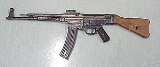
Sturmgewehr 44

Encyclopedia
The StG 44 was an assault rifle
developed in Nazi Germany
during World War II
and was the first of its kind to see major deployment, considered by many historians to be the first modern assault rifle (the first assault rifle being the Fedorov Avtomat
). It is also known under the designations MP 43 and MP 44 (Maschinenpistole 43, Maschinenpistole 44 respectively), which denote earlier development versions of the same weapon with some differences like a different butt end, muzzle nut, shape of the front sight base or with a unstepped barrel, all only visible with close inspection.
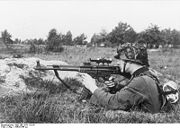 MP 43, MP 44, and StG 44 were different designations for what was essentially the same rifle, with minor updates in production. The variety in nomenclatures resulted from the complicated bureaucracy
in Nazi Germany. Developed from the Mkb 42(H) "machine carbine", the StG44 combined the characteristics of a carbine
, submachine gun
and automatic rifle
. StG is an abbreviation of . The name was chosen for propaganda
reasons and literally means "storm rifle" as in "to storm (i.e. "assault") an enemy position". After the adoption of the StG 44, the English translation "assault rifle
" became the accepted designation for this type of infantry small arm.
The rifle was chambered for the 8x33mm Kurz cartridge
, also known as 7.9 mm Kurz. This shorter version of the German standard (8x57mm IS) rifle
round, in combination with the weapon's selective-fire design, provided a compromise between the controllable firepower of a submachine gun at close quarters with the accuracy and power of a Karabiner 98k
bolt action rifle at intermediate ranges. While the StG44 had less range and power than the more powerful infantry rifles of the day, Wehrmacht
studies had shown that most combat engagements occurred at less than 300 m, with the majority within 200 m. Full-power rifle cartridges were excessive for the vast majority of uses for the average soldier. Only a trained specialist, such as a sniper
, could make full use of the standard rifle round's range and power.
The StG 44's receiver
was made of heavy stamped and welded steel
as were other contemporary arms such as the MP 40 and MG 42. This made for a fairly heavy rifle, especially one firing an intermediate-power cartridge. Difficulties with fabrication, the need to use available non-priority steels, and the exigencies of war resulted in a heavy receiver. U.S. military intelligence criticized the weight of the weapon along with the inclusion of the fully automatic feature which it considered "ineffectual for all practical purposes", convinced that full automatic fire with StG 44 was permitted in emergencies only. This was a misinterpretation of the manual however, as the German manual states that automatic fire was "advised only in emergencies", this was mainly to make sure that the regular soldier didn't unnecessarily waste his ammunition spraying at targets, but instead fired in short accurate bursts to achieve maximum accuracy and effect; the StG could easily and safely be used in full automatic mode. The British were also critical saying that the receiver could be bent and the bolt locked up by the mere act of knocking a leaning rifle onto a hard floor. Many of these criticisms are more a testimonial of the Allied aversion rather than an accurate view of the weapon's characteristics which were proven highly effective during combat in the war.
To its credit, it was the first successful weapon of its class, and the concept had a major impact on modern infantry small arms development. By all accounts, the StG 44 fulfilled its role admirably, particularly on the Eastern Front
, offering a greatly increased volume of fire compared to standard infantry rifles. In the end, it came too late to have a significant effect on the outcome of the war.
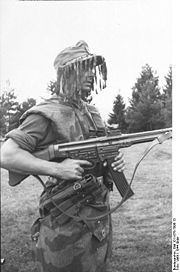 At the start of the Second World War, German infantry were equipped with weapons comparable to those of most other military forces. A typical infantry unit was equipped with a mix of bolt action rifles and some form of light
or medium
machine gun
s. One difference from other armies was the emphasis on the machine gun as the primary infantry weapon. In contrast, allied doctrine centered around the rifleman, with machine guns employed as support and point-defense weapons. German units tended to be machine gun "heavy", carrying more ammunition for the machine gun than for the rifles, using belt ammunition for their more modern section-level weapons to maintain a higher rate of fire, and generally thinking of the rifle as a support weapon. Although newer rifle designs had been studied on several occasions, the infantry squad primary centered around the machine gun.
One problem with this mix was that the standard rifles were too large to be effectively used by mechanized and armored forces, where they were difficult to maneuver in the cramped spaces of an armored vehicle. Submachine guns such as the MP 28, MP 38, and MP 40 were issued to augment infantry rifle use and increase individual firepower, but suffered from a distinct lack of range and accuracy beyond 100 m. A small fast-firing weapon would have been useful in this role, but again the need did not seem pressing.
The issue arose once again during the invasion of the Soviet Union
. The Red Army
had been in the process of replacing its own bolt action rifles in the immediate pre–war era. Increasing numbers of semi-automatic
Tokarev
SVT-38 and SVT-40s were reaching Red Army units, though issue was generally restricted to elite units and non-commissioned officer
s. Submachine guns were extremely widespread, and issued on a far larger scale; some Soviet rifle companies were completely equipped with PPSh-41
submachine guns.
This experience with high volumes of hand-held automatic 'assault' fire forced German commanders to rethink their small arms requirements. The German army had been attempting to introduce semi-automatic weapons of their own, notably the Gewehr 41
, but these early rifles proved troublesome in service, and production was insufficient to meet forecast requirements. Several attempts had been made to introduce lightweight machine guns or automatic rifles for these roles, but invariably recoil from the powerful 8x57mm JS round made them too difficult to control in automatic fire
.
The German solution was to use a round of intermediate power, between that of a full-power rifle cartridge and pistol ammunition. Experiments with several such intermediate rounds had been going on since the 1930s, but had been constantly rejected for use by the army. By 1941, it was becoming clear that action needed to be taken, and one of the experimental rounds, the Polte 8x33mm ("short cartridge") was selected. To minimize logistical problems, the Mauser 8 mm rifle cartridge was used as the basis for the final 7.9mm Kurz intermediate round, which also utilized an aerodynamic spitzer
rifle bullet design.
.jpg) Contracts for rifles firing the 7.9mm Kurz round were sent to both Walther and Haenel (whose design group was headed by Hugo Schmeisser
Contracts for rifles firing the 7.9mm Kurz round were sent to both Walther and Haenel (whose design group was headed by Hugo Schmeisser
), who were asked to submit prototype weapons under the name 1942 (MKb 42, literally "machine (ie. fully automatic) carbine"). Both designs were similar, using a gas-operated
action, with both semi-automatic and fully automatic firing modes.
The original prototype of Haenel's design, the MKb 42(H), fired from an open bolt
and used a striker for firing. The receiver and trigger housing with pistol grip were made from steel stampings, which were attached to the barrel
assembly on a hinge, allowing the weapon to be folded open for quick disassembly and cleaning. The Haenel design proved superior to Walther's MKb 42(W), and the army then asked Haenel for another version incorporating a list of minor changes designated MKb 42(H). One was to include lugs for mounting a standard bayonet
, another to change the pitch of the rifling. A production run of these modified versions was sent to the field in November 1942, and the users appreciated it with a few reservations. Another set of modifications added a hinged cover over the ejection port to keep it clean in combat, and rails to mount a telescopic sight. A run of these modified MKb 42(H)s in late 1942 and early 1943 produced 11,833 guns for field trials.
Ultimately it was recommended that a hammer firing system operating from a closed bolt similar to Walther's design be incorporated. The gas expansion chamber over the barrel was deemed unnecessary, and was removed from successive designs, as was the underbarrel bayonet
lug.
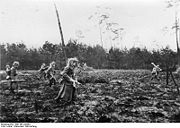 As work moved forward to incorporate this new firing system, development temporarily came to halt when Hitler suspended all new rifle programs due to administrative infighting within the Third Reich, ordered that more, newer submachine guns were to be built and strongly disagreed with the use of the new ammunition. To keep the MKb 42(H) alive, the Waffen Amt (Armament Office) re-designated it into the Maschinenpistole 43 (MP 43) and making a few improvements, billed as an upgrade to existing submachine guns.
This deception was eventually discovered by Adolf Hitler
who again had the program halted. In March 1943, he permitted it to recommence for evaluation purposes only. Running for six months until September 1943, the evaluation produced positive results and Hitler allowed the MP 43 program to continue and in order to make mass production possible. The first MP 43 were distributed to the Waffen-SS
, and in October 1943, some especially to the 93rd Infantry Division
on the Eastern Front when war was raging. Production and distribution continued to different troops until April 1944, where Hitler ordered it re-designated MP 44 with adding minor updates after taking some interest in the weapon tests. In July 1944, at a meeting of the various army heads about the Eastern Front, when Hitler asked what they needed, a general exclaimed, "More of these new rifles!". This caused some confusion (Hitler's response is reputed to have been "What new rifle?"), but once Hitler was given a chance to see and test-fire the MP 44, he was impressed and gave it the title Sturmgewehr. Seeing the possibility of a propaganda
gain, the rifle was again renamed as the StG 44, to highlight the new class of weapon it represented, translated "Storm (Assault) rifle, model 1944", thereby introducing the term.
Seeking to enhance the propaganda value of the new weapon, Hitler ordered it re-designated StG44 (Assault Rifle, Model 1944), giving the rifle its own class. Production soon began with the first batches of the new rifle being shipped to troops on the Eastern Front. A total of 425,977 StG44s were produced by the end of the war and work had commenced on a follow-on rifle, the StG45. Among the attachments available for the StG44 was the Krummlauf, a bent barrel that permitted firing around corners. These were most commonly made with 30° and 45° bends.
By the end of the war, some 425,977 StG 44 variants of all types were produced. The assault rifle proved a valuable weapon, especially on the Eastern front, where it was first deployed. A properly trained soldier with a StG44 had an improved tactical repertoire, in that he could effectively engage targets at longer ranges than with an MP 40, but be much more useful than the Kar 98k in close combat, as well as provide covering fire like a light machine gun. It was also found to be exceptionally reliable in the extreme cold of the Russian winter. The StG44's rate of fire varied between 500 and 600 rpm.
The StG 44 was an intermediate weapon for the period; the muzzle velocity from its 419 mm (16.5 in) barrel was 685 m/s, compared to 760 m/s of the Karabiner 98k, 744 m/s of the British
Bren, 600 m/s of the M1 carbine
, and 365 m/s achieved by the MP40.
One unusual addition to the design was the Krummlauf
; a bent barrel attachment for rifles with a periscope sighting device for shooting around corners from a safe position. It was produced in several variants: a "I" version for infantry use, a "P" version for use in tanks (to cover the dead areas in the close range around the tank, to defend against assaulting infantry), versions with 30°, 45°, 60° and 90° bends, a version for the StG 44 and one for the MG 42. Only the 30° "I" version for the StG 44 was produced in any numbers. The bent barrel attachments had very short lifespans – approx. 300 rounds for the 30° version, and 160 rounds for the 45° variant. The 30° model was able to achieve a 35x35 cm grouping at 100 m.
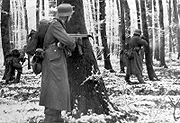 The Sturmgewehr was also at times fitted with the Zielgerät 1229
infrared aiming device, also known by its codename Vampir ("vampire"). This device consisted of a large scope, rather like modern starlight scopes, and a large infra-red lamp on top, the scope being able to pick up the infra-red that would be invisible to the naked eye.
A primary use of the MP44/StG44 was to counter the Soviet PPS
and PPSh-41
submachine guns, which used the 7.62x25mm Tokarev round. These cheap, mass-produced weapons used a 71-round drum magazine or 35-round box magazine and though shorter-ranged than the Kar98k rifle, were more effective weapons in close-quarter engagements. The StG 44, while lacking the range of the Kar 98k, had a considerably longer range than the PPS/PPSh submachine guns, a comparable rate of fire, an ability to switch between a fully automatic and a default semi-automatic fire mode and surprising accuracy. Furthermore the StG44's inline design gave it controllability even on full-auto. In short the StG44 provided the individual user with unparalelled firepower compared to that of all earlier handheld firearms, waranting other countries to soon embrace the assault rifle concept.
_prototype.jpg) In a somewhat unrelated development, Mauser
In a somewhat unrelated development, Mauser
continued design work on a series of experimental weapons in an effort to produce an acceptable service-wide rifle for the short cartridge system. One of these prototypes, a product of the engineers at the Light Weapon Development Group (Abteilung 37) at Oberndorf, was the MKb Gerät 06 (Maschinenkarabiner Gerät 06 or "machine carbine instrument 06") first appearing in 1942. This gun used a unique gas piston-delayed roller-locked action derived from the short recoil operation of the MG 42 machine gun but with a fixed barrel and gas system. It was realized that with careful attention to the mechanical ratios, the gas system could be omitted. The resultant weapon, the Gerät 06(H) was supposedly slated for adoption by the Wehrmacht as the StG 45(M). The operating principle lived on in postwar designs from CEAM/AME
, CETME
, and most famously, Heckler & Koch
.
Towards the end of the war, there were last-ditch efforts to develop cheap so-called Volksgewehr rifles in the 8x33mm caliber. One of these, the VG 1-5
(Volkssturmgewehr 1-5), used a gas-delayed blowback action based on the Barnitzke system, whereby gas bled from the barrel near the chamber created resistance to the rearward impulse of the operating parts, which ceases when the projectile leaves the muzzle, allowing the operating parts to be forced rearward by the residual pressure of the cartridge case. This principle has been used most successfully in the P7 pistol.
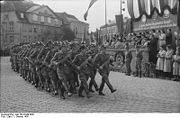 Generally accepted as the world's first assault rifle, the StG44's effect on post-war arms design was wide-ranging, as evidenced by Mikhail Kalashnikov
's AK-47
, and later in the U.S. M16
and its variants. The Soviet Union was quick to adopt the assault rifle concept. The AK-47 used a similar-sized intermediate round and followed the design concept, but was mechanically different.
After World War II, many Western countries continued using their existing full-caliber rifles. Although the 7.62x51mm NATO round adopted post-war was still a full-power cartridge, the trend towards the adoption of less powerful rounds was already underway in the West. For example, the M1 Garand had initially been developed for the .276 Pedersen
(7 mm) round, a cartridge less powerful than the standard .30-06 Springfield
. The U.S. Army's adoption of the M1 carbine
in 1941 proved the utility of a small, handy, low-powered rifle that required little training to use effectively. Franchi of Italy based the actions of both the LF-58
carbine and the LF-59
battle rifle on the StG-44.
America and, later, NATO developed assault rifles along a roughly similar path by at first adding selective-fire capability in a reduced power, full-caliber cartridge. The Soviet Union lightened the AK-47 and introduced the AKM
. America developed the concept of small-caliber, high-velocity (SCHV) bullets and further reduced the weight of their firearms with the introduction of the M16. The Soviets followed suit with the introducing the SCHV AK-74
rifle.
As for the Sturmgewehr itself, it remained in use with the East German Nationale Volksarmee with the designation MPi.44 until it was eventually replaced with variants of the AK-47 assault rifle. The Volkspolizei
used it until approximately 1962 when it was replaced by the PPSh-41
. Other countries to use the StG 44 after World War II included the Czechoslovak Socialist Republic
and the Socialist Federal Republic of Yugoslavia
, where units as the 63rd Paratroop Battalion
were equipped with it until the 1980s, when the rifles were ultimately transferred to Territorial Defense
reserves or sold to friendly regimes in the Middle East and Africa.
Argentina
manufactured their own trial versions of the StG 44 made by CITEFA
in the late 1940s and early 1950s, but instead adopted the FN FAL
in 1955, because it used the then more modern, common and powerful 7.62x51mm NATO round, that also lacked connections with the Third Reich.
New semi-automatic reproductions of the MKb 42(H), MP 43/1, and StG 44 are being manufactured in Germany today by HZA Kulmbach GmbH in the original 7.92x33mm Kurz chambering.
and other Eastern Bloc states supplied client regimes and guerrilla movements with captured German arms such as the StG 44 along with newly manufactured or repackaged 7.92x33mm ammunition. French forces discovered many in Algeria and determined the origin to be from Czechoslovakia. Examples also found their way into the hands of the Vietcong during the Vietnam War
, and the PLO. It is still used in very limited numbers by militia forces in the Middle East
as well as some countries in the Horn of Africa
. StG 44s have been confiscated from militia groups by U.S. forces in Iraq.
Assault rifle
An assault rifle is a selective fire rifle that uses an intermediate cartridge and a detachable magazine. Assault rifles are the standard infantry weapons in most modern armies...
developed in Nazi Germany
Nazi Germany
Nazi Germany , also known as the Third Reich , but officially called German Reich from 1933 to 1943 and Greater German Reich from 26 June 1943 onward, is the name commonly used to refer to the state of Germany from 1933 to 1945, when it was a totalitarian dictatorship ruled by...
during World War II
World War II
World War II, or the Second World War , was a global conflict lasting from 1939 to 1945, involving most of the world's nations—including all of the great powers—eventually forming two opposing military alliances: the Allies and the Axis...
and was the first of its kind to see major deployment, considered by many historians to be the first modern assault rifle (the first assault rifle being the Fedorov Avtomat
Fedorov Avtomat
The Fedorov Avtomat was an early assault rifle designed by Vladimir Grigoryevich Fedorov and produced in Russia in 1916. It was the first practical assault rifle to be adopted, and this concept would later become the basis for the first assault rifle to incorporate a modern layout, the StG 44...
). It is also known under the designations MP 43 and MP 44 (Maschinenpistole 43, Maschinenpistole 44 respectively), which denote earlier development versions of the same weapon with some differences like a different butt end, muzzle nut, shape of the front sight base or with a unstepped barrel, all only visible with close inspection.
Description
Bureaucracy
A bureaucracy is an organization of non-elected officials of a governmental or organization who implement the rules, laws, and functions of their institution, and are occasionally characterized by officialism and red tape.-Weberian bureaucracy:...
in Nazi Germany. Developed from the Mkb 42(H) "machine carbine", the StG44 combined the characteristics of a carbine
Carbine
A carbine , from French carabine, is a longarm similar to but shorter than a rifle or musket. Many carbines are shortened versions of full rifles, firing the same ammunition at a lower velocity due to a shorter barrel length....
, submachine gun
Submachine gun
A submachine gun is an automatic carbine, designed to fire pistol cartridges. It combines the automatic fire of a machine gun with the cartridge of a pistol. The submachine gun was invented during World War I , but the apex of its use was during World War II when millions of the weapon type were...
and automatic rifle
Automatic rifle
Automatic rifle is a term generally used to describe a semi-automatic rifle chambered for a rifle cartridge, capable of delivering both semi- and full automatic fire...
. StG is an abbreviation of . The name was chosen for propaganda
Propaganda
Propaganda is a form of communication that is aimed at influencing the attitude of a community toward some cause or position so as to benefit oneself or one's group....
reasons and literally means "storm rifle" as in "to storm (i.e. "assault") an enemy position". After the adoption of the StG 44, the English translation "assault rifle
Assault rifle
An assault rifle is a selective fire rifle that uses an intermediate cartridge and a detachable magazine. Assault rifles are the standard infantry weapons in most modern armies...
" became the accepted designation for this type of infantry small arm.
The rifle was chambered for the 8x33mm Kurz cartridge
Cartridge (firearms)
A cartridge, also called a round, packages the bullet, gunpowder and primer into a single metallic case precisely made to fit the firing chamber of a firearm. The primer is a small charge of impact-sensitive chemical that may be located at the center of the case head or at its rim . Electrically...
, also known as 7.9 mm Kurz. This shorter version of the German standard (8x57mm IS) rifle
Rifle
A rifle is a firearm designed to be fired from the shoulder, with a barrel that has a helical groove or pattern of grooves cut into the barrel walls. The raised areas of the rifling are called "lands," which make contact with the projectile , imparting spin around an axis corresponding to the...
round, in combination with the weapon's selective-fire design, provided a compromise between the controllable firepower of a submachine gun at close quarters with the accuracy and power of a Karabiner 98k
Karabiner 98k
The Karabiner 98 Kurz was a bolt action rifle chambered for the 8x57mm IS/7.92×57mm IS cartridge that was adopted as the standard service rifle in 1935 by the German Wehrmacht. It was one of the final developments in the long line of Mauser military rifles...
bolt action rifle at intermediate ranges. While the StG44 had less range and power than the more powerful infantry rifles of the day, Wehrmacht
Wehrmacht
The Wehrmacht – from , to defend and , the might/power) were the unified armed forces of Nazi Germany from 1935 to 1945. It consisted of the Heer , the Kriegsmarine and the Luftwaffe .-Origin and use of the term:...
studies had shown that most combat engagements occurred at less than 300 m, with the majority within 200 m. Full-power rifle cartridges were excessive for the vast majority of uses for the average soldier. Only a trained specialist, such as a sniper
Sniper
A sniper is a marksman who shoots targets from concealed positions or distances exceeding the capabilities of regular personnel. Snipers typically have specialized training and distinct high-precision rifles....
, could make full use of the standard rifle round's range and power.
The StG 44's receiver
Receiver (firearms)
In firearms terminology, the receiver is the part of a firearm that houses the operating parts. The receiver usually contains the bolt carrier group, trigger group, and magazine port. In most handguns, the receiver, or frame, holds the magazine well or rotary magazine as well as the trigger mechanism...
was made of heavy stamped and welded steel
Steel
Steel is an alloy that consists mostly of iron and has a carbon content between 0.2% and 2.1% by weight, depending on the grade. Carbon is the most common alloying material for iron, but various other alloying elements are used, such as manganese, chromium, vanadium, and tungsten...
as were other contemporary arms such as the MP 40 and MG 42. This made for a fairly heavy rifle, especially one firing an intermediate-power cartridge. Difficulties with fabrication, the need to use available non-priority steels, and the exigencies of war resulted in a heavy receiver. U.S. military intelligence criticized the weight of the weapon along with the inclusion of the fully automatic feature which it considered "ineffectual for all practical purposes", convinced that full automatic fire with StG 44 was permitted in emergencies only. This was a misinterpretation of the manual however, as the German manual states that automatic fire was "advised only in emergencies", this was mainly to make sure that the regular soldier didn't unnecessarily waste his ammunition spraying at targets, but instead fired in short accurate bursts to achieve maximum accuracy and effect; the StG could easily and safely be used in full automatic mode. The British were also critical saying that the receiver could be bent and the bolt locked up by the mere act of knocking a leaning rifle onto a hard floor. Many of these criticisms are more a testimonial of the Allied aversion rather than an accurate view of the weapon's characteristics which were proven highly effective during combat in the war.
To its credit, it was the first successful weapon of its class, and the concept had a major impact on modern infantry small arms development. By all accounts, the StG 44 fulfilled its role admirably, particularly on the Eastern Front
Eastern Front (World War II)
The Eastern Front of World War II was a theatre of World War II between the European Axis powers and co-belligerent Finland against the Soviet Union, Poland, and some other Allies which encompassed Northern, Southern and Eastern Europe from 22 June 1941 to 9 May 1945...
, offering a greatly increased volume of fire compared to standard infantry rifles. In the end, it came too late to have a significant effect on the outcome of the war.
Background
Light machine gun
A light machine gun is a machine gun designed to be employed by an individual soldier, with or without an assistant, as an infantry support weapon. Light machine guns are often used as squad automatic weapons.-Characteristics:...
or medium
Medium machine gun
A medium machine gun or MMG, in modern terms, usually refers to a belt-fed automatic firearm firing a full-power rifle cartridge.-History:...
machine gun
Machine gun
A machine gun is a fully automatic mounted or portable firearm, usually designed to fire rounds in quick succession from an ammunition belt or large-capacity magazine, typically at a rate of several hundred rounds per minute....
s. One difference from other armies was the emphasis on the machine gun as the primary infantry weapon. In contrast, allied doctrine centered around the rifleman, with machine guns employed as support and point-defense weapons. German units tended to be machine gun "heavy", carrying more ammunition for the machine gun than for the rifles, using belt ammunition for their more modern section-level weapons to maintain a higher rate of fire, and generally thinking of the rifle as a support weapon. Although newer rifle designs had been studied on several occasions, the infantry squad primary centered around the machine gun.
One problem with this mix was that the standard rifles were too large to be effectively used by mechanized and armored forces, where they were difficult to maneuver in the cramped spaces of an armored vehicle. Submachine guns such as the MP 28, MP 38, and MP 40 were issued to augment infantry rifle use and increase individual firepower, but suffered from a distinct lack of range and accuracy beyond 100 m. A small fast-firing weapon would have been useful in this role, but again the need did not seem pressing.
The issue arose once again during the invasion of the Soviet Union
Soviet Union
The Soviet Union , officially the Union of Soviet Socialist Republics , was a constitutionally socialist state that existed in Eurasia between 1922 and 1991....
. The Red Army
Red Army
The Workers' and Peasants' Red Army started out as the Soviet Union's revolutionary communist combat groups during the Russian Civil War of 1918-1922. It grew into the national army of the Soviet Union. By the 1930s the Red Army was among the largest armies in history.The "Red Army" name refers to...
had been in the process of replacing its own bolt action rifles in the immediate pre–war era. Increasing numbers of semi-automatic
Semi-automatic firearm
A semi-automatic, or self-loading firearm is a weapon which performs all steps necessary to prepare the weapon to fire again after firing—assuming cartridges remain in the weapon's feed device or magazine...
Tokarev
Fedor Tokarev
Fedor Vasilievich Tokarev was a Russian weapons designer and deputy of the Supreme Soviet of the USSR from 1941 to 1950. Outside the former Soviet Union he is best known as the designer of the Tokarev TT-30 and TT-33 self-loading pistol and the Tokarev SVT-38 and SVT-40 self-loading rifle, both...
SVT-38 and SVT-40s were reaching Red Army units, though issue was generally restricted to elite units and non-commissioned officer
Non-commissioned officer
A non-commissioned officer , called a sub-officer in some countries, is a military officer who has not been given a commission...
s. Submachine guns were extremely widespread, and issued on a far larger scale; some Soviet rifle companies were completely equipped with PPSh-41
PPSh-41
The PPSh-41 was a Soviet submachine gun designed by Georgi Shpagin as an inexpensive, simplified alternative to the PPD-40. Intended for use by minimally-trained conscript soldiers, the PPSh was a magazine-fed selective-fire submachine gun using an open-bolt, blowback action...
submachine guns.
This experience with high volumes of hand-held automatic 'assault' fire forced German commanders to rethink their small arms requirements. The German army had been attempting to introduce semi-automatic weapons of their own, notably the Gewehr 41
Gewehr 41
The Gewehr 41 rifles, commonly known as the G41 or G41, were semi-automatic rifles used by Nazi Germany during World War II-Background:...
, but these early rifles proved troublesome in service, and production was insufficient to meet forecast requirements. Several attempts had been made to introduce lightweight machine guns or automatic rifles for these roles, but invariably recoil from the powerful 8x57mm JS round made them too difficult to control in automatic fire
Automatic firearm
An automatic firearm is a firearm that loads another round mechanically after the first round has been fired.The term can be used to refer to semi-automatic firearms, which fire one shot per single pull of the trigger , or fully automatic firearms, which will continue to load and fire ammunition...
.
The German solution was to use a round of intermediate power, between that of a full-power rifle cartridge and pistol ammunition. Experiments with several such intermediate rounds had been going on since the 1930s, but had been constantly rejected for use by the army. By 1941, it was becoming clear that action needed to be taken, and one of the experimental rounds, the Polte 8x33mm ("short cartridge") was selected. To minimize logistical problems, the Mauser 8 mm rifle cartridge was used as the basis for the final 7.9mm Kurz intermediate round, which also utilized an aerodynamic spitzer
Spitzer (bullet)
A spitzer, also commonly referred to as a spire point bullet, is an aerodynamic bullet design used in most intermediate and high-powered rifle cartridges...
rifle bullet design.
MKb 42
Hugo Schmeisser
Hugo Schmeisser was a German developer of infantry weapons in the 20th century.Schmeisser was born in Jena, Saxe-Weimar. His father, Louis Schmeisser , was one of the best-known weapons designers in Europe...
), who were asked to submit prototype weapons under the name 1942 (MKb 42, literally "machine (ie. fully automatic) carbine"). Both designs were similar, using a gas-operated
Gas-operated reloading
Gas-operation is a system of operation used to provide energy to operate autoloading firearms. In gas-operation, a portion of high pressure gas from the cartridge being fired is used to power a mechanism to extract the spent case and chamber a new cartridge. Energy from the gas is harnessed...
action, with both semi-automatic and fully automatic firing modes.
The original prototype of Haenel's design, the MKb 42(H), fired from an open bolt
Open bolt
A semi or full automatic firearm is said to fire from an open bolt if, when ready to fire, the bolt and working parts are held to the rear. When the trigger is pulled the bolt goes forward, feeding a round from the magazine into the chamber and firing it...
and used a striker for firing. The receiver and trigger housing with pistol grip were made from steel stampings, which were attached to the barrel
Gun barrel
A gun barrel is the tube, usually metal, through which a controlled explosion or rapid expansion of gases are released in order to propel a projectile out of the end at a high velocity....
assembly on a hinge, allowing the weapon to be folded open for quick disassembly and cleaning. The Haenel design proved superior to Walther's MKb 42(W), and the army then asked Haenel for another version incorporating a list of minor changes designated MKb 42(H). One was to include lugs for mounting a standard bayonet
Bayonet
A bayonet is a knife, dagger, sword, or spike-shaped weapon designed to fit in, on, over or underneath the muzzle of a rifle, musket or similar weapon, effectively turning the gun into a spear...
, another to change the pitch of the rifling. A production run of these modified versions was sent to the field in November 1942, and the users appreciated it with a few reservations. Another set of modifications added a hinged cover over the ejection port to keep it clean in combat, and rails to mount a telescopic sight. A run of these modified MKb 42(H)s in late 1942 and early 1943 produced 11,833 guns for field trials.
Ultimately it was recommended that a hammer firing system operating from a closed bolt similar to Walther's design be incorporated. The gas expansion chamber over the barrel was deemed unnecessary, and was removed from successive designs, as was the underbarrel bayonet
Bayonet
A bayonet is a knife, dagger, sword, or spike-shaped weapon designed to fit in, on, over or underneath the muzzle of a rifle, musket or similar weapon, effectively turning the gun into a spear...
lug.
MP 43, MP 44, StG 44
This deception was eventually discovered by Adolf Hitler
Adolf Hitler
Adolf Hitler was an Austrian-born German politician and the leader of the National Socialist German Workers Party , commonly referred to as the Nazi Party). He was Chancellor of Germany from 1933 to 1945, and head of state from 1934 to 1945...
who again had the program halted. In March 1943, he permitted it to recommence for evaluation purposes only. Running for six months until September 1943, the evaluation produced positive results and Hitler allowed the MP 43 program to continue and in order to make mass production possible. The first MP 43 were distributed to the Waffen-SS
Waffen-SS
The Waffen-SS was a multi-ethnic and multi-national military force of the Third Reich. It constituted the armed wing of the Schutzstaffel or SS, an organ of the Nazi Party. The Waffen-SS saw action throughout World War II and grew from three regiments to over 38 divisions, and served alongside...
, and in October 1943, some especially to the 93rd Infantry Division
93rd Infantry Division (Germany)
The 93rd Infantry Division was a German infantry division that was formed in the fall of 1939. The division fought in the Second World War in both the Battle of France and on the Eastern Front...
on the Eastern Front when war was raging. Production and distribution continued to different troops until April 1944, where Hitler ordered it re-designated MP 44 with adding minor updates after taking some interest in the weapon tests. In July 1944, at a meeting of the various army heads about the Eastern Front, when Hitler asked what they needed, a general exclaimed, "More of these new rifles!". This caused some confusion (Hitler's response is reputed to have been "What new rifle?"), but once Hitler was given a chance to see and test-fire the MP 44, he was impressed and gave it the title Sturmgewehr. Seeing the possibility of a propaganda
Propaganda
Propaganda is a form of communication that is aimed at influencing the attitude of a community toward some cause or position so as to benefit oneself or one's group....
gain, the rifle was again renamed as the StG 44, to highlight the new class of weapon it represented, translated "Storm (Assault) rifle, model 1944", thereby introducing the term.
Seeking to enhance the propaganda value of the new weapon, Hitler ordered it re-designated StG44 (Assault Rifle, Model 1944), giving the rifle its own class. Production soon began with the first batches of the new rifle being shipped to troops on the Eastern Front. A total of 425,977 StG44s were produced by the end of the war and work had commenced on a follow-on rifle, the StG45. Among the attachments available for the StG44 was the Krummlauf, a bent barrel that permitted firing around corners. These were most commonly made with 30° and 45° bends.
By the end of the war, some 425,977 StG 44 variants of all types were produced. The assault rifle proved a valuable weapon, especially on the Eastern front, where it was first deployed. A properly trained soldier with a StG44 had an improved tactical repertoire, in that he could effectively engage targets at longer ranges than with an MP 40, but be much more useful than the Kar 98k in close combat, as well as provide covering fire like a light machine gun. It was also found to be exceptionally reliable in the extreme cold of the Russian winter. The StG44's rate of fire varied between 500 and 600 rpm.
The StG 44 was an intermediate weapon for the period; the muzzle velocity from its 419 mm (16.5 in) barrel was 685 m/s, compared to 760 m/s of the Karabiner 98k, 744 m/s of the British
Great Britain
Great Britain or Britain is an island situated to the northwest of Continental Europe. It is the ninth largest island in the world, and the largest European island, as well as the largest of the British Isles...
Bren, 600 m/s of the M1 carbine
M1 Carbine
The M1 carbine is a lightweight, easy to use semi-automatic carbine that became a standard firearm for the U.S. military during World War II, the Korean War and the Vietnam War, and was produced in several variants. It was widely used by U.S...
, and 365 m/s achieved by the MP40.
One unusual addition to the design was the Krummlauf
Krummlauf
The Krummlauf is a bent barrel attachment for the Sturmgewehr 44 assault rifle developed by Germany in World War II.The curved barrel included a periscope sighting device for shooting around corners from a safe position....
; a bent barrel attachment for rifles with a periscope sighting device for shooting around corners from a safe position. It was produced in several variants: a "I" version for infantry use, a "P" version for use in tanks (to cover the dead areas in the close range around the tank, to defend against assaulting infantry), versions with 30°, 45°, 60° and 90° bends, a version for the StG 44 and one for the MG 42. Only the 30° "I" version for the StG 44 was produced in any numbers. The bent barrel attachments had very short lifespans – approx. 300 rounds for the 30° version, and 160 rounds for the 45° variant. The 30° model was able to achieve a 35x35 cm grouping at 100 m.
Zielgerät 1229
The Zielgerät 1229 , also known in its code name Vampir, was an active infrared device developed for the Wehrmacht for the Sturmgewehr 44 assault rifle, intended primarily for night use.-Design:...
infrared aiming device, also known by its codename Vampir ("vampire"). This device consisted of a large scope, rather like modern starlight scopes, and a large infra-red lamp on top, the scope being able to pick up the infra-red that would be invisible to the naked eye.
A primary use of the MP44/StG44 was to counter the Soviet PPS
PPS submachine gun
The PPS was a family of Soviet submachine guns chambered in 7.62x25mm Tokarev, developed by Alexei Sudayev as a low-cost personal defense weapon for reconnaissance units, vehicle crews and support service personnel.The PPS and its variants were used extensively by the Red...
and PPSh-41
PPSh-41
The PPSh-41 was a Soviet submachine gun designed by Georgi Shpagin as an inexpensive, simplified alternative to the PPD-40. Intended for use by minimally-trained conscript soldiers, the PPSh was a magazine-fed selective-fire submachine gun using an open-bolt, blowback action...
submachine guns, which used the 7.62x25mm Tokarev round. These cheap, mass-produced weapons used a 71-round drum magazine or 35-round box magazine and though shorter-ranged than the Kar98k rifle, were more effective weapons in close-quarter engagements. The StG 44, while lacking the range of the Kar 98k, had a considerably longer range than the PPS/PPSh submachine guns, a comparable rate of fire, an ability to switch between a fully automatic and a default semi-automatic fire mode and surprising accuracy. Furthermore the StG44's inline design gave it controllability even on full-auto. In short the StG44 provided the individual user with unparalelled firepower compared to that of all earlier handheld firearms, waranting other countries to soon embrace the assault rifle concept.
Late prototypes
Mauser
Mauser was a German arms manufacturer of a line of bolt-action rifles and pistols from the 1870s to 1995. Mauser designs were built for the German armed forces...
continued design work on a series of experimental weapons in an effort to produce an acceptable service-wide rifle for the short cartridge system. One of these prototypes, a product of the engineers at the Light Weapon Development Group (Abteilung 37) at Oberndorf, was the MKb Gerät 06 (Maschinenkarabiner Gerät 06 or "machine carbine instrument 06") first appearing in 1942. This gun used a unique gas piston-delayed roller-locked action derived from the short recoil operation of the MG 42 machine gun but with a fixed barrel and gas system. It was realized that with careful attention to the mechanical ratios, the gas system could be omitted. The resultant weapon, the Gerät 06(H) was supposedly slated for adoption by the Wehrmacht as the StG 45(M). The operating principle lived on in postwar designs from CEAM/AME
Atelier Mécanique de Mulhouse
Atelier Mécanique de Mulhouse , formerly known as Centre d'Études et d'Armement de Mulhouse , was a French weapons manufacturer that operated from 1946 to 1967.-History:...
, CETME
CETME
CETME is an acronym for Centro de Estudios Técnicos de Materiales Especiales , a Spanish government design and development establishment. While being involved in many projects CETME was mostly known for its small arms research and development...
, and most famously, Heckler & Koch
Heckler & Koch
Heckler & Koch GmbH is a German defense manufacturing company that produces various small arms. Some of their products include the SA80, MP5 submachine gun, G3 automatic rifle, the G36 assault rifle, the HK 416, the MP7 personal defense weapon, the USP series of handguns, and the high-precision...
.
Towards the end of the war, there were last-ditch efforts to develop cheap so-called Volksgewehr rifles in the 8x33mm caliber. One of these, the VG 1-5
Volkssturmgewehr 1-5
The Volkssturmgewehr 1-5 is a set of 5 rifle designs developed by Nazi Germany during the last months of World War II...
(Volkssturmgewehr 1-5), used a gas-delayed blowback action based on the Barnitzke system, whereby gas bled from the barrel near the chamber created resistance to the rearward impulse of the operating parts, which ceases when the projectile leaves the muzzle, allowing the operating parts to be forced rearward by the residual pressure of the cartridge case. This principle has been used most successfully in the P7 pistol.
Post-war
Mikhail Kalashnikov
Lieutenant General Mikhail Timofeyevich Kalashnikov is a Russian small arms designer, most famous for designing the AK-47 assault rifle, the AKM and the AK-74.-Early life:...
's AK-47
AK-47
The AK-47 is a selective-fire, gas-operated 7.62×39mm assault rifle, first developed in the Soviet Union by Mikhail Kalashnikov. It is officially known as Avtomat Kalashnikova . It is also known as a Kalashnikov, an "AK", or in Russian slang, Kalash.Design work on the AK-47 began in the last year...
, and later in the U.S. M16
M16 rifle
The M16 is the United States military designation for the AR-15 rifle adapted for both semi-automatic and full-automatic fire. Colt purchased the rights to the AR-15 from ArmaLite, and currently uses that designation only for semi-automatic versions of the rifle. The M16 fires the 5.56×45mm NATO...
and its variants. The Soviet Union was quick to adopt the assault rifle concept. The AK-47 used a similar-sized intermediate round and followed the design concept, but was mechanically different.
After World War II, many Western countries continued using their existing full-caliber rifles. Although the 7.62x51mm NATO round adopted post-war was still a full-power cartridge, the trend towards the adoption of less powerful rounds was already underway in the West. For example, the M1 Garand had initially been developed for the .276 Pedersen
.276 Pedersen
The .276 Pedersen round was an experimental 7 mm cartridge developed for the U.S. Army and used in the Pedersen rifle and early versions of what would become the M1 Garand rifle.-Summary:...
(7 mm) round, a cartridge less powerful than the standard .30-06 Springfield
.30-06 Springfield
The .30-06 Springfield cartridge or 7.62×63mm in metric notation, was introduced to the United States Army in 1906 and standardized, and was in use until the 1960s and early 1970s. It replaced the .30-03, 6 mm Lee Navy, and .30 US Army...
. The U.S. Army's adoption of the M1 carbine
M1 Carbine
The M1 carbine is a lightweight, easy to use semi-automatic carbine that became a standard firearm for the U.S. military during World War II, the Korean War and the Vietnam War, and was produced in several variants. It was widely used by U.S...
in 1941 proved the utility of a small, handy, low-powered rifle that required little training to use effectively. Franchi of Italy based the actions of both the LF-58
Franchi LF-58
The Franchi LF-58 is a carbine of Italian origin chambered in .30 Carbine. The weapon is gas operated and comes with a side folding wire stock similar to that of the LF-57 submachine gun....
carbine and the LF-59
Franchi LF-59
The Franchi LF-59 is a battle rifle heavily based on the FN FAL. The weapon shared the same reliability as the FAL but the Italian forces selected the BM-59....
battle rifle on the StG-44.
America and, later, NATO developed assault rifles along a roughly similar path by at first adding selective-fire capability in a reduced power, full-caliber cartridge. The Soviet Union lightened the AK-47 and introduced the AKM
AKM
The AKM is a 7.62mm assault rifle designed by Mikhail Kalashnikov. It is an upgraded version of the AK-47 rifle and was developed in the 1950s....
. America developed the concept of small-caliber, high-velocity (SCHV) bullets and further reduced the weight of their firearms with the introduction of the M16. The Soviets followed suit with the introducing the SCHV AK-74
AK-74
The AK-74 is an assault rifle developed in the early 1970s in the Soviet Union as the replacement for the earlier AKM...
rifle.
As for the Sturmgewehr itself, it remained in use with the East German Nationale Volksarmee with the designation MPi.44 until it was eventually replaced with variants of the AK-47 assault rifle. The Volkspolizei
Volkspolizei
The Volkspolizei , or VP, were the national police of the German Democratic Republic . The Volkspolizei were responsible for most law enforcement in East Germany, but its organisation and structure were such that it could be considered a paramilitary force as well...
used it until approximately 1962 when it was replaced by the PPSh-41
PPSh-41
The PPSh-41 was a Soviet submachine gun designed by Georgi Shpagin as an inexpensive, simplified alternative to the PPD-40. Intended for use by minimally-trained conscript soldiers, the PPSh was a magazine-fed selective-fire submachine gun using an open-bolt, blowback action...
. Other countries to use the StG 44 after World War II included the Czechoslovak Socialist Republic
Czechoslovak Socialist Republic
The Czechoslovak Socialist Republic was the official name of Czechoslovakia from 1960 until end of 1989 , a Soviet satellite state of the Eastern Bloc....
and the Socialist Federal Republic of Yugoslavia
Socialist Federal Republic of Yugoslavia
The Socialist Federal Republic of Yugoslavia was the Yugoslav state that existed from the abolition of the Yugoslav monarchy until it was dissolved in 1992 amid the Yugoslav Wars. It was a socialist state and a federation made up of six socialist republics: Bosnia and Herzegovina, Croatia,...
, where units as the 63rd Paratroop Battalion
63rd Paratroop Battalion
The 63rd Parachute Battalion is one of the battalions constituting the Special Brigade of the Serbian Army. It used to be of brigade-size, but it has the status of a battalion within the restructured Serbian Army...
were equipped with it until the 1980s, when the rifles were ultimately transferred to Territorial Defense
Territorial Defense Forces (Yugoslavia)
The Territorial Defense Forces were a separate part of the armed forces of the former Socialist Federal Republic of Yugoslavia. The forces acted as a Home Guard which roughly corresponded to a military reserve force or an official governmental paramilitary...
reserves or sold to friendly regimes in the Middle East and Africa.
Argentina
Argentina
Argentina , officially the Argentine Republic , is the second largest country in South America by land area, after Brazil. It is constituted as a federation of 23 provinces and an autonomous city, Buenos Aires...
manufactured their own trial versions of the StG 44 made by CITEFA
CITEFA
The Institute of Scientific and Technological Research of the Armed Forces , is an Argentine federal agency in charge of the research, development and homologation of armament....
in the late 1940s and early 1950s, but instead adopted the FN FAL
FN FAL
The Fusil Automatique Léger or FAL is a self-loading, selective fire battle rifle produced by the Belgian armaments manufacturer Fabrique Nationale de Herstal . During the Cold War it was adopted by many North Atlantic Treaty Organization countries, with the notable exception of the United States...
in 1955, because it used the then more modern, common and powerful 7.62x51mm NATO round, that also lacked connections with the Third Reich.
New semi-automatic reproductions of the MKb 42(H), MP 43/1, and StG 44 are being manufactured in Germany today by HZA Kulmbach GmbH in the original 7.92x33mm Kurz chambering.
Non state groups
After World War II, the Soviet UnionSoviet Union
The Soviet Union , officially the Union of Soviet Socialist Republics , was a constitutionally socialist state that existed in Eurasia between 1922 and 1991....
and other Eastern Bloc states supplied client regimes and guerrilla movements with captured German arms such as the StG 44 along with newly manufactured or repackaged 7.92x33mm ammunition. French forces discovered many in Algeria and determined the origin to be from Czechoslovakia. Examples also found their way into the hands of the Vietcong during the Vietnam War
Vietnam War
The Vietnam War was a Cold War-era military conflict that occurred in Vietnam, Laos, and Cambodia from 1 November 1955 to the fall of Saigon on 30 April 1975. This war followed the First Indochina War and was fought between North Vietnam, supported by its communist allies, and the government of...
, and the PLO. It is still used in very limited numbers by militia forces in the Middle East
Middle East
The Middle East is a region that encompasses Western Asia and Northern Africa. It is often used as a synonym for Near East, in opposition to Far East...
as well as some countries in the Horn of Africa
Horn of Africa
The Horn of Africa is a peninsula in East Africa that juts hundreds of kilometers into the Arabian Sea and lies along the southern side of the Gulf of Aden. It is the easternmost projection of the African continent...
. StG 44s have been confiscated from militia groups by U.S. forces in Iraq.
