


Dusky Dolphin

Encyclopedia
The dusky dolphin is a dolphin
found in coastal waters in the Southern Hemisphere
. Its specific epithet is Latin
for "dark" or "dim". It is very closely genetically
related to the Pacific white-sided dolphin
, but current scientific consensus is that they are distinct species. The dolphin's range is patchy with major populations around South America
, southwestern Africa
, New Zealand
and various oceanic islands with some sightings around southern Australia
and Tasmania
. The dusky dolphin prefers cool currents and inshore waters but can also be found offshore. It feeds on a variety of fish
and squid
species and has flexible hunting tactics. The dusky dolphin is known for its remarkable acrobatics, having a number of aerial behaviors. The status of the dolphin is unknown but it has been commonly caught in gill nets
.
in 1828 from stuffed skin and a single skull shipped from the Cape of Good Hope
to the British Museum
. Gray first described the species as Delphinus obscurus, with the subgenus
Grampus in his 1828 Specilegia Zoologica. Gray reported that the animal was captured around the Cape of Good Hope by a Captain Haviside (often misspelt "Heaviside") and sent to the British Museum though the Royal College of Surgeons in 1827.
However Gray later wrote that a similar dolphin was described as Delphinus supercilious by French surgeons and naturalists René Primevère Lesson and Prosper Garnot from a specimen collected off the coast of Tasmania
two years before his own classification. Gray considered D. supercilious to be a junior synonym
of his D. obscurus and he credits Lesson and Garnot (1826) for their original description. Meanwhile, Charles Darwin
also described what turned out to be this species as Delphinus fitzroyi from a specimen harpooned off Argentina in 1838. The dusky dolphin was reclassified as Prodelphinus obscurus in 1885 by British naturalist William Henry Flower
, before gaining its current binomial name, Lagenorhynchus obscurus, from American biologist Frederick W. True
in 1889.
are considered phylogenetically related species. Some researchers have suggested that they are the same species but morphological and life history evidence shows otherwise. The two sister species diverged at around 1.9–3.0 million years ago. Recent analysis of the mitochondrial cytochrome b gene indicates that the genus Lagenorhynchus, as traditionally conceived, is not a natural (monophyletic) group. Another study finds that the dusky and the Pacific white-sided dolphin form the sister group to the (expanded) genus Cephalorhynchus
. If this placement is accurate, a new genus name will need to be coined to accommodate these two species.
Dusky dolphins from Argentina and southwest Africa separated 2000 generations ago from an ancestral Atlantic population and subsequently diverged without much gene flow
. Most populations have low genetic diversity, with the Peruvian population being an expectation. Possible hybrids of dusky dolphins have been described with a long-beaked common dolphin
and a southern right whale dolphin
...
There is almost no sexual dimorphism
in this species, although males have more curved dorsal fins with broader bases and greater surface areas. The back of the dolphin is dark grey or black, and the dorsal fin
is distinctively two-toned—the leading edge matches the back in color, but the trailing edge is a much lighter greyish white. Dusky dolphins have a long, light grey patch on their foreside leading to a short, dark grey beak. The throat and belly are white, and the beak and lower jaw are dark grey. There are two blazes of white color running back on the body from the dorsal fin to the tail. Right between the white areas remains a characteristic thorn-shaped patch of dark colour, by which the species can easily be recognized. Aside from that, dusky dolphins may be confused with other members of their genus when observed at sea.
It can be distinguished from the common dolphin
s, which have a more prominent and longer beak and yellow flank markings. The skull of a dusky dolphin has a longer and narrower rostrum than that of a hourglass dolphin
or Peale's dolphin
of similar age and size.
in the west and from southern Patagonia
to around 36º S in the east. Its range also includes the Falkland Islands
. They are particularly common from Peninsula Valdes to Mar de Plata. In comparison, they are uncommon in the Beagle Channel
and the inshore waters of the Tierra del Fuego
region.
Dusky dolphins are found throughout New Zealand waters. The center of their abundance is from East Cape
and Cape Palliser
on the North Island
to Timaru
and Oamaru on the South Island
. They are especially common in the cold waters of the Southland and Canterbury currents. In Africa, the dusky dolphin ranges from Lobito Bay, Angola in the north to False Bay
, South Africa in the south. Within Australian waters, dusky dolphins have been recorded in colder waters off Kangaroo Island
, eastern Tasmania and Bass Strait
, although they are uncommon and those that are sighted there are possibly transients from New Zealand. Dusky dolphins are also found around Campbell, Auckland and Chatham in the western South Pacific, Tristan da Cunha
in the South Atlantic and Île Amsterdam
and Île Saint-Paul
in the southern Indian Ocean.
s and South American sea lion
s. They have been found close to, but have apparently not interacted with, bottlenose dolphin
s and may feed in the same areas as Risso's dolphin
s. They also associate with various seabirds like kelp gull
s, cormorant
s, tern
s, shearwater
s, petrel
s and albatross
es. In New Zealand, dusky dolphins mingle with common dolphins. Dusky dolphins have also been observed with southern right whale dolphin
s and pilot whale
s off southwestern Africa.
s. Dusky dolphins project broadband short-duration echolocation
signals similar to that of other whistle-producing toothed whales. Most of the species' echolocation signals have bi-modal frequency spectra with a low-frequency peak between 40 and 50 kHz and a high-frequency peak between 80 and 110 kHz. The echolocation signals are at a levels about 9–12 dB
lower than for the larger white-beaked dolphin
which is of the same genus but is over twice as heavy.
s, hake
s, horse mackerel
, hoki
and red cod
. They are generally coordinate hunters. These dolphins have very flexible foraging strategies that can change depending on the environment. In certain parts of New Zealand, were deep oceanic waters meet the shore, dusky dolphins forage in deep scattering layer
s at night. They arrive at the hunting site individually but form groups when in the layer. The dolphins use their echolocation to detect and isolate an individual prey. Groups of foraging dolphins tend to increase when the layer is near the surface and decrease when it descends.
When hunting in shallower waters in New Zealand and Argentina, dusky dolphins tend to forage during the day. The dolphins chase schools of fish or squid and herd them into stationary balls. They may control the school by using light reflected from their white bellies. Dolphins herd prey against the surface but also horizontally against the shore, a point of land or the hull of a boat. During these times, it is believed that dusky dolphins increase prey availability for other predators including other dolphins, seabird
s, shark
s and pinniped
s. In Argentina, dusky dolphins may use bird aggregations to coordinate foraging efforts. On the other hand, pinnipeds and sharks take advantage
of the dolphin hunts which leaves almost no advantage to the dolphins. Dusky dolphins are themselves preyed on by killer whales and large sharks. Dolphins avoid killer whales by swimming into shallower water. Dusky dolphins are also susceptible to parasitism
by certain nematode
, cestode and trematode species, mostly Nasitrema sp., Anisakis
sp., Phyllobothrium delphini, Braunina cordiformis and Pholeter gasterophilus.
with most group size increases occurring during foraging and decreases in group sizes occurring during resting and traveling. In the Golfo San José off the Valdes Peninsula
, dolphins commonly switch between small traveling groups and large socio-sexual groups and encounter a variety of associates. Studies of dolphins off Kaikoura
, New Zealand show that dolphins normally live in large groups that split into smaller sub-groups. These sub-groups are composed of mating adults (mating groups), mothers with calves (nursery groups) and non-breeding adults. Dusky dolphins have a promiscuous mating system in which both males and females mate with multiple partners. Mating groups are generally made of around ten males and a single female. These mating groups can be found in both shallow and deep water but more often gather near shore.
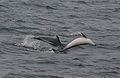 In the mating groups, the males pursue the female in high speed chases. Male reproductive success seems to be determined by speed and agility rather than size, strength or aggression. Females exercise their choice in sexual partners by extending the chase as long as possible. Females may try to evade males that do not
demonstrate vigor or social skill. It is also possible that males may form alliances to catch females. Unlike male bottlenose dolphin
s, male dusky dolphins can't monopolize females. The time when female dusky dolphins first reproduce varies between regions. New Zealand dolphins first reproduce at about 7–8 years with possibly 6–7 years for Argentine dolphins. A study of dusky dolphins off the coast of Peru showed that the reproductive cycle lasts around 28.6 months with mother dolphins becoming pregnant for 12.9 months, lactate for a further 12 months and rest for 3.7 months before the cycle begins again. During copulation, females tend to be on the top. As with all species where females mate with multiple partners, male dusky dolphins have large testicles for sperm competition
. Dusky dolphins sometimes engage in sexual behavior for reasons other than reproduction, perhaps in greeting or communication. Homosexual behavior between males has been observed. Social sexual behavior tends to be more relaxed.
Females with calves tend to gather in nursery groups in shallow water. Nursery groups likely provide calves protection from predators and marauding males as well as give them opportunities for resting, foraging, socializing and social learning. The formation of nursery groups may grant mothers and calves increased time for rest which is important for growing calves and females which face increased energetic constraints due to lactation. While the behaviors of nursery groups vary by month, resting is the predominant behavior during most months. The formation of nursery groups in shallow waters also allow members to exploit prey species other than those found in deep scattering layers. Both adults and calves have been observed to chase and catch fish and the adults may be teaching the calves how to hunt. In contrast to shallower waters, hunting in deep water at night may be too dangerous for calves. Calves are particularly vulnerable to predators like killer whales and use of shallow water by nursery groups may be a predator avoidance strategy. Nursery groups tend to avoid mating groups. Adult males in these groups will aggressively herd and chase single females. This may separate calves from their mothers and may make them become subjects of adult male harassment themselves. Calves may also become even more vulnerable to predators as they become exhausted and disorientated. Mother dolphins may look after calves that are not their own
.

The Dusky dolphin is listed on Appendix II of the Convention on the Conservation of Migratory Species of Wild Animals (CMS
). It is listed on Appendix II as it has an unfavourable conservation status or would benefit significantly from international co-operation organised by tailored agreements.
. Management of marine farming is a wider socio-economic and ecological issue due to regular seasonal migration of dusky dolphins and frequent feeding associations with other apex predators make. Dusky dolphins are most often encountered during the winter in Admiralty Bay, which has the with the greatest density of proposed farming activity in the region. It appears that dolphins rarely use areas in existing farms and few have been observed to enter the boundaries of them. Dolphins that enter mussel farms will move rapidly up the lanes and between rows of lines and floats.
s) as the target species. For dusky dolphins, the number of tourists increased from 1,393 in 1997 to 1,840 in 2000. Encounters with dolphins grew from 25% during 1999 to 90% in 2001 and most of groups observed ranged from 50–100 animals. Dolphin watching in this areas started as an alternative to whale watching, which was mostly based on that of the southern right whale
. Dusky dolphin watching is also popular in New Zealand, whose dolphin watching industry begin in the late 1980s. Whale and dolphin watching tours have grown in since then and the number of permitted dolphin tour operators increased from none to over 75 since the late 1980s. New Zealand has several locations to view and swim with dusky dolphins, notably in Marlborough Sounds
.
While dusky dolphin tourism is a larger industry in New Zealand than it is in Argentina, the effects of tourism on the dolphins seem to be lower in the former than the latter. New Zealand tours are operated under permits are limited in number and have conditions and guidelines related to approach procedures and swim operations. By contrast, there is no direct regulation of dolphin watching in Argentina. As such, dolphin activities are often disturbed by touring vessels.
Dolphin
Dolphins are marine mammals that are closely related to whales and porpoises. There are almost forty species of dolphin in 17 genera. They vary in size from and , up to and . They are found worldwide, mostly in the shallower seas of the continental shelves, and are carnivores, mostly eating...
found in coastal waters in the Southern Hemisphere
Southern Hemisphere
The Southern Hemisphere is the part of Earth that lies south of the equator. The word hemisphere literally means 'half ball' or "half sphere"...
. Its specific epithet is Latin
Latin
Latin is an Italic language originally spoken in Latium and Ancient Rome. It, along with most European languages, is a descendant of the ancient Proto-Indo-European language. Although it is considered a dead language, a number of scholars and members of the Christian clergy speak it fluently, and...
for "dark" or "dim". It is very closely genetically
Genetics
Genetics , a discipline of biology, is the science of genes, heredity, and variation in living organisms....
related to the Pacific white-sided dolphin
Pacific White-sided Dolphin
The Pacific White-sided Dolphin is a very active dolphin found in the cool to temperate waters of the North Pacific Ocean.-Taxonomy:...
, but current scientific consensus is that they are distinct species. The dolphin's range is patchy with major populations around South America
South America
South America is a continent situated in the Western Hemisphere, mostly in the Southern Hemisphere, with a relatively small portion in the Northern Hemisphere. The continent is also considered a subcontinent of the Americas. It is bordered on the west by the Pacific Ocean and on the north and east...
, southwestern Africa
Africa
Africa is the world's second largest and second most populous continent, after Asia. At about 30.2 million km² including adjacent islands, it covers 6% of the Earth's total surface area and 20.4% of the total land area...
, New Zealand
New Zealand
New Zealand is an island country in the south-western Pacific Ocean comprising two main landmasses and numerous smaller islands. The country is situated some east of Australia across the Tasman Sea, and roughly south of the Pacific island nations of New Caledonia, Fiji, and Tonga...
and various oceanic islands with some sightings around southern Australia
Southern Australia
The term southern Australia is generally considered to include the States and territories of Australia of New South Wales, Victoria, South Australia, Tasmania and the Australian Capital Territory...
and Tasmania
Tasmania
Tasmania is an Australian island and state. It is south of the continent, separated by Bass Strait. The state includes the island of Tasmania—the 26th largest island in the world—and the surrounding islands. The state has a population of 507,626 , of whom almost half reside in the greater Hobart...
. The dusky dolphin prefers cool currents and inshore waters but can also be found offshore. It feeds on a variety of fish
Fish
Fish are a paraphyletic group of organisms that consist of all gill-bearing aquatic vertebrate animals that lack limbs with digits. Included in this definition are the living hagfish, lampreys, and cartilaginous and bony fish, as well as various extinct related groups...
and squid
Squid
Squid are cephalopods of the order Teuthida, which comprises around 300 species. Like all other cephalopods, squid have a distinct head, bilateral symmetry, a mantle, and arms. Squid, like cuttlefish, have eight arms arranged in pairs and two, usually longer, tentacles...
species and has flexible hunting tactics. The dusky dolphin is known for its remarkable acrobatics, having a number of aerial behaviors. The status of the dolphin is unknown but it has been commonly caught in gill nets
Gillnet
Gillnetting is a common fishing method used by commercial and artisanal fishermen of all the oceans and in some freshwater and estuary areas. The gillnet also is used by fisheries scientists to monitor fish populations. Because gillnets can be so effective their use is closely monitored and...
.
Taxonomy
It is commonly thought that the dusky dolphin was first described by John Edward GrayJohn Edward Gray
John Edward Gray, FRS was a British zoologist. He was the elder brother of George Robert Gray and son of the pharmacologist and botanist Samuel Frederick Gray ....
in 1828 from stuffed skin and a single skull shipped from the Cape of Good Hope
Cape of Good Hope
The Cape of Good Hope is a rocky headland on the Atlantic coast of the Cape Peninsula, South Africa.There is a misconception that the Cape of Good Hope is the southern tip of Africa, because it was once believed to be the dividing point between the Atlantic and Indian Oceans. In fact, the...
to the British Museum
British Museum
The British Museum is a museum of human history and culture in London. Its collections, which number more than seven million objects, are amongst the largest and most comprehensive in the world and originate from all continents, illustrating and documenting the story of human culture from its...
. Gray first described the species as Delphinus obscurus, with the subgenus
Subgenus
In biology, a subgenus is a taxonomic rank directly below genus.In zoology, a subgeneric name can be used independently or included in a species name, in parentheses, placed between the generic name and the specific epithet: e.g. the Tiger Cowry of the Indo-Pacific, Cypraea tigris Linnaeus, which...
Grampus in his 1828 Specilegia Zoologica. Gray reported that the animal was captured around the Cape of Good Hope by a Captain Haviside (often misspelt "Heaviside") and sent to the British Museum though the Royal College of Surgeons in 1827.
However Gray later wrote that a similar dolphin was described as Delphinus supercilious by French surgeons and naturalists René Primevère Lesson and Prosper Garnot from a specimen collected off the coast of Tasmania
Tasmania
Tasmania is an Australian island and state. It is south of the continent, separated by Bass Strait. The state includes the island of Tasmania—the 26th largest island in the world—and the surrounding islands. The state has a population of 507,626 , of whom almost half reside in the greater Hobart...
two years before his own classification. Gray considered D. supercilious to be a junior synonym
Synonym (taxonomy)
In scientific nomenclature, a synonym is a scientific name that is or was used for a taxon of organisms that also goes by a different scientific name. For example, Linnaeus was the first to give a scientific name to the Norway spruce, which he called Pinus abies...
of his D. obscurus and he credits Lesson and Garnot (1826) for their original description. Meanwhile, Charles Darwin
Charles Darwin
Charles Robert Darwin FRS was an English naturalist. He established that all species of life have descended over time from common ancestry, and proposed the scientific theory that this branching pattern of evolution resulted from a process that he called natural selection.He published his theory...
also described what turned out to be this species as Delphinus fitzroyi from a specimen harpooned off Argentina in 1838. The dusky dolphin was reclassified as Prodelphinus obscurus in 1885 by British naturalist William Henry Flower
William Henry Flower
Sir William Henry Flower KCB FRCS FRS was an English comparative anatomist and surgeon. Flower became a leading authority on mammals, and especially on the primate brain...
, before gaining its current binomial name, Lagenorhynchus obscurus, from American biologist Frederick W. True
Frederick W. True
Frederick William True was an American biologist, the first head curator of biology at the United States National Museum, now part of the Smithsonian Institution....
in 1889.
Genetics
The dusky dolphin and the Pacific white-sided dolphinPacific White-sided Dolphin
The Pacific White-sided Dolphin is a very active dolphin found in the cool to temperate waters of the North Pacific Ocean.-Taxonomy:...
are considered phylogenetically related species. Some researchers have suggested that they are the same species but morphological and life history evidence shows otherwise. The two sister species diverged at around 1.9–3.0 million years ago. Recent analysis of the mitochondrial cytochrome b gene indicates that the genus Lagenorhynchus, as traditionally conceived, is not a natural (monophyletic) group. Another study finds that the dusky and the Pacific white-sided dolphin form the sister group to the (expanded) genus Cephalorhynchus
Cephalorhynchus
Cephalorhynchus is a genus in the dolphin family Delphinidae. It consists of four species:*Commerson's Dolphin, Cephalorhyncus commersonii*Chilean Dolphin, Cephalorhyncus eutropia*Heaviside's Dolphin, Cephalorhyncus heavisidii...
. If this placement is accurate, a new genus name will need to be coined to accommodate these two species.
Dusky dolphins from Argentina and southwest Africa separated 2000 generations ago from an ancestral Atlantic population and subsequently diverged without much gene flow
Gene flow
In population genetics, gene flow is the transfer of alleles of genes from one population to another.Migration into or out of a population may be responsible for a marked change in allele frequencies...
. Most populations have low genetic diversity, with the Peruvian population being an expectation. Possible hybrids of dusky dolphins have been described with a long-beaked common dolphin
Long-beaked Common Dolphin
The Long-beaked Common Dolphin is a species of common dolphin. It has a more restricted range than the Short-beaked Common Dolphin . It has a disjointed range in coastal areas in tropical and warmer temperate oceans...
and a southern right whale dolphin
Southern Right Whale Dolphin
The southern right whale dolphin, Lissodelphis peronii, is a small and slender species of mammal found in cool waters of the southern hemisphere...
...
Description
The dusky dolphin is small to medium in length compared with other species in the family. There is significant variation in size among the different population areas. The largest dusky dolphins have been encountered off the coast of Peru, where they are up to 210 cm (6 feet) in length and 100 kg (210 pounds) in mass. The size for dusky dolphins in New Zealand have been recorded to be a length range of 167–178 cm and a weight range of 69–78 kg for females and a length range of 165–175 cm and a weigh range of 70–85 kg for males.There is almost no sexual dimorphism
Sexual dimorphism
Sexual dimorphism is a phenotypic difference between males and females of the same species. Examples of such differences include differences in morphology, ornamentation, and behavior.-Examples:-Ornamentation / coloration:...
in this species, although males have more curved dorsal fins with broader bases and greater surface areas. The back of the dolphin is dark grey or black, and the dorsal fin
Dorsal fin
A dorsal fin is a fin located on the backs of various unrelated marine and freshwater vertebrates, including most fishes, marine mammals , and the ichthyosaurs...
is distinctively two-toned—the leading edge matches the back in color, but the trailing edge is a much lighter greyish white. Dusky dolphins have a long, light grey patch on their foreside leading to a short, dark grey beak. The throat and belly are white, and the beak and lower jaw are dark grey. There are two blazes of white color running back on the body from the dorsal fin to the tail. Right between the white areas remains a characteristic thorn-shaped patch of dark colour, by which the species can easily be recognized. Aside from that, dusky dolphins may be confused with other members of their genus when observed at sea.
It can be distinguished from the common dolphin
Common dolphin
The common dolphin is the name given to two species of dolphin making up the genus Delphinus.Prior to the mid-1990s, most taxonomists only recognised one species in this genus, the common dolphin Delphinus delphis...
s, which have a more prominent and longer beak and yellow flank markings. The skull of a dusky dolphin has a longer and narrower rostrum than that of a hourglass dolphin
Hourglass Dolphin
The hourglass dolphin is a small dolphin in the family Delphinidae that inhabits Antarctic and sub-Antarctic waters....
or Peale's dolphin
Peale's Dolphin
Peale's Dolphin is a small dolphin found in the waters around Tierra del Fuego at the foot of South America. It is also commonly known as the Black-chinned Dolphin or even Peale's Black-chinned Dolphin...
of similar age and size.
Populations and distribution
The dusky dolphin has a discontinuous semi-circumpolar range. The dolphins can be found off the coasts of South America, southwestern Africa, southern Australia and Tasmania, New Zealand and some oceanic islands. Off South America, dusky dolphins range from southern Peru to Cape HornCape Horn
Cape Horn is the southernmost headland of the Tierra del Fuego archipelago of southern Chile, and is located on the small Hornos Island...
in the west and from southern Patagonia
Patagonia
Patagonia is a region located in Argentina and Chile, integrating the southernmost section of the Andes mountains to the southwest towards the Pacific ocean and from the east of the cordillera to the valleys it follows south through Colorado River towards Carmen de Patagones in the Atlantic Ocean...
to around 36º S in the east. Its range also includes the Falkland Islands
Falkland Islands
The Falkland Islands are an archipelago in the South Atlantic Ocean, located about from the coast of mainland South America. The archipelago consists of East Falkland, West Falkland and 776 lesser islands. The capital, Stanley, is on East Falkland...
. They are particularly common from Peninsula Valdes to Mar de Plata. In comparison, they are uncommon in the Beagle Channel
Beagle Channel
thumb|right|300px|Aereal view of Beagle Channel. The Chilean [[Navarino Island]] is seen in the top-right while the Argentine part of [[Isla Grande de Tierra del Fuego]] is seen at the bottom-left....
and the inshore waters of the Tierra del Fuego
Tierra del Fuego
Tierra del Fuego is an archipelago off the southernmost tip of the South American mainland, across the Strait of Magellan. The archipelago consists of a main island Isla Grande de Tierra del Fuego divided between Chile and Argentina with an area of , and a group of smaller islands including Cape...
region.
Dusky dolphins are found throughout New Zealand waters. The center of their abundance is from East Cape
East Cape
East Cape is the easternmost point of the main islands of New Zealand. It is located to the north of Gisborne in the northeast of the North Island....
and Cape Palliser
Cape Palliser
Cape Palliser is a promontory on the southern coast of New Zealand's North Island and the southernmost point of the North Island - it is in fact considerably further south than Nelson or Blenheim in the South Island....
on the North Island
North Island
The North Island is one of the two main islands of New Zealand, separated from the much less populous South Island by Cook Strait. The island is in area, making it the world's 14th-largest island...
to Timaru
Timaru
TimaruUrban AreaPopulation:27,200Extent:Former Timaru City CouncilTerritorial AuthorityName:Timaru District CouncilPopulation:42,867 Land area:2,736.54 km² Mayor:Janie AnnearWebsite:...
and Oamaru on the South Island
South Island
The South Island is the larger of the two major islands of New Zealand, the other being the more populous North Island. It is bordered to the north by Cook Strait, to the west by the Tasman Sea, to the south and east by the Pacific Ocean...
. They are especially common in the cold waters of the Southland and Canterbury currents. In Africa, the dusky dolphin ranges from Lobito Bay, Angola in the north to False Bay
False Bay
False Bay is a body of water defined by Cape Hangklip and the Cape Peninsula in the extreme South-West of South Africa.- Description and location :...
, South Africa in the south. Within Australian waters, dusky dolphins have been recorded in colder waters off Kangaroo Island
Kangaroo Island
Kangaroo Island is Australia's third-largest island after Tasmania and Melville Island. It is southwest of Adelaide at the entrance of Gulf St Vincent. Its closest point to the mainland is off Cape Jervis, on the tip of the Fleurieu Peninsula in the state of South Australia. The island is long...
, eastern Tasmania and Bass Strait
Bass Strait
Bass Strait is a sea strait separating Tasmania from the south of the Australian mainland, specifically the state of Victoria.-Extent:The International Hydrographic Organization defines the limits of the Bass Strait as follows:...
, although they are uncommon and those that are sighted there are possibly transients from New Zealand. Dusky dolphins are also found around Campbell, Auckland and Chatham in the western South Pacific, Tristan da Cunha
Tristan da Cunha
Tristan da Cunha is a remote volcanic group of islands in the south Atlantic Ocean and the main island of that group. It is the most remote inhabited archipelago in the world, lying from the nearest land, South Africa, and from South America...
in the South Atlantic and Île Amsterdam
Île Amsterdam
New Amsterdam, Amsterdam Island, or Île Amsterdam is a French island in the Indian Ocean located at . It is part of the French Southern and Antarctic Lands.- History :...
and Île Saint-Paul
Île Saint-Paul
Île Saint-Paul is an island forming part of the French Southern and Antarctic Lands in the Indian Ocean, with an area of . It is located about southwest of the larger Île Amsterdam, and south of Réunion...
in the southern Indian Ocean.
Ecology and behavior
Dusky dolphins prefer cool, upwelling waters as well as cold currents. They largely live in inshore waters and can be found up to the outer continental shelf and in similar zones in offshore islands. Dusky dolphins can move over great distances (around 780 km) but have no well defined seasonal migrations. However, dolphins off Argentina and New Zealand make inshore and offshore seasonal and diurnal movements. In Argentina, dusky dolphins associate closely with southern right whaleSouthern Right Whale
The southern right whale is a baleen whale, one of three species classified as right whales belonging to the genus Eubalaena. Like other right whales, the southern right whale is readily distinguished from others by the callosities on its head, a broad back without a dorsal fin, and a long arching...
s and South American sea lion
South American Sea Lion
The South American sea lion , also called the southern sea lion and the Patagonian sea lion, is a sea lion found on the Chilean, Peruvian, Uruguayan, Argentine and Southern Brazilian coasts. It is the only member of the genus Otaria...
s. They have been found close to, but have apparently not interacted with, bottlenose dolphin
Bottlenose Dolphin
Bottlenose dolphins, the genus Tursiops, are the most common and well-known members of the family Delphinidae, the family of oceanic dolphins. Recent molecular studies show the genus contains two species, the common bottlenose dolphin and the Indo-Pacific bottlenose dolphin , instead of one...
s and may feed in the same areas as Risso's dolphin
Risso's Dolphin
Risso's dolphin is the only species of dolphin in the genus Grampus.-Taxonomy:Risso's dolphin is named after Antoine Risso, whose description formed the basis of the first public description of the animal, by Georges Cuvier, in 1812...
s. They also associate with various seabirds like kelp gull
Kelp Gull
The Kelp Gull , also known as the Dominican Gull, breeds on coasts and islands through much of the southern hemisphere. The race L. d. vetula occurs around southern Africa, and nominate L. d...
s, cormorant
Cormorant
The bird family Phalacrocoracidae is represented by some 40 species of cormorants and shags. Several different classifications of the family have been proposed recently, and the number of genera is disputed.- Names :...
s, tern
Tern
Terns are seabirds in the family Sternidae, previously considered a subfamily of the gull family Laridae . They form a lineage with the gulls and skimmers which in turn is related to skuas and auks...
s, shearwater
Shearwater
Shearwaters are medium-sized long-winged seabirds. There are more than 30 species of shearwaters, a few larger ones in the genus Calonectris and many smaller species in the genus Puffinus...
s, petrel
Petrel
Petrels are tube-nosed seabirds in the bird order Procellariiformes. The common name does not indicate relationship beyond that point, as "petrels" occur in three of the four families within that group...
s and albatross
Albatross
Albatrosses, of the biological family Diomedeidae, are large seabirds allied to the procellariids, storm-petrels and diving-petrels in the order Procellariiformes . They range widely in the Southern Ocean and the North Pacific...
es. In New Zealand, dusky dolphins mingle with common dolphins. Dusky dolphins have also been observed with southern right whale dolphin
Southern Right Whale Dolphin
The southern right whale dolphin, Lissodelphis peronii, is a small and slender species of mammal found in cool waters of the southern hemisphere...
s and pilot whale
Pilot whale
Pilot whales are cetaceans belonging to the genus Globicephala. There are two extant species, the long-finned pilot whale and the short-finned pilot whale . The two are not readily distinguished at sea and analysis of the skulls is the best way to tell the difference between them...
s off southwestern Africa.
Vocalizations and echolocation
In general, three different types of sounds are produced by dolphins (and other toothed whales). These are click trains, which are a series of individual clicks, usually broadband signals with a rapid rise time, burst pulses, which are individual clicks whose repetition is so high that they are heard by humans only as a buzzing sound and whistles, which are pure-tone, narrow-banded frequency modulated signals which vary in frequency with time. Dusky dolphins have been recorded to make all three sounds but most commonly make burst pulses. Whistling is more common when dusky dolphins mingled with other dolphin species like common dolphinCommon dolphin
The common dolphin is the name given to two species of dolphin making up the genus Delphinus.Prior to the mid-1990s, most taxonomists only recognised one species in this genus, the common dolphin Delphinus delphis...
s. Dusky dolphins project broadband short-duration echolocation
Animal echolocation
Echolocation, also called biosonar, is the biological sonar used by several kinds of animals.Echolocating animals emit calls out to the environment and listen to the echoes of those calls that return from various objects near them. They use these echoes to locate and identify the objects...
signals similar to that of other whistle-producing toothed whales. Most of the species' echolocation signals have bi-modal frequency spectra with a low-frequency peak between 40 and 50 kHz and a high-frequency peak between 80 and 110 kHz. The echolocation signals are at a levels about 9–12 dB
Decibel
The decibel is a logarithmic unit that indicates the ratio of a physical quantity relative to a specified or implied reference level. A ratio in decibels is ten times the logarithm to base 10 of the ratio of two power quantities...
lower than for the larger white-beaked dolphin
White-beaked Dolphin
The White-beaked dolphin is a marine mammal belonging to the family Delphinidae in the suborder Odontoceti .-Taxonomy:...
which is of the same genus but is over twice as heavy.
Foraging and predation
Dusky dolphins prey consume a variety of fish and squid species. Common fish species eaten include anchovies, lantern fish, pilchards, sculpinSculpin
A Sculpin is a fish that belongs to the order Scorpaeniformes, suborder Cottoidei and superfamily Cottoidea, that contains 11 families, 149 genera, and 756 species...
s, hake
Hake
The term hake refers to fish in either of:* family Phycidae of the northern oceans* family Merlucciidae of the southern oceans-Hake fish:...
s, horse mackerel
Horse mackerel
A horse mackerel is a large fish, such as the tuna, and the scad or saurel of the Pacific coast:*Australian bonito *various Jack mackerels*Pilot fish...
, hoki
Blue grenadier
The blue grenadier, hoki, blue hake, New Zealand whiptail, whiptail or whiptail hake, Macruronus novaezelandiae, is a merluccid hake of the family Merlucciidae found around southern Australia and New Zealand at depths of between . Its length is between...
and red cod
Red codling
The red codling or hoka, Pseudophycis bachus, is a morid cod of the genus Pseudophycis, found around southern Australia and New Zealand, from the surface to 700 m. Its length is up to 90 cm. P. bachus is a food source for the diving Yellow-eyed Penguin, Megadyptes antipodes-References:* Tony...
. They are generally coordinate hunters. These dolphins have very flexible foraging strategies that can change depending on the environment. In certain parts of New Zealand, were deep oceanic waters meet the shore, dusky dolphins forage in deep scattering layer
Deep scattering layer
The deep scattering layer, sometimes referred to as "The Sound Scattering Layer"; is the name given to a layer in the ocean consisting of a variety of marine animals. It was discovered through the use of sonar, as ships found a layer that scattered the sound and was thus sometimes mistaken for the...
s at night. They arrive at the hunting site individually but form groups when in the layer. The dolphins use their echolocation to detect and isolate an individual prey. Groups of foraging dolphins tend to increase when the layer is near the surface and decrease when it descends.
When hunting in shallower waters in New Zealand and Argentina, dusky dolphins tend to forage during the day. The dolphins chase schools of fish or squid and herd them into stationary balls. They may control the school by using light reflected from their white bellies. Dolphins herd prey against the surface but also horizontally against the shore, a point of land or the hull of a boat. During these times, it is believed that dusky dolphins increase prey availability for other predators including other dolphins, seabird
Seabird
Seabirds are birds that have adapted to life within the marine environment. While seabirds vary greatly in lifestyle, behaviour and physiology, they often exhibit striking convergent evolution, as the same environmental problems and feeding niches have resulted in similar adaptations...
s, shark
Shark
Sharks are a type of fish with a full cartilaginous skeleton and a highly streamlined body. The earliest known sharks date from more than 420 million years ago....
s and pinniped
Pinniped
Pinnipeds or fin-footed mammals are a widely distributed and diverse group of semiaquatic marine mammals comprising the families Odobenidae , Otariidae , and Phocidae .-Overview: Pinnipeds are typically sleek-bodied and barrel-shaped...
s. In Argentina, dusky dolphins may use bird aggregations to coordinate foraging efforts. On the other hand, pinnipeds and sharks take advantage
Kleptoparasitism
Kleptoparasitism or cleptoparasitism is a form of feeding in which one animal takes prey or other food from another that has caught, collected, or otherwise prepared the food, including stored food...
of the dolphin hunts which leaves almost no advantage to the dolphins. Dusky dolphins are themselves preyed on by killer whales and large sharks. Dolphins avoid killer whales by swimming into shallower water. Dusky dolphins are also susceptible to parasitism
Parasitism
Parasitism is a type of symbiotic relationship between organisms of different species where one organism, the parasite, benefits at the expense of the other, the host. Traditionally parasite referred to organisms with lifestages that needed more than one host . These are now called macroparasites...
by certain nematode
Nematode
The nematodes or roundworms are the most diverse phylum of pseudocoelomates, and one of the most diverse of all animals. Nematode species are very difficult to distinguish; over 28,000 have been described, of which over 16,000 are parasitic. It has been estimated that the total number of nematode...
, cestode and trematode species, mostly Nasitrema sp., Anisakis
Anisakis
Anisakis is a genus of parasitic nematodes, which have a life cycle involving fish and marine mammals. They are infective to humans and cause anisakiasis...
sp., Phyllobothrium delphini, Braunina cordiformis and Pholeter gasterophilus.
Social behavior and reproduction
Dusky dolphins live in a fission-fusion societyFission-fusion society
In primatology, a fission-fusion society is one in which the social group, e.g. bonobo collectives of 100-strong, sleep in one locality together, but forage in small groups going off in different directions during the day. This form of social organization occurs in several other species of...
with most group size increases occurring during foraging and decreases in group sizes occurring during resting and traveling. In the Golfo San José off the Valdes Peninsula
Valdes Peninsula
The Valdes Peninsula is a peninsula on the Atlantic coast in the Viedma Department in the north east of Chubut Province, Argentina. About in size, it is an important nature reserve which was listed as a World Heritage Site by UNESCO in 1999.- Geography :The nearest large town is Puerto Madryn...
, dolphins commonly switch between small traveling groups and large socio-sexual groups and encounter a variety of associates. Studies of dolphins off Kaikoura
Kaikoura
Kaikoura is a town on the east coast of the South Island of New Zealand. It is located on State Highway 1 180 km north of Christchurch.Kaikoura became the first local authority to reach the Green Globe tourism certification standard....
, New Zealand show that dolphins normally live in large groups that split into smaller sub-groups. These sub-groups are composed of mating adults (mating groups), mothers with calves (nursery groups) and non-breeding adults. Dusky dolphins have a promiscuous mating system in which both males and females mate with multiple partners. Mating groups are generally made of around ten males and a single female. These mating groups can be found in both shallow and deep water but more often gather near shore.
demonstrate vigor or social skill. It is also possible that males may form alliances to catch females. Unlike male bottlenose dolphin
Bottlenose Dolphin
Bottlenose dolphins, the genus Tursiops, are the most common and well-known members of the family Delphinidae, the family of oceanic dolphins. Recent molecular studies show the genus contains two species, the common bottlenose dolphin and the Indo-Pacific bottlenose dolphin , instead of one...
s, male dusky dolphins can't monopolize females. The time when female dusky dolphins first reproduce varies between regions. New Zealand dolphins first reproduce at about 7–8 years with possibly 6–7 years for Argentine dolphins. A study of dusky dolphins off the coast of Peru showed that the reproductive cycle lasts around 28.6 months with mother dolphins becoming pregnant for 12.9 months, lactate for a further 12 months and rest for 3.7 months before the cycle begins again. During copulation, females tend to be on the top. As with all species where females mate with multiple partners, male dusky dolphins have large testicles for sperm competition
Sperm competition
Sperm competition is a term used to refer to the competitive process between spermatozoa of two different males to fertilize an egg of a lone female. Competition occurs whenever females engage in promiscuous mating to increase their chances in producing more viable offspring...
. Dusky dolphins sometimes engage in sexual behavior for reasons other than reproduction, perhaps in greeting or communication. Homosexual behavior between males has been observed. Social sexual behavior tends to be more relaxed.
Females with calves tend to gather in nursery groups in shallow water. Nursery groups likely provide calves protection from predators and marauding males as well as give them opportunities for resting, foraging, socializing and social learning. The formation of nursery groups may grant mothers and calves increased time for rest which is important for growing calves and females which face increased energetic constraints due to lactation. While the behaviors of nursery groups vary by month, resting is the predominant behavior during most months. The formation of nursery groups in shallow waters also allow members to exploit prey species other than those found in deep scattering layers. Both adults and calves have been observed to chase and catch fish and the adults may be teaching the calves how to hunt. In contrast to shallower waters, hunting in deep water at night may be too dangerous for calves. Calves are particularly vulnerable to predators like killer whales and use of shallow water by nursery groups may be a predator avoidance strategy. Nursery groups tend to avoid mating groups. Adult males in these groups will aggressively herd and chase single females. This may separate calves from their mothers and may make them become subjects of adult male harassment themselves. Calves may also become even more vulnerable to predators as they become exhausted and disorientated. Mother dolphins may look after calves that are not their own
Alloparenting
In biology and sociology, alloparenting is where individuals other than the actual parents act in a parental role.One common form of alloparenting is where grandparents adopt a parental role. This is sometimes named a "skipped generation household"...
.
Aerial behavior
Dusky dolphins perform a number of aerial displays. Displays include leaps, backslaps, headslaps, tailslaps, spins and noseouts. The dolphins also perform head-over-tail leaps which is considered the most "acrobatic" of the displays. A headfirst re-entry is performed when a dolphin leaps clear out of the water and subsequently arches its back strongly and flips the tail to make a headfirst re-entry. In "humping", it does the same motion except the snout and tail do not leave the water when the dolphin is arching. Leaps, head-over-tail leaps, backslaps, headslaps, tailslaps and spins often occur in groups. One dolphin starts a particular leap and then continues it 3–20 times. Young dusky dolphins apparently are not born with the ability to perform the leaps and must learn to master each one. Calves appear to learn the leaps in the following order: noisy leaps, head first re-entries, coordinated leaps and acrobatic leaps. Adult dusky dolphins may perform different leaps in different contexts and calves may independently learn how to perform leaps but learn when to perform these when interacting others.Relationship with humans
Status
The dusky dolphin is protected in much of its range. Dusky dolphins are considered abundant although there are few population estimates available. Direct catches and bycatches have been large and continue in some regions. However, assessment of global population status is not possible with the currently available estimates of abundance and removals. The subpopulation off Peru has probably been overexploited but present data do not allow estimation of present decline. Dusky dolphins are known to be taken directly in the multi-species small cetacean fisheries of Peru and Chile. An expanded directed fishery for dolphins and porpoises may have started in Peru after the demise of the anchoveta fishery in 1972. Unknown numbers have caught in gill nets in New Zealand, however currents catches have dropped and are lower than in the 1970s and 1980s. The dolphins are also thought to have been harpooned off South Africa, but the numbers are not considered large.The Dusky dolphin is listed on Appendix II of the Convention on the Conservation of Migratory Species of Wild Animals (CMS
Bonn Convention
The Convention on the Conservation of Migratory Species of Wild Animals aims to conserve terrestrial, marine and avian migratory species throughout their range...
). It is listed on Appendix II as it has an unfavourable conservation status or would benefit significantly from international co-operation organised by tailored agreements.
Mussel farming
The effect of mussel farming on dusky dolphins has been studied in Admiralty Bay, New ZealandAdmiralty Bay, New Zealand
Admiralty Bay is a large indentation in the northern coast of New Zealand's South Island. It lies close to the northernmost mainland point of the Marlborough Sounds, immediately to the south of D'Urville Island....
. Management of marine farming is a wider socio-economic and ecological issue due to regular seasonal migration of dusky dolphins and frequent feeding associations with other apex predators make. Dusky dolphins are most often encountered during the winter in Admiralty Bay, which has the with the greatest density of proposed farming activity in the region. It appears that dolphins rarely use areas in existing farms and few have been observed to enter the boundaries of them. Dolphins that enter mussel farms will move rapidly up the lanes and between rows of lines and floats.
Tourism
Dusky dolphins are popular attractions for whale-watching tours. Since 1997, dolphin watching activities have increased in Patagonia, with dusky dolphins (along with Commerson's dolphinCommerson's Dolphin
Commerson's Dolphin is one of four dolphins in the Cephalorhynchus genus. The species has also the common names Skunk Dolphin, Piebald Dolphin and Panda Dolphin...
s) as the target species. For dusky dolphins, the number of tourists increased from 1,393 in 1997 to 1,840 in 2000. Encounters with dolphins grew from 25% during 1999 to 90% in 2001 and most of groups observed ranged from 50–100 animals. Dolphin watching in this areas started as an alternative to whale watching, which was mostly based on that of the southern right whale
Southern Right Whale
The southern right whale is a baleen whale, one of three species classified as right whales belonging to the genus Eubalaena. Like other right whales, the southern right whale is readily distinguished from others by the callosities on its head, a broad back without a dorsal fin, and a long arching...
. Dusky dolphin watching is also popular in New Zealand, whose dolphin watching industry begin in the late 1980s. Whale and dolphin watching tours have grown in since then and the number of permitted dolphin tour operators increased from none to over 75 since the late 1980s. New Zealand has several locations to view and swim with dusky dolphins, notably in Marlborough Sounds
Marlborough Sounds
The Marlborough Sounds are an extensive network of sea-drowned valleys created by a combination of land subsidence and rising sea levels at the north of the South Island of New Zealand...
.
While dusky dolphin tourism is a larger industry in New Zealand than it is in Argentina, the effects of tourism on the dolphins seem to be lower in the former than the latter. New Zealand tours are operated under permits are limited in number and have conditions and guidelines related to approach procedures and swim operations. By contrast, there is no direct regulation of dolphin watching in Argentina. As such, dolphin activities are often disturbed by touring vessels.
General
- Encyclopedia of Marine Mammals. Perrin, W. F., Wursig, B and J. G.M. Thewissen., editors. (2008) Academic Press; 2nd edition, ISBN 012373553X
- The Dusky Dolphin: Master Acrobat off Different Shores. Würsig, B., and Würsig, M., editors. (2010) Academic Press. ISBN 0123737230.
- Whales, Dolphins and. Porpoises, K. S, Norris. editor, (1977) University of California Press. ISBN 0520032837
- Sensory Abilities of Cetaceans. Thomas, J.; Kastelein, R., editors. (1990) Plenum Press. ISBN 0306436957.
- Cetacean Societies. Mann, J., editor. (2000) University of Chicago Press, ISBN 0226503410.