


Bloomery

Encyclopedia
A bloomery is a type of furnace
once widely used for smelting
iron
from its oxides. The bloomery was the earliest form of smelter capable of smelting iron. A bloomery's product is a porous mass of iron and slag
called a bloom. This mix of slag and iron in the bloom is termed sponge iron, which is usually consolidated (shingled
) and further forge
d into wrought iron
. The bloomery has now largely been superseded by the blast furnace
, which produces pig iron
.
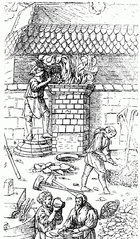 A bloomery consists of a pit or chimney
with heat-resistant walls made of earth
, clay
, or stone
. Near the bottom, one or more pipes (made of clay or metal) enter through the side walls. These pipes, called tuyère
s, allow air to enter the furnace, either by natural draft, or forced with bellows
or a trompe
. An opening at the bottom of the bloomery may be used to remove the bloom, or the bloomery can be tipped over and the bloom removed from the top.
and the iron ore. The charcoal is produced by heating wood
to produce the nearly pure carbon
fuel needed for the smelting process. The ore
is broken into small pieces and usually roasted in a fire to remove any moisture in the ore. Any large impurities in the ore can be crushed and removed. Since slag from previous blooms may have a high iron content, it can also be broken up and recycled into the bloomery with the new ore.
In operation, the bloomery is preheated by burning charcoal, and once hot, iron ore and additional charcoal are introduced through the top, in a roughly one to one ratio. Inside the furnace, carbon monoxide
from the incomplete combustion
of the charcoal reduces
the iron oxides in the ore to metallic iron
, without melting the ore; this allows the bloomery to operate at lower temperatures than the melting temperature of the ore. As the desired product of a bloomery is iron which is easily forgeable, nearly pure, and with a low carbon content, the temperature and ratio of charcoal to iron ore must be carefully controlled to keep the iron from absorbing too much carbon and thus becoming unforgeable. Because the bloomery is self-fluxing the addition of limestone
is not required to form a slag.
The small particles of iron produced in this way fall to the bottom of the furnace and become welded together to form the spongy mass of the bloom. The bottom of the furnace also fills with molten slag, often consisting of fayalite
, a compound of silicon
, oxygen
and iron mixed with other impurities from the ore. Because the bloom is highly porous, and its open spaces are full of slag, the bloom must later be reheated and beaten with a hammer to drive the molten slag out of it. Iron treated this way is said to be wrought, and the resulting nearly pure iron wrought iron or bar iron. It is also possible to produce steel
by manipulating the charge of and air flow to the bloomery .
and tin
.
The onset of the Iron Age
in most parts of the world coincides with the first widespread use of the bloomery. While earlier examples of iron are found, their high nickel
content indicates that this is meteor
ic iron. Other early samples of iron may have been produced by accidental introduction of iron ore in bronze
smelting operations.
has long been considered the exception: by 5th century BC, metalworkers in the southern state of Wu had invented the blast furnace, and the means to both cast iron and to decarburize the carbon-rich pig iron produced in a blast furnace to a low-carbon, wrought iron-like material. It was thought that the Chinese skipped the bloomery process completely, starting with the blast furnace and the finery forge
to get wrought iron. Recent evidence, however, shows that bloomeries were used earlier in China, migrating in from the west as early as 800 BC, before being supplanted by the locally developed blast furnace. Supporting this theory was the discovery of 'more than ten' iron digging elements found in the tomb of the Qin Duke Jing (d. 537 BCE), whose tomb is located in Fengxiang County, Shaanxi (a museum exists on the site today).
Bloomery type furnaces typically produce a range of iron products from very low carbon iron to cast iron. Cast iron occurs when the iron melts and absorbs 2% to 4% carbon. It cannot be forged. Natural steel is also produced, ranging for approximately 0.2% to 1.5% carbon. The master smith had to select bits of low carbon (wrought) iron and low carbon (mild) steel, forge weld them together to make sheets, pile bits of high carbon steel on the sheet, put another low carbon sheet on top,and forge weld it all together. Then he had to forge it out thin, fold it , and forge weld it. This pound-out, fold and weld process eventually got the material more or less homogenous and got rid of much of the slag. The process had to be repeated up to 15 times when high quality steel was needed, as for a sword. This is part of the reason decent swords were so expensive. Each welding heat burns out about 0.03% carbon, so the mastersmith had to make sure there was enough high carbon steel in the raw mixture.
and Wales
, despite the arrival of the blast furnace in the Weald
in about 1491, bloomery forges (probably using water-power for a hammer as well as the bellows) were operating in the West Midlands
region beyond 1580. In Furness
and Cumberland
, they operated into the early 17th century and the last one in England (near Garstang
) did not close until about 1770.
and southern France
as Catalan
forges to the mid-19th century, and in Austria
as the stuckofen to 1775. In Adirondacks, New York
, new bloomeries using the hot blast
technique were built in the 19th century.
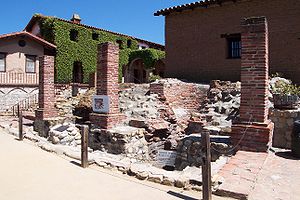 In the Spanish colonization of the Americas
, bloomeries or "Catalan forges" were part of 'self sufficiency' at some of the missions, encomienda
s, and pueblos. As part of the Franciscan Spanish missions
in Alta California
, the "Catalan forges" at Mission San Juan Capistrano
from the 1790s are the oldest existing facilities of their kind in the present day state of California
. The bloomeries' sign proclaims the site as being "...part of Orange County
's first industrial complex."
Furnace
A furnace is a device used for heating. The name derives from Latin fornax, oven.In American English and Canadian English, the term furnace on its own is generally used to describe household heating systems based on a central furnace , and sometimes as a synonym for kiln, a device used in the...
once widely used for smelting
Smelting
Smelting is a form of extractive metallurgy; its main use is to produce a metal from its ore. This includes iron extraction from iron ore, and copper extraction and other base metals from their ores...
iron
Iron
Iron is a chemical element with the symbol Fe and atomic number 26. It is a metal in the first transition series. It is the most common element forming the planet Earth as a whole, forming much of Earth's outer and inner core. It is the fourth most common element in the Earth's crust...
from its oxides. The bloomery was the earliest form of smelter capable of smelting iron. A bloomery's product is a porous mass of iron and slag
Slag
Slag is a partially vitreous by-product of smelting ore to separate the metal fraction from the unwanted fraction. It can usually be considered to be a mixture of metal oxides and silicon dioxide. However, slags can contain metal sulfides and metal atoms in the elemental form...
called a bloom. This mix of slag and iron in the bloom is termed sponge iron, which is usually consolidated (shingled
Shingling (metallurgy)
Shingling was a stage in the production of bar iron or steel, in the finery and puddling processes. As with many ironmaking terms, this is derived from the French - cinglage....
) and further forge
Forge
A forge is a hearth used for forging. The term "forge" can also refer to the workplace of a smith or a blacksmith, although the term smithy is then more commonly used.The basic smithy contains a forge, also known as a hearth, for heating metals...
d into wrought iron
Wrought iron
thumb|The [[Eiffel tower]] is constructed from [[puddle iron]], a form of wrought ironWrought iron is an iron alloy with a very low carbon...
. The bloomery has now largely been superseded by the blast furnace
Blast furnace
A blast furnace is a type of metallurgical furnace used for smelting to produce industrial metals, generally iron.In a blast furnace, fuel and ore and flux are continuously supplied through the top of the furnace, while air is blown into the bottom of the chamber, so that the chemical reactions...
, which produces pig iron
Pig iron
Pig iron is the intermediate product of smelting iron ore with a high-carbon fuel such as coke, usually with limestone as a flux. Charcoal and anthracite have also been used as fuel...
.
Structure and process
Chimney
A chimney is a structure for venting hot flue gases or smoke from a boiler, stove, furnace or fireplace to the outside atmosphere. Chimneys are typically vertical, or as near as possible to vertical, to ensure that the gases flow smoothly, drawing air into the combustion in what is known as the...
with heat-resistant walls made of earth
Earth
Earth is the third planet from the Sun, and the densest and fifth-largest of the eight planets in the Solar System. It is also the largest of the Solar System's four terrestrial planets...
, clay
Clay
Clay is a general term including many combinations of one or more clay minerals with traces of metal oxides and organic matter. Geologic clay deposits are mostly composed of phyllosilicate minerals containing variable amounts of water trapped in the mineral structure.- Formation :Clay minerals...
, or stone
Rock (geology)
In geology, rock or stone is a naturally occurring solid aggregate of minerals and/or mineraloids.The Earth's outer solid layer, the lithosphere, is made of rock. In general rocks are of three types, namely, igneous, sedimentary, and metamorphic...
. Near the bottom, one or more pipes (made of clay or metal) enter through the side walls. These pipes, called tuyère
Tuyere
A tuyere, also can be spelled as tuyère, is a tube, nozzle or pipe through which air is blown into a furnace or hearth.Air or oxygen is injected into a hearth under pressure from bellows or a blast engine or other devices...
s, allow air to enter the furnace, either by natural draft, or forced with bellows
Bellows
A bellows is a device for delivering pressurized air in a controlled quantity to a controlled location.Basically, a bellows is a deformable container which has an outlet nozzle. When the volume of the bellows is decreased, the air escapes through the outlet...
or a trompe
Trompe
A trompe is a water-powered gas compressor, commonly used before the advent of the electric-powered compressor. A trompe is somewhat like an airlift pump working in reverse....
. An opening at the bottom of the bloomery may be used to remove the bloom, or the bloomery can be tipped over and the bloom removed from the top.
Process
The first step taken before the bloomery can be used is the preparation of the charcoalCharcoal
Charcoal is the dark grey residue consisting of carbon, and any remaining ash, obtained by removing water and other volatile constituents from animal and vegetation substances. Charcoal is usually produced by slow pyrolysis, the heating of wood or other substances in the absence of oxygen...
and the iron ore. The charcoal is produced by heating wood
Wood
Wood is a hard, fibrous tissue found in many trees. It has been used for hundreds of thousands of years for both fuel and as a construction material. It is an organic material, a natural composite of cellulose fibers embedded in a matrix of lignin which resists compression...
to produce the nearly pure carbon
Carbon
Carbon is the chemical element with symbol C and atomic number 6. As a member of group 14 on the periodic table, it is nonmetallic and tetravalent—making four electrons available to form covalent chemical bonds...
fuel needed for the smelting process. The ore
Ore
An ore is a type of rock that contains minerals with important elements including metals. The ores are extracted through mining; these are then refined to extract the valuable element....
is broken into small pieces and usually roasted in a fire to remove any moisture in the ore. Any large impurities in the ore can be crushed and removed. Since slag from previous blooms may have a high iron content, it can also be broken up and recycled into the bloomery with the new ore.
In operation, the bloomery is preheated by burning charcoal, and once hot, iron ore and additional charcoal are introduced through the top, in a roughly one to one ratio. Inside the furnace, carbon monoxide
Carbon monoxide
Carbon monoxide , also called carbonous oxide, is a colorless, odorless, and tasteless gas that is slightly lighter than air. It is highly toxic to humans and animals in higher quantities, although it is also produced in normal animal metabolism in low quantities, and is thought to have some normal...
from the incomplete combustion
Combustion
Combustion or burning is the sequence of exothermic chemical reactions between a fuel and an oxidant accompanied by the production of heat and conversion of chemical species. The release of heat can result in the production of light in the form of either glowing or a flame...
of the charcoal reduces
Redox
Redox reactions describe all chemical reactions in which atoms have their oxidation state changed....
the iron oxides in the ore to metallic iron
Iron
Iron is a chemical element with the symbol Fe and atomic number 26. It is a metal in the first transition series. It is the most common element forming the planet Earth as a whole, forming much of Earth's outer and inner core. It is the fourth most common element in the Earth's crust...
, without melting the ore; this allows the bloomery to operate at lower temperatures than the melting temperature of the ore. As the desired product of a bloomery is iron which is easily forgeable, nearly pure, and with a low carbon content, the temperature and ratio of charcoal to iron ore must be carefully controlled to keep the iron from absorbing too much carbon and thus becoming unforgeable. Because the bloomery is self-fluxing the addition of limestone
Limestone
Limestone is a sedimentary rock composed largely of the minerals calcite and aragonite, which are different crystal forms of calcium carbonate . Many limestones are composed from skeletal fragments of marine organisms such as coral or foraminifera....
is not required to form a slag.
The small particles of iron produced in this way fall to the bottom of the furnace and become welded together to form the spongy mass of the bloom. The bottom of the furnace also fills with molten slag, often consisting of fayalite
Fayalite
Fayalite is the iron-rich end-member of the olivine solid-solution series. In common with all minerals in the olivine group, fayalite crystallizes in the orthorhombic system with cell parameters a 4.82 Å, b 10.48 Å and c Å 6.09.Iron rich olivine is a relatively common constituent of acidic and...
, a compound of silicon
Silicon
Silicon is a chemical element with the symbol Si and atomic number 14. A tetravalent metalloid, it is less reactive than its chemical analog carbon, the nonmetal directly above it in the periodic table, but more reactive than germanium, the metalloid directly below it in the table...
, oxygen
Oxygen
Oxygen is the element with atomic number 8 and represented by the symbol O. Its name derives from the Greek roots ὀξύς and -γενής , because at the time of naming, it was mistakenly thought that all acids required oxygen in their composition...
and iron mixed with other impurities from the ore. Because the bloom is highly porous, and its open spaces are full of slag, the bloom must later be reheated and beaten with a hammer to drive the molten slag out of it. Iron treated this way is said to be wrought, and the resulting nearly pure iron wrought iron or bar iron. It is also possible to produce steel
Steel
Steel is an alloy that consists mostly of iron and has a carbon content between 0.2% and 2.1% by weight, depending on the grade. Carbon is the most common alloying material for iron, but various other alloying elements are used, such as manganese, chromium, vanadium, and tungsten...
by manipulating the charge of and air flow to the bloomery .
History
Iron appears to have been smelted in the west as early as 3000 BC, but bronze smiths, not being familiar with iron, did not put it to use until much later. In the west, iron began to be used around 1200 BC, presumably as a replacement for bronze, which was becoming harder to come by due to shortages of copperCopper
Copper is a chemical element with the symbol Cu and atomic number 29. It is a ductile metal with very high thermal and electrical conductivity. Pure copper is soft and malleable; an exposed surface has a reddish-orange tarnish...
and tin
Tin
Tin is a chemical element with the symbol Sn and atomic number 50. It is a main group metal in group 14 of the periodic table. Tin shows chemical similarity to both neighboring group 14 elements, germanium and lead and has two possible oxidation states, +2 and the slightly more stable +4...
.
The onset of the Iron Age
Iron Age
The Iron Age is the archaeological period generally occurring after the Bronze Age, marked by the prevalent use of iron. The early period of the age is characterized by the widespread use of iron or steel. The adoption of such material coincided with other changes in society, including differing...
in most parts of the world coincides with the first widespread use of the bloomery. While earlier examples of iron are found, their high nickel
Nickel
Nickel is a chemical element with the chemical symbol Ni and atomic number 28. It is a silvery-white lustrous metal with a slight golden tinge. Nickel belongs to the transition metals and is hard and ductile...
content indicates that this is meteor
METEOR
METEOR is a metric for the evaluation of machine translation output. The metric is based on the harmonic mean of unigram precision and recall, with recall weighted higher than precision...
ic iron. Other early samples of iron may have been produced by accidental introduction of iron ore in bronze
Bronze
Bronze is a metal alloy consisting primarily of copper, usually with tin as the main additive. It is hard and brittle, and it was particularly significant in antiquity, so much so that the Bronze Age was named after the metal...
smelting operations.
Imperial China
ChinaChina
Chinese civilization may refer to:* China for more general discussion of the country.* Chinese culture* Greater China, the transnational community of ethnic Chinese.* History of China* Sinosphere, the area historically affected by Chinese culture...
has long been considered the exception: by 5th century BC, metalworkers in the southern state of Wu had invented the blast furnace, and the means to both cast iron and to decarburize the carbon-rich pig iron produced in a blast furnace to a low-carbon, wrought iron-like material. It was thought that the Chinese skipped the bloomery process completely, starting with the blast furnace and the finery forge
Finery forge
Iron tapped from the blast furnace is pig iron, and contains significant amounts of carbon and silicon. To produce malleable wrought iron, it needs to undergo a further process. In the early modern period, this was carried out in a finery forge....
to get wrought iron. Recent evidence, however, shows that bloomeries were used earlier in China, migrating in from the west as early as 800 BC, before being supplanted by the locally developed blast furnace. Supporting this theory was the discovery of 'more than ten' iron digging elements found in the tomb of the Qin Duke Jing (d. 537 BCE), whose tomb is located in Fengxiang County, Shaanxi (a museum exists on the site today).
Medieval Europe
Early bloomeries were relatively small, smelting less than 1 kg of iron with each firing. Medieval Europe saw the construction of progressively larger bloomeries, leveling off at around 15 kg on average, though exceptions did exist. The use of waterwheels to power the bellows allowed the bloomery to become larger and hotter; European average bloom sizes quickly rose to 300 kg, where they levelled off through the demise of the bloomery. Water powered bellows and larger bloomeries also increased the heat to the point where the iron could melt; this was not considered desirable because it allowed carbon to diffuse into the molten iron, producing unworkable pig iron. Molten iron was not desirable until the advent of the blast furnace.Bloomery type furnaces typically produce a range of iron products from very low carbon iron to cast iron. Cast iron occurs when the iron melts and absorbs 2% to 4% carbon. It cannot be forged. Natural steel is also produced, ranging for approximately 0.2% to 1.5% carbon. The master smith had to select bits of low carbon (wrought) iron and low carbon (mild) steel, forge weld them together to make sheets, pile bits of high carbon steel on the sheet, put another low carbon sheet on top,and forge weld it all together. Then he had to forge it out thin, fold it , and forge weld it. This pound-out, fold and weld process eventually got the material more or less homogenous and got rid of much of the slag. The process had to be repeated up to 15 times when high quality steel was needed, as for a sword. This is part of the reason decent swords were so expensive. Each welding heat burns out about 0.03% carbon, so the mastersmith had to make sure there was enough high carbon steel in the raw mixture.
British Isles
In EnglandEngland
England is a country that is part of the United Kingdom. It shares land borders with Scotland to the north and Wales to the west; the Irish Sea is to the north west, the Celtic Sea to the south west, with the North Sea to the east and the English Channel to the south separating it from continental...
and Wales
Wales
Wales is a country that is part of the United Kingdom and the island of Great Britain, bordered by England to its east and the Atlantic Ocean and Irish Sea to its west. It has a population of three million, and a total area of 20,779 km²...
, despite the arrival of the blast furnace in the Weald
Weald
The Weald is the name given to an area in South East England situated between the parallel chalk escarpments of the North and the South Downs. It should be regarded as three separate parts: the sandstone "High Weald" in the centre; the clay "Low Weald" periphery; and the Greensand Ridge which...
in about 1491, bloomery forges (probably using water-power for a hammer as well as the bellows) were operating in the West Midlands
West Midlands (region)
The West Midlands is an official region of England, covering the western half of the area traditionally known as the Midlands. It contains the second most populous British city, Birmingham, and the larger West Midlands conurbation, which includes the city of Wolverhampton and large towns of Dudley,...
region beyond 1580. In Furness
Furness
Furness is a peninsula in south Cumbria, England. At its widest extent, it is considered to cover the whole of North Lonsdale, that part of the Lonsdale hundred that is an exclave of the historic county of Lancashire, lying to the north of Morecambe Bay....
and Cumberland
Cumberland
Cumberland is a historic county of North West England, on the border with Scotland, from the 12th century until 1974. It formed an administrative county from 1889 to 1974 and now forms part of Cumbria....
, they operated into the early 17th century and the last one in England (near Garstang
Garstang
Garstang is a town and civil parish within the Wyre borough of Lancashire, England. It is ten miles north-northwest of the city of Preston and eleven miles south of Lancaster, and had a total resident population of 4,074 in 2001....
) did not close until about 1770.
Europe
They survived in SpainSpain
Spain , officially the Kingdom of Spain languages]] under the European Charter for Regional or Minority Languages. In each of these, Spain's official name is as follows:;;;;;;), is a country and member state of the European Union located in southwestern Europe on the Iberian Peninsula...
and southern France
France
The French Republic , The French Republic , The French Republic , (commonly known as France , is a unitary semi-presidential republic in Western Europe with several overseas territories and islands located on other continents and in the Indian, Pacific, and Atlantic oceans. Metropolitan France...
as Catalan
Catalonia
Catalonia is an autonomous community in northeastern Spain, with the official status of a "nationality" of Spain. Catalonia comprises four provinces: Barcelona, Girona, Lleida, and Tarragona. Its capital and largest city is Barcelona. Catalonia covers an area of 32,114 km² and has an...
forges to the mid-19th century, and in Austria
Austria
Austria , officially the Republic of Austria , is a landlocked country of roughly 8.4 million people in Central Europe. It is bordered by the Czech Republic and Germany to the north, Slovakia and Hungary to the east, Slovenia and Italy to the south, and Switzerland and Liechtenstein to the...
as the stuckofen to 1775. In Adirondacks, New York
New York
New York is a state in the Northeastern region of the United States. It is the nation's third most populous state. New York is bordered by New Jersey and Pennsylvania to the south, and by Connecticut, Massachusetts and Vermont to the east...
, new bloomeries using the hot blast
Hot blast
Hot blast refers to the preheating of air blown into a blast furnace or other metallurgical process. This has the result of considerably reducing the fuel consumed in the process...
technique were built in the 19th century.
New World
Spanish colonization of the Americas
Colonial expansion under the Spanish Empire was initiated by the Spanish conquistadores and developed by the Monarchy of Spain through its administrators and missionaries. The motivations for colonial expansion were trade and the spread of the Christian faith through indigenous conversions...
, bloomeries or "Catalan forges" were part of 'self sufficiency' at some of the missions, encomienda
Encomienda
The encomienda was a system that was employed mainly by the Spanish crown during the colonization of the Americas to regulate Native American labor....
s, and pueblos. As part of the Franciscan Spanish missions
Spanish missions in California
The Spanish missions in California comprise a series of religious and military outposts established by Spanish Catholics of the Franciscan Order between 1769 and 1823 to spread the Christian faith among the local Native Americans. The missions represented the first major effort by Europeans to...
in Alta California
Alta California
Alta California was a province and territory in the Viceroyalty of New Spain and later a territory and department in independent Mexico. The territory was created in 1769 out of the northern part of the former province of Las Californias, and consisted of the modern American states of California,...
, the "Catalan forges" at Mission San Juan Capistrano
Mission San Juan Capistrano
Mission San Juan Capistrano was a Spanish mission in Southern California, located in present-day San Juan Capistrano. It was founded on All Saints Day November 1, 1776, by Spanish Catholics of the Franciscan Order...
from the 1790s are the oldest existing facilities of their kind in the present day state of California
California
California is a state located on the West Coast of the United States. It is by far the most populous U.S. state, and the third-largest by land area...
. The bloomeries' sign proclaims the site as being "...part of Orange County
Orange County, California
Orange County is a county in the U.S. state of California. Its county seat is Santa Ana. As of the 2010 census, its population was 3,010,232, up from 2,846,293 at the 2000 census, making it the third most populous county in California, behind Los Angeles County and San Diego County...
's first industrial complex."
External links
- Technology and archaeology of the earliest iron smelting and smithing
- Rockbridge bloomery
- Viking-Era Norse techniques by DARC
- WIRG experimental bloomery
- Precursors of the blast furnace
- Roger Smith's article on bloomery construction
- How Stuff Works
- The Smelter's Art Experimental Iron Production at The Rockbridge Bloomery
- Early use of iron in China
- The Catalan process for the direct production of malleable iron and its spread to Europe and the Americas PDF by Estanislau Tomàs (retrieved March 23, 2010)