

Geisha

Encyclopedia
, Geiko or Geigi are traditional, female Japan
ese entertainers whose skills include performing various Japanese arts such as classical music and dance.
 Geisha , like all Japanese nouns, has no distinct singular or plural variants. The word consists of two kanji
, (gei) meaning "art
" and (sha) meaning "person" or "doer". The most literal translation of geisha into English would be "artist," "performing artist," or "artisan." Another name for geisha in is geiko , which is usually used to refer to geisha from western Japan, which includes Kyoto.
Apprentice geisha are called maiko
( or ), literally "dance child") or hangyoku (半玉), "half-jewel" (meaning that they are paid half of the wage of a full geisha), or by the more generic term o-shaku , literally "one who pours (alcohol)". The white make-up and elaborate kimono and hair of a maiko is the popular image held of geisha. A woman entering the geisha community does not have to begin as a maiko, having the opportunity to begin her career as a full geisha. Either way, however, usually a year's training is involved before debuting either as a maiko or as a geisha. A woman above 21 is considered too old to be a maiko and becomes a full geisha upon her initiation into the geisha community. However, those who do go through the maiko stage can enjoy more prestige later in their professional lives.
The only modern maiko that can apprentice before the age of eighteen are in Kyoto
. So on average, Tokyo hangyoku (who typically begin at 18) are slightly older than their Kyoto counterparts (who usually start at 15). Historically, geisha often began the earliest stages of their training at a very young age, sometimes as early as at 3 or 5 years. The early shikomi (servant) and minarai (watching apprentice) stages of geisha training lasted years, which is significantly longer than in contemporary times.
It is still said that geisha inhabit a separate reality which they call the karyūkai or "the flower and willow world." Before they disappeared the courtesans were the colorful "flowers" and the geisha the "willows" because of their subtlety, strength, and grace.
(Kyoto) in 794 the conditions that would form Japanese Geisha culture began to emerge, as it became the home of a beauty-obsessed elite. Skilled female performers, such as Shirabyōshi
dancers, thrived.
Traditional Japan embraced sexual delights (it is not a Shinto
taboo) and men were not constrained to be faithful to their wives. The ideal wife was a modest mother and manager of the home; by Confucian custom
love had secondary importance. For sexual enjoyment and romantic attachment, men did not go to their wives, but to courtesan
s. Walled-in pleasure quarters
were built in the 16th century, and in 1617 the shogunate
designated "pleasure quarters", outside of which prostitution would be illegal, and within which "yūjo" ("play women") would be classified and licensed. The highest yūjo class was the Geisha's predecessor, called "Oiran
", a combination of actress and prostitute, originally playing on stages set in the dry Kamo
riverbed in Kyoto. They performed erotic dances and skits, and this new art was dubbed kabuku, meaning "to be wild and outrageous". The dances were called "kabuki," and this was the beginning of kabuki theater.
. Gradually, they all became specialized and the new profession, purely of entertainment, arose. It was near the turn of the eighteenth century that the first entertainers of the pleasure quarters, called geisha, appeared. The very first geishas were men, entertaining customers waiting to see the most popular and gifted courtesans (oiran).
The forerunners of the female geisha were the teenage odoriko ("dancing girls"
): expensively trained as chaste dance
rs-for-hire. In the 1680s, they were popular paid entertainers in the private homes of upper-class samurai, though many had turned to prostitution by the early 18th century. Those who were no longer teenagers (and could no longer style themselves odoriko) adopted other names—one being "geisha", after the male entertainers. The first woman known to have called herself geisha was a Fukagawa
prostitute, in about 1750. She was a skilled singer and shamisen
-player named Kikuya who was an immediate success, making female geisha extremely popular in 1750s Fukagawa. As they became more widespread throughout the 1760s and 1770s, many began working only as entertainers (rather than prostitutes) often in the same establishments as male geisha.
By 1800, being a geisha was considered a female occupation (though there are still a handful of male geisha working today). Eventually, the gaudy Oiran began to fall out of fashion, becoming less popular than the chic, "iki", and modern geisha. By the 1830s, the evolving geisha style was emulated by fashionable women throughout society. There were many different classifications and ranks of geisha. Some women would have sex with their male customers, whereas others would entertain strictly with their art forms. Prostitution was legal up until the 1900s, so it was practiced in many quarters throughout Japan.
World War II
brought a huge decline in the geisha arts because most women had to go to factories or other places to work for Japan. The geisha name also lost some status during this time because prostitutes began referring to themselves as "geisha girls" to American military men. In 1944, everything in the geisha's world, including teahouses, bars, and houses, was forced to shut down, and all employees were put to work in factories. About a year later, they were allowed to reopen. The very few women who returned to the geisha areas decided to reject Western influence and revert back to traditional ways of entertainment and life. "The image of the geisha was formed during Japan's feudal past, and this is now the image they must keep in order to remain geisha". It was up to the these returning geisha to bring back traditional standards in the profession, though with increased rights for the geisha:
Before the war, a maiko's virginity would be auctioned (the original "mizuage
"). This was outlawed in 1959, but has been reported as relatively normal in the 1990s, and happening "on a limited basis" in 2001. Compulsory education laws passed in the 1960s made traditional geisha apprenticeships difficult, leading to a decline in women entering the field. The simultaneous growth of Japanese industry, which opened other opportunities for women, further contributed to the decline of the geisha industry.
In her book Geisha, a Life, Mineko Iwasaki
said: "I lived in the karyukai during the 1960s and 1970s, a time when Japan was undergoing the radical transformation from a post-feudal to a modern society. But I existed in a world apart, a special realm whose mission and identity depended on preserving the time-honored traditions of the past."
("flower towns"). Gion Kōbu
, Pontochō
and Kamishichiken
have the highest status; they are very expensive, and are frequented by powerful businessmen and politicians (Gion Kōbu is sometimes seen as having the very highest ranking). Geikos from the other two hanamachi (Gion Higashi and Miyagawa-cho
) have high prestige but are considered to be one rank lower.
At the opposite end of the spectrum are the hot-spring geisha. These geisha work in the spa resorts and are viewed by most Japanese as no better than a common prostitute. They normally cater to far less exclusive patrons, and are much less expensive. If their income is supplemented by selling sex, they remain distinct from regular prostitutes; like all geisha, they are trained in the art of Japanese dance and music. Even so, hanamachi geisha might be horrified if categorized with hot-spring geisha.
A maiko is essentially an apprentice and is therefore bonded under a contract to her okiya. The okiya supplies her with food, board, kimonos, obis
, and other tools of her trade. Her training is very expensive, and her debt must be repaid to the okiya with the earnings she makes. This repayment may continue after the maiko becomes a full-fledged geisha and only when her debts are settled is she permitted to move out to live and work independently.
A maiko
will start her formal training on the job as a minarai, which literally means "learning by watching". Before she can do this she must find an onee-san ("older sister": an older geisha acting as her mentor). It is the onee-sans responsibility to bring her to the ozashiki (お座敷, a banquet in any traditional Japanese building
with tatami
), to sit and observe as the onee-san is at work. This is a way in which she will gain insights of the job, and seek out potential clients. Although minarai attend ozashiki, they do not participate at an advanced level. Their kimono
, more elaborate than a maiko's, are intended to do the talking for them. Minarai can be hired for parties but are usually uninvited (yet welcomed) guests at parties that their onee-san attends. They only charge a third of the usual fee. Minarai generally work with a particular tea house (minarai-jaya) learning from the okaa-san (literally "mother," the proprietress of the house). From her, they would learn techniques such as conversation and gaming, which would not be taught to them in school. This stage lasts only about a month or so.
After a short period the final stage of training begins, and the students are called "maiko
". Maiko (literally "dance girl") are apprentice geisha, and this stage can last for years. Maiko learn from their senior geisha mentor and follow them to all their engagements. The onee-san and imouto-san (senior/junior, literally "older sister/younger sister") relationship is important. The onee-san teaches her maiko everything about working in the hanamachi
. The onee-san will teach her proper ways of serving tea, playing shamisen
, dancing, casual conversation and more. The onee-san will even help pick the maiko's new professional name with kanji
or symbols related to her name.
There are three major elements of a maiko's training. The first is the formal arts training. This takes place in special geisha schools which are found in every hanamachi. The second element is the entertainment training which the maiko learns at various teahouses and parties by observing her onee-san. The third is the social skill of navigating the complex social web of the hanamachi. This is done on the streets. Formal greetings, gifts, and visits are key parts of any social structure in Japan and for a maiko, they are crucial for her to build the support network she needs to survive as a geisha.
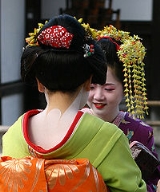
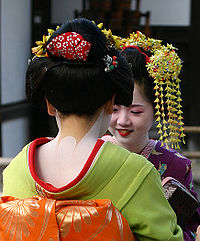
Maiko are considered one of the great sights of Japanese tourism, and look very different from fully qualified Geisha. They are at the peak of traditional Japanese femininity. The scarlet-fringed collar of a maiko's kimono hangs very loosely in the back to accentuate the nape of the neck, which is considered a primary erotic area in Japanese sexuality. She wears the same white makeup for her face on her nape, leaving two or sometimes three stripes of bare skin exposed. Her kimono is bright and colorful with an elaborately tied obi hanging down to her ankles. She takes very small steps and wears traditional wooden shoes called okobo
which stand nearly ten centimeters high. There are 5 different hairstyle
s that a maiko wears, that mark the different stages of her apprenticeship. The "Nihongami
" hairstyle with "kanzashi" hair-ornamentation strips is most closely associated with maiko, who spend hours each week at the hairdresser and sleep on holed-pillows to preserve the elaborate styling. Maiko can develop a bald spot on their crown caused by rubbing from Kanzashi strips and tugging in hairdressing. This was associated with the maiko's womanhood, as it came from a pulled knot in the ofuku hairstyle that a maiko would wear after her mizuage
or first sexual experience (before which, the maiden
wareshinobu style was worn).
Around the age of 20–22, the maiko is promoted to a full-fledged geisha in a ceremony called erikae
(turning of the collar). This could happen after two to five years of her life as a maiko or hangyoku, depending on at what age she debuted. She now charges full price for her time. Geisha remain as such until they retire.
Geisha learn the traditional skills of dance and instruments, and hold high social status
. Geisha are single women, though they may have lovers or boyfriends whom they have personally picked, who support them financially.
Geisha may gracefully flirt with their (often infatuated) guests, but they will always remain in control of the hospitality. Over their years of apprenticeship they learn to adapt to different situations and personalities, mastering the art of the hostess.
The majority of women were wives who didn't work outside of their familial duties. Becoming a geisha was a way for women to support themselves without submitting to becoming a wife. The geisha women live in a strictly matriarchal society. Women dominate. Women run the geisha houses, they are teachers, they run the teahouses, they recruit aspiring geisha, and they keep track of geishas' finances. The only major role men play in geisha society is that of guest, though women sometimes take that role as well.
Historically, Japanese feminists have seen geisha as exploited women but some modern geisha see themselves as liberated feminists. "We find our own way, without doing family responsibilities. Isn't that what feminists are?”. These women leave their families at a young age to immerse themselves in their art. Some believe that since men can make a life for themselves, always being in control, so why can't women? They "have grown adept at using their silken charms to wind their men around their little fingers... [to] manipulate the dumb, unsuspecting male of the species... to make a man think that he is the one who has the brilliant ideas". Not all geisha identify themselves with feminism
, and there is a concern that the geisha tradition holds back progress for Japanese women.
Prostitution was legal in Japan until 1958, which is another reason that people may be misinformed about geishas not offering sex to customers. The two became especially confused after many of the professional prostitutes who catered to the occupying soldiers after World War II styled themselves as "geisha"; at a time when few true geisha were able to work, the counterfeit geisha usurped the meaning of the word in the eyes of many foreigners.
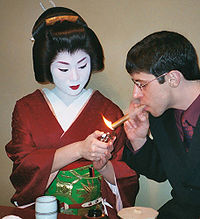
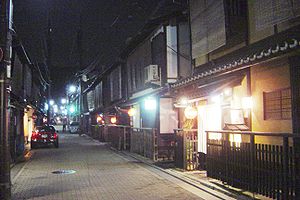 Modern geisha still live in traditional geisha houses called okiya in areas called hanamachi
( "flower towns"), particularly during their apprenticeship. Many experienced geisha are successful enough to choose to live independently. The elegant, high-culture world that geisha are a part of is called karyūkai ( "the flower and willow world").
Before the twentieth century, geisha training began when a girl was around the age of four. Now, girls usually go to school until they are teenagers and then make the personal decision to train to become a geisha. Young women who wish to become geisha now most often begin their training after completing middle school, high school, or even college. Many women begin their careers in adulthood.
Geisha still study traditional instruments: the shamisen
, shakuhachi
, and drums, as well as learning games, traditional songs, calligraphy, Japanese traditional dances, tea ceremony
, literature, and poetry
. Women dancers drawing their art from butō (a classical Japanese dance) were trained by the Hanayagi school, whose top dancers performed internationally. Ichinohe Sachiko choreographed and performed traditional dances in Heian court costumes, characterized by the slow, formal, and elegant motions of this classical age of Japanese culture in which geisha are trained.
By watching other geisha, and with the assistance of the owner of the geisha house, apprentices also become skilled dealing with clients and in the complex traditions surrounding selecting and wearing kimono
, a floor length silk robe embroidered with intricate designs which is held together by a sash at the waist which is called an obi.
Kyoto is considered by many to be where the geisha tradition is the strongest today, including Gion Kobu. The geisha in these districts are known as geiko. The Tokyo hanamachi of Shimbashi, Asakusa and Kagurazaka
are also well known.
In modern Japan, geisha and maiko are now a rare sight outside hanamachi. In the 1920s, there were over 80,000 geisha in Japan, but today, there are far fewer. The exact number is unknown to outsiders and is estimated to be from 1,000 to 2,000, mostly in the resort town of Atami
. Most common are sightings of tourists who pay a fee to be dressed up as a maiko.
A sluggish economy, declining interest in the traditional arts, the exclusive nature of the flower and willow world, and the expense of being entertained by geisha have all contributed to the tradition's decline.
Geisha are often hired to attend parties and gatherings, traditionally at tea houses or at traditional Japanese restaurants (ryōtei). The charge for a geisha's time (measured by burning incense stick) is called senkōdai or gyokudai ( "jewel fee"). In Kyoto, the terms ohana and hanadai , meaning "flower fees", are preferred. The customer makes arrangements through the geisha union office ( kenban), which keeps each geisha's schedule and makes her appointments both for entertaining and for training.
Non-Japanese women have also become geisha. In 2007, Australian national Fiona Graham debuted under the name Sayuki in the Asakusa district of Tokyo, and in 2010, Romanian national Isabella Onou debuted under the name Fukutarō in the Izu-Nagaoka district of Shizuoka.
Notably, the geisha (including maiko) of the Kamishichiken
district in northwest Kyoto serve tea to 3,000 guests on February 25 in an annual open-air tea ceremony (野点, nodate) at the plum-blossom festival (梅花祭, baikasai) at Kitano Tenman-gū
shrine. As of 2010, these geisha also serve beer in a beer garden
at Kamishichiken Kaburenjo Theatre during summer months (July to early September); another geisha beer garden is available at the Gion Shinmonso ryokan in the Gion district. These beer gardens also feature traditional dances by the geisha in the evenings.
The word geisha literally means "artist" and late in the eighteenth century this could have described an array of Japanese women artists: Shiro, purely an entertainer; kerobi, a tumbling geisha; kido, a geisha who stood at the entrance to carnivals; or joro, a prostitute and the type of woman that professional geishas have been wrongly mistaken as for many years.
The dance of the geisha has evolved from the dance performed on the kabuki stage. The "wild and outrageous" dances transformed into a more subtle, stylized, and controlled form of dance. It is extremely disciplined, similar to t'ai chi. Every dance uses gestures to tell a story and only a connoisseur can understand the subdued symbolism. For example, a tiny hand gesture represents reading a love letter, holding the corner of a handkerchief in the mouth represents coquetry and the long sleeves of the elaborate kimono are often used to symbolize dabbing tears.
The dances are accompanied by traditional Japanese music. The primary instrument is the shamisen
. The shamisen was introduced to the geisha culture in 1750 and has been mastered by female Japanese artists for years. This shamisen, originating in Okinawa, is a banjo-like three-stringed instrument that is played with a plectrum. It has a very distinct, melancholy sound that is often accompanied by flute. The instrument is described as "melancholy" because traditional shamisen music uses only minor third
s and sixths. All geisha must learn shamisen-playing, though it takes years to master. Along with the shamisen and the flute, geisha also learned to play a ko-tsuzumi
, a small, hourglass-shaped
shoulder drum, and a large floor taiko
(drum). Some geisha would not only dance and play music, but would write beautiful, melancholy poems. Others painted pictures or composed music.
s; however, clients know that nothing more can be expected. In a social style that is common in Japan, men are amused by the illusion of that which is never to be.
Geisha have been confused with the Edo period
's high-class courtesans known as oiran, from whom they evolved. Like geisha, oiran wore elaborate hairstyles and white makeup, but oiran knotted their obi
in the front. It has been commonly thought the obi was tied that way for easy removal, though anthropologist Liza Dalby
has suggested that it was because it was the practice of married women at the time.
During the Edo period, prostitution
was legal. Prostitutes such as the oiran worked within walled-in districts licensed by the government. In the late eighteenth century, dancing women called "odoriko" and newly popular female geisha began entertaining men at banquets in unlicensed districts. Some were apprehended for illegal prostitution and sent to the licensed quarters, where there was a strict distinction between geisha and prostitutes, and the former were forbidden to sell sex. In contrast, "machi geisha", who worked outside the licensed districts, often engaged in illegal prostitution.
In 1872, shortly after the Meiji Restoration
, the new government passed a law liberating "prostitutes (shōgi) and geisha (geigi)". The wording of this statute was the subject of controversy. Some officials thought that prostitutes and geisha worked at different ends of the same profession—selling sex— and that all prostitutes should henceforth be called "geisha". In the end, the government decided to maintain a line between the two groups, arguing that geisha were more refined and should not be soiled by association with prostitutes.
Also, geisha working in onsen
towns such as Atami are dubbed onsen geisha
. Onsen geisha have been given a bad reputation due to the prevalence of prostitutes in such towns who market themselves as "geisha," as well as sordid rumors of dance routines like Shallow River (which involves the "dancers" lifting the skirts of their kimono
higher and higher). In contrast to these "one-night geisha," the true onsen geisha are in fact competent dancers and musicians. However, the autobiography of Sayo Masuda, an onsen geisha who worked in Nagano Prefecture in the 1930s, reveals that in the past, such women were often under intense pressure to sell sex.
It was traditional in the past for established geisha to take a danna, or patron. A danna was typically a wealthy man, sometimes married, who had the means to support the very large expenses related to a geisha's traditional training and other costs. This sometimes occurs today as well, but very rarely. A geisha and her danna may or may not be in love, but intimacy is never viewed as a reward for the danna's financial support. The traditional conventions and values within such a relationship are very intricate and not well understood, even by many Japanese.
While it is true that a geisha is free to pursue personal relationships with men she meets through her work, such relationships are carefully chosen and unlikely to be casual. A hanamachi tends to be a very tight-knit community and a geisha's good reputation is not taken lightly.
during the period of the Allied Occupation of Japan
. They almost exclusively serviced American GIs
stationed in the country, who referred to them as "Geesha girls" (a mispronunciation).
These women dressed in kimono
and imitated the look of geisha. Americans unfamiliar with the Japanese culture could not tell the difference between legitimate geisha and these costumed prostitutes. Shortly after their arrival in 1945, occupying American GIs are said to have congregated on the Ginza
and shouted in unison, "We want geesha girls!"
Eventually, the term "geisha girl" became a general word for any female Japanese prostitute or worker in the mizu shobai
and included bar hostesses
and streetwalkers.
Geisha girls are speculated by researchers
to be largely responsible for the continuing misconception in the West that all geisha are engaged in prostitution.
, where a man paid money for the privilege of having sex with the apprentice geisha; this also signifies her coming of age
. This transition usually occurs around the age of twenty. After that a geisha must be able to stand on the strength of her own artistic accomplishments and leaves her "Older sister".
Mizuage literally means "raising the waters" and originally meant unloading a ship's cargo of fish. Over time, the word came to represent money earned in the entertainment business.
During the Edo period
, courtesans' undergoing mizuage were sponsored by a patron who had the right of taking their virginity
. This practice became illegal in 1959. All maikos had to go through this ceremony in order to become a full fledged geisha. Once the mizuage patron's function was served (of deflowering the young maiko) he was to have no further relations with the girl.
The money acquired for a maiko’s mizuage was a great sum and it was used to promote her debut as a geisha. The ceremonial deflowering of the Geisha was not only a commercial transaction, but was a rite of passage
: A fully fledged geisha is a sophisticated "professional woman" expected to have worldly knowledge of the opposite sex.
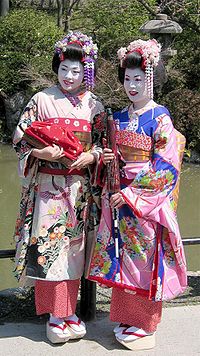 A geisha's appearance changes throughout her career, from the girlish, heavily made-up maiko, to the more sombre appearance of an older established geisha. Different hairstyles and hairpins signify different stages of a young girl’s development and even a detail as minute as the length of one’s eyebrows is significant. Short eyebrows are for the young and long eyebrows display maturity.
The traditional makeup of an apprentice geisha features a thick white base with red lipstick
and red and black accents around the eyes and eyebrows. Originally, the white base mask was made with lead, but after the discovery that it poisoned the skin and caused terrible skin and back problems for the older geisha towards the end of the Meiji Era
, it was replaced with rice powder.
The application of makeup is hard to perfect and is a time-consuming process. Makeup is applied before dressing to avoid dirtying the kimono. First, a wax or oil substance called bintsuke-abura is applied to the skin. Next, white powder is mixed with water into a paste and applied with a bamboo brush starting from the neck and working upwards. The white makeup covers the face, neck, and chest, with two or three unwhitened areas (forming a W or V shape, usually a traditional W shape) left on the nape
, to accentuate this traditionally erotic area, and a line of bare skin around the hairline, which creates the illusion of a mask.
After the foundation layer is applied, a sponge is patted all over the face, throat, chest, the nape and neck to remove excess moisture and to blend the foundation. Next the eyes and eyebrows are drawn in. Traditionally, charcoal was used, but today, modern cosmetics are used. The eyebrows and edges of the eyes are colored black with a thin charcoal; a maiko also applies red around her eyes.
The lips are filled in using a small brush. The color comes in a small stick, which is melted in water. Crystallized sugar is then added to give the lips lustre. Rarely will a geisha color in both lips fully in the Western style, as white creates optical illusions and colouring the lips fully would make them appear overly large. The lower lip is colored in partially and the upper lip left white for maiko in her first year, after which the upper lip is also colored. Newly full-fledged geisha will color in only the top lip fully. Most geisha wear the top lip colored in fully or stylized, and the bottom lip in a curved stripe that does not follow the shape of the lip. Geisha round the bottom lips to create the illusion of a flower bud.
Maiko who are in their last stage of training sometimes color their teeth black
for a brief period. This practice used to be common among married women in Japan and, earlier, at the imperial court, but survives only in some districts. It is done partly because uncoloured teeth seem very yellow in contrast to white face makeup; colouring the teeth black means that they seem to "disappear" in the darkness of the open mouth. This illusion is of course more pronounced at a distance.
For the first three years, a maiko wears this heavy makeup almost constantly. During her initiation, the maiko is helped with her makeup either by her onee-san, or "older sister" (an experienced geisha who is her mentor), or by the okaa-san, or "mother" of her geisha house. After this, she applies the makeup herself.
After a maiko has been working for three years, she changes her make-up to a more subdued style. The reason for this is that she has now become mature, and the simpler style shows her own natural beauty. For formal occasions, the mature geisha will still apply white make-up. For geisha over thirty, the heavy white make-up is only worn during those special dances that require it.
. Apprentice geisha wear highly colorful kimono with extravagant obi
. Always, the obi is brighter than the kimono she is wearing to give a certain exotic balance. Maiko of Kyoto wear the obi tied in a style called "darari" (dangling obi), while Tokyo "hangyoku" wear it tied in various ways, including taiko musubi. Older geisha of Kyoto wear more subdued patterns and styles (most notably the obi tied in a simpler knot utilized by married women known as the "taiko musubi" , or "drum knot"). Tokyo and Kanazawa geisha wear , taiko musubi and .
An apprentice geisha's kimono will have, in addition to the heavy dangling obi, pocketed sleeves called "furi" that dangle all the way to the ground
. During a dance or performance, an apprentice must wrap the pocketed sleeves around her arms many times to avoid tripping.
The color, pattern, and style of kimono is dependent on the season and the event the geisha is attending. In winter, geisha can be seen wearing a three-quarter length haori lined with hand-painted silk over their kimono. Lined kimono are worn during colder seasons, and unlined kimono during the summer. A kimono can take from two to three years to complete, due to painting and embroidering.
Geiko wear red or pink nagajuban, or under-kimono. A maiko wears red with white printed patterns. The junior maiko's collar is predominantly red with white, silver, or gold embroidery. Two to three years into her apprenticeship, the red collar will be entirely embroidered in white (when viewed from the front) to show her seniority. At around age 20, her collar will turn from red to white.
Geisha wear a flat-soled sandal, zori
, outdoors, and wear only tabi
(white split-toed socks) indoors. In inclement weather geisha wear raised wooden clogs, called geta
. Maiko wear a special wooden clog known as okobo
.
Under modern labor laws, girls cannot begin apprenticeship in the geisha world until they are eighteen (with an exception for Kyoto, where fifteen year old girls can become full-time apprentice maiko) but they used to enter at age eleven or twelve and be full geisha by eighteen. Mineko Iwasaki, the inspirational character for Arthur Golden’s Memoirs of a Geisha explains, "The whole idea is perfection. That’s why we need so much training. We can’t charge guests to look at imperfection. It has to be perfect."
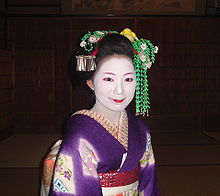 The hairstyles of geisha have varied through history. In the past, it has been common for women to wear their hair down in some periods, but up in others. During the 17th century, women began putting all their hair up again, and it is during this time that the traditional shimada hairstyle
, a type of traditional chignon
worn by most established geisha, developed.
There are four major types of the shimada: the taka shimada, a high chignon usually worn by young, single women; the tsubushi shimada, a more flattened chignon generally worn by older women; the uiwata, a chignon that is usually bound up with a piece of colored cotton crepe
; and a style that resembles a divided peach, which is worn only by maiko. This is sometimes called "Momoware", or "split peach". Additional hairstyles: Ofuku, Katsuyama, Yakko-shimada, and Sakko
. Maiko of Miyagawa-chō and Pontochō will wear an additional six hairstyles leading up to the Sakko, including Umemodoki, Oshidori no Hina, Kikugasane, and Osafune.
These hairstyles are decorated with elaborate hair-combs and hairpins (kanzashi
). In the seventeenth century and after the Meiji Restoration
period, hair-combs were large and conspicuous, generally more ornate for higher-class women. Following the Meiji Restoration and into the modern era, smaller and less conspicuous hair-combs became more popular.
Geisha sleep with their necks on small supports (takamakura), instead of pillows, so they could keep their hairstyle perfect. To reinforce this habit, their mentors would pour rice around the base of the support. If the geisha's head rolled off the support while she slept, rice would stick to the pomade in her hair. Even if there are no accidents, a maiko will need her hair styled every week. Many modern geisha use wig
s in their professional lives, while maiko use their natural hair. Either must be regularly tended by highly skilled artisans. Traditional hairstyling is a slowly dying art. Over time, the hairstyle can cause balding on the top of the head.
and the autobiography of former geisha Iwasaki Mineko, titled Geisha of Gion.
Japan
Japan is an island nation in East Asia. Located in the Pacific Ocean, it lies to the east of the Sea of Japan, China, North Korea, South Korea and Russia, stretching from the Sea of Okhotsk in the north to the East China Sea and Taiwan in the south...
ese entertainers whose skills include performing various Japanese arts such as classical music and dance.
Terms
Kanji
Kanji are the adopted logographic Chinese characters hanzi that are used in the modern Japanese writing system along with hiragana , katakana , Indo Arabic numerals, and the occasional use of the Latin alphabet...
, (gei) meaning "art
Art
Art is the product or process of deliberately arranging items in a way that influences and affects one or more of the senses, emotions, and intellect....
" and (sha) meaning "person" or "doer". The most literal translation of geisha into English would be "artist," "performing artist," or "artisan." Another name for geisha in is geiko , which is usually used to refer to geisha from western Japan, which includes Kyoto.
Apprentice geisha are called maiko
Maiko
is a Japanese word for dancing girl and is an apprentice geisha. Maiko is also a feminine Japanese given name.-Possible writings:Maiko can be written using different kanji characters and can mean:*舞子 or 舞妓, apprentice geishaas a given name...
( or ), literally "dance child") or hangyoku (半玉), "half-jewel" (meaning that they are paid half of the wage of a full geisha), or by the more generic term o-shaku , literally "one who pours (alcohol)". The white make-up and elaborate kimono and hair of a maiko is the popular image held of geisha. A woman entering the geisha community does not have to begin as a maiko, having the opportunity to begin her career as a full geisha. Either way, however, usually a year's training is involved before debuting either as a maiko or as a geisha. A woman above 21 is considered too old to be a maiko and becomes a full geisha upon her initiation into the geisha community. However, those who do go through the maiko stage can enjoy more prestige later in their professional lives.
The only modern maiko that can apprentice before the age of eighteen are in Kyoto
Kyoto
is a city in the central part of the island of Honshū, Japan. It has a population close to 1.5 million. Formerly the imperial capital of Japan, it is now the capital of Kyoto Prefecture, as well as a major part of the Osaka-Kobe-Kyoto metropolitan area.-History:...
. So on average, Tokyo hangyoku (who typically begin at 18) are slightly older than their Kyoto counterparts (who usually start at 15). Historically, geisha often began the earliest stages of their training at a very young age, sometimes as early as at 3 or 5 years. The early shikomi (servant) and minarai (watching apprentice) stages of geisha training lasted years, which is significantly longer than in contemporary times.
It is still said that geisha inhabit a separate reality which they call the karyūkai or "the flower and willow world." Before they disappeared the courtesans were the colorful "flowers" and the geisha the "willows" because of their subtlety, strength, and grace.
Origins
In the early stages of Japanese history, there were female entertainers: saburuko (serving girls) were mostly wandering girls whose families were displaced from struggles in the late 600s. Some of these saburuko girls sold sexual services, while others with a better education made a living by entertaining at high-class social gatherings. After the imperial court moved the capital to Heian-kyōHeian-kyo
Heian-kyō , was one of several former names for the city now known as Kyoto. It was the capital of Japan for over one thousand years, from 794 to 1868 with an interruption in 1180....
(Kyoto) in 794 the conditions that would form Japanese Geisha culture began to emerge, as it became the home of a beauty-obsessed elite. Skilled female performers, such as Shirabyōshi
Shirabyoshi
were female dancers, prominent in the Japanese Imperial Court, who performed traditional Japanese dances dressed as men. The profession of shirabyōshi developed in the 12th century...
dancers, thrived.
Traditional Japan embraced sexual delights (it is not a Shinto
Shinto
or Shintoism, also kami-no-michi, is the indigenous spirituality of Japan and the Japanese people. It is a set of practices, to be carried out diligently, to establish a connection between present day Japan and its ancient past. Shinto practices were first recorded and codified in the written...
taboo) and men were not constrained to be faithful to their wives. The ideal wife was a modest mother and manager of the home; by Confucian custom
Confucian view of marriage
To the Confucians, marriage is of important significance both in the family and in society. In the perspective of family, marriage can bring families of different surnames together, and continue the family life of the concerned clans. Therefore, only the benefits and demerits of the clans, instead...
love had secondary importance. For sexual enjoyment and romantic attachment, men did not go to their wives, but to courtesan
Courtesan
A courtesan was originally a female courtier, which means a person who attends the court of a monarch or other powerful person.In feudal society, the court was the centre of government as well as the residence of the monarch, and social and political life were often completely mixed together...
s. Walled-in pleasure quarters
Red-light district
A red-light district is a part of an urban area where there is a concentration of prostitution and sex-oriented businesses, such as sex shops, strip clubs, adult theaters, etc...
were built in the 16th century, and in 1617 the shogunate
Tokugawa shogunate
The Tokugawa shogunate, also known as the and the , was a feudal regime of Japan established by Tokugawa Ieyasu and ruled by the shoguns of the Tokugawa family. This period is known as the Edo period and gets its name from the capital city, Edo, which is now called Tokyo, after the name was...
designated "pleasure quarters", outside of which prostitution would be illegal, and within which "yūjo" ("play women") would be classified and licensed. The highest yūjo class was the Geisha's predecessor, called "Oiran
Oiran
were courtesans in Japan. The oiran were considered a type of "woman of pleasure" or prostitute. However, they are distinguished from the yūjo in that they were entertainers, and many became celebrities of their times outside the pleasure districts...
", a combination of actress and prostitute, originally playing on stages set in the dry Kamo
Kamo River
The is located in Kyoto Prefecture, Japan. The riverbanks are popular walking spots for residents and tourists. In summer, restaurants open balconies looking out to the river. There are pathways running alongside the river on which one can walk along the river, and some stepping stones that cross...
riverbed in Kyoto. They performed erotic dances and skits, and this new art was dubbed kabuku, meaning "to be wild and outrageous". The dances were called "kabuki," and this was the beginning of kabuki theater.
18th century emergence of the "geisha"
These pleasure quarters quickly became glamorous entertainment centers, offering more than sex. The highly accomplished courtesans of these districts entertained their clients by dancing, singing, and playing music. Some were renowned poets and calligraphersCalligraphy
Calligraphy is a type of visual art. It is often called the art of fancy lettering . A contemporary definition of calligraphic practice is "the art of giving form to signs in an expressive, harmonious and skillful manner"...
. Gradually, they all became specialized and the new profession, purely of entertainment, arose. It was near the turn of the eighteenth century that the first entertainers of the pleasure quarters, called geisha, appeared. The very first geishas were men, entertaining customers waiting to see the most popular and gifted courtesans (oiran).
The forerunners of the female geisha were the teenage odoriko ("dancing girls"
Odoriko
The is a limited express train service in Japan operated by East Japan Railway Company , which runs between Tokyo and or in Shizuoka Prefecture.-Operations:...
): expensively trained as chaste dance
Dance
Dance is an art form that generally refers to movement of the body, usually rhythmic and to music, used as a form of expression, social interaction or presented in a spiritual or performance setting....
rs-for-hire. In the 1680s, they were popular paid entertainers in the private homes of upper-class samurai, though many had turned to prostitution by the early 18th century. Those who were no longer teenagers (and could no longer style themselves odoriko) adopted other names—one being "geisha", after the male entertainers. The first woman known to have called herself geisha was a Fukagawa
Fukagawa (Tokyo)
is a region in Kōtō ward of Tokyo metropolis, Japan. It is one of the representative shitamachi of Tokyo. Formerly, it was a ward of the historical Tokyo City. Its postal code is 135-0033....
prostitute, in about 1750. She was a skilled singer and shamisen
Shamisen
The , also called is a three-stringed, Japanese musical instrument played with a plectrum called a bachi. The Japanese pronunciation is usually "shamisen" but sometimes "jamisen" when used as a suffix . -Construction:The shamisen is a plucked stringed instrument...
-player named Kikuya who was an immediate success, making female geisha extremely popular in 1750s Fukagawa. As they became more widespread throughout the 1760s and 1770s, many began working only as entertainers (rather than prostitutes) often in the same establishments as male geisha.
Rise of the geisha
The geisha who worked within the pleasure quarters were essentially imprisoned and strictly forbidden to sell sex in order to protect the business of the Oiran. While licensed courtesans existed to meet men's sexual needs, machi geisha carved out a separate niche as artists and erudite female companions.By 1800, being a geisha was considered a female occupation (though there are still a handful of male geisha working today). Eventually, the gaudy Oiran began to fall out of fashion, becoming less popular than the chic, "iki", and modern geisha. By the 1830s, the evolving geisha style was emulated by fashionable women throughout society. There were many different classifications and ranks of geisha. Some women would have sex with their male customers, whereas others would entertain strictly with their art forms. Prostitution was legal up until the 1900s, so it was practiced in many quarters throughout Japan.
World War II
World War II
World War II, or the Second World War , was a global conflict lasting from 1939 to 1945, involving most of the world's nations—including all of the great powers—eventually forming two opposing military alliances: the Allies and the Axis...
brought a huge decline in the geisha arts because most women had to go to factories or other places to work for Japan. The geisha name also lost some status during this time because prostitutes began referring to themselves as "geisha girls" to American military men. In 1944, everything in the geisha's world, including teahouses, bars, and houses, was forced to shut down, and all employees were put to work in factories. About a year later, they were allowed to reopen. The very few women who returned to the geisha areas decided to reject Western influence and revert back to traditional ways of entertainment and life. "The image of the geisha was formed during Japan's feudal past, and this is now the image they must keep in order to remain geisha". It was up to the these returning geisha to bring back traditional standards in the profession, though with increased rights for the geisha:
Before the war, a maiko's virginity would be auctioned (the original "mizuage
Mizuage
was a ceremony undergone by a Japanese maiko to signify her coming of age. When the older geisha considered the young maiko ready to come of age, the topknot of her hair was symbolically cut...
"). This was outlawed in 1959, but has been reported as relatively normal in the 1990s, and happening "on a limited basis" in 2001. Compulsory education laws passed in the 1960s made traditional geisha apprenticeships difficult, leading to a decline in women entering the field. The simultaneous growth of Japanese industry, which opened other opportunities for women, further contributed to the decline of the geisha industry.
In her book Geisha, a Life, Mineko Iwasaki
Mineko Iwasaki
, born , was Japan's number one geiko until her sudden retirement at the age of 29. Arthur Golden later used her story to write the book Memoirs of a Geisha.-Geisha:...
said: "I lived in the karyukai during the 1960s and 1970s, a time when Japan was undergoing the radical transformation from a post-feudal to a modern society. But I existed in a world apart, a special realm whose mission and identity depended on preserving the time-honored traditions of the past."
Ranking
At the pinnacle of the complex geisha ranking system are the grand dowagers of Kyoto. The gokagai of Kyoto are its five geisha districts, also known as hanamachiHanamachi
A hanamachi is a Japanese courtesan and geisha district. The word's literal meaning is "flower street". Such districts would contain various okiya . Nowadays, the term hanamachi is commonly used in modern Japan to refer to the areas where modern-day okiya are still operating. In Kyoto's Gion...
("flower towns"). Gion Kōbu
Gion
is a district of Kyoto, Japan, originally developed in the Middle Ages, in front of Yasaka Shrine. The district was built to accommodate the needs of travelers and visitors to the shrine...
, Pontochō
Pontocho
Pontochō is a Hanamachi district in Kyoto, Japan, known for geisha and home to many geisha houses and traditional tea houses. Like Gion, Pontochō is famous for the preservation of forms of traditional architecture and entertainment.-Etymology:...
and Kamishichiken
Kamishichiken
is a district of Kyoto, Japan. It is the oldest hanamachi in northwest Kyoto, just east of the Kitano Tenman-gū Shrine. The name Kamishichiken literally means "Seven Upper Houses." These refer to the seven teahouses built from the equipment and material leftover from the rebuilding of the Kitano...
have the highest status; they are very expensive, and are frequented by powerful businessmen and politicians (Gion Kōbu is sometimes seen as having the very highest ranking). Geikos from the other two hanamachi (Gion Higashi and Miyagawa-cho
Miyagawacho
Miyagawachō is one of the hanamachi or geisha districts in Kyoto. Miya-gawa means “Shrine River”, referring to the nickname of the Kamo River just south of Shijō...
) have high prestige but are considered to be one rank lower.
At the opposite end of the spectrum are the hot-spring geisha. These geisha work in the spa resorts and are viewed by most Japanese as no better than a common prostitute. They normally cater to far less exclusive patrons, and are much less expensive. If their income is supplemented by selling sex, they remain distinct from regular prostitutes; like all geisha, they are trained in the art of Japanese dance and music. Even so, hanamachi geisha might be horrified if categorized with hot-spring geisha.
Stages of training
Traditionally, Geisha began their training at a very young age. Some girls were bonded to geisha houses (okiya) as children. These girls were referred to as hangyoku and were as young as nine years old. This was not a common practice in reputable districts and disappeared in the 1950s with the outlawing of child labor. Daughters of geisha were often brought up as geisha themselves, usually as the successor (atotori, meaning "heir" or "heiress" in this particular situation) or daughter-role (musume-bun) to the okiya.A maiko is essentially an apprentice and is therefore bonded under a contract to her okiya. The okiya supplies her with food, board, kimonos, obis
Obi (sash)
is a sash for traditional Japanese dress, keikogi worn for Japanese martial arts, and a part of kimono outfits.The obi for men's kimono is rather narrow, wide at most, but a woman's formal obi can be wide and more than long. Nowadays, a woman's wide and decorative obi does not keep the kimono...
, and other tools of her trade. Her training is very expensive, and her debt must be repaid to the okiya with the earnings she makes. This repayment may continue after the maiko becomes a full-fledged geisha and only when her debts are settled is she permitted to move out to live and work independently.
A maiko
Maiko
is a Japanese word for dancing girl and is an apprentice geisha. Maiko is also a feminine Japanese given name.-Possible writings:Maiko can be written using different kanji characters and can mean:*舞子 or 舞妓, apprentice geishaas a given name...
will start her formal training on the job as a minarai, which literally means "learning by watching". Before she can do this she must find an onee-san ("older sister": an older geisha acting as her mentor). It is the onee-sans responsibility to bring her to the ozashiki (お座敷, a banquet in any traditional Japanese building
Minka
are private residences constructed in any one of several traditional Japanese building styles.In the context of the four divisions of society, minka were the dwellings of farmers, artisans, and merchants , but this connotation no longer exists in the modern Japanese language, and any traditional...
with tatami
Tatami
A is a type of mat used as a flooring material in traditional Japanese-style rooms. Traditionally made of rice straw to form the core , with a covering of woven soft rush straw, tatami are made in standard sizes, with the length exactly twice the width...
), to sit and observe as the onee-san is at work. This is a way in which she will gain insights of the job, and seek out potential clients. Although minarai attend ozashiki, they do not participate at an advanced level. Their kimono
Kimono
The is a Japanese traditional garment worn by men, women and children. The word "kimono", which literally means a "thing to wear" , has come to denote these full-length robes...
, more elaborate than a maiko's, are intended to do the talking for them. Minarai can be hired for parties but are usually uninvited (yet welcomed) guests at parties that their onee-san attends. They only charge a third of the usual fee. Minarai generally work with a particular tea house (minarai-jaya) learning from the okaa-san (literally "mother," the proprietress of the house). From her, they would learn techniques such as conversation and gaming, which would not be taught to them in school. This stage lasts only about a month or so.
After a short period the final stage of training begins, and the students are called "maiko
Maiko
is a Japanese word for dancing girl and is an apprentice geisha. Maiko is also a feminine Japanese given name.-Possible writings:Maiko can be written using different kanji characters and can mean:*舞子 or 舞妓, apprentice geishaas a given name...
". Maiko (literally "dance girl") are apprentice geisha, and this stage can last for years. Maiko learn from their senior geisha mentor and follow them to all their engagements. The onee-san and imouto-san (senior/junior, literally "older sister/younger sister") relationship is important. The onee-san teaches her maiko everything about working in the hanamachi
Hanamachi
A hanamachi is a Japanese courtesan and geisha district. The word's literal meaning is "flower street". Such districts would contain various okiya . Nowadays, the term hanamachi is commonly used in modern Japan to refer to the areas where modern-day okiya are still operating. In Kyoto's Gion...
. The onee-san will teach her proper ways of serving tea, playing shamisen
Shamisen
The , also called is a three-stringed, Japanese musical instrument played with a plectrum called a bachi. The Japanese pronunciation is usually "shamisen" but sometimes "jamisen" when used as a suffix . -Construction:The shamisen is a plucked stringed instrument...
, dancing, casual conversation and more. The onee-san will even help pick the maiko's new professional name with kanji
Kanji
Kanji are the adopted logographic Chinese characters hanzi that are used in the modern Japanese writing system along with hiragana , katakana , Indo Arabic numerals, and the occasional use of the Latin alphabet...
or symbols related to her name.
There are three major elements of a maiko's training. The first is the formal arts training. This takes place in special geisha schools which are found in every hanamachi. The second element is the entertainment training which the maiko learns at various teahouses and parties by observing her onee-san. The third is the social skill of navigating the complex social web of the hanamachi. This is done on the streets. Formal greetings, gifts, and visits are key parts of any social structure in Japan and for a maiko, they are crucial for her to build the support network she needs to survive as a geisha.
Maiko are considered one of the great sights of Japanese tourism, and look very different from fully qualified Geisha. They are at the peak of traditional Japanese femininity. The scarlet-fringed collar of a maiko's kimono hangs very loosely in the back to accentuate the nape of the neck, which is considered a primary erotic area in Japanese sexuality. She wears the same white makeup for her face on her nape, leaving two or sometimes three stripes of bare skin exposed. Her kimono is bright and colorful with an elaborately tied obi hanging down to her ankles. She takes very small steps and wears traditional wooden shoes called okobo
Okobo
, also referred to as pokkuri, bokkuri, or koppori geta from the sound made when walking, are wooden sandals worn by maiko during their apprenticeship. Okobo are very tall and usually made from a block of willow wood. Usually, the wood has either no finish or a natural finish, but during the...
which stand nearly ten centimeters high. There are 5 different hairstyle
Hairstyle
A hairstyle, hairdo, or haircut refers to the styling of hair, usually on the human head. The fashioning of hair can be considered an aspect of personal grooming, fashion, and cosmetics, although practical, cultural, and popular considerations also influence some hairstyles.-History of...
s that a maiko wears, that mark the different stages of her apprenticeship. The "Nihongami
Nihongami
Nihongami is one of many traditional Japanese hairstyles, dating to the Edo period, today most often seen on maiko . Traditionally, two sides of the hair stick out until it curves to the back...
" hairstyle with "kanzashi" hair-ornamentation strips is most closely associated with maiko, who spend hours each week at the hairdresser and sleep on holed-pillows to preserve the elaborate styling. Maiko can develop a bald spot on their crown caused by rubbing from Kanzashi strips and tugging in hairdressing. This was associated with the maiko's womanhood, as it came from a pulled knot in the ofuku hairstyle that a maiko would wear after her mizuage
Mizuage
was a ceremony undergone by a Japanese maiko to signify her coming of age. When the older geisha considered the young maiko ready to come of age, the topknot of her hair was symbolically cut...
or first sexual experience (before which, the maiden
Maiden
Maiden or Maidens may refer to:* A female virgin; see virginity* Maiden name, the family name carried by a woman before marriage; see married and maiden names* Maiden, the first of the three aspects of the Triple Goddess...
wareshinobu style was worn).
Around the age of 20–22, the maiko is promoted to a full-fledged geisha in a ceremony called erikae
Erikae
is a ceremony where a maiko becomes a geisha and begins to wear the white collar of a geisha instead of the red worn by apprentices. Her hairstyle would also be changed to the shimada worn by older women, from the ofuku-style....
(turning of the collar). This could happen after two to five years of her life as a maiko or hangyoku, depending on at what age she debuted. She now charges full price for her time. Geisha remain as such until they retire.
Female dominance in geisha society
"The biggest industry in Japan is not shipbuilding, producing cultured pearls, or manufacturing transistor radios or cameras. It is entertainment". The term geisha literally translates to mean "entertainer". Some prostitutes refer to themselves as "geisha", but they are not. A geisha's sex and love life is usually distinct from her professional life. A successful geisha can entrance her male customers with music, dance, and conversation. "Geishas are not submissive and subservient, but in fact they are some of the most financially and emotionally successful and strongest women in Japan, and traditionally have been so".Geisha learn the traditional skills of dance and instruments, and hold high social status
Social status
In sociology or anthropology, social status is the honor or prestige attached to one's position in society . It may also refer to a rank or position that one holds in a group, for example son or daughter, playmate, pupil, etc....
. Geisha are single women, though they may have lovers or boyfriends whom they have personally picked, who support them financially.
Relationships with male guests
The appeal of a high-ranking geisha to her typical male guest has historically been very different from that of his wife. The ideal geisha showed her skill, while the ideal wife was modest. The ideal geisha seemed carefree, the ideal wife somber and responsible. Geisha do sometimes marry their clients but they must then retire; there can never be a married geisha.Geisha may gracefully flirt with their (often infatuated) guests, but they will always remain in control of the hospitality. Over their years of apprenticeship they learn to adapt to different situations and personalities, mastering the art of the hostess.
Matriarchal society
Women in the geisha society are some of the most successful businesswomen in Japan. In the geisha society, women run everything. Without the impeccable business skills of the female teahouse owners, the world of geisha would cease to exist. The teahouse owners are entrepreneurs, whose service to the geisha is highly necessary for the society to run smoothly. Infrequently, men take contingent positions such as hair stylists, dressers (dressing a maiko requires considerable strength) and accountants, but men have a limited role in geisha society.The majority of women were wives who didn't work outside of their familial duties. Becoming a geisha was a way for women to support themselves without submitting to becoming a wife. The geisha women live in a strictly matriarchal society. Women dominate. Women run the geisha houses, they are teachers, they run the teahouses, they recruit aspiring geisha, and they keep track of geishas' finances. The only major role men play in geisha society is that of guest, though women sometimes take that role as well.
Historically, Japanese feminists have seen geisha as exploited women but some modern geisha see themselves as liberated feminists. "We find our own way, without doing family responsibilities. Isn't that what feminists are?”. These women leave their families at a young age to immerse themselves in their art. Some believe that since men can make a life for themselves, always being in control, so why can't women? They "have grown adept at using their silken charms to wind their men around their little fingers... [to] manipulate the dumb, unsuspecting male of the species... to make a man think that he is the one who has the brilliant ideas". Not all geisha identify themselves with feminism
Feminism
Feminism is a collection of movements aimed at defining, establishing, and defending equal political, economic, and social rights and equal opportunities for women. Its concepts overlap with those of women's rights...
, and there is a concern that the geisha tradition holds back progress for Japanese women.
Misconceptions
There are many misconceptions over what a geisha truly is because of the tumultuous past of artisans, prostitutes, and pleasure quarters in Japan. “The world of the geisha, the "flower and willow" world, are very separate societies that are shrouded in mystery. The myths that have been created by outsiders about the environment and the lifestyle of the geisha world have, for the most part, been able to grow unchecked. And because it is a very private, elite world, most people would be uncomfortable speaking about it”.Prostitution was legal in Japan until 1958, which is another reason that people may be misinformed about geishas not offering sex to customers. The two became especially confused after many of the professional prostitutes who catered to the occupying soldiers after World War II styled themselves as "geisha"; at a time when few true geisha were able to work, the counterfeit geisha usurped the meaning of the word in the eyes of many foreigners.
Modern geisha
Hanamachi
A hanamachi is a Japanese courtesan and geisha district. The word's literal meaning is "flower street". Such districts would contain various okiya . Nowadays, the term hanamachi is commonly used in modern Japan to refer to the areas where modern-day okiya are still operating. In Kyoto's Gion...
( "flower towns"), particularly during their apprenticeship. Many experienced geisha are successful enough to choose to live independently. The elegant, high-culture world that geisha are a part of is called karyūkai ( "the flower and willow world").
Before the twentieth century, geisha training began when a girl was around the age of four. Now, girls usually go to school until they are teenagers and then make the personal decision to train to become a geisha. Young women who wish to become geisha now most often begin their training after completing middle school, high school, or even college. Many women begin their careers in adulthood.
Geisha still study traditional instruments: the shamisen
Shamisen
The , also called is a three-stringed, Japanese musical instrument played with a plectrum called a bachi. The Japanese pronunciation is usually "shamisen" but sometimes "jamisen" when used as a suffix . -Construction:The shamisen is a plucked stringed instrument...
, shakuhachi
Shakuhachi
The is a Japanese end-blown flute. It is traditionally made of bamboo, but versions now exist in ABS and hardwoods. It was used by the monks of the Fuke school of Zen Buddhism in the practice of...
, and drums, as well as learning games, traditional songs, calligraphy, Japanese traditional dances, tea ceremony
Japanese tea ceremony
The Japanese tea ceremony, also called the Way of Tea, is a Japanese cultural activity involving the ceremonial preparation and presentation of matcha, powdered green tea. In Japanese, it is called . The manner in which it is performed, or the art of its performance, is called...
, literature, and poetry
Japanese poetry
Japanese poets first encountered Chinese poetry during the Tang Dynasty. It took them several hundred years to digest the foreign impact, make it a part of their culture and merge it with their literary tradition in their mother tongue, and begin to develop the diversity of their native poetry. For...
. Women dancers drawing their art from butō (a classical Japanese dance) were trained by the Hanayagi school, whose top dancers performed internationally. Ichinohe Sachiko choreographed and performed traditional dances in Heian court costumes, characterized by the slow, formal, and elegant motions of this classical age of Japanese culture in which geisha are trained.
By watching other geisha, and with the assistance of the owner of the geisha house, apprentices also become skilled dealing with clients and in the complex traditions surrounding selecting and wearing kimono
Kimono
The is a Japanese traditional garment worn by men, women and children. The word "kimono", which literally means a "thing to wear" , has come to denote these full-length robes...
, a floor length silk robe embroidered with intricate designs which is held together by a sash at the waist which is called an obi.
Kyoto is considered by many to be where the geisha tradition is the strongest today, including Gion Kobu. The geisha in these districts are known as geiko. The Tokyo hanamachi of Shimbashi, Asakusa and Kagurazaka
Kagurazaka
is a neighbourhood in Tokyo, near Iidabashi Station. It has a sloping street at its center, lined by numerous cafés and restaurants. It is served by Tokyo Metro Tozai Line and Toei Oedo Line.-History:...
are also well known.
In modern Japan, geisha and maiko are now a rare sight outside hanamachi. In the 1920s, there were over 80,000 geisha in Japan, but today, there are far fewer. The exact number is unknown to outsiders and is estimated to be from 1,000 to 2,000, mostly in the resort town of Atami
Atami, Shizuoka
is a city located in the eastern end of Shizuoka Prefecture, Japan. As of February 2010, the city has an estimated population of 39,755 and a population density of 645 people per km². The total area is 61.56 km².-Geography:...
. Most common are sightings of tourists who pay a fee to be dressed up as a maiko.
A sluggish economy, declining interest in the traditional arts, the exclusive nature of the flower and willow world, and the expense of being entertained by geisha have all contributed to the tradition's decline.
Geisha are often hired to attend parties and gatherings, traditionally at tea houses or at traditional Japanese restaurants (ryōtei). The charge for a geisha's time (measured by burning incense stick) is called senkōdai or gyokudai ( "jewel fee"). In Kyoto, the terms ohana and hanadai , meaning "flower fees", are preferred. The customer makes arrangements through the geisha union office ( kenban), which keeps each geisha's schedule and makes her appointments both for entertaining and for training.
Non-Japanese women have also become geisha. In 2007, Australian national Fiona Graham debuted under the name Sayuki in the Asakusa district of Tokyo, and in 2010, Romanian national Isabella Onou debuted under the name Fukutarō in the Izu-Nagaoka district of Shizuoka.
Innovation
While traditionally geisha have led a cloistered existence, in recent years they have become more publicly visible, and entertainment is available without requiring the traditional introduction and connections.Notably, the geisha (including maiko) of the Kamishichiken
Kamishichiken
is a district of Kyoto, Japan. It is the oldest hanamachi in northwest Kyoto, just east of the Kitano Tenman-gū Shrine. The name Kamishichiken literally means "Seven Upper Houses." These refer to the seven teahouses built from the equipment and material leftover from the rebuilding of the Kitano...
district in northwest Kyoto serve tea to 3,000 guests on February 25 in an annual open-air tea ceremony (野点, nodate) at the plum-blossom festival (梅花祭, baikasai) at Kitano Tenman-gū
Kitano Tenman-gu
' is a Shinto shrine in Kamigyō-ku, Kyoto, Japan.-History:It was built in 947, to appease the angry spirit of bureaucrat, scholar and poet Sugawara no Michizane, who had been exiled as a result of political maneuvers of his enemies in the Fujiwara clan....
shrine. As of 2010, these geisha also serve beer in a beer garden
Beer garden
Beer garden is an open-air area where beer, other drinks and local food are served. The concept originates from and is most common in Southern Germany...
at Kamishichiken Kaburenjo Theatre during summer months (July to early September); another geisha beer garden is available at the Gion Shinmonso ryokan in the Gion district. These beer gardens also feature traditional dances by the geisha in the evenings.
Arts
Geisha begin their study of music and dance when they are very young and continue it throughout their lives. Geisha can work into their eighties and nineties, and are expected to train every day even after seventy years of experience.The word geisha literally means "artist" and late in the eighteenth century this could have described an array of Japanese women artists: Shiro, purely an entertainer; kerobi, a tumbling geisha; kido, a geisha who stood at the entrance to carnivals; or joro, a prostitute and the type of woman that professional geishas have been wrongly mistaken as for many years.
The dance of the geisha has evolved from the dance performed on the kabuki stage. The "wild and outrageous" dances transformed into a more subtle, stylized, and controlled form of dance. It is extremely disciplined, similar to t'ai chi. Every dance uses gestures to tell a story and only a connoisseur can understand the subdued symbolism. For example, a tiny hand gesture represents reading a love letter, holding the corner of a handkerchief in the mouth represents coquetry and the long sleeves of the elaborate kimono are often used to symbolize dabbing tears.
The dances are accompanied by traditional Japanese music. The primary instrument is the shamisen
Shamisen
The , also called is a three-stringed, Japanese musical instrument played with a plectrum called a bachi. The Japanese pronunciation is usually "shamisen" but sometimes "jamisen" when used as a suffix . -Construction:The shamisen is a plucked stringed instrument...
. The shamisen was introduced to the geisha culture in 1750 and has been mastered by female Japanese artists for years. This shamisen, originating in Okinawa, is a banjo-like three-stringed instrument that is played with a plectrum. It has a very distinct, melancholy sound that is often accompanied by flute. The instrument is described as "melancholy" because traditional shamisen music uses only minor third
Minor third
In classical music from Western culture, a third is a musical interval encompassing three staff positions , and the minor third is one of two commonly occurring thirds. The minor quality specification identifies it as being the smallest of the two: the minor third spans three semitones, the major...
s and sixths. All geisha must learn shamisen-playing, though it takes years to master. Along with the shamisen and the flute, geisha also learned to play a ko-tsuzumi
Tsuzumi
The is a Japanese drum of Chinese/Indian origin. It consists of a wooden body shaped like an hourglass, and it is taut, with two drum heads with cords that can be squeezed or released to increase or decrease the tension of the heads respectively...
, a small, hourglass-shaped
Hourglass drum
Hourglass drums are a sub-category of membranophone, or drum, characterized by an hourglass shape. They are also known as waisted drums...
shoulder drum, and a large floor taiko
Taiko
means "drum" in Japanese . Outside Japan, the word is often used to refer to any of the various Japanese drums and to the relatively recent art-form of ensemble taiko drumming...
(drum). Some geisha would not only dance and play music, but would write beautiful, melancholy poems. Others painted pictures or composed music.
Geisha and prostitution
There remains some confusion about the nature of the geisha profession. Geisha are regarded as prostitutes by many non-Japanese. However, legitimate geisha do not engage in paid sex with clients. Their purpose is to entertain their customer, be it by dancing, reciting verse, playing musical instruments, or engaging in light conversation. Geisha engagements may include flirting with men and playful innuendoInnuendo
An innuendo is a baseless invention of thoughts or ideas. It can also be a remark or question, typically disparaging , that works obliquely by allusion...
s; however, clients know that nothing more can be expected. In a social style that is common in Japan, men are amused by the illusion of that which is never to be.
Geisha have been confused with the Edo period
Edo period
The , or , is a division of Japanese history which was ruled by the shoguns of the Tokugawa family, running from 1603 to 1868. The political entity of this period was the Tokugawa shogunate....
's high-class courtesans known as oiran, from whom they evolved. Like geisha, oiran wore elaborate hairstyles and white makeup, but oiran knotted their obi
Obi (sash)
is a sash for traditional Japanese dress, keikogi worn for Japanese martial arts, and a part of kimono outfits.The obi for men's kimono is rather narrow, wide at most, but a woman's formal obi can be wide and more than long. Nowadays, a woman's wide and decorative obi does not keep the kimono...
in the front. It has been commonly thought the obi was tied that way for easy removal, though anthropologist Liza Dalby
Liza Dalby
Liza Crihfield Dalby is an American anthropologist and novelist specializing in Japanese culture. For her graduate studied, Dalby studied and performed fieldwork in Japan of the geisha community which she wrote about in her Ph.D dissertation. Since that time she has written five books. Her first...
has suggested that it was because it was the practice of married women at the time.
During the Edo period, prostitution
Prostitution in Japan
Prostitution in Japan has existed throughout the country's history.While the Anti-Prostitution Law of 1956 states that "No person may either do prostitution or become the customer of it," various loopholes, liberal interpretations of the law, and loose enforcement have allowed the sex industry to...
was legal. Prostitutes such as the oiran worked within walled-in districts licensed by the government. In the late eighteenth century, dancing women called "odoriko" and newly popular female geisha began entertaining men at banquets in unlicensed districts. Some were apprehended for illegal prostitution and sent to the licensed quarters, where there was a strict distinction between geisha and prostitutes, and the former were forbidden to sell sex. In contrast, "machi geisha", who worked outside the licensed districts, often engaged in illegal prostitution.
In 1872, shortly after the Meiji Restoration
Meiji Restoration
The , also known as the Meiji Ishin, Revolution, Reform or Renewal, was a chain of events that restored imperial rule to Japan in 1868...
, the new government passed a law liberating "prostitutes (shōgi) and geisha (geigi)". The wording of this statute was the subject of controversy. Some officials thought that prostitutes and geisha worked at different ends of the same profession—selling sex— and that all prostitutes should henceforth be called "geisha". In the end, the government decided to maintain a line between the two groups, arguing that geisha were more refined and should not be soiled by association with prostitutes.
Also, geisha working in onsen
Onsen
An is a term for hot springs in the Japanese language, though the term is often used to describe the bathing facilities and inns around the hot springs. As a volcanically active country, Japan has thousands of onsen scattered along its length and breadth...
towns such as Atami are dubbed onsen geisha
Onsen geisha
Onsen geisha is a term referring to Japanese geisha, or entertainers, who work in onsen resorts or towns. The term onsen geisha has a negative connotation in that the term has come to be synonymous with prostitute...
. Onsen geisha have been given a bad reputation due to the prevalence of prostitutes in such towns who market themselves as "geisha," as well as sordid rumors of dance routines like Shallow River (which involves the "dancers" lifting the skirts of their kimono
Kimono
The is a Japanese traditional garment worn by men, women and children. The word "kimono", which literally means a "thing to wear" , has come to denote these full-length robes...
higher and higher). In contrast to these "one-night geisha," the true onsen geisha are in fact competent dancers and musicians. However, the autobiography of Sayo Masuda, an onsen geisha who worked in Nagano Prefecture in the 1930s, reveals that in the past, such women were often under intense pressure to sell sex.
Personal relationships and danna
Geisha are expected to be single women; those who choose to marry must retire from the profession.It was traditional in the past for established geisha to take a danna, or patron. A danna was typically a wealthy man, sometimes married, who had the means to support the very large expenses related to a geisha's traditional training and other costs. This sometimes occurs today as well, but very rarely. A geisha and her danna may or may not be in love, but intimacy is never viewed as a reward for the danna's financial support. The traditional conventions and values within such a relationship are very intricate and not well understood, even by many Japanese.
While it is true that a geisha is free to pursue personal relationships with men she meets through her work, such relationships are carefully chosen and unlikely to be casual. A hanamachi tends to be a very tight-knit community and a geisha's good reputation is not taken lightly.
"Geisha girls"
"Geisha girls" were Japanese women who worked as prostitutesProstitution
Prostitution is the act or practice of providing sexual services to another person in return for payment. The person who receives payment for sexual services is called a prostitute and the person who receives such services is known by a multitude of terms, including a "john". Prostitution is one of...
during the period of the Allied Occupation of Japan
Occupied Japan
At the end of World War II, Japan was occupied by the Allied Powers, led by the United States with contributions also from Australia, India, New Zealand and the United Kingdom. This foreign presence marked the first time in its history that the island nation had been occupied by a foreign power...
. They almost exclusively serviced American GIs
Military of the United States
The United States Armed Forces are the military forces of the United States. They consist of the Army, Navy, Marine Corps, Air Force, and Coast Guard.The United States has a strong tradition of civilian control of the military...
stationed in the country, who referred to them as "Geesha girls" (a mispronunciation).
These women dressed in kimono
Kimono
The is a Japanese traditional garment worn by men, women and children. The word "kimono", which literally means a "thing to wear" , has come to denote these full-length robes...
and imitated the look of geisha. Americans unfamiliar with the Japanese culture could not tell the difference between legitimate geisha and these costumed prostitutes. Shortly after their arrival in 1945, occupying American GIs are said to have congregated on the Ginza
Ginza
is a district of Chūō, Tokyo, located south of Yaesu and Kyōbashi, west of Tsukiji, east of Yūrakuchō and Uchisaiwaichō, and north of Shinbashi.It is known as an upscale area of Tokyo with numerous department stores, boutiques, restaurants and coffeehouses. Ginza is recognized as one of the most...
and shouted in unison, "We want geesha girls!"
Eventually, the term "geisha girl" became a general word for any female Japanese prostitute or worker in the mizu shobai
Mizu shobai
Mizu shōbai , or the water trade, is the traditional euphemism for the night-time entertainment business in Japan, provided by hostess or snack bars, bars, and cabarets...
and included bar hostesses
Hostess bar
Hostess clubs are a common feature in the night-time entertainment industry of Japan, east Asian countries and other areas with a high east Asian population. They employ primarily female staff and cater to males seeking drinks and attentive conversation. The more recent host clubs are similar...
and streetwalkers.
Geisha girls are speculated by researchers
Japanology
Japanese Studies is a term generally used in Europe to describe the historical and cultural study of Japan; in North America, the academic field is usually referred to as Japanese studies, which includes contemporary social sciences as well as classical humanistic fields.European Japanology is the...
to be largely responsible for the continuing misconception in the West that all geisha are engaged in prostitution.
Mizuage
Mizuage was a ceremony undergone by a maikoMaiko
is a Japanese word for dancing girl and is an apprentice geisha. Maiko is also a feminine Japanese given name.-Possible writings:Maiko can be written using different kanji characters and can mean:*舞子 or 舞妓, apprentice geishaas a given name...
, where a man paid money for the privilege of having sex with the apprentice geisha; this also signifies her coming of age
Coming of age
Coming of age is a young person's transition from childhood to adulthood. The age at which this transition takes place varies in society, as does the nature of the transition. It can be a simple legal convention or can be part of a ritual, as practiced by many societies...
. This transition usually occurs around the age of twenty. After that a geisha must be able to stand on the strength of her own artistic accomplishments and leaves her "Older sister".
Mizuage literally means "raising the waters" and originally meant unloading a ship's cargo of fish. Over time, the word came to represent money earned in the entertainment business.
During the Edo period
Edo period
The , or , is a division of Japanese history which was ruled by the shoguns of the Tokugawa family, running from 1603 to 1868. The political entity of this period was the Tokugawa shogunate....
, courtesans' undergoing mizuage were sponsored by a patron who had the right of taking their virginity
Virginity
Virginity refers to the state of a person who has never engaged in sexual intercourse. There are cultural and religious traditions which place special value and significance on this state, especially in the case of unmarried females, associated with notions of personal purity, honor and worth...
. This practice became illegal in 1959. All maikos had to go through this ceremony in order to become a full fledged geisha. Once the mizuage patron's function was served (of deflowering the young maiko) he was to have no further relations with the girl.
The money acquired for a maiko’s mizuage was a great sum and it was used to promote her debut as a geisha. The ceremonial deflowering of the Geisha was not only a commercial transaction, but was a rite of passage
Rite of passage
A rite of passage is a ritual event that marks a person's progress from one status to another. It is a universal phenomenon which can show anthropologists what social hierarchies, values and beliefs are important in specific cultures....
: A fully fledged geisha is a sophisticated "professional woman" expected to have worldly knowledge of the opposite sex.
Appearance
Makeup
In modern times the traditional makeup of apprentice geisha is one of their most recognizable characteristics, though established geisha generally only wear full white face makeup characteristic of maiko during special performances.The traditional makeup of an apprentice geisha features a thick white base with red lipstick
Lipstick
Lipstick is a cosmetic product containing pigments, oils, waxes, and emollients that applies color, texture, and protection to the lips. Many varieties of lipstick are known. As with most other types of makeup, lipstick is typically, but not exclusively, worn by women...
and red and black accents around the eyes and eyebrows. Originally, the white base mask was made with lead, but after the discovery that it poisoned the skin and caused terrible skin and back problems for the older geisha towards the end of the Meiji Era
Meiji period
The , also known as the Meiji era, is a Japanese era which extended from September 1868 through July 1912. This period represents the first half of the Empire of Japan.- Meiji Restoration and the emperor :...
, it was replaced with rice powder.
The application of makeup is hard to perfect and is a time-consuming process. Makeup is applied before dressing to avoid dirtying the kimono. First, a wax or oil substance called bintsuke-abura is applied to the skin. Next, white powder is mixed with water into a paste and applied with a bamboo brush starting from the neck and working upwards. The white makeup covers the face, neck, and chest, with two or three unwhitened areas (forming a W or V shape, usually a traditional W shape) left on the nape
Nape
The nape is the back of the neck. In technical anatomical/medical terminology, the nape is referred to by the word nucha, which also gives the adjective corresponding to "nape" in English, "nuchal"....
, to accentuate this traditionally erotic area, and a line of bare skin around the hairline, which creates the illusion of a mask.
After the foundation layer is applied, a sponge is patted all over the face, throat, chest, the nape and neck to remove excess moisture and to blend the foundation. Next the eyes and eyebrows are drawn in. Traditionally, charcoal was used, but today, modern cosmetics are used. The eyebrows and edges of the eyes are colored black with a thin charcoal; a maiko also applies red around her eyes.
The lips are filled in using a small brush. The color comes in a small stick, which is melted in water. Crystallized sugar is then added to give the lips lustre. Rarely will a geisha color in both lips fully in the Western style, as white creates optical illusions and colouring the lips fully would make them appear overly large. The lower lip is colored in partially and the upper lip left white for maiko in her first year, after which the upper lip is also colored. Newly full-fledged geisha will color in only the top lip fully. Most geisha wear the top lip colored in fully or stylized, and the bottom lip in a curved stripe that does not follow the shape of the lip. Geisha round the bottom lips to create the illusion of a flower bud.
Maiko who are in their last stage of training sometimes color their teeth black
Ohaguro
is a custom of dyeing one's teeth black. It was most popular in Japan until the Meiji era, as well as in the southeastern parts of China and Southeast Asia. Dyeing was mainly done by married women, though occasionally men did it as well...
for a brief period. This practice used to be common among married women in Japan and, earlier, at the imperial court, but survives only in some districts. It is done partly because uncoloured teeth seem very yellow in contrast to white face makeup; colouring the teeth black means that they seem to "disappear" in the darkness of the open mouth. This illusion is of course more pronounced at a distance.
For the first three years, a maiko wears this heavy makeup almost constantly. During her initiation, the maiko is helped with her makeup either by her onee-san, or "older sister" (an experienced geisha who is her mentor), or by the okaa-san, or "mother" of her geisha house. After this, she applies the makeup herself.
After a maiko has been working for three years, she changes her make-up to a more subdued style. The reason for this is that she has now become mature, and the simpler style shows her own natural beauty. For formal occasions, the mature geisha will still apply white make-up. For geisha over thirty, the heavy white make-up is only worn during those special dances that require it.
Dress
Geisha always wear kimonoKimono
The is a Japanese traditional garment worn by men, women and children. The word "kimono", which literally means a "thing to wear" , has come to denote these full-length robes...
. Apprentice geisha wear highly colorful kimono with extravagant obi
Obi (sash)
is a sash for traditional Japanese dress, keikogi worn for Japanese martial arts, and a part of kimono outfits.The obi for men's kimono is rather narrow, wide at most, but a woman's formal obi can be wide and more than long. Nowadays, a woman's wide and decorative obi does not keep the kimono...
. Always, the obi is brighter than the kimono she is wearing to give a certain exotic balance. Maiko of Kyoto wear the obi tied in a style called "darari" (dangling obi), while Tokyo "hangyoku" wear it tied in various ways, including taiko musubi. Older geisha of Kyoto wear more subdued patterns and styles (most notably the obi tied in a simpler knot utilized by married women known as the "taiko musubi" , or "drum knot"). Tokyo and Kanazawa geisha wear , taiko musubi and .
An apprentice geisha's kimono will have, in addition to the heavy dangling obi, pocketed sleeves called "furi" that dangle all the way to the ground
Furisode
A is a style of kimono distinguishable by its long sleeves, which average between 39 and 42 inches in length. It is the most formal style of kimono worn by unmarried women in Japan. The furisode is made of very fine, brightly-colored silk, and is commonly rented or bought by parents for their...
. During a dance or performance, an apprentice must wrap the pocketed sleeves around her arms many times to avoid tripping.
The color, pattern, and style of kimono is dependent on the season and the event the geisha is attending. In winter, geisha can be seen wearing a three-quarter length haori lined with hand-painted silk over their kimono. Lined kimono are worn during colder seasons, and unlined kimono during the summer. A kimono can take from two to three years to complete, due to painting and embroidering.
Geiko wear red or pink nagajuban, or under-kimono. A maiko wears red with white printed patterns. The junior maiko's collar is predominantly red with white, silver, or gold embroidery. Two to three years into her apprenticeship, the red collar will be entirely embroidered in white (when viewed from the front) to show her seniority. At around age 20, her collar will turn from red to white.
Geisha wear a flat-soled sandal, zori
Zori
are flat and thonged Japanese sandals made of rice straw or other plant fibers, cloth, lacquered wood, leather, rubber, or—increasingly—synthetic materials...
, outdoors, and wear only tabi
Tabi
are traditional Japanese socks. Ankle-high and with a separation between the big toe and other toes, they are worn by both men and women with zori, geta, and other traditional thonged footwear. Tabi are also essential with traditional clothing—kimono and other wafuku as well as being worn by...
(white split-toed socks) indoors. In inclement weather geisha wear raised wooden clogs, called geta
Geta (footwear)
Geta are a form of traditional Japanese footwear that resemble both clogs and flip-flops. They are a kind of sandal with an elevated wooden base held onto the foot with a fabric thong to keep the foot well above the ground. They are worn with traditional Japanese clothing such as kimono or yukata,...
. Maiko wear a special wooden clog known as okobo
Okobo
, also referred to as pokkuri, bokkuri, or koppori geta from the sound made when walking, are wooden sandals worn by maiko during their apprenticeship. Okobo are very tall and usually made from a block of willow wood. Usually, the wood has either no finish or a natural finish, but during the...
.
Under modern labor laws, girls cannot begin apprenticeship in the geisha world until they are eighteen (with an exception for Kyoto, where fifteen year old girls can become full-time apprentice maiko) but they used to enter at age eleven or twelve and be full geisha by eighteen. Mineko Iwasaki, the inspirational character for Arthur Golden’s Memoirs of a Geisha explains, "The whole idea is perfection. That’s why we need so much training. We can’t charge guests to look at imperfection. It has to be perfect."
Hair
Shimada (hairstyle)
The Shimada is a women's hairstyle in Japan, similar to a chignon. Its modern usage is mainly limited to geisha, but during the Edo period it was also worn by ordinary girls in their late teens...
, a type of traditional chignon
Chignon (hairstyle)
A chignon is a popular type of hairstyle. The word “chignon” comes from the French phrase “chignon du cou,” which means nape of the neck. Chignons are generally achieved by pinning the hair into a knot at the nape of the neck or at the back of the head, but there are many different variations of...
worn by most established geisha, developed.
There are four major types of the shimada: the taka shimada, a high chignon usually worn by young, single women; the tsubushi shimada, a more flattened chignon generally worn by older women; the uiwata, a chignon that is usually bound up with a piece of colored cotton crepe
Crape
Crape is a silk, wool, or polyester fabric of a gauzy texture, having a peculiar crisp or crimpy appearance....
; and a style that resembles a divided peach, which is worn only by maiko. This is sometimes called "Momoware", or "split peach". Additional hairstyles: Ofuku, Katsuyama, Yakko-shimada, and Sakko
Sakko
The sakko hairstyle is used by maiko today, but was used in the Edo period for a wife to show dedication to her husband. Maiko use it for a ceremony called Erikae, or from maiko to geiko. Maiko use black wax to stain their teeth as well as this. Crane items kanzashi are added as well as...
. Maiko of Miyagawa-chō and Pontochō will wear an additional six hairstyles leading up to the Sakko, including Umemodoki, Oshidori no Hina, Kikugasane, and Osafune.
These hairstyles are decorated with elaborate hair-combs and hairpins (kanzashi
Kanzashi
are hair ornaments used in traditional Japanese hairstyles. Some believe they may also have been used for defence in an emergency.In the English-speaking world, the term "kanzashi" is sometimes applied to the folded cloth flowers that traditionally adorned tsumami kanzashi, or to the technique used...
). In the seventeenth century and after the Meiji Restoration
Meiji Restoration
The , also known as the Meiji Ishin, Revolution, Reform or Renewal, was a chain of events that restored imperial rule to Japan in 1868...
period, hair-combs were large and conspicuous, generally more ornate for higher-class women. Following the Meiji Restoration and into the modern era, smaller and less conspicuous hair-combs became more popular.
Geisha sleep with their necks on small supports (takamakura), instead of pillows, so they could keep their hairstyle perfect. To reinforce this habit, their mentors would pour rice around the base of the support. If the geisha's head rolled off the support while she slept, rice would stick to the pomade in her hair. Even if there are no accidents, a maiko will need her hair styled every week. Many modern geisha use wig
Wig
A wig is a head of hair made from horsehair, human hair, wool, feathers, yak hair, buffalo hair, or synthetic materials which is worn on the head for fashion or various other aesthetic and stylistic reasons, including cultural and religious observance. The word wig is short for periwig and first...
s in their professional lives, while maiko use their natural hair. Either must be regularly tended by highly skilled artisans. Traditional hairstyling is a slowly dying art. Over time, the hairstyle can cause balding on the top of the head.
In popular culture
The growing interest in geisha and their exotic appearance have spawned various popular culture phenomena both in Japan and in the West. Western interest in geisha increased with the 1997 novel and 2005 film Memoirs of a GeishaMemoirs of a Geisha
Memoirs of a Geisha is a novel by American author Arthur Golden, published in 1997. The novel, told in first person perspective, tells the fictional story of a geisha working in Kyoto, Japan, before and after World War II...
and the autobiography of former geisha Iwasaki Mineko, titled Geisha of Gion.
Geisha photography
- A girl inherited Maiko (apprentice geisha) life (2007) by Naoyuki Ogino at the Canon Gallery, Japan
- A Geisha's Journey (2008) Photographs by Naoyuki Ogino, text by Komomo, ISBN 9784770030672, Kodansha International http://www.kodansha-intl.com/books/html/en/9784770030672.html
- Geisha of Pontocho (1954) by P.D. Perkins. Photographs by Francis Haar. Published by Tokyo News Service.
In film
- Sisters of the GionSisters of the Gionis a 1936 black and white Japanese film drama directed by Kenji Mizoguchi.The film is based on the novel Yama by Aleksandr Kuprin....
(1936)—Dir. Kenji MizoguchiKenji MizoguchiKenji Mizoguchi was a Japanese film director and screenwriter. His film Ugetsu won the Silver Lion at the Venice Film Festival, and appeared in the Sight & Sound Critics' Top Ten Poll in 1962 and 1972. Mizoguchi is renowned for his mastery of the long take and mise-en-scène... - The Life of OharuThe Life of Oharuis a 1952 historical fiction black-and-white film by director Kenji Mizoguchi starring Kinuyo Tanaka as Oharu, a one-time concubine of a daimyō who struggles to escape the stigma of having been sold into prostitution by her father...
( Saikaku Ichidai Onna) (1952)—Dir. Kenji MizoguchiKenji MizoguchiKenji Mizoguchi was a Japanese film director and screenwriter. His film Ugetsu won the Silver Lion at the Venice Film Festival, and appeared in the Sight & Sound Critics' Top Ten Poll in 1962 and 1972. Mizoguchi is renowned for his mastery of the long take and mise-en-scène... - A GeishaA Geishais a 1953 Japanese film directed by Kenji Mizoguchi, centred around life in post-war Gion through the relationship between an established geisha, Miyoharu, and teenaged Eiko, who pleads with Miyoharu to take her on as an apprentice or maiko...
(1953)—Dir. Kenji MizoguchiKenji MizoguchiKenji Mizoguchi was a Japanese film director and screenwriter. His film Ugetsu won the Silver Lion at the Venice Film Festival, and appeared in the Sight & Sound Critics' Top Ten Poll in 1962 and 1972. Mizoguchi is renowned for his mastery of the long take and mise-en-scène... - The Teahouse of the August Moon (1956)—Dir. Daniel MannDaniel MannDaniel Mann, also known as Daniel Chugerman , was an American film and television director.Daniel Mann was born in Brooklyn, New York. He was a stage actor since childhood, and attended Erasmus Hall High School, New York's Professional Children's School and the Neighborhood Playhouse...
- The Barbarian and the GeishaThe Barbarian and the GeishaThe Barbarian and the Geisha is a 1958 film starring John Wayne, Sam Jaffe and Japanese American actress Eiko Ando set in 1850s Japan. Shot largely on location, it was directed by John Huston.-Plot:...
(1958)—Dir. John HustonJohn HustonJohn Marcellus Huston was an American film director, screenwriter and actor. He wrote most of the 37 feature films he directed, many of which are today considered classics: The Maltese Falcon , The Treasure of the Sierra Madre , Key Largo , The Asphalt Jungle , The African Queen , Moulin Rouge... - The Geisha BoyThe Geisha BoyThe Geisha Boy is a 1958 American comedy film starring Jerry Lewis. Filmed from June 16 to August 7, 1958, it was released on December 23, 1958 by Paramount Pictures. This film marked the film debut of Suzanne Pleshette.-Plot:...
(1958)—Dir. Frank TashlinFrank TashlinFrank Tashlin, born Francis Fredrick von Taschlein, also known as Tish Tash or Frank Tash was an American animator, screenwriter, and film director.-Animator:... - Late ChrysanthemumsLate Chrysanthemumsis a 1954 film directed by Mikio Naruse. It follows four retired geisha and their struggles to make ends meet in post World War II Japan. The film is based on three short stories by female author Fumiko Hayashi, published in 1948...
(Bangiku) (1958)—Dir. Mikio NaruseMikio Narusewas a Japanese filmmaker, screenwriter, and producer who directed some 89 films spanning the period 1930 to 1967.Naruse is known for imbuing his films with a bleak and pessimistic outlook... - Cry for HappyCry for HappyCry for Happy is a 1961 colour movie directed by George Marshall.-Plot:A Navy photographer and his three-man team occupy a Tokyo geisha house during the Korean War. Though off-limits,...
(1961)—George Marshall comedy - My GeishaMy GeishaMy Geisha is a 1962 American comedy film directed by Jack Cardiff, starring Yves Montand, Shirley MacLaine, and Edward G. Robinson, and released by Paramount Pictures...
(1962)—Dir. Jack CardiffJack CardiffJack Cardiff, OBE, BSC was a British cinematographer, director and photographer.His career spanned the development of cinema, from silent film, through early experiments in Technicolor to filmmaking in the 21st century... - The Wolves (1971)—Dir. Hideo GoshaHideo Goshawas a Japanese film director.Among his most famous films are Goyokin and Hitokiri, released in 1969, and The Wolves, released in 1971. His most famous film in the West is Sword of the Beast, released by Criterion....
- The World of GeishaThe World of Geishaaka A Man and a Woman Behind the Fusuma Screen is a 1973 Japanese film in Nikkatsu's Roman porno series, directed by Tatsumi Kumashiro and starring Junko Miyashita...
(1973)—Dir. Tatsumi Kumashiro - In the Realm of the SensesIn the Realm of the Sensesis a 1976 Franco-Japanese romantic drama film directed by Nagisa Oshima. It is a fictionalised and sexually explicit treatment of an incident from 1930s Japan, that of Sada Abe...
(1976)—Dir. Nagisa OshimaNagisa Oshimais a Japanese film director and screenwriter. After graduating from Kyoto University he was hired by Shochiku Ltd. and quickly progressed to directing his own movies, making his debut feature A Town of Love and Hope in 1959.... - Ihara Saikaku Koshoku Ichidai Otoko (1991)—Dir. Yukio Abe
- The Geisha HouseThe Geisha House-Cast:*Maki Miyamoto as Tokiko aka Omocha*Junko Fuji as Satoe*Kaho Minami as Terucho*Mai Kitajima as Somemaru*Masahiko Tsugawa as Yoshikawa*Yumiko Nogawa as Michiko*Mariko Okada as Hanaman's owner*Takeshi Katô as Kitayama*Noboru Mitani as Mikami...
(1999)—Dir. Kinji FukasakuKinji Fukasakuwas a Japanese film actor, screenwriter, and best known as a celebrated and innovative filmmaker. He was born in Mito, Ibaraki, Japan, and died in Tokyo, from prostate cancer... - The Sea is Watching (2002)—Dir. Kei KumaiKei Kumaiwas a Japanese film director from Azumino, Nagano prefecture. After his studies in literature at Shinshu University, he worked as director's assistant....
- ZatoichiZatoichiis a fictional character featured in one of Japan's longest running series of films and a television series set in the Edo period. The character, a blind masseur and swordmaster, was created by novelist . This originally minor character was developed for the screen by Daiei Studios and actor...
(2003)—Dir. Takeshi KitanoTakeshi Kitanois a Japanese filmmaker, comedian, singer, actor, film editor, presenter, screenwriter, author, poet, painter, and one-time video game designer who has received critical acclaim, both in his native Japan and abroad, for his highly idiosyncratic cinematic work. The famed Japanese film critic... - Fighter in the WindFighter in the WindFighter in the Wind is a 2004 South Korean film. It is based on the Japanese book Karate Baka Ichidai which is an account of karate competitor Choi Yeung-Eui who went to Japan after World War II to become a fighter pilot but found a very different path instead...
(2004)—Dir. Yang Yun-ho - Memoirs of a GeishaMemoirs of a Geisha (film)Memoirs of a Geisha is a 2005 film adaptation of the novel of the same name, produced by Steven Spielberg's Amblin Entertainment and Spyglass Entertainment and by Douglas Wick's Red Wagon Productions. It was directed by Rob Marshall. It was released in the United States on December 9, 2005 by...
(2005)—Dir. Rob MarshallRob MarshallRob Marshall is an American theater director, film director and choreographer. He is a six-time Tony Award nominee, Academy Award nominee, Golden Globe nominee and four-time Emmy winner whose most noted work is the 2002 Academy Award for Best Picture winner Chicago.-Life and career:Marshall was... - Wakeful Nights (2005)—Dir. Masahiko TsugawaMasahiko Tsugawa, born Masahiko Kato on January 2, 1940 in Kyoto, Japan is a Japanese actor and director.He made his debut at the age of 16 in the Kō Nakahira film Crazed Fruit in 1956. Tsugawa's family was heavily involved in the film industry since before his birth...
- Maiko Haaaan!!!Maiko Haaaan!!!-Plot:Kimihiko Onizuka is a salaryman infatuated with maiko and whose greatest goal in life is to play a party game called "yakyuken" with one. Upon being transferred to his company's Kyoto branch, he dumps his coworker girlfriend Fujiko and makes his first ever visit to a geisha house...
(2007)—Dir. Nobuo Mizuta
In music
- Geisha Girl—Hank LocklinHank LocklinLawrence Hankins Locklin , better known as Hank Locklin, was an American country music singer-songwriter...
(#4 US Country in 1957) - Lost to a Geisha Girl—Skeeter DavisSkeeter DavisMary Frances Penick , better known as Skeeter Davis, was an American country music singer best known for crossover pop music songs of the early 1960s. She started out as part of The Davis Sisters as a teenager in the late 1940s, eventually landing on RCA Records. In the late '50s, she became a solo...
(#15 in US Country in 1958, answer to the previous)
See also
- TaikomochiTaikomochiThe taikomochi or hōkan , were the original male geisha of Japan.-History:The Japanese version of the jester, these men were once attendants to daimyo from the 13th century, originating from the 'Ji Sect of Pure Land Buddhism', which focused on dancing...
- Mineko IwasakiMineko Iwasaki, born , was Japan's number one geiko until her sudden retirement at the age of 29. Arthur Golden later used her story to write the book Memoirs of a Geisha.-Geisha:...
- Ichiriki OchayaIchiriki OchayaThe Ichiriki Ochaya is one of the most famous and historic Ochaya in Kyoto, Japan...
- HanayoHanayois a Japanese musician and artist. She is known for her playful and subversive artwork, often deeply rooted in Japanese culture. Hanayo currently lives and works in Berlin.- Career :...
- Memoirs of a GeishaMemoirs of a GeishaMemoirs of a Geisha is a novel by American author Arthur Golden, published in 1997. The novel, told in first person perspective, tells the fictional story of a geisha working in Kyoto, Japan, before and after World War II...
- YijiYijiA Yiji was a high-class Courtesan in ancient China. Yiji were rarely involved in direct sex trade but rather performed music and arts such as poetry to please dignitaries and intellectuals.-Evolution of Yiji:...
Further reading
- Aihara, Kyoko. Geisha: A Living Tradition. London: Carlton Books, 2000. ISBN 1858689376, ISBN 1858689708.
- Ariyoshi Sawako, The Twilight Years. Translated by Mildred Tahara. New York: Kodansha America, 1987.
- Burns, Stanley B., and Elizabeth A. Burns. Geisha: A Photographic History, 1872–1912. Brooklyn, N.Y.: powerHouse Books, 2006. ISBN 1576873366.
- Downer, Lesley. Women of the Pleasure Quarters: The Secret History of the Geisha. New York: Broadway Books, 2001. ISBN 0767904893, ISBN 0767904907.
- Foreman, Kelly. "The Gei of Geisha. Music, Identity, and Meaning." London: Ashgate Press, 2008.
- Ishihara, Tetsuo. Peter MacIntosh, trans. Nihongami no Sekai: Maiko no kamigata (The World of Traditional Japanese Hairstyles: Hairstyles of the Maiko). Kyōtō: Dōhōsha Shuppan, 1993. ISBN 4810412946.
- Iwasaki, MinekoMineko Iwasaki, born , was Japan's number one geiko until her sudden retirement at the age of 29. Arthur Golden later used her story to write the book Memoirs of a Geisha.-Geisha:...
, with Rande Brown. Geisha, A Life (also known as Geisha of Gion). New York: Atria Books, 2002. ISBN 0743444329, ISBN 0756781612; ISBN 074343059X. - Masuda, Sayo. G.G. Rowley, trans. Autobiography of a GeishaAutobiography of a Geishais a book by .- About the author :Masuda was born in 1925, near the town of Shiojiri in Nagano Prefecture. During her later teen years, into her early twenties, she was an onsen geisha at a hot-spring resort in Japan. After this, she became a prostitute, vigorously protesting the passage of...
. New York: Columbia University Press, 2003. ISBN 0231129505. * Masuda, Sayo. G.G. Rowley, trans. Autobiography of a GeishaAutobiography of a Geishais a book by .- About the author :Masuda was born in 1925, near the town of Shiojiri in Nagano Prefecture. During her later teen years, into her early twenties, she was an onsen geisha at a hot-spring resort in Japan. After this, she became a prostitute, vigorously protesting the passage of...
. New York: Columbia University Press, 2003. ISBN 0231129505. - Scott, A.C. The Flower and Willow World; The Story of the Geisha. New York: Orion Press, 1960.
External links
- Geisha Girl (documentary)
- Japanese Society Performing Arts http://www.photius.com/countries/japan/society/japan_society_performing_arts.html*Japanese Dance http://www.photius.com/countries/japan/society/japan_society_dance.html
- The apprentice geisha (maiko)'s explanation
- Photos of maiko by Naoyuki Ogino
- Photos of geisha and maiko by Lubomir Cernota
- Information on geisha and maiko from Japanlinked.com
- Geisha and Maiko of Gion, photos by Francois Bergeron
- Geisha and maiko photos by Frantisek Staud
- Jidaigeki Renaissance Project: Geisha