


Battle of Ia Drang

Encyclopedia
The Battle of Ia Drang was the first major battle between the United States Army
and the People's Army of Vietnam (PAVN) (referred to by U.S. fighting units as the North Vietnamese Army (NVA) during the Vietnam War
).
The two-part battle took place between November 14 and November 18, 1965, at two landing zones (LZs) northwest of Plei Me in the Central Highlands of South Vietnam
(approximately 35 miles south-west of Pleiku
). The battle derives its name from the Drang River which runs through the valley northwest of Plei Me, in which the engagement took place. "Ia" means "river" in the local Montagnard
language.
Representing the American forces were elements of the 1st Battalion and 2nd Battalion of the 7th Cavalry Regiment, and the 5th Cavalry Regiment of the United States Army
. The North Vietnamese forces included the 66th and 1st battalion/33rd Regiments of the NVA as well National Liberation Front
(NLF) (known world wide as the Viet Cong) of the H15 Battalion. The battle involved close air support by U.S. bombers, including B-52 bombers from Guam.
Casualty reports vary widely between the U.S. and Vietnamese. The North Vietnamese reported 554 KIA
and 669 WIA
(346 killed before this battle) while the U.S. estimated North Vietnamese deaths as from 1,519 to 2,262. The U.S. reported their casualties as 305 KIA, 524 WIA, including 234 killed and 245 wounded during this battle. The People's Army of Vietnam reported total U.S and ARVN casualties as 2,974 killed and wounded, including an estimated 1.700 U.S. troops.
The battle is documented in the critically acclaimed book We Were Soldiers Once… And Young by Harold G. Moore
and Joseph L. Galloway
. In 2002, Randall Wallace
depicted the first part of the battle in the film We Were Soldiers
starring Mel Gibson
and Barry Pepper
as Moore and Galloway, respectively. The National Geographic Channel
has also aired a program titled "Day Under Fire: Vietnam War" which focuses mainly on the battle of Ia Drang.
(ARVN) main forces in South Vietnam. ARVN commanders were initially under direct orders by President Ngo Dinh Diem
to avoid pitched combat at all costs, allowing the NLF (VC
) forces (known around the world as the Viet Cong, or simply "VC") to train and grow without significant opposition, despite losing several leaders to CIA search and destroy squads which relied heavily on rocket
attacks using attack helicopters. Even after Diem's overthrow in a 1963 coup, the new military leadership largely consisted of commanders put in place by Diem prior to the coup. They showed equal lack of interest in fighting the NLF, spending their time in a series of coups and counter-coups.
In this unstable political climate the NLF (VC
) units were able to mount increasingly larger military operations. At first these were limited to building up larger formations (battalion
s and regiments) but by late 1964 they had evolved into an all-out war against ARVN units, which they outperformed in all ways. By early 1965 the majority of rural South Vietnam was under limited VC control, increasingly supported by NVA regulars from North Vietnam. By 1965 ARVN units in the field were hopelessly outclassed and being ambushed and slaughtered.
U.S. advisers in the field had long been pushing for the ARVN forces to be "taken over" by U.S. commanders. In addition to actually getting the men to fight (something they generally seemed willing to do when well-led) the better training and leadership of the U.S. command was expected to be more than enough to make up for the existing deficiencies in the ARVN command. However, the newly-appointed commander of the Vietnam efforts, General William Westmoreland
, felt the direct application of U.S. forces was a more appropriate solution; perhaps the ARVN units would not fight, but the same was certainly not true of U.S. Army regulars. By early 1965 he had secured the commitment of upwards of 300,000 U.S. regulars from Lyndon B. Johnson
, and was actively trying to get them into the field as soon as possible. Buildup of combat-ready forces took place throughout the summer of 1965.
By 1965, the VC forces were in nominal control of most of the countryside and had set up a major military infrastructure in the Central Highlands
, to the northeast of the Saigon region. Vietnamese communist forces had operated in this area during the previous decade in their war against the French
, winning a notable victory at the Battle of Mang Yang Pass
in 1954. There were few reliable roads into the area, making it an ideal place for the communist forces to form bases that were relatively immune from attack by the generally road-bound ARVN forces. During 1965 large groups of North Vietnamese regulars of the PAVN moved into the area in order to conduct major offensive operations. Attacks to the southwest from these bases threatened to cut South Vietnam in two.
The U.S. command saw this as an ideal area to test their newly developed air mobility tactics. Air mobility called for battalion-sized forces to be delivered into, supplied, and extracted from an area of action using helicopter
s. Since heavy weapons of a normal combined-arms force could not follow, the infantry would be supported by coordinated air
, artillery
, and aerial rocket
fire arranged from a distance and directed by local observers. They had been practicing these tactics in the U.S. in the newly-created 11th Air Assault Division (Test). The 11th was redesignated the 1st Cavalry Division (the 1st Cavalry had been in South Korea since the Korean War
, it was redesignated the 2nd Infantry Division and its colors transferred to the 11th Air Assault (Test) at Ft. Benning Georgia
just before deployment overseas.) The division's troopers dubbed themselves the Air Cav. Starting in July 1965 they began deploying to Camp Radcliffe, An Khe, Vietnam. By November most of the division's three brigades were in-field and ready for operations.
In early November 3rd Brigade, 1st Cavalry Division was sent into combat on a search-and-destroy mission in order to track down a force that had unsuccessfully attempted to overrun
the Special Forces
base at Plei Me, about 25 miles (40 km) south of the 3rd Brigade's base of operations at Pleiku
. The 3rd Brigade had searched around the base for several days but had found nothing. Westmoreland sent word to continue the search westwards toward the Cambodia
n border, but unsure of where to look, the 3rd's commander, Col. Thomas "Tim" Brown, returned to Pleiku in an attempt to gather additional intelligence. He learned of some sort of concentration of forces on Chu Pong Mountain at 13°34′11"N 107°40′54"E, 14 miles (22 km) northwest of Plei Me. Brown decided that this was likely the only lead they had and decided to test the intelligence with a reconnaissance in force.
Hal Moore
, for the mission, with the explicit orders to not attempt to scale the mountain. There were several clearings in the area that had been designated as possible helicopter landing zone
s, typically named for a letter of the NATO phonetic alphabet
. Moore selected:
Artillery support would be provided from firebase
FB Falcon, about 8 km to the northeast at 13°37′22"N 107°45′51"E.
X-Ray was approximately the size of a misshapen football field, some 100 meters in length (east to west). It was estimated that only eight Hueys
could fit in the clearing at a given time. The 1st/7th was typical for U.S. Army units of the time, consisting of three rifle companies (Alpha through Charlie) and a heavy weapons company (Delta), with about 450 men in total, of the 765 of the battalion's authorized strength. They were to be shuttled by 16 Huey transport helicopters, which could generally carry 10 to 12 equipped troops, so the battalion would have to be delivered in several "lifts" carrying just less than one complete company
each time. Each lift would take about 30 minutes. Moore arranged the lifts to deliver Bravo company first, along with his command team, followed by Alpha, Charlie, and finally Delta.
Moore's plan was to move Bravo and Alpha northwest past the creek bed, and Charlie south toward the mountain. Delta Company, which comprised special weapons forces including mortar
, recon
, and machine gun
units, was to be used as the battlefield reserve. In the center of the LZ was a large termite hill that was to become Moore's command post.
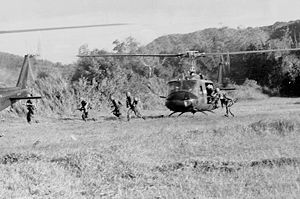 At 10:48 on November 14, the first elements of Bravo Company of the 1st Battalion/7th Cavalry touched down at LZ X-Ray, following around 30 minutes of bombardment via artillery, aerial rockets, and air strikes. Accompanying Captain John Herren's Bravo Company were Moore and his command group. Instead of attempting to secure the entire landing zone with such a limited force, most of Bravo was kept near the center of the LZ as a strike force, while smaller units were sent out to reconnoiter the surrounding area.
Following their arrival, Herren ordered Alpha to move west past the creek bed. Within approximately 30 minutes, one of his squads under Sergeant John Mingo surprised and captured an unarmed NVA soldier of the 33rd NVA Regiment. The prisoner revealed that there were three North Vietnamese battalions on the Chu Pong Mountain – an estimated 1,600 North Vietnamese troops compared to fewer than 200 American soldiers on the ground at that point.
At 11:20, the second lift of the battalion arrived, with the rest of Bravo Company and one platoon of Alpha Company, commanded by Captain Tony Nadal.
At 12:10, the third lift of American forces arrived, consisting of most of Alpha Company. Alpha took up positions to the rear and left flank of Bravo along the dry creek bed, and to the west and to the south facing perpendicular down the creek bed.
At 12:15, the first shots were fired on Bravo Company's three platoons that were patrolling the jungle northwest of the dry creek bed. At 12:20, Herren ordered his 1st Platoon under Lieutenant Al Devney and 2nd Platoon under Lieutenant Henry Herrick to advance abreast of each other, and the 3rd (under Lieutenant Dennis Deal) to follow as a reserve unit.
Devney's platoon led approximately 100 yards (91.4 m) west of the creek bed, with Herrick's men to his rear and right flank. Just before 13:00, Devney's platoon was heavily assaulted on both flanks by the North Vietnamese, taking casualties and becoming pinned down in the process. It was around this point that Herrick radioed in that his men were taking fire from their right flank, and that he was pursuing a squad of communist forces in that direction.
An intense firefight quickly erupted in the clearing; during the first three or four minutes his platoon suffered no casualties and inflicted heavy losses on the North Vietnamese who streamed out of the trees. Herrick soon radioed in that the enemy were closing in around his left and right flanks. Captain Herren responded by ordering Herrick to attempt to link back with Devney's 1st Platoon. Herrick replied that there was a large force between his men and 1st Platoon.
The situation quickly disintegrated for Herrick's 2nd Platoon, which began taking casualties as the North Vietnamese attack persisted. Herrick ordered his men to form a defensive perimeter on a small knoll in the clearing. Within approximately 25 minutes, five men of 2nd Platoon were killed, including Herrick who radioed Herren that he was hit and was passing command over to Sergeant Carl Palmer. Herrick gave vital instructions to his men before he died, including orders to destroy the signals codes and call in artillery support.
Sergeant Ernie Savage assumed command after Sergeant Palmer and Sergeant Robert Stokes were killed. The platoon was technically under the command of Sergeant First Class Mac McHenry, who was positioned elsewhere on the perimeter. Savage assumed command by virtue of being close to the radio and began the process of calling in repeated bombardments of artillery support around the platoon's position. By this point, eight men of 2nd Platoon had been killed and 13 wounded. Under Savage's leadership, and with the extraordinary care of platoon medic Charlie Lose, the men held the knoll for the duration of the battle at X-Ray.
Specialist Galen Bungum of Herrick's Platoon later said of the stand at the knoll:
Sergeant Savage later recalled of the repeated NVA assaults:
At around 13:45, through his Operations Officer flying above the battlefield (Captain Matt Dillon), Moore called in air strikes, artillery, and aerial rocket artillery on the mountain to prevent the North Vietnamese from advancing on the battalion's position.
Lieutenant Bob Taft's 3rd Platoon of Alpha Company confronted approximately 150 Vietnamese soldiers advancing down the length and sides of the creek bed (from the south) toward the battalion. 3rd Platoon's troops were told to drop their packs and move forward for the assault. The resulting exchange was particularly costly for 3rd Platoon — its lead forces were quickly cut down. 3rd Platoon was forced to pull back, and Taft was killed. Sergeant Lorenzo Nathan, a Korean War
veteran, took command and 3rd Platoon was able to halt the NVA advance down the creek bed.
The NVA forces shifted their attack to 3rd Platoon's right flank in an attempt to flank Bravo. Their advance was quickly stopped by Lieutenant Walter "Joe" Marm
's 2nd Platoon (Alpha Company) situated on Bravo's left flank. Moore had ordered Captain Nadal to lend Bravo one of his platoons, in an effort to allow Herren to attempt to fight through to Herrick's position.
From Marm's new position, his men killed some 80 NVA troops with a close range machine gun, rifle, and grenade assault. The NVA survivors who were not mown down made their way back to the creek bed, where they were cut down by additional fire from the rest of Alpha Company. Lieutenant Taft's dogtags were discovered on the body of a NVA soldier who had been killed by 3rd Platoon. Upset that Taft's body had been left on the battlefield amidst the chaos, Nadal and his radio operator, Sergeant Jack Gell, brought Taft and the bodies of other Americans back to the creek bed under heavy fire.
The small contingent of Delta took up position on Alpha's left flank. Charlie Company, assembled along the south and southwest in full strength, was met within minutes by a head-on assault. Edwards radioed in that an estimated 175 to 200 NVA troops were charging his company's lines. With a clear line of sight over their sector of the battlefield, Charlie Company was able to call in and adjust heavy ordnance support with precision, employing the napalm
tipped artillery shells, inflicting devastating losses on the Vietnamese forces. Many NVA soldiers were burned to death as they scrambled from their bunkers in a hasty retreat only to meet a second barrage of artillery
shells. as By 15:00 the attack had been quelled, and the NVA ended up withdrawing from the assault approximately one hour after it had been launched.
Covering the critical left flank from being rolled up by the North Vietnamese were two of Alpha's machine gun crews positioned 75 yards (68.6 m) southwest of the company's main position. Specialist Theron Ladner (with his assistant gunner Private First Class Rodriguez Rivera) and Specialist 4 Russell Adams (with a-gunner Specialist 4 Bill Beck) had positioned their guns 10 yards (9.1 m) apart, and proceeded to pour heavy fire into the Vietnamese forces attempting to cut into the perimeter between Charlie and Alpha companies. Moore later credited the two gun teams with single-handedly preventing the NVA from rolling up Alpha Company and driving a wedge into the battalion between Alpha and Charlie.
Adams and Rivera were severely wounded in the onslaught. After the two were carried to the battalion's collection point at Moore's command post to await evacuation by air, Beck, Ladner, and Private First Class Edward Dougherty (an ammo-bearer) continued their close range suppression of the Vietnamese advance.
Beck later said of the battle:
Delta's troops also experienced heavy losses in repelling the NVA assault, and Captain Lefebvre was wounded soon after arriving to X-Ray. One of his platoon leaders, Lieutenant Raul Taboada was also severely wounded, and Lefebvre passed command to Staff Sergeant George Gonzales (who, unknown to Lefebvre, had also been wounded).
While medical evacuation helicopters (medevac
s) were supposed to transport the battalion's growing casualties, only two were evacuated by medevacs before the pilots called off their mission under intense fire from the NVA. Casualties were loaded onto the assault Hueys (lifting the battalion's forces to X-Ray), whose pilots carried load after load of wounded from the battlefield. Battalion intelligence officer Captain Tom Metsker (who had been wounded) was fatally hit when helping his wounded comrade Ray Lefebvre aboard a Huey.
At 15:20, the last of the battalion arrived, and Lieutenant Larry Litton assumed command of Delta. It was during this lift that one Huey, having approached the LZ too high, crash-landed on the outskirts of the perimeter near the command post (those on board were quickly rescued by the battalion).
With Delta's weapons teams on the ground, its mortar units were massed with the rest of the battalion's in a single station to support Alpha and Bravo. Delta's reconnaissance platoon (commanded by Lieutenant James Rackstraw) was positioned along the north and east of the LZ, establishing a 360-degree perimeter over X-Ray. Had the NVA forces circled around to the north of the U.S. positions prior to this point, they would have found their approach unhindered.
Shortly after, Alpha and Bravo began their advance toward Herrick's lost platoon from the creek bed. The force quickly suffered casualties. At one point, Bravo's advance was halted by a firmly entrenched North Vietnamese machine gun position at a large termite hill. After firing a light anti-tank weapon (LAW)
into it with no effect, Lieutenant Marm attacked the position single-handedly. Under fire, Marm charged the Vietnamese gun, eliminating it with grenade and rifle fire. The following day, a dozen dead NVA troops (including one officer) were found in the position. Marm was wounded in the neck and jaw in the assault and was later awarded the Medal of Honor
for his lone assault.
The second push had advanced just over 75 yards (68.6 m) toward the lost platoon's position before reaching a stalemate with the NVA. At one point, the NVA were firing on Alpha's 1st Platoon (which was leading the advance and was at risk of becoming separated from the battalion) with an American M-60 machine gun that had been taken off a dead gunner of Herrick's platoon. The stalemate lasted between 20 and 30 minutes before Nadal and Herren requested permission to withdraw back to X-Ray (to which Moore agreed).
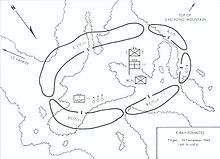 Near 17:00 hours the lead elements of Bravo Company of the 2nd Battalion/7th Cavalry (the "sister battalion" of the 1st/7th under Moore) arrived at LZ X-Ray to reinforce the embattled battalion. In preparation for a defensive position to last the night, Moore ordered Bravo's (2nd/7th) commander Captain Myron Diduryk to place two of his platoons between Bravo (1st/7th) and Delta on the northeast side of the perimeter. Diduryk's 2nd Platoon was used to reinforce Charlie Company's position (which was stretched over a disproportionately long line).
By nightfall, the battle had taken a heavy toll on Moore's battalion. Bravo had taken 47 casualties (including one officer), and Alpha had taken 34 casualties (including three officers). Charlie Company was comparatively healthy (having taken only four casualties).
The American forces were placed on full alert throughout the night. Under the light of a bright moon, the Vietnamese probed every company on the perimeter (with the exception of Delta) in small squad-sized units. The Americans exercised some level of restraint in their response. The M-60 gun
crews, tactically positioned around the perimeter to provide for multiple fields of fire, were told to hold their fire until otherwise ordered (so as to conceal their true location from the NVA).
The lost platoon under Sergeant Savage's command suffered three sizable assaults of the night (one just before midnight, one at 03:15, and one at 04:30). The NVA, using bugles
to signal their forces, were repelled from the knoll with artillery, grenade, and rifle fire. The lost platoon survived the night without taking additional casualties.
At 06:50, patrols from Charlie Company's 1st Platoon (under Lieutenant Neil Kroger) and 2nd Platoon (under Lieutenant John Geoghegan) had advanced 150 yards (137.2 m) from the perimeter before coming into contact with NVA troops. A firefight broke out, and the patrols quickly withdrew to the perimeter.
Shortly after, an estimated 200-plus North Vietnamese troops charged 1st and 2nd platoons on the south side of the perimeter. Heavy ordnance support was called in, but the NVA were soon within 75 yards (68.6 m) of the battalion's lines. Their fire began to cut through Charlie Company's positions and into the command post and the American lines across the LZ.
1st and 2nd platoons suffered significant casualties in this assault, including Kroger and Geoghegan. Geoghegan was killed while attempting to rescue one of his wounded men, Private First Class Willie Godboldt (who died of his wounds shortly thereafter). Two M-60 crews (under Specialist James Comer and Specialist 4 Clinton Poley, Specialist 4 Nathaniel Byrd, and Specialist 4 George Foxe) were instrumental in suppressing the North Vietnamese advance from completely overrunning Geoghegan's lines.
Following this attack, Charlie's 3rd Platoon was soon met with a NVA assault. Captain Edwards was wounded, and Lieutenant John Arrington assumed command of the company (and was quickly wounded).
Under heavy attack on three sides, the battalion fought off repeated waves of PAVN infantry. It was during this battle that Specialist Willard Parish of Charlie Company, situated on Delta's lines, earned a Silver Star
for suppressing an intense Vietnamese assault in his sector. After expending his M-60 ammunition, Parish resorted to his .45 sidearm to repel NVA forces that advanced within 20 yards (18.3 m) of his foxhole. After the battle, over 100 dead North Vietnamese troops were discovered around Parish's position.
As the battle along the southern line intensified, Lieutenant Charlie W. Hastings (USAF liaison: forward air controller), made the decision (based on criteria established by the USAF) to transmit the code phrase "Broken Arrow
", which relayed that an American combat unit was in danger of being overrun. In so doing, Hastings was calling on all available support aircraft in the country to come to the battalion's defense, drawing on a significant arsenal of heavy ordnance support.
On Charlie Company's broken lines, NVA troops walked the lines for several minutes, killing wounded Americans and stripping their bodies of weapons and other items. It was around this time, at 07:55, that Moore ordered his lines to throw colored smoke grenades over the lines to identify the battalion's perimeter. Aerial fire support was then called in on the NVA at close range – including those along Charlie Company's lines.
Shortly after, Moore's command post was subjected to what could have been a catastrophic friendly fire
incident. Two F-100 Super Sabre
jets approached X-Ray, the first dropping napalm
inadvertently on American lines, the second approaching the command post in a similar manner. The command post was saved when Hastings frantically radioed for the second jet to change course. Despite Hastings' best efforts, several Americans were wounded and killed by this air strike.
By 10:00, the North Vietnamese had begun to withdraw from the battle – although occasional fire continued to harass the battalion. Charlie Company, having inflicted scores of losses on the NVA, had suffered 42 Killed in action
(KIA) and 20 Wounded in action
(WIA) over the course of the two-and-a-half-hour assault. Lieutenant Rick Rescorla
of Diduryk's Bravo Company, who later died in the September 11 attacks on the World Trade Center, later remarked after having policed up the battlefield in Charlie Company's sector following the assaults:
 Given the tempo of combat at LZ X-Ray and the losses being suffered, other units of the 1st Cavalry Division planned to land nearby and then move overland to X-Ray. The 2nd Battalion of the 5th Cavalry was to be flown into LZ Victor, about 3.5 kilometers east-southeast of LZ X-Ray. They flew in at 08:00 and quickly organized to move out, the trip taking about 4 hours. Most of this was uneventful until they were approaching X-Ray. At about 10:00, some 800 yards (731.5 m) to the east of the LZ, the 2nd/7th's Alpha company received some light fire and had to set up a combat front. At 12:05, Tully's forces had arrived at the LZ.
fire and began the process of carrying the wounded and dead of the lost platoon back to X-Ray.
The expanded force at X-Ray, consisting of Moore's weakened 1st Battalion of the 7th, Tully's 2nd Battalion of the 5th, and one company of the 2nd Battalion of the 7th consolidated at X-Ray for the night. At the LZ, the wounded and dead were evacuated, and the remaining American forces dug in and fortified their lines.
s and trip flares set by Captain Diduryk's Bravo Company began to erupt. At 04:22, the NVA launched a fierce assault against Diduryk's men.
Bravo fought off this attack by an estimated 300 NVA in minutes. A decisive factor in this stand, in addition to rifle and machine gun fire from Bravo's lines, was the skilled placement of artillery strikes by Diduryk's forward observer, Lieutenant Bill Lund. Making use of four different artillery batteries, Lund organized fire into separate concentrations along the battlefield, with devastating consequences for the waves of advancing NVA.
The NVA repeated their assault on Diduryk's lines some 20 minutes after the first, as flares dropped from American C-123 Provider
aircraft flying above illuminated the battlefield to Bravo's advantage. For around 30 minutes, Bravo fought off the NVA advance with a combination of small arms and Lund's skilled organization of artillery strikes.
Shortly after 05:00, a third attack was launched against Diduryk's forces, which was repelled by Lieutenant James Lane's platoon within 30 minutes.
At almost 06:30, the NVA launched yet another attack on Diduryk's men – this time in the vicinity of the company command post. Again, Lund's precision in ordering artillery strikes cut down scores of NVA forces, while Diduryk's men repelled those who survived with rifle and machine gun fire.
At the end of these attacks, with daybreak approaching, Diduryk's Bravo Company had only six lightly wounded among its ranks – with none killed.
The battle was ostensibly over. The NVA forces had suffered hundreds of casualties and were no longer capable of a fight. U.S. forces had suffered 79 killed and 121 injured and had been reinforced to levels that would guarantee their safety. Given the situation there was no reason for the U.S. forces to stay in the field, their mission was complete and arguably a success. Moreover, Col. Brown, in overall command, was worried about reports that additional PAVN units were moving into the area over the border. He wanted to withdraw the units, but General Westmoreland demanded that the 2nd/7th Cav. and 1st/5th Cav stay at X-Ray in order to avoid the appearance of a retreat.
es were on their way from Guam
, and their target was the slopes of the Chu Pong massif. The U.S. ground forces had to move outside a two-mile (3 km) safety zone by midmorning to be clear of the bombardment. Tully's men moved out at 09:00; McDade's followed ten minutes later.
sandal foot markings, bamboo arrows on the ground pointing north, matted grass and grains of rice". After marching about 2,000 meters, Alpha Company leading the 2nd/7th headed northwest, while the 2nd/5th continued on to LZ Columbus. Alpha Company came upon some grass huts which they were directed to burn. At 11:38, Bob Tully's men, the 2nd/5th, were logged into its objective, LZ Columbus.
Communist troops in the area consisted of the 8th Battalion, 66th Regiment, the 1st Battalion 33rd Regiment, and the headquarters of the 3rd Battalion, 33rd Regiment, of the NVA. While the 33rd Regiment's battalions were understrength from casualties incurred during the battle
at the Special Forces Plei Me camp, the 8th was General An's reserve battalion, fresh and rested.
Alpha Company soon noticed the sudden absence of air cover and their commander, Captain Joel Sugdinis wondered where the ARA
choppers were. He soon heard the sound of distant explosions to his rear; the B-52's were making their bombing runs on the Chu Pong massif.
Lieutenant D. P. (Pat) Payne, the recon platoon leader, was walking around some termite hills when he suddenly came upon a North Vietnamese soldier resting on the ground. Payne jumped on the NVA trooper and took him prisoner. Simultaneously, about ten yards away, his platoon sergeant captured a second NVA soldier. Other members of the NVA recon team may have escaped and reported to the headquarters of the 1st Battalion, 33rd Regiment. The North Vietnamese then began to organize an assault on the American column. As word of the capture reached him, Lt. Col. McDade ordered a halt as he went forward from the rear of the column to interrogate the prisoners personally. The POW's were policed up about a hundred yards from the southwestern edge of the clearing called Albany, the report of which reached division forward at Pleiku
at 11:57.
McDade then called his company commanders forward for a conference; most of whom were accompanied by their radio operators. Alpha Company moved forward to LZ Albany; McDade and his command group were with them. Following orders, the other company commanders were moving forward to join McDade. Delta Company, which was next in the column following Alpha Company, was holding in place; so was Charlie Company which was next in line. Battalion Headquarters Company followed, and Alpha Company of the 1st Battalion, 5th Cavalry brought up the rear of the column. The American column was halted in unprepared, open terrain, and strung out in 550 yards (502.9 m) line of march. Most of the units had flank security posted, but the men were worn out from almost sixty hours without sleep and four hours of marching. The elephant grass
was chest-high so visibility was limited. The column's radios for air or artillery support were with the company commanders.
Lt. Pat Payne's reconnaissance platoon had walked to within 200 yards (182.9 m) of the headquarters of the 3rd Battalion, 33rd Regiment; the 550-man strong 8th Battalion, 66th Regiment had been bivouacked off to the northeast of the American column. As the Americans rested in the tall grass, North Vietnamese soldiers were swarming towards them by the hundreds. It was 13:15. The close quarters, intense battle lasted for sixteen hours.
McDade's command group made it into the clump of trees between the two clearings that constituted LZ Albany. They took cover from rifle and mortar fire within the trees and termite hills. The recon platoon and the Alpha Company 1st Platoon provided initial defense at the position. By 13:26, they had been cut off from the rest of the column; the area from whence they had come was swarming with NVA soldiers. While they waited for air support, the Americans holding Albany drove off assaults by NVA troopers and sniped at the exposed enemy wandering around the perimeter. It was later discovered that North Vietnamese were mopping up, looking for Americans wounded in the tall grass and killing them.
All the while the noise of battle could be heard in the woods as the other companies fought for their lives. Charlie and Alpha companies lost a combined 70 men in the first minutes. Charlie Company suffered 45 dead and more than 50 wounded, the heaviest casualties of any unit that fought on Albany. Air Force A-1E Skyraiders
soon provided much-needed support, dropping napalm
. However, because of the fog of war
and the inter-mixing of both American and North Vietnamese troops, it is likely that the air and artillery strikes killed not just NVA, but Americans as well.
The 2nd Battalion, 7th Cavalry had been reduced to a small perimeter at Albany composed of survivors of Alpha Company, the recon platoon, survivors from the decimated Charlie and Delta Companies and the command group. There was also a smaller perimeter at the rear of the column about 500–700 yards due south: Captain George Forrest's Alpha Company, 1st Battalion, 5th Cavalry. Captain Forrest had run a gauntlet all the way from the conference called by McDade back to his company when the NVA mortars started coming in.
At around 16:00, Captain Myron Diduryk's Bravo Company, 2nd Battalion, 7th Cavalry, veterans of the fight at LZ X-Ray, got the word that they would be deployed in the Battalion's relief. At 18:45 the first helicopters swept over the Albany clearing and the troopers deployed into the tall grass. Lieutenant Rick Rescorla
, the sole remaining platoon leader in Bravo Company, led the reinforcements into the Albany perimeter, which was expanded to provide better security. The wounded at Albany were evacuated at around 22:30 that evening, the helicopters receiving intense ground fire as they landed and took off. The Americans at Albany then settled down for the night.
The next day, Friday, November 18 dawned on the battlefield. The Americans began to police up their dead. This task took the better part of the day and the next. American and North Vietnamese dead were scattered all over the field of battle. Rescorla described the scene as, "a long, bloody traffic accident in the jungle." While policing the battlefield, Rescorla recovered a large, battered, old French army bugle
from a dying NVA soldier. The Americans finally left Albany for LZ Crooks at 13°40′5.6"N 107°39′10"E, six miles (10 km) away, on November 19.
The battle at LZ Albany cost the Americans 155 men killed and 124 wounded. One American, Toby Braveboy, was recovered on November 24 when he waved down a passing H-13
scout helicopter.
, followed in the wake of the deliveries to widows in the Ft. Benning housing complex, grieving with the wives and comforting the children, and attended the funerals of all the men killed under her husband's command who were buried at Fort Benning
. Her complaints about the notifications prompted the Army to quickly set up two-man teams to deliver them, consisting of an officer and a chaplain.
Mrs. Frank Henry, the wife of the battalion executive officer, and Mrs. James Scott, wife of the battalion command sergeant major, performed the same duty for the dead of the 2nd Battalion, 7th Cavalry.
(later Colonel) received the Medal of Honor
on February 15, 1967 for his actions during the 3-day battle at LZ X-Ray. His MOH citation recounts several examples of conspicuous gallantry, some despite being severely wounded.
On February 26, 2007, helicopter
pilots Major Bruce Crandall (later Lieutenant Colonel) and Captain Ed Freeman
(later Major) were each awarded the Medal of Honor for their numerous volunteer flights (22 and 14, respectively) in their unarmed Hueys into LZ X-Ray while enemy fire was so heavy that medical evacuation helicopters refused to approach. With each flight, Crandall and Freeman delivered much needed water and ammunition and extracted wounded soldiers, saving countless lives.
Sergeant Ernie Savage's precise placement of artillery throughout the siege of the "Lost Platoon" enabled the platoon to survive the long ordeal. For his "gallantry under relentless enemy fire on an otherwise insignificant knoll in the valley of the Ia Drang," Ernie Savage received the Distinguished Service Cross.
Lieutenant Colonel Harold "Hal" Moore
(later Lieutenant General), Commanding Officer, 1st Battalion, 7/1 U.S. Cavalry
(Airmobile) was awarded the Distinguished Service Cross
for his actions at LZ X-Ray. His DSC citation particularly commends his "leadership by example" as well as his skill in battle against overwhelming odds and his unwavering courage.
Journalist Joseph Galloway
was the only civilian awarded the Bronze Star Medal
for valor
during the Vietnam war when he repeatedly disregarded his own safety to rescue wounded soldiers while under fire.
Although many notable decorations have been awarded to veterans of the Battle of Ia Drang, in his book "We Were Soldiers Once...And Young", Harold Moore writes:
United States Army
The United States Army is the main branch of the United States Armed Forces responsible for land-based military operations. It is the largest and oldest established branch of the U.S. military, and is one of seven U.S. uniformed services...
and the People's Army of Vietnam (PAVN) (referred to by U.S. fighting units as the North Vietnamese Army (NVA) during the Vietnam War
Vietnam War
The Vietnam War was a Cold War-era military conflict that occurred in Vietnam, Laos, and Cambodia from 1 November 1955 to the fall of Saigon on 30 April 1975. This war followed the First Indochina War and was fought between North Vietnam, supported by its communist allies, and the government of...
).
The two-part battle took place between November 14 and November 18, 1965, at two landing zones (LZs) northwest of Plei Me in the Central Highlands of South Vietnam
South Vietnam
South Vietnam was a state which governed southern Vietnam until 1975. It received international recognition in 1950 as the "State of Vietnam" and later as the "Republic of Vietnam" . Its capital was Saigon...
(approximately 35 miles south-west of Pleiku
Pleiku
Pleiku is a town in central Vietnam, located in that nation's central highland region. It is the capital of the Gia Lai Province; it is inhabited primarily by the Bahnar and Jarai ethnic groups, sometimes known as the Montagnards or Degar....
). The battle derives its name from the Drang River which runs through the valley northwest of Plei Me, in which the engagement took place. "Ia" means "river" in the local Montagnard
Degar
The Degar are the indigenous peoples of the Central Highlands of Vietnam. The term Montagnard means "mountain people" in French and is a carryover from the French colonial period in Vietnam. In Vietnamese, they are known by the term thượng - this term can also be applied to other minority ethnic...
language.
Representing the American forces were elements of the 1st Battalion and 2nd Battalion of the 7th Cavalry Regiment, and the 5th Cavalry Regiment of the United States Army
United States Army
The United States Army is the main branch of the United States Armed Forces responsible for land-based military operations. It is the largest and oldest established branch of the U.S. military, and is one of seven U.S. uniformed services...
. The North Vietnamese forces included the 66th and 1st battalion/33rd Regiments of the NVA as well National Liberation Front
National Front for the Liberation of South Vietnam
The Vietcong , or National Liberation Front , was a political organization and army in South Vietnam and Cambodia that fought the United States and South Vietnamese governments during the Vietnam War . It had both guerrilla and regular army units, as well as a network of cadres who organized...
(NLF) (known world wide as the Viet Cong) of the H15 Battalion. The battle involved close air support by U.S. bombers, including B-52 bombers from Guam.
Casualty reports vary widely between the U.S. and Vietnamese. The North Vietnamese reported 554 KIA
Killed in action
Killed in action is a casualty classification generally used by militaries to describe the deaths of their own forces at the hands of hostile forces. The United States Department of Defense, for example, says that those declared KIA need not have fired their weapons but have been killed due to...
and 669 WIA
Wounded in action
Wounded in action describes soldiers who have been wounded while fighting in a combat zone during war time, but have not been killed. Typically it implies that they are temporarily or permanently incapable of bearing arms or continuing to fight....
(346 killed before this battle) while the U.S. estimated North Vietnamese deaths as from 1,519 to 2,262. The U.S. reported their casualties as 305 KIA, 524 WIA, including 234 killed and 245 wounded during this battle. The People's Army of Vietnam reported total U.S and ARVN casualties as 2,974 killed and wounded, including an estimated 1.700 U.S. troops.
The battle is documented in the critically acclaimed book We Were Soldiers Once… And Young by Harold G. Moore
Hal Moore
Harold Gregory "Hal" Moore, Jr. is a retired lieutenant general in the United States Army and author. Moore is a recipient of the Distinguished Service Cross, which is the second highest military decoration of the United States Army, and was the first of his West Point class to be promoted to...
and Joseph L. Galloway
Joseph L. Galloway
Joseph Lee "Joe" Galloway , is an American newspaper correspondent and columnist. He is the former Military Affairs consultant for the Knight-Ridder chain of newspapers and is presently a columnist with McClatchy Newspapers...
. In 2002, Randall Wallace
Randall Wallace
Randall Wallace is an American screenwriter, director, producer, and songwriter who came to prominence by writing the screenplay for the 1995 film Braveheart. His work on the film earned him an Oscar nomination for Best Original Screenplay and a Writers Guild of America award for Best...
depicted the first part of the battle in the film We Were Soldiers
We Were Soldiers
We Were Soldiers is a 2002 American war film that dramatizes the Battle of Ia Drang on November 14, 1965. The film was directed by Randall Wallace and stars Mel Gibson. It is based on the book We Were Soldiers Once… And Young by Lieutenant General Hal Moore and reporter Joseph L...
starring Mel Gibson
Mel Gibson
Mel Colm-Cille Gerard Gibson, AO is an American actor, film director, producer and screenwriter. Born in Peekskill, New York, Gibson moved with his parents to Sydney, Australia when he was 12 years old and later studied acting at the Australian National Institute of Dramatic Art.After appearing in...
and Barry Pepper
Barry Pepper
Barry Robert Pepper is a Canadian actor. He is best known for playing roles like Sergeant Michael Strank in the Clint Eastwood film, Flags of Our Fathers, Private Daniel Jackson in Saving Private Ryan, Roger Maris in 61*, Ned Pepper in True Grit and for his recent role as Robert F...
as Moore and Galloway, respectively. The National Geographic Channel
National Geographic Channel
National Geographic Channel, also commercially abbreviated and trademarked as Nat Geo, is a subscription television channel that airs non-fiction television programs produced by the National Geographic Society. Like History and the Discovery Channel, the channel features documentaries with factual...
has also aired a program titled "Day Under Fire: Vietnam War" which focuses mainly on the battle of Ia Drang.
Background
Throughout 1963 and 1964 a series of political and military mishaps had seriously affected the capabilities of the Army of the Republic of VietnamArmy of the Republic of Vietnam
The Army of the Republic of Viet Nam , sometimes parsimoniously referred to as the South Vietnamese Army , was the land-based military forces of the Republic of Vietnam , which existed from October 26, 1955 until the fall of Saigon on April 30, 1975...
(ARVN) main forces in South Vietnam. ARVN commanders were initially under direct orders by President Ngo Dinh Diem
Ngo Dinh Diem
Ngô Đình Diệm was the first president of South Vietnam . In the wake of the French withdrawal from Indochina as a result of the 1954 Geneva Accords, Diệm led the effort to create the Republic of Vietnam. Accruing considerable U.S. support due to his staunch anti-Communism, he achieved victory in a...
to avoid pitched combat at all costs, allowing the NLF (VC
VC
VC may refer to:* Vehicle code, a motor vehicle traffic legal system* Vanadium carbide, an inorganic compound* Vancouver Canucks, a NHL hockey team* Vanier College* Vassar College...
) forces (known around the world as the Viet Cong, or simply "VC") to train and grow without significant opposition, despite losing several leaders to CIA search and destroy squads which relied heavily on rocket
Rocket
A rocket is a missile, spacecraft, aircraft or other vehicle which obtains thrust from a rocket engine. In all rockets, the exhaust is formed entirely from propellants carried within the rocket before use. Rocket engines work by action and reaction...
attacks using attack helicopters. Even after Diem's overthrow in a 1963 coup, the new military leadership largely consisted of commanders put in place by Diem prior to the coup. They showed equal lack of interest in fighting the NLF, spending their time in a series of coups and counter-coups.
In this unstable political climate the NLF (VC
VC
VC may refer to:* Vehicle code, a motor vehicle traffic legal system* Vanadium carbide, an inorganic compound* Vancouver Canucks, a NHL hockey team* Vanier College* Vassar College...
) units were able to mount increasingly larger military operations. At first these were limited to building up larger formations (battalion
Battalion
A battalion is a military unit of around 300–1,200 soldiers usually consisting of between two and seven companies and typically commanded by either a Lieutenant Colonel or a Colonel...
s and regiments) but by late 1964 they had evolved into an all-out war against ARVN units, which they outperformed in all ways. By early 1965 the majority of rural South Vietnam was under limited VC control, increasingly supported by NVA regulars from North Vietnam. By 1965 ARVN units in the field were hopelessly outclassed and being ambushed and slaughtered.
U.S. advisers in the field had long been pushing for the ARVN forces to be "taken over" by U.S. commanders. In addition to actually getting the men to fight (something they generally seemed willing to do when well-led) the better training and leadership of the U.S. command was expected to be more than enough to make up for the existing deficiencies in the ARVN command. However, the newly-appointed commander of the Vietnam efforts, General William Westmoreland
William Westmoreland
William Childs Westmoreland was a United States Army General, who commanded US military operations in the Vietnam War at its peak , during the Tet Offensive. He adopted a strategy of attrition against the National Liberation Front of South Vietnam and the North Vietnamese Army. He later served as...
, felt the direct application of U.S. forces was a more appropriate solution; perhaps the ARVN units would not fight, but the same was certainly not true of U.S. Army regulars. By early 1965 he had secured the commitment of upwards of 300,000 U.S. regulars from Lyndon B. Johnson
Lyndon B. Johnson
Lyndon Baines Johnson , often referred to as LBJ, was the 36th President of the United States after his service as the 37th Vice President of the United States...
, and was actively trying to get them into the field as soon as possible. Buildup of combat-ready forces took place throughout the summer of 1965.
By 1965, the VC forces were in nominal control of most of the countryside and had set up a major military infrastructure in the Central Highlands
Tây Nguyên
Tây Nguyên, translated as Western Highlands and sometimes also called Central Highlands, is one of the regions of Vietnam. It contains the provinces of Đắk Lắk, Đắk Nông, Gia Lai, Kon Tum, Lâm Đồng....
, to the northeast of the Saigon region. Vietnamese communist forces had operated in this area during the previous decade in their war against the French
First Indochina War
The First Indochina War was fought in French Indochina from December 19, 1946, until August 1, 1954, between the French Union's French Far East...
, winning a notable victory at the Battle of Mang Yang Pass
Battle of Mang Yang Pass
The Battle of Mang Yang Pass was the last official battle of the First Indochina War. It was one of the bloodiest defeats of the French Union together with the battle of Dien Bien Phu in 1954 and the battle of Cao Bang in 1950.-Background:Groupement Mobile No. 100 The Battle of Mang Yang Pass...
in 1954. There were few reliable roads into the area, making it an ideal place for the communist forces to form bases that were relatively immune from attack by the generally road-bound ARVN forces. During 1965 large groups of North Vietnamese regulars of the PAVN moved into the area in order to conduct major offensive operations. Attacks to the southwest from these bases threatened to cut South Vietnam in two.
The U.S. command saw this as an ideal area to test their newly developed air mobility tactics. Air mobility called for battalion-sized forces to be delivered into, supplied, and extracted from an area of action using helicopter
Helicopter
A helicopter is a type of rotorcraft in which lift and thrust are supplied by one or more engine-driven rotors. This allows the helicopter to take off and land vertically, to hover, and to fly forwards, backwards, and laterally...
s. Since heavy weapons of a normal combined-arms force could not follow, the infantry would be supported by coordinated air
Close air support
In military tactics, close air support is defined as air action by fixed or rotary winged aircraft against hostile targets that are close to friendly forces, and which requires detailed integration of each air mission with fire and movement of these forces.The determining factor for CAS is...
, artillery
Artillery
Originally applied to any group of infantry primarily armed with projectile weapons, artillery has over time become limited in meaning to refer only to those engines of war that operate by projection of munitions far beyond the range of effect of personal weapons...
, and aerial rocket
Aerial Rocket Artillery
Although sometimes used as a generic term for any armed helicopters, the term Aerial Rocket Artillery refers specifically to the armed helicopter units which were organic to the division artillery of the United States Army’s two airmobile divisions during the Vietnam War...
fire arranged from a distance and directed by local observers. They had been practicing these tactics in the U.S. in the newly-created 11th Air Assault Division (Test). The 11th was redesignated the 1st Cavalry Division (the 1st Cavalry had been in South Korea since the Korean War
Korean War
The Korean War was a conventional war between South Korea, supported by the United Nations, and North Korea, supported by the People's Republic of China , with military material aid from the Soviet Union...
, it was redesignated the 2nd Infantry Division and its colors transferred to the 11th Air Assault (Test) at Ft. Benning Georgia
Georgia (U.S. state)
Georgia is a state located in the southeastern United States. It was established in 1732, the last of the original Thirteen Colonies. The state is named after King George II of Great Britain. Georgia was the fourth state to ratify the United States Constitution, on January 2, 1788...
just before deployment overseas.) The division's troopers dubbed themselves the Air Cav. Starting in July 1965 they began deploying to Camp Radcliffe, An Khe, Vietnam. By November most of the division's three brigades were in-field and ready for operations.
In early November 3rd Brigade, 1st Cavalry Division was sent into combat on a search-and-destroy mission in order to track down a force that had unsuccessfully attempted to overrun
Siege of Plei Me
The Siege of Plei Me was a battle during the Vietnam War, which led up to the Battle of Ia Drang. The repulsion of the North Vietnamese assault immediately set the stage for the offensive in Ia Drang.-Background:...
the Special Forces
Special forces
Special forces, or special operations forces are terms used to describe elite military tactical teams trained to perform high-risk dangerous missions that conventional units cannot perform...
base at Plei Me, about 25 miles (40 km) south of the 3rd Brigade's base of operations at Pleiku
Pleiku
Pleiku is a town in central Vietnam, located in that nation's central highland region. It is the capital of the Gia Lai Province; it is inhabited primarily by the Bahnar and Jarai ethnic groups, sometimes known as the Montagnards or Degar....
. The 3rd Brigade had searched around the base for several days but had found nothing. Westmoreland sent word to continue the search westwards toward the Cambodia
Cambodia
Cambodia , officially known as the Kingdom of Cambodia, is a country located in the southern portion of the Indochina Peninsula in Southeast Asia...
n border, but unsure of where to look, the 3rd's commander, Col. Thomas "Tim" Brown, returned to Pleiku in an attempt to gather additional intelligence. He learned of some sort of concentration of forces on Chu Pong Mountain at 13°34′11"N 107°40′54"E, 14 miles (22 km) northwest of Plei Me. Brown decided that this was likely the only lead they had and decided to test the intelligence with a reconnaissance in force.
Landing zones
Brown selected his 1st Battalion, 7th Cavalry, led by Lieutenant ColonelLieutenant colonel
Lieutenant colonel is a rank of commissioned officer in the armies and most marine forces and some air forces of the world, typically ranking above a major and below a colonel. The rank of lieutenant colonel is often shortened to simply "colonel" in conversation and in unofficial correspondence...
Hal Moore
Hal Moore
Harold Gregory "Hal" Moore, Jr. is a retired lieutenant general in the United States Army and author. Moore is a recipient of the Distinguished Service Cross, which is the second highest military decoration of the United States Army, and was the first of his West Point class to be promoted to...
, for the mission, with the explicit orders to not attempt to scale the mountain. There were several clearings in the area that had been designated as possible helicopter landing zone
Landing Zone
A Landing Zone or "LZ" is a military term for any area where an aircraft can land.In the United States military, a landing zone is the actual point where aircraft land...
s, typically named for a letter of the NATO phonetic alphabet
NATO phonetic alphabet
The NATO phonetic alphabet, more accurately known as the NATO spelling alphabet and also called the ICAO phonetic or spelling alphabet, the ITU phonetic alphabet, and the international radiotelephony spelling alphabet, is the most widely used spelling alphabet...
. Moore selected:
- LZ X-Ray at 13°34′4.6"N 107°42′50.4"E as his landing zone, a flat clearing surrounded by low trees at the northern base of the Chu Pong Massif and bordered by a dry creek bed on the west. The Ia Drang River was about 2 km to the northwest.
- LZ Albany to the north at 13°35′43"N 107°42′55"E
- LZ Columbus, just east of Albany at 13°35′20.8"N 107°44′29"E
- LZ Tango about 2 km to the north at 13°35′28.8"N 107°42′46"E
- LZ Yankee a similar distance south at 13°33′14.1"N 107°43′1.3"E
- LZ Whiskey, 2.1 km south-east at 13°33′17.8"N 107°43′40.8"E
- LZ Victor at 13°33′33"N 107°43′47.8"E about 4 km to the south-southeast.
Artillery support would be provided from firebase
Fire support base
A fire support base is a military encampment designed to provide indirect fire artillery fire support to infantry operating in areas beyond the normal range of direct fire support from their own base camps....
FB Falcon, about 8 km to the northeast at 13°37′22"N 107°45′51"E.
X-Ray was approximately the size of a misshapen football field, some 100 meters in length (east to west). It was estimated that only eight Hueys
UH-1 Iroquois
The Bell UH-1 Iroquois is a military helicopter powered by a single, turboshaft engine, with a two-bladed main rotor and tail rotor. The helicopter was developed by Bell Helicopter to meet the United States Army's requirement for a medical evacuation and utility helicopter in 1952, and first flew...
could fit in the clearing at a given time. The 1st/7th was typical for U.S. Army units of the time, consisting of three rifle companies (Alpha through Charlie) and a heavy weapons company (Delta), with about 450 men in total, of the 765 of the battalion's authorized strength. They were to be shuttled by 16 Huey transport helicopters, which could generally carry 10 to 12 equipped troops, so the battalion would have to be delivered in several "lifts" carrying just less than one complete company
Company (military unit)
A company is a military unit, typically consisting of 80–225 soldiers and usually commanded by a Captain, Major or Commandant. Most companies are formed of three to five platoons although the exact number may vary by country, unit type, and structure...
each time. Each lift would take about 30 minutes. Moore arranged the lifts to deliver Bravo company first, along with his command team, followed by Alpha, Charlie, and finally Delta.
Moore's plan was to move Bravo and Alpha northwest past the creek bed, and Charlie south toward the mountain. Delta Company, which comprised special weapons forces including mortar
Mortar (weapon)
A mortar is an indirect fire weapon that fires explosive projectiles known as bombs at low velocities, short ranges, and high-arcing ballistic trajectories. It is typically muzzle-loading and has a barrel length less than 15 times its caliber....
, recon
Reconnaissance
Reconnaissance is the military term for exploring beyond the area occupied by friendly forces to gain information about enemy forces or features of the environment....
, and machine gun
Machine gun
A machine gun is a fully automatic mounted or portable firearm, usually designed to fire rounds in quick succession from an ammunition belt or large-capacity magazine, typically at a rate of several hundred rounds per minute....
units, was to be used as the battlefield reserve. In the center of the LZ was a large termite hill that was to become Moore's command post.
Landings
Following their arrival, Herren ordered Alpha to move west past the creek bed. Within approximately 30 minutes, one of his squads under Sergeant John Mingo surprised and captured an unarmed NVA soldier of the 33rd NVA Regiment. The prisoner revealed that there were three North Vietnamese battalions on the Chu Pong Mountain – an estimated 1,600 North Vietnamese troops compared to fewer than 200 American soldiers on the ground at that point.
At 11:20, the second lift of the battalion arrived, with the rest of Bravo Company and one platoon of Alpha Company, commanded by Captain Tony Nadal.
At 12:10, the third lift of American forces arrived, consisting of most of Alpha Company. Alpha took up positions to the rear and left flank of Bravo along the dry creek bed, and to the west and to the south facing perpendicular down the creek bed.
At 12:15, the first shots were fired on Bravo Company's three platoons that were patrolling the jungle northwest of the dry creek bed. At 12:20, Herren ordered his 1st Platoon under Lieutenant Al Devney and 2nd Platoon under Lieutenant Henry Herrick to advance abreast of each other, and the 3rd (under Lieutenant Dennis Deal) to follow as a reserve unit.
Devney's platoon led approximately 100 yards (91.4 m) west of the creek bed, with Herrick's men to his rear and right flank. Just before 13:00, Devney's platoon was heavily assaulted on both flanks by the North Vietnamese, taking casualties and becoming pinned down in the process. It was around this point that Herrick radioed in that his men were taking fire from their right flank, and that he was pursuing a squad of communist forces in that direction.
Herrick's platoon is cut off
In pursuit of the North Vietnamese on his right flank, Herrick's platoon was quickly spread out over a space of around 50 meters, and became separated from the rest of the battalion by approximately 100 meters. Soon, Herrick radioed in to ask whether he should enter or circumvent a clearing that his platoon had come across in the bush. Herrick expressed concerns that he might become cut off from the battalion if he tried to skirt the clearing and therefore would be leading his men through it in pursuit of the enemy.An intense firefight quickly erupted in the clearing; during the first three or four minutes his platoon suffered no casualties and inflicted heavy losses on the North Vietnamese who streamed out of the trees. Herrick soon radioed in that the enemy were closing in around his left and right flanks. Captain Herren responded by ordering Herrick to attempt to link back with Devney's 1st Platoon. Herrick replied that there was a large force between his men and 1st Platoon.
The situation quickly disintegrated for Herrick's 2nd Platoon, which began taking casualties as the North Vietnamese attack persisted. Herrick ordered his men to form a defensive perimeter on a small knoll in the clearing. Within approximately 25 minutes, five men of 2nd Platoon were killed, including Herrick who radioed Herren that he was hit and was passing command over to Sergeant Carl Palmer. Herrick gave vital instructions to his men before he died, including orders to destroy the signals codes and call in artillery support.
Sergeant Ernie Savage assumed command after Sergeant Palmer and Sergeant Robert Stokes were killed. The platoon was technically under the command of Sergeant First Class Mac McHenry, who was positioned elsewhere on the perimeter. Savage assumed command by virtue of being close to the radio and began the process of calling in repeated bombardments of artillery support around the platoon's position. By this point, eight men of 2nd Platoon had been killed and 13 wounded. Under Savage's leadership, and with the extraordinary care of platoon medic Charlie Lose, the men held the knoll for the duration of the battle at X-Ray.
Specialist Galen Bungum of Herrick's Platoon later said of the stand at the knoll:
Sergeant Savage later recalled of the repeated NVA assaults:
Battle for the creek bed
With Herrick's platoon cut off and surrounded, the rest of the battalion fought to maintain a perimeter. At 13:32, Charlie Company under Captain Bob Edwards arrived, taking up positions along the south and southwest facing the mountain.At around 13:45, through his Operations Officer flying above the battlefield (Captain Matt Dillon), Moore called in air strikes, artillery, and aerial rocket artillery on the mountain to prevent the North Vietnamese from advancing on the battalion's position.
Lieutenant Bob Taft's 3rd Platoon of Alpha Company confronted approximately 150 Vietnamese soldiers advancing down the length and sides of the creek bed (from the south) toward the battalion. 3rd Platoon's troops were told to drop their packs and move forward for the assault. The resulting exchange was particularly costly for 3rd Platoon — its lead forces were quickly cut down. 3rd Platoon was forced to pull back, and Taft was killed. Sergeant Lorenzo Nathan, a Korean War
Korean War
The Korean War was a conventional war between South Korea, supported by the United Nations, and North Korea, supported by the People's Republic of China , with military material aid from the Soviet Union...
veteran, took command and 3rd Platoon was able to halt the NVA advance down the creek bed.
The NVA forces shifted their attack to 3rd Platoon's right flank in an attempt to flank Bravo. Their advance was quickly stopped by Lieutenant Walter "Joe" Marm
Walter Joseph Marm, Jr.
Walter Joseph "Joe" Marm, Jr. is a retired United States Army officer and a recipient of the United States military's highest decoration—the Medal of Honor—for his actions in the Vietnam War.-Biography:...
's 2nd Platoon (Alpha Company) situated on Bravo's left flank. Moore had ordered Captain Nadal to lend Bravo one of his platoons, in an effort to allow Herren to attempt to fight through to Herrick's position.
From Marm's new position, his men killed some 80 NVA troops with a close range machine gun, rifle, and grenade assault. The NVA survivors who were not mown down made their way back to the creek bed, where they were cut down by additional fire from the rest of Alpha Company. Lieutenant Taft's dogtags were discovered on the body of a NVA soldier who had been killed by 3rd Platoon. Upset that Taft's body had been left on the battlefield amidst the chaos, Nadal and his radio operator, Sergeant Jack Gell, brought Taft and the bodies of other Americans back to the creek bed under heavy fire.
Attack from the south
At 14:30 hours, the last troops of Charlie Company arrived, along with the lead elements of Delta Company under Captain Ray Lefebvre. The insertion took place with intense NVA fire pouring into the LZ, and the Huey crews and newly arrived Battalion forces suffered many casualties.The small contingent of Delta took up position on Alpha's left flank. Charlie Company, assembled along the south and southwest in full strength, was met within minutes by a head-on assault. Edwards radioed in that an estimated 175 to 200 NVA troops were charging his company's lines. With a clear line of sight over their sector of the battlefield, Charlie Company was able to call in and adjust heavy ordnance support with precision, employing the napalm
Napalm
Napalm is a thickening/gelling agent generally mixed with gasoline or a similar fuel for use in an incendiary device, primarily as an anti-personnel weapon...
tipped artillery shells, inflicting devastating losses on the Vietnamese forces. Many NVA soldiers were burned to death as they scrambled from their bunkers in a hasty retreat only to meet a second barrage of artillery
Artillery
Originally applied to any group of infantry primarily armed with projectile weapons, artillery has over time become limited in meaning to refer only to those engines of war that operate by projection of munitions far beyond the range of effect of personal weapons...
shells. as By 15:00 the attack had been quelled, and the NVA ended up withdrawing from the assault approximately one hour after it had been launched.
Attack on Alpha and Delta
At approximately the same time, Alpha and the lead elements of Delta (which had accompanied Alpha at the perimeter in the vicinity of the creek bed) were met by a fierce NVA attack.Covering the critical left flank from being rolled up by the North Vietnamese were two of Alpha's machine gun crews positioned 75 yards (68.6 m) southwest of the company's main position. Specialist Theron Ladner (with his assistant gunner Private First Class Rodriguez Rivera) and Specialist 4 Russell Adams (with a-gunner Specialist 4 Bill Beck) had positioned their guns 10 yards (9.1 m) apart, and proceeded to pour heavy fire into the Vietnamese forces attempting to cut into the perimeter between Charlie and Alpha companies. Moore later credited the two gun teams with single-handedly preventing the NVA from rolling up Alpha Company and driving a wedge into the battalion between Alpha and Charlie.
Adams and Rivera were severely wounded in the onslaught. After the two were carried to the battalion's collection point at Moore's command post to await evacuation by air, Beck, Ladner, and Private First Class Edward Dougherty (an ammo-bearer) continued their close range suppression of the Vietnamese advance.
Beck later said of the battle:
Delta's troops also experienced heavy losses in repelling the NVA assault, and Captain Lefebvre was wounded soon after arriving to X-Ray. One of his platoon leaders, Lieutenant Raul Taboada was also severely wounded, and Lefebvre passed command to Staff Sergeant George Gonzales (who, unknown to Lefebvre, had also been wounded).
While medical evacuation helicopters (medevac
MEDEVAC
Medical evacuation, often termed Medevac or Medivac, is the timely and efficient movement and en route care provided by medical personnel to the wounded being evacuated from the battlefield or to injured patients being evacuated from the scene of an accident to receiving medical facilities using...
s) were supposed to transport the battalion's growing casualties, only two were evacuated by medevacs before the pilots called off their mission under intense fire from the NVA. Casualties were loaded onto the assault Hueys (lifting the battalion's forces to X-Ray), whose pilots carried load after load of wounded from the battlefield. Battalion intelligence officer Captain Tom Metsker (who had been wounded) was fatally hit when helping his wounded comrade Ray Lefebvre aboard a Huey.
360-degree perimeter
Captain Edwards ordered Sergeant Gonzales to position Delta Company on Charlie's left flank, extending the perimeter to cover the southeast side of X-Ray.At 15:20, the last of the battalion arrived, and Lieutenant Larry Litton assumed command of Delta. It was during this lift that one Huey, having approached the LZ too high, crash-landed on the outskirts of the perimeter near the command post (those on board were quickly rescued by the battalion).
With Delta's weapons teams on the ground, its mortar units were massed with the rest of the battalion's in a single station to support Alpha and Bravo. Delta's reconnaissance platoon (commanded by Lieutenant James Rackstraw) was positioned along the north and east of the LZ, establishing a 360-degree perimeter over X-Ray. Had the NVA forces circled around to the north of the U.S. positions prior to this point, they would have found their approach unhindered.
Second push to the lost platoon
As the NVA attack on Alpha Company diminished, Moore organized for another effort to rescue Herrick's lost platoon. At 15:45, Moore ordered Alpha and Bravo to evacuate their casualties and pull back from engagement with the enemy.Shortly after, Alpha and Bravo began their advance toward Herrick's lost platoon from the creek bed. The force quickly suffered casualties. At one point, Bravo's advance was halted by a firmly entrenched North Vietnamese machine gun position at a large termite hill. After firing a light anti-tank weapon (LAW)
M72 LAW
The M72 LAW is a portable one-shot 66 mm unguided anti-tank weapon, designed in the United States by Paul V. Choate, Charles B. Weeks, and Frank A. Spinale et al...
into it with no effect, Lieutenant Marm attacked the position single-handedly. Under fire, Marm charged the Vietnamese gun, eliminating it with grenade and rifle fire. The following day, a dozen dead NVA troops (including one officer) were found in the position. Marm was wounded in the neck and jaw in the assault and was later awarded the Medal of Honor
Medal of Honor
The Medal of Honor is the highest military decoration awarded by the United States government. It is bestowed by the President, in the name of Congress, upon members of the United States Armed Forces who distinguish themselves through "conspicuous gallantry and intrepidity at the risk of his or her...
for his lone assault.
The second push had advanced just over 75 yards (68.6 m) toward the lost platoon's position before reaching a stalemate with the NVA. At one point, the NVA were firing on Alpha's 1st Platoon (which was leading the advance and was at risk of becoming separated from the battalion) with an American M-60 machine gun that had been taken off a dead gunner of Herrick's platoon. The stalemate lasted between 20 and 30 minutes before Nadal and Herren requested permission to withdraw back to X-Ray (to which Moore agreed).
Americans dig in for the night
By nightfall, the battle had taken a heavy toll on Moore's battalion. Bravo had taken 47 casualties (including one officer), and Alpha had taken 34 casualties (including three officers). Charlie Company was comparatively healthy (having taken only four casualties).
The American forces were placed on full alert throughout the night. Under the light of a bright moon, the Vietnamese probed every company on the perimeter (with the exception of Delta) in small squad-sized units. The Americans exercised some level of restraint in their response. The M-60 gun
M60 machine gun
The M60 is a family of American general-purpose machine guns firing 7.62×51mm NATO cartridges from a disintegrating belt of M13 links...
crews, tactically positioned around the perimeter to provide for multiple fields of fire, were told to hold their fire until otherwise ordered (so as to conceal their true location from the NVA).
The lost platoon under Sergeant Savage's command suffered three sizable assaults of the night (one just before midnight, one at 03:15, and one at 04:30). The NVA, using bugles
Bugle (instrument)
The bugle is one of the simplest brass instruments, having no valves or other pitch-altering devices. All pitch control is done by varying the player's embouchure, since the bugle has no other mechanism for controlling pitch. Consequently, the bugle is limited to notes within the harmonic series...
to signal their forces, were repelled from the knoll with artillery, grenade, and rifle fire. The lost platoon survived the night without taking additional casualties.
Attack at dawn
Just before dawn at 06:20, Moore ordered his companies to put out reconnaissance patrols to probe for North Vietnamese forces.At 06:50, patrols from Charlie Company's 1st Platoon (under Lieutenant Neil Kroger) and 2nd Platoon (under Lieutenant John Geoghegan) had advanced 150 yards (137.2 m) from the perimeter before coming into contact with NVA troops. A firefight broke out, and the patrols quickly withdrew to the perimeter.
Shortly after, an estimated 200-plus North Vietnamese troops charged 1st and 2nd platoons on the south side of the perimeter. Heavy ordnance support was called in, but the NVA were soon within 75 yards (68.6 m) of the battalion's lines. Their fire began to cut through Charlie Company's positions and into the command post and the American lines across the LZ.
1st and 2nd platoons suffered significant casualties in this assault, including Kroger and Geoghegan. Geoghegan was killed while attempting to rescue one of his wounded men, Private First Class Willie Godboldt (who died of his wounds shortly thereafter). Two M-60 crews (under Specialist James Comer and Specialist 4 Clinton Poley, Specialist 4 Nathaniel Byrd, and Specialist 4 George Foxe) were instrumental in suppressing the North Vietnamese advance from completely overrunning Geoghegan's lines.
Following this attack, Charlie's 3rd Platoon was soon met with a NVA assault. Captain Edwards was wounded, and Lieutenant John Arrington assumed command of the company (and was quickly wounded).
Three-pronged attack
At 07:45, the NVA launched an assault on Crack Rock, near its connection with the beleaguered Charlie Company. Fire started to penetrate the battalion command post, which suffered several wounded (including Moore's own radio operator, Specialist 4 Robert Ouellette).Under heavy attack on three sides, the battalion fought off repeated waves of PAVN infantry. It was during this battle that Specialist Willard Parish of Charlie Company, situated on Delta's lines, earned a Silver Star
Silver Star
The Silver Star is the third-highest combat military decoration that can be awarded to a member of any branch of the United States armed forces for valor in the face of the enemy....
for suppressing an intense Vietnamese assault in his sector. After expending his M-60 ammunition, Parish resorted to his .45 sidearm to repel NVA forces that advanced within 20 yards (18.3 m) of his foxhole. After the battle, over 100 dead North Vietnamese troops were discovered around Parish's position.
As the battle along the southern line intensified, Lieutenant Charlie W. Hastings (USAF liaison: forward air controller), made the decision (based on criteria established by the USAF) to transmit the code phrase "Broken Arrow
Broken Arrow
Broken Arrow may refer to:*Broken Arrow, Oklahoma, United States*Broken Arrow Public Schools- Film and television :*Broken Arrow , a Golden Globe-winning western film...
", which relayed that an American combat unit was in danger of being overrun. In so doing, Hastings was calling on all available support aircraft in the country to come to the battalion's defense, drawing on a significant arsenal of heavy ordnance support.
On Charlie Company's broken lines, NVA troops walked the lines for several minutes, killing wounded Americans and stripping their bodies of weapons and other items. It was around this time, at 07:55, that Moore ordered his lines to throw colored smoke grenades over the lines to identify the battalion's perimeter. Aerial fire support was then called in on the NVA at close range – including those along Charlie Company's lines.
Shortly after, Moore's command post was subjected to what could have been a catastrophic friendly fire
Friendly fire
Friendly fire is inadvertent firing towards one's own or otherwise friendly forces while attempting to engage enemy forces, particularly where this results in injury or death. A death resulting from a negligent discharge is not considered friendly fire...
incident. Two F-100 Super Sabre
F-100 Super Sabre
The North American F-100 Super Sabre was a supersonic jet fighter aircraft that served with the United States Air Force from 1954 to 1971 and with the Air National Guard until 1979. The first of the Century Series collection of USAF jet fighters, it was the first USAF fighter capable of...
jets approached X-Ray, the first dropping napalm
Napalm
Napalm is a thickening/gelling agent generally mixed with gasoline or a similar fuel for use in an incendiary device, primarily as an anti-personnel weapon...
inadvertently on American lines, the second approaching the command post in a similar manner. The command post was saved when Hastings frantically radioed for the second jet to change course. Despite Hastings' best efforts, several Americans were wounded and killed by this air strike.
Attack ends
At 09:10, the first elements of Alpha Company of the 2nd Battalion of the 7th Cavalry under Captain Joel Sugdinis arrived at X-Ray. Sugdinis' forces reinforced the remains of Charlie Company's lines.By 10:00, the North Vietnamese had begun to withdraw from the battle – although occasional fire continued to harass the battalion. Charlie Company, having inflicted scores of losses on the NVA, had suffered 42 Killed in action
Killed in action
Killed in action is a casualty classification generally used by militaries to describe the deaths of their own forces at the hands of hostile forces. The United States Department of Defense, for example, says that those declared KIA need not have fired their weapons but have been killed due to...
(KIA) and 20 Wounded in action
Wounded in action
Wounded in action describes soldiers who have been wounded while fighting in a combat zone during war time, but have not been killed. Typically it implies that they are temporarily or permanently incapable of bearing arms or continuing to fight....
(WIA) over the course of the two-and-a-half-hour assault. Lieutenant Rick Rescorla
Rick Rescorla
Cyril Richard "Rick" Rescorla was a retired United States Army officer of British birth who served with distinction in Northern Rhodesia as a member of the Northern Rhodesia Police and as a soldier in the Vietnam War as a Second Lieutenant in the United States Army...
of Diduryk's Bravo Company, who later died in the September 11 attacks on the World Trade Center, later remarked after having policed up the battlefield in Charlie Company's sector following the assaults:
Reinforcements
Third push to the lost platoon
Using a plan devised by Moore, Tully commanded Bravo/1st/7th and his own Alpha/2nd/5th and Charlie/2nd/5th companies in a third major effort to relieve the lost platoon under Sergeant Ernie Savage. Making use of fire support, the relief force slowly but successfully made its way to the knoll without encountering NVA elements. 2nd Platoon had survived but at a significant cost; out of the 29 men, nine were KIA and a further 13 WIA. At around 15:30, the relief force began to encounter sniperSniper
A sniper is a marksman who shoots targets from concealed positions or distances exceeding the capabilities of regular personnel. Snipers typically have specialized training and distinct high-precision rifles....
fire and began the process of carrying the wounded and dead of the lost platoon back to X-Ray.
The expanded force at X-Ray, consisting of Moore's weakened 1st Battalion of the 7th, Tully's 2nd Battalion of the 5th, and one company of the 2nd Battalion of the 7th consolidated at X-Ray for the night. At the LZ, the wounded and dead were evacuated, and the remaining American forces dug in and fortified their lines.
Second night
While the American lines at X-Ray were harassed at various times during the night by PAVN probes, it was shortly before 04:00 that grenade booby trapBooby trap
A booby trap is a device designed to harm or surprise a person, unknowingly triggered by the presence or actions of the victim. As the word trap implies, they often have some form of bait designed to lure the victim towards it. However, in other cases the device is placed on busy roads or is...
s and trip flares set by Captain Diduryk's Bravo Company began to erupt. At 04:22, the NVA launched a fierce assault against Diduryk's men.
Bravo fought off this attack by an estimated 300 NVA in minutes. A decisive factor in this stand, in addition to rifle and machine gun fire from Bravo's lines, was the skilled placement of artillery strikes by Diduryk's forward observer, Lieutenant Bill Lund. Making use of four different artillery batteries, Lund organized fire into separate concentrations along the battlefield, with devastating consequences for the waves of advancing NVA.
The NVA repeated their assault on Diduryk's lines some 20 minutes after the first, as flares dropped from American C-123 Provider
C-123 Provider
The C-123 Provider was an American military transport aircraft designed by Chase Aircraft and subsequently built by Fairchild Aircraft for the United States Air Force...
aircraft flying above illuminated the battlefield to Bravo's advantage. For around 30 minutes, Bravo fought off the NVA advance with a combination of small arms and Lund's skilled organization of artillery strikes.
Shortly after 05:00, a third attack was launched against Diduryk's forces, which was repelled by Lieutenant James Lane's platoon within 30 minutes.
At almost 06:30, the NVA launched yet another attack on Diduryk's men – this time in the vicinity of the company command post. Again, Lund's precision in ordering artillery strikes cut down scores of NVA forces, while Diduryk's men repelled those who survived with rifle and machine gun fire.
At the end of these attacks, with daybreak approaching, Diduryk's Bravo Company had only six lightly wounded among its ranks – with none killed.
LZ X-Ray secured
By the morning of November 16, the 1st Battalion, 7th Cavalry had been reinforced by the remaining elements of 2nd Battalion, 7th Cavalry and 2nd Battalion, 5th Cavalry. Unattrited this would have put the U.S. forces on rough parity with the original NVA forces, three battalions, or about one complete brigade each. That afternoon, 1st/7th Cav. withdrew from the battle zone while the 2nd/7th Cav. and 2nd/5th Cav. took up defensive positions for the night.The battle was ostensibly over. The NVA forces had suffered hundreds of casualties and were no longer capable of a fight. U.S. forces had suffered 79 killed and 121 injured and had been reinforced to levels that would guarantee their safety. Given the situation there was no reason for the U.S. forces to stay in the field, their mission was complete and arguably a success. Moreover, Col. Brown, in overall command, was worried about reports that additional PAVN units were moving into the area over the border. He wanted to withdraw the units, but General Westmoreland demanded that the 2nd/7th Cav. and 1st/5th Cav stay at X-Ray in order to avoid the appearance of a retreat.
2nd/7th Cav and the ambush near LZ Albany
The next day, the two remaining battalions abandoned LZ X-Ray and began a tactical march to new landing zones, 2nd/5th under Lt. Col. Bob Tully to LZ Columbus about 4 km to the northeast, and 2nd/7th under Lt. Col. Robert McDade to LZ Albany about 4 km to the north-northeast, close to the Ia Drang. Air Force B-52 StratofortressB-52 Stratofortress
The Boeing B-52 Stratofortress is a long-range, subsonic, jet-powered strategic bomber operated by the United States Air Force since the 1950s. The B-52 was designed and built by Boeing, who have continued to provide maintainence and upgrades to the aircraft in service...
es were on their way from Guam
Guam
Guam is an organized, unincorporated territory of the United States located in the western Pacific Ocean. It is one of five U.S. territories with an established civilian government. Guam is listed as one of 16 Non-Self-Governing Territories by the Special Committee on Decolonization of the United...
, and their target was the slopes of the Chu Pong massif. The U.S. ground forces had to move outside a two-mile (3 km) safety zone by midmorning to be clear of the bombardment. Tully's men moved out at 09:00; McDade's followed ten minutes later.
Events leading to the ambush
The first indication of enemy presence was observed by the point units of the American column, the point squad of the reconnaissance platoon under Staff Sergeant Donald J. Slovak, who saw "Ho Chi MinhHo Chi Minh
Hồ Chí Minh , born Nguyễn Sinh Cung and also known as Nguyễn Ái Quốc, was a Vietnamese Marxist-Leninist revolutionary leader who was prime minister and president of the Democratic Republic of Vietnam...
sandal foot markings, bamboo arrows on the ground pointing north, matted grass and grains of rice". After marching about 2,000 meters, Alpha Company leading the 2nd/7th headed northwest, while the 2nd/5th continued on to LZ Columbus. Alpha Company came upon some grass huts which they were directed to burn. At 11:38, Bob Tully's men, the 2nd/5th, were logged into its objective, LZ Columbus.
Communist troops in the area consisted of the 8th Battalion, 66th Regiment, the 1st Battalion 33rd Regiment, and the headquarters of the 3rd Battalion, 33rd Regiment, of the NVA. While the 33rd Regiment's battalions were understrength from casualties incurred during the battle
Siege of Plei Me
The Siege of Plei Me was a battle during the Vietnam War, which led up to the Battle of Ia Drang. The repulsion of the North Vietnamese assault immediately set the stage for the offensive in Ia Drang.-Background:...
at the Special Forces Plei Me camp, the 8th was General An's reserve battalion, fresh and rested.
Alpha Company soon noticed the sudden absence of air cover and their commander, Captain Joel Sugdinis wondered where the ARA
Aerial Rocket Artillery
Although sometimes used as a generic term for any armed helicopters, the term Aerial Rocket Artillery refers specifically to the armed helicopter units which were organic to the division artillery of the United States Army’s two airmobile divisions during the Vietnam War...
choppers were. He soon heard the sound of distant explosions to his rear; the B-52's were making their bombing runs on the Chu Pong massif.
Lieutenant D. P. (Pat) Payne, the recon platoon leader, was walking around some termite hills when he suddenly came upon a North Vietnamese soldier resting on the ground. Payne jumped on the NVA trooper and took him prisoner. Simultaneously, about ten yards away, his platoon sergeant captured a second NVA soldier. Other members of the NVA recon team may have escaped and reported to the headquarters of the 1st Battalion, 33rd Regiment. The North Vietnamese then began to organize an assault on the American column. As word of the capture reached him, Lt. Col. McDade ordered a halt as he went forward from the rear of the column to interrogate the prisoners personally. The POW's were policed up about a hundred yards from the southwestern edge of the clearing called Albany, the report of which reached division forward at Pleiku
Pleiku
Pleiku is a town in central Vietnam, located in that nation's central highland region. It is the capital of the Gia Lai Province; it is inhabited primarily by the Bahnar and Jarai ethnic groups, sometimes known as the Montagnards or Degar....
at 11:57.
McDade then called his company commanders forward for a conference; most of whom were accompanied by their radio operators. Alpha Company moved forward to LZ Albany; McDade and his command group were with them. Following orders, the other company commanders were moving forward to join McDade. Delta Company, which was next in the column following Alpha Company, was holding in place; so was Charlie Company which was next in line. Battalion Headquarters Company followed, and Alpha Company of the 1st Battalion, 5th Cavalry brought up the rear of the column. The American column was halted in unprepared, open terrain, and strung out in 550 yards (502.9 m) line of march. Most of the units had flank security posted, but the men were worn out from almost sixty hours without sleep and four hours of marching. The elephant grass
Elephant Grass
Pennisetum purpureum is a species of grass native to the tropical grasslands of Africa. It is a tall perennial plant, growing to tall, rarely up to , with leaves long and broad....
was chest-high so visibility was limited. The column's radios for air or artillery support were with the company commanders.
Contact
An hour and ten minutes after the NVA recon soldiers were captured, Alpha Company and McDade's command group had reached the Albany clearing. McDade and his group walked across the clearing and into a clump of trees. Beyond that clump of trees was another clearing. The remainder of the battalion was in a dispersed column to the east of the LZ. Battalion Sergeant Major James Scott and Sergeant Charles Bass then attempted to question the prisoners again. While they were doing this, Bass heard Vietnamese voices, and the interpreter confirmed that these were NVA talking. Alpha Company had been in the LZ about five minutes. Right about then, small arms fire erupted.Lt. Pat Payne's reconnaissance platoon had walked to within 200 yards (182.9 m) of the headquarters of the 3rd Battalion, 33rd Regiment; the 550-man strong 8th Battalion, 66th Regiment had been bivouacked off to the northeast of the American column. As the Americans rested in the tall grass, North Vietnamese soldiers were swarming towards them by the hundreds. It was 13:15. The close quarters, intense battle lasted for sixteen hours.
Ambush
The North Vietnamese forces first struck at the head of the 2nd Battalion column and rapidly spread down the right or east side of the column in an L-shaped ambush. NVA troops ran down the length of the column, with units peeling off to attack the outnumbered Americans, engaging in intense, brutal close-range and hand-to-hand combat.McDade's command group made it into the clump of trees between the two clearings that constituted LZ Albany. They took cover from rifle and mortar fire within the trees and termite hills. The recon platoon and the Alpha Company 1st Platoon provided initial defense at the position. By 13:26, they had been cut off from the rest of the column; the area from whence they had come was swarming with NVA soldiers. While they waited for air support, the Americans holding Albany drove off assaults by NVA troopers and sniped at the exposed enemy wandering around the perimeter. It was later discovered that North Vietnamese were mopping up, looking for Americans wounded in the tall grass and killing them.
All the while the noise of battle could be heard in the woods as the other companies fought for their lives. Charlie and Alpha companies lost a combined 70 men in the first minutes. Charlie Company suffered 45 dead and more than 50 wounded, the heaviest casualties of any unit that fought on Albany. Air Force A-1E Skyraiders
A-1 Skyraider
The Douglas A-1 Skyraider was an American single-seat attack aircraft that saw service between the late 1940s and early 1980s. It became a piston-powered, propeller-driven anachronism in the jet age, and was nicknamed "Spad", after a French World War I fighter...
soon provided much-needed support, dropping napalm
Napalm
Napalm is a thickening/gelling agent generally mixed with gasoline or a similar fuel for use in an incendiary device, primarily as an anti-personnel weapon...
. However, because of the fog of war
Fog of war
The fog of war is a term used to describe the uncertainty in situation awareness experienced by participants in military operations. The term seeks to capture the uncertainty regarding own capability, adversary capability, and adversary intent during an engagement, operation, or campaign...
and the inter-mixing of both American and North Vietnamese troops, it is likely that the air and artillery strikes killed not just NVA, but Americans as well.
The 2nd Battalion, 7th Cavalry had been reduced to a small perimeter at Albany composed of survivors of Alpha Company, the recon platoon, survivors from the decimated Charlie and Delta Companies and the command group. There was also a smaller perimeter at the rear of the column about 500–700 yards due south: Captain George Forrest's Alpha Company, 1st Battalion, 5th Cavalry. Captain Forrest had run a gauntlet all the way from the conference called by McDade back to his company when the NVA mortars started coming in.
American reinforcements arrive
At 14:55, Bravo Company, 1st Battalion, 5th Cavalry under Captain Buse Tully began marching from LZ Columbus to the rear of the 2nd Battalion, 7th Cavalry column that was about two miles (3 km) away. By 16:30, they came into contact with the Alpha Company perimeter under Captain Forrest. A one-helicopter landing zone was secured, and the wounded were evacuated. Captain Tully's men then began to push forward towards where the rest of the ambushed column would be. PAVN troopers contested their advance, and the Americans came under fire from a wood line. Tully's men assaulted the tree line and drove off the North Vietnamese. At 18:25, orders were received to secure into a two-company perimeter for the night. They planned to resume the advance at daybreak.At around 16:00, Captain Myron Diduryk's Bravo Company, 2nd Battalion, 7th Cavalry, veterans of the fight at LZ X-Ray, got the word that they would be deployed in the Battalion's relief. At 18:45 the first helicopters swept over the Albany clearing and the troopers deployed into the tall grass. Lieutenant Rick Rescorla
Rick Rescorla
Cyril Richard "Rick" Rescorla was a retired United States Army officer of British birth who served with distinction in Northern Rhodesia as a member of the Northern Rhodesia Police and as a soldier in the Vietnam War as a Second Lieutenant in the United States Army...
, the sole remaining platoon leader in Bravo Company, led the reinforcements into the Albany perimeter, which was expanded to provide better security. The wounded at Albany were evacuated at around 22:30 that evening, the helicopters receiving intense ground fire as they landed and took off. The Americans at Albany then settled down for the night.
The next day, Friday, November 18 dawned on the battlefield. The Americans began to police up their dead. This task took the better part of the day and the next. American and North Vietnamese dead were scattered all over the field of battle. Rescorla described the scene as, "a long, bloody traffic accident in the jungle." While policing the battlefield, Rescorla recovered a large, battered, old French army bugle
Bugle (instrument)
The bugle is one of the simplest brass instruments, having no valves or other pitch-altering devices. All pitch control is done by varying the player's embouchure, since the bugle has no other mechanism for controlling pitch. Consequently, the bugle is limited to notes within the harmonic series...
from a dying NVA soldier. The Americans finally left Albany for LZ Crooks at 13°40′5.6"N 107°39′10"E, six miles (10 km) away, on November 19.
The battle at LZ Albany cost the Americans 155 men killed and 124 wounded. One American, Toby Braveboy, was recovered on November 24 when he waved down a passing H-13
Bell 47
The Bell 47 is a two-bladed, single engine, light helicopter manufactured by Bell Helicopter. Based on the third Model 30 prototype, Bell's first helicopter designed by Arthur M. Young, the Bell 47 became the first helicopter certified for civilian use on 8 March 1946...
scout helicopter.
Result
This battle can be seen as a blueprint for tactics by both sides. The Americans used air mobility, artillery fire and close air support to accomplish battlefield objectives. The NVA and Viet Cong forces learned that they could neutralize that firepower by quickly engaging American forces at very close range. The North Vietnamese commander, General Nguyen Huu An, included his lessons from the battle at X-ray in his orders for Albany, "Move inside the column, grab them by the belt, and thus avoid casualties from the artillery and air." Both Westmoreland and General An thought this battle to be a success. This battle was one of the few set piece battles of the war and was one of the first battles to popularize the US concept of the "body count" as a measure of success, as they claimed that the kill ratio was nearly 10–1.Casualty notification
The U.S. Army had not yet set up casualty-notification teams this early in the war. The notification telegrams at this time were handed over to taxi cab drivers for delivery to the next of kin. Hal Moore's wife, Julia Compton MooreJulia Compton Moore
The award recognizes the civilian spouses of soldiers for "Outstanding Contributions to the United States Army".-See also:*Battle of Ia Drang*We Were Soldiers*We Were Soldiers Once ... And Young*Joseph L. Galloway*Hal Moore-References:...
, followed in the wake of the deliveries to widows in the Ft. Benning housing complex, grieving with the wives and comforting the children, and attended the funerals of all the men killed under her husband's command who were buried at Fort Benning
Fort Benning
Fort Benning is a United States Army post located southeast of the city of Columbus in Muscogee and Chattahoochee counties in Georgia and Russell County, Alabama...
. Her complaints about the notifications prompted the Army to quickly set up two-man teams to deliver them, consisting of an officer and a chaplain.
Mrs. Frank Henry, the wife of the battalion executive officer, and Mrs. James Scott, wife of the battalion command sergeant major, performed the same duty for the dead of the 2nd Battalion, 7th Cavalry.
Notable awards
Second Lieutenant Walter MarmWalter Joseph Marm, Jr.
Walter Joseph "Joe" Marm, Jr. is a retired United States Army officer and a recipient of the United States military's highest decoration—the Medal of Honor—for his actions in the Vietnam War.-Biography:...
(later Colonel) received the Medal of Honor
Medal of Honor
The Medal of Honor is the highest military decoration awarded by the United States government. It is bestowed by the President, in the name of Congress, upon members of the United States Armed Forces who distinguish themselves through "conspicuous gallantry and intrepidity at the risk of his or her...
on February 15, 1967 for his actions during the 3-day battle at LZ X-Ray. His MOH citation recounts several examples of conspicuous gallantry, some despite being severely wounded.
On February 26, 2007, helicopter
Helicopter
A helicopter is a type of rotorcraft in which lift and thrust are supplied by one or more engine-driven rotors. This allows the helicopter to take off and land vertically, to hover, and to fly forwards, backwards, and laterally...
pilots Major Bruce Crandall (later Lieutenant Colonel) and Captain Ed Freeman
Ed Freeman
Ed W. "Too Tall" Freeman was a United States Army helicopter pilot who received the U.S. military's highest decoration, the Medal of Honor, for his actions in the Battle of Ia Drang during the Vietnam War...
(later Major) were each awarded the Medal of Honor for their numerous volunteer flights (22 and 14, respectively) in their unarmed Hueys into LZ X-Ray while enemy fire was so heavy that medical evacuation helicopters refused to approach. With each flight, Crandall and Freeman delivered much needed water and ammunition and extracted wounded soldiers, saving countless lives.
Sergeant Ernie Savage's precise placement of artillery throughout the siege of the "Lost Platoon" enabled the platoon to survive the long ordeal. For his "gallantry under relentless enemy fire on an otherwise insignificant knoll in the valley of the Ia Drang," Ernie Savage received the Distinguished Service Cross.
Lieutenant Colonel Harold "Hal" Moore
Hal Moore
Harold Gregory "Hal" Moore, Jr. is a retired lieutenant general in the United States Army and author. Moore is a recipient of the Distinguished Service Cross, which is the second highest military decoration of the United States Army, and was the first of his West Point class to be promoted to...
(later Lieutenant General), Commanding Officer, 1st Battalion, 7/1 U.S. Cavalry
Cavalry
Cavalry or horsemen were soldiers or warriors who fought mounted on horseback. Cavalry were historically the third oldest and the most mobile of the combat arms...
(Airmobile) was awarded the Distinguished Service Cross
Distinguished Service Cross (United States)
The Distinguished Service Cross is the second highest military decoration that can be awarded to a member of the United States Army, for extreme gallantry and risk of life in actual combat with an armed enemy force. Actions that merit the Distinguished Service Cross must be of such a high degree...
for his actions at LZ X-Ray. His DSC citation particularly commends his "leadership by example" as well as his skill in battle against overwhelming odds and his unwavering courage.
Journalist Joseph Galloway
Joseph L. Galloway
Joseph Lee "Joe" Galloway , is an American newspaper correspondent and columnist. He is the former Military Affairs consultant for the Knight-Ridder chain of newspapers and is presently a columnist with McClatchy Newspapers...
was the only civilian awarded the Bronze Star Medal
Bronze Star Medal
The Bronze Star Medal is a United States Armed Forces individual military decoration that may be awarded for bravery, acts of merit, or meritorious service. As a medal it is awarded for merit, and with the "V" for valor device it is awarded for heroism. It is the fourth-highest combat award of the...
for valor
Valor device
The Valor device is an award of the United States military which is a bronze attachment to certain medals to indicate that it was received for valor...
during the Vietnam war when he repeatedly disregarded his own safety to rescue wounded soldiers while under fire.
Although many notable decorations have been awarded to veterans of the Battle of Ia Drang, in his book "We Were Soldiers Once...And Young", Harold Moore writes:
- "We had problems on the awards... Too many men had died bravely and heroically, while the men who had witnessed their deeds had also been killed... Acts of valor that, on other fields, on other days, would have been rewarded with the Medal of Honor or Distinguished Service Cross or a Silver StarSilver StarThe Silver Star is the third-highest combat military decoration that can be awarded to a member of any branch of the United States armed forces for valor in the face of the enemy....
were recognized only with a telegram saying, 'The Secretary of the Army regrets...' The same was true of our sister battalion, the 2nd of the 7th."
See also
- Chickenhawk (book)Chickenhawk (book)Chickenhawk is Robert Mason's narrative of his experiences as a UH-1 Iroquois helicopter pilot during the Vietnam War. The book chronicles his enlistment, flight training, deployment to and experiences in Vietnam, and his experiences after returning from the war.- Writing, Publishing, and Reaction...
, 1983 narrative by Vietnam War helicopter pilot Robert Mason - LZ Albany
- Robert Mason (writer)Robert Mason (writer)Robert C. Mason is a Vietnam War veteran and author of several books, including his first, best-selling memoir: Chickenhawk . Mason piloted Huey "Slicks" in the United States Army as a Warrant Officer 1...
- We Were Soldiers Once… And Young, 1992 book by Lt. Gen. Harold G. Moore (Ret.) and war journalist Joseph L. GallowayJoseph L. GallowayJoseph Lee "Joe" Galloway , is an American newspaper correspondent and columnist. He is the former Military Affairs consultant for the Knight-Ridder chain of newspapers and is presently a columnist with McClatchy Newspapers...
- We Were SoldiersWe Were SoldiersWe Were Soldiers is a 2002 American war film that dramatizes the Battle of Ia Drang on November 14, 1965. The film was directed by Randall Wallace and stars Mel Gibson. It is based on the book We Were Soldiers Once… And Young by Lieutenant General Hal Moore and reporter Joseph L...
, 2002 war film based on the book
External links
- LZ X-Ray
- OPERATION SILVER BAYONET: THE BATTLE OF THE IA DRANG
- Rescue at LZ Albany
- Major Bruce P.Crandall – Medal of Honor for actions at LZX-Ray
- Captain Ed W. Freeman – Medal of Honor for actions at LZ X-Ray
- 2nd Lieutenant Walter J. Marm Jr. – Medal of Honor for actions at LZ X-Ray
- Jack Smith's account of the battle