

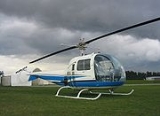
Bell 47

Encyclopedia
The Bell 47 is a two-bladed, single engine, light helicopter
manufactured by Bell Helicopter. Based on the third Model 30
prototype, Bell's first helicopter designed by Arthur M. Young
, the Bell 47 became the first helicopter certified for civilian use on 8 March 1946. More than 5,600 Bell 47 aircraft were produced, including those produced under license by Agusta
in Italy
, Kawasaki Heavy Industries
in Japan
, and Westland Aircraft
in the United Kingdom
. The Bell 47J Ranger
is a modified version with a fully enclosed cabin and fuselage.
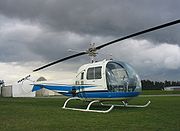 Early models varied in appearance, with open cockpit
s or sheet metal
cabins, fabric covered or open structures, some with four-wheel landing gear.
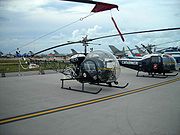
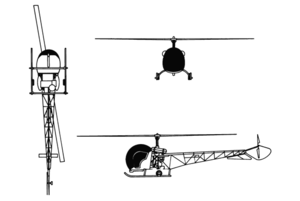
Later model D and Korean War H-13D and E types settled on a more utilitarian style. The most common model, the 47G introduced in 1953, can be recognized by the full bubble canopy
, exposed welded-tube tail boom, saddle fuel tank
s and skid landing gear.
The later three-seat 47H had an enclosed cabin with full cowling and monocoque
tail boom. It was an attempt to market a "luxury" version of the basic 47G. Relatively few were produced.
Engine
s were Franklin
or Lycoming
vertically-mounted piston engine
s of 200 to 305 HP
(150 to 230 kW
). Seating varied from two (early 47s and the later G-5A) to four (the J and KH-4).
As of 2005, many are still in use as trainer
s and in agriculture
.
There are currently (April 2011) 1068 registered with the FAA& 15 in the UK CAA
Bell 47s were produced in Japan by a Bell and Kawasaki venture; this led to the Kawasaki KH-4 variant, a four-seat version of the Model 47 with a cabin similar to the Bell 47J. It differed from the "J" in having a standard uncovered tailboom and fuel tanks like the G series. It was sold throughout Asia, and some were used in Australia.
In February 2010, the Bell 47 type certificate
s were transferred to Scott's Helicopter Services.
, it was designated the H-13 Sioux
by the United States Army
. It has also served as the helicopter of choice for basic helicopter flight instruction in many countries.
NASA
had a number of Bell 47s during the Apollo program, used by astronauts as trainers for the Lunar Lander
. Eugene Cernan had a near disastrous accident shortly before his flight to the moon on Apollo 17
, crashing into the Indian River
.
The Los Angeles County Fire Department in California used the Bell 47 as the department's very first aircraft in 1957.
Two helicopter types, the 47G and the 47J Ranger, were used in the popular television series (1957-1960) Whirlybirds
.
Batman used the Bell 47 as the "Batcopter" in "Batman the Movie" in 1966.
The San Diego County Sheriff's Department used the Bell 47 when it started its law enforcement helicopter division in 1971.
Bell 47A: Improved version of the Bell 47, powered by a 117-kW (157-hp) Franklin O-335-1 piston engine.
Bell 47B: Equivalent to the military YR-13/HTL-1, powered by the Franklin O-335-1 piston engine.
Bell 47B-3: Agricultural/utility version with open crew positions. Also, offered in a version to the US Postal Service as the Bell "Airmailer" .
Bell 47C
Bell 47D: First to appear with a moulded 'goldfish bowl' canopy.
Bell 47D-1: Introduced in 1949, it had an open tubework tailboom reminiscent of the Bell Model 30, ship number 3, and a three-seat configuration.
Bell 47E: Powered by a 149-kW (200-hp) Franklin 6V4-200-C32 engine.
Bell 47F
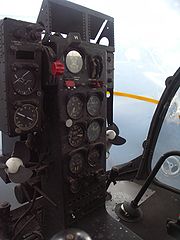 Bell 47G: Combines a 149 kW Franklin engine with the three-seat configuration of the 47D-1 and introduced the twin saddle-bag fuel tank configuration.
Bell 47G-2: Powered by the Lycoming VO-435 engine. Produced under license by Westland Aircraft
as the Westland Sioux, for the UK military.
Bell 47G-2A: Powered by a 179 kW version of the VO-435.
Bell 47G-2A-1: Wider cabin, improved rotor blades and increased fuel capacity.
Bell 47G-3: Powered by a supercharged 168 kW Franklin 6VS-335-A.
Bell 47G-3B: Powered by a turbocharged 209 kW Avco Lycoming TVO-435.
Bell 47G-4: Three-seat helicopter powered by an Avco Lycoming VO-540
engine.
Bell 47G-5: A three-seat, utility version. A two-seat agricultural version was later known as the Ag-5. The 47G-5 was the last model to be produced by Bell.
Bell 47H-1: A three-seat version with an enclosed cabin and fuselage.
Bell 47J Ranger
: A four-seat version powered by an Avco Lycoming VO-435 engine.
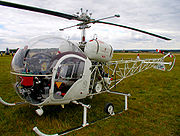 Agusta A.115:1971 Italian prototype of a Bell 47J with an unclad, tubular tail boom, and powered by a Turboméca
Astazou II turboshaft engine
Meridionali/Agusta EMA 124: Italian prototype with redesigned forward fuselage. Not produced.
Kawasaki KH-4: Japanese production version with redesigned, lengthened cabin, and redesigned control system
El Tomcat Mk.II
 Brazil
Canada
South Africa
United Kingdom
United States
Austria
Canada
New Zealand
United States
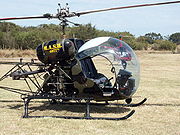 The Bell 47 appeared, and played key roles, in film and television productions. It has been associated with both the M*A*S*H film and M*A*S*H television series, and the Whirlybirds
TV series (1957–1960).
Helicopter
A helicopter is a type of rotorcraft in which lift and thrust are supplied by one or more engine-driven rotors. This allows the helicopter to take off and land vertically, to hover, and to fly forwards, backwards, and laterally...
manufactured by Bell Helicopter. Based on the third Model 30
Bell 30
|-See also:-External links: August 1944 article on Bell 30. Photo at bottom of page....
prototype, Bell's first helicopter designed by Arthur M. Young
Arthur M. Young
Arthur Middleton Young was an American inventor, helicopter pioneer, cosmologist, philosopher, astrologer and author. Young was the designer of Bell Helicopter's first helicopter, the Model 30, and inventor of the stabilizer bar used on many of Bell's early helicopter designs...
, the Bell 47 became the first helicopter certified for civilian use on 8 March 1946. More than 5,600 Bell 47 aircraft were produced, including those produced under license by Agusta
Agusta
Agusta is an Italian helicopter manufacturer. It is based in Samarate, Northern Italy. It is a subsidiary of Finmeccanica. The company was founded by Count Giovanni Agusta in 1923, who flew his first airplane in 1907...
in Italy
Italy
Italy , officially the Italian Republic languages]] under the European Charter for Regional or Minority Languages. In each of these, Italy's official name is as follows:;;;;;;;;), is a unitary parliamentary republic in South-Central Europe. To the north it borders France, Switzerland, Austria and...
, Kawasaki Heavy Industries
Kawasaki Heavy Industries
is an international corporation based in Japan. It has headquarters in both Chūō-ku, Kobe and Minato, Tokyo.The company is named after its founder Shōzō Kawasaki and has no connection with the city of Kawasaki, Kanagawa....
in Japan
Japan
Japan is an island nation in East Asia. Located in the Pacific Ocean, it lies to the east of the Sea of Japan, China, North Korea, South Korea and Russia, stretching from the Sea of Okhotsk in the north to the East China Sea and Taiwan in the south...
, and Westland Aircraft
Westland Aircraft
Westland Aircraft was a British aircraft manufacturer located in Yeovil in Somerset. Formed as a separate company by separation from Petters Ltd just before the start of the Second World War, Westland had been building aircraft since 1915...
in the United Kingdom
United Kingdom
The United Kingdom of Great Britain and Northern IrelandIn the United Kingdom and Dependencies, other languages have been officially recognised as legitimate autochthonous languages under the European Charter for Regional or Minority Languages...
. The Bell 47J Ranger
Bell 47J Ranger
|-See also:-References:* -External links:* from The International Directory of Civil Aircraft by Gerard Frawley...
is a modified version with a fully enclosed cabin and fuselage.
Design and development
Cockpit
A cockpit or flight deck is the area, usually near the front of an aircraft, from which a pilot controls the aircraft. Most modern cockpits are enclosed, except on some small aircraft, and cockpits on large airliners are also physically separated from the cabin...
s or sheet metal
Sheet metal
Sheet metal is simply metal formed into thin and flat pieces. It is one of the fundamental forms used in metalworking, and can be cut and bent into a variety of different shapes. Countless everyday objects are constructed of the material...
cabins, fabric covered or open structures, some with four-wheel landing gear.
Later model D and Korean War H-13D and E types settled on a more utilitarian style. The most common model, the 47G introduced in 1953, can be recognized by the full bubble canopy
Bubble canopy
A bubble canopy is a canopy made like a soap bubble, which attempts to provide 360° vision to the pilot.-History:Bubble canopies have been in use since World War II. The British had already developed the "Malcolm hood", which was a bulged canopy, but the British Miles M.20 was one of the first...
, exposed welded-tube tail boom, saddle fuel tank
Fuel tank
A fuel tank is safe container for flammable fluids. Though any storage tank for fuel may be so called, the term is typically applied to part of an engine system in which the fuel is stored and propelled or released into an engine...
s and skid landing gear.
The later three-seat 47H had an enclosed cabin with full cowling and monocoque
Monocoque
Monocoque is a construction technique that supports structural load by using an object's external skin, as opposed to using an internal frame or truss that is then covered with a non-load-bearing skin or coachwork...
tail boom. It was an attempt to market a "luxury" version of the basic 47G. Relatively few were produced.
Engine
Engine
An engine or motor is a machine designed to convert energy into useful mechanical motion. Heat engines, including internal combustion engines and external combustion engines burn a fuel to create heat which is then used to create motion...
s were Franklin
Franklin Engine Company
The Franklin Engine Company was a manufacturer of aircraft engines, formed as the H. H. Franklin Co. in 1902, located in Syracuse, New York, United States. Barely surviving bankruptcy in 1933, the company was purchased by a group of ex-employees and renamed Aircooled Motors in 1937...
or Lycoming
Lycoming Engines
Lycoming Engines is a U.S. aircraft engine company, known primarily for its general aviation engines. For most of its history Lycoming has been part of the AVCO group as AVCO Lycoming. In 1987 AVCO was purchased by Textron to become Textron Lycoming...
vertically-mounted piston engine
Reciprocating engine
A reciprocating engine, also often known as a piston engine, is a heat engine that uses one or more reciprocating pistons to convert pressure into a rotating motion. This article describes the common features of all types...
s of 200 to 305 HP
Horsepower
Horsepower is the name of several units of measurement of power. The most common definitions equal between 735.5 and 750 watts.Horsepower was originally defined to compare the output of steam engines with the power of draft horses in continuous operation. The unit was widely adopted to measure the...
(150 to 230 kW
Watt
The watt is a derived unit of power in the International System of Units , named after the Scottish engineer James Watt . The unit, defined as one joule per second, measures the rate of energy conversion.-Definition:...
). Seating varied from two (early 47s and the later G-5A) to four (the J and KH-4).
As of 2005, many are still in use as trainer
Trainer (aircraft)
A trainer is a class of aircraft designed specifically to facilitate in-flight training of pilots and aircrews. The use of a dedicated trainer aircraft with additional safety features—such as tandem flight controls, forgiving flight characteristics and a simplified cockpit arrangement—allows...
s and in agriculture
Agricultural aircraft
An agricultural aircraft is an aircraft that has been built or converted for agricultural use - usually aerial application of pesticides or fertilizer ; in these roles they are referred to as "crop dusters" or "top dressers"...
.
There are currently (April 2011) 1068 registered with the FAA& 15 in the UK CAA
Bell 47s were produced in Japan by a Bell and Kawasaki venture; this led to the Kawasaki KH-4 variant, a four-seat version of the Model 47 with a cabin similar to the Bell 47J. It differed from the "J" in having a standard uncovered tailboom and fuel tanks like the G series. It was sold throughout Asia, and some were used in Australia.
In February 2010, the Bell 47 type certificate
Type certificate
A Type Certificate, is awarded by aviation regulating bodies to aerospace manufacturers after it has been established that the particular design of a civil aircraft, engine, or propeller has fulfilled the regulating bodies' current prevailing airworthiness requirements for the safe conduct of...
s were transferred to Scott's Helicopter Services.
Operational history
The Bell 47 helicopter entered U.S. military service in late 1946, in a variety of versions and designations for three decades. In the Korean WarKorean War
The Korean War was a conventional war between South Korea, supported by the United Nations, and North Korea, supported by the People's Republic of China , with military material aid from the Soviet Union...
, it was designated the H-13 Sioux
H-13 Sioux
The H-13 Sioux was a two-bladed, single engine, light helicopter built by Bell Helicopter. Westland Aircraft manufactured the Sioux under license for the British military as the Sioux AH.1 and HT.2.-Development:...
by the United States Army
United States Army
The United States Army is the main branch of the United States Armed Forces responsible for land-based military operations. It is the largest and oldest established branch of the U.S. military, and is one of seven U.S. uniformed services...
. It has also served as the helicopter of choice for basic helicopter flight instruction in many countries.
NASA
NASA
The National Aeronautics and Space Administration is the agency of the United States government that is responsible for the nation's civilian space program and for aeronautics and aerospace research...
had a number of Bell 47s during the Apollo program, used by astronauts as trainers for the Lunar Lander
Apollo Lunar Module
The Apollo Lunar Module was the lander portion of the Apollo spacecraft built for the US Apollo program by Grumman to carry a crew of two from lunar orbit to the surface and back...
. Eugene Cernan had a near disastrous accident shortly before his flight to the moon on Apollo 17
Apollo 17
Apollo 17 was the eleventh and final manned mission in the American Apollo space program. Launched at 12:33 a.m. EST on December 7, 1972, with a three-member crew consisting of Commander Eugene Cernan, Command Module Pilot Ronald Evans, and Lunar Module Pilot Harrison Schmitt, Apollo 17 remains the...
, crashing into the Indian River
Indian River (Florida)
The Indian River is a waterway in Florida, a part of the Indian River Lagoon system which forms the Atlantic Intracoastal Waterway. It extends southward from the Ponce de Leon inlet in New Smyrna Beach, Florida [Volusia County] southward and across the "Haulover Canal" and along the western shore...
.
The Los Angeles County Fire Department in California used the Bell 47 as the department's very first aircraft in 1957.
Two helicopter types, the 47G and the 47J Ranger, were used in the popular television series (1957-1960) Whirlybirds
Whirlybirds
Whirlybirds is an American drama television series....
.
Batman used the Bell 47 as the "Batcopter" in "Batman the Movie" in 1966.
The San Diego County Sheriff's Department used the Bell 47 when it started its law enforcement helicopter division in 1971.
Records
- 13 May 1949, a Bell 47 set an altitude record of 18,550 feet (5,650 m).
- 21 September 1950, first helicopter to fly over the Alps.
- 17 September 1952, Bell pilot Elton J. Smith set a world distance record of 1,217 mi (1,959 km), by flying nonstop from Hurst, Texas to Buffalo, New York.
Civilian
Bell 47: Pre-production version, powered by a 133-kW (178-hp) Franklin piston engine.Bell 47A: Improved version of the Bell 47, powered by a 117-kW (157-hp) Franklin O-335-1 piston engine.
Bell 47B: Equivalent to the military YR-13/HTL-1, powered by the Franklin O-335-1 piston engine.
Bell 47B-3: Agricultural/utility version with open crew positions. Also, offered in a version to the US Postal Service as the Bell "Airmailer" .
Bell 47C
Bell 47D: First to appear with a moulded 'goldfish bowl' canopy.
Bell 47D-1: Introduced in 1949, it had an open tubework tailboom reminiscent of the Bell Model 30, ship number 3, and a three-seat configuration.
Bell 47E: Powered by a 149-kW (200-hp) Franklin 6V4-200-C32 engine.
Bell 47F
Bell 47G-2: Powered by the Lycoming VO-435 engine. Produced under license by Westland Aircraft
Westland Aircraft
Westland Aircraft was a British aircraft manufacturer located in Yeovil in Somerset. Formed as a separate company by separation from Petters Ltd just before the start of the Second World War, Westland had been building aircraft since 1915...
as the Westland Sioux, for the UK military.
Bell 47G-2A: Powered by a 179 kW version of the VO-435.
Bell 47G-2A-1: Wider cabin, improved rotor blades and increased fuel capacity.
Bell 47G-3: Powered by a supercharged 168 kW Franklin 6VS-335-A.
Bell 47G-3B: Powered by a turbocharged 209 kW Avco Lycoming TVO-435.
Bell 47G-4: Three-seat helicopter powered by an Avco Lycoming VO-540
Lycoming O-540
|-Specifications :-See also:-External links:...
engine.
Bell 47G-5: A three-seat, utility version. A two-seat agricultural version was later known as the Ag-5. The 47G-5 was the last model to be produced by Bell.
Bell 47H-1: A three-seat version with an enclosed cabin and fuselage.
Bell 47J Ranger
Bell 47J Ranger
|-See also:-References:* -External links:* from The International Directory of Civil Aircraft by Gerard Frawley...
: A four-seat version powered by an Avco Lycoming VO-435 engine.
Licenced versions
Turbomeca
Turbomeca is a French manufacturer of low- and medium-power gas turbine turboshaft engines for helicopters. The company also produces gas turbine engines for aircraft and missiles, as well as turbines for land, industrial and marine applications...
Astazou II turboshaft engine
Meridionali/Agusta EMA 124: Italian prototype with redesigned forward fuselage. Not produced.
Kawasaki KH-4: Japanese production version with redesigned, lengthened cabin, and redesigned control system
Conversions
Carson Super C-4El Tomcat Mk.II
Continental Copters El Tomcat
|-References:* -See also:...
- Bell 47G-2 modified extensively for agricultural spraying by Continental Copters Inc. First flew in April 1959. Followed by further improved versions.
Operators
Government operators
- Italian Air ForceItalian Air ForceThe Italian Air Force has gone under different names in different periods:*Regia Aeronautica , from 1923 to June 1946*Aeronautica Nazionale Repubblicana, the air force of Italian Social Republic during World War II...
- Italian ArmyItalian ArmyThe Italian Army is the ground defence force of the Italian Armed Forces. It is all-volunteer force of active-duty personnel, numbering 108,355 in 2010. Its best-known combat vehicles are the Dardo infantry fighting vehicle, the Centauro tank destroyer and the Ariete tank, and among its aircraft...
, formerly including CarabinieriCarabinieriThe Carabinieri is the national gendarmerie of Italy, policing both military and civilian populations, and is a branch of the armed forces.-Early history:... - Italian NavyItalian NavyItalian Navy may refer to:* Pre-unitarian navies of the Italian states* Regia Marina, the Royal Navy of the Kingdom of Italy * Italian Navy , the navy of the Italian Republic...
- Guardia di FinanzaGuardia di FinanzaThe Guardia di Finanza is a Italian law enforcement agency under the authority of the Minister of Economy and Finance. Like the Carabinieri, it is part of the Italian Armed Forces. The Guard is essentially responsible for dealing with financial crime and smuggling; it has also evolved into Italy's...
- Vigili del FuocoVigili del FuocoThe Vigili del Fuoco, literally the Fire Watch, is Italy's institutional agency for fire and rescue service...
(Fire brigades)
- Royal New Zealand Air ForceRoyal New Zealand Air ForceThe Royal New Zealand Air Force is the air arm of the New Zealand Defence Force...
five aircraft due to be replaced in July 2011 by eight Agusta-Westland AW109s
Aircraft on display
- Museu AeroespacialMuseu AeroespacialMuseu Aeroespacial is a national aviation museum located 25 km west of Rio de Janeiro, Brazil.-History:The Museu Aeroespacial was inaugurated on 18 October 1976 at the installations of the old Escola de Aeronáutica , at Afonsos Air Force Base - the "Cradle of Military...
in Rio de JaneiroRio de JaneiroRio de Janeiro , commonly referred to simply as Rio, is the capital city of the State of Rio de Janeiro, the second largest city of Brazil, and the third largest metropolitan area and agglomeration in South America, boasting approximately 6.3 million people within the city proper, making it the 6th...
Canada
- Alberta Aviation MuseumAlberta Aviation MuseumThe Alberta Aviation Museum is a museum in Edmonton, Alberta, Canada. It is located on-site at the Edmonton City Centre Airport CYXD on the southwest corner of the field ....
in Edmonton, Alberta is restoring a 47G Model. - Aero Space Museum of Calgary has a Bell 47G on display.
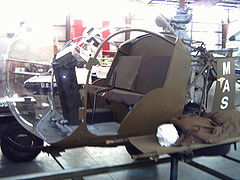
- Canada Aviation and Space Museum, in Ottawa, Ontario, has a Bell 47 on display, as well as a removed cockpit section for visitors to sit in.
- Canadian Bushplane Heritage CentreCanadian Bushplane Heritage CentreCanadian Bushplane Heritage Centre , located on the north bank of the St. Marys River in Sault Ste. Marie, Ontario, Canada, is dedicated to preserving the history of bush flying and forest protection in Canada...
in Sault ste Marie, Ontario, has a Bell 47D on display.
South Africa
- South African Air Force MuseumSouth African Air Force MuseumThe South African Air Force Museum houses, exhibits and restores material related to the history of the South African Air Force. The Museum is divided into three locations, AFB Swartkop outside Pretoria, AFB Ysterplaat in Cape Town and at the Port Elizabeth airport.-AFB Swartkop:Swartkop is the...
- Bell 47G Sioux Mk.2 (ex RAF XT562)
United Kingdom
- A Westland Sioux is on display at The Helicopter MuseumThe Helicopter Museum (Weston)The Helicopter Museum in Weston-super-Mare, North Somerset, England, is a museum featuring a collection of more than 80 helicopters and autogyros from around the world, both civilian and military...
in Weston-super-Mare. - North East Aircraft MuseumNorth East Aircraft MuseumThe North East Aircraft Museum is a volunteer-run aviation museum situated on the site of the former RAF Usworth/Sunderland Airport, between Washington and Sunderland, England. The museum has the largest aviation collection between Yorkshire and Scotland and houses over 30 aircraft and a wide...
, Tyne & Wear, has a Bell 47D under restoration as of November 2010. - Newark Air MuseumNewark Air Museumright|thumb|200px|[[Handley Page Hastings]] T5 TG517 at the Newark Air Museum.Newark Air Museum is an air museum located on a former Royal Air Force station at Winthorpe, near Newark on Trent in Nottinghamshire, England. The museum contains a variety of aircraft...
, Winthorpe, Nottinghamshire, has a Westland Sioux on display as of May 2011
United States
- Fantasy of FlightFantasy of FlightFantasy of Flight is an aviation-related attraction in Polk City, Florida, USA that takes visitors back to the pioneering days of early flight, World War I, World War II and beyond. The attraction opened in November of 1995, and houses the world's largest private aircraft collection on display...
in Polk City, Florida has a Bell 47G on display. - Steven F. Udvar-Hazy CenterSteven F. Udvar-Hazy CenterThe Steven F. Udvar-Hazy Center is the Smithsonian National Air and Space Museum 's annex at Washington Dulles International Airport in the Chantilly area of Fairfax County, Virginia, United States....
, Washington Dulles International AirportWashington Dulles International AirportWashington Dulles International Airport is a public airport in Dulles, Virginia, 26 miles west of downtown Washington, D.C. The airport serves the Baltimore-Washington-Northern Virginia metropolitan area centered on the District of Columbia. It is named after John Foster Dulles, Secretary of...
in Chantilly, VirginiaChantilly, VirginiaChantilly is an unincorporated community located in western Fairfax County and southeastern Loudoun County of Northern Virginia. Recognized by the U.S. Census Bureau as a census designated place , the community population was 23,039 as of the 2010 census -- down from 41,041 in 2000, due to the...
, includes a Bell 47 and the Bell Model 30 predecessor. - Museum of Modern ArtMuseum of Modern ArtThe Museum of Modern Art is an art museum in Midtown Manhattan in New York City, on 53rd Street, between Fifth and Sixth Avenues. It has been important in developing and collecting modernist art, and is often identified as the most influential museum of modern art in the world...
(MoMA) in New York CityNew York CityNew York is the most populous city in the United States and the center of the New York Metropolitan Area, one of the most populous metropolitan areas in the world. New York exerts a significant impact upon global commerce, finance, media, art, fashion, research, technology, education, and...
has a Bell 47D-1 on permanent display. - EAAExperimental Aircraft AssociationThe Experimental Aircraft Association is an international organization of aviation enthusiasts based in Oshkosh, Wisconsin. Since its inception it has grown internationally with over 160,000 members and about 1,000 chapters worldwide....
AirVenture Museum in OshkoshOshkosh, WisconsinAs of the census of 2000, there were 62,916 people, 24,082 households, and 13,654 families residing in the city. The population density was 2,662.2 people per square mile . There were 25,420 housing units at an average density of 1,075.6 per square mile...
, WisconsinWisconsinWisconsin is a U.S. state located in the north-central United States and is part of the Midwest. It is bordered by Minnesota to the west, Iowa to the southwest, Illinois to the south, Lake Michigan to the east, Michigan to the northeast, and Lake Superior to the north. Wisconsin's capital is...
, has multiple Bell 47 helicopters available to ride.
Survivors
Australia- Bell47.com.au in BrisbaneBrisbaneBrisbane is the capital and most populous city in the Australian state of Queensland and the third most populous city in Australia. Brisbane's metropolitan area has a population of over 2 million, and the South East Queensland urban conurbation, centred around Brisbane, encompasses a population of...
uses a Bell 47G5A for tourist flights.
Austria
- Red Bull - FlyingBulls - Hangar-7 in SalzburgSalzburg-Population development:In 1935, the population significantly increased when Salzburg absorbed adjacent municipalities. After World War II, numerous refugees found a new home in the city. New residential space was created for American soldiers of the postwar Occupation, and could be used for...
flies a Bell 47 G-3B-1 (SOLOY conversion).
Canada
- The College of the North AtlanticCollege of the North AtlanticCollege of the North Atlantic is the public college of the Canadian province of Newfoundland and Labrador. The enabling legislation is theCollege Act....
(Gander Campus), Newfoundland and Labrador has a functioning Bell 47 used as a training aid for students taking the Aircraft Maintenance Engineering program.
New Zealand
- Adventure Aviation in TaurangaTaurangaTauranga is the most populous city in the Bay of Plenty region, in the North Island of New Zealand.It was settled by Europeans in the early 19th century and was constituted as a city in 1963...
uses a Bell 47G in a "M*A*S*H" paint scheme for tourist flights. - Number 3 Squadron (Training Flight) of the Royal New Zealand Air Force (RNZAF) still operates the B47G as an ab-initio training helicopter. The first helicopters to be flown by the RNZAF, six B47G-3B-1 (NZ3701 -NZ3706) were delivered in 1965. Seven B47G-3B-2 (NZ3707 - NZ3713) were purchased in 1968 and delivered during 1970. The five remaining Sioux in RNZAF service are all B47G-3B-2. All will be replaced in 2011 by the Augusta A109LUH.
United States
- Dedicated Helicopters, Inc. of Palm Springs, California has a military TH-13T serial 67-17005, turned civilian serial 3687(N170HF) giving rides every week.
Specifications (Bell 47G-3B)
Popular culture
Whirlybirds
Whirlybirds is an American drama television series....
TV series (1957–1960).
See also
External links
- Bell 47.net
- Bell 47 Enthusiast site
- Model 47G Museum site
- Model 47G specs from The International Directory of Civil Aircraft by Gerard Frawley