

Linguistic meaning

Encyclopedia
The nature of meaning, its definition
, elements, and types, was discussed by philosophers Aristotle
, Augustine
, and Aquinas. According to them 'meaning is a relationship between two sorts of things: signs and the kinds of things they mean (intend, express or signify)'. One term in the relationship of meaning necessarily causes something else to come to the mind. In other words: 'a sign is defined as an entity
that indicates another entity to some agent for some purpose'.
The types of meanings vary according to the types of the thing that is being represented. Namely:
All subsequent inquiries emphasize some particular perspectives within the general AAA framework.
The major contemporary positions of meaning come under the following partial definitions of meaning:
s, or to mental activity in general. Those who seek an explanation for meaning in the former sort of account endorse a stronger sort of idea theory of mind than the latter.
Each idea is understood to be necessarily about something external and/or internal, real or imaginary. For example, in contrast to the abstract meaning of the universal
"dog", the referent "this dog" may mean a particular real life chihuahua. In both cases, the word is about something, but in the former it is about the class of dogs as generally understood, while in the latter it is about a very real and particular dog in the real world.
, considered all ideas to be both imaginable objects of sensation and the very unimaginable objects of reflection. He said in his Essay Concerning Human Understanding, that words are used both as signs for ideas—but also to signify the lack of certain ideas. David Hume
held that thoughts were kinds of imaginable entities. (See his Enquiry Concerning Human Understanding, section 2). Hume argued that any words that could not call upon any past experience were without meaning.
and Ludwig Wittgenstein
held however that ideas alone are unable to account for the different variations within a general meaning. For example, any hypothetical image of the meaning of "dog" has to include such varied images as a chihuahua, a pug, and a Black Lab; and this seems impossible to imagine, all of those particular breeds looking very different from one another. Another way to see this point is to question why it is that, if we have an image of a specific type of dog (say of a chihuahua), it should be entitled to represent the entire concept.
Another criticism is that some meaningful words, known as non-lexical items, don't have any meaningfully associated image. For example, the word "the" has a meaning, but one would be hard-pressed to find a mental representation that fits it. Still another objection lies in the observation that certain linguistic items name something in the real world, and are meaningful, yet which we have no mental representations to deal with. For instance, it is not known what Bismarck's mother looked like, yet the phrase "Bismarck's mother" still has meaning.
Another problem is that of composition - that it is difficult to explain how words and phrases combine into sentences if only ideas were involved in meaning.
 Eleanor Rosch
and George Lakoff
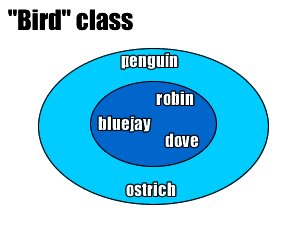
advanced the theory of prototypes, which suggests that many lexical categories, at least on the face of things, have "radial structures". That is to say, there are some ideal member(s) in the category that seem to represent the category better than other members. For example, the category of "birds" may feature the robin as the prototype, or the ideal kind of bird. With experience, subjects might come to evaluate membership in the category of "bird" by comparing candidate members to the prototype and evaluating for similarities. So, for example, a penguin or an ostrich would sit at the fringe of the meaning of "bird", because a penguin is unlike a robin.
Intimately related to these researches is the notion of a psychologically basic level, which is both the first level named and understood by children, and "the highest level at which a single mental image can reflect the entire category". (Lakoff 1987:46) The "basic level" of cognition is understood by Lakoff as crucially drawing upon "image-schemas" along with various other cognitive processes.
The philosophers (Ned Block, Gilbert Harman
, H. Field) and the cognitive scientists (G. Miller and P. Johnson-Laird) say that the meaning of a term can be found by investigating its role in relation to other concepts and mental states. They endorse a view called "conceptual role semantics". Those proponents of this view who understand meanings to be exhausted by the content of mental states can be said to endorse "one-factor" accounts of conceptual role semantics. and thus fit within the tradition of idea theories.
s they involve. For such theories, an emphasis is placed upon reference
to actual things in the world to account for meaning, with the caveat that reference more or less explains the greater part (or all) of meaning itself.
argued that proper names present at least two problems in explaining meaning.
Frege can be interpreted as arguing that it was therefore a mistake to think that the meaning of a name is the thing it refers to. Instead, the meaning must be something else—the "sense" of the word. Two names for the same person, then, can have different senses (or meanings): one referent might be picked out by more than one sense. This sort of theory is called a mediated reference theory
.
Frege argued that, ultimately, the same bifurcation of meaning must apply to most or all linguistic categories, such as to quantificational expressions like "All boats float". Ironically enough, it is now accepted by many philosophers as applying to all expressions but proper names.
and Alfred North Whitehead
in their groundbreaking Principia Mathematica
, which attempted to produce a formal language with which the truth of all mathematical statements could be demonstrated from first principles.
Russell differed from Frege greatly on many points, however. He rejected (or perhaps misunderstood) Frege's sense-reference distinction. He also disagreed that language was of fundamental significance to philosophy, and saw the project of developing formal logic as a way of eliminating all of the confusions caused by ordinary language, and hence at creating a perfectly transparent medium in which to conduct traditional philosophical argument. He hoped, ultimately, to extend the proofs of the Principia to all possible true statements, a scheme he called logical atomism
. For a while it appeared that his pupil Wittgenstein
had succeeded in this plan with his "Tractatus Logico-Philosophicus
".
Russell's work, and that of his colleague G. E. Moore, developed in response to what they perceived as the nonsense dominating British philosophy departments at the turn of the century, which was a kind of British Idealism
most of which was derived (albeit very distantly) from the work of Hegel. In response Moore developed an approach ("Common Sense Philosophy") which sought to examine philosophical difficulties by a close analysis of the language used in order to determine its meaning. In this way Moore sought to expunge philosophical absurdities such as "time is unreal". Moore's work would have significant, if oblique, influence (largely mediated by Wittgenstein) on Ordinary language philosophy
.
A semantic theory of truth
was produced by Alfred Tarski
for formal semantics. According to Tarski's account, meaning consists of a recursive set of rules that end up yielding an infinite set of sentences, "'p' is true if and only if p", covering the whole language. His innovation produced the notion of propositional function
s discussed on the section on universals
(which he called "sentential functions"), and a model-theoretic approach to semantics (as opposed to a proof-theoretic one). Finally, some links were forged to the correspondence theory of truth
(Tarski, 1944).
Perhaps the most influential current approach in the contemporary theory of meaning is that sketched by Donald Davidson
in his introduction to the collection of essays Truth and Meaning in 1967. There he argued for the following two theses:
The result is a theory of meaning that rather resembles, by no accident, Tarski's account.
Davidson's account, though brief, constitutes the first systematic presentation of truth-conditional semantics
. He proposed simply translating natural languages into first-order predicate calculus in order to reduce meaning to a function of truth.
examined the relation between sense and reference in dealing with possible and actual situations. He showed that one consequence of his interpretation of certain systems of modal logic
was that the reference of a proper name is necessarily linked to its referent, but that the sense is not. So for instance "Hesperus" necessarily refers to Hesperus, even in those imaginary cases and worlds in which perhaps Hesperus is not the evening star. That is, Hesperus is necessarily Hesperus, but only contingently the morning star.
This results in the curious situation that part of the meaning of a name - that it refers to some particular thing - is a necessary fact about that name, but another part - that it is used in some particular way or situation - is not.
Kripke also drew the distinction between speaker's meaning and semantic meaning, elaborating on the work of ordinary language philosophers Paul Grice
and Keith Donnellan
. The speaker's meaning is what the speaker intends to refer to by saying something; the semantic meaning is what the words uttered by the speaker mean according to the language.
In some cases, people do not say what they mean; in other cases, they say something that is in error. In both these cases, the speaker's meaning and the semantic meaning seem to be different. Sometimes words do not actually express what the speaker wants them to express; so words will mean one thing, and what people intend to convey by them might mean another. The meaning of the expression, in such cases, is ambiguous.
". In it, he suggested that meaning was nothing more than a vague and dispensable notion. Instead, he asserted, what was more interesting to study was the synonymy between signs. He also pointed out that verificationism was tied to the distinction between analytic and synthetic statements, and asserted that such a divide was defended ambiguously. He also suggested that the unit of analysis for any potential investigation into the world (and, perhaps, meaning) would be the entire body of statements taken as a collective, not just individual statements on their own.
Other criticisms can be raised on the basis of the limitations that truth-conditional theorists themselves admit to. Tarski, for instance, recognized that truth-conditional theories of meaning only make sense of statements, but fail to explain the meanings of the lexical parts that make up statements. Rather, the meaning of the parts of statements is presupposed by an understanding of the truth-conditions of a whole statement, and explained in terms of what he called "satisfaction conditions".
Still another objection (noted by Frege and others) was that some kinds of statements don't seem to have any truth-conditions at all. For instance, "Hello!" has no truth-conditions, because it doesn't even attempt to tell the listener anything about the state of affairs
in the world. In other words, different propositions have different grammatical moods.
Deflationist
accounts of truth, sometimes called 'irrealist' accounts, are the staunchest source of criticism of truth-conditional theories of meaning. According to them, "truth" is a word with no serious meaning or function in discourse. For instance, for the deflationist, the sentences "It's true that Tiny Tim is trouble" and "Tiny Tim is trouble" are equivalent. In consequence, for the deflationist, any appeal to truth as an account of meaning has little explanatory power.
The sort of truth-theories presented here can also be attacked for their formalism both in practice and principle. The principle of formalism is challenged by the informalists, who suggest that language is largely a construction of the speaker, and so, not compatible with formalization. The practice of formalism is challenged by those who observe that formal languages (such as present-day quantificational logic) fail to capture the expressive power of natural languages (as is arguably demonstrated in the awkward character of the quantificational explanation of definite description statements, as laid out by Bertrand Russell).
Finally, over the past century, forms of logic have been developed that are not dependent exclusively on the notions of truth and falsity. Some of these types of logic have been called modal logic
s. They explain how certain logical connectives such as "if-then" work in terms of necessity
and possibility
. Indeed, modal logic was the basis of one of the most popular and rigorous formulations in modern semantics called the Montague grammar
. The successes of such systems naturally give rise to the argument that these systems have captured the natural meaning of connectives like if-then far better than an ordinary, truth-functional logic ever could.
became very influential and led to the development of a wide range of philosophical tools.
was originally an artificial language philosopher, following the influence of Russell, Frege, and the Vienna Circle. In his Tractatus Logico-Philosophicus
he had supported the idea of an ideal language built up from atomic statements using logical connectives. However, as he matured, he came to appreciate more and more the phenomenon of natural language. Philosophical Investigations
, published after his death, signalled a sharp departure from his earlier work with its focus upon ordinary language use. His approach is often summarised by the aphorism "the meaning of a word is its use in a language". However, following in Frege's footsteps, in the Tractatus, Wittgenstein declares: "... Only in the context of a proposition has a name meaning."
His work would come to inspire future generations and spur forward a whole new discipline, which explained meaning in a new way. Meaning in a natural language was seen as primarily a question of how the speaker uses words within the language to express intention.
This close examination of natural language
proved to be a powerful philosophical technique. Practitioners who were influenced by Wittgenstein's approach have included an entire tradition of thinkers, featuring P. F. Strawson
, Paul Grice
, R. M. Hare
, R. S. Peters, and Jürgen Habermas
.
was re-thinking his approach to language, reflections on the complexity of language led to a more expansive approach to meaning. Following the lead of George Edward Moore
, J. L. Austin
examined the use of words in great detail. He argued against fixating on the meaning of words. He showed that dictionary definitions are of limited philosophical use, since there is no simple "appendage" to a word that can be called its meaning. Instead, he showed how to focus on the way in which words are used in order to do things. He analysed the structure of utterances into three distinct parts: locution
s, illocutions
and perlocutions
. His pupil John Searle
developed the idea under the label "speech act
s". Their work greatly influenced pragmatics
.
Indeed, one of the hallmarks of the ordinary use perspective is its insistence upon the distinctions between meaning and use. "Meanings", for ordinary language philosophers, are the instructions for usage of words - the common and conventional definitions of words. Usage, on the other hand, is the actual meanings that individual speakers have - the things that an individual speaker in a particular context wants to refer to. The word "dog" is an example of a meaning, but pointing at a nearby dog and shouting "This dog smells foul!" is an example of usage. From this distinction between usage and meaning arose the divide between the fields of Pragmatics
and Semantics
.
Yet another distinction is of some utility in discussing language: "mentioning". Mention is when an expression refers to itself as a linguistic item, usually surrounded by quotation marks. For instance, in the expression "'Opopanax' is hard to spell", what is referred to is the word itself ("opopanax") and not what it means (an obscure gum resin). Frege had referred to instances of mentioning as "opaque contexts".
In his essay, "Reference and Definite Descriptions", Keith Donnellan
sought to improve upon Strawson's distinction. He pointed out that there are two uses of definite descriptions: attributive and referential. Attributive uses provide a description of whoever is being referred to, while referential uses point out the actual referent. Attributive uses are like mediated references, while referential uses are more directly referential.
, working within the ordinary language tradition, understood "meaning" - in his 1957 eponymous article - to have two kinds: natural and non-natural. Natural meaning had to do with cause and effect, for example with the expression "these spots mean measles". Non-natural meaning, on the other hand, had to do with the intentions of the speaker in communicating something to the listener.
In his essay, Logic and Conversation, Grice went on to explain and defend an explanation of how conversations work. His guiding maxim was called the cooperative principle, which claimed that the speaker and the listener will have mutual expectations of the kind of information that will be shared. The principle is broken down into four maxims: Quality (which demands truthfulness and honesty), Quantity (demand for just enough information as is required), Relation (relevance of things brought up), and Manner (lucidity). This principle, if and when followed, lets the speaker and listener figure out the meaning of certain implications by way of inference.
The works of Grice led to an avalanche of research and interest in the field, both supportive and critical. One spinoff was called Relevance theory
, developed by Dan Sperber
and Deirdre Wilson during the mid-1980s, whose goal was to make the notion of relevance more clear. Similarly, in his work, "Universal pragmatics
", Jurgen Habermas began a program that sought to improve upon the work of the ordinary language tradition. In it, he laid out the goal of a valid conversation as a pursuit of mutual understanding.
argued against the kind of truth-conditional semantics
presented by Davidson. Instead, he argued that basing semantics on assertion conditions avoids a number of difficulties with truth-conditional semantics, such as the transcendental nature of certain kinds of truth condition. He leverages work done in proof-theoretic semantics
to provide a kind of inferential role semantics, where:
A semantics based upon assertion conditions is called a verificationist semantics: cf. the verificationism of the Vienna Circle.
This work is closely related, though not identical, to one-factor theories of conceptual role semantics.
has noted that use theories (of the Wittgensteinian kind) seem to be committed to the notion that language is a public phenomenon—that there is no such thing as a "private language". Fodor opposes such claims because he thinks it is necessary to create or describe the language of thought
, which would seemingly require the existence of a "private language".
Some philosophers of language, such as Christopher Gauker, have criticised Gricean theories of communication and meaning for their excessive focus on the efforts of a listener to discover the speaker's intentions. This, Gauker argues, is not required for linguistic communication, and so will not suffice for theory.
In the 1960s, David Kellogg Lewis
published another thesis of meaning as use, as he described meaning as a feature of a social convention
(see also convention (philosophy) and conventions as regularities of a specific sort. Lewis' work was an application of game theory
in philosophical matters. Conventions, he argued, are a species of coordination
equilibria
.
Definition
A definition is a passage that explains the meaning of a term , or a type of thing. The term to be defined is the definiendum. A term may have many different senses or meanings...
, elements, and types, was discussed by philosophers Aristotle
Aristotle
Aristotle was a Greek philosopher and polymath, a student of Plato and teacher of Alexander the Great. His writings cover many subjects, including physics, metaphysics, poetry, theater, music, logic, rhetoric, linguistics, politics, government, ethics, biology, and zoology...
, Augustine
Augustine of Hippo
Augustine of Hippo , also known as Augustine, St. Augustine, St. Austin, St. Augoustinos, Blessed Augustine, or St. Augustine the Blessed, was Bishop of Hippo Regius . He was a Latin-speaking philosopher and theologian who lived in the Roman Africa Province...
, and Aquinas. According to them 'meaning is a relationship between two sorts of things: signs and the kinds of things they mean (intend, express or signify)'. One term in the relationship of meaning necessarily causes something else to come to the mind. In other words: 'a sign is defined as an entity
Entity
An entity is something that has a distinct, separate existence, although it need not be a material existence. In particular, abstractions and legal fictions are usually regarded as entities. In general, there is also no presumption that an entity is animate.An entity could be viewed as a set...
that indicates another entity to some agent for some purpose'.
The types of meanings vary according to the types of the thing that is being represented. Namely:
- There are the things in the world, which might have meaning;
- There are things in the world that are also signs of other things in the world, and so, are always meaningful (i.e., natural signs of the physical world and ideas within the mind);
- There are things that are always necessarily meaningful, such as words, and other nonverbal symbols.
All subsequent inquiries emphasize some particular perspectives within the general AAA framework.
The major contemporary positions of meaning come under the following partial definitions of meaning:
- Psychological theories, exhausted by notions of thoughtThought"Thought" generally refers to any mental or intellectual activity involving an individual's subjective consciousness. It can refer either to the act of thinking or the resulting ideas or arrangements of ideas. Similar concepts include cognition, sentience, consciousness, and imagination...
, intentionIntentionIntention is an agent's specific purpose in performing an action or series of actions, the end or goal that is aimed at. Outcomes that are unanticipated or unforeseen are known as unintended consequences....
, or understanding; - Logical theories, involving notions such as intensionIntensionIn linguistics, logic, philosophy, and other fields, an intension is any property or quality connoted by a word, phrase or other symbol. In the case of a word, it is often implied by the word's definition...
, cognitive content, or senseSenseSenses are physiological capacities of organisms that provide inputs for perception. The senses and their operation, classification, and theory are overlapping topics studied by a variety of fields, most notably neuroscience, cognitive psychology , and philosophy of perception...
, along with extensionExtension (semantics)In any of several studies that treat the use of signs - for example, in linguistics, logic, mathematics, semantics, and semiotics - the extension of a concept, idea, or sign consists of the things to which it applies, in contrast with its comprehension or intension, which consists very roughly of...
, reference, or denotation; - Message, content, informationInformationInformation in its most restricted technical sense is a message or collection of messages that consists of an ordered sequence of symbols, or it is the meaning that can be interpreted from such a message or collection of messages. Information can be recorded or transmitted. It can be recorded as...
, or communicationCommunicationCommunication is the activity of conveying meaningful information. Communication requires a sender, a message, and an intended recipient, although the receiver need not be present or aware of the sender's intent to communicate at the time of communication; thus communication can occur across vast...
; - TruthTruthTruth has a variety of meanings, such as the state of being in accord with fact or reality. It can also mean having fidelity to an original or to a standard or ideal. In a common usage, it also means constancy or sincerity in action or character...
conditions; - Usage, and the instructions for usage; and
- MeasurementMeasurementMeasurement is the process or the result of determining the ratio of a physical quantity, such as a length, time, temperature etc., to a unit of measurement, such as the metre, second or degree Celsius...
, computation, or operation.
Idea theories of meaning
Some have argued that meanings are ideas, where the term "ideas" is used to refer to either mental representationMental representation
A representation, in philosophy of mind, cognitive psychology, neuroscience, and cognitive science, is a hypothetical internal cognitive symbol that represents external reality, or else a mental process that makes use of such a symbol; "a formal system for making explicit certain entities or types...
s, or to mental activity in general. Those who seek an explanation for meaning in the former sort of account endorse a stronger sort of idea theory of mind than the latter.
Each idea is understood to be necessarily about something external and/or internal, real or imaginary. For example, in contrast to the abstract meaning of the universal
Universal (metaphysics)
In metaphysics, a universal is what particular things have in common, namely characteristics or qualities. In other words, universals are repeatable or recurrent entities that can be instantiated or exemplified by many particular things. For example, suppose there are two chairs in a room, each of...
"dog", the referent "this dog" may mean a particular real life chihuahua. In both cases, the word is about something, but in the former it is about the class of dogs as generally understood, while in the latter it is about a very real and particular dog in the real world.
Stronger idea theories
John LockeJohn Locke
John Locke FRS , widely known as the Father of Liberalism, was an English philosopher and physician regarded as one of the most influential of Enlightenment thinkers. Considered one of the first of the British empiricists, following the tradition of Francis Bacon, he is equally important to social...
, considered all ideas to be both imaginable objects of sensation and the very unimaginable objects of reflection. He said in his Essay Concerning Human Understanding, that words are used both as signs for ideas—but also to signify the lack of certain ideas. David Hume
David Hume
David Hume was a Scottish philosopher, historian, economist, and essayist, known especially for his philosophical empiricism and skepticism. He was one of the most important figures in the history of Western philosophy and the Scottish Enlightenment...
held that thoughts were kinds of imaginable entities. (See his Enquiry Concerning Human Understanding, section 2). Hume argued that any words that could not call upon any past experience were without meaning.
Counter arguments
George BerkeleyGeorge Berkeley
George Berkeley , also known as Bishop Berkeley , was an Irish philosopher whose primary achievement was the advancement of a theory he called "immaterialism"...
and Ludwig Wittgenstein
Ludwig Wittgenstein
Ludwig Josef Johann Wittgenstein was an Austrian philosopher who worked primarily in logic, the philosophy of mathematics, the philosophy of mind, and the philosophy of language. He was professor in philosophy at the University of Cambridge from 1939 until 1947...
held however that ideas alone are unable to account for the different variations within a general meaning. For example, any hypothetical image of the meaning of "dog" has to include such varied images as a chihuahua, a pug, and a Black Lab; and this seems impossible to imagine, all of those particular breeds looking very different from one another. Another way to see this point is to question why it is that, if we have an image of a specific type of dog (say of a chihuahua), it should be entitled to represent the entire concept.
Another criticism is that some meaningful words, known as non-lexical items, don't have any meaningfully associated image. For example, the word "the" has a meaning, but one would be hard-pressed to find a mental representation that fits it. Still another objection lies in the observation that certain linguistic items name something in the real world, and are meaningful, yet which we have no mental representations to deal with. For instance, it is not known what Bismarck's mother looked like, yet the phrase "Bismarck's mother" still has meaning.
Another problem is that of composition - that it is difficult to explain how words and phrases combine into sentences if only ideas were involved in meaning.
Weaker idea theories
Eleanor Rosch
Eleanor Rosch is a professor of psychology at the University of California, Berkeley, specializing in cognitive psychology and primarily known for her work on categorization, in particular her prototype theory, which has profoundly influenced the field of cognitive psychology...
and George Lakoff
George Lakoff
George P. Lakoff is an American cognitive linguist and professor of linguistics at the University of California, Berkeley, where he has taught since 1972...
advanced the theory of prototypes, which suggests that many lexical categories, at least on the face of things, have "radial structures". That is to say, there are some ideal member(s) in the category that seem to represent the category better than other members. For example, the category of "birds" may feature the robin as the prototype, or the ideal kind of bird. With experience, subjects might come to evaluate membership in the category of "bird" by comparing candidate members to the prototype and evaluating for similarities. So, for example, a penguin or an ostrich would sit at the fringe of the meaning of "bird", because a penguin is unlike a robin.
Intimately related to these researches is the notion of a psychologically basic level, which is both the first level named and understood by children, and "the highest level at which a single mental image can reflect the entire category". (Lakoff 1987:46) The "basic level" of cognition is understood by Lakoff as crucially drawing upon "image-schemas" along with various other cognitive processes.
The philosophers (Ned Block, Gilbert Harman
Gilbert Harman
Gilbert Harman is a contemporary American philosopher, teaching at Princeton University, who has published widely in linguistics, semantics, cognitive science, philosophy of mind, ethics, moral psychology, epistemology, statistical learning theory, and metaphysics. He and George Miller...
, H. Field) and the cognitive scientists (G. Miller and P. Johnson-Laird) say that the meaning of a term can be found by investigating its role in relation to other concepts and mental states. They endorse a view called "conceptual role semantics". Those proponents of this view who understand meanings to be exhausted by the content of mental states can be said to endorse "one-factor" accounts of conceptual role semantics. and thus fit within the tradition of idea theories.
Truth and meaning
Some have asserted that meaning is nothing substantially more or less than the truth conditionTruth condition
In semantics, truth conditions are what obtain precisely when a sentence is true. For example, "It is snowing in Nebraska" is true precisely when it is snowing in Nebraska....
s they involve. For such theories, an emphasis is placed upon reference
Reference
Reference is derived from Middle English referren, from Middle French rèférer, from Latin referre, "to carry back", formed from the prefix re- and ferre, "to bear"...
to actual things in the world to account for meaning, with the caveat that reference more or less explains the greater part (or all) of meaning itself.
Logic and language
The logical positivists argued that the meaning of a statement arose from how it is verified.Gottlob Frege
In his paper Über Sinn und Bedeutung (now usually translated as On Sense and Reference), Gottlob FregeGottlob Frege
Friedrich Ludwig Gottlob Frege was a German mathematician, logician and philosopher. He is considered to be one of the founders of modern logic, and made major contributions to the foundations of mathematics. He is generally considered to be the father of analytic philosophy, for his writings on...
argued that proper names present at least two problems in explaining meaning.
- Suppose the meaning of a name is the thing it refers to. Sam, then, means a person in the world who is named Sam. But if the object referred to by the name did not exist—i.e., Pegasus -- then, according to that theory, it would be meaningless.
- Suppose two different names refer to the same object. Hesperus and Phosphorus were the names given to what were considered distinct celestial bodies. It was later shown that they were the same thing (the planet Venus). If the words meant the same thing, then substituting one for the other in a sentence would not result in a sentence that differs in meaning from the original. But in that case, "Hesperus is Phosphorus" would mean the same thing as "Hesperus is Hesperus". This is clearly absurd, since we learn something new and unobvious by the former statement, but not by the latter.
Frege can be interpreted as arguing that it was therefore a mistake to think that the meaning of a name is the thing it refers to. Instead, the meaning must be something else—the "sense" of the word. Two names for the same person, then, can have different senses (or meanings): one referent might be picked out by more than one sense. This sort of theory is called a mediated reference theory
Mediated reference theory
The mediated reference theory is a semantic theory that posits that words refer to something in the external world, but insists that there is more to the meaning of a name than simply the object to which it refers. It thus stands opposed to the theory of direct reference. Its most famous advocate...
.
Frege argued that, ultimately, the same bifurcation of meaning must apply to most or all linguistic categories, such as to quantificational expressions like "All boats float". Ironically enough, it is now accepted by many philosophers as applying to all expressions but proper names.
Bertrand Russell
Logical analysis was further advanced by Bertrand RussellBertrand Russell
Bertrand Arthur William Russell, 3rd Earl Russell, OM, FRS was a British philosopher, logician, mathematician, historian, and social critic. At various points in his life he considered himself a liberal, a socialist, and a pacifist, but he also admitted that he had never been any of these things...
and Alfred North Whitehead
Alfred North Whitehead
Alfred North Whitehead, OM FRS was an English mathematician who became a philosopher. He wrote on algebra, logic, foundations of mathematics, philosophy of science, physics, metaphysics, and education...
in their groundbreaking Principia Mathematica
Principia Mathematica
The Principia Mathematica is a three-volume work on the foundations of mathematics, written by Alfred North Whitehead and Bertrand Russell and published in 1910, 1912, and 1913...
, which attempted to produce a formal language with which the truth of all mathematical statements could be demonstrated from first principles.
Russell differed from Frege greatly on many points, however. He rejected (or perhaps misunderstood) Frege's sense-reference distinction. He also disagreed that language was of fundamental significance to philosophy, and saw the project of developing formal logic as a way of eliminating all of the confusions caused by ordinary language, and hence at creating a perfectly transparent medium in which to conduct traditional philosophical argument. He hoped, ultimately, to extend the proofs of the Principia to all possible true statements, a scheme he called logical atomism
Logical atomism
Logical atomism is a philosophical belief that originated in the early 20th century with the development of analytic philosophy. Its principal exponents were the British philosopher Bertrand Russell, the early work of his Austrian-born pupil and colleague Ludwig Wittgenstein, and his German...
. For a while it appeared that his pupil Wittgenstein
Ludwig Wittgenstein
Ludwig Josef Johann Wittgenstein was an Austrian philosopher who worked primarily in logic, the philosophy of mathematics, the philosophy of mind, and the philosophy of language. He was professor in philosophy at the University of Cambridge from 1939 until 1947...
had succeeded in this plan with his "Tractatus Logico-Philosophicus
Tractatus Logico-Philosophicus
The Tractatus Logico-Philosophicus is the only book-length philosophical work published by the Austrian philosopher Ludwig Wittgenstein in his lifetime. It was an ambitious project: to identify the relationship between language and reality and to define the limits of science...
".
Russell's work, and that of his colleague G. E. Moore, developed in response to what they perceived as the nonsense dominating British philosophy departments at the turn of the century, which was a kind of British Idealism
Idealism
In philosophy, idealism is the family of views which assert that reality, or reality as we can know it, is fundamentally mental, mentally constructed, or otherwise immaterial. Epistemologically, idealism manifests as a skepticism about the possibility of knowing any mind-independent thing...
most of which was derived (albeit very distantly) from the work of Hegel. In response Moore developed an approach ("Common Sense Philosophy") which sought to examine philosophical difficulties by a close analysis of the language used in order to determine its meaning. In this way Moore sought to expunge philosophical absurdities such as "time is unreal". Moore's work would have significant, if oblique, influence (largely mediated by Wittgenstein) on Ordinary language philosophy
Ordinary language philosophy
Ordinary language philosophy is a philosophical school that approaches traditional philosophical problems as rooted in misunderstandings philosophers develop by distorting or forgetting what words actually mean in everyday use....
.
Other truth theories
The Vienna Circle, a famous group of logical positivists from the early 20th century (closely allied with Russell and Frege), adopted the verificationist theory of meaning. The verificationist theory of meaning (in at least one of its forms) states that to say that an expression is meaningful is to say that there are some conditions of experience that could exist to show that the expression is true. As noted, Frege and Russell were two proponents of this way of thinking.A semantic theory of truth
Semantic theory of truth
A semantic theory of truth is a theory of truth in the philosophy of language which holds that truth is a property of sentences.-Origin:The semantic conception of truth, which is related in different ways to both the correspondence and deflationary conceptions, is due to work published by Polish...
was produced by Alfred Tarski
Alfred Tarski
Alfred Tarski was a Polish logician and mathematician. Educated at the University of Warsaw and a member of the Lwow-Warsaw School of Logic and the Warsaw School of Mathematics and philosophy, he emigrated to the USA in 1939, and taught and carried out research in mathematics at the University of...
for formal semantics. According to Tarski's account, meaning consists of a recursive set of rules that end up yielding an infinite set of sentences, "'p' is true if and only if p", covering the whole language. His innovation produced the notion of propositional function
Propositional function
A propositional function in logic, is a statement expressed in a way that would assume the value of true or false, except that within the statement is a variable that is not defined or specified, which leaves the statement undetermined...
s discussed on the section on universals
Universal (metaphysics)
In metaphysics, a universal is what particular things have in common, namely characteristics or qualities. In other words, universals are repeatable or recurrent entities that can be instantiated or exemplified by many particular things. For example, suppose there are two chairs in a room, each of...
(which he called "sentential functions"), and a model-theoretic approach to semantics (as opposed to a proof-theoretic one). Finally, some links were forged to the correspondence theory of truth
Correspondence theory of truth
The correspondence theory of truth states that the truth or falsity of a statement is determined only by how it relates to the world, and whether it accurately describes that world...
(Tarski, 1944).
Perhaps the most influential current approach in the contemporary theory of meaning is that sketched by Donald Davidson
Donald Davidson (philosopher)
Donald Herbert Davidson was an American philosopher born in Springfield, Massachusetts, who served as Slusser Professor of Philosophy at the University of California, Berkeley from 1981 to 2003 after having also held teaching appointments at Stanford University, Rockefeller University, Princeton...
in his introduction to the collection of essays Truth and Meaning in 1967. There he argued for the following two theses:
- Any learnable language must be statable in a finite form, even if it is capable of a theoretically infinite number of expressions—as we may assume that natural human languages are, at least in principle. If it could not be stated in a finite way then it could not be learned through a finite, empirical method such as the way humans learn their languages. It follows that it must be possible to give a theoretical semantics for any natural language which could give the meanings of an infinite number of sentences on the basis of a finite system of axioms.
- Giving the meaning of a sentence, he further argued, was equivalent to stating its truth conditions. He proposed that it must be possible to account for language as a set of distinct grammatical features together with a lexicon, and for each of them explain its workings in such a way as to generate trivial (obviously correct) statements of the truth conditions of all the (infinitely many) sentences built up from these.
The result is a theory of meaning that rather resembles, by no accident, Tarski's account.
Davidson's account, though brief, constitutes the first systematic presentation of truth-conditional semantics
Truth-conditional semantics
Truth-conditional semantics is an approach to semantics of natural language that sees the meaning of assertions as being the same as, or reducible to, their truth conditions...
. He proposed simply translating natural languages into first-order predicate calculus in order to reduce meaning to a function of truth.
Saul Kripke
Saul KripkeSaul Kripke
Saul Aaron Kripke is an American philosopher and logician. He is a professor emeritus at Princeton and teaches as a Distinguished Professor of Philosophy at the CUNY Graduate Center...
examined the relation between sense and reference in dealing with possible and actual situations. He showed that one consequence of his interpretation of certain systems of modal logic
Modal logic
Modal logic is a type of formal logic that extends classical propositional and predicate logic to include operators expressing modality. Modals — words that express modalities — qualify a statement. For example, the statement "John is happy" might be qualified by saying that John is...
was that the reference of a proper name is necessarily linked to its referent, but that the sense is not. So for instance "Hesperus" necessarily refers to Hesperus, even in those imaginary cases and worlds in which perhaps Hesperus is not the evening star. That is, Hesperus is necessarily Hesperus, but only contingently the morning star.
This results in the curious situation that part of the meaning of a name - that it refers to some particular thing - is a necessary fact about that name, but another part - that it is used in some particular way or situation - is not.
Kripke also drew the distinction between speaker's meaning and semantic meaning, elaborating on the work of ordinary language philosophers Paul Grice
Paul Grice
Herbert Paul Grice , usually publishing under the name H. P. Grice, H...
and Keith Donnellan
Keith Donnellan
Keith Donnellan is a contemporary philosopher and Professor Emeritus of the UCLA department of Philosophy. He has made important contributions to the philosophy of language, most notably to the analysis of proper names and definite descriptions...
. The speaker's meaning is what the speaker intends to refer to by saying something; the semantic meaning is what the words uttered by the speaker mean according to the language.
In some cases, people do not say what they mean; in other cases, they say something that is in error. In both these cases, the speaker's meaning and the semantic meaning seem to be different. Sometimes words do not actually express what the speaker wants them to express; so words will mean one thing, and what people intend to convey by them might mean another. The meaning of the expression, in such cases, is ambiguous.
Critiques of truth-theories of meaning
W.V. Quine attacked both verificationism and the very notion of meaning in his famous essay, "Two Dogmas of EmpiricismTwo Dogmas of Empiricism
W. V. Quine's paper Two Dogmas of Empiricism, published in 1951, is one of the most celebrated papers of twentieth century philosophy in the analytic tradition. According to Harvard professor of philosophy Peter Godfrey-Smith, this "paper [is] sometimes regarded as the most important in all of...
". In it, he suggested that meaning was nothing more than a vague and dispensable notion. Instead, he asserted, what was more interesting to study was the synonymy between signs. He also pointed out that verificationism was tied to the distinction between analytic and synthetic statements, and asserted that such a divide was defended ambiguously. He also suggested that the unit of analysis for any potential investigation into the world (and, perhaps, meaning) would be the entire body of statements taken as a collective, not just individual statements on their own.
Other criticisms can be raised on the basis of the limitations that truth-conditional theorists themselves admit to. Tarski, for instance, recognized that truth-conditional theories of meaning only make sense of statements, but fail to explain the meanings of the lexical parts that make up statements. Rather, the meaning of the parts of statements is presupposed by an understanding of the truth-conditions of a whole statement, and explained in terms of what he called "satisfaction conditions".
Still another objection (noted by Frege and others) was that some kinds of statements don't seem to have any truth-conditions at all. For instance, "Hello!" has no truth-conditions, because it doesn't even attempt to tell the listener anything about the state of affairs
State of affairs
The state of affairs is that combination of circumstances applying within a society or group at a particular time. The current state of affairs may be considered acceptable by many observers, but not necessarily by all. The state of affairs may present a challenge, or be complicated, or contain a...
in the world. In other words, different propositions have different grammatical moods.
Deflationist
Deflationary theory of truth
A deflationary theory of truth is one of a family of theories which all have in common the claim that assertions that predicate truth of a statement do not attribute a property called truth to such a statement.-Redundancy theory:...
accounts of truth, sometimes called 'irrealist' accounts, are the staunchest source of criticism of truth-conditional theories of meaning. According to them, "truth" is a word with no serious meaning or function in discourse. For instance, for the deflationist, the sentences "It's true that Tiny Tim is trouble" and "Tiny Tim is trouble" are equivalent. In consequence, for the deflationist, any appeal to truth as an account of meaning has little explanatory power.
The sort of truth-theories presented here can also be attacked for their formalism both in practice and principle. The principle of formalism is challenged by the informalists, who suggest that language is largely a construction of the speaker, and so, not compatible with formalization. The practice of formalism is challenged by those who observe that formal languages (such as present-day quantificational logic) fail to capture the expressive power of natural languages (as is arguably demonstrated in the awkward character of the quantificational explanation of definite description statements, as laid out by Bertrand Russell).
Finally, over the past century, forms of logic have been developed that are not dependent exclusively on the notions of truth and falsity. Some of these types of logic have been called modal logic
Modal logic
Modal logic is a type of formal logic that extends classical propositional and predicate logic to include operators expressing modality. Modals — words that express modalities — qualify a statement. For example, the statement "John is happy" might be qualified by saying that John is...
s. They explain how certain logical connectives such as "if-then" work in terms of necessity
Necessity
In U.S. criminal law, necessity may be either a possible justification or an exculpation for breaking the law. Defendants seeking to rely on this defense argue that they should not be held liable for their actions as a crime because their conduct was necessary to prevent some greater harm and when...
and possibility
Possibility
Possibility is the condition or fact of being possible. The Latin origins of the word hint at ability. Possibility also refers to something that "could happen", that is not precluded by the facts, but usually not probable...
. Indeed, modal logic was the basis of one of the most popular and rigorous formulations in modern semantics called the Montague grammar
Montague grammar
Montague grammar is an approach to natural language semantics, named after American logician Richard Montague. The Montague grammar is based on formal logic, especially higher order predicate logic and lambda calculus, and makes use of the notions of intensional logic, via Kripke models...
. The successes of such systems naturally give rise to the argument that these systems have captured the natural meaning of connectives like if-then far better than an ordinary, truth-functional logic ever could.
Usage and meaning
Throughout the 20th Century, English philosophy focused closely on analysis of language. This style of analytic philosophyAnalytic philosophy
Analytic philosophy is a generic term for a style of philosophy that came to dominate English-speaking countries in the 20th century...
became very influential and led to the development of a wide range of philosophical tools.
Ludwig Wittgenstein
The philosopher Ludwig WittgensteinLudwig Wittgenstein
Ludwig Josef Johann Wittgenstein was an Austrian philosopher who worked primarily in logic, the philosophy of mathematics, the philosophy of mind, and the philosophy of language. He was professor in philosophy at the University of Cambridge from 1939 until 1947...
was originally an artificial language philosopher, following the influence of Russell, Frege, and the Vienna Circle. In his Tractatus Logico-Philosophicus
Tractatus Logico-Philosophicus
The Tractatus Logico-Philosophicus is the only book-length philosophical work published by the Austrian philosopher Ludwig Wittgenstein in his lifetime. It was an ambitious project: to identify the relationship between language and reality and to define the limits of science...
he had supported the idea of an ideal language built up from atomic statements using logical connectives. However, as he matured, he came to appreciate more and more the phenomenon of natural language. Philosophical Investigations
Philosophical Investigations
Philosophical Investigations is, along with the Tractatus Logico-Philosophicus, one of the most influential works by the 20th-century philosopher Ludwig Wittgenstein...
, published after his death, signalled a sharp departure from his earlier work with its focus upon ordinary language use. His approach is often summarised by the aphorism "the meaning of a word is its use in a language". However, following in Frege's footsteps, in the Tractatus, Wittgenstein declares: "... Only in the context of a proposition has a name meaning."
His work would come to inspire future generations and spur forward a whole new discipline, which explained meaning in a new way. Meaning in a natural language was seen as primarily a question of how the speaker uses words within the language to express intention.
This close examination of natural language
Natural language
In the philosophy of language, a natural language is any language which arises in an unpremeditated fashion as the result of the innate facility for language possessed by the human intellect. A natural language is typically used for communication, and may be spoken, signed, or written...
proved to be a powerful philosophical technique. Practitioners who were influenced by Wittgenstein's approach have included an entire tradition of thinkers, featuring P. F. Strawson
P. F. Strawson
Sir Peter Frederick Strawson FBA was an English philosopher. He was the Waynflete Professor of Metaphysical Philosophy at the University of Oxford from 1968 to 1987. Before that he was appointed as a college lecturer at University College, Oxford in 1947 and became a tutorial fellow the...
, Paul Grice
Paul Grice
Herbert Paul Grice , usually publishing under the name H. P. Grice, H...
, R. M. Hare
R. M. Hare
Richard Mervyn Hare was an English moral philosopher who held the post of White's Professor of Moral Philosophy at the University of Oxford from 1966 until 1983. He subsequently taught for a number of years at the University of Florida...
, R. S. Peters, and Jürgen Habermas
Jürgen Habermas
Jürgen Habermas is a German sociologist and philosopher in the tradition of critical theory and pragmatism. He is perhaps best known for his theory on the concepts of 'communicative rationality' and the 'public sphere'...
.
J. L. Austin
At around the same time Ludwig WittgensteinLudwig Wittgenstein
Ludwig Josef Johann Wittgenstein was an Austrian philosopher who worked primarily in logic, the philosophy of mathematics, the philosophy of mind, and the philosophy of language. He was professor in philosophy at the University of Cambridge from 1939 until 1947...
was re-thinking his approach to language, reflections on the complexity of language led to a more expansive approach to meaning. Following the lead of George Edward Moore
George Edward Moore
George Edward Moore OM, was an English philosopher. He was, with Bertrand Russell, Ludwig Wittgenstein, and Gottlob Frege, one of the founders of the analytic tradition in philosophy...
, J. L. Austin
J. L. Austin
John Langshaw Austin was a British philosopher of language, born in Lancaster and educated at Shrewsbury School and Balliol College, Oxford University. Austin is widely associated with the concept of the speech act and the idea that speech is itself a form of action...
examined the use of words in great detail. He argued against fixating on the meaning of words. He showed that dictionary definitions are of limited philosophical use, since there is no simple "appendage" to a word that can be called its meaning. Instead, he showed how to focus on the way in which words are used in order to do things. He analysed the structure of utterances into three distinct parts: locution
Locution
* Locution - a figure of speech - a use of a word that diverges from its usual meaning, or a phrase with a specialized meaning not based on the literal meaning of the words in it such as a metaphor, simile, or personification...
s, illocutions
Illocutionary act
Illocutionary act is a term in linguistics introduced by John L. Austin in his investigation of the various aspects of speech acts. We may sum up Austin's theory of speech acts with the following example...
and perlocutions
Perlocutionary act
A perlocutionary act is a speech act, as viewed at the level of its psychological consequences, such as persuading, convincing, scaring, enlightening, inspiring, or otherwise getting someone to do or realize something...
. His pupil John Searle
John Searle
John Rogers Searle is an American philosopher and currently the Slusser Professor of Philosophy at the University of California, Berkeley.-Biography:...
developed the idea under the label "speech act
Speech act
Speech Act is a technical term in linguistics and the philosophy of language. The contemporary use of the term goes back to John L. Austin's doctrine of locutionary, illocutionary, and perlocutionary acts...
s". Their work greatly influenced pragmatics
Pragmatics
Pragmatics is a subfield of linguistics which studies the ways in which context contributes to meaning. Pragmatics encompasses speech act theory, conversational implicature, talk in interaction and other approaches to language behavior in philosophy, sociology, and linguistics. It studies how the...
.
Peter Strawson
Past philosophers had understood reference to be tied to words themselves. However, Sir Peter Strawson disagreed in his seminal essay, "On Referring", where he argued that there is nothing true about statements on their own; rather, only the uses of statements could be considered to be true or false.Indeed, one of the hallmarks of the ordinary use perspective is its insistence upon the distinctions between meaning and use. "Meanings", for ordinary language philosophers, are the instructions for usage of words - the common and conventional definitions of words. Usage, on the other hand, is the actual meanings that individual speakers have - the things that an individual speaker in a particular context wants to refer to. The word "dog" is an example of a meaning, but pointing at a nearby dog and shouting "This dog smells foul!" is an example of usage. From this distinction between usage and meaning arose the divide between the fields of Pragmatics
Pragmatics
Pragmatics is a subfield of linguistics which studies the ways in which context contributes to meaning. Pragmatics encompasses speech act theory, conversational implicature, talk in interaction and other approaches to language behavior in philosophy, sociology, and linguistics. It studies how the...
and Semantics
Semantics
Semantics is the study of meaning. It focuses on the relation between signifiers, such as words, phrases, signs and symbols, and what they stand for, their denotata....
.
Yet another distinction is of some utility in discussing language: "mentioning". Mention is when an expression refers to itself as a linguistic item, usually surrounded by quotation marks. For instance, in the expression "'Opopanax' is hard to spell", what is referred to is the word itself ("opopanax") and not what it means (an obscure gum resin). Frege had referred to instances of mentioning as "opaque contexts".
In his essay, "Reference and Definite Descriptions", Keith Donnellan
Keith Donnellan
Keith Donnellan is a contemporary philosopher and Professor Emeritus of the UCLA department of Philosophy. He has made important contributions to the philosophy of language, most notably to the analysis of proper names and definite descriptions...
sought to improve upon Strawson's distinction. He pointed out that there are two uses of definite descriptions: attributive and referential. Attributive uses provide a description of whoever is being referred to, while referential uses point out the actual referent. Attributive uses are like mediated references, while referential uses are more directly referential.
Paul Grice
The philosopher Paul GricePaul Grice
Herbert Paul Grice , usually publishing under the name H. P. Grice, H...
, working within the ordinary language tradition, understood "meaning" - in his 1957 eponymous article - to have two kinds: natural and non-natural. Natural meaning had to do with cause and effect, for example with the expression "these spots mean measles". Non-natural meaning, on the other hand, had to do with the intentions of the speaker in communicating something to the listener.
In his essay, Logic and Conversation, Grice went on to explain and defend an explanation of how conversations work. His guiding maxim was called the cooperative principle, which claimed that the speaker and the listener will have mutual expectations of the kind of information that will be shared. The principle is broken down into four maxims: Quality (which demands truthfulness and honesty), Quantity (demand for just enough information as is required), Relation (relevance of things brought up), and Manner (lucidity). This principle, if and when followed, lets the speaker and listener figure out the meaning of certain implications by way of inference.
The works of Grice led to an avalanche of research and interest in the field, both supportive and critical. One spinoff was called Relevance theory
Relevance theory
Relevance theory is a proposal by Dan Sperber and Deirdre Wilson that seeks to explain the second method of communication: one that takes into account implicit inferences...
, developed by Dan Sperber
Dan Sperber
Dan Sperber is a French social and cognitive scientist. His most influential work has been in the fields of cognitive anthropology and linguistic pragmatics: developing, with British psychologist Deirdre Wilson, relevance theory in the latter; and an approach to cultural evolution known as the...
and Deirdre Wilson during the mid-1980s, whose goal was to make the notion of relevance more clear. Similarly, in his work, "Universal pragmatics
Universal pragmatics
Universal pragmatics, more recently placed under the heading of formal pragmatics, is the philosophical study of the necessary conditions for reaching an understanding through communication...
", Jurgen Habermas began a program that sought to improve upon the work of the ordinary language tradition. In it, he laid out the goal of a valid conversation as a pursuit of mutual understanding.
Inferential role semantics
Michael DummettMichael Dummett
Sir Michael Anthony Eardley Dummett FBA D.Litt is a British philosopher. He was, until 1992, Wykeham Professor of Logic at the University of Oxford...
argued against the kind of truth-conditional semantics
Truth-conditional semantics
Truth-conditional semantics is an approach to semantics of natural language that sees the meaning of assertions as being the same as, or reducible to, their truth conditions...
presented by Davidson. Instead, he argued that basing semantics on assertion conditions avoids a number of difficulties with truth-conditional semantics, such as the transcendental nature of certain kinds of truth condition. He leverages work done in proof-theoretic semantics
Proof-theoretic semantics
Proof-theoretic semantics is an approach to the semantics of logic that attempts to locate the meaning of propositions and logical connectives not in terms of interpretations, as in Tarskian approaches to semantics, but in the role that the proposition or logical connective plays within the system...
to provide a kind of inferential role semantics, where:
- The meaning of sentences and grammatical constructs is given by their assertion conditions; and
- Such a semantics is only guaranteed to be coherent if the inferences associated with the parts of language are in logical harmonyLogical harmonyLogical harmony, a name coined by Sir Michael Dummett, is a supposed constraint on the rules of inference that can be used in a given logical system....
.
A semantics based upon assertion conditions is called a verificationist semantics: cf. the verificationism of the Vienna Circle.
This work is closely related, though not identical, to one-factor theories of conceptual role semantics.
Critiques of use theories of meaning
Cognitive scientist Jerry FodorJerry Fodor
Jerry Alan Fodor is an American philosopher and cognitive scientist. He holds the position of State of New Jersey Professor of Philosophy at Rutgers University and is the author of many works in the fields of philosophy of mind and cognitive science, in which he has laid the groundwork for the...
has noted that use theories (of the Wittgensteinian kind) seem to be committed to the notion that language is a public phenomenon—that there is no such thing as a "private language". Fodor opposes such claims because he thinks it is necessary to create or describe the language of thought
Language of thought
In philosophy of mind, the language of thought hypothesis put forward by American philosopher Jerry Fodor describes thoughts as represented in a "language" that allows complex thoughts to be built up by combining simpler thoughts in various ways...
, which would seemingly require the existence of a "private language".
Some philosophers of language, such as Christopher Gauker, have criticised Gricean theories of communication and meaning for their excessive focus on the efforts of a listener to discover the speaker's intentions. This, Gauker argues, is not required for linguistic communication, and so will not suffice for theory.
In the 1960s, David Kellogg Lewis
David Kellogg Lewis
David Kellogg Lewis was an American philosopher. Lewis taught briefly at UCLA and then at Princeton from 1970 until his death. He is also closely associated with Australia, whose philosophical community he visited almost annually for more than thirty years...
published another thesis of meaning as use, as he described meaning as a feature of a social convention
Convention (norm)
A convention is a set of agreed, stipulated or generally accepted standards, norms, social norms or criteria, often taking the form of a custom....
(see also convention (philosophy) and conventions as regularities of a specific sort. Lewis' work was an application of game theory
Game theory
Game theory is a mathematical method for analyzing calculated circumstances, such as in games, where a person’s success is based upon the choices of others...
in philosophical matters. Conventions, he argued, are a species of coordination
Coordination game
In game theory, coordination games are a class of games with multiple pure strategy Nash equilibria in which players choose the same or corresponding strategies...
equilibria
Nash equilibrium
In game theory, Nash equilibrium is a solution concept of a game involving two or more players, in which each player is assumed to know the equilibrium strategies of the other players, and no player has anything to gain by changing only his own strategy unilaterally...
.
Further reading
- Akmajian, Adrian, Richard Demers, Ann Farmer, and Robert Harnish. Linguistics: an introduction to language and communication, 4th edition. 1995. Cambridge: MIT Press.
- Allan, Keith. Linguistic Meaning, Volume One. 1986. New York: Routledge & Kegan Paul.
- Austin, J. L. How to Do Things With Words. 1962. Cambridge: Harvard University Press.
- Berger, Peter and Thomas Luckmann. The Social Construction of Reality : A Treatise in the Sociology of Knowledge. 1967. First Anchor Books Edition. 240 pages.
- Davidson, Donald. Inquiries into Truth and Interpretation, 2nd edition. 2001. Oxford: Oxford University Press.
- Dummett, Michael. Frege: Philosophy of Language, 2nd Edition. 1981. Cambridge: Harvard University Press.
- Frege, Gottlob. The Frege Reader. Edited by Michael Beaney. 1997. Oxford: Blackwell.
- Gauker, Christopher. Words without Meaning. 2003. MIT Press.
- Goffman, Erving. Presentation of Self in Everyday Life. 1959. Anchor Books.
- Grice, Paul. Studies in the Way of Words. 1989. Cambridge: Harvard University Press.
- Searle, John and Daniel Vanderveken. Foundations of Illocutionary Logic. 1985. Cambridge: Cambridge University Press.
- Searle, John. Speech Acts. 1969. Cambridge: Cambridge University Press.
- Searle, John. Expression and Meaning. 1979. Cambridge: Cambridge University Press.
- Stonier, Tom. Information and Meaning. An Evolutionary Perspective. 1997. XIII, 255 p. 23,5 cm.