


Articulatory phonetics

Encyclopedia
The field of articulatory phonetics is a subfield of phonetics
. In studying articulation, phoneticians explain how humans produce speech sound
s via the interaction of different physiological structures.
Generally, articulatory phonetics is concerned with the transformation of aerodynamic energy
into acoustic
energy. Aerodynamic energy refers to the airflow through the vocal tract
. Its potential
form is air pressure; its kinetic
form is the actual dynamic airflow. Acoustic energy is variation in the air pressure that can be represented as sound waves, which are then perceived by the human auditory system
as sound.
Air cavities
are containers of air molecule
s of specific volume
s and mass
es. The main air cavities present in the articulatory system are the supraglottal cavity and the subglottal cavity. They are so-named because the glottis
, the openable space between the vocal folds
internal to the larynx
, separates the two cavities. The supraglottal cavity or the orinasal cavity is divided into an oral subcavity (the cavity from the glottis to the lip
s excluding the nasal cavity) and a nasal subcavity
(the cavity from the velopharyngeal port, which can be closed by raising the velum
to the nostril
s). The subglottal cavity consists of the trachea
and the lung
s. The atmosphere
external to the articulatory stem may also be consisted an air cavity whose potential connecting points with respect to the body are the nostrils and the lips.
Piston
s are initiators. The term initiator refers to the fact that they are used to initiate a change in the volumes of air cavities, and, by Boyle's Law
, the corresponding air pressure
of the cavity. The term initiation refers to the change. Since changes in air pressures between connected cavities lead to airflow between the cavities, initiation is also referred to as an airstream mechanism
. The three pistons present in the articulatory system are the larynx, the tongue
body, and the physiological structures used to manipulate lung volume (in particular, the floor and the walls of the chest
). The lung pistons are used to initiate a pulmonic airstream (found in all human languages). The larynx is used to initiate the glottalic airstream mechanism by changing the volume of the supraglottal and subglottal cavities via vertical movement of the larynx (with a closed glottis). Ejectives and implosives are made with this airstream mechanism. The tongue body creates a velaric airsteam by changing the pressure within in the oral cavity: the tongue body changes the mouth subcavity. Click consonant
s use the velaric airstream mechanism. Pistons are controlled by various muscle
s.
Valve
s regulate airflow between cavities. Airflow occurs when an air valve is open and there is a pressure difference between in the connecting cavities. When an air valve is closed, there is no airflow. The air valves are the vocal folds (the glottis), which regulate between the supraglottal and subglottal cavities, the velopharyngeal port, which regulates between the oral and nasal cavities, the tongue, which regulates between the oral cavity and the atmosphere, and the lips, which also regulate between the oral cavity and the atmosphere. Like the pistons, the air valves are also controlled by various muscles.
when producing a [b], [p] or [m] articulation is done by bringing both lips together.
[f] and [v] are also used with the lips. They however are also articulated by touching the bottom lip to the upper teeth.
[θ] and [ð] these sounds are both spelled as "th". they are pronounced by inserting the tip of the tongue between the teeth.
(θ as in think) (ð as in thy)
[t][d][n][s][z][l][r] these seven sounds are produced in many ways where the tongue is raised towards the alveolar ridge.
[ʃ][ʒ][ʧ][ʤ][j] with these sounds the constriction occurs by raising the front part of the tongue to the palate.
[k][g][ŋ] with these sounds, the constriction occurs by raising the back part of the tongue to the soft palate or the velum. they are generally the final or initial sounds of words. for example: bac[k] or ba[g].
[h][ʔ] the sound [h] is from the flow of air coming from an open glottis, past the tongue and lips as they prepare to pronounce a vowel sound, which always follows [h]. if the air is stopped completely at the glottis by tightly closed vocal chords the sound upon release of the chords is called a glottal stop [ʔ].
[ʀ][q][ԍ] these sounds are produced by raising the back of the tongue to the uvula. The the 'r' in french is often a uvular trill (symbolized by [ʀ]). the uvular sounds [q] and [ԍ] occur in Arabic. these do not normally occur in English.
 For all practical purposes, temperature
can be treated as constant
in the articulatory system. Thus, Boyle's Law
can usefully be written
as the following two equations.
What the above equations express is that given an initial pressure
 and volume
 at time 1 the product
of these two values will be equal to the product of the pressure and volume
  at a later time 2. This means that if there is an increase in the volume of cavity, there will be a corresponding decrease in pressure of that same cavity, and vice versa. In other words, volume and pressure are inversely proportional (or negatively correlated) to each other. As applied to a description of the subglottal cavity, when the lung pistons contract the lungs, the volume of the subglottal cavity decreases while the subglottal air pressure increases. Conversely, if the lungs are expanded, the pressure decreases.
A situation can be considered where (1) the vocal fold valve is closed separating the supraglottal cavity from the subglottal cavity, (2) the mouth is open and, therefore, supraglottal air pressure is equal to atmospheric pressure, and (3) the lungs are contracted
resulting in a subglottal pressure that has increased to a pressure that is greater than atmospheric pressure. If the vocal fold valve is subsequently opened, the previously two separate cavities become one unified cavity although the cavities will still be aerodynamically isolated because the glottic valve between them is relatively small and constrictive. Pascal's Law
states that the pressure within a system must be equal throughout the system. When the subglottal pressure is greater than supraglottal pressure, there is a pressure inequality in the unified cavity. Since pressure is a force
applied to a surface area
by definition and a force is the product of mass
and acceleration
according to Newton's Second Law of Motion, the pressure inequality will be resolved by having part of the mass in air molecule
s found in the subglottal cavity move to the supraglottal cavity. This movement of mass is airflow. The airflow will continue until a pressure equilibrium is reached. Similarly, in an ejective consonant
with a glottalic airstream mechanism
, the lips or the tongue (i.e., the buccal or lingual valve) are initially closed and the closed glottis (the laryngeal piston) is raised decreasing the oral cavity volume behind the valve closure and increasing the pressure compared to the volume and pressure at a resting state. When the closed valve is opened, airflow will result from the cavity behind the initial closure outward until intraoral pressure is equal to atmospheric pressure
. That is, air will flow from a cavity of higher pressure to a cavity of lower pressure until the equilibrium point; the pressure as potential energy
is, thus, converted into airflow as kinetic energy
.
is one of the oldest instrumental phonetic techniques used to record data regarding articulators. In traditional, static palatography, a speaker's palate is coated with a dark powder. The speaker then produces a word, usually with a single consonant. The tongue wipes away some of the powder at the place of articulation. The experimenter can then use a mirror to photograph the entire upper surface of the speaker's mouth. This photograph, in which the place of articulation can be seen as the area where the powder has been removed, is called a palatogram.
Technology has since made possible electropalatography
(or EPG). In order to collect EPG data, the speaker is fitted with a special prosthetic palate, which contains a number of electrodes. The way in which the electrodes are "contacted" by the tongue during speech provides phoneticians with important information, such as how much of the palate is contacted in different speech sounds, or which regions of the palate are contacted, or what the duration of the contact is.
Phonetics
Phonetics is a branch of linguistics that comprises the study of the sounds of human speech, or—in the case of sign languages—the equivalent aspects of sign. It is concerned with the physical properties of speech sounds or signs : their physiological production, acoustic properties, auditory...
. In studying articulation, phoneticians explain how humans produce speech sound
Sound
Sound is a mechanical wave that is an oscillation of pressure transmitted through a solid, liquid, or gas, composed of frequencies within the range of hearing and of a level sufficiently strong to be heard, or the sensation stimulated in organs of hearing by such vibrations.-Propagation of...
s via the interaction of different physiological structures.
Generally, articulatory phonetics is concerned with the transformation of aerodynamic energy
Energy
In physics, energy is an indirectly observed quantity. It is often understood as the ability a physical system has to do work on other physical systems...
into acoustic
Acoustics
Acoustics is the interdisciplinary science that deals with the study of all mechanical waves in gases, liquids, and solids including vibration, sound, ultrasound and infrasound. A scientist who works in the field of acoustics is an acoustician while someone working in the field of acoustics...
energy. Aerodynamic energy refers to the airflow through the vocal tract
Vocal tract
The vocal tract is the cavity in human beings and in animals where sound that is produced at the sound source is filtered....
. Its potential
Potential energy
In physics, potential energy is the energy stored in a body or in a system due to its position in a force field or due to its configuration. The SI unit of measure for energy and work is the Joule...
form is air pressure; its kinetic
Kinetic energy
The kinetic energy of an object is the energy which it possesses due to its motion.It is defined as the work needed to accelerate a body of a given mass from rest to its stated velocity. Having gained this energy during its acceleration, the body maintains this kinetic energy unless its speed changes...
form is the actual dynamic airflow. Acoustic energy is variation in the air pressure that can be represented as sound waves, which are then perceived by the human auditory system
Auditory system
The auditory system is the sensory system for the sense of hearing.- Outer ear :The folds of cartilage surrounding the ear canal are called the pinna...
as sound.
Overview
The vocal tract can viewed through an aerodynamic-biomechanic model that includes three main components:- air cavities
- pistons
- air valves
Air cavities
Body cavity
By the broadest definition, a body cavity is any fluid-filled space in a multicellular organism. However, the term usually refers to the space located between an animal’s outer covering and the outer lining of the gut cavity, where internal organs develop...
are containers of air molecule
Molecule
A molecule is an electrically neutral group of at least two atoms held together by covalent chemical bonds. Molecules are distinguished from ions by their electrical charge...
s of specific volume
Volume
Volume is the quantity of three-dimensional space enclosed by some closed boundary, for example, the space that a substance or shape occupies or contains....
s and mass
Mass
Mass can be defined as a quantitive measure of the resistance an object has to change in its velocity.In physics, mass commonly refers to any of the following three properties of matter, which have been shown experimentally to be equivalent:...
es. The main air cavities present in the articulatory system are the supraglottal cavity and the subglottal cavity. They are so-named because the glottis
Glottis
The glottis is defined as the combination of the vocal folds and the space in between the folds .-Function:...
, the openable space between the vocal folds
Vocal folds
The vocal folds, also known commonly as vocal cords, are composed of twin infoldings of mucous membrane stretched horizontally across the larynx...
internal to the larynx
Larynx
The larynx , commonly called the voice box, is an organ in the neck of amphibians, reptiles and mammals involved in breathing, sound production, and protecting the trachea against food aspiration. It manipulates pitch and volume...
, separates the two cavities. The supraglottal cavity or the orinasal cavity is divided into an oral subcavity (the cavity from the glottis to the lip
Lip
Lips are a visible body part at the mouth of humans and many animals. Lips are soft, movable, and serve as the opening for food intake and in the articulation of sound and speech...
s excluding the nasal cavity) and a nasal subcavity
Nasal cavity
The nasal cavity is a large air filled space above and behind the nose in the middle of the face.- Function :The nasal cavity conditions the air to be received by the other areas of the respiratory tract...
(the cavity from the velopharyngeal port, which can be closed by raising the velum
Velum
Velum may refer to:* Superior medullary velum, part of the nervous system that stretches between parts of the brain* Veil , the veil-like membrane of immature mushrooms extending from the margin of the cap to the stem and torn by growth...
to the nostril
Nostril
A nostril is one of the two channels of the nose, from the point where they bifurcate to the external opening. In birds and mammals, they contain branched bones or cartilages called turbinates, whose function is to warm air on inhalation and remove moisture on exhalation...
s). The subglottal cavity consists of the trachea
Vertebrate trachea
In tetrapod anatomy the trachea, or windpipe, is a tube that connects the pharynx or larynx to the lungs, allowing the passage of air. It is lined with pseudostratified ciliated columnar epithelium cells with goblet cells that produce mucus...
and the lung
Lung
The lung is the essential respiration organ in many air-breathing animals, including most tetrapods, a few fish and a few snails. In mammals and the more complex life forms, the two lungs are located near the backbone on either side of the heart...
s. The atmosphere
Atmosphere
An atmosphere is a layer of gases that may surround a material body of sufficient mass, and that is held in place by the gravity of the body. An atmosphere may be retained for a longer duration, if the gravity is high and the atmosphere's temperature is low...
external to the articulatory stem may also be consisted an air cavity whose potential connecting points with respect to the body are the nostrils and the lips.
Piston
Piston
A piston is a component of reciprocating engines, reciprocating pumps, gas compressors and pneumatic cylinders, among other similar mechanisms. It is the moving component that is contained by a cylinder and is made gas-tight by piston rings. In an engine, its purpose is to transfer force from...
s are initiators. The term initiator refers to the fact that they are used to initiate a change in the volumes of air cavities, and, by Boyle's Law
Boyle's law
Boyle's law is one of many gas laws and a special case of the ideal gas law. Boyle's law describes the inversely proportional relationship between the absolute pressure and volume of a gas, if the temperature is kept constant within a closed system...
, the corresponding air pressure
Pressure
Pressure is the force per unit area applied in a direction perpendicular to the surface of an object. Gauge pressure is the pressure relative to the local atmospheric or ambient pressure.- Definition :...
of the cavity. The term initiation refers to the change. Since changes in air pressures between connected cavities lead to airflow between the cavities, initiation is also referred to as an airstream mechanism
Airstream mechanism
In phonetics, the airstream mechanism is the method by which airflow is created in the vocal tract. Along with phonation, it is one of two mandatory aspects of sound production; without these, there can be no speech sound....
. The three pistons present in the articulatory system are the larynx, the tongue
Tongue
The tongue is a muscular hydrostat on the floors of the mouths of most vertebrates which manipulates food for mastication. It is the primary organ of taste , as much of the upper surface of the tongue is covered in papillae and taste buds. It is sensitive and kept moist by saliva, and is richly...
body, and the physiological structures used to manipulate lung volume (in particular, the floor and the walls of the chest
Chest
The chest is a part of the anatomy of humans and various other animals. It is sometimes referred to as the thorax or the bosom.-Chest anatomy - Humans and other hominids:...
). The lung pistons are used to initiate a pulmonic airstream (found in all human languages). The larynx is used to initiate the glottalic airstream mechanism by changing the volume of the supraglottal and subglottal cavities via vertical movement of the larynx (with a closed glottis). Ejectives and implosives are made with this airstream mechanism. The tongue body creates a velaric airsteam by changing the pressure within in the oral cavity: the tongue body changes the mouth subcavity. Click consonant
Click consonant
Clicks are speech sounds found as consonants in many languages of southern Africa, and in three languages of East Africa. Examples of these sounds familiar to English speakers are the tsk! tsk! or tut-tut used to express disapproval or pity, the tchick! used to spur on a horse, and the...
s use the velaric airstream mechanism. Pistons are controlled by various muscle
Muscle
Muscle is a contractile tissue of animals and is derived from the mesodermal layer of embryonic germ cells. Muscle cells contain contractile filaments that move past each other and change the size of the cell. They are classified as skeletal, cardiac, or smooth muscles. Their function is to...
s.
Valve
Valve
A valve is a device that regulates, directs or controls the flow of a fluid by opening, closing, or partially obstructing various passageways. Valves are technically pipe fittings, but are usually discussed as a separate category...
s regulate airflow between cavities. Airflow occurs when an air valve is open and there is a pressure difference between in the connecting cavities. When an air valve is closed, there is no airflow. The air valves are the vocal folds (the glottis), which regulate between the supraglottal and subglottal cavities, the velopharyngeal port, which regulates between the oral and nasal cavities, the tongue, which regulates between the oral cavity and the atmosphere, and the lips, which also regulate between the oral cavity and the atmosphere. Like the pistons, the air valves are also controlled by various muscles.
Initiation
To produce any kind of sound their must movement of air. To produce sounds that people today can interpret as words, the movement of air must pass though the vocal chords, up through the throat and, into the mouth or nose to then leave the body. What forms the different sounds and allows people to create different words is though the different position's of the mouth (or as linguists call it "the oral cavity". This is to distinguish it from the nasal cavity)The Two Classes of Sounds
Sounds of all languages fall under two categories: Consonants and Vowels.Consonants
Consonants are produced with some form of restriction or closing in the vocal tract that hinders the air flow from the lungs. consonants are classified according to where in the vocal tract the airflow has been restricted. This is also known as places of articulation.Places of articulation
Movement of the tongue and lips can create these constrictions and by forming the oral cavity in different ways, different sounds can be produced.Bilabial
when producing a [b], [p] or [m] articulation is done by bringing both lips together.
Labiodental
[f] and [v] are also used with the lips. They however are also articulated by touching the bottom lip to the upper teeth.
Interdental
[θ] and [ð] these sounds are both spelled as "th". they are pronounced by inserting the tip of the tongue between the teeth.
(θ as in think) (ð as in thy)
Alveolar
[t][d][n][s][z][l][r] these seven sounds are produced in many ways where the tongue is raised towards the alveolar ridge.
Palatal
[ʃ][ʒ][ʧ][ʤ][j] with these sounds the constriction occurs by raising the front part of the tongue to the palate.
Velar
[k][g][ŋ] with these sounds, the constriction occurs by raising the back part of the tongue to the soft palate or the velum. they are generally the final or initial sounds of words. for example: bac[k] or ba[g].
Glottal
[h][ʔ] the sound [h] is from the flow of air coming from an open glottis, past the tongue and lips as they prepare to pronounce a vowel sound, which always follows [h]. if the air is stopped completely at the glottis by tightly closed vocal chords the sound upon release of the chords is called a glottal stop [ʔ].
Uvulars
[ʀ][q][ԍ] these sounds are produced by raising the back of the tongue to the uvula. The the 'r' in french is often a uvular trill (symbolized by [ʀ]). the uvular sounds [q] and [ԍ] occur in Arabic. these do not normally occur in English.
Airflow
Temperature
Temperature is a physical property of matter that quantitatively expresses the common notions of hot and cold. Objects of low temperature are cold, while various degrees of higher temperatures are referred to as warm or hot...
can be treated as constant
Constant (mathematics)
In mathematics, a constant is a non-varying value, i.e. completely fixed or fixed in the context of use. The term usually occurs in opposition to variable In mathematics, a constant is a non-varying value, i.e. completely fixed or fixed in the context of use. The term usually occurs in opposition...
in the articulatory system. Thus, Boyle's Law
Boyle's law
Boyle's law is one of many gas laws and a special case of the ideal gas law. Boyle's law describes the inversely proportional relationship between the absolute pressure and volume of a gas, if the temperature is kept constant within a closed system...
can usefully be written
as the following two equations.

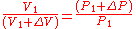
What the above equations express is that given an initial pressure
Pressure
Pressure is the force per unit area applied in a direction perpendicular to the surface of an object. Gauge pressure is the pressure relative to the local atmospheric or ambient pressure.- Definition :...
and volumeVolume
Volume is the quantity of three-dimensional space enclosed by some closed boundary, for example, the space that a substance or shape occupies or contains....
at time 1 the productProduct (mathematics)
In mathematics, a product is the result of multiplying, or an expression that identifies factors to be multiplied. The order in which real or complex numbers are multiplied has no bearing on the product; this is known as the commutative law of multiplication...
of these two values will be equal to the product of the pressure
and volume at a later time 2. This means that if there is an increase in the volume of cavity, there will be a corresponding decrease in pressure of that same cavity, and vice versa. In other words, volume and pressure are inversely proportional (or negatively correlated) to each other. As applied to a description of the subglottal cavity, when the lung pistons contract the lungs, the volume of the subglottal cavity decreases while the subglottal air pressure increases. Conversely, if the lungs are expanded, the pressure decreases.A situation can be considered where (1) the vocal fold valve is closed separating the supraglottal cavity from the subglottal cavity, (2) the mouth is open and, therefore, supraglottal air pressure is equal to atmospheric pressure, and (3) the lungs are contracted
Muscle contraction
Muscle fiber generates tension through the action of actin and myosin cross-bridge cycling. While under tension, the muscle may lengthen, shorten, or remain the same...
resulting in a subglottal pressure that has increased to a pressure that is greater than atmospheric pressure. If the vocal fold valve is subsequently opened, the previously two separate cavities become one unified cavity although the cavities will still be aerodynamically isolated because the glottic valve between them is relatively small and constrictive. Pascal's Law
Pascal's law
In the physical sciences, Pascal's law or the Principle of transmission of fluid-pressure states that "pressure exerted anywhere in a confined incompressible fluid is transmitted equally in all directions throughout the fluid such that the pressure ratio remains the same." The law was established...
states that the pressure within a system must be equal throughout the system. When the subglottal pressure is greater than supraglottal pressure, there is a pressure inequality in the unified cavity. Since pressure is a force
Force
In physics, a force is any influence that causes an object to undergo a change in speed, a change in direction, or a change in shape. In other words, a force is that which can cause an object with mass to change its velocity , i.e., to accelerate, or which can cause a flexible object to deform...
applied to a surface area
Surface area
Surface area is the measure of how much exposed area a solid object has, expressed in square units. Mathematical description of the surface area is considerably more involved than the definition of arc length of a curve. For polyhedra the surface area is the sum of the areas of its faces...
by definition and a force is the product of mass
Mass
Mass can be defined as a quantitive measure of the resistance an object has to change in its velocity.In physics, mass commonly refers to any of the following three properties of matter, which have been shown experimentally to be equivalent:...
and acceleration
Acceleration
In physics, acceleration is the rate of change of velocity with time. In one dimension, acceleration is the rate at which something speeds up or slows down. However, since velocity is a vector, acceleration describes the rate of change of both the magnitude and the direction of velocity. ...
according to Newton's Second Law of Motion, the pressure inequality will be resolved by having part of the mass in air molecule
Molecule
A molecule is an electrically neutral group of at least two atoms held together by covalent chemical bonds. Molecules are distinguished from ions by their electrical charge...
s found in the subglottal cavity move to the supraglottal cavity. This movement of mass is airflow. The airflow will continue until a pressure equilibrium is reached. Similarly, in an ejective consonant
Ejective consonant
In phonetics, ejective consonants are voiceless consonants that are pronounced with simultaneous closure of the glottis. In the phonology of a particular language, ejectives may contrast with aspirated or tenuis consonants...
with a glottalic airstream mechanism
Airstream mechanism
In phonetics, the airstream mechanism is the method by which airflow is created in the vocal tract. Along with phonation, it is one of two mandatory aspects of sound production; without these, there can be no speech sound....
, the lips or the tongue (i.e., the buccal or lingual valve) are initially closed and the closed glottis (the laryngeal piston) is raised decreasing the oral cavity volume behind the valve closure and increasing the pressure compared to the volume and pressure at a resting state. When the closed valve is opened, airflow will result from the cavity behind the initial closure outward until intraoral pressure is equal to atmospheric pressure
Atmospheric pressure
Atmospheric pressure is the force per unit area exerted into a surface by the weight of air above that surface in the atmosphere of Earth . In most circumstances atmospheric pressure is closely approximated by the hydrostatic pressure caused by the weight of air above the measurement point...
. That is, air will flow from a cavity of higher pressure to a cavity of lower pressure until the equilibrium point; the pressure as potential energy
Potential energy
In physics, potential energy is the energy stored in a body or in a system due to its position in a force field or due to its configuration. The SI unit of measure for energy and work is the Joule...
is, thus, converted into airflow as kinetic energy
Kinetic energy
The kinetic energy of an object is the energy which it possesses due to its motion.It is defined as the work needed to accelerate a body of a given mass from rest to its stated velocity. Having gained this energy during its acceleration, the body maintains this kinetic energy unless its speed changes...
.
Sound sources
Sound sources refer to the conversion of aerodynamic energy into acoustic energy. There are two main types of sound sources in the articulatory system: periodic (or more precisely semi-periodic) and aperiodic. A periodic sound source is vocal fold vibration produced at the glottis found in vowels and voiced consonants. A less common periodic sound source is the vibration of an oral articulator like the tongue found in alveolar trills. Aperiodic sound sources are the turbulent noise of fricative consonants and the short-noise burst of plosive releases produced in the oral cavity.Periodic sources
- Non-vocal fold vibration: 20-40 cycles per second
- Vocal fold vibration
- Lower limit: 70-80 modal (bass), 30-40 creaky
- Upper limit: 1170 (soprano)
Vocal fold vibration
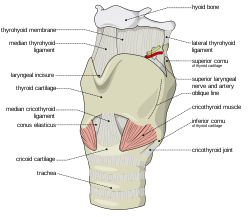
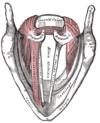
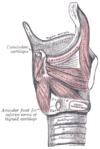
- larynxLarynxThe larynx , commonly called the voice box, is an organ in the neck of amphibians, reptiles and mammals involved in breathing, sound production, and protecting the trachea against food aspiration. It manipulates pitch and volume...
:- cricoid cartilage
- thyroid cartilageThyroid cartilageThe thyroid cartilage is the largest of the nine cartilages that make up the laryngeal skeleton, the cartilage structure in and around the trachea that contains the larynx....
- arytenoid cartilageArytenoid cartilageThe arytenoid cartilages are a pair of small three-sided pyramids which form part of the larynx, to which the vocal folds are attached...
- interarytenoid musclesArytenoid muscleThe arytenoid is a single muscle, filling up the posterior concave surfaces of the arytenoid cartilages.It arises from the posterior surface and lateral border of one arytenoid cartilage, and is inserted into the corresponding parts of the opposite cartilage.It consists of oblique and transverse...
(fold adduction) - posterior cricoarytenoid musclePosterior cricoarytenoid muscleThe posterior cricoarytenoid muscles are extremely small, paired muscles that extend from the posterior cricoid cartilage to the arytenoid cartilages in the larynx. By rotating the arytenoid cartilages laterally, these muscles abduct the vocal cords and thereby open the rima glottidis. Their action...
(fold abduction) - lateral cricoarytenoid muscleLateral cricoarytenoid muscleThe lateral cricoarytenoid muscles extend from the lateral cricoid cartilage to the ipsilateral arytenoid cartilage. By rotating the arytenoid cartilages medially, these muscles adduct the vocal cords and thereby close the rima glottidis, protecting the airway...
(fold shortening/stiffening) - thyroarytenoid muscleThyroarytenoid muscleThe thyroarytenoid is a broad, thin muscle that lies parallel with and lateral to the vocal fold and that supports the wall of the ventricle and its appendix...
(medial compression/fold stiffening, internal to folds) - cricothyroid muscleCricothyroid muscleThe cricothyroid muscle is the only tensor muscle of the larynx, aiding with phonation. It attaches to the anterolateral aspect of the cricoid and the inferior cornu and lower lamina of the thyroid cartilage, and its action tilts the thyroid forward to help tense the vocal cords...
(fold lengthening) - hyoid boneHyoid boneThe hyoid bone is a horseshoe-shaped bone situated in the anterior midline of the neck between the chin and the thyroid cartilage. At rest, it lies at the level of the base of the mandible in the front and the third cervical vertebra behind.Unlike other bones, the hyoid is only distantly...
- sternothyroid muscleSternothyroid muscleThe Sternothyreoideus is shorter and wider than the Sternohyoideus, beneath which it is situated.It arises from the posterior surface of the manubrium sterni, below the origin of the Sternohyoideus, and from the edge of the cartilage of the first rib, and sometimes that of the second rib, it is...
(lowers thyroid) - sternohyoid muscleSternohyoid muscleThe sternohyoid muscle is a thin, narrow muscle attaching the hyoid bone to the sternum, one of the paired strap muscles of the infrahyoid muscles serving to depress the hyoid bone...
(lowers hyoid) - stylohyoid muscleStylohyoid muscleThe stylohyoid muscle is a slender muscle, lying anterior, and superior of the posterior belly of the digastric muscle. It shares this muscle's innervation by the facial nerve, and functions to draw the hyoid bone backwards and elevate the tongue....
(raises hyoid) - digastric muscleDigastric muscleThe digastric muscle is a small muscle located under the jaw. so digastric muscles are muscle fibers in ligament of treitz ,omohyoid , occipitofrontalis....
(raises hyoid)
Experimental techniques
- Plethysmography
- ElectromyographyElectromyographyElectromyography is a technique for evaluating and recording the electrical activity produced by skeletal muscles. EMG is performed using an instrument called an electromyograph, to produce a record called an electromyogram. An electromyograph detects the electrical potential generated by muscle...
- Photoglottography
- Electrolaryngography
- Magnetic resonance imagingMagnetic resonance imagingMagnetic resonance imaging , nuclear magnetic resonance imaging , or magnetic resonance tomography is a medical imaging technique used in radiology to visualize detailed internal structures...
(MRI) - RadiographyRadiographyRadiography is the use of X-rays to view a non-uniformly composed material such as the human body. By using the physical properties of the ray an image can be developed which displays areas of different density and composition....
- Medical ultrasonographyMedical ultrasonographyDiagnostic sonography is an ultrasound-based diagnostic imaging technique used for visualizing subcutaneous body structures including tendons, muscles, joints, vessels and internal organs for possible pathology or lesions...
- Electromagnetic articulography
- Aerometry
- EndoscopyEndoscopyEndoscopy means looking inside and typically refers to looking inside the body for medical reasons using an endoscope , an instrument used to examine the interior of a hollow organ or cavity of the body. Unlike most other medical imaging devices, endoscopes are inserted directly into the organ...
- VideokymographyVideokymographyVideokymography is a high-speed medical imaging method to visualize the human vocal fold vibration dynamics. It was invented by Jan G. Švec.A digital technique for high-speed visualization of vibration, called videokymography, was developed and applied to the vocal folds...
Palatography
In order to understand how sounds are made, experimental procedures are often adopted. PalatographyPalatography
Palatography is a technique used to identify which parts of the mouth are used when making different sounds. This technique is often used by linguists doing field work on little-known natural languages...
is one of the oldest instrumental phonetic techniques used to record data regarding articulators. In traditional, static palatography, a speaker's palate is coated with a dark powder. The speaker then produces a word, usually with a single consonant. The tongue wipes away some of the powder at the place of articulation. The experimenter can then use a mirror to photograph the entire upper surface of the speaker's mouth. This photograph, in which the place of articulation can be seen as the area where the powder has been removed, is called a palatogram.
Technology has since made possible electropalatography
Electropalatography
Electropalatography is a technique used to monitor contacts between the tongue and hard palate, particularly during articulation and speech....
(or EPG). In order to collect EPG data, the speaker is fitted with a special prosthetic palate, which contains a number of electrodes. The way in which the electrodes are "contacted" by the tongue during speech provides phoneticians with important information, such as how much of the palate is contacted in different speech sounds, or which regions of the palate are contacted, or what the duration of the contact is.
See also
- list of phonetics topics
- manner of articulationManner of articulationIn linguistics, manner of articulation describes how the tongue, lips, jaw, and other speech organs are involved in making a sound. Often the concept is only used for the production of consonants, even though the movement of the articulars will also greatly alter the resonant properties of the...
- place of articulationPlace of articulationIn articulatory phonetics, the place of articulation of a consonant is the point of contact where an obstruction occurs in the vocal tract between an articulatory gesture, an active articulator , and a passive location...
- vowelVowelIn phonetics, a vowel is a sound in spoken language, such as English ah! or oh! , pronounced with an open vocal tract so that there is no build-up of air pressure at any point above the glottis. This contrasts with consonants, such as English sh! , where there is a constriction or closure at some...
- consonantConsonantIn articulatory phonetics, a consonant is a speech sound that is articulated with complete or partial closure of the vocal tract. Examples are , pronounced with the lips; , pronounced with the front of the tongue; , pronounced with the back of the tongue; , pronounced in the throat; and ,...
- International Phonetic AlphabetInternational Phonetic AlphabetThe International Phonetic Alphabet "The acronym 'IPA' strictly refers [...] to the 'International Phonetic Association'. But it is now such a common practice to use the acronym also to refer to the alphabet itself that resistance seems pedantic...