

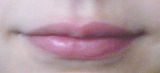
Lip

Encyclopedia
Lips are a visible body part at the mouth of humans and many animals. Lips are soft, movable, and serve as the opening for food intake and in the articulation of sound and speech. Human lips are a tactile sensory organ, and can be erogenous when used in kiss
ing and other acts of intimacy.
. The fleshy protuberance located in the center of the upper lip is a tubercle
known by various terms including the procheilon (also spelled prochilon), the "tuberculum labii superioris", and the "labial tubercle". The vertical groove extending from the procheilon to the nasal septum
is called the philtrum
.
The skin of the lip, with three to five cellular layers, is very thin compared to typical face skin, which has up to 16 layers. With light skin color, the lip skin contains fewer melanocytes (cells which produce melanin pigment
, which give skin its color). Because of this, the blood vessel
s appear through the skin of the lips, which leads to their notable red coloring. With darker skin color this effect is less prominent, as in this case the skin of the lips contains more melanin and thus is visually darker. The skin of the lip forms the border between the exterior skin of the face, and the interior mucous membrane
of the inside of the mouth.
The lip skin is not hairy, and does not have sweat gland
s or sebaceous gland
s. Therefore it does not have the usual protection layer of sweat and body oils which keep the skin smooth, inhibit pathogens, and regulate warmth. For these reasons, the lips dry out faster and become chapped more easily.
of the lips is stratified squamous epithelium
. The mucous membrane is represented by a large area in the sensory cortex
, and is therefore highly sensitive. The Frenulum Labii Inferioris is the frenulum
of the lower lip. The Frenulum Labii Superioris is the frenulum of the upper lip.
is one of the six non-terminal branches of the external carotid artery
. It supplies the lips by its superior and inferior labial branches, each of which bifurcate and anastomose with their companion artery from the other side.
. All muscles of facial expression are derived from the mesoderm of the second pharyngeal arch, and are therefore supplied (motor supply) by the nerve of the second pharyngeal arch, the facial nerve
(7th cranial nerve). The muscles of facial expression are all specialized members of the panniculus carnosus
, which attach to the dermis
and so wrinkle, or dimple the overlying skin. Functionally, the muscles of facial expression are arranged in groups around the orbits
, nose
and mouth
.
The muscles acting on the lips:
, bilabial
, and labiodental consonant
sounds - and thus create an important part of the speech apparatus. The lips enable whistling and the performing of wind instruments such as the trumpet, clarinet, flute and saxophone.
. The lips therefore play a crucial role in kissing and other acts of intimacy.
A woman's lips are also a visible expression of her fertility. In studies performed on the science of human attraction, psychologists have concluded that a woman's facial and sexual attractiveness is closely linked to the makeup of her hormones during puberty and development. Contrary to the effects of testosterone
on a man's facial structure, the effects of a woman's oestrogen levels serve to maintain a relatively "childlike" and youthful facial structure during puberty and during final maturation. It has been shown that the more oestrogen a woman has, the larger her eyes and the fuller her lips. Surveys performed by sexual psychologists have also found that universally, men find a woman's full lips to be more sexually attractive than lips that are less so. A woman's lips are therefore sexually attractive to males because they serve as a biological indicator of a woman's health and fertility. As such, a woman's lipstick (or collagen
lip enhancement
) takes advantage of this fact by "tricking" men into thinking that a woman has more oestrogen than she actually has, and thus that she is more fertile and attractive.
Lip size is linked to sexual attraction in both men and women. Women are attracted to men with masculine lips, that are more middle size and not too big or too small; they are to be rugged and sensual. In general, the researchers found that a small nose, big eyes and voluptuous lips are sexually attractive both in men and women.
or frown. Lips can also be made pouty when whining, or perky to be provocative.
As part of the mouth, the lips are also associated with the symbolism associated with the mouth as orifice by which food is taken in. The lips are also linked symbolically to neonatal psychology (see for example oral stage
of the psychology according to Sigmund Freud
).
s, they become much more prominent, being separated from the jaws by a deep cleft. They are also more mobile in mammals than in other groups, since it is only in this group that they have any attached muscles. In some teleost fish, the lips may be modified to carry sensitive barbels
. In bird
s and turtle
s, the lips are hard and keratin
ous, forming a solid beak
.
Kiss
A kiss is the act of pressing one's lips against the lips or other body parts of another person or of an object. Cultural connotations of kissing vary widely. Depending on the culture and context, a kiss can express sentiments of love, passion, affection, respect, greeting, friendship, and good...
ing and other acts of intimacy.
Anatomical basics of the human lip
The upper and lower lips are referred to as the "Labium superius oris" and "Labium inferius oris", respectively. The juncture where the lips meet the surrounding skin of the mouth area is the vermilion border, and the typically reddish area within the borders is called the vermilion zone. The vermilion border of the upper lip is known as the cupid's bowCupid's bow
Cupid's bow is a facial feature where the double curve of a human upper lip is said to resemble the bow of Cupid, the Roman god of erotic love...
. The fleshy protuberance located in the center of the upper lip is a tubercle
Tubercle
A tubercle is generally a wart-like projection, but it has slightly different meaning depending on which family of plants or animals it is used to refer to....
known by various terms including the procheilon (also spelled prochilon), the "tuberculum labii superioris", and the "labial tubercle". The vertical groove extending from the procheilon to the nasal septum
Nasal septum
The nasal septum separates the left and right airways in the nose, dividing the two nostrils.It is depressed by the Depressor septi nasi muscle.-Composition:The fleshy external end of the nasal septum is sometimes also called columella....
is called the philtrum
Philtrum
The philtrum , is a medial cleft common to many mammals, extending from the nose to the upper lip, and, together with a glandular rhinarium and slit-like nostrils, is believed to constitute the primitive condition for mammals in general...
.
The skin of the lip, with three to five cellular layers, is very thin compared to typical face skin, which has up to 16 layers. With light skin color, the lip skin contains fewer melanocytes (cells which produce melanin pigment
Pigment
A pigment is a material that changes the color of reflected or transmitted light as the result of wavelength-selective absorption. This physical process differs from fluorescence, phosphorescence, and other forms of luminescence, in which a material emits light.Many materials selectively absorb...
, which give skin its color). Because of this, the blood vessel
Blood vessel
The blood vessels are the part of the circulatory system that transports blood throughout the body. There are three major types of blood vessels: the arteries, which carry the blood away from the heart; the capillaries, which enable the actual exchange of water and chemicals between the blood and...
s appear through the skin of the lips, which leads to their notable red coloring. With darker skin color this effect is less prominent, as in this case the skin of the lips contains more melanin and thus is visually darker. The skin of the lip forms the border between the exterior skin of the face, and the interior mucous membrane
Mucous membrane
The mucous membranes are linings of mostly endodermal origin, covered in epithelium, which are involved in absorption and secretion. They line cavities that are exposed to the external environment and internal organs...
of the inside of the mouth.
The lip skin is not hairy, and does not have sweat gland
Sweat gland
Sweat glands, or sudoriferous glands, are small tubular structures of the skin that produce sweat. There are two kinds of sweat glands:...
s or sebaceous gland
Sebaceous gland
The sebaceous glands are microscopic glands in the skin that secrete an oily/waxy matter, called sebum, to lubricate and waterproof the skin and hair of mammals...
s. Therefore it does not have the usual protection layer of sweat and body oils which keep the skin smooth, inhibit pathogens, and regulate warmth. For these reasons, the lips dry out faster and become chapped more easily.
Anatomy in detail
The skinSkin
-Dermis:The dermis is the layer of skin beneath the epidermis that consists of connective tissue and cushions the body from stress and strain. The dermis is tightly connected to the epidermis by a basement membrane. It also harbors many Mechanoreceptors that provide the sense of touch and heat...
of the lips is stratified squamous epithelium
Stratified squamous epithelium
A stratified squamous epithelium consists of squamous epithelial cells arranged in layers upon a basement membrane. Only one layer is in contact with the basement membrane; the other layers adhere to one another to maintain structural integrity...
. The mucous membrane is represented by a large area in the sensory cortex
Somatosensory system
The somatosensory system is a diverse sensory system composed of the receptors and processing centres to produce the sensory modalities such as touch, temperature, proprioception , and nociception . The sensory receptors cover the skin and epithelia, skeletal muscles, bones and joints, internal...
, and is therefore highly sensitive. The Frenulum Labii Inferioris is the frenulum
Frenulum
A frenulum is a small fold of tissue that secures or restricts the motion of a mobile organ in the body.-In human anatomy:...
of the lower lip. The Frenulum Labii Superioris is the frenulum of the upper lip.
Sensory nerve supply
- Trigeminal nerveTrigeminal nerveThe trigeminal nerve contains both sensory and motor fibres. It is responsible for sensation in the face and certain motor functions such as biting, chewing, and swallowing. Sensory information from the face and body is processed by parallel pathways in the central nervous system...
- The infraorbital nerveInfraorbital nerveAfter the maxillary nerve enters the infraorbital canal, the nerve is frequently called the infraorbital nerve. This nerve innervates the lower eyelid, upper lip, and part of the nasal vestibule and exits the infraorbital foramen of the maxilla.-See also:...
is a branch of the maxillary branch. It supplies not only the upper lip, but much of the skin of the face between the upper lip and the lower eyelid, except for the bridge of the noseNoseAnatomically, a nose is a protuberance in vertebrates that houses the nostrils, or nares, which admit and expel air for respiration in conjunction with the mouth. Behind the nose are the olfactory mucosa and the sinuses. Behind the nasal cavity, air next passes through the pharynx, shared with the...
. - The mental nerveMental nerveMental nerve is a general somatic afferent nerve which provides sensation to the anterior aspects of the chin and lower lip as well as the buccal gingivae of the mandibular anterior teeth and the premolars...
is a branch of the mandibular branch ( via the inferior alveolar nerveInferior alveolar nerveThe inferior alveolar nerve is a branch of the mandibular nerve, which is itself the third branch of the trigeminal nerve .-Path:...
). It supplies the skin and mucous membrane of the lower lip and labial gingivaGingivaThe gingiva , or gums, consists of the mucosal tissue that lies over the mandible and maxilla inside the mouth.-General description:...
(gum) anteriorly.
- The infraorbital nerve
Blood supply
The facial arteryFacial artery
The facial artery is a branch of the external carotid artery that supplies structures of the superficial face.-Structure:...
is one of the six non-terminal branches of the external carotid artery
External carotid artery
In human anatomy, the external carotid artery is a major artery of the head and neck. It arises from the common carotid artery when it bifurcates into the external and internal carotid artery.-Course:...
. It supplies the lips by its superior and inferior labial branches, each of which bifurcate and anastomose with their companion artery from the other side.
Muscles acting on the lips
The muscles acting on the lips are considered part of the muscles of facial expressionFacial expression
A facial expression one or more motions or positions of the muscles in the skin. These movements convey the emotional state of the individual to observers. Facial expressions are a form of nonverbal communication. They are a primary means of conveying social information among humans, but also occur...
. All muscles of facial expression are derived from the mesoderm of the second pharyngeal arch, and are therefore supplied (motor supply) by the nerve of the second pharyngeal arch, the facial nerve
Facial nerve
The facial nerve is the seventh of twelve paired cranial nerves. It emerges from the brainstem between the pons and the medulla, and controls the muscles of facial expression, and functions in the conveyance of taste sensations from the anterior two-thirds of the tongue and oral cavity...
(7th cranial nerve). The muscles of facial expression are all specialized members of the panniculus carnosus
Panniculus carnosus
The panniculus carnosus is a part of the subcutaneous tissues in the study of animal anatomy. It is a layer of striated muscle deep to the panniculus adiposus. In humans the platysma muscle of the neck, palmaris brevis in the hand, and the dartos muscle in the scrotum are described as a discrete...
, which attach to the dermis
Dermis
The dermis is a layer of skin between the epidermis and subcutaneous tissues, and is composed of two layers, the papillary and reticular dermis...
and so wrinkle, or dimple the overlying skin. Functionally, the muscles of facial expression are arranged in groups around the orbits
Orbit (anatomy)
In anatomy, the orbit is the cavity or socket of the skull in which the eye and its appendages are situated. "Orbit" can refer to the bony socket, or it can also be used to imply the contents...
, nose
Nose
Anatomically, a nose is a protuberance in vertebrates that houses the nostrils, or nares, which admit and expel air for respiration in conjunction with the mouth. Behind the nose are the olfactory mucosa and the sinuses. Behind the nasal cavity, air next passes through the pharynx, shared with the...
and mouth
Mouth
The mouth is the first portion of the alimentary canal that receives food andsaliva. The oral mucosa is the mucous membrane epithelium lining the inside of the mouth....
.
The muscles acting on the lips:
- SphincterSphincterA sphincter is an anatomical structure, or a circular muscle, that normally maintains constriction of a natural body passage or orifice and which relaxes as required by normal physiological functioning...
s of the oral orifice- BuccinatorBuccinator muscleThe buccinator is a thin quadrilateral muscle, occupying the interval between the maxilla and the mandible at the side of the face.-Action:Its purpose is to pull back the angle of the mouth and to flatten the cheek area, which aids in holding the cheek to the teeth during chewing.It aids whistling...
- Orbicularis orisOrbicularis oris muscleIn human anatomy, the orbicularis oris muscle is the sphincter muscle around the mouth."Orbicularis Oris is a complex of muscles in the lips that encircle the mouth; until recently it was misinterpreted as a sphincter, or circular muscle, but it is actually composed of four independent quadrants...
- Buccinator
- Anchor point for several muscles
- ModiolusModiolus (anatomy)In facial anatomy, the modiolus is a chiasma of facial muscles held together by fibrous tissue, located lateral and slightly superior to each angle of the mouth. It is important in moving the mouth, facial expression and in dentistry...
- Modiolus
- Lip elevation
- Levator labii superiorisLevator labii superiorisThe levator labii superioris is a muscle of the human body used in facial expression. It is a broad sheet, the origin of which extends from the side of the nose to the zygomatic bone....
- levator labii superioris alaeque nasiLevator labii superioris alaeque nasi muscleThe levator labii superioris alaeque nasi muscle is, translated from Latin, the "lifter of the upper lip and of the wing of the nose". It has the longest name of any muscle in an animal...
- Levator anguli orisLevator anguli orisThe levator anguli oris is a facial muscle of the mouth arising from the canine fossa, immediately below the infraorbital foramen....
- Zygomaticus minor
- Zygomaticus majorZygomaticus major muscleThe Zygomatic major is a muscle of the human body. It is a muscle of facial expression which draws the angle of the mouth superiorly and posteriorly . Like all muscles of facial expression, the zygomatic major is innervated by the facial nerve...
- Levator labii superioris
- Lip depression
- RisoriusRisoriusThe risorius is a muscle of facial expression which arises in the fascia over the parotid gland and, passing horizontally forward, superficial to the platysma, inserts onto the skin at the angle of the mouth...
- Depressor anguli orisDepressor anguli oris muscleThe Depressor anguli oris arises from the oblique line of the mandible, whence its fibres converge, to be inserted, by a narrow fasciculus, into the angle of the mouth.-Anatomy:...
- Depressor labii inferiorisDepressor labii inferioris muscleThe depressor labii inferioris is a facial muscle that helps lower the bottom lip.-Structure:This muscle arises from the oblique line of the mandible, and inserts on the skin of the lower lip, blending in with the orbicularis oris muscle.At its origin, depressor labii is continuous with the fibers...
- MentalisMentalisThe Mentalis is a paired central muscle of the lower lip, situated at the tip of the chin. It raises and pushes up the lower lip, causing wrinkling of the chin, as in doubt or displeasure...
- Risorius
Food intake
Because they have their own muscles and bordering muscles, the lips are easily movable. Lips are used for eating functions, like holding food or to get it in the mouth. In addition, lips serve to close the mouth airtight shut, to hold food and drink inside, and to keep out unwanted objects. Through making a narrow funnel with the lips, the suction of the mouth is increased. This suction is essential for babies to breast feed. Lips can also be used to suck in other contexts, such as sucking on a straw to drink liquids.Articulation
The lips serve for creating different sounds - mainly the labialLabial consonant
Labial consonants are consonants in which one or both lips are the active articulator. This precludes linguolabials, in which the tip of the tongue reaches for the posterior side of the upper lip and which are considered coronals...
, bilabial
Bilabial consonant
In phonetics, a bilabial consonant is a consonant articulated with both lips. The bilabial consonants identified by the International Phonetic Alphabet are:...
, and labiodental consonant
Labiodental consonant
In phonetics, labiodentals are consonants articulated with the lower lip and the upper teeth.-Labiodental consonant in IPA:The labiodental consonants identified by the International Phonetic Alphabet are:...
sounds - and thus create an important part of the speech apparatus. The lips enable whistling and the performing of wind instruments such as the trumpet, clarinet, flute and saxophone.
Tactile organ
The lip has many nerve endings and reacts as part of the tactile (touch) senses. Lips are very sensitive to touch, warmth, and cold. It is therefore an important aid for exploring unknown objects for babies and toddlers.Erogenous zone
Because of their high number of nerve endings, the lips are an erogenous zoneErogenous zone
An erogenous zone is an area of the human body that has heightened sensitivity, the stimulation of which may result in the production of erotic sensations or sexual excitement.People have erogenous zones all over their bodies, but which areas are more sensitive than others vary...
. The lips therefore play a crucial role in kissing and other acts of intimacy.
A woman's lips are also a visible expression of her fertility. In studies performed on the science of human attraction, psychologists have concluded that a woman's facial and sexual attractiveness is closely linked to the makeup of her hormones during puberty and development. Contrary to the effects of testosterone
Testosterone
Testosterone is a steroid hormone from the androgen group and is found in mammals, reptiles, birds, and other vertebrates. In mammals, testosterone is primarily secreted in the testes of males and the ovaries of females, although small amounts are also secreted by the adrenal glands...
on a man's facial structure, the effects of a woman's oestrogen levels serve to maintain a relatively "childlike" and youthful facial structure during puberty and during final maturation. It has been shown that the more oestrogen a woman has, the larger her eyes and the fuller her lips. Surveys performed by sexual psychologists have also found that universally, men find a woman's full lips to be more sexually attractive than lips that are less so. A woman's lips are therefore sexually attractive to males because they serve as a biological indicator of a woman's health and fertility. As such, a woman's lipstick (or collagen
Collagen
Collagen is a group of naturally occurring proteins found in animals, especially in the flesh and connective tissues of mammals. It is the main component of connective tissue, and is the most abundant protein in mammals, making up about 25% to 35% of the whole-body protein content...
lip enhancement
Lip enhancement
Lip enhancement is a type of cosmetic surgery or non-surgical procedure that aims to improve the appearance of the lips by increasing their fullness through enlargement.-History:...
) takes advantage of this fact by "tricking" men into thinking that a woman has more oestrogen than she actually has, and thus that she is more fertile and attractive.
Lip size is linked to sexual attraction in both men and women. Women are attracted to men with masculine lips, that are more middle size and not too big or too small; they are to be rugged and sensual. In general, the researchers found that a small nose, big eyes and voluptuous lips are sexually attractive both in men and women.
Facial expressions
The lips visibly express emotions such as a smileSmile
A smile is a facial expression formed by flexing the muscles near both ends of the mouth. The smile can also be found around the eyes . Among humans, it is an expression denoting pleasure, joy, happiness, or amusement, but can also be an involuntary expression of anxiety, in which case it is known...
or frown. Lips can also be made pouty when whining, or perky to be provocative.
Symbolic meaning
Lips are often viewed as a symbol for sensuality and sexuality. This has many origins; above all, the lips are a very sensitive erogenous and tactile organ. Furthermore, in many cultures of the world, a woman's mouth and lips are veiled because of their representative association with the vulva, and because of their role as a woman's secondary sexual organ.As part of the mouth, the lips are also associated with the symbolism associated with the mouth as orifice by which food is taken in. The lips are also linked symbolically to neonatal psychology (see for example oral stage
Oral stage
In Freudian psychoanalysis, the term oral stage denotes the first psychosexual development stage wherein the mouth of the infant is his or her primary erogenous zone...
of the psychology according to Sigmund Freud
Sigmund Freud
Sigmund Freud , born Sigismund Schlomo Freud , was an Austrian neurologist who founded the discipline of psychoanalysis...
).
Changes to the lip
- One of the most frequent changes of the lips is a blue coloring due to cyanosisCyanosisCyanosis is the appearance of a blue or purple coloration of the skin or mucous membranes due to the tissues near the skin surface being low on oxygen. The onset of cyanosis is 2.5 g/dL of deoxyhemoglobin. The bluish color is more readily apparent in those with high hemoglobin counts than it is...
; the blood contains less oxygen, and thus has a dark red to blue color, which shows through the thin skin. Cyanosis is the reason why corpses sometimes have blue lips. In cold weather cyanosis can appear, so especially in the winter, blue lips may not be an uncommon sight. - Lips can (temporarily) swell. The reasons for this are varied and can be from sexual stimulation, injuries and side effects of medications, sleeping, or misalignment of teeth.
- Cracks or splits in the angles of the lips could be the result of an inflammationInflammationInflammation is part of the complex biological response of vascular tissues to harmful stimuli, such as pathogens, damaged cells, or irritants. Inflammation is a protective attempt by the organism to remove the injurious stimuli and to initiate the healing process...
of the lips, Angular cheilitisAngular cheilitisAngular cheilitis is an inflammatory lesion at the labial commissure, or corner of the mouth, and often occurs bilaterally. The condition manifests as deep cracks or splits...
.
Diseases
As an organ of the body, the lip can be a focus of disease or show symptoms of a disease:- Lip herpes (technically Herpes labialis, a form of herpes simplexHerpes simplexHerpes simplex is a viral disease caused by both Herpes simplex virus type 1 and type 2 . Infection with the herpes virus is categorized into one of several distinct disorders based on the site of infection. Oral herpes, the visible symptoms of which are colloquially called cold sores or fever...
) is a viral infection which appears in the formation of painful blisters at the lip. It is also commonly known as a cold sore. - CarcinomaCarcinomaCarcinoma is the medical term for the most common type of cancer occurring in humans. Put simply, a carcinoma is a cancer that begins in a tissue that lines the inner or outer surfaces of the body, and that generally arises from cells originating in the endodermal or ectodermal germ layer during...
(a malignant cancer that arises from epithelial cells) at the lips, is caused predominantly by using tobacco and overexposure of sunlight. To a lesser extent, it could also come from lack of oral hygieneOral hygieneTeeth cleaning is part of oral hygiene and involves the removal of dental plaque from teeth with the intention of preventing cavities , gingivitis, and periodontal disease. People routinely clean their own teeth by brushing and interdental cleaning, and dental hygienists can remove hardened...
or poor fitting dentures. Alcohol appears to increase the carcinoma risk associated with tobacco use.
In other animals
In most vertebrates, the lips are relatively unimportant folds of tissue lying just outside the jaws. However, in mammalMammal
Mammals are members of a class of air-breathing vertebrate animals characterised by the possession of endothermy, hair, three middle ear bones, and mammary glands functional in mothers with young...
s, they become much more prominent, being separated from the jaws by a deep cleft. They are also more mobile in mammals than in other groups, since it is only in this group that they have any attached muscles. In some teleost fish, the lips may be modified to carry sensitive barbels
Barbel (anatomy)
A barbel on a fish is a slender, whiskerlike tactile organ near the mouth. Fish that have barbels include the catfish, the carp, the goatfish, sturgeon, the zebrafish and some species of shark...
. In bird
Bird
Birds are feathered, winged, bipedal, endothermic , egg-laying, vertebrate animals. Around 10,000 living species and 188 families makes them the most speciose class of tetrapod vertebrates. They inhabit ecosystems across the globe, from the Arctic to the Antarctic. Extant birds range in size from...
s and turtle
Turtle
Turtles are reptiles of the order Testudines , characterised by a special bony or cartilaginous shell developed from their ribs that acts as a shield...
s, the lips are hard and keratin
Keratin
Keratin refers to a family of fibrous structural proteins. Keratin is the key of structural material making up the outer layer of human skin. It is also the key structural component of hair and nails...
ous, forming a solid beak
Beak
The beak, bill or rostrum is an external anatomical structure of birds which is used for eating and for grooming, manipulating objects, killing prey, fighting, probing for food, courtship and feeding young...
.
See also
- Chapped lipsChapped lipsChapped lips or Cracked lips is a condition whereby the lips become dry and possibly cracked. It may be caused by the evaporation of moisture. Often the lips become dry because the layer of oil that is naturally produced by the body to coat the lips is removed or is lacking...
- Cleft lip
- Cupid's bowCupid's bowCupid's bow is a facial feature where the double curve of a human upper lip is said to resemble the bow of Cupid, the Roman god of erotic love...
- Facial expressionFacial expressionA facial expression one or more motions or positions of the muscles in the skin. These movements convey the emotional state of the individual to observers. Facial expressions are a form of nonverbal communication. They are a primary means of conveying social information among humans, but also occur...
- Herpes
- KissKissA kiss is the act of pressing one's lips against the lips or other body parts of another person or of an object. Cultural connotations of kissing vary widely. Depending on the culture and context, a kiss can express sentiments of love, passion, affection, respect, greeting, friendship, and good...
- Lip balmLip balmLip balm or lip salve is a wax-like substance applied topically to the lips of the mouth to relieve chapped or dry lips, angular cheilitis, stomatitis, or cold sores. Lip balm often contains beeswax or carnauba wax, camphor, cetyl alcohol, lanolin, paraffin, and petrolatum, among other ingredients...
- Lip enhancementLip enhancementLip enhancement is a type of cosmetic surgery or non-surgical procedure that aims to improve the appearance of the lips by increasing their fullness through enlargement.-History:...
- Lip glossLip glossLip gloss is a product used primarily to give lips a glossy lustre and sometimes subtle color. It is distributed as a liquid or a soft solid...
- Lip piercingLip piercingA lip piercing is a type of body piercing that penetrates the lips or the area surrounding the lips, which can be pierced in a variety of ways.Approximate healing times for most lip piercings are between 1 to 2 months, however there is a possibility of serious infections developing if the piercing...
- LipstickLipstickLipstick is a cosmetic product containing pigments, oils, waxes, and emollients that applies color, texture, and protection to the lips. Many varieties of lipstick are known. As with most other types of makeup, lipstick is typically, but not exclusively, worn by women...