

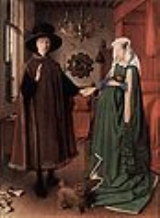
Arnolfini portrait

Encyclopedia
The Arnolfini Portrait is an oil painting on oak
panel
dated 1434 by the Early Netherlandish painter
Jan van Eyck
. It is also known as The Arnolfini Wedding, The Arnolfini Marriage, The Arnolfini Double Portrait or the Portrait of Giovanni Arnolfini and his Wife, among other titles. This painting is believed to be a portrait of the Italian merchant Giovanni Arnolfini
and his wife, presumably in their home in the Flemish
city of Bruges
. It is considered one of the most original and complex paintings in Western art history. Both signed and dated by Van Eyck in 1434, it is, with the Ghent Altarpiece
by the same artist and his brother Hubert, the oldest very famous panel painting to have been executed in oils rather than in tempera
. The painting was bought by the National Gallery
in London in 1842.
Van Eyck created a painting with an almost reflective surface by applying layer after layer of translucent thin glazes. The intense glowing colours also help to highlight the realism, and to show the material wealth and opulence of Arnolfini's world. Van Eyck took advantage of the longer drying time, compared to tempera
, of oil paint to blend colours by painting wet-in-wet to achieve subtle variations in light and shade to heighten the illusion of three-dimensional forms. He carefully distinguished textures and captured surface appearance precisely. He also rendered effects of both direct and diffuse light by showing the light from the window on the left reflected by various surfaces. It has been suggested that he used a magnifying glass in order to paint the minute details such as the individual highlights on each of the amber beads hanging beside the mirror.
The illusionism of the painting was remarkable for its time, in part for the rendering of detail, but particularly for the use of light to evoke space in an interior, for "its utterly convincing depiction of a room, as well of the people who inhabit it".
: to both faces, to the mirror, and to other elements. The couple are shown in an upstairs room with a chest and a bed in it in early summer as indicated by the fruit on the cherry tree
outside the window. The room probably functioned as a reception room, as it was the fashion in France and Burgundy where beds in reception rooms were used as seating, except, for example, when a mother with a new baby received visitors. The window has six interior wooden shutters, but only the top opening has glass, with clear bulls-eye pieces set in blue, red and green stained glass.
The two figures are very richly dressed; despite the season both their outer garments, his tabard
and her dress, are trimmed and fully lined with fur. The furs may be the especially expensive sable
for him and ermine
or miniver
for her. He wears a hat of plaited straw dyed black, as often worn in the summer at the time. His tabard
was once rather more purple than it appears now, as the pigments have faded; it may be intended to be silk velvet (another very expensive element). Underneath he wears a doublet of patterned material, probably silk damask
. Her dress has elaborate dagging (cloth folded and sewn together, then cut and frayed decoratively) on the sleeves, and a long train. Her blue underdress is also trimmed with white fur.
Although the woman's plain gold necklace and the plain rings both wear are the only jewellery visible, both outfits would have been enormously expensive, and appreciated as such by a contemporary viewer. But especially in the case of the man, there may be an element of restraint in their clothes befitting their merchant status - portraits of aristocrats tend to show gold chains and more decorated cloth.
The interior of the room has other signs of wealth; the brass chandelier
is large and elaborate by contemporary standards, and would have been very expensive. It would probably also have had a mechanism with pulley
and chains above, to lower it for managing the candles. Van Eyck has probably omitted this for lack of room. The convex mirror at the back, in a wooden frame with scenes of The Passion
painted behind glass, is shown larger than such mirrors could actually be made at this date - another discreet departure from realism by Van Eyck. There is also no sign of a fireplace (including in the mirror), nor anywhere obvious to put one. Even the orange
s casually placed to the left are a sign of wealth; they were very expensive in Burgundy, and may have been one of the items dealt in by Arnolfini. Further signs of luxury are the elaborate bed-hangings, which are probably held up by iron rods suspended from the ceiling, and the carvings on the chair and bench against the back wall (to the right, partly hidden by the bed). Another sign of wealth is the small Oriental carpet
on the floor by the bed; many owners of such expensive objects placed them on tables, as they still do in the Netherlands
.
The view in the mirror shows two figures just inside the door that the couple are facing. The second figure, wearing red, is presumably the artist although, unlike Velázquez
in Las Meninas
, he does not seem to be painting. Scholars have made this assumption based on the appearance of figures wearing red headdresses in some other van Eyck works (e.g., the Portrait of a Man (Self Portrait?)
and the figure in the background of the Madonna with Chancellor Rolin). The dog is an early form of the breed now known as the Brussels griffon.
The painting is also signed, inscribed and dated on the wall above the mirror: "Johannes de eyck fuit hic. 1434" ("Jan van Eyck was here. 1434"). The inscription looks as if it were painted in large letters on the wall, as was done with proverbs and other phrases at this period. Other surviving van Eyck signatures are painted in trompe l'oeil
on the wooden frame of his paintings, so that they appear to have been carved in the wood.
and Cavalcaselle
linked the double portrait with the early 16th century inventories of Margaret of Austria and suggested that the painting showed portraits of Giovanni di Arrigo Arnolfini and his wife. The name of Giovanni's wife is given in other documents as Giovanna Cenami. This proposal was widely accepted but in 1997 it was established that they were married in 1447, thirteen years after the date on the painting and six years after van Eyck's death. It is now believed that the subject is either Giovanni di Arrigo or his cousin, Giovanni di Nicolao Arnolfini, and an unknown wife of either one of them. This is either an undocumented first wife of Giovanni di Arrigo or a second wife of Giovanni di Nicolao, or, according to a recent proposal, Giovanni di Nicolao's first wife Costanza Trenta, who had died by February 1433. In the latter case, this would make the painting partly an unusual memorial portrait, showing one living and one dead person. Both Giovanni di Arrigo and Giovanni di Nicolao Arnolfini were Italian merchants, originally from Lucca
, but resident in Bruges
since at least 1419. The man in this painting is the subject of a further portrait by Van Eyck in the Gemäldegalerie, Berlin
, leading to speculation he was a friend of the artist.
published an article entitled Jan van Eyck's 'Arnolfini' Portrait in the Burlington Magazine, arguing that the elaborate signature on the back wall, and other factors, showed that it was painted as a legal document recording a marriage. Panofsky also argues that the items presented in the painting all have a disguised symbolism attached to their appearance. Some of the meanings attached to this symbolism are discussed below in the "Interpretation and Symbolism" section.
 Since then, there has been considerable debate on this point. Art historian Edwin Hall considers that the painting depicts a betrothal, not a marriage. Art historian Margaret D. Carroll argues that the painting is a portrait of a married couple that alludes also to the husband's grant of legal authority to his wife. Carroll also proposes that the portrait was meant to affirm Giovanni Arnolfini’s good character as a merchant and aspiring member of the Burgundian Court. She argues that the painting depicts a couple, already married, now formalizing a subsequent legal arrangement, a mandate, by which the husband "hands over" to his wife the legal authority to conduct business on her own or his behalf (like a power-of-attorney). The claim is not that the painting had any legal force, but that van Eyck played upon the imagery of legal contract as a pictorial conceit. While the two figures in the mirror could be thought of as witnesses to the oath-taking, the artist himself provides (witty) authentication with his notarial signature on the wall.
.jpg) Jan Baptist Bedaux agrees somewhat with Panofsky that this is a marriage contract portrait in his 1986 article “The reality of symbols: the question of disguised symbolism in Jan van Eyck’s Arnolfini Portrait.” However, he disagrees with Panofsky’s idea of items in the portrait having hidden meanings. Bedaux argues, “if the symbols are disguised to such an extent that they do not clash with reality as conceived at the time…there will be no means of proving that the painter actually intended such symbolism.” He also conjectures that if these disguised symbols were normal parts of the marriage ritual, then one could not say for sure whether the items were part of a “disguised symbolism” or just social reality.
Jan Baptist Bedaux agrees somewhat with Panofsky that this is a marriage contract portrait in his 1986 article “The reality of symbols: the question of disguised symbolism in Jan van Eyck’s Arnolfini Portrait.” However, he disagrees with Panofsky’s idea of items in the portrait having hidden meanings. Bedaux argues, “if the symbols are disguised to such an extent that they do not clash with reality as conceived at the time…there will be no means of proving that the painter actually intended such symbolism.” He also conjectures that if these disguised symbols were normal parts of the marriage ritual, then one could not say for sure whether the items were part of a “disguised symbolism” or just social reality.
Craig Harbison takes the middle ground between Panofsky and Bedaux in their debate about "disguised symbolism" and realism. Harbison argues that “Jan van Eyck is there as storyteller…[who] must have been able to understand that, within the context of people’s lives, objects could have multiple associations.” Harbison presents the idea that there are many possible purposes for the portrait and ways it can be interpreted. He maintains that this portrait cannot be fully interpreted until scholars accept the notion that objects can have multiple associations. Harbison urges the notion that one needs to conduct a multivalent
reading of the painting that includes references to the secular and sexual context of the Burgundian Court, as well as religious and sacramental references to marriage.
Lorne Campbell in the National Gallery Catalogue sees no need to find a special meaning in the painting beyond that of a double portrait, very possibly made to commemorate the marriage, but not a legal record. He cites examples of miniatures from manuscripts showing similarly elaborate inscriptions on walls as a normal form of decoration at the time. Another portrait in the National Gallery by Van Eyck, Portrait of a Man (Leal Souvenir), has a legalistic form of signature.
Margaret Koster's new suggestion, discussed above and below, that the portrait is a memorial one, of a wife already dead for a year or so, would displace these theories.
Art historian Maximiliaan Martens has suggested that the painting was meant as a gift for the Arnolfini family in Italy. It had the purpose of showing the prosperity and wealth of the couple depicted. He feels this might explain oddities in the painting, for example why the couple are standing in typical winter clothing while a cherry tree is in fruit outside, and why the phrase "Johannes de eyck fuit hic 1434" is featured so large in the centre of the painting.
The symbolism behind the action of the couple’s joined hands has also been debated among scholars. Many point to this gesture as proof of the painting’s purpose. Is it a marriage contract or something else? Panofsky interprets the gesture as an act of fides, Latin for “marital oath.”[22] He calls the representation of the couple "qui desponsari videbantur per fidem" which means, "who were contracting their marriage by marital oath." The man is grasping the woman’s right hand with his left which is the basis for the controversy. Some scholars like Jan Baptist Bedaux and Peter Schabacker argue that if this painting does show a marriage ceremony, then the use of the left hand points to the marriage being morganatic and not clandestine. A marriage is said to be morganatic if a man marries a woman of unequal rank. However, the subjects originally thought by most scholars to be represented in this painting, Giovanni Arnolfini and Giovanna Cenami, were of equal status and rank in the courtly system, so the theory would not hold true. On the opposite side of the debate are scholars like Margaret Carroll. She suggests that the painting deploys the imagery of a contract between an already married couple giving the wife the authority to act on her husband’s behalf in business dealings. Carroll identifies Arnolfini’s raised right hand as a gesture of oath-taking known as "fidem levare," and his joining hands with his wife as a gesture of consent known as "fides manualis.”
Although many viewers assume the wife to be pregnant, this is not believed to be so. Art historians point to numerous paintings of female virgin saints similarly dressed, and believe that this look was fashionable for women's dresses at the time. Fashion would have been important to Arnolfini, especially since he was a cloth merchant. The more cloth a person wore, the more wealthy he or she was assumed to be. Another indication that the woman is not pregnant is that Giovanna Cenami (the identification of the woman according to most earlier scholars) died childless, as did Costanza Trenta (a possible identification according to recent archival evidence); whether a hypothetical unsuccessful pregnancy would have been left recorded in a portrait is questionable. As mentioned above, some viewers have argued that the woman in the portrait is already pregnant, thus the protruding belly. Harbison, however, maintains her gesture is merely an indication of the extreme desire of the couple shown for fertility and progeny.
There is a carved figure of Saint Margaret
, patron saint of pregnancy and childbirth, as a finial on the bedpost,. Saint Margaret was invoked to assist women in labor and to cure infertility. The figure could also represent Saint Martha the patroness of housewives as Harbison suggests. From the bedpost hangs a brush, symbolic of domestic care. Furthermore, the brush and the rosary (a popular wedding gift) appearing together on either side of the mirror may also allude to the dual Christian injunctions ora et labora (pray and work). According to Jan Baptist Bedaux, the broom could also symbolize proverbial chastity; it "sweeps out impurities".
.jpg) The small medallions set into the frame of the convex mirror at the back of the room show tiny scenes from the Passion of Christ and may represent God's promise of salvation for the figures reflected on the mirror's convex surface. Furthering the Memorial theory, all the scenes on the wife's side are of Christ's death and resurrection. Those on the husbands side concern Christ's life. See mirror detail under Reproductions below. The mirror itself may represent the eye of God observing the vows of the wedding. A spotless mirror was also an established symbol of Mary, referring to the Holy Virgin's immaculate conception
The small medallions set into the frame of the convex mirror at the back of the room show tiny scenes from the Passion of Christ and may represent God's promise of salvation for the figures reflected on the mirror's convex surface. Furthering the Memorial theory, all the scenes on the wife's side are of Christ's death and resurrection. Those on the husbands side concern Christ's life. See mirror detail under Reproductions below. The mirror itself may represent the eye of God observing the vows of the wedding. A spotless mirror was also an established symbol of Mary, referring to the Holy Virgin's immaculate conception
and purity. The mirror reflects two figures in the doorway, one of whom may be the painter himself. In Panofsky's controversial view, the figures are shown to prove that the two witnesses required to make a wedding legal were present, and Van Eyck's signature on the wall acts as some form of actual documentation of an event at which he was himself present. according to one author "The painting is often referenced for its immaculate depiction of non-Euclidean geometry
", referring to the image on the convex mirror.
, or can be seen as an emblem of lust
, signifying the couple's desire to have a child. The dog could also be simply a lap dog, a gift from husband to wife. Many wealthy women in the court had lap dogs as companions. So, the dog could reflect the wealth of the couple and their position in courtly life. The green of the woman's dress symbolizes hope
, possibly the hope of becoming a mother. Her white cap could signify purity
, but probably signifies her being married. Behind the pair, the curtains of the marriage bed have been opened; the red curtains might allude to the physical act of love between the married couple.
The single candle in the left-front holder of the ornate six-branched chandelier is possibly the candle used in traditional Flemish marriage customs. Lit in full daylight, like the sanctuary lamp in a church, the candle may allude to the presence of the Holy Ghost or the ever-present eye of God
. Alternatively, Margaret Koster's posits that the painting is a memorial portrait, the single lit candle on Giovanni's side contrasts with the burnt-out candle whose wax stub can just be seen on his wife's side. In a metaphor commonly used in literature, he lives on, she is dead.
The cherries on the tree outside the window may symbolize love
. The oranges which lie on the window sill and chest may symbolize the purity and innocence that reigned in the Garden of Eden before the Fall of Man. They were uncommon and a sign of wealth in the Netherlands
, but in Italy
were a symbol of fecundity
in marriage. The fruit could more simply be a sign of the couple’s wealth since fruit was very expensive during this time.
 The known provenance
of the painting is as follows:
Oak
An oak is a tree or shrub in the genus Quercus , of which about 600 species exist. "Oak" may also appear in the names of species in related genera, notably Lithocarpus...
panel
Panel painting
A panel painting is a painting made on a flat panel made of wood, either a single piece, or a number of pieces joined together. Until canvas became the more popular support medium in the 16th century, it was the normal form of support for a painting not on a wall or vellum, which was used for...
dated 1434 by the Early Netherlandish painter
Early Netherlandish painting
Early Netherlandish painting refers to the work of artists active in the Low Countries during the 15th- and early 16th-century Northern renaissance, especially in the flourishing Burgundian cities of Bruges and Ghent...
Jan van Eyck
Jan van Eyck
Jan van Eyck was a Flemish painter active in Bruges and considered one of the best Northern European painters of the 15th century....
. It is also known as The Arnolfini Wedding, The Arnolfini Marriage, The Arnolfini Double Portrait or the Portrait of Giovanni Arnolfini and his Wife, among other titles. This painting is believed to be a portrait of the Italian merchant Giovanni Arnolfini
Giovanni Arnolfini
Giovanni di Nicolao Arnolfini was a merchant from Lucca, a city in Tuscany, Italy.Giovanni, called here di Nicolao or son of Nicolao to distinguish him from his cousin Giovanni di Arrigo Arnolfini , moved to Bruges in Flanders at an early age to work in the family business and lived there for the...
and his wife, presumably in their home in the Flemish
Flanders
Flanders is the community of the Flemings but also one of the institutions in Belgium, and a geographical region located in parts of present-day Belgium, France and the Netherlands. "Flanders" can also refer to the northern part of Belgium that contains Brussels, Bruges, Ghent and Antwerp...
city of Bruges
Bruges
Bruges is the capital and largest city of the province of West Flanders in the Flemish Region of Belgium. It is located in the northwest of the country....
. It is considered one of the most original and complex paintings in Western art history. Both signed and dated by Van Eyck in 1434, it is, with the Ghent Altarpiece
Ghent Altarpiece
The Ghent Altarpiece or Adoration of the Mystic Lamb is a very large and complex Early Netherlandish polyptych panel painting which is considered to be one of Belgium's masterpieces and one of the world's treasures.It was once in the Joost Vijdt chapel at Saint Bavo Cathedral, Ghent, Belgium, but...
by the same artist and his brother Hubert, the oldest very famous panel painting to have been executed in oils rather than in tempera
Tempera
Tempera, also known as egg tempera, is a permanent fast-drying painting medium consisting of colored pigment mixed with a water-soluble binder medium . Tempera also refers to the paintings done in this medium. Tempera paintings are very long lasting, and examples from the 1st centuries AD still exist...
. The painting was bought by the National Gallery
National Gallery, London
The National Gallery is an art museum on Trafalgar Square, London, United Kingdom. Founded in 1824, it houses a collection of over 2,300 paintings dating from the mid-13th century to 1900. The gallery is an exempt charity, and a non-departmental public body of the Department for Culture, Media...
in London in 1842.
Van Eyck created a painting with an almost reflective surface by applying layer after layer of translucent thin glazes. The intense glowing colours also help to highlight the realism, and to show the material wealth and opulence of Arnolfini's world. Van Eyck took advantage of the longer drying time, compared to tempera
Tempera
Tempera, also known as egg tempera, is a permanent fast-drying painting medium consisting of colored pigment mixed with a water-soluble binder medium . Tempera also refers to the paintings done in this medium. Tempera paintings are very long lasting, and examples from the 1st centuries AD still exist...
, of oil paint to blend colours by painting wet-in-wet to achieve subtle variations in light and shade to heighten the illusion of three-dimensional forms. He carefully distinguished textures and captured surface appearance precisely. He also rendered effects of both direct and diffuse light by showing the light from the window on the left reflected by various surfaces. It has been suggested that he used a magnifying glass in order to paint the minute details such as the individual highlights on each of the amber beads hanging beside the mirror.
The illusionism of the painting was remarkable for its time, in part for the rendering of detail, but particularly for the use of light to evoke space in an interior, for "its utterly convincing depiction of a room, as well of the people who inhabit it".
Description
The painting is generally in very good condition, though with small losses of original paint and damages, which have mostly been retouched. Infra-red reflectograms of the painting show many small alterations, or pentimenti, in the underdrawingUnderdrawing
Underdrawing is the drawing done on a painting ground before paint is applied, for example, an imprimatura or an underpainting. Underdrawing was used extensively by 15th century painters like Jan van Eyck and Rogier van der Weyden. These artists "underdrew" with a brush, using hatching strokes for...
: to both faces, to the mirror, and to other elements. The couple are shown in an upstairs room with a chest and a bed in it in early summer as indicated by the fruit on the cherry tree
Cherry Tree
Cherry Tree may refer to:* A tree that produces cherries* An ornamental cherry tree that produces cherry blossomsPlaces* Cherry Tree, Pennsylvania, a borough in Indiana County, Pennsylvania, United States* Cherry Tree, Oklahoma...
outside the window. The room probably functioned as a reception room, as it was the fashion in France and Burgundy where beds in reception rooms were used as seating, except, for example, when a mother with a new baby received visitors. The window has six interior wooden shutters, but only the top opening has glass, with clear bulls-eye pieces set in blue, red and green stained glass.
The two figures are very richly dressed; despite the season both their outer garments, his tabard
Tabard
A tabard is a short coat, either sleeveless, or with short sleeves or shoulder pieces, which was a common item of men's clothing in the Middle Ages, usually for outdoors. It might be belted, or not...
and her dress, are trimmed and fully lined with fur. The furs may be the especially expensive sable
Sable
The sable is a species of marten which inhabits forest environments, primarily in Russia from the Ural Mountains throughout Siberia, in northern Mongolia and China and on Hokkaidō in Japan. Its range in the wild originally extended through European Russia to Poland and Scandinavia...
for him and ermine
Ermine
Ermine has several uses:* A common name for the stoat * The white fur and black tail end of this animal, which is historically worn by and associated with royalty and high officials...
or miniver
Miniver
*Miniver is an unspotted white fur derived from the stoat, and with particular use in the robes of peers. For the use of the fur in heraldry, see Ermine and Tincture *For the fictional character, see Mrs. Miniver...
for her. He wears a hat of plaited straw dyed black, as often worn in the summer at the time. His tabard
Tabard
A tabard is a short coat, either sleeveless, or with short sleeves or shoulder pieces, which was a common item of men's clothing in the Middle Ages, usually for outdoors. It might be belted, or not...
was once rather more purple than it appears now, as the pigments have faded; it may be intended to be silk velvet (another very expensive element). Underneath he wears a doublet of patterned material, probably silk damask
Damask
Damask is a reversible figured fabric of silk, wool, linen, cotton, or synthetic fibers, with a pattern formed by weaving. Damasks are woven with one warp yarn and one weft yarn, usually with the pattern in warp-faced satin weave and the ground in weft-faced or sateen weave...
. Her dress has elaborate dagging (cloth folded and sewn together, then cut and frayed decoratively) on the sleeves, and a long train. Her blue underdress is also trimmed with white fur.
Although the woman's plain gold necklace and the plain rings both wear are the only jewellery visible, both outfits would have been enormously expensive, and appreciated as such by a contemporary viewer. But especially in the case of the man, there may be an element of restraint in their clothes befitting their merchant status - portraits of aristocrats tend to show gold chains and more decorated cloth.
The interior of the room has other signs of wealth; the brass chandelier
Chandelier
A chandelier is a branched decorative ceiling-mounted light fixture with two or more arms bearing lights. Chandeliers are often ornate, containing dozens of lamps and complex arrays of glass or crystal prisms to illuminate a room with refracted light...
is large and elaborate by contemporary standards, and would have been very expensive. It would probably also have had a mechanism with pulley
Pulley
A pulley, also called a sheave or a drum, is a mechanism composed of a wheel on an axle or shaft that may have a groove between two flanges around its circumference. A rope, cable, belt, or chain usually runs over the wheel and inside the groove, if present...
and chains above, to lower it for managing the candles. Van Eyck has probably omitted this for lack of room. The convex mirror at the back, in a wooden frame with scenes of The Passion
Passion (Christianity)
The Passion is the Christian theological term used for the events and suffering – physical, spiritual, and mental – of Jesus in the hours before and including his trial and execution by crucifixion...
painted behind glass, is shown larger than such mirrors could actually be made at this date - another discreet departure from realism by Van Eyck. There is also no sign of a fireplace (including in the mirror), nor anywhere obvious to put one. Even the orange
Orange (fruit)
An orange—specifically, the sweet orange—is the citrus Citrus × sinensis and its fruit. It is the most commonly grown tree fruit in the world....
s casually placed to the left are a sign of wealth; they were very expensive in Burgundy, and may have been one of the items dealt in by Arnolfini. Further signs of luxury are the elaborate bed-hangings, which are probably held up by iron rods suspended from the ceiling, and the carvings on the chair and bench against the back wall (to the right, partly hidden by the bed). Another sign of wealth is the small Oriental carpet
Oriental carpets in Renaissance painting
Carpets of Middle-Eastern origin, either from the Ottoman Empire, Armenia, Azerbaijan, the Levant or the Mamluk state of Egypt or Northern Africa, were used as important decorative features in paintings from the 14th century onwards...
on the floor by the bed; many owners of such expensive objects placed them on tables, as they still do in the Netherlands
Netherlands
The Netherlands is a constituent country of the Kingdom of the Netherlands, located mainly in North-West Europe and with several islands in the Caribbean. Mainland Netherlands borders the North Sea to the north and west, Belgium to the south, and Germany to the east, and shares maritime borders...
.
The view in the mirror shows two figures just inside the door that the couple are facing. The second figure, wearing red, is presumably the artist although, unlike Velázquez
Diego Velázquez
Diego Rodríguez de Silva y Velázquez was a Spanish painter who was the leading artist in the court of King Philip IV. He was an individualistic artist of the contemporary Baroque period, important as a portrait artist...
in Las Meninas
Las Meninas
Las Meninas is a 1656 painting by Diego Velázquez, the leading artist of the Spanish Golden Age, in the Museo del Prado in Madrid. The work's complex and enigmatic composition raises questions about reality and illusion, and creates an uncertain relationship between the viewer and the figures...
, he does not seem to be painting. Scholars have made this assumption based on the appearance of figures wearing red headdresses in some other van Eyck works (e.g., the Portrait of a Man (Self Portrait?)
Portrait of a Man (Self Portrait?)
The Portrait of a Man , also often known as Portrait of a Man in a Turban, or in a red turban, etc, is an oil painting by the Early Netherlandish master Jan van Eyck, from 1433...
and the figure in the background of the Madonna with Chancellor Rolin). The dog is an early form of the breed now known as the Brussels griffon.
The painting is also signed, inscribed and dated on the wall above the mirror: "Johannes de eyck fuit hic. 1434" ("Jan van Eyck was here. 1434"). The inscription looks as if it were painted in large letters on the wall, as was done with proverbs and other phrases at this period. Other surviving van Eyck signatures are painted in trompe l'oeil
Trompe l'oeil
Trompe-l'œil, which can also be spelled without the hyphen in English as trompe l'oeil, is an art technique involving extremely realistic imagery in order to create the optical illusion that the depicted objects appear in three dimensions.-History in painting:Although the phrase has its origin in...
on the wooden frame of his paintings, so that they appear to have been carved in the wood.
Identity of subjects
In their book published in 1857, CroweJoseph Archer Crowe
Sir Joseph Archer Crowe , was an English consular official and art critic, whose volumes of the History of Painting in Italy, co-written with the Italian critic Giovanni Battista Cavalcaselle , stand at the beginning of disciplined modern art history writing in English,...
and Cavalcaselle
Giovanni Battista Cavalcaselle
Giovanni Battista Cavalcaselle was an Italian writer and art critic.-Biography:Cavalcaselle was born in Legnago, Veneto. He studied at the Academy of Fine Arts in Venice. Cavalcaselle participated in the Revolution of 1848 and in the Roman Republic.After the latter's fall, he lived in England for...
linked the double portrait with the early 16th century inventories of Margaret of Austria and suggested that the painting showed portraits of Giovanni di Arrigo Arnolfini and his wife. The name of Giovanni's wife is given in other documents as Giovanna Cenami. This proposal was widely accepted but in 1997 it was established that they were married in 1447, thirteen years after the date on the painting and six years after van Eyck's death. It is now believed that the subject is either Giovanni di Arrigo or his cousin, Giovanni di Nicolao Arnolfini, and an unknown wife of either one of them. This is either an undocumented first wife of Giovanni di Arrigo or a second wife of Giovanni di Nicolao, or, according to a recent proposal, Giovanni di Nicolao's first wife Costanza Trenta, who had died by February 1433. In the latter case, this would make the painting partly an unusual memorial portrait, showing one living and one dead person. Both Giovanni di Arrigo and Giovanni di Nicolao Arnolfini were Italian merchants, originally from Lucca
Lucca
Lucca is a city and comune in Tuscany, central Italy, situated on the river Serchio in a fertile plainnear the Tyrrhenian Sea. It is the capital city of the Province of Lucca...
, but resident in Bruges
Bruges
Bruges is the capital and largest city of the province of West Flanders in the Flemish Region of Belgium. It is located in the northwest of the country....
since at least 1419. The man in this painting is the subject of a further portrait by Van Eyck in the Gemäldegalerie, Berlin
Gemäldegalerie, Berlin
The Gemäldegalerie is an art museum in Berlin, Germany. It holds one of the world's leading collections of European art from the 13th to the 18th centuries. It is located on Kulturforum west of Potsdamer Platz. Its collection includes masterpieces from such artists as Albrecht Dürer, Lucas...
, leading to speculation he was a friend of the artist.
Scholarly debate
In 1934 Erwin PanofskyErwin Panofsky
Erwin Panofsky was a German art historian, whose academic career was pursued mostly in the U.S. after the rise of the Nazi regime. Panofsky's work remains highly influential in the modern academic study of iconography...
published an article entitled Jan van Eyck's 'Arnolfini' Portrait in the Burlington Magazine, arguing that the elaborate signature on the back wall, and other factors, showed that it was painted as a legal document recording a marriage. Panofsky also argues that the items presented in the painting all have a disguised symbolism attached to their appearance. Some of the meanings attached to this symbolism are discussed below in the "Interpretation and Symbolism" section.
Craig Harbison takes the middle ground between Panofsky and Bedaux in their debate about "disguised symbolism" and realism. Harbison argues that “Jan van Eyck is there as storyteller…[who] must have been able to understand that, within the context of people’s lives, objects could have multiple associations.” Harbison presents the idea that there are many possible purposes for the portrait and ways it can be interpreted. He maintains that this portrait cannot be fully interpreted until scholars accept the notion that objects can have multiple associations. Harbison urges the notion that one needs to conduct a multivalent
Multivalent
Multivalent may refer to:*Multivalent , the property of having multiple valences*Polyvalent: something which has many values, meanings, or appeals*Multivalent , a Java-based web browser...
reading of the painting that includes references to the secular and sexual context of the Burgundian Court, as well as religious and sacramental references to marriage.
Lorne Campbell in the National Gallery Catalogue sees no need to find a special meaning in the painting beyond that of a double portrait, very possibly made to commemorate the marriage, but not a legal record. He cites examples of miniatures from manuscripts showing similarly elaborate inscriptions on walls as a normal form of decoration at the time. Another portrait in the National Gallery by Van Eyck, Portrait of a Man (Leal Souvenir), has a legalistic form of signature.
Margaret Koster's new suggestion, discussed above and below, that the portrait is a memorial one, of a wife already dead for a year or so, would displace these theories.
Art historian Maximiliaan Martens has suggested that the painting was meant as a gift for the Arnolfini family in Italy. It had the purpose of showing the prosperity and wealth of the couple depicted. He feels this might explain oddities in the painting, for example why the couple are standing in typical winter clothing while a cherry tree is in fruit outside, and why the phrase "Johannes de eyck fuit hic 1434" is featured so large in the centre of the painting.
Figures and marriage
It is thought that the couple is already married because of the woman’s headdress. A non-married woman would have her hair down, according to Margaret Carroll. The placement of the two figures suggests conventional 15th century views of marriage and gender roles – the woman stands near the bed and well into the room, symbolic of her role as the caretaker of the house, whereas Giovanni stands near the open window, symbolic of his role in the outside world. Giovanni looks directly out at the viewer, his wife gazes obediently at her husband. His hand is vertically raised, representing his commanding position of authority, whilst she has her hand in a lower, horizontal, more submissive pose. However, her gaze at her husband can also show her equality to him because she is not looking down at the floor as lower class women would. They are part of the Burgundian court life and in that system she is his equal not his subordinate.The symbolism behind the action of the couple’s joined hands has also been debated among scholars. Many point to this gesture as proof of the painting’s purpose. Is it a marriage contract or something else? Panofsky interprets the gesture as an act of fides, Latin for “marital oath.”[22] He calls the representation of the couple "qui desponsari videbantur per fidem" which means, "who were contracting their marriage by marital oath." The man is grasping the woman’s right hand with his left which is the basis for the controversy. Some scholars like Jan Baptist Bedaux and Peter Schabacker argue that if this painting does show a marriage ceremony, then the use of the left hand points to the marriage being morganatic and not clandestine. A marriage is said to be morganatic if a man marries a woman of unequal rank. However, the subjects originally thought by most scholars to be represented in this painting, Giovanni Arnolfini and Giovanna Cenami, were of equal status and rank in the courtly system, so the theory would not hold true. On the opposite side of the debate are scholars like Margaret Carroll. She suggests that the painting deploys the imagery of a contract between an already married couple giving the wife the authority to act on her husband’s behalf in business dealings. Carroll identifies Arnolfini’s raised right hand as a gesture of oath-taking known as "fidem levare," and his joining hands with his wife as a gesture of consent known as "fides manualis.”
Although many viewers assume the wife to be pregnant, this is not believed to be so. Art historians point to numerous paintings of female virgin saints similarly dressed, and believe that this look was fashionable for women's dresses at the time. Fashion would have been important to Arnolfini, especially since he was a cloth merchant. The more cloth a person wore, the more wealthy he or she was assumed to be. Another indication that the woman is not pregnant is that Giovanna Cenami (the identification of the woman according to most earlier scholars) died childless, as did Costanza Trenta (a possible identification according to recent archival evidence); whether a hypothetical unsuccessful pregnancy would have been left recorded in a portrait is questionable. As mentioned above, some viewers have argued that the woman in the portrait is already pregnant, thus the protruding belly. Harbison, however, maintains her gesture is merely an indication of the extreme desire of the couple shown for fertility and progeny.
There is a carved figure of Saint Margaret
Margaret the Virgin
Margaret the Virgin, also known as Margaret of Antioch , virgin and martyr, is celebrated as a saint by the Roman Catholic and Anglican Churches on July 20; and on July 17 in the Orthodox Church. Her historical existence has been questioned; she was declared apocryphal by Pope Gelasius I in 494,...
, patron saint of pregnancy and childbirth, as a finial on the bedpost,. Saint Margaret was invoked to assist women in labor and to cure infertility. The figure could also represent Saint Martha the patroness of housewives as Harbison suggests. From the bedpost hangs a brush, symbolic of domestic care. Furthermore, the brush and the rosary (a popular wedding gift) appearing together on either side of the mirror may also allude to the dual Christian injunctions ora et labora (pray and work). According to Jan Baptist Bedaux, the broom could also symbolize proverbial chastity; it "sweeps out impurities".
Mirror
Immaculate Conception
The Immaculate Conception of Mary is a dogma of the Roman Catholic Church, according to which the Virgin Mary was conceived without any stain of original sin. It is one of the four dogmata in Roman Catholic Mariology...
and purity. The mirror reflects two figures in the doorway, one of whom may be the painter himself. In Panofsky's controversial view, the figures are shown to prove that the two witnesses required to make a wedding legal were present, and Van Eyck's signature on the wall acts as some form of actual documentation of an event at which he was himself present. according to one author "The painting is often referenced for its immaculate depiction of non-Euclidean geometry
Non-Euclidean geometry
Non-Euclidean geometry is the term used to refer to two specific geometries which are, loosely speaking, obtained by negating the Euclidean parallel postulate, namely hyperbolic and elliptic geometry. This is one term which, for historical reasons, has a meaning in mathematics which is much...
", referring to the image on the convex mirror.
Other objects
The little dog symbolizes loyaltyLoyalty
Loyalty is faithfulness or a devotion to a person, country, group, or cause There are many aspects to...
, or can be seen as an emblem of lust
Lust
Lust is an emotional force that is directly associated with the thinking or fantasizing about one's desire, usually in a sexual way.-Etymology:The word lust is phonetically similar to the ancient Roman lustrum, which literally meant "purification"...
, signifying the couple's desire to have a child. The dog could also be simply a lap dog, a gift from husband to wife. Many wealthy women in the court had lap dogs as companions. So, the dog could reflect the wealth of the couple and their position in courtly life. The green of the woman's dress symbolizes hope
Hope
Hope is the emotional state which promotes the belief in a positive outcome related to events and circumstances in one's life. It is the "feeling that what is wanted can be had or that events will turn out for the best" or the act of "look[ing] forward to with desire and reasonable confidence" or...
, possibly the hope of becoming a mother. Her white cap could signify purity
Virtue
Virtue is moral excellence. A virtue is a positive trait or quality subjectively deemed to be morally excellent and thus is valued as a foundation of principle and good moral being....
, but probably signifies her being married. Behind the pair, the curtains of the marriage bed have been opened; the red curtains might allude to the physical act of love between the married couple.
The single candle in the left-front holder of the ornate six-branched chandelier is possibly the candle used in traditional Flemish marriage customs. Lit in full daylight, like the sanctuary lamp in a church, the candle may allude to the presence of the Holy Ghost or the ever-present eye of God
Eye of Providence
The Eye of Providence is a symbol showing an eye often surrounded by rays of light or a glory and usually enclosed by a triangle...
. Alternatively, Margaret Koster's posits that the painting is a memorial portrait, the single lit candle on Giovanni's side contrasts with the burnt-out candle whose wax stub can just be seen on his wife's side. In a metaphor commonly used in literature, he lives on, she is dead.
The cherries on the tree outside the window may symbolize love
Love
Love is an emotion of strong affection and personal attachment. In philosophical context, love is a virtue representing all of human kindness, compassion, and affection. Love is central to many religions, as in the Christian phrase, "God is love" or Agape in the Canonical gospels...
. The oranges which lie on the window sill and chest may symbolize the purity and innocence that reigned in the Garden of Eden before the Fall of Man. They were uncommon and a sign of wealth in the Netherlands
Netherlands
The Netherlands is a constituent country of the Kingdom of the Netherlands, located mainly in North-West Europe and with several islands in the Caribbean. Mainland Netherlands borders the North Sea to the north and west, Belgium to the south, and Germany to the east, and shares maritime borders...
, but in Italy
Italy
Italy , officially the Italian Republic languages]] under the European Charter for Regional or Minority Languages. In each of these, Italy's official name is as follows:;;;;;;;;), is a unitary parliamentary republic in South-Central Europe. To the north it borders France, Switzerland, Austria and...
were a symbol of fecundity
Fecundity
Fecundity, derived from the word fecund, generally refers to the ability to reproduce. In demography, fecundity is the potential reproductive capacity of an individual or population. In biology, the definition is more equivalent to fertility, or the actual reproductive rate of an organism or...
in marriage. The fruit could more simply be a sign of the couple’s wealth since fruit was very expensive during this time.
Provenance
Provenance
Provenance, from the French provenir, "to come from", refers to the chronology of the ownership or location of an historical object. The term was originally mostly used for works of art, but is now used in similar senses in a wide range of fields, including science and computing...
of the painting is as follows:
- 1434 - Painting dated by van Eyck; presumably owned by the sitters.
- before 1516 - In possession of Don Diego de Guevara (d. BrusselsBrusselsBrussels , officially the Brussels Region or Brussels-Capital Region , is the capital of Belgium and the de facto capital of the European Union...
1520), a Spanish career courtier of the Habsburgs (himself the subject of a fine portrait by Michael SittowMichael SittowMichael Sittow, also known as Master Michiel, Michel Sittow, Michiel, Miguel and many other variants was a painter from Reval who was trained in the tradition of Early Netherlandish painting...
in the National Gallery of ArtNational Gallery of ArtThe National Gallery of Art and its Sculpture Garden is a national art museum, located on the National Mall between 3rd and 9th Streets at Constitution Avenue NW, in Washington, DC...
). He lived most of his life in the Netherlands, and may have known the Arnolfinis in their later years. By 1516 he had given the portrait to Margaret of AustriaMargarete of AustriaMargaret of Austria was, by her two marriages, Princess of Asturias and Duchess of Savoy, and was appointed Governor of the Habsburg Netherlands from 1507 to 1515 and again from 1519 to 1530.-Early life:...
, Habsburg Regent of the Netherlands. - 1516 - Painting is the first item in an inventory of Margaret's paintings, made in her presence at MechelenMechelenMechelen Footnote: Mechelen became known in English as 'Mechlin' from which the adjective 'Mechlinian' is derived...
. The item says (in French): "a large picture which is called Hernoul le Fin with his wife in a chamber, which was given to Madame by Don Diego, whose arms are on the cover of the said picture; done by the painter Johannes." A note in the margin says "It is necessary to put on a lock to close it: which Madame has ordered to be done." - 1523-4 - In another Mechelen inventory, a similar description, this time the name of the subject is given as "Arnoult Fin".
- 1558 - In 1530 the painting was inherited by Margaret's niece Mary of Hungary, who in 1556 went to live in Spain. It is clearly described in an inventory taken after her death in 1558, when it was inherited by Philip II of SpainPhilip II of SpainPhilip II was King of Spain, Portugal, Naples, Sicily, and, while married to Mary I, King of England and Ireland. He was lord of the Seventeen Provinces from 1556 until 1581, holding various titles for the individual territories such as duke or count....
. A painting of two of his young daughters commissioned by Philip clearly copies the pose of the figures (Prado).http://commons.wikimedia.org/wiki/Image:Infantas_Isabella_Clara_Eugenia_and_Catalina_Micaela_of_Spain.jpg - 1599 - a German visitor saw it in the AlcazarAlcázarAn alcázar , alcácer or alcàsser is a type of castle in Spain and Portugal. The term derives from the Arabic word القصر meaning "fort, castle or palace"; and the Arabic word is derived from the Latin word, 'castrum', meaning an army camp or fort...
Palace in MadridMadridMadrid is the capital and largest city of Spain. The population of the city is roughly 3.3 million and the entire population of the Madrid metropolitan area is calculated to be 6.271 million. It is the third largest city in the European Union, after London and Berlin, and its metropolitan...
. Now it had verses from OvidOvidPublius Ovidius Naso , known as Ovid in the English-speaking world, was a Roman poet who is best known as the author of the three major collections of erotic poetry: Heroides, Amores, and Ars Amatoria...
painted on the frame: "See that you promise: what harm is there in promises? In promises anyone can be rich." It is very likely that Velázquez knew the painting, which may have influenced his Las MeninasLas MeninasLas Meninas is a 1656 painting by Diego Velázquez, the leading artist of the Spanish Golden Age, in the Museo del Prado in Madrid. The work's complex and enigmatic composition raises questions about reality and illusion, and creates an uncertain relationship between the viewer and the figures...
, which shows a room in the same palace. - 1700 - In an inventory after the death of Carlos II it was still in the palace, with shutters and the verses from OvidOvidPublius Ovidius Naso , known as Ovid in the English-speaking world, was a Roman poet who is best known as the author of the three major collections of erotic poetry: Heroides, Amores, and Ars Amatoria...
. - 1794 - Now in the Palacio Nuevo in Madrid.
- 1816 - The painting is now in London, in the possession of Colonel James Hay, a Scottish soldier. He claimed that after being seriously wounded at the Battle of WaterlooBattle of WaterlooThe Battle of Waterloo was fought on Sunday 18 June 1815 near Waterloo in present-day Belgium, then part of the United Kingdom of the Netherlands...
the previous year, the painting hung in the room where he convalesced in Brussels. He fell in love with it, and persuaded the owner to sell. More relevant to the real facts is no doubt Hay's presence at the Battle of VitoriaBattle of VitoriaAt the Battle of Vitoria an allied British, Portuguese, and Spanish army under General the Marquess of Wellington broke the French army under Joseph Bonaparte and Marshal Jean-Baptiste Jourdan near Vitoria in Spain, leading to eventual victory in the Peninsular War.-Background:In July 1812, after...
(1813) in Spain, where a large coach loaded by King Joseph BonaparteJoseph BonaparteJoseph-Napoléon Bonaparte was the elder brother of Napoleon Bonaparte, who made him King of Naples and Sicily , and later King of Spain...
with easily portable artworks from the Spanish royal collections was first plundered by British troops, before what was left was recovered by their commanders and returned to the Spanish. Hay offered the painting to the Prince Regent, later George IV of England, via Sir Thomas LawrenceThomas Lawrence (painter)Sir Thomas Lawrence RA FRS was a leading English portrait painter and president of the Royal Academy.Lawrence was a child prodigy. He was born in Bristol and began drawing in Devizes, where his father was an innkeeper. At the age of ten, having moved to Bath, he was supporting his family with his...
. The Prince had it on approval for two years at Carlton HouseCarlton HouseCarlton House was a mansion in London, best known as the town residence of the Prince Regent for several decades from 1783. It faced the south side of Pall Mall, and its gardens abutted St. James's Park in the St James's district of London...
before eventually returning it in 1818. - c1828 - Hay gave it a friend to look after, not seeing it or the friend for the next thirteen years, until he arranged for it to be included in a public exhibition.
- 1841 - The painting was included in a public exhibition.
- 1842 - Bought by the recently-formed National GalleryNational Gallery, LondonThe National Gallery is an art museum on Trafalgar Square, London, United Kingdom. Founded in 1824, it houses a collection of over 2,300 paintings dating from the mid-13th century to 1900. The gallery is an exempt charity, and a non-departmental public body of the Department for Culture, Media...
, LondonLondonLondon is the capital city of :England and the :United Kingdom, the largest metropolitan area in the United Kingdom, and the largest urban zone in the European Union by most measures. Located on the River Thames, London has been a major settlement for two millennia, its history going back to its...
for £600, as inventory number 186, where it remains. The shutters have gone, along with the original frame.

Sources
- Bedaux, Jan Baptist, "The reality of symbols: the question of disguised symbolism in Jan van Eyck’s Arnolfini portrait", Simiolus: Netherlands Quarterly for the History of Art, volume 16, issue 1, pages 5–28, 1986, JSTOR
- Campbell, Lorne, The Fifteenth Century Netherlandish Paintings, London: National Gallery, 1998, ISBN 0-300-07701-7
- Carroll, Margaret D., "In the name of God and profit: Jan van Eyck’s Arnolfini portrait", Representations, volume 44, pages 96–132, Autumn 1993, JSTOR
- Carroll, Margaret D., Painting and Politics in Northern Europe: Van Eyck, Bruegel, Rubens, and their contemporaries, University Park, PA:Pennsylvania State University Press, 2008, ISBN 0-271-02954-4
- Crowe, Joseph A. and Cavalcaselle, Giovanni B., The early Flemish Painters: notices of their lives and works, London: John Murray, 1857
- Hall, Edwin, The Arnolfini Betrothal: Medieval Marriage and the Enigma of Van Eyck's Double Portrait, Berkeley: University of California Press, 1994, ISBN 0-520-08251-6. The text is also available from the California Digital Library.
- Harbison, Craig, "Sexuality and social standing in Jan van Eyck’s Arnolfini double portrait", Renaissance Quarterly, volume 43, issue 2, pages 249–291, Summer 1990, JSTOR
- Koster, Margaret L., "The Arnolfini double portrait: a simple solution", Apollo, volume 158, issue 499, pages 3–14, September 2003
- Panofsky, Erwin, "Jan van Eyck's Arnolfini Portrait", The Burlington Magazine for Connoisseurs, volume 64, issue 372, pages 117–119 + 122–127, March 1934, JSTOR
- Panofsky, Erwin, Early Netherlandish Painting, its origins and character 2 volumes, Cambridge: Harvard University Press, 1953
- Panofsky, Erwin, "Jan van Eyck's Arnolfini portrait", in Creighton, Gilbert, Renaissance Art, New York: Harper and Row, pages 1–20, 1970
Further reading
- Colenbrander, Herman Th., "'In promises anyone can be rich!' Jan van Eyck's Arnolfini double portrait: a 'Morgengave'", Zeitschrift für Kunstgeschichte, volume 68, issue 3, pages 413–424, 2005, JSTOR
- Hicks, Carola, Girl in a Green Gown: The History and Mystery of the Arnolfini Portrait, London: Random House, 2011, ISBN 0-7011-8337-3
External links
- The Arnolfini Portrait on the National Gallery website
- Mystery of the Marriage - Open University program
- Erwin Panofsky and The Arnolfini Portrait
- Blog essay on theories around the painting by John Haber
- Press interview with art historian Craig Harbison
- Not «The Arnolfini Portrait» but «The Van Eyck Wedding» - News about a Critical Essay, proposing the painting is a self-portrait of the painter with his spouse Margaretha