


Giovanni Arnolfini

Encyclopedia
Giovanni di Nicolao Arnolfini (c. 1400 – after 1452) was a merchant
from Lucca
, a city in Tuscany
, Italy
.
Giovanni, called here di Nicolao or son of Nicolao to distinguish him from his cousin Giovanni di Arrigo Arnolfini (see below), moved to Bruges
in Flanders
at an early age to work in the family business and lived there for the rest of his life. He became wealthy trading in silk
and other fabrics, tapestries and other precious objects, although in later years he seems to have suffered business reverses, and to have retired from trading.
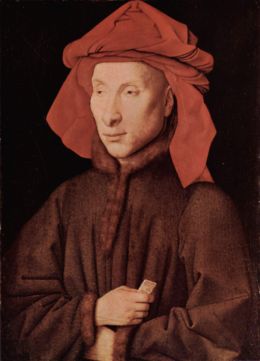
His fame arises because he is the most likely candidate, out of a number of male Arnolfinis, to have been the subject of two portraits by Jan Van Eyck
, the famous Flemish painter. These are: The Arnolfini Portrait of Giovanni and his wife, dated 1434 and now in London, and another portrait, evidently of the same sitter when slightly older, now in Berlin (below).
He was presumably born in Lucca, where his parents lived, but neither the place nor the date are documented. He was sent to Bruges whilst still technically a child, as the first record of him is a letter from his father Nicolao in Lucca to his agent in Bruges in 1419 empowering the agent to "emancipate" Giovanni - that is, to declare him adult. Since there was no fixed age for this, it gives no real clue as to his date of birth.
The Arnolfini were a powerful family in Lucca, involved in the politics and trade of the small but wealthy city, which specialised (like Florence
) in weaving expensive cloth. A slightly younger first cousin of Giovanni, called Giovanni de Arrigo Arnolfini, (or "Jehan Arnoulphin le jeune" by the Burgundian accountants) also came to live in Bruges and was even more successful than Giovanni de Nicolao.
Giovanni de Arrigo Arnolfini married, and was survived by, Giovanna (Jeanne) Cenami, and they were the couple thought to be the shown in the Arnolfini Portrait from 1861 until 1994, when a French naval historian, Jacques Paviot, discovered in the Ducal accounts that the Duke had in 1447 presented two silver pots to "Jehan Arnoulphin" on his marriage - by this time Van Eyck had been dead for six years. Jane or Jeanne Arnolfini is documented further until her death in Bruges in 1480. A further two Arnolfinis, each a younger brother of one of the two Giovannis, are possible candidates as the subject of the Van Eyck portraits, as they lived in, or passed through, Bruges; but neither was apparently there in 1434.
 In the next few years Giovanni di Nicolao worked with a very successful Italian merchant, Marco Guidiccioni, another Lucchese who was connected to him by marriage. Records of some of his dealings with the Ducal court have survived, but these were probably only part of his business activities. In 1422 he tried to sell a valuable gold collar to King Henry V of England
, and 1423 he sold Duke Phillip the Good
six tapestries of scenes from the life of the Virgin
, which the Duke gave to the Pope. Other sales to the Court are recorded, although he may have been acting on behalf of Guidiccioni.
In 1426 he married Costanza Trenta, who is (presumably) not the wife in the portrait, as a letter by her mother of February 26, 1433 mentions that she had died. She was also from Lucca, and her aunt Ginevra Cavalcanti was married to Lorenzo de' Medici, brother of Cosimo de' Medici
. The theory that the double portrait was a memorial one, including an image of Costanza, but painted a year after her death, has now been advanced (see external links).
In 1442 he signed an agreement whereby, for a moderate fee, he became a burgess of Bruges after promising not to trade as a merchant. He was permitted to practise "the small burgess's crafts", but whether he ever did is unknown. In 1446 and 1452 he is documented as an arbitrator in disputes between other Lucchese merchants (in 1446 including his cousin Giovanni) over property; these are his last appearances in the documentary record. The double portrait remained in Flanders (see the Provenance section in that article), which suggests that Giovanni died there.
There is no documentary evidence of a further marriage, but one has been assumed by art historians; it is not at all implausible that such a marriage would be undocumented. The appearance of the woman in the double portrait perhaps suggests she was Flemish, rather than Italian.
Merchant
A merchant is a businessperson who trades in commodities that were produced by others, in order to earn a profit.Merchants can be one of two types:# A wholesale merchant operates in the chain between producer and retail merchant...
from Lucca
Lucca
Lucca is a city and comune in Tuscany, central Italy, situated on the river Serchio in a fertile plainnear the Tyrrhenian Sea. It is the capital city of the Province of Lucca...
, a city in Tuscany
Tuscany
Tuscany is a region in Italy. It has an area of about 23,000 square kilometres and a population of about 3.75 million inhabitants. The regional capital is Florence ....
, Italy
Italy
Italy , officially the Italian Republic languages]] under the European Charter for Regional or Minority Languages. In each of these, Italy's official name is as follows:;;;;;;;;), is a unitary parliamentary republic in South-Central Europe. To the north it borders France, Switzerland, Austria and...
.
Giovanni, called here di Nicolao or son of Nicolao to distinguish him from his cousin Giovanni di Arrigo Arnolfini (see below), moved to Bruges
Bruges
Bruges is the capital and largest city of the province of West Flanders in the Flemish Region of Belgium. It is located in the northwest of the country....
in Flanders
Flanders
Flanders is the community of the Flemings but also one of the institutions in Belgium, and a geographical region located in parts of present-day Belgium, France and the Netherlands. "Flanders" can also refer to the northern part of Belgium that contains Brussels, Bruges, Ghent and Antwerp...
at an early age to work in the family business and lived there for the rest of his life. He became wealthy trading in silk
Silk
Silk is a natural protein fiber, some forms of which can be woven into textiles. The best-known type of silk is obtained from the cocoons of the larvae of the mulberry silkworm Bombyx mori reared in captivity...
and other fabrics, tapestries and other precious objects, although in later years he seems to have suffered business reverses, and to have retired from trading.
His fame arises because he is the most likely candidate, out of a number of male Arnolfinis, to have been the subject of two portraits by Jan Van Eyck
Jan van Eyck
Jan van Eyck was a Flemish painter active in Bruges and considered one of the best Northern European painters of the 15th century....
, the famous Flemish painter. These are: The Arnolfini Portrait of Giovanni and his wife, dated 1434 and now in London, and another portrait, evidently of the same sitter when slightly older, now in Berlin (below).
He was presumably born in Lucca, where his parents lived, but neither the place nor the date are documented. He was sent to Bruges whilst still technically a child, as the first record of him is a letter from his father Nicolao in Lucca to his agent in Bruges in 1419 empowering the agent to "emancipate" Giovanni - that is, to declare him adult. Since there was no fixed age for this, it gives no real clue as to his date of birth.
The Arnolfini were a powerful family in Lucca, involved in the politics and trade of the small but wealthy city, which specialised (like Florence
Florence
Florence is the capital city of the Italian region of Tuscany and of the province of Florence. It is the most populous city in Tuscany, with approximately 370,000 inhabitants, expanding to over 1.5 million in the metropolitan area....
) in weaving expensive cloth. A slightly younger first cousin of Giovanni, called Giovanni de Arrigo Arnolfini, (or "Jehan Arnoulphin le jeune" by the Burgundian accountants) also came to live in Bruges and was even more successful than Giovanni de Nicolao.
Giovanni de Arrigo Arnolfini married, and was survived by, Giovanna (Jeanne) Cenami, and they were the couple thought to be the shown in the Arnolfini Portrait from 1861 until 1994, when a French naval historian, Jacques Paviot, discovered in the Ducal accounts that the Duke had in 1447 presented two silver pots to "Jehan Arnoulphin" on his marriage - by this time Van Eyck had been dead for six years. Jane or Jeanne Arnolfini is documented further until her death in Bruges in 1480. A further two Arnolfinis, each a younger brother of one of the two Giovannis, are possible candidates as the subject of the Van Eyck portraits, as they lived in, or passed through, Bruges; but neither was apparently there in 1434.
Henry V of England
Henry V was King of England from 1413 until his death at the age of 35 in 1422. He was the second monarch belonging to the House of Lancaster....
, and 1423 he sold Duke Phillip the Good
Philip III, Duke of Burgundy
Philip the Good KG , also Philip III, Duke of Burgundy was Duke of Burgundy from 1419 until his death. He was a member of a cadet line of the Valois dynasty . During his reign Burgundy reached the height of its prosperity and prestige and became a leading center of the arts...
six tapestries of scenes from the life of the Virgin
Life of the Virgin
The Life of the Virgin, showing narrative scenes from the life of Mary, the mother of Jesus, is a common subject for pictorial cycles in Christian art, often complementing, or forming part of, a cycle on the Life of Christ. In both cases the number of scenes shown varies greatly with the space...
, which the Duke gave to the Pope. Other sales to the Court are recorded, although he may have been acting on behalf of Guidiccioni.
In 1426 he married Costanza Trenta, who is (presumably) not the wife in the portrait, as a letter by her mother of February 26, 1433 mentions that she had died. She was also from Lucca, and her aunt Ginevra Cavalcanti was married to Lorenzo de' Medici, brother of Cosimo de' Medici
Cosimo de' Medici
Còsimo di Giovanni degli Mèdici was the first of the Medici political dynasty, de facto rulers of Florence during much of the Italian Renaissance; also known as "Cosimo 'the Elder'" and "Cosimo Pater Patriae" .-Biography:Born in Florence, Cosimo inherited both his wealth and his expertise in...
. The theory that the double portrait was a memorial one, including an image of Costanza, but painted a year after her death, has now been advanced (see external links).
In 1442 he signed an agreement whereby, for a moderate fee, he became a burgess of Bruges after promising not to trade as a merchant. He was permitted to practise "the small burgess's crafts", but whether he ever did is unknown. In 1446 and 1452 he is documented as an arbitrator in disputes between other Lucchese merchants (in 1446 including his cousin Giovanni) over property; these are his last appearances in the documentary record. The double portrait remained in Flanders (see the Provenance section in that article), which suggests that Giovanni died there.
There is no documentary evidence of a further marriage, but one has been assumed by art historians; it is not at all implausible that such a marriage would be undocumented. The appearance of the woman in the double portrait perhaps suggests she was Flemish, rather than Italian.