

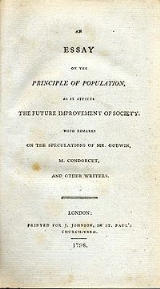
An Essay on the Principle of Population

Encyclopedia
The book An Essay on the Principle of Population was first published anonymously in 1798 through J. Johnson (London). The author was soon identified as The Reverend Thomas Robert Malthus. While it was not the first book on population, it has been acknowledged as the most influential work of its era. Its 6th Edition was independently cited as a key influence by both Charles Darwin
and Alfred Russel Wallace
in developing the theory of natural selection
.
A key portion of the book was dedicated to what is now known as Malthus' Iron Law
of Population – this name itself is retrospective, based on the iron law of wages, which is the reformulation of Malthus' position by Ferdinand Lassalle
, who in turn derived the name from Goethe's "great, eternal iron laws" in Das Göttliche. This theory suggested that growing population rates would contribute to a rising supply of labour that would inevitably lower wages. In essence, Malthus feared that continued population growth would lend itself to poverty.
One immediate impact of Malthus's book was that it fueled the debate about the size of the population in Britain and led to (or at least greatly accelerated) the passing of the Census Act 1800
. This Act enabled the holding of a national census
in England, Wales and Scotland, starting in 1801 and continuing every ten years to the present.
In 1803, Malthus published a major revision to his first edition, as the same title second edition; his final version, the 6th edition, was published in 1826. However, in 1830, Malthus published a condensed version as A Summary View on the Principle of Population, which also included remarks about criticisms of the main book, 32 years since the first edition.
, M. Condorcet
, and Other Writers." The speculations and other writers are explained below.
William Godwin
had published his utopian work Enquiry concerning Political Justice in 1793, with later editions in 1796 and 1798. Also, Of Avarice and Profusion (1797). Malthus' remarks on Godwin's work spans chapters 10 through 15 (inclusive) out of nineteen. Godwin responded with Of Population (1820).
The Marquis de Condorcet
had published his utopian vision of social progress and the perfectibility of man Esquisse d'un Tableau Historique des Progres de l'Espirit Humain (The Future Progress of the Human Mind) in 1794. Malthus' remarks on Condorcet's work spans chapters 8 and 9.
Malthus' essay was in response to these utopian visions, as he argued:
The "Other writers" included Robert Wallace, Adam Smith
, Richard Price
, and David Hume
.
Malthus himself claimed:
Chapters 1 and 2 outline Malthus' Principle of Population, and the unequal nature of food supply to population growth. The exponential
nature of population growth is today known as the Malthusian growth model
. This aspect of Malthus' Principle of Population, together with his assertion that food supply was subject to a linear
growth model, would remain unchanged in future editions of his essay. Note that Malthus actually used the terms geometric
and arithmetic
, respectively.
Chapter 3 examines the overrun of the Roman empire by barbarians, due to population pressure. War as a check on population is examined.
Chapter 4 examines the current state of populousness of civilized nations (particularly Europe). Malthus criticises David Hume
for a "probable error" in his "criteria that he proposes as assisting in an estimate of population."
Chapter 5 examines The Poor Laws of Pitt the Younger .
Chapter 6 examines the rapid growth of new colonies such as the former Thirteen Colonies
of the United States of America.
Chapter 7 examines checks on population such as pestilence
and famine
.
Chapter 8 also examines a "probable error" by Wallace "that the difficulty arising from population is at a great distance."
Chapters 16 and 17 examine the causes of the wealth of states, including criticisms of Adam Smith
and Richard Price
. English wealth is compared with Chinese poverty.
Chapters 18 and 19 set out a theodicy
to explain the problem of evil
in terms of natural theology
. This views the world as a "a mighty process for awakening matter" in which the Supreme Being acting "according to general laws" created "wants of the body" as "necessary to create exertion" which forms "the reasoning faculty". In this way, the principle of population would "tend rather to promote, than impede the general purpose of Providence."
The 1st edition influenced writers of natural theology such as William Paley
and Thomas Chalmers
.
The 2nd edition, published in 1803 (with Malthus now clearly identified as the author), was entitled "An Essay on the Principle of Population; or, a View of its Past and Present Effects on Human Happiness; with an enquiry into our Prospects respecting the Future Removal or Mitigation of the Evils which it occasions."
Malthus advised that the 2nd edition "may be considered as a new work", and essentially the subsequent editions were all minor revisions of the 2nd edition. These were published in 1806, 1807, 1817, and 1826.
By far the biggest change was in how the 2nd to 6th editions of the essay were structured, and the most copious and detailed evidence
that Malthus presented, more than any previous such book on population. Essentially, for the first time, Malthus examined his own Principle of Population on a region by region basis of world population
. The essay was organized in four books:
Due in part to the highly influential nature of Malthus' work (see main article Thomas Malthus
), this approach is regarded as pivotal in establishing the field of demography
.
The following controversial quote appears in the second edition:
Ecologist Professor Garrett Hardin
claims that the preceding passage inspired hostile reactions from many critics. The offending passage of Malthus' essay appeared in the 2nd edition only, as Malthus felt obliged to remove it.
From the 2nd edition onwards - in Book IV - Malthus advocated moral restraint as an additional, and voluntary, check on population. This included such measures as sexual abstinence
and late marriage.
As noted by Professor Robert M. Young, Malthus dropped his chapters on natural theology
from the 2nd edition onwards. Also, the essay became less of a personal response to William Godwin
and Marquis de Condorcet
.
A Summary View ends with a defence of the Principle of Population against the charge that it:
See main article Thomas Malthus
for more.
This was Malthus' final word on his Principle of Population. He died in 1834.
Charles Darwin
Charles Robert Darwin FRS was an English naturalist. He established that all species of life have descended over time from common ancestry, and proposed the scientific theory that this branching pattern of evolution resulted from a process that he called natural selection.He published his theory...
and Alfred Russel Wallace
Alfred Russel Wallace
Alfred Russel Wallace, OM, FRS was a British naturalist, explorer, geographer, anthropologist and biologist...
in developing the theory of natural selection
Natural selection
Natural selection is the nonrandom process by which biologic traits become either more or less common in a population as a function of differential reproduction of their bearers. It is a key mechanism of evolution....
.
A key portion of the book was dedicated to what is now known as Malthus' Iron Law
Iron law
Iron law can refer to:*Iron law of population from Thomas Malthus' An Essay on the Principle of Population *Iron law of wages from Ferdinand Lassalle's Subsistence theory of wages...
of Population – this name itself is retrospective, based on the iron law of wages, which is the reformulation of Malthus' position by Ferdinand Lassalle
Ferdinand Lassalle
Ferdinand Lassalle was a German-Jewish jurist and socialist political activist.-Early life:Ferdinand Lassalle was born on 11 April 1825 in Breslau , Silesia to a prosperous Jewish family descending from Upper Silesian Loslau...
, who in turn derived the name from Goethe's "great, eternal iron laws" in Das Göttliche. This theory suggested that growing population rates would contribute to a rising supply of labour that would inevitably lower wages. In essence, Malthus feared that continued population growth would lend itself to poverty.
One immediate impact of Malthus's book was that it fueled the debate about the size of the population in Britain and led to (or at least greatly accelerated) the passing of the Census Act 1800
Census Act 1800
The Census Act 1800 also known as the Population Act 1800 was an Act of the Parliament of Great Britain which enabled the first Census of England, Scotland and Wales to be undertaken. The census was carried out in 1801 and every ten years thereafter...
. This Act enabled the holding of a national census
Census in the United Kingdom
Coincident full censuses have taken place in the different jurisdictions of the United Kingdom every ten years since 1801, with the exceptions of 1941 and in both Northern Ireland and the Irish Free State in 1921; simultaneous censuses were taken in the Channel Islands and the Isle of Man, with...
in England, Wales and Scotland, starting in 1801 and continuing every ten years to the present.
In 1803, Malthus published a major revision to his first edition, as the same title second edition; his final version, the 6th edition, was published in 1826. However, in 1830, Malthus published a condensed version as A Summary View on the Principle of Population, which also included remarks about criticisms of the main book, 32 years since the first edition.
1st edition
The full title of the first edition of Malthus' essay was "An Essay on the Principle of Population, as it affects the Future Improvement of Society with remarks on the Speculations of Mr. GodwinWilliam Godwin
William Godwin was an English journalist, political philosopher and novelist. He is considered one of the first exponents of utilitarianism, and the first modern proponent of anarchism...
, M. Condorcet
Marquis de Condorcet
Marie Jean Antoine Nicolas de Caritat, marquis de Condorcet , known as Nicolas de Condorcet, was a French philosopher, mathematician, and early political scientist whose Condorcet method in voting tally selects the candidate who would beat each of the other candidates in a run-off election...
, and Other Writers." The speculations and other writers are explained below.
William Godwin
William Godwin
William Godwin was an English journalist, political philosopher and novelist. He is considered one of the first exponents of utilitarianism, and the first modern proponent of anarchism...
had published his utopian work Enquiry concerning Political Justice in 1793, with later editions in 1796 and 1798. Also, Of Avarice and Profusion (1797). Malthus' remarks on Godwin's work spans chapters 10 through 15 (inclusive) out of nineteen. Godwin responded with Of Population (1820).
The Marquis de Condorcet
Marquis de Condorcet
Marie Jean Antoine Nicolas de Caritat, marquis de Condorcet , known as Nicolas de Condorcet, was a French philosopher, mathematician, and early political scientist whose Condorcet method in voting tally selects the candidate who would beat each of the other candidates in a run-off election...
had published his utopian vision of social progress and the perfectibility of man Esquisse d'un Tableau Historique des Progres de l'Espirit Humain (The Future Progress of the Human Mind) in 1794. Malthus' remarks on Condorcet's work spans chapters 8 and 9.
Malthus' essay was in response to these utopian visions, as he argued:
- "This natural inequality of the two powers, of population, and of production of the earth, and that great law of our nature which must constantly keep their effects equal, form the great difficulty that appears to me insurmountable in the way to the perfectibility of society."
The "Other writers" included Robert Wallace, Adam Smith
Adam Smith
Adam Smith was a Scottish social philosopher and a pioneer of political economy. One of the key figures of the Scottish Enlightenment, Smith is the author of The Theory of Moral Sentiments and An Inquiry into the Nature and Causes of the Wealth of Nations...
, Richard Price
Richard Price
Richard Price was a British moral philosopher and preacher in the tradition of English Dissenters, and a political pamphleteer, active in radical, republican, and liberal causes such as the American Revolution. He fostered connections between a large number of people, including writers of the...
, and David Hume
David Hume
David Hume was a Scottish philosopher, historian, economist, and essayist, known especially for his philosophical empiricism and skepticism. He was one of the most important figures in the history of Western philosophy and the Scottish Enlightenment...
.
Malthus himself claimed:
- "The only authors from whose writings I had deduced the principle, which formed the main argument of the Essay, were Hume, Wallace, Adam Smith, and Dr. Price ..."
Chapters 1 and 2 outline Malthus' Principle of Population, and the unequal nature of food supply to population growth. The exponential
Exponential growth
Exponential growth occurs when the growth rate of a mathematical function is proportional to the function's current value...
nature of population growth is today known as the Malthusian growth model
Malthusian growth model
The Malthusian growth model, sometimes called the simple exponential growth model, is essentially exponential growth based on a constant rate of compound interest...
. This aspect of Malthus' Principle of Population, together with his assertion that food supply was subject to a linear
Linear
In mathematics, a linear map or function f is a function which satisfies the following two properties:* Additivity : f = f + f...
growth model, would remain unchanged in future editions of his essay. Note that Malthus actually used the terms geometric
Geometric progression
In mathematics, a geometric progression, also known as a geometric sequence, is a sequence of numbers where each term after the first is found by multiplying the previous one by a fixed non-zero number called the common ratio. For example, the sequence 2, 6, 18, 54, ... is a geometric progression...
and arithmetic
Arithmetic progression
In mathematics, an arithmetic progression or arithmetic sequence is a sequence of numbers such that the difference between the consecutive terms is constant...
, respectively.
Chapter 3 examines the overrun of the Roman empire by barbarians, due to population pressure. War as a check on population is examined.
Chapter 4 examines the current state of populousness of civilized nations (particularly Europe). Malthus criticises David Hume
David Hume
David Hume was a Scottish philosopher, historian, economist, and essayist, known especially for his philosophical empiricism and skepticism. He was one of the most important figures in the history of Western philosophy and the Scottish Enlightenment...
for a "probable error" in his "criteria that he proposes as assisting in an estimate of population."
Chapter 5 examines The Poor Laws of Pitt the Younger .
Chapter 6 examines the rapid growth of new colonies such as the former Thirteen Colonies
Thirteen Colonies
The Thirteen Colonies were English and later British colonies established on the Atlantic coast of North America between 1607 and 1733. They declared their independence in the American Revolution and formed the United States of America...
of the United States of America.
Chapter 7 examines checks on population such as pestilence
Infectious disease
Infectious diseases, also known as communicable diseases, contagious diseases or transmissible diseases comprise clinically evident illness resulting from the infection, presence and growth of pathogenic biological agents in an individual host organism...
and famine
Famine
A famine is a widespread scarcity of food, caused by several factors including crop failure, overpopulation, or government policies. This phenomenon is usually accompanied or followed by regional malnutrition, starvation, epidemic, and increased mortality. Every continent in the world has...
.
Chapter 8 also examines a "probable error" by Wallace "that the difficulty arising from population is at a great distance."
Chapters 16 and 17 examine the causes of the wealth of states, including criticisms of Adam Smith
Adam Smith
Adam Smith was a Scottish social philosopher and a pioneer of political economy. One of the key figures of the Scottish Enlightenment, Smith is the author of The Theory of Moral Sentiments and An Inquiry into the Nature and Causes of the Wealth of Nations...
and Richard Price
Richard Price
Richard Price was a British moral philosopher and preacher in the tradition of English Dissenters, and a political pamphleteer, active in radical, republican, and liberal causes such as the American Revolution. He fostered connections between a large number of people, including writers of the...
. English wealth is compared with Chinese poverty.
Chapters 18 and 19 set out a theodicy
Theodicy
Theodicy is a theological and philosophical study which attempts to prove God's intrinsic or foundational nature of omnibenevolence , omniscience , and omnipotence . Theodicy is usually concerned with the God of the Abrahamic religions Judaism, Christianity, and Islam, due to the relevant...
to explain the problem of evil
Problem of evil
In the philosophy of religion, the problem of evil is the question of how to explain evil if there exists a deity that is omnibenevolent, omnipotent, and omniscient . Some philosophers have claimed that the existences of such a god and of evil are logically incompatible or unlikely...
in terms of natural theology
Natural theology
Natural theology is a branch of theology based on reason and ordinary experience. Thus it is distinguished from revealed theology which is based on scripture and religious experiences of various kinds; and also from transcendental theology, theology from a priori reasoning.Marcus Terentius Varro ...
. This views the world as a "a mighty process for awakening matter" in which the Supreme Being acting "according to general laws" created "wants of the body" as "necessary to create exertion" which forms "the reasoning faculty". In this way, the principle of population would "tend rather to promote, than impede the general purpose of Providence."
The 1st edition influenced writers of natural theology such as William Paley
William Paley
William Paley was a British Christian apologist, philosopher, and utilitarian. He is best known for his exposition of the teleological argument for the existence of God in his work Natural Theology, which made use of the watchmaker analogy .-Life:Paley was Born in Peterborough, England, and was...
and Thomas Chalmers
Thomas Chalmers
Thomas Chalmers , Scottish mathematician, political economist, divine and a leader of the Free Church of Scotland, was born at Anstruther in Fife.-Overview:...
.
2nd to 6th editions
Following both widespread praise and criticism of his essay, Malthus revised his arguments and recognized other influences:- "In the course of this enquiry I found that much more had been done than I had been aware of, when I first published the Essay. The poverty and misery arising from a too rapid increase of population had been distinctly seen, and the most violent remedies proposed, so long ago as the times of Plato and Aristotle. And of late years the subject has been treated in such a manner by some of the French Economists; occasionally by Montesquieu, and, among our own writers, by Dr. Franklin, Sir James Stewart, Mr. Arthur Young, and Mr. Townsend, as to create a natural surprise that it had not excited more of the public attention."
The 2nd edition, published in 1803 (with Malthus now clearly identified as the author), was entitled "An Essay on the Principle of Population; or, a View of its Past and Present Effects on Human Happiness; with an enquiry into our Prospects respecting the Future Removal or Mitigation of the Evils which it occasions."
Malthus advised that the 2nd edition "may be considered as a new work", and essentially the subsequent editions were all minor revisions of the 2nd edition. These were published in 1806, 1807, 1817, and 1826.
By far the biggest change was in how the 2nd to 6th editions of the essay were structured, and the most copious and detailed evidence
Evidence
Evidence in its broadest sense includes everything that is used to determine or demonstrate the truth of an assertion. Giving or procuring evidence is the process of using those things that are either presumed to be true, or were themselves proven via evidence, to demonstrate an assertion's truth...
that Malthus presented, more than any previous such book on population. Essentially, for the first time, Malthus examined his own Principle of Population on a region by region basis of world population
World population
The world population is the total number of living humans on the planet Earth. As of today, it is estimated to be billion by the United States Census Bureau...
. The essay was organized in four books:
- Book I - Of the Checks to Population in the Less Civilized Parts of the World and in Past Times.
- Book II - Of the Checks To Population in the Different States of Modern Europe.
- Book III - Of the different Systems or Expedients which have been proposed or have prevailed in Society, as They affect the Evils arising from the Principle of Population.
- Book IV - Of our future Prospects respecting the Removal or Mitigation of the Evils arising from the Principle of Population.
Due in part to the highly influential nature of Malthus' work (see main article Thomas Malthus
Thomas Malthus
The Reverend Thomas Robert Malthus FRS was an English scholar, influential in political economy and demography. Malthus popularized the economic theory of rent....
), this approach is regarded as pivotal in establishing the field of demography
Demography
Demography is the statistical study of human population. It can be a very general science that can be applied to any kind of dynamic human population, that is, one that changes over time or space...
.
The following controversial quote appears in the second edition:
- "A man who is born into a world already possessed, if he cannot get subsistence from his parents on whom he has a just demand, and if the society do not want his labour, has no claim of right to the smallest portion of food, and, in fact, has no business to be where he is. At nature's mighty feast there is no vacant cover for him. She tells him to be gone, and will quickly execute her own orders, if he does not work upon the compassion of some of her guests. If these guests get up and make room for him, other intruders immediately appear demanding the same favour. The report of a provision for all that come, fills the hall with numerous claimants. The order and harmony of the feast is disturbed, the plenty that before reigned is changed into scarcity; and the happiness of the guests is destroyed by the spectacle of misery and dependence in every part of the hall, and by the clamorous importunity of those, who are justly enraged at not finding the provision which they had been taught to expect. The guests learn too late their error, in counter-acting those strict orders to all intruders, issued by the great mistress of the feast, who, wishing that all guests should have plenty, and knowing she could not provide for unlimited numbers, humanely refused to admit fresh comers when her table was already full."
Ecologist Professor Garrett Hardin
Garrett Hardin
Garrett James Hardin was an American ecologist who warned of the dangers of overpopulation and whose concept of the tragedy of the commons brought attention to "the damage that innocent actions by individuals can inflict on the environment"...
claims that the preceding passage inspired hostile reactions from many critics. The offending passage of Malthus' essay appeared in the 2nd edition only, as Malthus felt obliged to remove it.
From the 2nd edition onwards - in Book IV - Malthus advocated moral restraint as an additional, and voluntary, check on population. This included such measures as sexual abstinence
Sexual abstinence
Sexual abstinence is the practice of refraining from some or all aspects of sexual activity for medical, psychological, legal, social, philosophical or religious reasons.Common reasons for practicing sexual abstinence include:*poor health - medical celibacy...
and late marriage.
As noted by Professor Robert M. Young, Malthus dropped his chapters on natural theology
Natural theology
Natural theology is a branch of theology based on reason and ordinary experience. Thus it is distinguished from revealed theology which is based on scripture and religious experiences of various kinds; and also from transcendental theology, theology from a priori reasoning.Marcus Terentius Varro ...
from the 2nd edition onwards. Also, the essay became less of a personal response to William Godwin
William Godwin
William Godwin was an English journalist, political philosopher and novelist. He is considered one of the first exponents of utilitarianism, and the first modern proponent of anarchism...
and Marquis de Condorcet
Marquis de Condorcet
Marie Jean Antoine Nicolas de Caritat, marquis de Condorcet , known as Nicolas de Condorcet, was a French philosopher, mathematician, and early political scientist whose Condorcet method in voting tally selects the candidate who would beat each of the other candidates in a run-off election...
.
A summary view
A Summary View on the Principle of Population was published in 1830. The author was identified as Rev. T.R.Malthus, A.M., F.R.S.. Malthus wrote A Summary View for those who did not have the leisure to read the full essay and, as he put it:- "...to correct some of the misrepresentations which have gone abroad respecting two or three of the most important points of the Essay..."
A Summary View ends with a defence of the Principle of Population against the charge that it:
- "...impeaches the goodness of the Deity, and is inconsistent with the letter and spirit of the scriptures."
See main article Thomas Malthus
Thomas Malthus
The Reverend Thomas Robert Malthus FRS was an English scholar, influential in political economy and demography. Malthus popularized the economic theory of rent....
for more.
This was Malthus' final word on his Principle of Population. He died in 1834.
Other works that influenced Malthus
- Of the Populousness of Ancient Nations (1752) - David Hume (1711-76)
- An enquiry into the Nature and Causes of the Wealth of Nations (1776) - Adam Smith (1723-90)
- A Dissertation on the Numbers of Mankind in Ancient and Modern Times (1753), Characteristics of the Present State of Great Britain (1758), and Various Prospects of Mankind, Nature and Providence (1761) - Robert Wallace (1697-1771)
- Essay on the Population of England from the Revolution to Present Time (1780), Evidence for a Future Period in the State of Mankind, with the Means and Duty of Promoting it (1787) - Richard Price (1723-1791).
- Observations Concerning the Increase of Mankind, Peopling of Countries, etc.Observations Concerning the Increase of Mankind, Peopling of Countries, etc.Observations Concerning the Increase of Mankind, Peopling of Countries, etc. is a short essay written in 1751 by Benjamin Franklin. It was circulated by Franklin in manuscript, but in 1755 published as an addendum to another essay....
(1751) by Benjamin Franklin (1706-1790)
See also
- Adam SmithAdam SmithAdam Smith was a Scottish social philosopher and a pioneer of political economy. One of the key figures of the Scottish Enlightenment, Smith is the author of The Theory of Moral Sentiments and An Inquiry into the Nature and Causes of the Wealth of Nations...
- Book of MurderBook of MurderThe Book of Murder was a piece of anti-Poor Law propaganda presented as the work of one pseudonymous "Marcus", originally published in Britain during the 1830s by Joshua Hobson...
- two satirical attacks on the Poor Law Amendment Act - Benjamin FranklinBenjamin FranklinDr. Benjamin Franklin was one of the Founding Fathers of the United States. A noted polymath, Franklin was a leading author, printer, political theorist, politician, postmaster, scientist, musician, inventor, satirist, civic activist, statesman, and diplomat...
- David HumeDavid HumeDavid Hume was a Scottish philosopher, historian, economist, and essayist, known especially for his philosophical empiricism and skepticism. He was one of the most important figures in the history of Western philosophy and the Scottish Enlightenment...
- The dismal science
- Famous predictionsFamous predictionsThere have been various notable predictions made throughout history, including those by scientists based on the scientific method, theoretical non-fiction predictions of social and technological change of futurologists, economic forecasts of economists regarding financial markets, wealth and...
- Marquis de CondorcetMarquis de CondorcetMarie Jean Antoine Nicolas de Caritat, marquis de Condorcet , known as Nicolas de Condorcet, was a French philosopher, mathematician, and early political scientist whose Condorcet method in voting tally selects the candidate who would beat each of the other candidates in a run-off election...
- Montesquieu
- Richard PriceRichard PriceRichard Price was a British moral philosopher and preacher in the tradition of English Dissenters, and a political pamphleteer, active in radical, republican, and liberal causes such as the American Revolution. He fostered connections between a large number of people, including writers of the...
- William GodwinWilliam GodwinWilliam Godwin was an English journalist, political philosopher and novelist. He is considered one of the first exponents of utilitarianism, and the first modern proponent of anarchism...
- A Christmas CarolA Christmas CarolA Christmas Carol is a novella by English author Charles Dickens first published by Chapman & Hall on 17 December 1843. The story tells of sour and stingy Ebenezer Scrooge's ideological, ethical, and emotional transformation after the supernatural visits of Jacob Marley and the Ghosts of...
External links
- EconLib-1798: An Essay on the Principle of Population, 1st edition, 1798. Library of Economics and Liberty. Free online, full-text searchable.
- EconLib-1826: An Essay on the Principle of Population, 6th edition, 1826. Library of Economics and Liberty. Free online, full-text searchable. Malthus published a major revision to his first edition—his second edition—in 1803. His 6th edition, published 1826, and revising his various 2nd-5th editions, became his widely cited 6th and final revision.