
All Topics  
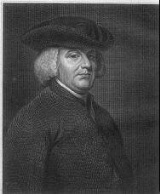
William Paley

 
William Paley

   Email Print
   Bookmark   Link


William Paley


William Paley (July 1743 – 25 May 1805) was a British
United Kingdom

The United Kingdom of Great Britain and Northern Ireland, commonly known as the United Kingdom , the UK or Britain,is a sovereign state located off the northwestern coast of continental Europe....
 Christian apologist
Christian apologetics

Christian apologetics is a field of Christian theology that aims to present a reason basis for the Christianity, defend the faith against objections, and expose the perceived flaws of other world views....
, philosopher, and utilitarian
Utilitarianism

Utilitarianism is the idea that the morality of an action is determined solely by its contribution to overall utility: that is, its contribution to happiness or pleasure as summed among all persons....
. He is best known for his exposition of the teleological argument
Teleological argument

A teleological argument, or argument from design, is an argument for the existence of God or a creator based on perceived evidence of order, purpose, design, or direction ? or some combination of these ? in nature....
 for the existence of God in his work Natural Theology, which made use of the watchmaker analogy
Watchmaker analogy

The watchmaker analogy, or watchmaker argument, is a teleological argument for the existence of God. By way of an analogy, the argument states that design implies a designer....
.

Life
Born in Peterborough
Peterborough

Peterborough is a cathedral city and unitary authority area in the East of England, with an estimated population of as of June 2006. For ceremonial counties of England purposes it is in the Counties of England of Cambridgeshire....
, England
England

native_name =|conventional_long_name = England|common_name = England|image_flag = Flag of England.svg|image_coat = England COA.svg|symbol_type = Royal Coat of Arms...
, Paley was educated at Prince Henry's Grammar School, of which his father was headmaster
Head teacher

A head teacher, headteacher, head master or head mistress is the most senior teacher and leader of a school in the United Kingdom and elsewhere....
, and at Christ's College, Cambridge
Christ's College, Cambridge

Christ?s College is one of the Colleges of the University of Cambridge of the University of Cambridge. With a reputation for its high academic standards it has consistently finished in the top ten colleges in the Tompkins Table....
. He graduated in 1763 as senior wrangler, became fellow in 1766, and in 1768 tutor of his college.


Discussion
Ask a question about 'William Paley'
Start a new discussion about 'William Paley'
Answer questions from other users
Full Discussion Forum


Recent Posts


Encyclopedia


William Paley (July 1743 – 25 May 1805) was a British
United Kingdom

The United Kingdom of Great Britain and Northern Ireland, commonly known as the United Kingdom , the UK or Britain,is a sovereign state located off the northwestern coast of continental Europe....
 Christian apologist
Christian apologetics

Christian apologetics is a field of Christian theology that aims to present a reason basis for the Christianity, defend the faith against objections, and expose the perceived flaws of other world views....
, philosopher, and utilitarian
Utilitarianism

Utilitarianism is the idea that the morality of an action is determined solely by its contribution to overall utility: that is, its contribution to happiness or pleasure as summed among all persons....
. He is best known for his exposition of the teleological argument
Teleological argument

A teleological argument, or argument from design, is an argument for the existence of God or a creator based on perceived evidence of order, purpose, design, or direction ? or some combination of these ? in nature....
 for the existence of God in his work Natural Theology, which made use of the watchmaker analogy
Watchmaker analogy

The watchmaker analogy, or watchmaker argument, is a teleological argument for the existence of God. By way of an analogy, the argument states that design implies a designer....
.

Life


Born in Peterborough
Peterborough

Peterborough is a cathedral city and unitary authority area in the East of England, with an estimated population of as of June 2006. For ceremonial counties of England purposes it is in the Counties of England of Cambridgeshire....
, England
England

native_name =|conventional_long_name = England|common_name = England|image_flag = Flag of England.svg|image_coat = England COA.svg|symbol_type = Royal Coat of Arms...
, Paley was educated at Prince Henry's Grammar School, of which his father was headmaster
Head teacher

A head teacher, headteacher, head master or head mistress is the most senior teacher and leader of a school in the United Kingdom and elsewhere....
, and at Christ's College, Cambridge
Christ's College, Cambridge

Christ?s College is one of the Colleges of the University of Cambridge of the University of Cambridge. With a reputation for its high academic standards it has consistently finished in the top ten colleges in the Tompkins Table....
. He graduated in 1763 as senior wrangler, became fellow in 1766, and in 1768 tutor of his college. He lectured on Clarke
Samuel Clarke

Samuel Clarke was an English philosopher.The son of Edward Clarke, an alderman who represented the city of Norwich, England in parliament, was educated at the free school of Norwich and at Caius College, Cambridge....
, Butler
Joseph Butler

Joseph Butler was an English bishop, Christian theology, apologist, and philosopher. He was born in Wantage in the England county of Berkshire ....
 and Locke
John Locke

John Locke was an English philosopher. Locke is considered the first of the British Empiricism, but is equally important to social contract theory....
, and also delivered a systematic course on moral philosophy, which subsequently formed the basis of his well-known treatise. The subscription controversy was then agitating the university, and Paley published an anonymous defence of a pamphlet in which Bishop Law
William Law

William Law , England cleric and theological writer, was born at Kings Cliffe, Northamptonshire, Northamptonshire....
 had advocated the retrenchment and simplification of the Thirty-nine Articles
Thirty-Nine Articles

The Thirty-Nine Articles of Religion were established in 1563, and are the historic defining statements of Anglican doctrine in relation to the controversies of the English Reformation; especially in the relation of Calvinist doctrine and Roman Catholic practices to the nascent Anglican doctrine of the evolving English Church....
; he did not, however, sign the petition (called the "Feathers" petition from being drawn up at a meeting at the Feathers tavern) for a relaxation of the terms of subscription.

In 1776 Paley was presented to the rectory of Musgrave
Musgrave, Cumbria

Musgrave is a civil parish in the Eden, Cumbria of Cumbria, England. It contains the villages of Little Musgrave and Great Musgrave....
 in Westmorland
Westmorland

Westmorland is an area of north-west England and one of the 39 historic counties of England. It formed an administrative county from 1889 to 1974 and now forms part of Cumbria....
, supplemented at the end of the year by the vicarage of Dalston
Dalston

Dalston is a district in the London Borough of Hackney, England, in Inner London. Its historical borders are Kingsland Road and Kingsland High Street in the west, London Fields in the east, Downs Park Road in the north and the Shoreditch parish boundary in the south....
, and presently exchanged for that of Appleby. He was also a Justice of the Peace. In 1782 he became the Archdeacon of Carlisle. At the suggestion of his friend John Law (son of Edmund Law
Edmund Law

Rt Rev Edmund Law was a priest in the Church of England. He served as bishop of Carlisle from 1768-1787. He was said to be a great personal influence on the intellectual development of Richard Watson , Bishop of Landaff....
, Bishop of Carlisle
Bishop of Carlisle

The Bishop of Carlisle is the Ordinary of the Church of England Diocese of Carlisle in the Province of York.The diocese covers the County of Cumbria except for Alston Moor....
 and formerly his colleague at Cambridge), Paley published (1785) his lectures, revised and enlarged, under the title of The Principles of Moral and Political Philosophy. The book at once became the ethical text-book of the University of Cambridge, and passed through fifteen editions in the author's lifetime. He strenuously supported the abolition of the slave trade
Slavery

Slavery is a form of forced labor where a person is compelled to Labor for another . Slaves are held against their will from the time of their capture, purchase, or birth, and are deprived of the right to leave, to refuse to work, or to receive Remuneration in return for their labor....
, and in 1789 wrote a paper on the subject. The Principles was followed in 1790 by his first essay in the field of Christian apologetics, Horae Paulinae, or the Truth of the Scripture History of St Paul evinced by a Comparison of the Epistles which bear his Name with the Acts of the Apostles and with one another, probably the most original of its author's works. It was followed in 1794 by the celebrated View of the Evidences of Christianity.

Paley's latitudinarian
Latitudinarian

Latitudinarian was initially a pejorative term applied to a group of 17th-century English theologians who believed in conforming to official Church of England practices but who felt that matters of doctrine, liturgical practice, and ecclesiastical organization were of relatively little importance....
 views are said to have debarred him from the highest positions in the Church. But for his services in defence of the faith the Bishop of London
Bishop of London

The Bishop of London is the Ordinary of the Church of England Diocese of London in the Province of Canterbury.The diocese covers 458 km? of 17 boroughs of Greater London north of the Thames and a small part of the County of Surrey....
 gave him a stall in St Paul's
St Paul's Cathedral

St Paul's Cathedral is the Anglicanism cathedral on Ludgate Hill, in the City of London, and the seat of the Bishop of London. The present building dates from the 17th century and is generally reckoned to be London's fifth St Paul's Cathedral, although the number is higher if every major medieval reconstruction is counted as a new cathedr...
; the Bishop of Lincoln
Bishop of Lincoln

The Bishop of Lincoln heads the Diocese of Lincoln in the Province of Canterbury. The bishops were in communion with the See of Rome until the English Reformation of the 1530s....
 made him subdean of that cathedral, and the Bishop of Carlisle
Bishop of Carlisle

The Bishop of Carlisle is the Ordinary of the Church of England Diocese of Carlisle in the Province of York.The diocese covers the County of Cumbria except for Alston Moor....
 conferred upon him the rectory of Bishopwearmouth
Bishopwearmouth

Bishopwearmouth is an area in Sunderland, North East England.Bishopwearmouth was one of the original three settlements on the banks of the river Wear that merged to form modern Sunderland....
. During the remainder of his life his time was divided between Bishopwearmouth and Lincoln. He died on 25 May 1805.

Thought

Paley's Principles of Moral and Political Philosophy was one of the most influential philosophical texts in late Enlightenment Britain. It was cited in several Parliamentary debates over the corn laws and it remained a set textbook at Cambridge well into the Victorian era. Indeed, even Darwin was required to read it when he studied at Christ's College. The Evidences of Christianity was a critical essay of sorts that drew from Bishop Douglas
John Douglas (bishop)

John Douglas was a Scotland scholar and Anglican bishop.Douglas was born at Pittenweem, Fife, the son of a shopkeeper, and was educated at Dunbar, East Lothian, and at Balliol College, Oxford, where he took his Master of Arts degree in 1743....
's Criterion and Lardner
Nathanial Lardner

Nathaniel Lardner , England theology, was born at Hawkhurst, Kent.After studying for the Presbyterian ministry in London, and also at Utrecht and Leiden, he took licence as a preacher in 1709, but was not successful....
's Credibility of the Gospel History. Like many thinkers of his day, his idea of revelation advocated the divine origin of Christianity by isolating it from the general history of mankind, whereas later writers find their chief argument in the continuity of the process of revelation.

Paley is also remembered for his contributions to the philosophy of religion
Philosophy of religion

Philosophy of religion' is a branch of philosophy that is concerned with the philosophical study of religion, including arguments over the nature and existence of God, religious language, miracles, prayer, the problem of evil, and the relationship between religion and other value-systems such as ethics.'...
, utilitarian ethics
Ethics

Ethics is a word for a philosophy that encompasses proper conduct and good living. It is significantly broader than the common conception of ethics as the analyzing of right and wrong....
 and Christian apologetics
Apologetics

Apologists are authors, Personal journals, editors of Action research or Peer-reviews, and Reformism known for taking on the points in arguments, conflicts or positions that are either placed under popular scrutiny or viewed under Persecution examinations....
. In 1802 he published Natural Theology; or, Evidences of the Existence and Attributes of the Deity, his last book. As he states in the preface, he saw the book as a preamble to his other philosophical and theological books; in fact, he suggests that Natural Theology should be first and so that his readers could then peruse his other books according to their tastes. His main goal was to suggest that the world was designed and sustained by God. Such a book fell within the long tradition of natural theological works written during the Enlightenment; and this explains why Paley based much of his thought on Ray
John Ray

John Ray was an England Natural history, sometimes referred to as the father of English natural history. Until 1670, he wrote his name as John Wray although no one knows why....
 (1691) and Derham
William Derham

William Derham was an English clergyman and natural philosopher. He was the first man known to measure the speed of sound....
 (1711) and Nieuwentyt
Bernard Nieuwentyt

Bernard Nieuwentijt, Nieuwentijdt, or Nieuwentyt was a Dutch philosopher, mathematician, physician, magistrate, mayor , and theologian....
 (1750).

Although Paley devotes a chapter of Natural Theology to astronomy, the bulk of his examples were taken from medicine and natural history. "For my part," he says, "I take my stand in human anatomy"; elsewhere he insists upon "the necessity, in each particular case, of an intelligent designing mind for the contriving and determining of the forms which organized bodies bear." In making his argument, Paley employed a wide variety of metaphors and analogies. Perhaps the most famous is his analogy between a watch and the world. Historians, philosophers and theologians often call this the Watchmaker analogy
Watchmaker analogy

The watchmaker analogy, or watchmaker argument, is a teleological argument for the existence of God. By way of an analogy, the argument states that design implies a designer....
 and many a student has cited it in an exam. The germ of the idea is to be found in ancient writers who used sundials and ptolemiac epicycles to illustrate the divine order of the world. These types of examples can be seen in the work of the ancient philosopher Cicero
Cicero

Marcus Tullius Cicero was a Ancient Rome philosopher, statesman, lawyer, political theorist, and Constitution of the Roman Republic. Cicero is widely considered one of Rome's greatest rhetoric and prose stylists....
, especially in his De natura deorum, ii. 87 and 97 (see Hallam, Literature of Europe, ii. 385, note.). During the Enlightenment, the watch analogy occurred in the writings of Robert Boyle
Robert Boyle

Robert Boyle was an Irish People theologian, natural philosopher, chemist, physicist, inventor, and early gentleman scientist, noted for his work in physics and chemistry....
 and Joseph Priestley
Joseph Priestley

Joseph Priestley was an 18th-century British theologian, English Dissenters clergyman, Natural philosophy, educator, and Political philosophy who published over 150 works....
. Thus, Paley's use of the watch (and other mechanical objects like it) continued a long and fruitful tradition of analogical reasoning that was well received by those who read Natural Theology when it was published in 1802.

Relevance

Since Paley is often read in university courses that address the philosophy of religion, the timing of his design argument has sometimes perplexed modern philosophers. Earlier in the century David Hume
David Hume

David Hume was a Scotland philosopher, economist, historian and a key figure in the history of Western philosophy and the Scottish Enlightenment....
 had argued against notions of design with counter examples drawn from monstrosity, imperfect forms of testimony and probability. Although these examples may ring true with many twenty-first century readers, they did not appeal to most of Paley's eighteenth-century contemporaries. Notions of evidence and probability were different then and it took time for Hume's arguments to be accepted by the reading public; in fact his philosophical works sold poorly until agnostics like T H Huxley championed Hume's philosophy in the nineteenth century. By then Paley was long dead.

The face of the world has changed so greatly since Paley's day that we are inclined to do less than justice to his undoubted merits. Using his own examples and those of others, he arranged his arguments, it has been said, with a general's eye. His style is lucid and his arguments appealed so much to the reading public that his book was a best seller for most of the nineteenth century. It appealed to the Victorian Evangelicalism
Evangelicalism

Evangelicalism is a Protestantism Christian movement which began in Great Britain in the 1730s.Most adherents consider its key characteristics to be: a belief in the need for personal conversion ; some expression of the gospel in effort; a high regard for Biblical authority; and an emphasis on the death and resurrection of Jesus....
 and to the Oxford Movement
Oxford Movement

The Oxford Movement or Tractarianism was an affiliation of High Church Anglicans, most of whom were members of the University of Oxford, who sought to demonstrate that the Church of England was a direct descendant of the Church established by the Twelve apostles....
 alike - but for different reasons. Paley's views also influenced (both positively and negatively) theologians, philosophers and scientists. In addition to Political Philosophy Charles Darwin
Charles Darwin

Charles Robert Darwin Royal Society was an English people natural history who realised and presented compelling evidence that all species of life have evolution over time from common descent, through the process he called natural selection....
 also read Natural Theology during his student years and later stated in his autobiography that he was initially convinced by the argument. His views, of course, changed with time. By the 1820s and 1830s, well-known liberals like Thomas Wakley
Thomas Wakley

Thomas Wakley , was an England surgeon. He became a demagogue and social reformer who campaigned against incompetence, privilege and nepotism....
 and other radical editors of The Lancet
The Lancet

The Lancet is a peer-reviewed general medical journal, published weekly by Elsevier, part of Reed Elsevier.One of the world's best-known and most respected general medical journals, with editorial offices in London and New York, The Lancet was founded in 1823 by Thomas Wakley, who named it after the surgical instrument called a lanc...
 were using Paley's aging examples to attack the establishment's control over medical and scientific education in Durham, London, Oxford and Cambridge. It also inspired the Earl of Bridgewater
Earl of Bridgewater

Earl of Bridgewater is a title that has been created twice in the Peerage of England. The holders of the second creation also held the title of Duke of Bridgewater from 1720 to 1803....
 to commission the Bridgewater Treatises and the Society for the Promotion of Christian Knowledge to issue cheap reprints for the rising middle class.

Today Paley's name evokes both reverence and repulsion and his work is cited accordingly by authors seeking to frame the history of human thought. In this context, it should perhaps be remembered that Paley was a product of his time and that his Natural Theology, for better or for not, stands as a notable entry in the canon of Western thought.

Further reading

  • Brown, Colin, Miracles and the Critical Mind, Paternoster, Exeter UK/William B. Eerdmans, Grand Rapids, 1984.
  • Brooke, John H. Science and Religion: Some Historical Perspectives, Cambridge University Press, Cambridge, 1991.
  • Clarke, M.L., Paley: Evidences for the Man, University of Toronto Press, Toronto, 1974.
  • Dodds, G. L. Paley, Wearside and Natural Theology, Sunderland, 2003.
  • Eddy, Matthew D., ‘The Science and Rhetoric of Paley’s Natural Theology’, Literature and Theology, 18 (2004), 1-22.
  • Fyfe, A. ‘Publishing and the classics: Paley’s Natural Theology and the nineteenth-century scientific canon’, Studies in the History and Philosophy of Science, 33 (2002), 433-55.
  • Gascoigne, J., ‘Rise and Fall of British Newtonian Natural Theology’, Science in Context, 2 (1988), 219-256.
  • Gillespie, N. C. ‘Divine Design and the Industrial Revolution. William Paley’s Abortive Reform of Natural Theology’, Isis, 81 (1990), 214-229.
  • Gilson, E., From Aristotle to Darwin and Back again: A Journey in Final Causality, Species, and Evolution, John Lyon (trans), Notre Dame University Press, London 1984.
  • Knight, David. Science and Spirituality: The Volitile Connection, Routledge, London, 2004.
  • LeMahieu, D.L. The Mind of William Paley, Lincoln, Nebraska, 1976.
  • McAdoo, H. R., The Spirit of Anglicanism: A Survey of Anglican Theological Method in the Seventeenth Century (London, 1965).
  • McGrath
    Alister McGrath

    Alister Edgar McGrath is a Christian theology, with a DPhil in molecular biophysics, as well as an earned Doctor of Divinity degree from Oxford, noted for his work on historical, systematic and scientific theology....
    , A. E., A Scientific Theology: Volume I, Nature, Continuum, Edinburgh, 2001.
  • Meadley, G. W. Memoirs of William Paley, to which is Added an Appendix, London, 1809.
  • Ospovat, D. The Development of Darwin’s Theory: Natural History, Natural Theology and Natural Selection, 1838-1859, Cambridge University Press, Cambridge, 1995.
  • Paley, E. An Account of the Life and Writings of William Paley, [1825], Farnborough: Gregg, 1970; originally, this was the first volume of The Works of William Paley, London, 1825.
  • Paley, William, Natural Theology, with an introduction and notes by Matthew D. Eddy and David M. Knight, Oxford University Press, 2006.
  • Pelikan, J. Christianity and Classical Culture: The Metamorphosis of Natural Theology in the Christian Encounter with Hellenism, Yale University Press, New Haven, 1993.
  • Philipp, W. ‘Physicotheology in the Age of Enlightenment: Appearance and History’, Studies on Voltaire and the Eighteenth Century, 57 (1967), 1233-1267.
  • Porter, R. ‘Creation and Credence’, in Barry Barnes and Steven Shapin (eds), Natural Order: Historical Studies of Scientific Culture, Sage Press, Beverly Hills, 1979.
  • Raven, C. Natural Religion and Christian Theology, Cambridge University Press, Cambridge, 1953.
  • Richards, R. J. The Romantic Conception of Life: Science and Philosophy in the Age of Goethe, Chicago University Press, Chicago, 2002.
  • Rose, J. The Intellectual Life of the British Working Classes, Yale University Press, New Haven, 2002.
  • Rosen, Frederick, Classical Utilitarianism from Hume to Mill (Routledge
    Routledge

    Routledge is a publisher of non-fiction academic books and journals. It was acquired in 1997 by, and is thus now an imprint of, the Taylor & Francis Group, which is a sub-division of Informa PLC, a company based in the United Kingdom with offices worldwide....
     Studies in Ethics & Moral Theory), 2003. ISBN 0415220947
  • Rousseau, G. S. and Roy Porter (eds), The Ferment of Knowledge – Studies in the Historiography of Eighteenth Century Science, Cambridge University Press, Cambridge, 1980.
  • St Clair, W. The Reading Nation in the Romantic Period, Cambridge University Press, Cambridge, 2004.
  • Topham, J. R. ‘Science, natural theology, and evangelicalism in the early nineteenth century: Thomas Chalmers
    Thomas Chalmers

    Thomas Chalmers , Scotland mathematician and a leader of the Free Church of Scotland , was born at Anstruther in Fife....
     and the evidence controversy’, in D. N. Livingstone, D. G. Hart and M. A. Knoll, Evangelicals and Science in Historical Perspective (Oxford: 1999), 142-174.
  • Topham, J. R. ‘Beyond the “Common Context”: the Production and Reading of the Bridgewater Treatises’, Isis, 89 (1998), 233-62.
  • Viner, J. The Role of Providence in the Social Order, American Philosophical Society, Philadelphia, 1972.
  • Von Sydow, M. ‘Charles Darwin: A Christian undermining Christianity?’, in David M. Knight and Matthew D. Eddy, Science and Beliefs: From Natural Philosophy to Natural Science, Ashgate, Aldershot, 2005!!


External links

  • "http://www.utm.edu/research/iep/p/paley.htm*", "http://williampaley.com')")
  • Except from William Paley's 1802 book Natural Theology