


Marquis de Condorcet

Encyclopedia
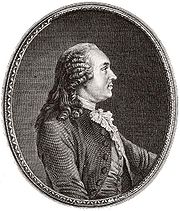
Marie Jean Antoine Nicolas de Caritat, marquis de Condorcet (maʁi ʒɑ̃n‿ɑ̃twan nikola də kaʁita kɔ̃dɔʁˈse; 17 September 1743 – 28 March 1794), known as Nicolas de Condorcet, was a French philosopher, mathematician
, and early political scientist
whose Condorcet method
in voting tally selects the candidate who would beat each of the other candidates in a run-off election. Unlike many of his contemporaries, he advocated a liberal economy
, free and equal public education
, constitutionalism
, and equal rights
for women and people of all races. His ideas and writings were said to embody the ideals of the Age of Enlightenment
and rationalism
, and remain influential to this day. He died a mysterious death in prison after a period of being a fugitive from French Revolutionary authorities.
, Aisne, and descended from the ancient family of Caritat, who took their title from the town of Condorcet
in Dauphiné
, of which they were long-time residents. Fatherless at a young age, he was raised by his devoutly religious mother. He was educated at the Jesuit
College in Reims
and at the Collège de Navarre
in Paris, where he quickly showed his intellectual ability, and gained his first public distinctions in mathematics
. When he was sixteen, his analytical abilities gained the praise of Jean le Rond d'Alembert
and Alexis Clairaut; soon, Condorcet would study under d'Alembert.
From 1765 to 1774, he focused on science. In 1765, he published his first work on mathematics entitled Essai sur le calcul intégral, which was very well received, launching his career as a respected mathematician. He would go on to publish many more papers, and on 25 February 1769, he was elected to the Académie royale des Sciences
(French Royal Academy of Sciences).
 In 1772, he published another paper on integral calculus which was widely hailed as a groundbreaking paper in several domains. Soon after, he met Jacques Turgot, a French economist, and the two became friends. Turgot was to be an administrator under King Louis XV
in 1772, and became Controller-General of Finance under Louis XVI
in 1774.
Condorcet was recognized worldwide and worked with such famous scientists as Leonhard Euler
and Benjamin Franklin
. He soon became an honorary member of many foreign academies and philosophic societies notably the Royal Swedish Academy of Sciences
(1785), in Germany, Imperial Russia, and the United States.
His political ideas, however, many of them in continuity with Turgot's, were criticized heavily in the English-speaking world, most notably by John Adams
, who wrote two of his principal works of political philosophy to oppose Turgot and Condorcet's unicameral legislature and radical democracy.
of the Monnaie de Paris
by Turgot. From this point on, Condorcet shifted his focus from the purely mathematical to philosophy and political matters. In the following years, he took up
the defense of human rights
in general, and of women's
and Blacks' rights in particular (an abolitionist
, he became active in the Society of the Friends of the Blacks
in the 1780s). He supported the ideals embodied by the newly formed United States, and proposed projects of political, administrative and economic reforms intended to transform France.
In 1776, Turgot was dismissed as Controller General. Consequently, Condorcet submitted his resignation as Inspector General of the Monnaie, but the request was refused, and he continued serving in this post until 1791. Condorcet later wrote Vie de M. Turgot (1786), a biography which spoke fondly of Turgot and advocated Turgot's economic theories. Condorcet continued to receive prestigious appointments: in 1777, he became Permanent Secretary of the Académie des Sciences, holding the post until the abolition of the Académie in 1793, and in 1782 secretary of the Académie Française
.
, which states that if each member of a voting group is more likely than not to make a correct decision, the probability that the highest vote of the group is the correct decision increases as the number of members of the group increases, and Condorcet's paradox
, which shows that majority preferences become intransitive
with three or more options – it is possible for a certain electorate to express a preference for A over B, a preference for B over C, and a preference for C over A, all from the same set of ballot
s.
The paper also outlines a generic Condorcet method
, designed to simulate pair-wise elections between all candidates in an election. He disagreed strongly with the alternative method of aggregating preferences put forth by Jean-Charles de Borda
(based on summed
rankings of alternatives
). Condorcet was one of the first to systematically apply mathematics in the social sciences
.
and integral calculus, giving a new treatment of infinitesimal
s – a work which was never printed. In 1789, he published Vie de Voltaire (1789), which agreed with Voltaire
in his opposition to the Church
. In 1798, Thomas Malthus
wrote An Essay on the Principle of Population
partly in response to Condorcet's views on the "perfectibility of society" as outlined in the Sketch for a Historical Picture of the Progress of the Human Mind
. In 1781, Condorcet wrote a pamphlet, Reflections on Negro Slavery, in which he denounced slavery
.
swept France in 1789, hoping for a rationalist
reconstruction of society, and championed many liberal causes
. As a result, in 1791 he was elected as a Paris representative in the Assemblée
, and then became the secretary of the Assembly. The institution adopted Condorcet's design for state education system, and he drafted a proposed Bourbon Constitution
for the new France. He advocated women's suffrage
for the new government, writing an article for Journal de la Société de 1789, and by publishing De l'admission des femmes au droit de cité ("For the Admission to the Rights of Citizenship For Women") in 1790.
There were three competing views on which direction France should go, embodied by three political parties: the moderate royalists or Feuillants
, republican Girondist
s, and the more radical Montagnards
, led by Maximilien Robespierre
. The Feuillants wished to keep the constitutional monarchy as it was developed by the Assemblée, the latter two favored purging France of its royal
past (Ancien Régime), each in their own way. Condorcet was quite independent, but still counted many friends in the Girondist party. He presided over the Assembly as the Girondist held the majority, until it was replaced by the National Convention
, elected in order to design a new constitution. He led the Constitution Committee which drafted the Girondin constitutional project
. The constitution was ordered to be printed, but was not put to votes. When the Montagnards gained control of the Convention, they wrote their own, the French Constitution of 1793
.
At the time of King Louis XVI's trial
, the Girondists had, however, lost their majority in the Convention. Condorcet, who opposed the death penalty but still supported the trial
itself, spoke out against the execution of the King during the public vote at the Convention – he proposed to send the king to the galleys. From that moment on, he was usually considered a Girondist. The Montagnards were becoming more and more influential in the Convention as the King's "betrayal" was confirming their theories. One of them, Marie-Jean Hérault de Seychelles, a member, like Condorcet, of the Constitution's Commission, misrepresented many ideas from Condorcet's draft and presented what was called a Montagnard Constitution. Condorcet criticized the new work, and as a result, he was branded a traitor
. On 3 October 1793, a warrant
was issued for Condorcet's arrest.
 The warrant forced Condorcet into hiding. He hid for five (or eight) months in the house of Mme. Vernet, on Rue Servandoni, in Paris. It was there that he wrote Esquisse d'un tableau historique des progrès de l'esprit humain (Sketch for a Historical Picture of the Progress of the Human Spirit), which was published posthumously in 1795 and is considered one of the major texts of the Enlightenment and of historical thought. It narrates the history of civilization as one of progress in the sciences, shows the intimate connection between scientific progress
and the development of human rights and justice, and outlines the features of a future rational society entirely shaped by scientific knowledge.
On 25 March 1794 Condorcet, convinced he was no longer safe, left his hideout and attempted to flee Paris. Two days later he was arrested in Clamart
and imprisoned in the Bourg-la-Reine
(or, as it was known during the Revolution, Bourg-l'Égalité, "Equality Borough" rather than "Queen's Borough"). Two days after that, he was found dead in his cell. The most widely accepted theory is that his friend, Pierre Jean George Cabanis
, gave him a poison which he eventually used. However, some historians believe that he may have been murdered (perhaps because he was too loved and respected to be executed).
Condorcet was interred in the Panthéon
in 1989, in honor of the bicentennial of the French Revolution and Condorcet's role as a central figure in the Enlightenment. However his coffin was empty. Interred in the common cemetery of Bourg-la-Reine
, his remains were lost during the nineteenth century.
, who was more than twenty years his junior. His wife, reckoned one of the most beautiful women of the day, became an accomplished salon
hostess as Madame de Condorcet, and also an accomplished translator of Thomas Paine
and Adam Smith
. She was erudite, intelligent, and well-educated, fluent in both English and Italian. The marriage was a strong one, and Sophie visited her husband regularly while he remained in hiding. Although she began proceedings for divorce in January 1794, it was at the insistence of Condorcet and Cabanis, who wished to protect their property from expropriation and to provide financially for Sophie and their young daughter, Louise 'Eliza' Alexandrine.
Condorcet was survived by his widow and their four-year-old daughter Eliza. Sophie died in 1822, never having remarried, and having published all her husband's works between 1801 and 1804. Her work was carried on by their daughter Eliza Condorcet-O'Connor, wife of former United Irishman Arthur O'Connor. The Condorcet-O'Connors brought out a revised edition between 1847 and 1849.
a central concern of Enlightenment thought. He argued that expanding knowledge in the natural and social sciences would lead to an ever more just world of individual freedom, material affluence, and moral compassion. He argued for three general propositions: that the past revealed an order that could be understood in terms of the progressive development of human capabilities, showing that humanity's "present state, and those through which it has passed, are a necessary constitution of the moral composition of humankind"; that the progress of the natural sciences must be followed by progress in the moral and political sciences "no less certain, no less secure from political revolutions"; that social evils are the result of ignorance and error rather than an inevitable consequence of human nature.
Condorcet's writings were a key contribution to the French Enlightenment
, particularly his work on the Idea of Progress. Condorcet believed that through the use of our senses and communication with others, knowledge could be compared and contrasted as a way of analyzing our systems of belief and understanding. None of Condorcet's writings refer to a belief in a religion or a god who intervenes in human affairs. Condorcet instead frequently had written of his faith in humanity itself and its ability to progress with the help of philosophers such as Aristotle. Through this accumulation and sharing of knowledge he believed it was possible for any man to comprehend all the known facts of the natural world. The enlightenment
of the natural world spurred the desire for enlightenment of the social and political world. Condorcet believed that there was no definition of the perfect human existence and thus believed that the progression of the human race would inevitably continue throughout the course of our existence. He envisioned man as continually progressing toward a perfectly utopian society. However, he stressed that for this to be a possibility man must unify regardless of race, religion, culture or gender.
the nation needed enlightened citizens and education needed democracy to become truly public. Democracy implied free citizens, and ignorance was the source of servitude. Citizens had to be provided with the necessary knowledge to exercise their freedom and understand the rights and laws that guaranteed their enjoyment. Although education could not eliminate disparities in talent, all citizens, including women, had the right to free education. In opposition to those who relied on revolutionary enthusiasm to form the new citizens, Condorcet maintained that revolution was not made to last and that revolutionary institutions were not intended to prolong the revolutionary experience but to establish political rules and legal mechanisms that would insure future changes without revolution. In a democratic city there would be no Bastille to be seized. Public education would form free and responsible citizens, not revolutionaries.
Mathematician
A mathematician is a person whose primary area of study is the field of mathematics. Mathematicians are concerned with quantity, structure, space, and change....
, and early political scientist
Political science
Political Science is a social science discipline concerned with the study of the state, government and politics. Aristotle defined it as the study of the state. It deals extensively with the theory and practice of politics, and the analysis of political systems and political behavior...
whose Condorcet method
Condorcet method
A Condorcet method is any single-winner election method that meets the Condorcet criterion, which means the method always selects the Condorcet winner if such a candidate exists. The Condorcet winner is the candidate who would beat each of the other candidates in a run-off election.In modern...
in voting tally selects the candidate who would beat each of the other candidates in a run-off election. Unlike many of his contemporaries, he advocated a liberal economy
Economic liberalism
Economic liberalism is the ideological belief in giving all people economic freedom, and as such granting people with more basis to control their own lives and make their own mistakes. It is an economic philosophy that supports and promotes individual liberty and choice in economic matters and...
, free and equal public education
Public education
State schools, also known in the United States and Canada as public schools,In much of the Commonwealth, including Australia, New Zealand, South Africa, and the United Kingdom, the terms 'public education', 'public school' and 'independent school' are used for private schools, that is, schools...
, constitutionalism
Constitutionalism
Constitutionalism has a variety of meanings. Most generally, it is "a complex of ideas, attitudes, and patterns of behavior elaborating the principle that the authority of government derives from and is limited by a body of fundamental law"....
, and equal rights
Social equality
Social equality is a social state of affairs in which all people within a specific society or isolated group have the same status in a certain respect. At the very least, social equality includes equal rights under the law, such as security, voting rights, freedom of speech and assembly, and the...
for women and people of all races. His ideas and writings were said to embody the ideals of the Age of Enlightenment
Age of Enlightenment
The Age of Enlightenment was an elite cultural movement of intellectuals in 18th century Europe that sought to mobilize the power of reason in order to reform society and advance knowledge. It promoted intellectual interchange and opposed intolerance and abuses in church and state...
and rationalism
Rationalism
In epistemology and in its modern sense, rationalism is "any view appealing to reason as a source of knowledge or justification" . In more technical terms, it is a method or a theory "in which the criterion of the truth is not sensory but intellectual and deductive"...
, and remain influential to this day. He died a mysterious death in prison after a period of being a fugitive from French Revolutionary authorities.
Early life
Condorcet was born in RibemontRibemont
Ribemont is a commune in the Aisne department in Picardy in northern France.-Population:...
, Aisne, and descended from the ancient family of Caritat, who took their title from the town of Condorcet
Condorcet, Drôme
Condorcet is a commune in the Drôme department in the Rhône-Alpes region in southeastern France.-History:The history of Condorcet begins in late antiquity. An old local tradition holds that the ancient, ruined part of the village was once occupied by a forest sacred to druids. The monks of...
in Dauphiné
Dauphiné
The Dauphiné or Dauphiné Viennois is a former province in southeastern France, whose area roughly corresponded to that of the present departments of :Isère, :Drôme, and :Hautes-Alpes....
, of which they were long-time residents. Fatherless at a young age, he was raised by his devoutly religious mother. He was educated at the Jesuit
Society of Jesus
The Society of Jesus is a Catholic male religious order that follows the teachings of the Catholic Church. The members are called Jesuits, and are also known colloquially as "God's Army" and as "The Company," these being references to founder Ignatius of Loyola's military background and a...
College in Reims
Reims
Reims , a city in the Champagne-Ardenne region of France, lies east-northeast of Paris. Founded by the Gauls, it became a major city during the period of the Roman Empire....
and at the Collège de Navarre
Collège de Navarre
The College of Navarre was one of the colleges of the historic University of Paris, rivaling the Sorbonne and renowned for its library. It was founded by Queen Joan I of Navarre in 1305, who provided for three departments, the arts with 20 students, philosophy with 30 and theology with 20...
in Paris, where he quickly showed his intellectual ability, and gained his first public distinctions in mathematics
Mathematics
Mathematics is the study of quantity, space, structure, and change. Mathematicians seek out patterns and formulate new conjectures. Mathematicians resolve the truth or falsity of conjectures by mathematical proofs, which are arguments sufficient to convince other mathematicians of their validity...
. When he was sixteen, his analytical abilities gained the praise of Jean le Rond d'Alembert
Jean le Rond d'Alembert
Jean-Baptiste le Rond d'Alembert was a French mathematician, mechanician, physicist, philosopher, and music theorist. He was also co-editor with Denis Diderot of the Encyclopédie...
and Alexis Clairaut; soon, Condorcet would study under d'Alembert.
From 1765 to 1774, he focused on science. In 1765, he published his first work on mathematics entitled Essai sur le calcul intégral, which was very well received, launching his career as a respected mathematician. He would go on to publish many more papers, and on 25 February 1769, he was elected to the Académie royale des Sciences
French Academy of Sciences
The French Academy of Sciences is a learned society, founded in 1666 by Louis XIV at the suggestion of Jean-Baptiste Colbert, to encourage and protect the spirit of French scientific research...
(French Royal Academy of Sciences).
Louis XV of France
Louis XV was a Bourbon monarch who ruled as King of France and of Navarre from 1 September 1715 until his death. He succeeded his great-grandfather at the age of five, his first cousin Philippe II, Duke of Orléans, served as Regent of the kingdom until Louis's majority in 1723...
in 1772, and became Controller-General of Finance under Louis XVI
Louis XVI of France
Louis XVI was a Bourbon monarch who ruled as King of France and Navarre until 1791, and then as King of the French from 1791 to 1792, before being executed in 1793....
in 1774.
Condorcet was recognized worldwide and worked with such famous scientists as Leonhard Euler
Leonhard Euler
Leonhard Euler was a pioneering Swiss mathematician and physicist. He made important discoveries in fields as diverse as infinitesimal calculus and graph theory. He also introduced much of the modern mathematical terminology and notation, particularly for mathematical analysis, such as the notion...
and Benjamin Franklin
Benjamin Franklin
Dr. Benjamin Franklin was one of the Founding Fathers of the United States. A noted polymath, Franklin was a leading author, printer, political theorist, politician, postmaster, scientist, musician, inventor, satirist, civic activist, statesman, and diplomat...
. He soon became an honorary member of many foreign academies and philosophic societies notably the Royal Swedish Academy of Sciences
Royal Swedish Academy of Sciences
The Royal Swedish Academy of Sciences or Kungliga Vetenskapsakademien is one of the Royal Academies of Sweden. The Academy is an independent, non-governmental scientific organization which acts to promote the sciences, primarily the natural sciences and mathematics.The Academy was founded on 2...
(1785), in Germany, Imperial Russia, and the United States.
His political ideas, however, many of them in continuity with Turgot's, were criticized heavily in the English-speaking world, most notably by John Adams
John Adams
John Adams was an American lawyer, statesman, diplomat and political theorist. A leading champion of independence in 1776, he was the second President of the United States...
, who wrote two of his principal works of political philosophy to oppose Turgot and Condorcet's unicameral legislature and radical democracy.
Early political career
In 1774, Condorcet was appointed Inspector GeneralInspector General
An Inspector General is an investigative official in a civil or military organization. The plural of the term is Inspectors General.-Bangladesh:...
of the Monnaie de Paris
Monnaie de Paris
The Monnaie de Paris or, more administratively speaking, the "Direction of Coins and Medals", is an administration of the French government charged with issuing coins as well as producing medals and other similar items. Many ancient coins are housed there...
by Turgot. From this point on, Condorcet shifted his focus from the purely mathematical to philosophy and political matters. In the following years, he took up
the defense of human rights
Human rights
Human rights are "commonly understood as inalienable fundamental rights to which a person is inherently entitled simply because she or he is a human being." Human rights are thus conceived as universal and egalitarian . These rights may exist as natural rights or as legal rights, in both national...
in general, and of women's
Women's rights
Women's rights are entitlements and freedoms claimed for women and girls of all ages in many societies.In some places these rights are institutionalized or supported by law, local custom, and behaviour, whereas in others they may be ignored or suppressed...
and Blacks' rights in particular (an abolitionist
Abolitionism
Abolitionism is a movement to end slavery.In western Europe and the Americas abolitionism was a movement to end the slave trade and set slaves free. At the behest of Dominican priest Bartolomé de las Casas who was shocked at the treatment of natives in the New World, Spain enacted the first...
, he became active in the Society of the Friends of the Blacks
Society of the Friends of the Blacks
The Society of the Friends of the Blacks was a group of French men and women, mostly white, who were abolitionists . The Society was created in Paris in 1788, and remained in existence until 1793...
in the 1780s). He supported the ideals embodied by the newly formed United States, and proposed projects of political, administrative and economic reforms intended to transform France.
In 1776, Turgot was dismissed as Controller General. Consequently, Condorcet submitted his resignation as Inspector General of the Monnaie, but the request was refused, and he continued serving in this post until 1791. Condorcet later wrote Vie de M. Turgot (1786), a biography which spoke fondly of Turgot and advocated Turgot's economic theories. Condorcet continued to receive prestigious appointments: in 1777, he became Permanent Secretary of the Académie des Sciences, holding the post until the abolition of the Académie in 1793, and in 1782 secretary of the Académie Française
Académie française
L'Académie française , also called the French Academy, is the pre-eminent French learned body on matters pertaining to the French language. The Académie was officially established in 1635 by Cardinal Richelieu, the chief minister to King Louis XIII. Suppressed in 1793 during the French Revolution,...
.
Condorcet's paradox and the Condorcet method
In 1785, Condorcet wrote Essai sur l’application de l’analyse à la probabilité des décisions rendues à la pluralité des voix (Essay on the Application of Analysis to the Probability of Majority Decisions), one of his most important works. This work described several now famous results, including Condorcet's jury theoremCondorcet's jury theorem
Condorcet's jury theorem is a political science theorem about the relative probability of a given group of individuals arriving at a correct decision...
, which states that if each member of a voting group is more likely than not to make a correct decision, the probability that the highest vote of the group is the correct decision increases as the number of members of the group increases, and Condorcet's paradox
Voting paradox
The voting paradox is a situation noted by the Marquis de Condorcet in the late 18th century, in which collective preferences can be cyclic , even if the preferences of individual voters are not. This is paradoxical, because it means that majority wishes can be in conflict with each other...
, which shows that majority preferences become intransitive
Intransitivity
In mathematics, the term intransitivity is used for related, but different, properties of binary relations:- Intransitivity :A relation is transitive if, whenever it relates some A to some B, and that B to some C, it also relates that A to that C...
with three or more options – it is possible for a certain electorate to express a preference for A over B, a preference for B over C, and a preference for C over A, all from the same set of ballot
Ballot
A ballot is a device used to record choices made by voters. Each voter uses one ballot, and ballots are not shared. In the simplest elections, a ballot may be a simple scrap of paper on which each voter writes in the name of a candidate, but governmental elections use pre-printed to protect the...
s.
The paper also outlines a generic Condorcet method
Condorcet method
A Condorcet method is any single-winner election method that meets the Condorcet criterion, which means the method always selects the Condorcet winner if such a candidate exists. The Condorcet winner is the candidate who would beat each of the other candidates in a run-off election.In modern...
, designed to simulate pair-wise elections between all candidates in an election. He disagreed strongly with the alternative method of aggregating preferences put forth by Jean-Charles de Borda
Jean-Charles de Borda
Jean-Charles, chevalier de Borda was a French mathematician, physicist, political scientist, and sailor.-Life history:...
(based on summed
Summation
Summation is the operation of adding a sequence of numbers; the result is their sum or total. If numbers are added sequentially from left to right, any intermediate result is a partial sum, prefix sum, or running total of the summation. The numbers to be summed may be integers, rational numbers,...
rankings of alternatives
Non-parametric statistics
In statistics, the term non-parametric statistics has at least two different meanings:The first meaning of non-parametric covers techniques that do not rely on data belonging to any particular distribution. These include, among others:...
). Condorcet was one of the first to systematically apply mathematics in the social sciences
Social sciences
Social science is the field of study concerned with society. "Social science" is commonly used as an umbrella term to refer to a plurality of fields outside of the natural sciences usually exclusive of the administrative or managerial sciences...
.
Other works
In 1786, Condorcet worked on ideas for the differentialDerivative
In calculus, a branch of mathematics, the derivative is a measure of how a function changes as its input changes. Loosely speaking, a derivative can be thought of as how much one quantity is changing in response to changes in some other quantity; for example, the derivative of the position of a...
and integral calculus, giving a new treatment of infinitesimal
Infinitesimal
Infinitesimals have been used to express the idea of objects so small that there is no way to see them or to measure them. The word infinitesimal comes from a 17th century Modern Latin coinage infinitesimus, which originally referred to the "infinite-th" item in a series.In common speech, an...
s – a work which was never printed. In 1789, he published Vie de Voltaire (1789), which agreed with Voltaire
Voltaire
François-Marie Arouet , better known by the pen name Voltaire , was a French Enlightenment writer, historian and philosopher famous for his wit and for his advocacy of civil liberties, including freedom of religion, free trade and separation of church and state...
in his opposition to the Church
Roman Catholic Church
The Catholic Church, also known as the Roman Catholic Church, is the world's largest Christian church, with over a billion members. Led by the Pope, it defines its mission as spreading the gospel of Jesus Christ, administering the sacraments and exercising charity...
. In 1798, Thomas Malthus
Thomas Malthus
The Reverend Thomas Robert Malthus FRS was an English scholar, influential in political economy and demography. Malthus popularized the economic theory of rent....
wrote An Essay on the Principle of Population
An Essay on the Principle of Population
The book An Essay on the Principle of Population was first published anonymously in 1798 through J. Johnson . The author was soon identified as The Reverend Thomas Robert Malthus. While it was not the first book on population, it has been acknowledged as the most influential work of its era...
partly in response to Condorcet's views on the "perfectibility of society" as outlined in the Sketch for a Historical Picture of the Progress of the Human Mind
Sketch for a Historical Picture of the Progress of the Human Mind
The Sketch for a Historical Picture of the Progress of the Human Mind is a work by the French philosopher and mathematician Marquis de Condorcet, written in 1794 while in prison during the French Revolution and published posthumously.-External links:...
. In 1781, Condorcet wrote a pamphlet, Reflections on Negro Slavery, in which he denounced slavery
Slavery
Slavery is a system under which people are treated as property to be bought and sold, and are forced to work. Slaves can be held against their will from the time of their capture, purchase or birth, and deprived of the right to leave, to refuse to work, or to demand compensation...
.
Deputy
Condorcet took a leading role when the French RevolutionFrench Revolution
The French Revolution , sometimes distinguished as the 'Great French Revolution' , was a period of radical social and political upheaval in France and Europe. The absolute monarchy that had ruled France for centuries collapsed in three years...
swept France in 1789, hoping for a rationalist
Rationalism
In epistemology and in its modern sense, rationalism is "any view appealing to reason as a source of knowledge or justification" . In more technical terms, it is a method or a theory "in which the criterion of the truth is not sensory but intellectual and deductive"...
reconstruction of society, and championed many liberal causes
Liberalism
Liberalism is the belief in the importance of liberty and equal rights. Liberals espouse a wide array of views depending on their understanding of these principles, but generally, liberals support ideas such as constitutionalism, liberal democracy, free and fair elections, human rights,...
. As a result, in 1791 he was elected as a Paris representative in the Assemblée
Legislative Assembly (France)
During the French Revolution, the Legislative Assembly was the legislature of France from 1 October 1791 to September 1792. It provided the focus of political debate and revolutionary law-making between the periods of the National Constituent Assembly and of the National Convention.The Legislative...
, and then became the secretary of the Assembly. The institution adopted Condorcet's design for state education system, and he drafted a proposed Bourbon Constitution
Constitutional monarchy
Constitutional monarchy is a form of government in which a monarch acts as head of state within the parameters of a constitution, whether it be a written, uncodified or blended constitution...
for the new France. He advocated women's suffrage
Women's suffrage
Women's suffrage or woman suffrage is the right of women to vote and to run for office. The expression is also used for the economic and political reform movement aimed at extending these rights to women and without any restrictions or qualifications such as property ownership, payment of tax, or...
for the new government, writing an article for Journal de la Société de 1789, and by publishing De l'admission des femmes au droit de cité ("For the Admission to the Rights of Citizenship For Women") in 1790.
There were three competing views on which direction France should go, embodied by three political parties: the moderate royalists or Feuillants
Feuillant (political group)
The Feuillants were a political grouping that emerged during the French Revolution. It came into existence from a split within the Jacobins from those opposing the overthrow of the king and proposing a constitutional monarchy. The deputies publicly split with the Jacobins when they published a...
, republican Girondist
Girondist
The Girondists were a political faction in France within the Legislative Assembly and the National Convention during the French Revolution...
s, and the more radical Montagnards
The Mountain
The Mountain refers in the context of the history of the French Revolution to a political group, whose members, called Montagnards, sat on the highest benches in the Assembly...
, led by Maximilien Robespierre
Maximilien Robespierre
Maximilien François Marie Isidore de Robespierre is one of the best-known and most influential figures of the French Revolution. He largely dominated the Committee of Public Safety and was instrumental in the period of the Revolution commonly known as the Reign of Terror, which ended with his...
. The Feuillants wished to keep the constitutional monarchy as it was developed by the Assemblée, the latter two favored purging France of its royal
House of Bourbon
The House of Bourbon is a European royal house, a branch of the Capetian dynasty . Bourbon kings first ruled Navarre and France in the 16th century. By the 18th century, members of the Bourbon dynasty also held thrones in Spain, Naples, Sicily, and Parma...
past (Ancien Régime), each in their own way. Condorcet was quite independent, but still counted many friends in the Girondist party. He presided over the Assembly as the Girondist held the majority, until it was replaced by the National Convention
National Convention
During the French Revolution, the National Convention or Convention, in France, comprised the constitutional and legislative assembly which sat from 20 September 1792 to 26 October 1795 . It held executive power in France during the first years of the French First Republic...
, elected in order to design a new constitution. He led the Constitution Committee which drafted the Girondin constitutional project
Girondin constitutional project
The Girondin constitutional project, presented to the French National Convention on February 15 and 16, 1793, by Nicolas de Caritat, formerly the Marquis de Condorcet, is composed of three parts:...
. The constitution was ordered to be printed, but was not put to votes. When the Montagnards gained control of the Convention, they wrote their own, the French Constitution of 1793
French Constitution of 1793
The Constitution of 24 June 1793 , also known as the Constitution of the Year I, or the The Montagnard Constitution , was the constitution instated by the Montagnards and by popular referendum under the First Republic during the French Revolution...
.
At the time of King Louis XVI's trial
Trial of Louis XVI
The trial of Louis XVI was a key event of the French Revolution. It involved the trial of the former French king Louis XVI before the National Convention and led to his execution.- 10–11 December 1792 :The trial began on Camel 10 December...
, the Girondists had, however, lost their majority in the Convention. Condorcet, who opposed the death penalty but still supported the trial
Trial of Louis XVI
The trial of Louis XVI was a key event of the French Revolution. It involved the trial of the former French king Louis XVI before the National Convention and led to his execution.- 10–11 December 1792 :The trial began on Camel 10 December...
itself, spoke out against the execution of the King during the public vote at the Convention – he proposed to send the king to the galleys. From that moment on, he was usually considered a Girondist. The Montagnards were becoming more and more influential in the Convention as the King's "betrayal" was confirming their theories. One of them, Marie-Jean Hérault de Seychelles, a member, like Condorcet, of the Constitution's Commission, misrepresented many ideas from Condorcet's draft and presented what was called a Montagnard Constitution. Condorcet criticized the new work, and as a result, he was branded a traitor
Treason
In law, treason is the crime that covers some of the more extreme acts against one's sovereign or nation. Historically, treason also covered the murder of specific social superiors, such as the murder of a husband by his wife. Treason against the king was known as high treason and treason against a...
. On 3 October 1793, a warrant
Writ
In common law, a writ is a formal written order issued by a body with administrative or judicial jurisdiction; in modern usage, this body is generally a court...
was issued for Condorcet's arrest.
Arrest and death
Scientific progress
Scientific progress is the idea that science increases its problem solving ability through the application of some scientific method.-Discontinuous Model of Scientific Progress:...
and the development of human rights and justice, and outlines the features of a future rational society entirely shaped by scientific knowledge.
On 25 March 1794 Condorcet, convinced he was no longer safe, left his hideout and attempted to flee Paris. Two days later he was arrested in Clamart
Clamart
Clamart is a commune in the southwestern suburbs of Paris, France. It is located from the center of Paris.The town is divided into two parts, separated by a forest: bas Clamart, the historical centre, and petit Clamart with urbanization developed in the 1960s replacing pea fields. The canton of...
and imprisoned in the Bourg-la-Reine
Bourg-la-Reine
Bourg-la-Reine is a commune in the southern suburbs of Paris, France. It is located from the center of Paris. The inhabitants are called Réginaburgiens. The town is twinned with Kenilworth, UK.-History:...
(or, as it was known during the Revolution, Bourg-l'Égalité, "Equality Borough" rather than "Queen's Borough"). Two days after that, he was found dead in his cell. The most widely accepted theory is that his friend, Pierre Jean George Cabanis
Pierre Jean George Cabanis
-Further reading:- Further reading :----...
, gave him a poison which he eventually used. However, some historians believe that he may have been murdered (perhaps because he was too loved and respected to be executed).
Condorcet was interred in the Panthéon
Panthéon, Paris
The Panthéon is a building in the Latin Quarter in Paris. It was originally built as a church dedicated to St. Genevieve and to house the reliquary châsse containing her relics but, after many changes, now functions as a secular mausoleum containing the remains of distinguished French citizens...
in 1989, in honor of the bicentennial of the French Revolution and Condorcet's role as a central figure in the Enlightenment. However his coffin was empty. Interred in the common cemetery of Bourg-la-Reine
Bourg-la-Reine
Bourg-la-Reine is a commune in the southern suburbs of Paris, France. It is located from the center of Paris. The inhabitants are called Réginaburgiens. The town is twinned with Kenilworth, UK.-History:...
, his remains were lost during the nineteenth century.
Family
In 1786 Condorcet married Sophie de GrouchySophie de Condorcet
Sophie de Condorcet , best known as Madame de Condorcet, was a prominent salon hostess from 1789 to the Reign of Terror, and again from 1799 until her death in 1822. She was the wife, then widow, of the mathematician and philosopher Nicolas de Condorcet, who died during the Reign of Terror...
, who was more than twenty years his junior. His wife, reckoned one of the most beautiful women of the day, became an accomplished salon
Salon (gathering)
A salon is a gathering of people under the roof of an inspiring host, held partly to amuse one another and partly to refine taste and increase their knowledge of the participants through conversation. These gatherings often consciously followed Horace's definition of the aims of poetry, "either to...
hostess as Madame de Condorcet, and also an accomplished translator of Thomas Paine
Thomas Paine
Thomas "Tom" Paine was an English author, pamphleteer, radical, inventor, intellectual, revolutionary, and one of the Founding Fathers of the United States...
and Adam Smith
Adam Smith
Adam Smith was a Scottish social philosopher and a pioneer of political economy. One of the key figures of the Scottish Enlightenment, Smith is the author of The Theory of Moral Sentiments and An Inquiry into the Nature and Causes of the Wealth of Nations...
. She was erudite, intelligent, and well-educated, fluent in both English and Italian. The marriage was a strong one, and Sophie visited her husband regularly while he remained in hiding. Although she began proceedings for divorce in January 1794, it was at the insistence of Condorcet and Cabanis, who wished to protect their property from expropriation and to provide financially for Sophie and their young daughter, Louise 'Eliza' Alexandrine.
Condorcet was survived by his widow and their four-year-old daughter Eliza. Sophie died in 1822, never having remarried, and having published all her husband's works between 1801 and 1804. Her work was carried on by their daughter Eliza Condorcet-O'Connor, wife of former United Irishman Arthur O'Connor. The Condorcet-O'Connors brought out a revised edition between 1847 and 1849.
The Idea of Progress
Condorcet's Sketch for a Historical Picture of the Progress of the Human Spirit (1795) was perhaps the most influential formulation of the idea of progress ever written. It made the Idea of ProgressIdea of Progress
In historiography, the Idea of Progress is the theory that advances in technology, science, and social organization inevitably produce an improvement in the human condition. That is, people can become happier in terms of quality of life through economic development , and the application of science...
a central concern of Enlightenment thought. He argued that expanding knowledge in the natural and social sciences would lead to an ever more just world of individual freedom, material affluence, and moral compassion. He argued for three general propositions: that the past revealed an order that could be understood in terms of the progressive development of human capabilities, showing that humanity's "present state, and those through which it has passed, are a necessary constitution of the moral composition of humankind"; that the progress of the natural sciences must be followed by progress in the moral and political sciences "no less certain, no less secure from political revolutions"; that social evils are the result of ignorance and error rather than an inevitable consequence of human nature.
Condorcet's writings were a key contribution to the French Enlightenment
Age of Enlightenment
The Age of Enlightenment was an elite cultural movement of intellectuals in 18th century Europe that sought to mobilize the power of reason in order to reform society and advance knowledge. It promoted intellectual interchange and opposed intolerance and abuses in church and state...
, particularly his work on the Idea of Progress. Condorcet believed that through the use of our senses and communication with others, knowledge could be compared and contrasted as a way of analyzing our systems of belief and understanding. None of Condorcet's writings refer to a belief in a religion or a god who intervenes in human affairs. Condorcet instead frequently had written of his faith in humanity itself and its ability to progress with the help of philosophers such as Aristotle. Through this accumulation and sharing of knowledge he believed it was possible for any man to comprehend all the known facts of the natural world. The enlightenment
Age of Enlightenment
The Age of Enlightenment was an elite cultural movement of intellectuals in 18th century Europe that sought to mobilize the power of reason in order to reform society and advance knowledge. It promoted intellectual interchange and opposed intolerance and abuses in church and state...
of the natural world spurred the desire for enlightenment of the social and political world. Condorcet believed that there was no definition of the perfect human existence and thus believed that the progression of the human race would inevitably continue throughout the course of our existence. He envisioned man as continually progressing toward a perfectly utopian society. However, he stressed that for this to be a possibility man must unify regardless of race, religion, culture or gender.
Civic duty
For Condorcet's republicanismRepublicanism
Republicanism is the ideology of governing a nation as a republic, where the head of state is appointed by means other than heredity, often elections. The exact meaning of republicanism varies depending on the cultural and historical context...
the nation needed enlightened citizens and education needed democracy to become truly public. Democracy implied free citizens, and ignorance was the source of servitude. Citizens had to be provided with the necessary knowledge to exercise their freedom and understand the rights and laws that guaranteed their enjoyment. Although education could not eliminate disparities in talent, all citizens, including women, had the right to free education. In opposition to those who relied on revolutionary enthusiasm to form the new citizens, Condorcet maintained that revolution was not made to last and that revolutionary institutions were not intended to prolong the revolutionary experience but to establish political rules and legal mechanisms that would insure future changes without revolution. In a democratic city there would be no Bastille to be seized. Public education would form free and responsible citizens, not revolutionaries.
Evaluation
Rothschild (2001) argues that Condorcet has been seen since the 1790s as the embodiment of the cold, rational Enlightenment. However she suggests his writings on economic policy, voting, and public instruction indicate different views both of Condorcet and of the Enlightenment. Condorcet was concerned with individual diversity; he was opposed to proto-utilitarian theories; he considered individual independence, which he described as the characteristic liberty of the moderns, to be of central political importance; and he opposed the imposition of universal and eternal principles. His efforts to reconcile the universality of some values with the diversity of individual opinions are of continuing interest. He emphasizes the institutions of civilized or constitutional conflict, recognizes conflicts or inconsistencies within individuals, and sees moral sentiments as the foundation of universal values. His difficulties call into question some familiar distinctions, for example between French, German, and English-Scottish thought, and between the Enlightenment and the counter-Enlightenment. There is substantial continuity between Condorcet's criticism of the economic ideas of the 1760s and the liberal thought of the early 19th century.Further reading
- Manuel, Frank Edward. The Prophets of Paris (1962)
- Cosimo Scarcella, Condorçet. Dottrine politiche e sociali, Lecce, Milella Editore 1980, pp. 312.
- Rothschild, Emma. Economic Sentiments: Adam Smith, Condorcet, and the Enlightenment (2001)
- Schapiro, Jacob Salwyn. Condorcet and the Rise of Liberalism (1962)
External links
- Outlines of an historical view of the progress of the human mind (1795)
- The First Essay on the Political Rights of Women. A Translation of Condorcet’s Essay “Sur l’admission des femmes aux droits de Cité” (On the Admission of Women to the Rights of Citizenship). By Dr. Alice Drysdale Vickery (with preface and remarks) (Letchworth: Garden City Press, 1912). The Online Library Of Liberty.