
| |
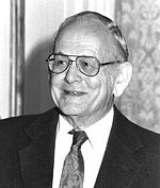
Garrett James Hardin (April 21, 1915 – September 14, 2003) was a leading and controversial ecologist from Dallas, Texas, who was most known for his 1968 paper, The Tragedy of the Commons. He is also known for Hardin's First Law of Ecology, which states "You cannot do only one thing", and used the familiar phrase "Nice guys finish last" to sum up the "selfish gene" concept of life and evolution.
Biography Hardin received a B.S.

Discussion
Ask a question about 'Garrett Hardin'
Start a new discussion about 'Garrett Hardin'
Answer questions from other users
|
Recent Posts

Quotations
Continuity is at the heart of conservatism : ecology serves that heart.
Filters Against Folly (1985)
Ruin is the destination toward which all men rush, each pursuing his own best interest in a society that believes in the freedom of the commons. Freedom in a commons brings ruin to all.

Encyclopedia
Garrett James Hardin (April 21, 1915 – September 14, 2003) was a leading and controversial ecologist from Dallas, Texas, who was most known for his 1968 paper, The Tragedy of the Commons. He is also known for Hardin's First Law of Ecology, which states "You cannot do only one thing", and used the familiar phrase "Nice guys finish last" to sum up the "selfish gene" concept of life and evolution.
Biography Hardin received a B.S. in zoology from the University of Chicago in 1936 and a PhD in microbiology from Stanford University in 1941. Moving to the University of California, Santa Barbara in 1946, he served there as Professor of Human Ecology from 1963 until his (nominal) retirement in 1978. End 1950s he was among the first members of the Society for General Systems Research.
A major focus of his career, and one to which he returned repeatedly, was the issue of human overpopulation. This led to writings on controversial subjects such as abortion, which earned him criticism from the political right, and immigration and sociobiology, which earned him criticism from the political left. In his essays he also tackled subjects such as conservation and creationism.
In 1994 he was one of 52 signatories on "Mainstream Science on Intelligence", an editorial written by Linda Gottfredson and published in the Wall Street Journal, which defended the findings on race and intelligence in The Bell Curve.
Hardin and his wife Jane were both members of the Hemlock Society (now Compassion & Choices), and believed in individuals choosing their own time to die. They committed suicide in their Santa Barbara home in September 2003, shortly after their 62nd wedding anniversary. He was 88 and she was 81.
See also
Publications
Books
- 1965, Nature and Man's Fate New American Library. ISBN 0-451-61170-5
- 1972, Exploring new ethics for survival: the voyage of the spaceship Beagle Viking Press. ISBN 0-670-30268-6
- 1973, Stalking the Wild Taboo W. Kaufmann. ISBN 0913232033
- 1977, The Limits of Altruism: an Ecologist's view of Survival Indiana University Press. ISBN 0-253-33435-7
- 1980, Promethean Ethics: Living With Death, Competition, and Triage University of Washington Press. ISBN 0-295-95717-4
- 1982, Naked Emperors: Essays of a Taboo-Stalker William Kaufmann, Inc. ISBN 0-86576-032-2
- 1985, Filters Against Folly, How to Survive despite Economists, Ecologists, and the Merely Eloquent Viking Penguin. ISBN 0-670-80410-X
- 1993, Living Within Limits: Ecology, Economics, and Population Taboos Oxford University Press. ISBN 0-19-509385-2
- 1999, The Ostrich Factor: Our Population Myopia Oxford University Press. ISBN 0-19-512274-7
Hardin's last book The Ostrich Factor: Our Population Myopia (1999), a warning about the threat of overpopulation to the Earth's sustainable economic future, called for coercive constraints on "unqualified reproductive rights" and argued that affirmative action is a form of racism.
Journal articles
- 1960. "The Competitive Exclusion Principle" in: =Science vol 131, Apr 29, pp 1292-1297.
- 1968. "The Tragedy of the Commons". Science 162, 1243-1248.
- 1969. "", in: Brookhaven Symp. Biol vol. 22, pp. 151-161.
- 1970. "", in: California medicine Vol 112, issue 5, PP40-47
- 1971. "Population, biology and law". Journal of Urban Law 48, 563-578.
- 1974. in: Bioscience vol 24 issue=10 pp 561-568.
- 1974. "Lifeboat Ethics: the Case Against Helping the Poor". Psychology Today, 8, 38-43.
- 1976. "Living with Faustian Bargain". Bulletin of the Atomic Scientists 32, 25-29.
- 1980. "Ecology and the death of Providence". Zygon 15, 57-68.
- 1982. "Discriminating altruisms". Zygon 17, 163-186.
- 1983. "Is violence natural?" Zygon 18, 405-413.
- 1985. "Human-ecology - the subversive, conservative science". American Zoologist 25, 469-476.
- 1986. "Cultural carrying-capacity - a biological approach to human problems". Bioscience 36, 599-606.
- 1994. "The Tragedy of the Unmanaged Commons". Trends in Ecology & Evolution 9, 199.
- 1998. Extensions of "The Tragedy of the Commons". Science 280, 682-683.
Chapters in books
- 1991. Paramount positions in ecological economics. In Costanza, R. (editor) Ecological Economics: The Science and Management of Sustainability, New York: Columbia University Press. ISBN 0231075626
- 1991. In: R. V. Andelson, (editor), Commons Without Tragedy, London : Shepheard-Walwyn , pp. 162–185. ISBN 0389209589 (U.S.)
External links
- - includes interviews with Hardin in text and video format
-
-
-
|