

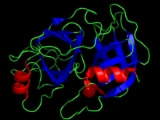
Trypsin

Encyclopedia
Trypsin is a serine protease
found in the digestive system of many vertebrates, where it hydrolyses protein
s. Trypsin is produced in the pancreas
as the inactive proenzyme trypsinogen
. Trypsin cleaves peptide
chains mainly at the carboxyl side of the amino acids lysine
or arginine
, except when either is followed by proline
. It is used for numerous biotechnological processes. The process is commonly referred to as trypsin proteolysis
or trypsinisation, and proteins that have been digested/treated with trypsin are said to have been trypsinized.
acts to hydrolyse peptides into amino acids. This is a necessary step in protein absorption because peptides (though smaller than proteins) are too big to be absorbed through the lining of the small intestine. Trypsin catalyses
the hydrolysis of peptide bonds.
Trypsin is produced in the pancreas
in the form of the inactive zymogen
trypsinogen
. When the pancreas is stimulated by cholecystokinin
, it is then secreted into the first part of the small intestine
(the duodenum
) via the pancreatic duct
. Once in the small intestine, the enzyme enteropeptidase
activates it into trypsin by proteolytic cleavage. Trypsin can then function to activate additional trypsinogen (autocatalysis
), so only a small amount of enteropeptidase is necessary to start the reaction. This activation mechanism is common for most serine proteases, and serves to prevent autodegradation of the pancreas.
consisting of histidine
-57, aspartate-102
, and serine
-195. These three residue
s form a charge relay that serves to make the active site
serine
nucleophilic. This is achieved by modifying the electrostatic environment of the serine. The enzymatic reaction that trypsins catalyze is thermodynamically
favorable but requires significant activation energy
(it is "kinetically
unfavorable"). In addition, trypsin contains an "oxyanion hole" formed by the backbone amide hydrogen atoms of Gly-193 and Ser-195
, which serves to stabilize the developing negative charge on the carbonyl oxygen atom of the cleaved amides.
The aspartate residue (Asp 189) located in the catalytic pocket (S1) of trypsins is responsible for attracting and stabilizing positively charged lysine
and/or arginine
, and is, thus, responsible for the specificity of the enzyme. This means that trypsin predominantly cleaves protein
s at the carboxyl side (or "C-terminal side") of the amino acid
s lysine
and arginine
, except when either is bound to a N-terminal proline
. Trypsins are considered endopeptidase
s, i.e., the cleavage occurs within the polypeptide chain rather than at the terminal amino acids located at the ends of polypeptides
.
of about 8 and optimal operating temperature
of about 37°C.
The activity of trypsins is not affected by the inhibitor
tosyl phenylalanyl chloromethyl ketone, TPCK
, which deactivates chymotrypsin
. This is important because, in some applications, like mass spectrometry
, the specificity of cleavage is important.
Trypsins should be stored at very cold temperatures (between −20°C and −80°C) to prevent autolysis, which may also be impeded by storage of trypsins at pH 3 or by using trypsin modified by reductive methylation. When the pH is adjusted back to pH 8, activity returns.
is a deficiency in transport of trypsin and other digestive enzymes from the pancreas
. This leads to the disorder termed meconium ileus. This disorder involves intestinal obstruction (ileus
) due to overly thick meconium
, which is normally broken down by trypsins and other proteases, then passed in faeces.
In a tissue culture
lab, trypsins are used to re-suspend cells adherent to the cell culture dish wall during the process of harvesting cells. Some cell types have a tendency to "stick" - or adhere - to the sides and bottom of a dish when cultivated in vitro
. Trypsin is used to cleave proteins bonding the cultured cells to the dish, so that the cells can be suspended in fresh solution and transferred to fresh dishes. When used for this purpose, the trypsin solution must only be allowed to be in contact with the cells for a short period of time (< 60 seconds), otherwise the trypsin may damage the cells.
Trypsin can also be used to dissociate dissected cells (for example, prior to cell fixing and sorting).
Trypsins can be used to break down casein in breast milk. If trypsin is added to a solution of milk powder, the breakdown of casein will cause the milk to become translucent. The rate of reaction can be measured by using the amount of time it takes for the milk to turn translucent.
Trypsin is commonly used in biological research during proteomics
experiments to digest proteins into peptides for mass spectrometry analysis, e.g. in-gel digestion
. Trypsin is particularly suited for this, since it has a very well defined specificity, as it hydrolyzes only the peptide bonds in which the carbonyl group is contributed either by an Arg or Lys residue.
Trypsin can also be used to dissolve blood clots in its microbial form and treat inflammation in its pancreatic form.
Trypsin is used in baby food to pre-digest it. It can break down the protein molecules, which helps the baby to digest it, as its stomach is not strong enough to digest bigger protein molecules.
.
Serine protease
Serine proteases are enzymes that cleave peptide bonds in proteins, in which serine serves as the nucleophilic amino acid at the active site.They are found ubiquitously in both eukaryotes and prokaryotes...
found in the digestive system of many vertebrates, where it hydrolyses protein
Protein
Proteins are biochemical compounds consisting of one or more polypeptides typically folded into a globular or fibrous form, facilitating a biological function. A polypeptide is a single linear polymer chain of amino acids bonded together by peptide bonds between the carboxyl and amino groups of...
s. Trypsin is produced in the pancreas
Pancreas
The pancreas is a gland organ in the digestive and endocrine system of vertebrates. It is both an endocrine gland producing several important hormones, including insulin, glucagon, and somatostatin, as well as a digestive organ, secreting pancreatic juice containing digestive enzymes that assist...
as the inactive proenzyme trypsinogen
Trypsinogen
Trypsinogen is the precursor form or zymogen of the pancreatic enzyme trypsin. It is found in pancreatic juice, along with amylase, lipase, and chymotrypsinogen. It is activated by enteropeptidase, which is found in the intestinal mucosa, to form trypsin. Once activated, the trypsin can activate...
. Trypsin cleaves peptide
Peptide
Peptides are short polymers of amino acid monomers linked by peptide bonds. They are distinguished from proteins on the basis of size, typically containing less than 50 monomer units. The shortest peptides are dipeptides, consisting of two amino acids joined by a single peptide bond...
chains mainly at the carboxyl side of the amino acids lysine
Lysine
Lysine is an α-amino acid with the chemical formula HO2CCH4NH2. It is an essential amino acid, which means that the human body cannot synthesize it. Its codons are AAA and AAG....
or arginine
Arginine
Arginine is an α-amino acid. The L-form is one of the 20 most common natural amino acids. At the level of molecular genetics, in the structure of the messenger ribonucleic acid mRNA, CGU, CGC, CGA, CGG, AGA, and AGG, are the triplets of nucleotide bases or codons that codify for arginine during...
, except when either is followed by proline
Proline
Proline is an α-amino acid, one of the twenty DNA-encoded amino acids. Its codons are CCU, CCC, CCA, and CCG. It is not an essential amino acid, which means that the human body can synthesize it. It is unique among the 20 protein-forming amino acids in that the α-amino group is secondary...
. It is used for numerous biotechnological processes. The process is commonly referred to as trypsin proteolysis
Proteolysis
Proteolysis is the directed degradation of proteins by cellular enzymes called proteases or by intramolecular digestion.-Purposes:Proteolysis is used by the cell for several purposes...
or trypsinisation, and proteins that have been digested/treated with trypsin are said to have been trypsinized.
Function
Trypsin in the duodenumDuodenum
The duodenum is the first section of the small intestine in most higher vertebrates, including mammals, reptiles, and birds. In fish, the divisions of the small intestine are not as clear and the terms anterior intestine or proximal intestine may be used instead of duodenum...
acts to hydrolyse peptides into amino acids. This is a necessary step in protein absorption because peptides (though smaller than proteins) are too big to be absorbed through the lining of the small intestine. Trypsin catalyses
Catalysis
Catalysis is the change in rate of a chemical reaction due to the participation of a substance called a catalyst. Unlike other reagents that participate in the chemical reaction, a catalyst is not consumed by the reaction itself. A catalyst may participate in multiple chemical transformations....
the hydrolysis of peptide bonds.
Trypsin is produced in the pancreas
Pancreas
The pancreas is a gland organ in the digestive and endocrine system of vertebrates. It is both an endocrine gland producing several important hormones, including insulin, glucagon, and somatostatin, as well as a digestive organ, secreting pancreatic juice containing digestive enzymes that assist...
in the form of the inactive zymogen
Zymogen
A zymogen is an inactive enzyme precursor. A zymogen requires a biochemical change for it to become an active enzyme. The biochemical change usually occurs in a lysosome where a specific part of the precursor enzyme is cleaved in order to activate it...
trypsinogen
Trypsinogen
Trypsinogen is the precursor form or zymogen of the pancreatic enzyme trypsin. It is found in pancreatic juice, along with amylase, lipase, and chymotrypsinogen. It is activated by enteropeptidase, which is found in the intestinal mucosa, to form trypsin. Once activated, the trypsin can activate...
. When the pancreas is stimulated by cholecystokinin
Cholecystokinin
Cholecystokinin is a peptide hormone of the gastrointestinal system responsible for stimulating the digestion of fat and protein...
, it is then secreted into the first part of the small intestine
Small intestine
The small intestine is the part of the gastrointestinal tract following the stomach and followed by the large intestine, and is where much of the digestion and absorption of food takes place. In invertebrates such as worms, the terms "gastrointestinal tract" and "large intestine" are often used to...
(the duodenum
Duodenum
The duodenum is the first section of the small intestine in most higher vertebrates, including mammals, reptiles, and birds. In fish, the divisions of the small intestine are not as clear and the terms anterior intestine or proximal intestine may be used instead of duodenum...
) via the pancreatic duct
Pancreatic duct
The pancreatic duct, or duct of Wirsung , is a duct joining the pancreas to the common bile duct to supply pancreatic juices which aid in digestion provided by the "exocrine pancreas"...
. Once in the small intestine, the enzyme enteropeptidase
Enteropeptidase
Enteropeptidase is an enzyme produced by cells of the duodenum and involved in human digestion. It is secreted from intestinal glands following the entry of ingested food passing from the stomach...
activates it into trypsin by proteolytic cleavage. Trypsin can then function to activate additional trypsinogen (autocatalysis
Autocatalysis
A single chemical reaction is said to have undergone autocatalysis, or be autocatalytic, if the reaction product itself is the catalyst for that reaction....
), so only a small amount of enteropeptidase is necessary to start the reaction. This activation mechanism is common for most serine proteases, and serves to prevent autodegradation of the pancreas.
Mechanism
The enzymatic mechanism is similar to that of other serine proteases. These enzymes contain a catalytic triadCatalytic triad
A catalytic triad refers to the three amino acid residues found inside the active site of certain protease enzymes: serine , aspartate , and histidine . They work together to break peptide bonds on polypeptides. In general terms, catalytic triad can refer to any set of three residues that function...
consisting of histidine
Histidine
Histidine Histidine, an essential amino acid, has a positively charged imidazole functional group. It is one of the 22 proteinogenic amino acids. Its codons are CAU and CAC. Histidine was first isolated by German physician Albrecht Kossel in 1896. Histidine is an essential amino acid in humans...
-57, aspartate-102
Sequence of proteases - chymotrypsin A - trypsin - elastase
In the catalytic triad of chymotrypsin, trypsin, and elastase, the three proteases function at three important molecular 'cutting' points. The sites are at amino acid residues of: histidine 57, aspartic acid 102, and serine 195....
, and serine
Serine
Serine is an amino acid with the formula HO2CCHCH2OH. It is one of the proteinogenic amino acids. By virtue of the hydroxyl group, serine is classified as a polar amino acid.-Occurrence and biosynthesis:...
-195. These three residue
Sequence of proteases - chymotrypsin A - trypsin - elastase
In the catalytic triad of chymotrypsin, trypsin, and elastase, the three proteases function at three important molecular 'cutting' points. The sites are at amino acid residues of: histidine 57, aspartic acid 102, and serine 195....
s form a charge relay that serves to make the active site
Active site
In biology the active site is part of an enzyme where substrates bind and undergo a chemical reaction. The majority of enzymes are proteins but RNA enzymes called ribozymes also exist. The active site of an enzyme is usually found in a cleft or pocket that is lined by amino acid residues that...
serine
Serine
Serine is an amino acid with the formula HO2CCHCH2OH. It is one of the proteinogenic amino acids. By virtue of the hydroxyl group, serine is classified as a polar amino acid.-Occurrence and biosynthesis:...
nucleophilic. This is achieved by modifying the electrostatic environment of the serine. The enzymatic reaction that trypsins catalyze is thermodynamically
Thermodynamics
Thermodynamics is a physical science that studies the effects on material bodies, and on radiation in regions of space, of transfer of heat and of work done on or by the bodies or radiation...
favorable but requires significant activation energy
Activation energy
In chemistry, activation energy is a term introduced in 1889 by the Swedish scientist Svante Arrhenius that is defined as the energy that must be overcome in order for a chemical reaction to occur. Activation energy may also be defined as the minimum energy required to start a chemical reaction...
(it is "kinetically
Enzyme kinetics
Enzyme kinetics is the study of the chemical reactions that are catalysed by enzymes. In enzyme kinetics, the reaction rate is measured and the effects of varying the conditions of the reaction investigated...
unfavorable"). In addition, trypsin contains an "oxyanion hole" formed by the backbone amide hydrogen atoms of Gly-193 and Ser-195
Sequence of proteases - chymotrypsin A - trypsin - elastase
In the catalytic triad of chymotrypsin, trypsin, and elastase, the three proteases function at three important molecular 'cutting' points. The sites are at amino acid residues of: histidine 57, aspartic acid 102, and serine 195....
, which serves to stabilize the developing negative charge on the carbonyl oxygen atom of the cleaved amides.
The aspartate residue (Asp 189) located in the catalytic pocket (S1) of trypsins is responsible for attracting and stabilizing positively charged lysine
Lysine
Lysine is an α-amino acid with the chemical formula HO2CCH4NH2. It is an essential amino acid, which means that the human body cannot synthesize it. Its codons are AAA and AAG....
and/or arginine
Arginine
Arginine is an α-amino acid. The L-form is one of the 20 most common natural amino acids. At the level of molecular genetics, in the structure of the messenger ribonucleic acid mRNA, CGU, CGC, CGA, CGG, AGA, and AGG, are the triplets of nucleotide bases or codons that codify for arginine during...
, and is, thus, responsible for the specificity of the enzyme. This means that trypsin predominantly cleaves protein
Protein
Proteins are biochemical compounds consisting of one or more polypeptides typically folded into a globular or fibrous form, facilitating a biological function. A polypeptide is a single linear polymer chain of amino acids bonded together by peptide bonds between the carboxyl and amino groups of...
s at the carboxyl side (or "C-terminal side") of the amino acid
Amino acid
Amino acids are molecules containing an amine group, a carboxylic acid group and a side-chain that varies between different amino acids. The key elements of an amino acid are carbon, hydrogen, oxygen, and nitrogen...
s lysine
Lysine
Lysine is an α-amino acid with the chemical formula HO2CCH4NH2. It is an essential amino acid, which means that the human body cannot synthesize it. Its codons are AAA and AAG....
and arginine
Arginine
Arginine is an α-amino acid. The L-form is one of the 20 most common natural amino acids. At the level of molecular genetics, in the structure of the messenger ribonucleic acid mRNA, CGU, CGC, CGA, CGG, AGA, and AGG, are the triplets of nucleotide bases or codons that codify for arginine during...
, except when either is bound to a N-terminal proline
Proline
Proline is an α-amino acid, one of the twenty DNA-encoded amino acids. Its codons are CCU, CCC, CCA, and CCG. It is not an essential amino acid, which means that the human body can synthesize it. It is unique among the 20 protein-forming amino acids in that the α-amino group is secondary...
. Trypsins are considered endopeptidase
Endopeptidase
Endopeptidase or endoproteinase are proteolytic peptidases that break peptide bonds of nonterminal amino acids , in contrast to exopeptidases, which break peptide bonds from their end-pieces. For this reason, endopeptidases cannot break down peptides into monomers, while exopeptidases can break...
s, i.e., the cleavage occurs within the polypeptide chain rather than at the terminal amino acids located at the ends of polypeptides
Peptide
Peptides are short polymers of amino acid monomers linked by peptide bonds. They are distinguished from proteins on the basis of size, typically containing less than 50 monomer units. The shortest peptides are dipeptides, consisting of two amino acids joined by a single peptide bond...
.
Properties
Trypsins have an optimal operating pHPH
In chemistry, pH is a measure of the acidity or basicity of an aqueous solution. Pure water is said to be neutral, with a pH close to 7.0 at . Solutions with a pH less than 7 are said to be acidic and solutions with a pH greater than 7 are basic or alkaline...
of about 8 and optimal operating temperature
Operating temperature
An operating temperature is the temperature at which an electrical or mechanical device operates. The device will operate effectively within a specified temperature range which varies based on the device function and application context, and ranges from the minimum operating temperature to the...
of about 37°C.
The activity of trypsins is not affected by the inhibitor
Enzyme inhibitor
An enzyme inhibitor is a molecule that binds to enzymes and decreases their activity. Since blocking an enzyme's activity can kill a pathogen or correct a metabolic imbalance, many drugs are enzyme inhibitors. They are also used as herbicides and pesticides...
tosyl phenylalanyl chloromethyl ketone, TPCK
Tosyl phenylalanyl chloromethyl ketone
Tosyl phenylalanyl chloromethyl ketone is a protease inhibitor. Its structural formula is 1-chloro-3-tosylamido-4-phenyl-2-butanone.-Uses:...
, which deactivates chymotrypsin
Chymotrypsin
Chymotrypsin is a digestive enzyme that can perform proteolysis. Chymotrypsin preferentially cleaves peptide amide bonds where the carboxyl side of the amide bond is a tyrosine, tryptophan, or phenylalanine. These amino acids contain an aromatic ring in their sidechain that fits into a...
. This is important because, in some applications, like mass spectrometry
Mass spectrometry
Mass spectrometry is an analytical technique that measures the mass-to-charge ratio of charged particles.It is used for determining masses of particles, for determining the elemental composition of a sample or molecule, and for elucidating the chemical structures of molecules, such as peptides and...
, the specificity of cleavage is important.
Trypsins should be stored at very cold temperatures (between −20°C and −80°C) to prevent autolysis, which may also be impeded by storage of trypsins at pH 3 or by using trypsin modified by reductive methylation. When the pH is adjusted back to pH 8, activity returns.
Isozymes
The following human genes encode proteins with trypsin enzymatic activity:Clinical significance
One consequence of the autosomal recessive disease cystic fibrosisCystic fibrosis
Cystic fibrosis is a recessive genetic disease affecting most critically the lungs, and also the pancreas, liver, and intestine...
is a deficiency in transport of trypsin and other digestive enzymes from the pancreas
Pancreas
The pancreas is a gland organ in the digestive and endocrine system of vertebrates. It is both an endocrine gland producing several important hormones, including insulin, glucagon, and somatostatin, as well as a digestive organ, secreting pancreatic juice containing digestive enzymes that assist...
. This leads to the disorder termed meconium ileus. This disorder involves intestinal obstruction (ileus
Ileus
Ileus is a disruption of the normal propulsive ability of the gastrointestinal tract.Ileus is commonly defined simply as bowel obstruction. However, authoritative sources define it as decreased motor activity of the GI tract due to non-mechanical causes...
) due to overly thick meconium
Meconium
Meconium is the earliest stools of an infant. Unlike later feces, meconium is composed of materials ingested during the time the infant spends in the uterus: intestinal epithelial cells, lanugo, mucus, amniotic fluid, bile, and water. Meconium is almost sterile, unlike later feces, is viscous and...
, which is normally broken down by trypsins and other proteases, then passed in faeces.
Applications
Trypsin is available in high quantity in pancreases, and can be purified rather easily. Hence it has been used widely in various biotechnological processes.In a tissue culture
Tissue culture
Tissue culture is the growth of tissues or cells separate from the organism. This is typically facilitated via use of a liquid, semi-solid, or solid growth medium, such as broth or agar...
lab, trypsins are used to re-suspend cells adherent to the cell culture dish wall during the process of harvesting cells. Some cell types have a tendency to "stick" - or adhere - to the sides and bottom of a dish when cultivated in vitro
In vitro
In vitro refers to studies in experimental biology that are conducted using components of an organism that have been isolated from their usual biological context in order to permit a more detailed or more convenient analysis than can be done with whole organisms. Colloquially, these experiments...
. Trypsin is used to cleave proteins bonding the cultured cells to the dish, so that the cells can be suspended in fresh solution and transferred to fresh dishes. When used for this purpose, the trypsin solution must only be allowed to be in contact with the cells for a short period of time (< 60 seconds), otherwise the trypsin may damage the cells.
Trypsin can also be used to dissociate dissected cells (for example, prior to cell fixing and sorting).
Trypsins can be used to break down casein in breast milk. If trypsin is added to a solution of milk powder, the breakdown of casein will cause the milk to become translucent. The rate of reaction can be measured by using the amount of time it takes for the milk to turn translucent.
Trypsin is commonly used in biological research during proteomics
Proteomics
Proteomics is the large-scale study of proteins, particularly their structures and functions. Proteins are vital parts of living organisms, as they are the main components of the physiological metabolic pathways of cells. The term "proteomics" was first coined in 1997 to make an analogy with...
experiments to digest proteins into peptides for mass spectrometry analysis, e.g. in-gel digestion
In-gel digestion
The in-gel digestion is part of the sample preparation for the mass spectrometric identification of proteins in course of proteomic analysis. The method was introduced 1992 by Rosenfeld...
. Trypsin is particularly suited for this, since it has a very well defined specificity, as it hydrolyzes only the peptide bonds in which the carbonyl group is contributed either by an Arg or Lys residue.
Trypsin can also be used to dissolve blood clots in its microbial form and treat inflammation in its pancreatic form.
Trypsin is used in baby food to pre-digest it. It can break down the protein molecules, which helps the baby to digest it, as its stomach is not strong enough to digest bigger protein molecules.
External links
- The MEROPSMeropsMerops may refer to:* Merops , a genus of bee-eaters.* MEROPS, an on-line database for peptidases.It may also refer to several figures from Greek mythology:* King of Ethiopia, husband of Clymene, who lay with Helios and bore Phaethon...
online database for peptidases and their inhibitors: Trypsin 1 S01.151, Trypsin 2 S01.258, Trypsin 3 S01.174 - Trypsin Inhibitors and Trypsin Assay Method at Sigma-AldrichSigma-AldrichSigma-Aldrich Corporation , is a life science and high technology company with over 7,600 employees and operations in 40 countries. Its chemical and biochemical products and kits are used in scientific research, biotechnology, pharmaceutical development, the diagnosis of disease, and as key...
.