

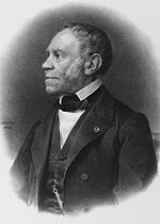
Anselme Payen

Encyclopedia
Anselme Payen was a French
chemist
known for discovering the enzyme diastase
, and the carbohydrate cellulose
.
Payen was born in Paris
. He began studying science with his father when he was 13-year-old, and later studied Chemistry
at the École Polytechnique
under the chemists Louis Nicolas Vauquelin
and Michel Eugène Chevreul
.
At the age of 23, Payen became manager of a borax
-refining factory, where he developed a process for synthesizing borax from soda
and boric acid
. Previously, all borax had been imported from the East Indies
exclusively by the Dutch
. Payen's new method of synthesizing borax allowed him to sell the mineral at one third the going price, and break the Dutch monopoly.
Payen also developed processes for refining sugar
, along with a way to refine starch
and alcohol
from potato
es, and a method for determination of nitrogen
. Payen invented a decolorimeter, which dealt with the analysis, decolorization, bleaching, and crystallization of sugar.
Payen discovered the first enzyme
, diastase
, in 1833. He is also known for isolating and naming the carbohydrate cellulose
.
In 1835, Payen became a professor at École Centrale Paris
. He was later elected professor at the Conservatoire National des Arts et Métiers
. He died in 1878.
The American Chemical Society
's Cellulose and Renewable Materials Division has established an annual award in his honor, the Anselme Payen Award
.
France
The French Republic , The French Republic , The French Republic , (commonly known as France , is a unitary semi-presidential republic in Western Europe with several overseas territories and islands located on other continents and in the Indian, Pacific, and Atlantic oceans. Metropolitan France...
chemist
Chemist
A chemist is a scientist trained in the study of chemistry. Chemists study the composition of matter and its properties such as density and acidity. Chemists carefully describe the properties they study in terms of quantities, with detail on the level of molecules and their component atoms...
known for discovering the enzyme diastase
Diastase
A diastase is any one of a group of enzymes which catalyses the breakdown of starch into maltose. Alpha amylase degrades starch to a mixture of the disaccharide maltose, the trisaccharide maltotriose, which contains three α -linked glucose residues, and oligosaccharides known as dextrins that...
, and the carbohydrate cellulose
Cellulose
Cellulose is an organic compound with the formula , a polysaccharide consisting of a linear chain of several hundred to over ten thousand β linked D-glucose units....
.
Payen was born in Paris
Paris
Paris is the capital and largest city in France, situated on the river Seine, in northern France, at the heart of the Île-de-France region...
. He began studying science with his father when he was 13-year-old, and later studied Chemistry
Chemistry
Chemistry is the science of matter, especially its chemical reactions, but also its composition, structure and properties. Chemistry is concerned with atoms and their interactions with other atoms, and particularly with the properties of chemical bonds....
at the École Polytechnique
École Polytechnique
The École Polytechnique is a state-run institution of higher education and research in Palaiseau, Essonne, France, near Paris. Polytechnique is renowned for its four year undergraduate/graduate Master's program...
under the chemists Louis Nicolas Vauquelin
Louis Nicolas Vauquelin
Nicolas Louis Vauquelin , was a French pharmacist and chemist.-Early life:Vauquelin was born at Saint-André-d'Hébertot in Normandy, France. His first acquaintance with chemistry was gained as laboratory assistant to an apothecary in Rouen , and after various vicissitudes he obtained an introduction...
and Michel Eugène Chevreul
Michel Eugène Chevreul
Michel Eugène Chevreul was a French chemist whose work with fatty acids led to early applications in the fields of art and science. He is credited with the discovery of margaric acid and designing an early form of soap made from animal fats and salt...
.
At the age of 23, Payen became manager of a borax
Borax
Borax, also known as sodium borate, sodium tetraborate, or disodium tetraborate, is an important boron compound, a mineral, and a salt of boric acid. It is usually a white powder consisting of soft colorless crystals that dissolve easily in water.Borax has a wide variety of uses...
-refining factory, where he developed a process for synthesizing borax from soda
Sodium
Sodium is a chemical element with the symbol Na and atomic number 11. It is a soft, silvery-white, highly reactive metal and is a member of the alkali metals; its only stable isotope is 23Na. It is an abundant element that exists in numerous minerals, most commonly as sodium chloride...
and boric acid
Boric acid
Boric acid, also called hydrogen borate or boracic acid or orthoboric acid or acidum boricum, is a weak acid of boron often used as an antiseptic, insecticide, flame retardant, as a neutron absorber, and as a precursor of other chemical compounds. It exists in the form of colorless crystals or a...
. Previously, all borax had been imported from the East Indies
East Indies
East Indies is a term used by Europeans from the 16th century onwards to identify what is now known as Indian subcontinent or South Asia, Southeastern Asia, and the islands of Oceania, including the Malay Archipelago and the Philippines...
exclusively by the Dutch
Netherlands
The Netherlands is a constituent country of the Kingdom of the Netherlands, located mainly in North-West Europe and with several islands in the Caribbean. Mainland Netherlands borders the North Sea to the north and west, Belgium to the south, and Germany to the east, and shares maritime borders...
. Payen's new method of synthesizing borax allowed him to sell the mineral at one third the going price, and break the Dutch monopoly.
Payen also developed processes for refining sugar
Sugar
Sugar is a class of edible crystalline carbohydrates, mainly sucrose, lactose, and fructose, characterized by a sweet flavor.Sucrose in its refined form primarily comes from sugar cane and sugar beet...
, along with a way to refine starch
Starch
Starch or amylum is a carbohydrate consisting of a large number of glucose units joined together by glycosidic bonds. This polysaccharide is produced by all green plants as an energy store...
and alcohol
Alcohol
In chemistry, an alcohol is an organic compound in which the hydroxy functional group is bound to a carbon atom. In particular, this carbon center should be saturated, having single bonds to three other atoms....
from potato
Potato
The potato is a starchy, tuberous crop from the perennial Solanum tuberosum of the Solanaceae family . The word potato may refer to the plant itself as well as the edible tuber. In the region of the Andes, there are some other closely related cultivated potato species...
es, and a method for determination of nitrogen
Nitrogen
Nitrogen is a chemical element that has the symbol N, atomic number of 7 and atomic mass 14.00674 u. Elemental nitrogen is a colorless, odorless, tasteless, and mostly inert diatomic gas at standard conditions, constituting 78.08% by volume of Earth's atmosphere...
. Payen invented a decolorimeter, which dealt with the analysis, decolorization, bleaching, and crystallization of sugar.
Payen discovered the first enzyme
Enzyme
Enzymes are proteins that catalyze chemical reactions. In enzymatic reactions, the molecules at the beginning of the process, called substrates, are converted into different molecules, called products. Almost all chemical reactions in a biological cell need enzymes in order to occur at rates...
, diastase
Diastase
A diastase is any one of a group of enzymes which catalyses the breakdown of starch into maltose. Alpha amylase degrades starch to a mixture of the disaccharide maltose, the trisaccharide maltotriose, which contains three α -linked glucose residues, and oligosaccharides known as dextrins that...
, in 1833. He is also known for isolating and naming the carbohydrate cellulose
Cellulose
Cellulose is an organic compound with the formula , a polysaccharide consisting of a linear chain of several hundred to over ten thousand β linked D-glucose units....
.
In 1835, Payen became a professor at École Centrale Paris
École Centrale Paris
École Centrale Paris is a French university-level institution in the field of engineering. It is also known by its original name École centrale des arts et manufactures, or ECP. Founded in 1829, it is one of the oldest and most prestigious engineering schools in France and has the special status...
. He was later elected professor at the Conservatoire National des Arts et Métiers
Conservatoire National des Arts et Métiers
The Conservatoire National des Arts et Métiers , or National Conservatory of Arts and Crafts, is a doctoral degree-granting higher education establishment operated by the French government, dedicated to providing education and conducting research for the promotion of science and industry...
. He died in 1878.
The American Chemical Society
American Chemical Society
The American Chemical Society is a scientific society based in the United States that supports scientific inquiry in the field of chemistry. Founded in 1876 at New York University, the ACS currently has more than 161,000 members at all degree-levels and in all fields of chemistry, chemical...
's Cellulose and Renewable Materials Division has established an annual award in his honor, the Anselme Payen Award
Anselme Payen Award
The Anselme Payen Award is an annual prize presented by the American Chemical Society's Cellulose and RenewableMaterials Division to honor "outstanding professional contributions to the science and chemical technology of cellulose and its allied products"....
.